Can Better Wording Fix the “Made With AI” Problem? New 2026 Research Says It’s Complicated
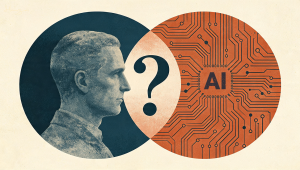
AI disclosure labels are becoming a standard component of digital advertising. Google expanded its AI transparency system in July 2026, allowing advertisers to identify image and video assets that were generated or modified with AI. Google also automatically labels certain assets created with its own generative AI advertising tools.
The wording of those disclosures has become a research subject because labels such as “Created with AI” identify AI involvement without explaining its purpose. A 2026 study published in the Journal of Marketing Analytics tested whether additional explanations could change consumer responses to AI disclosures. The results showed that wording affected evaluations under controlled conditions but produced different results when disclosures appeared inside realistic advertisements.
Organizations publishing AI-related material online can use a .com domain for websites containing advertising, disclosure policies, product information, or documentation.
What the 2026 Research Tested
Researchers Timo Schreiner, Yakov Bart, Koen Pauwels, Cosima Schütze, and Fabian Buder examined “beneficiary-framed” AI disclosures. Their research was published on August 27, 2026, after being accepted on August 13.
The research tested disclosures that explained why AI had been used and who was expected to benefit. The experiments included several explanations:
- Consumer benefits included personalization and product quality.
- Company benefits included efficiency and faster time to market.
- Other benefits included reduced employee workload and environmental impact.
- A minimal “Created with AI” disclosure served as the baseline.
- Explanations were tested at different levels of specificity.
The central question was whether explaining AI use produced more favorable consumer responses than simply identifying the presence of AI.
Specific Wording Helped in a Controlled Experiment
Study 1 recruited 339 U.S. participants through Prolific in March 2026. The participants had a mean age of 43.6 years, and 51.9% were male. No participants were excluded because all preregistered data-quality criteria were satisfied.
Participants evaluated the baseline disclosure and 12 explanatory statements. The statements were displayed independently, without accompanying advertising images or other visual elements.
More specific explanations received better evaluations than minimal and less-specific AI disclosures in this controlled setting. However, the effects associated with explaining who benefited from AI were not systematic and were described by the researchers as practically negligible.
The results therefore separated two variables: specificity could affect responses, while beneficiary framing did not consistently produce meaningful improvements.
The Effect Changed Inside Actual Advertisements
The researchers subsequently tested disclosures in Instagram-style advertisements. Study 2A recruited 359 U.S. participants through Prolific in March 2026. Participants viewed ads containing different disclosure formats.
The conditions included:
- a minimal AI disclosure;
- an unspecific explanatory disclosure;
- a specific explanatory disclosure.
The improvements found in the text-only experiment did not generalize to these more realistic advertising conditions. Explanatory disclosures failed to improve consumer responses consistently. Some measured effects were statistically equivalent to zero, while others were significantly negative.
These results demonstrate that responses to disclosure wording can depend on the context in which the wording appears.
Other 2026 Research Identified a Transparency Trade-Off
A separate 2026 study by Eun Ho Kim and Chang Geun Moon examined AI labeling, perceived advertising authenticity, brand trust, and brand attitude. The experiment compared generative-AI advertisements with and without AI-use disclosures. It also examined whether AI literacy moderated consumer responses.
Another 2026 study involving German Instagram users examined whether AI labels made users more skeptical about content. Researchers Fabian Pawelczyk, Drew Dimmery, and Pu Yan used a survey experiment to investigate responses to labeled material.
The growing use of synthetic media also creates a separate recognition problem. Research into AI disclosure operates alongside the broader deepfake confidence gap and people’s ability to identify what is real online.
Platforms Have Already Changed Their Labels
Platform terminology has not remained constant. Meta introduced “Made with AI” labels on Facebook, Instagram, and Threads in 2024 and subsequently changed the wording to “AI info.” The label can reflect detected industry-standard AI signals or disclosure by the person posting the content.
Google introduced additional advertising transparency features in July 2026. Its system includes a “How this ad was made” section in My Ad Center on Search, YouTube, and Discover. Advertisers can disclose content produced with external AI tools, while qualifying assets produced with Google’s own tools can receive labels automatically.
Disclosure Rules Also Have a Regulatory Function
AI labels are not used exclusively to influence consumer perceptions. They also provide information about content provenance and can form part of regulatory compliance.
Google states that regulations in the European Union, India, and New York require disclosures or labels for certain advertisements containing AI-generated or AI-edited assets. Google consequently permits AI-related text and visual labels directly inside image and video advertisements.
The platform also states that using its AI-labeling setting does not by itself guarantee compliance with applicable legal requirements.
Better Wording Does Not Produce a Universal Effect
The 2026 Journal of Marketing Analytics experiments provide a specific result: detailed explanations improved evaluations when disclosure statements were presented independently, but those improvements did not reliably persist when the disclosures appeared within realistic advertisements.
The evidence therefore does not support a single disclosure phrase as a demonstrated solution to negative responses toward AI-generated advertising. Disclosure specificity, advertising context, AI involvement, and the presentation of the label are separate variables that can affect how AI disclosures are interpreted.