The Teardrop Effect: A Practical Guide to Choosing a Pear-Shaped Engagement Ring
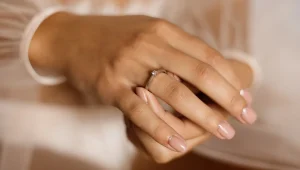
Certain forms of diamonds are coveted; the pear is likely to be remembered. Rounded on one side and tapering to a fine point on the other, it is as soft as a round stone, dramatic as a marquise, all within a single outline. It is a higher number of decisions attached to it too, than most and that is why it pays to be a bit prepared.
Why the pear flaunts so many hands.
A pear-shaped diamond catches the eye flowing down the length of the finger that makes the hand appear longer and thinner. Since such a big part of the stone surface is exposed to the sky, it will also appear bigger than a round diamond with the same amount of carats. That is a good quality to any one who prefers to be present and does not merely decide to keep a bigger and heavier stone in that place.
It fits also to other hands. A narrower pear on shorter fingers, a rounder one on longer fingers, makes a proportion between size and weight; the stone is made to make itself felt.
The shape is versatile, too. It can be used as a solitaire, with a halo or a two-stone design (a second stone), and it functions both in traditional and modern contexts.
Point up or down?
Traditionally, the point faces towards the fingertip, which emphasises the lengthening effect. Wearing it reversed, with the point towards the wrist, is less common but entirely valid, and some people prefer how it looks when the hand is at rest. When you try on a pear shape diamond ring, look at it both ways round, and with your hand relaxed as well as held out for a photograph.
Protect the point
The most sensitive section of a pear-shaped diamond is the tip, as on a fine point more knocks are taken off than on a rounded point. A setting that holds or cradles the point like a V, an arch or mound is used to ensure the point has been preserved in daily usage and to stand out sharp in appearance. It is a minor fact that pays off during years of usage.
The setting affects the general appearance of it; and it guards as much as it covers the stone. Prongs allow more light into the diamond and display its outline and a bezel a thin overset band of gold around the edges provides the greatest protection, as well as the smoothest, contemporary amber. Smaller stones are used to create a halo which gives it a sparkly appearance, and makes the centre stone look bigger, although it comes at the price of the busier silhouette.
Check, bow-tie and outline.
In addition to the standard grading report, the following three checks are pertinent to this shape:
- Symmetry: the two shoulders should curve evenly, and the point should line up with the centre of the rounded end.
- Bow-tie: many elongated shapes show a darker band across their middle. A faint one is normal; a pronounced one dulls the stone, so look at it in natural light or on video before you commit.
- Outline: some pears are slim and elongated, others fuller and rounder. Neither is better; choose the one that suits your hand.
Cut is the most crucial among the 4Cs and a separate document of a lab like GIA or IGI will heed to precisely what you are purchasing, be it a lab-grown or a mined diamond.
The decision to have the band and the gold.
The yellow gold makes the pear have a warm, slightly vintage touch and the white gold makes the stone look brighter and the look more modern. A slimmer band is in keeping with the shape, and a curved or contoured wedding ring can subsequently fit snugly under the point.
In case you are going to pile your rings, use both a fitted band which follows behind the stone and a straight one with some room between the two. They each fit the pear differently, and the argument of seeing them together on your own hand is the most expedient method to resolve.
Choosing with confidence
A shape with personality is the pear, and its specifics (direction, protection, symmetry) is what makes the difference between a ring that appears right in photographs and in real life. Make time with them, and the tear of the eye will play you decades rich.