How to Build a Digital Bible Study Routine That Encourages Deeper Reading
Various translations of the Bible, commentaries, reading plans and personal notes can be put under the reach of a phone or tablet. That is a good thing, but just having access will not form a good study habit. Most visitors close multiple sources and use a train of references and leave without storing the questions and observations that they need to revisit.
A better digital routine begins with a clear purpose. Before opening multiple apps or browser tabs, decide what you want to accomplish: read a complete passage, investigate a repeated word, prepare for a small-group discussion or reflect on a sermon. BibleNote’s guide to Bible study tools can help readers evaluate resources according to practical tasks such as checking context, finding passages, planning reading and organising notes.
The most useful routine is usually a simple one that can be repeated several times a week. The following approach keeps Scripture at the centre while using technology to support attention, understanding and recall.
Start With a Passage, Not a Collection of Apps
Digital reading facilitates rushing to different parts of the cross-references, search results and explanations. All these features will be helpful after the reader has read the passage itself.
Read through an entire paragraph or section. When the passage is a portion of a letter, narrative or poem, see what precedes and succeeds it. A verse can be better understood when you can see its argument, its speaker and his audience.
Ask a Few Questions Before Consulting Other Resources
Record your first observations before opening a commentary or asking a digital assistant:
- Who is speaking or writing?
- Who is the original audience?
- What happens before and after this section?
- Which words, images or ideas are repeated?
- Is there a command, promise, warning or question?
- What remains unclear?
These notes preserve your initial encounter with the text. They also help you use reference tools with a specific question in mind instead of browsing without direction.
Give Each Digital Tool One Clear Job
With a dense home screen, one can be left with an illusion of a fully-furnished office environment and the spread of information among non-related applications. It is easier to keep up with the routine by allocating one purpose to each tool.
An example is to have one app to read and compare translations, one to check the historical or literature background and a single place to keep notes. When a tool keeps on introducing new steps to you, without assisting you in understanding the passage or remembering it, they might not fit in the routine.
A useful tool should support at least one practical task:
- Read the passage in context
- Compare wording across translations
- Locate cross-references
- Check cultural or historical background
- Save observations and questions
- Review previous notes
- Prepare prompts for group discussion
The number of features matters less than whether the tool supports the way you actually study.
Use a Random Verse as a Starting Point
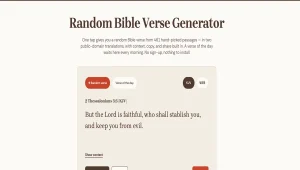
Some days, the main obstacle is deciding where to begin. A random Bible verse generator can provide a simple starting point for a short reading session. BibleNote’s tool allows readers to generate a passage, view surrounding context, and copy or share the verse using public-domain translations such as the KJV and WEB.
The selected verse should open a path into Scripture rather than close the study with a single isolated sentence.
Expand the Reading Window
After receiving a verse, take several additional steps:
- Read the surrounding paragraph or section.
- Identify the speaker, audience and setting.
- Check whether the verse belongs to an argument, prayer, prophecy, poem or narrative.
- Compare another translation if the wording is difficult.
- Write one observation and one question.
- Return to the passage later in the week.
Random selection can introduce readers to less familiar parts of the Bible. Context keeps that encounter grounded in the text. A randomly generated verse should never be treated as a prediction, a personalised divine message or a substitute for careful discernment.
Create Notes That Are Easy to Revisit
Digital notes often become a storage problem. A long document containing unrelated quotations may be searchable, but it can still be difficult to review.
A consistent structure makes each entry more useful. Try using the same five fields for every study session:
Passage
Record the book, chapter and verse range. Include the translation if the wording matters to your observation.
Main Idea
Summarise the passage in one or two sentences. Keep the summary close to what the text actually says.
Observations
List repeated words, contrasts, changes in tone, important actions or connections with nearby passages.
Questions
Separate questions about meaning from questions about application. Some questions may require a commentary, a pastor, a teacher or further group discussion.
Response
Record a prayer, a practical application or a subject you want to revisit. Avoid forcing an immediate personal application when the passage still requires further study.
This format also works well for sermon notes. Readers can connect a sermon’s main point with the cited passages, preserve questions and review the material during the week.
Build Review Into the Routine
A note becomes more valuable when it is revisited. Set aside ten minutes at the end of the week to review recent entries.
During that review, look for:
- Questions that remain unanswered
- Passages you want to read again
- Connections between different studies
- Notes that need clearer wording
- Topics suitable for a small-group discussion
- Quotations or references that need verification
Review also helps reveal whether the current digital setup is working. If important notes are difficult to find, simplify the folder structure or use more consistent titles. If reading sessions are repeatedly interrupted by notifications, enable a focus mode or download the passage for offline reading.
Keep Digital Assistance in Its Proper Role
Information may be organised, questions and references suggested and relevant brought to the top with the help of search tools, transcription tools and AI-assisted tools. Their performance still needs to be thoroughly checked.
Cross all the mentioned verses with a good translation of the Bible. Read around passage and ensure that quoted material has been represented properly. Doctrinal questions or issues related to pastoral care or significant personal choices should be discussed with a group of trusted members of a church who happen to be pastors, teachers or even mature adults.
Technology can only be effective as a reading aid. Services of scripture, context, sound scholarship, communal discernment are all necessary.
A Simple 20-Minute Digital Study Session
A short session can still have structure:
Minutes 1–5: Read
Read the passage twice. On the second reading, mark repeated words and important transitions.
Minutes 6–10: Observe
Write down the main idea, two observations and one question.
Minutes 11–15: Investigate
Use a cross-reference, translation comparison or trusted study resource to explore the question.
Minutes 16–20: Respond and Save
Record a brief response, prayer or discussion prompt. Give the note a clear title so that it can be found later.
This rhythm can be adjusted for longer study, sermon review or group preparation. Consistency matters more than filling every minute.
Frequently Asked Questions
How many Bible study apps do I need?
All a reader needs is a few reliable sources: a Bible reader, a reliable source of reference and a consistent location of notes. Include another tool when it addresses a definite issue in your every-day life.
Is it correct to use a random verse to start the Bible study?
An arbitrary verse can give a helpful place of departure when it results in the reading the passage around it. One should interpret it based on the literary, historical and theological context of the verse.
Will AI provide me with an explanation of a bible passage?
AI will be able to sort questions, synaptic information and references. Its responses can be erroneous, or cannot provide sufficient context with only one interpretation. Check references, use the credible research materials and discuss important questions with the trusted Christian leaders or teachers.
What can I do to read more of what I read?
Write a brief summary that is in your words, leave one substantive question and read the note again at the end of the week. Recall is generally more effectively assisted by regular review compared with accumulating vast marriage of material in one round.
Turn the Routine into a Sustained one.
An effective digital Bible reading practice does not entail the need to keep on switching to applications. It should have an outlined aim, checking the reading, a check with the background, notes and review to do.
On the following activity, select tools based on the activity, maintain consistent structures in your note and leave room to ask questions that take time and community. It is possible to make Scripture more accessible and revisited with the help of digital resources. The richness with the study continues to increase with scrutinizing reading, contemplation, and devotion to the text.