Nielsen: Kids/YA Category Immune to Digital Cannibalization

Kristin McLean of Nielsen Book revealed in her session at DBW 2016 Launch Kids conference (*) that the Kids/YA segment continues to be overwhelmingly print-focused.
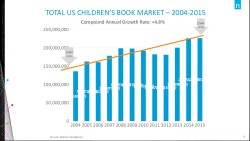
According to Nielsen’s consumer surveys, this segment has been trending upwards for the past ten years, and growing by an average of 4.8%. eBooks do appear to have trimmed print sales for a couple years, but in recent years print has made a resurgence while ebook revenues have continued to grow:
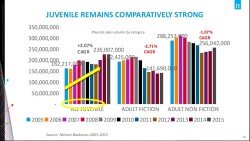
It’s not all good news, however; Nielsen’s surveys showed that ebooks still make up a small fraction of the juvenile segment, even though ebooks accounted for half of the adult fiction market in 2014.
Depending on your viewpoint, that could be good news. It’s a sign that digital still has a lot of room to grow, but I wouldn’t bet on it.
One detail that has been reiterated over and over at DBW today was that surveys have shown that teens and the younger crowd are committed to paper. Even though kids are heavy users of digital services and social networks, they still prefer paper books over ebooks.
It’s not that they dislike ebooks so much as they like to share their books with friends, and that’s something which you just can’t do yet with ebooks. (And given that kids tend to borrow more titles than they buy, I’d say cost is another factor.)
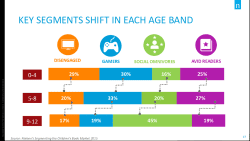
The surveys have also shown that avid readers and social onmivores, two groups that make up most of the juvenile book reading population, account for almost two-thirds of the 9-12 age cohort.
These two groups tend to buy more ebooks than gamers or the disengaged, but they also tend to borrow a lot more books than the other groups:
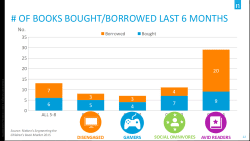
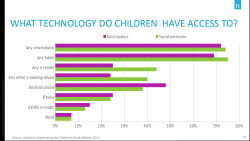
As you can see in the last slide, both avid readers and social omnivores are far more likely to have access to a smartphone or tablet. And contrary to what one might expect, avid readers were less likely than social omnivores to have access to an ereader (I would have expected that to go the other way, for obvious reasons).
So while there’s potential to sell more kids' ebooks to this market, it looks like authors and publishers would have more luck if they focused on digital content which is both easily sharable, and free.
P.S. While they are often referred to collectively as DBW, there are several conferences running concurrently this week in NYC. The session I attended was Launch Kids.
image by Julian Partridge
No Comments