Why Smart-Screen OLED Telemetry and Postless Ceramic Cores Are Redefining European Vape Hardware Engineering in 2026
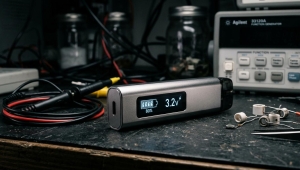
As European botanical extract fillers scale production of solventless live rosin, live resin, and high-viscosity distillates in 2026, legacy unregulated disposable pens with cotton-wrapped metal coils and central metal chimneys are rapidly being phased out. In their place, B2B hardware engineers are standardizing on pulse-width modulated (PWM) microcontroller architectures with integrated OLED telemetry displays and postless gravity-fed ceramic heating cores.
1. The Engineering Shift from Unregulated Cells to Smart-Screen Telemetry
For nearly a decade, the internal electronics of all-in-one (AIO) vaporizer hardware remained remarkably primitive. Most first-generation disposable devices relied on a direct-output lithium-ion cobalt cell wired through a basic pneumatic mems pressure sensor to a nichrome or Kanthal wire coil. As cell voltage sagged from 4.2 V at full charge down to 3.3 V near depletion, thermal wattage dropped by nearly 38 percent. Meanwhile, a single blinking bottom LED offered zero diagnostic distinction between a depleted battery, a dead short circuit, or an over-draw safety cutoff.
High-viscosity botanical distillates, live resins, and solventless rosins require strictly bounded thermal windows. While a heavy distillate (50,000 to 120,000 cP at 25 degrees C) vaporizes cleanly between 2.8 V and 3.2 V, terpene-rich live rosin (8,000 to 25,000 cP with 8% to 14% volatile monoterpenes) scorches rapidly above 2.4 V. When a device lacks constant-voltage buck regulation or visual feedback, end users routinely fire delicate terpene formulations at full battery voltage, scorching d-limonene and beta-myrcene and generating burnt off-notes halfway through the reservoir.
Modern smart-screen hardware solves this by pairing a synchronous buck-regulated microcontroller unit (MCU) with a compact side- or front-mounted digital display. According to engineering benchmarks on smart-screen disposable vape voltage and battery telemetry, next-generation B2B devices display three real-time parameters directly on the chassis:
- Real-Time State of Charge (SoC %): Displays exact remaining lithium-cobalt (LiCoO2) capacity from 100% down to 1% via coulomb-counted or load-compensated voltage curves, eliminating premature disposal when a 1.0 ml or 2.0 ml tank still holds extract.
- Stepped Constant-Voltage Selection (1.8 V / 2.4 V / 2.8 V / 3.2 V): Allows fillers or end users to lock in a constant 1.8 V to 2.2 V low-temperature profile for solventless live rosin, or step up to 2.8 V to 3.2 V for dense distillates.
- Active Preheat Countdown & Fault Diagnostics: Shows a visual 10-second timer during 1.8 V low-wattage preheating to gently liquefy cold oil around the ceramic intake ports before the first draw, while displaying distinct error codes for open-circuit or short-circuit protection.
Crucially, commercial-grade display driver ICs must maintain quiescent standby current below 5 microamperes (uA). Poorly engineered display boards that draw 50 uA to 100 uA in standby can drain a 350 mAh cell over six months of warehouse storage before the package is ever opened.
2. Postless Gravity-Fed Atomizers vs. Center-Post Metal Chimneys
Alongside digital telemetry, European buyers sourcing empty disposable vapes wholesale in Europe have rapidly migrated toward postless (center-post-free) reservoir geometry. Traditional cartridges and disposables run a cylindrical metal chimney directly through the center of the oil tank. That central metal tube creates three engineering liabilities:
- Heavy-Metal Contact Area: Acidic terpenes and prolonged warm storage increase the risk of trace lead (Pb), nickel (Ni), or chromium (Cr) migration from plated brass or low-grade steel center tubes during ISO/IEC 17025 ICP-MS leachate testing.
- Thermal Sinking into the Bulk Oil: Because 316L stainless steel has a thermal conductivity of roughly 16 W/m.K, the central metal chimney absorbs heat from the coil and conducts it back into the bulk reservoir, oxidizing cannabinoids and darkening the extract over time.
- Wick Starvation and Annular Oil Lock: High-viscosity oils frequently bridge across narrow annular gaps between the center post and the outer tank wall, trapping 15% to 20% of the fill above the intake apertures.
Postless hardware eliminates the central metal chimney entirely. Instead, a flat, microporous sintered ceramic heating floor sits directly at the base of an unobstructed PCTG or borosilicate glass reservoir, while dual lateral air channels route vapor around the perimeter of the tank. Gravity feeds 100% of the extract directly onto the ceramic floor, reducing residual oil waste below 3% and providing an unobstructed 360-degree viewing window.
3. Engineering Specification Matrix: Legacy vs. Next-Generation AIO Hardware
|
Engineering Parameter |
Legacy Unregulated Cotton/Post AIO |
2026 Smart-Screen Postless Ceramic AIO |
|
Voltage Regulation |
Unregulated battery sag (4.2 V down to 3.3 V) |
PWM Buck-Regulated Constant Voltage (1.8 V / 2.4 V / 2.8 V / 3.2 V) |
|
Wetted Vapor Path |
Cotton wick + nichrome wire + metal center tube |
Postless sintered microporous ceramic floor (zero cotton, zero center post) |
|
Quiescent Standby Draw |
10 uA to 80 uA (risk of dead shelf stock) |
Under 5 uA deep-sleep MCU (12-month shelf retention) |
|
Extract Residual Waste |
12% to 18% trapped on walls and above intake holes |
Under 3% (gravity-fed bottom ceramic deck) |
|
Charging & Cell Safety |
5 V unregulated micro-USB or non-rechargeable |
USB-C 5 V / 0.5 A CC/CV IC with UN38.3 T.1-T.8 certified LiCoO2 cell |
4. Matching Coil Resistance, Aperture Area, and Battery Capacity
For B2B production managers, hardware selection is ultimately a fluid-dynamics calculation. Pairing a 1.0 mm intake aperture designed for thin e-liquid with a 90,000 cP distillate guarantees dry hits, while pairing a 2.0 mm open slot with a 12% terpene blend risks flooding the airway during air-freight barometric pressure changes.
To eliminate trial-and-error sampling, European engineering teams can model their exact oil viscosity (cP), terpene percentage, and reservoir volume using the Empty Vapes B2B Extract Viscosity and Hardware Calculator. By matching microporous ceramic porosity (45% to 55% open-pore volume), resistance (1.2 Ohm to 1.6 Ohm), and USB-C rechargeable cell capacity (280 mAh to 400 mAh) prior to bulk filling, European brands cut hardware defect rates below 0.3% across production runs.
5. Frequently Asked Questions for B2B Hardware Procurement
Why does quiescent standby current matter when ordering empty smart-screen disposables in bulk?
Filled or empty all-in-one devices often sit in distribution warehouses and retail inventory for three to six months. An MCU and OLED driver with quiescent current below 5 uA consumes less than 3% of a 350 mAh battery over 180 days, ensuring every device powers on immediately out of the box.
Can postless ceramic disposables handle both thick distillate and runny live resin?
Yes, provided the ceramic pore porosity and voltage profile are matched to the extract. Thick distillates (60,000 to 120,000 cP) perform best at 2.8 V to 3.0 V on a 1.4 Ohm postless deck, whereas terpene-rich live resin and live rosin (8,000 to 25,000 cP) should be locked at 1.8 V to 2.2 V to preserve volatile monoterpenes.
How are smart-screen empty disposables classified for European Union customs?
Unpopulated electronic vaporizer devices containing a rechargeable lithium-ion battery classify under EU TARIC 8543.70.90 (3.7% MFN customs duty) and travel by air under IATA UN3481 Packing Instruction 967 Section II. Sourcing directly from an EU warehouse in Haarlem (Netherlands) eliminates third-country import clearance delays and upfront Import VAT cash lockup.