Beyond the Gutter: How Downspout Placement Helps Protect a Home’s Foundation
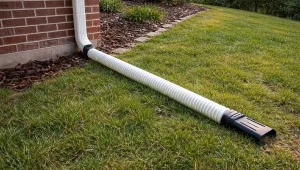
Downspout placement helps protect a home’s foundation by directing collected roof water toward a suitable discharge point instead of concentrating it beside the building. The important decisions include where the downspout begins, where it ends, and whether the ground carries water away afterward. Gutters alone cannot make those decisions work.
A neat vertical pipe can still deliver hundreds of gallons to the wrong place during a storm. Evaluating the outlet is therefore as important as evaluating the gutter above it.
Choose locations around water flow
An installer should first determine which roof areas drain to each section of gutter. From there, the layout needs enough appropriately sized outlets to avoid forcing too much water through a long run.
The most discreet location is not always the most effective one. A corner hidden behind a gate may be inconvenient for cleaning or may empty into an enclosed courtyard. A downspout beside a front walk may create an avoidable crossing hazard.
Southwest Seamless Rain Gutters offers downspout and leaderhead services in Arizona and Southern Nevada. When comparing a proposed layout, homeowners should ask for the collection area and discharge destination to be identified together, rather than considering the pipe as a decorative accessory.
Understand why repeated wetting matters
Concentrated discharge can erode soil, disturb landscaping, and leave moisture close to the structure. How that affects a foundation depends on the soil, building design, drainage conditions, and other sources of water.
Some soils change volume as moisture conditions change. Others can settle when wetted. Those conditions require qualified assessment; visible cracks should not automatically be blamed on gutters.
Pacific Northwest National Laboratory’s Building America Solution Center recommends carrying roof runoff away from foundations and keeping roof drainage separate from foundation drain systems. The underlying goal is to prevent collected roof water from being returned to the area the foundation drainage is meant to protect.
Distance helps only if the route works
A downspout extension should end where water continues away from the house. An extension that reaches across a level patio and empties into a depression may simply move the puddle.
PNNL guidance uses discharge at least five feet from the foundation as a residential best-practice reference for certain surface drainage arrangements. That distance is not a universal design approval. Property slopes, soils, local requirements, and adjacent structures can call for a different solution.
Before accepting an outlet location, ask:
- Does the receiving ground slope toward or away from the house?
- Can water collect behind landscape edging or a retaining wall?
- Will an extension obstruct a gate, walkway, or accessible route?
- Is there an approved destination if water cannot disperse on the lot?
- Can the outlet be inspected without moving heavy objects?
A splash block can reduce local erosion, but it cannot correct an adverse slope by itself.
Treat buried drains as a separate decision
Connecting a downspout to an underground pipe can tidy the exterior and move water across a constrained site. However, a hidden pipe needs a known destination, suitable capacity, access for cleaning, and a route that can be maintained.
An existing pipe should not be assumed functional because it disappears below grade. Ask where it ends and how that has been verified. An unknown or obstructed connection can send water back up the downspout.
For a hypothetical narrow-lot home, a surface extension might cross the only side-yard passage. A properly assessed buried route could be preferable, but only after the outlet, utilities, maintenance access, and applicable approvals have been checked.
Diagnose overflow before replacing everything
Water near a foundation can come from several sources: blocked elbows, disconnected extensions, settled paving, irrigation, or runoff arriving from outside the property. The first task is to identify the source.
If a gutter overflows only beside one outlet, ask whether debris, gutter pitch, or outlet capacity explains the pattern. An assessment of gutter repair and replacement needs can help separate a repairable defect from a layout that needs redesign.
Photographs taken from the ground during safe conditions can be useful. Note the location and direction of water movement, rather than relying only on where a puddle remains afterward.
Compare discharge options using the same questions
A short extension, a surface channel, and a buried pipe may all move water, but they have different access and maintenance implications. Compare them against the actual space available instead of choosing only by appearance.
For each option, ask where water will emerge, how the route will be kept clear, and what happens if the receiving area cannot accept more water. Also consider routine use of the property. An extension that must be removed every time a gate opens is unlikely to remain in the position shown on the installation drawing.
On a narrow lot, mark the proposed route before work begins. Walk through it as a resident would, including access for bins, gardening equipment, and maintenance. This can reveal practical conflicts that are difficult to see in a photograph of the downspout alone.
Ask which parts of the proposal belong to the gutter contractor and which require another specialist. A quote for a new downspout should not silently assume that a separate drainage contractor will provide a functioning outlet.
Keep an outlet record that is easy to use
Photograph the finished downspout and its discharge destination together. For an underground connection, record the known outlet and any cleaning access points. Keep those photographs with the installation scope so a future contractor does not have to rediscover the route.
A simple inspection note should state what was seen and what changed. For example, record that an extension was disconnected during garden work and reattached, rather than writing only that drainage was checked. Specific notes make recurring problems easier to distinguish from isolated maintenance issues.
Pay attention after work by other trades. Painting, pest control, landscaping, or equipment installation can alter access around an outlet. A small adjustment to accommodate another task may unintentionally redirect water or make a connection harder to inspect.
If moisture continues near the building after an obvious defect is corrected, revisit the diagnosis. Ask whether the water source, receiving grade, and underground route were actually verified. The goal is a clear explanation of the remaining condition, rather than repeatedly adding components without knowing where the water is coming from.
Common downspout questions
Can a downspout empty into a flower bed?
Potentially, if the bed has suitable capacity, setbacks, grading, and overflow. A small bed directly beside the wall may hold water where it should not collect.
Should every corner have a downspout?
Not necessarily. The required arrangement depends on roof collection areas, gutter geometry, rainfall design criteria, and discharge opportunities.
Are gutters a foundation repair?
No. They manage one source of water. Existing movement, settlement, or persistent moisture may need evaluation by a qualified foundation, drainage, or geotechnical professional.