Can an Indie Author Make a Whole Cozy Mystery Series Look From an Image Model? My Cover Tests
I write cozy mysteries under a pen name, and the third Lantern Lane book is due in the spring. Hattie Quillford is the fictional author I use for this write-up, but the problem is real: I need three covers that look like one series, an audiobook square, and thumbnails that still read at postage-stamp size. The last illustrated custom covers I priced from freelancers ran $400 to $900 per book. For a series selling a few hundred copies a month, that is a quarter’s royalties.
So before booking anyone, I spent an afternoon testing how far an image model gets on its own. Ten generations, all measured. Everything pictured is my own AI output, and every title, author name and review outlet in it is invented.
What I was checking
- Are title, series line and author name spelled exactly right? I counted letters, because one swapped vowel on a cover means a reprint.
- Does each genre look like its genre?
- Can books two and three match book one when I hand over book one as a reference image?
- What survives at thumbnail size, and is the file big enough for a paperback?
Test 1: the first cover
The prompt asked for a painterly seaside lane at dusk, a glowing bookshop window, a black cat on the step and a lantern, in teal and amber. Text, word for word: "A LANTERN LANE MYSTERY" as a small-caps series line, "Murder at the Mapleby Fair" as the title, "HATTIE QUILLFORD" at the bottom. 2:3 portrait, 2K.
It came back in 43 seconds at 1696 by 2528 pixels for $0.110. All 56 letters were correct and the serif title had the old-fashioned warmth the genre wants. One thing I did not ask for: the shop window carried a painted sign reading "Mapleby Books". It suits the story, but I had said "no other text", so it went in my notes as a habit to watch.
Test 2: three genres, first attempts
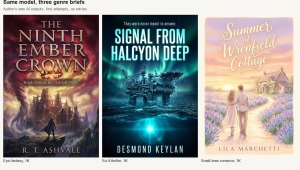
To see whether the model understands genre or just paints nicely, I wrote three briefs for other pen names: an epic fantasy with a "Book One of the Ashfall Cycle" subtitle, a science fiction thriller with a one-line tagline, and a small-town romance with a script title. These ran at 1K to keep them cheap.
Test 2. First attempts, no retries. The author’s own AI outputs for fictional books and authors.
Each took 22 to 33 seconds and cost $0.110. Spelling was perfect again: 148 of 148 letters, including the six-word tagline. More useful, each looked like its shelf: carved metallic capitals and a cloaked figure for the fantasy, condensed sans-serif and cold cyan for the thriller, hand lettering and lavender for the romance. None looks like a premium bespoke cover, but all three clear the competent mid-list bar most indie books need.
Test 3: keeping a series together
This was the test I cared about most. I fed book one back in as a reference image and asked for books two and three: same painting style, palette and typefaces in the same places, keep the cat, new scene. Book two is a village pumpkin show at night; book three a snowy harbour with a bell tower. Like every test here, both ran on the Nano Banana Pro API, which accepts up to 14 reference images per request, though one was enough.
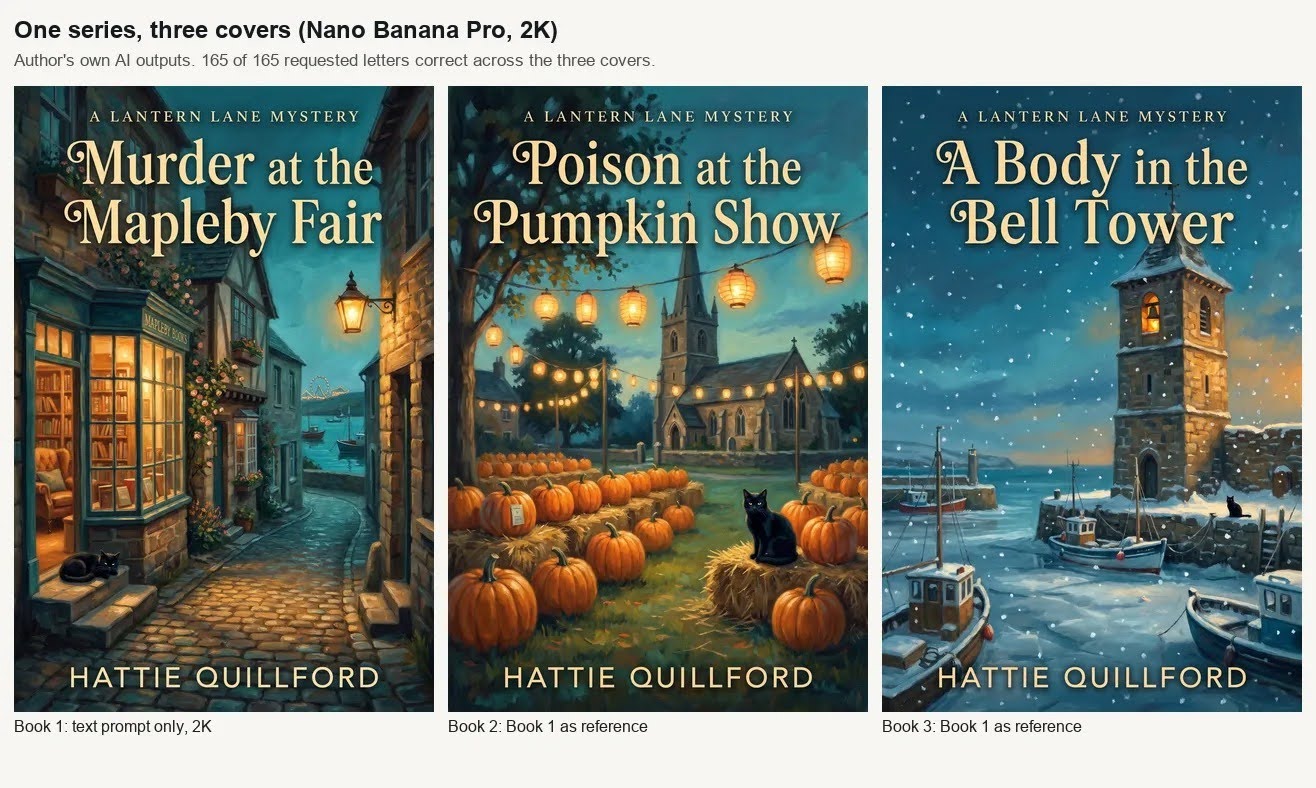
Test 3. Book 1 from a text prompt; Books 2 and 3 made with Book 1 as the reference image. The author’s own AI outputs.
Both finished in 33 seconds at $0.111 each. On a mock shelf they read as one set: series line, title and author name sit at the same heights in the same faces, and the cat turns up in each scene. All 165 requested letters across the three covers were right. The one flaw was a hand-written tag on a pumpkin with illegible scribble, a two-minute fix.
Test 4: the thumbnail problem
Most readers meet a cover at roughly 80 pixels wide in a search result or phone carousel, so I shrank all six covers to that width.
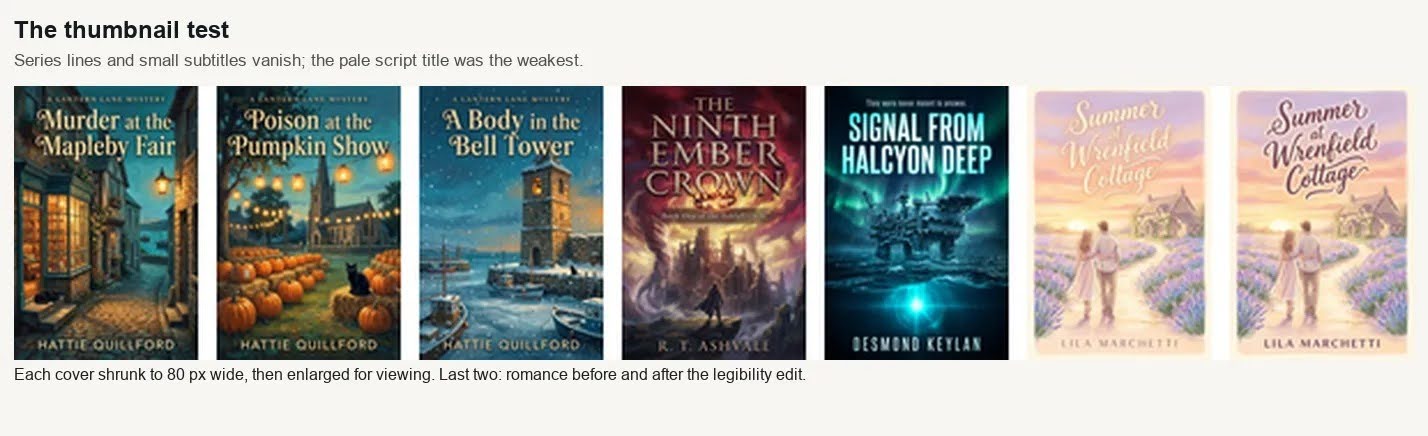
Test 4. Titles survive; series lines and small subtitles do not. The author’s own AI outputs.
Five of six titles stayed readable. The romance was the weak one: pale cream script on a pastel sky becomes a smudge. None of the three series lines could be read, nor the fantasy subtitle or thriller tagline. That is standard cover-design advice rather than a model failure: put the series name in the description, not in tiny caps.
I then asked for an edit of the romance cover only: keep the scene, make the script heavier and deep plum, darken the author name. It took 23 seconds and $0.111, and the title now reads at thumbnail size with the illustration untouched.
Test 5: print size
A 6 by 9 inch paperback at 300 dpi needs at least 1800 by 2700 pixels before bleed. The 2K files work out at about 282 dpi at that trim: fine for ebooks, borderline for print. So I asked for book one again at 4K, using the 2K cover as reference.
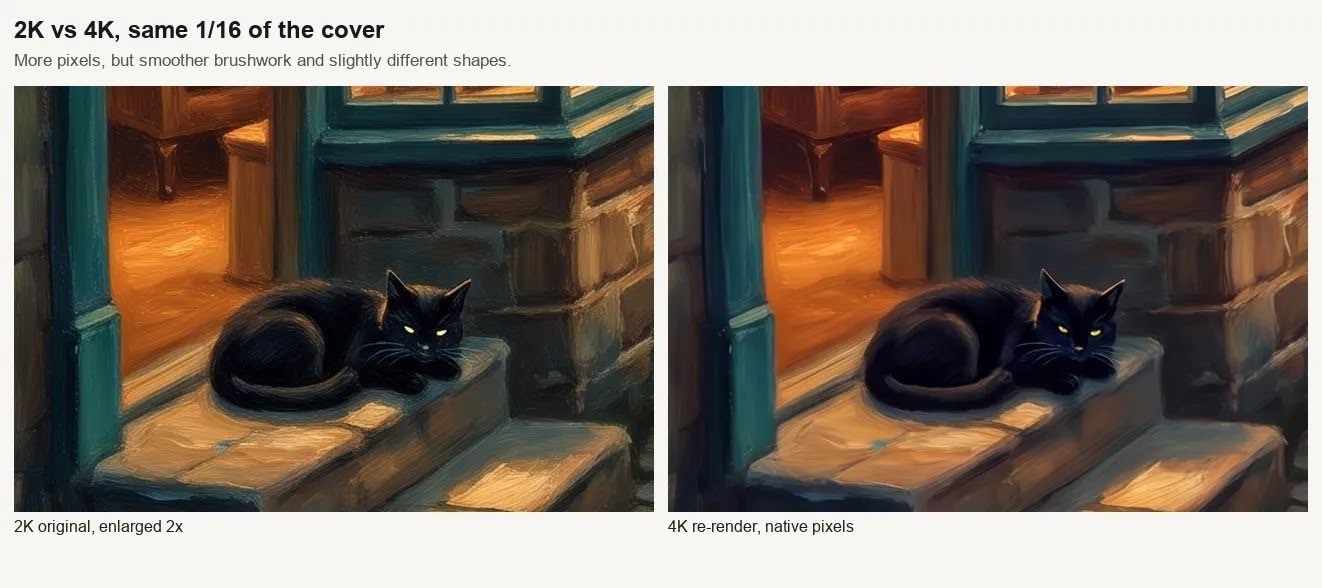
Test 5. Same corner of the cover, 2K enlarged versus 4K native. The author’s own AI outputs.
The 4K file arrived in 33 seconds at 3392 by 5056 pixels, plenty for a 6 by 9 trim, and cost $0.196. But it is a repaint, not an enlargement. Brush texture got smoother (my edge-detail measure fell about 43 percent) and the cat’s face changed slightly. If print and ebook must match exactly, generate at 4K from the start and shrink it for the ebook. Also, 2:3 is shorter than the shape many ebook stores recommend, so I still extend the canvas a little before upload.
Test 6: spin-off formats
A square audiobook version with a "Narrated by Imogen Pellow" line took 33 seconds and $0.111; the scene was sensibly recomposed and all requested text was right, though the shop sign came out half garbled. A second edit added a gold "BOOK 1" badge, a ten-word review quote and an invented outlet name at 1K, in 22 seconds for $0.111. Every word landed.
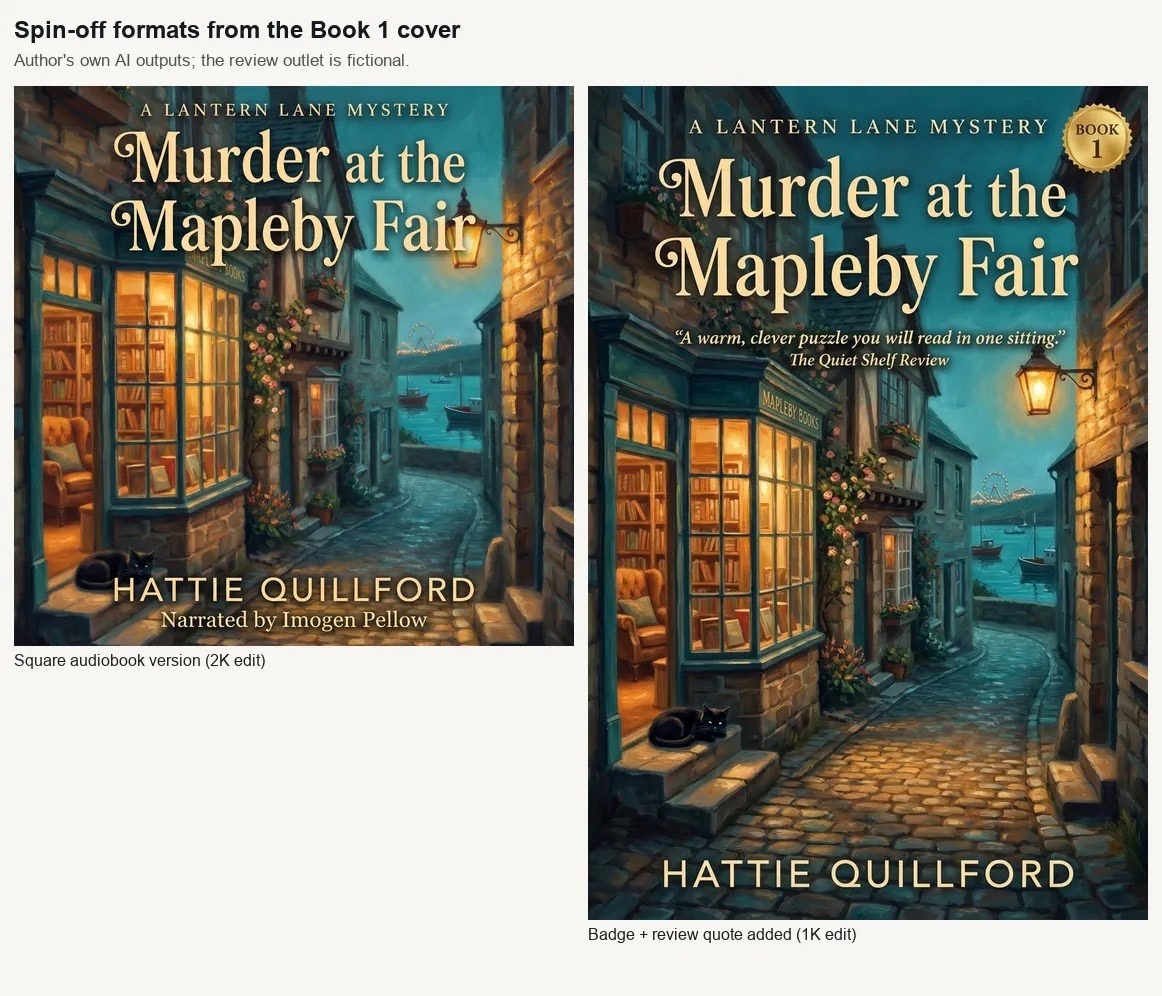
Test 6. Both made by editing the Book 1 cover. The review outlet is invented. The author’s own AI outputs.
The numbers
Ten jobs, 22 to 43 seconds each, 1.19intotal.Chargesranafewpercentabovethelistedper-imageprice(0.1072 at 1K and 2K, $0.192 at 4K), since final cost follows actual output. No misspellings in anything I asked for; the failures were unrequested extras and genre-standard legibility issues. Against $400 to $900 per commissioned cover the gap is obvious, but I still budget an hour of a designer’s time per book for clean-up, the spine and back cover, and the print file check.
Ethics and disclosure
I state in the front matter that the cover art is AI generated and tick the AI content box wherever a store asks. I never prompt with a living illustrator’s name or "in the style of" anyone, and I keep a log of every prompt and file. If a cover becomes the face of a long-running series, I would still commission a human illustrator for the final painting, using these tests as a precise brief. For a new pen name or an untested series, this is a sensible way to look professional on day one.