Nate Hoffelder

Nate Hoffelder

Streetlib Adds BajaLibros to its Distribution Network

Hot on the heels of the report on StreetLib’s partnership with OverDrive comes news that StreetLib is expanding further. This Italy-based ebook distributor has clinched a deal with the leading ebook retailer in Latin America, BajaLibros.

Starting 21 September, BajaLibros will be selling ebooks distributed by StreetLib in Latin America, the US, and Spain. The latest estimates put BajaLibros as the largest ebook retailer in South America (after Amazon), with a considerably smaller footprint in other markets.

BajaLibros is primarily a Spanish-language retailer. It has its own apps for Android and iOS, and in the past it also offered an ereader, the Papyre, which is no longer available.

This retailer has been in the US since 2013, but it originally launched in Argentina in 2010 before expanding into the rest of South America, Latin America, and Spain. It has also opened a branch in Canada, or so its website suggests.

***

Speaking of Latin America, BajaLibros is just the latest local ebook retailer to strike a deal with StreetLib.  StreetLib can also get an authors work into other Latin America stores like Mexico’s Librerias Gandhi, Panama’s El Sotano, PeruBookstore, and Nubleer (this last looks like a magazine service, not a bookstore, actually).

StreetLib also distributes to the major ebookstores, Kindle and iBooks, as well as Kobo, Nook, Google Play Books, Tolino, OverDrive, Bookmate, and many more.

StreetLib via eBookBargainsUK

image by DoNotLick

Amazon, Kobo Announce Price Policy Changes for Japanese eBook Sales

Here’s a quick heads up to remind authors that Amazon and Kobo will be changing how they collect taxes on ebooks sold in Japan.

Kobo and Amazon have each sent out reminders over the past week that, starting 1 October, they will be bundling Japan’s 8% consumption tax into the price of the ebooks sold in that country.

eBooks distributed through KDP and Kobo Writing Life and sold in the local Kobo and Kindle Stores will no longer have the taxes applied at the point of sale. Now the taxes will be reflected in the list price for the ebooks (just like VAT in Europe).

Both Kobo and Amazon have sent out notices so authors have time to adjust their prices. You can read the Kobo notice in their blog post, and you can find a copy of Amazon’s KDP email at the end of this post.

This shift represents the latest stage in Japan’s two-year-old plan to close the ebook tax loophole and tax foreign ebook retailers. It’s unclear whether it will generate additional funds, although it is bound to cause many headaches.

Kobo, for example, say that they were already collecting the required tax. It is unclear whether Amazon was collecting the tax, but given their habits of (legally) avoiding collecting taxes in Europe there’s a good chance they were pulling a similar trick in Japan.

Hello,

Starting October 1, 2015 an 8% consumption tax will be applied to all ebooks sold to customers living in Japan. No action is required of you, but we are notifying you because you currently have one or more titles available through KDP that may be affected by this change.

One-time Adjustment for Existing KDP Titles
Beginning October 1, list prices set for Amazon.co.jp will be tax-inclusive, meaning that the 8% consumption tax will be included in the list price you give us. For example, if you set your Amazon.co.jp list price at ¥1250, your new tax-inclusive list price would be ¥1250. Tax will be deducted from this price, and your royalties would be calculated on a resulting price of ¥1157. Keep in mind that you can change your price at any time subject to KDP’s Terms and Conditions….

Setting List Prices for Amazon.co.jp
Starting October 1, to make it easier to set customer friendly list prices without having to calculate tax, authors will set list prices for the JP marketplace that include consumption tax. To accommodate this, the KDP pricing grid will be updated to accept tax-inclusive list prices. In the pricing page, authors will also see their suggested price without tax to help them understand how royalties will be calculated. For those authors who set their JP marketplace price automatically from their US list price, we will convert the US list price to local currency and that will be the list price that includes tax.

For more information about this change, visit our Help pages.

image by eblaser

ALA Regains Control Of its Facebook Page After 3-Day Hack

Following 3 days of clickbait updates and hilarious commentary from librarians, the American Library Association took control of its Facebook page early Monday morning.

Sometime on 5 September hackers got access to one of the admin accounts that managed the ALA’s page, and the hackers quickly dumped  the other page admins, locked everyone else out, and proceeded to post updates like:

The ALA confirmed on Twitter on Saturday that their FB pad been hacked, Facebook had been informed, and that nothing was happening because (apparently) the responsible parties at Facebook were enjoying the holiday weekend and not checking their emails.

The hackers were also enjoying the weekend, and so were the librarians who trolled the clickbait updates with hilarious comments.

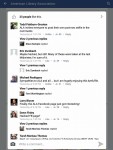
For example, Steve Kemple has been classifying each update with the relevant Dewey Decimal library categories:

Other responses include:

Fun was had all around, so much so that I wish the hacker was invited to stay. Alas, this morning the ALA reported that they had been handed control of the page again.

They’ve deleted the clickbait, and posted a staid update with the promise that the ALA’s social team would review its security procedure and make sure this does not happen again. I for one hope they don’t succeed; the hacked account was much more fun.

P.S. You can find an archive of the updates and responses on Facebook (courtesy of Tobey Maguire); some were found via Buzzfeed.

image by toodlepip


Walmart is Carrying a Self-Pub POD Book In-Store

Walmart might not have a large book section in most of its stores, but it can still move a lot of books. And that’s why Jamie McGuire, a hybrid author with S&S, was pleased to announce that she had gotten one of her books on to the store’s shelves:

Today, in a groundbreaking move by Wal-Mart, Beautiful Redemption: A Novel will be on the shelves in select stores! This is huge. This is pioneer stuff, friends, and this isjust the beginning of your favorite self-published titles being available to you!

I’m still looking for confirmation of this story, but I can add at this time that the novel in question is the second book in a trilogy. The first book in the series was published by Atria (S&S), but the last two books were self-published.

You can find the print edition of Beautiful Redemption on Amazon and other websites; it is distributed by the POD service Createspace (and so is its sequel). This book came out in January but is not yet listed on the Walmart website.

It is, however, in at least one Walmart store.

It’s quite common to find POD books on bookstores websites (this includes Walmart, where I found 60 titles in a search) but it’s far less common for those books to show up on a bookstore’s limited shelf space. (None are available in a Walmart store within 50 miles of my location.)

If McGuire has pulled this off (I want to see books on a shelf before reporting it as fact) then it is a major coup.

Update: Scratch that; a third search in Twitter has turned up a tweet that confirms the report. So this has happened.

Second Update: It’s a week later, and I have found a half-dozen other sightings (one, two, three, four, five, six).

found via IndieReader, ThePassiveVoice

image via Robert Swartwood

WSJ: High eBook Prices Result in Reduced Revenue

The Wall Street Journal has noticed that one of the classic laws of economics, namely the inverse relationship between price and demand, has been playing out in the US ebook market over the past six months.

It seems the agency contracts that the major publishers struck with Amazon really were as counterproductive as they appeared:

When the world’s largest publishers struck e-book distribution deals with Amazon.com Inc. over the past several months, they seemingly got what they wanted: the right to set the prices of their titles and avoid the steep discounts the online retail giant often applies.

But in the early going, that strategy doesn’t appear to be paying off. Three big publishers that signed new pacts with Amazon— Lagardere SCA’s Hachette Book Group, News Corp’s HarperCollins Publishers and CBS Corp.’s Simon & Schuster—reported declining e-book revenue in their latest reporting periods.

“The new business model for e-books is having a significant impact on what [the big] publishers report,” said one publishing executive. “There’s no question that publishers’ net receipts have gone down.”

A recent snapshot of e-book prices found that titles in the Kindle bookstore from the five biggest publishers cost, on average, $10.81, while all other 2015 e-books on the site had an average price of $4.95, according to industry researcher Codex Group LLC.

The WSJ must have good sources, because while we know that S&S and Hachette both reported declines in ebook revenue, the publicly available data from HarperCollins lacked specifics as to whether ebook sales had increased or declined.

Leaving that aside, it is true that ebook prices are higher, with ebooks gtom the major publishers sometimes costing as much as the hardback:

In some cases e-books cost almost as much as the hardcover. Amazon is selling the hardcover edition of Jonathan Franzen’s new novel “Purity” for $15.10—11 cents more than the $14.99 e-book price set by Macmillan Publishers, a unit of closely held Verlagsgruppe Georg von Holtzbrinck GmbH. The publisher declined to comment.

On Thursday morning, there wasn’t a single title priced at $9.99 among the top 20 titles on the company’s Kindle best-seller list. Last summer, Amazon offered the digital edition of James Patterson’s thriller “Invisible” for the bargain price of $8.99. Mr. Patterson’s newest tale of suspense, “Alert,” went on sale Aug. 3 on Amazon for $14.99, a price set by Hachette, Mr. Patterson’s publisher. The unit sales for Mr. Patterson’s e-books weren’t available.

Those ebook prices are so high that you might almost think that Amazon was engaging in a price war by slashing the prices of hardback books.

But that’s just crazy talk.

All we really know at this time is that, Mike Shatzkin put it in the understatement of the year, "unfortunately, it may be that consumers aren’t happy with the higher prices".

image by Jo Jakeman

DocStoc is Shutting Down

DocStoc, the cloud storage service for small businesses, has announced that it will be turning off its servers by the end of the year.

It has been sending out email to users, telling us that we need to pull our documents by the end of the year:

Thank you for being a valued Docstoc.com user. We regret to inform you that Docstoc will be closing down effective December 1, 2015. At that time, we will automatically be closing all accounts.

If applicable to your account, please make sure to visit the site no later than November 30th, 2015 to retrieve copies of any documents you previously uploaded to your account. If you have any questions between now and November 30th, please email us at [email protected].

This is a decision that has been long coming.

Launched in 2007, Docstoc quickly built a solid userbase among businesses, but it has long been overshadowed by Dropbox, which is also business-centric, as well as the cloud storage services from MS, Amazon, Google, etc. Even after Docstoc expanded into business services and creating its own content, it was still only a fraction the size of Dropbox.

Its diverse offerings made Docstoc a tempting acquisition target, and it was snatched up by Intuit in 2013. The only question remaining after that was when Intuit would shut down the cloud storage service, not if.

If you have a Docstoc account, be sure to download your files.

image by perspec_photo88

PoopFiction Picks the Perfect Prose For Your Bathroom Break

There are at least a dozen apps that can help you find your next read when you’re on the go, and now there’s a site that can help you find a story while you’re on the porcelain throne.

PoopFiction is a mobile site that promises to find you a story that will last as long as your time on the toilet. The stories are pulled from Project Gutenberg, and are all in the public domain, and the site offers a simple interface with only a few options:

This is a fun idea, but is it really going to see much use?

I mean, a dedicated reader will either have a book, ereader, smartphone, or another reading device when they’re going in to the restroom anyway (unless they’re the sanitary types that leave the gadgets outside). Any reading device will have a cornucopia of reading material (and possibly also other distractions like Twitter and Facebook), so there’s not much use for a site like PoopFiction.

DesignTaxi

image by majcher

B&N Launches a ReBranded Samsung Galaxy Tab S2 Nook 8″ Tablet, Now Selling it for $400

As I predicted two weeks ago, Barnes & Noble has announced a new Nook device today.

Samsung and B&N have just launched the Samsung Galaxy Tab S2 Nook. This $400 tablet features an 8″ screen and runs Android 5.0 Lollipop. It’s available today at Nook.com, and in B&N stores (just like I said it would be).

As you can see from the above image, the Galaxy Tab S2 Nook is in many ways an iPad Mini clone.  The 8″ screen has the same screen resolution as on the iPad Mini (1536 x 2048 pixels), and the Galaxy Tab S2 Nook also bears a more than superficial resemblance.

Under the hood, obviously, the difference are many. It runs not quite the latest version of Android on an 8-core CPU (Quad 1.9GHz + Quad 1.3GHz) with 3GB RAM. It has 32GB of storage and a microSD card slot, two cameras (2.1MP and 8MP), and a bevy of sensors.

This tablet packs in a 4Ah battery which is specced to last for up to 14 hours of video usage, and it also runs Samsung’s special blend of software, including multi-window mode that is bound to increase productivity.

You can find the complete specs of the original Tab S2 over on GSMArena, or on the B&N website.

Samsung announced this tablet in July and is just beginning to ship it to retailers. That’s both good news and bad news for B&N in that no one else has the tablet in stock, but it also means that B&N is competing with other retailers for the first rush of sales.

Best Buy, for example, has the original Samsung Galaxy Tab S2 in stock this week, and they’re promoting the tablet by offering a $50 to $100 trade-in deal. Bring in your old tablet, and you can get a credit towards the new Galaxy Tab S2.

If I were in the market for a new premium-priced tablet, that is what I would go for.

Oregon Library to Add Local Indie Books to its Catalog

Multnomah County Public Library is about to join the many libraries who encourage their patrons to read local.

The library has just launched a new Library Writers Project, and is inviting both aspiring authors and current indie authors in the Portland area to submit their works for consideration to be added to the public library’s catalog.

Authors will have to upload their books to Smashwords, the ebook distributor, and arrange for the book to be distributed through OverDrive. After that they’ll have to bring the book to the librarians' attention by filling out an online form.

That’s a lot of work just to get an ebook into a library, but to be fair the librarians are also going to put in a lot of work themselves. From The Oregonian:

Beginning today through the end of the year, library panels will screen excerpts of books written and submitted by library members. If they like it, they’ll purchase a few copies from Smashwords, and then depending on demand, they could purchase more, said Kady Ferris, electronic content librarian. Books would be available to members next year.

The librarians are going to be solving one of the two main stumbling blocks that keep self-pub books out of libraries: curation, or process of selecting the books patrons will want to read.

Asking that authors submit their books through Smashwords is intended to solve the other related problem: delivery, or making sure that the ebook arrives in a readily ingestible form.

For the current round of the project, the library is only inviting works of adult fiction, and limiting authors to only submitting a single title (but who knows, if they like one book enough to buy it then they might buy others). Only local authors will be accepted (the form asks for your Multnomah library card number), and the submission period closes at the end of the year.

According to the Library Writers Project website, all the submitted works will be reviewed by library staff with a wide range of reading interests. Each book will be read independently by two staff members, and if accepted the book will be bought and added to the library’s catalog.

The Multnomah County Public Library will also holding a series of events this fall intended to help the aspiring writer. There will be sessions on kickstarting the creative process and writing for kids, writing within genres, and a day of self-publishing workshops with keynote speaker Mark Coker, founder of Smashwords.

OregonLive

image  by EDrost88

Worldreader and Opera Bring Books to 5 Million Readers in Africa via Mobile Phones

The four-month-old partnership between Opera and the literacy non-profit Worldreader is already bearing fruit.

Worldreader announced on Monday that five million readers have used the app that Opera and Worldreader developed.

This app, which is prominently featured in Opera Mini in 34 African countries, enables readers to access a free online library consisting of 28,000 ebooks. That catalog spans 43 languages and a dozen categories, and includes ebooks from US and international publishers such as Publerati, Penguin Random House, Mills & Boo, and Open Road Media.

Worldreader may have gotten its start with literacy programs focused on distributing Kindles, but it has long since adopted a more platform-agnostic view. While the non-profit was able to get Kindles in the hands of thousands of readers, switching to reading apps has enabled Worldreader to bring ebooks to millions of readers.

"We want to make sure the entire world has access to the books they need and want," said Elizabeth Hensick Wood, Managing Director for Worldreader, Europe. "Through this partnership, Opera and Worldreader aim to reach millions of people every month, across 34 African countries, through the cell phones they already have."

The app is designed to work on small screens, and supports both online and offline reading. Initially developed as a web app, Worldreader Mobile is now available in Google Play, Windows Store, the Firefox Marketplace, and the Opera Mobile Store. It’s also available online at read.worldreader.org (but only for mobile phones).

Worldreader expects to reach ten million readers by the end of the year. They say that nearly a quarter of their readers come from Ethiopia, and that two-thirds are male.

Here are a few more facts about the readers:

  • Who is reading more on their mobile phones? Women. On average, women are reading 48% more than men. (Women read 11.5 minutes per session while men read 6.5 minutes per session).
  • How engaged are our readers? Active readers are spending 17 minutes reading per session.
  • What topics are popular with the readers? The most popular literary categories amongst these new readers are Love, Sports, Education, and Health.
  • What books are most popular? Most popular books include The Art of Public Speaking(education), Nutrition & Growth (health), Milk & Honey (romance), Laubach Way to Reading(education).

InfoDocket

EpubCheck 4.0 Released

 EpubCheck is the industry standard tool for verifying whether Epub files meet the official spec. The new version was made available to download on Github yesterday both as source code and as a compiled JAR file.

EpubCheck 4.0 can inspect your Epub ebook and make sure it complies with the latest Epub standards, including:

  • Epub 3.0.1
  • Epub Dictionaries and Glossaries 1.0
  • Epub Indexes 1.0
  • Epub Multiple-Rendition Publications 1.0
  • Epub Previews 1.0
  • Epub Region-Based Navigation 1.0

It also offers an early implementation of checks for several draft specifications:

  • Epub3 EDUPUB Profile
  • Epub Distributable Objects 1.0
  • Epub Scriptable Components Packaging and Integration 1.0

image by Johan Larsson

eBookids Wants to Be a Netflix for eBooks for Kids

Between Oyster, Scribd, Epic, Meegenius, and Reading Rainbow, subscription ebook services are a dime a dozen in 2015. But eBookids thinks there’s room for one more.

Launched in mid-June, eBookids is a niche reading service focused on 3- to 9-year-old children. It offers around 350 titles in French, Spanish, and English which can be read for 2 euros per month (it’s free until 1 October).

With around 350 titles, the service has more of a Reading Rainbow style offering than Epic. Rather than sign deals with publishers, eBookids employs a team of 3 illustrators and 2 authors who create the stories from scratch (Reading Rainbow does the same). eBookids also enhances the ebooks with audio, and it has a Youtube channel where the books are read to the children.

But it does not, however, offer mobile apps. Instead, eBookids is focused on the web browser. They feel that most of their users would prefer that the service be accessible anywhere, and not just on Android and iOS, the two leading mobile platforms.

And that’s not the only detail that sets eBookids apart. According to Actualitte, eBookids also retells important current events on a level that young children can grasp. The stories are illustrated, so that even the youngest can better understand what’s going on in the world today.


IDBoox

image  by <cleverCl@i®ê>

Public Libraries Want You to Read Local

Libraries as far apart as North Caroline, San Diego, and British Columbia are launching programs to connect their patrons with local authors.

Late last week the CBC shed light on the phenomenon when it reported on a province-wide Read Local program in Nova Scotia:

Hundreds of e-books from Atlantic Canadian authors are now available at public libraries across the province thanks to a new program called "Read Local."

The province of Nova Scotia provided $40,000 to help fund the program which is a partnership between the libraries and the Atlantic Publishers Marketing Association.

So far, 12 regional publishers have signed on.

That is possibly the single largest read local effort, but it is just the tip of the iceberg.

In addition to the program at the Greater Victoria Public Library (mentioned last week), I can also report that many other public libraries with Read Local program. Twenty minutes with Google has uncovered no less than six different Read Local efforts of various types.

The programs range from Madison Public Library highlighting books by local authors in its newsletter to a book fair in Durham, North Carolina. Many libraries maintain webpages dedicated to their Read Local programs, including San Diego Public Library, Johnson County Library (KS), Saint Paul Public Library, Caledon (Ontario), and of course Nova Scotia Provincial Library.

In related news, there is also Read Local BC, a campaign by the local Canadian publishers association which was intended to "celebrate the extraordinary depth of BC publishing". That campaign ran in April, so we missed it.

We also missed the Read Local book festival in Durham, North Carolina. Like the campaign in British Columbia, this festival was less a library program than one that the local library supported and helped organize.

From the News Observer:

The number of writers, illustrators, bloggers, book clubs, and even small presses that call our area home is astounding. Yet, in a city that thrives on festivals and celebrations, we haven’t come together as a town to honor our literary culture. Until now.

On May 15-17, an impressive cross section of our area’s literary minds and bookish professionals will converge on Downtown for the Read Local Book Festival, presented by Light Messages Publishing and Durham Public Library. The motive is simple: we want to raise money for Durham Library Foundation while celebrating our literary ecosystem.

The principles of a healthy ecosystem are fairly universal. To thrive, an ecosystem needs diversity with each member fulfilling a specific role. And our area’s literary ecosystem is no different. That’s why at Read Local, you’ll find self-published authors like Felicia Jamison and Leah Ward alongside emerging authors such as Elizabeth Hein, Carl Nordgren, and Samantha Bryant and household names like Jaki Shelton Greene, Monica Byrne, and Dasan Ahanu. You’ll also find your favorite local booksellers, up-and-coming illustrators, and several small presses.

So does your local public library support a Read Local program?

Mine does not, but I suspect that many do – we just have to find them. The programs mentioned above were relatively easy to find because they were all titled "Read Local", but there are bound to be more programs that are less visible.

I’m expecting that libraries with read local programs will prove much more common than libraries that offer help to local writers and authors. I only know of a few libraries with a self-pub or writer program. Seattle Public Library has one, and so does the Hartford County Library in Maryland. There’s also a multi-library program in Kentucky called ePublishOrBust.

via InfoDocket

image by EDrost88

Six Inch Nook eReader Clears the FCC, 8″ Cases Show Up on B&N Website

I need to issue a correction for my prediction earlier this week that B&N would soon be launching a new Nook device.

I was wrong; Barnes & Noble will be launching two models in the next couple weeks.

A new filing on the FCC’s website has revealed that B&N has a new Nook. All the more interesting details have been concealed, but we do know that this device is clearly labeled an ereader. It has Wifi (but not BT), and from the dimensions it is also clear that this is a 6″ ereader, and not the 8″ model I reported on Sunday.

Based on the model number (BNRV510-A), this is a replacement for the Nook Glowlight, which launched in late 2013. The new model is made by Netronix (an ereader OEM and partner to Kobo). It’s going to be a little smaller than its predecessor, and that’s about all I know at this time.

In related news, the B&N website is now showing several product listings for cases for 8″ Nook devices (here, here, here). The listings lack details and images, but they do lend credence to my earlier report.

I still lack specific details on the new devices, but we won’t have to wait long. B&N is set to have the new devices in store by 3 September, so the longest we’ll have to wait is another week.

Clarification: B&N stores are scheduled for a reset on 3 September. This may or may not involve new devices.

FCC (XHHBNRV510-A)

Thanks, Dave!

Amazon May Have Fired the Fire Phone Team, But They’re Hiring Elsewhere (Videos)

Amazon is sending mixed messages of late about its hardware projects.  On the one hand, we have leaked reports of mass layoffs, while on the other hand I have also uncovered recruitment videos.

The WSJ broke the layoff news yesterday, reporting that:

flamed out with critics and consumers last year in its first attempt at a smartphone. Now, rather than forge ahead, as it has with other projects, such as its Kindle tablets, the online retailer is retrenching.

In recent weeks Amazon has dismissed dozens of engineers who worked on its Fire phone at Lab126, its secretive hardware-development center in Silicon Valley, according to people familiar with the matter.

The layoffs were the first in the division’s 11-year history, these people said. But the precise toll on its roughly 3,000-person staff couldn’t be learned, in part because Amazon typically requires employees to sign a nondisclosure agreement in exchange for severance payments.

The layoffs should not be generalized to imply that all of Amazon’s hardware efforts are facing cutbacks, because Amazon is also actively recruiting employees for its other divisions.

Over the past few months Amazon has been posting videos on Youtube which highlight the work of various parts of the company.

There’s a bunch of videos on Lab126, as well as videos for Ivona (Poland, TTS), Evi (UK, voice recognition for Alexa/Echo), and the Kindle EU team.

There was also a promo video for Amazon’s screen tech sub, Liquavista:

https://www.youtube.com/watch?v=WZUSNrS3LK4

When that video was first noticed a couple weeks back, it caused a flurry of speculation. Many at Mobileread wondered whether it was a sign that Amazon was about to do something wonderful with Liquavista screens.

Given that this is but one video in a series, I don’t think we can draw that conclusion, but it is a sign that Amazon hasn’t forgotten the screent ech company they bought in 2013.

Speaking of speculation, here’s a rumor I didn’t really expect to come true.

Buried in the WSJ story on the Fire Phone team layoffs were a couple brief mentions of other devices that Amazon has under development which Amazon may have culled along with the Fire Phone.

It seems Amazon has an iPen prototype in the works, as well as a larger tablet:

Amazon has also halted or scaled back other development projects, according to people familiar with the situation, including a smart stylus internally called Nitro, which translates a users’ scribblings into digital shopping lists; a device dubbed Shimmer for projecting images on walls and other surfaces; and a tablet code-named Project Cairo, with a 14-inch screen.

That Project Cairo tablet sounds an awful lot like the 12″ tablet rumor that Digitimes reported earlier this week. True, the screen sizes are different, but there’s a high probability that a team working on a plus-sized tablet would be experimenting with several screen sizes with the goal of shipping a single model.

Alas, it doesn’t look like we’re going to see that Project Cairo tablet any time soon.

image  by kodomut