Nate Hoffelder

Nate Hoffelder

New Survey Shows eBook Buyers in the UK Outnumber Pirates By Fourteen to one

The aggressive/hoarder ebook pirate is often held up as the boogeyman of authors and publishers but that individual is rarer than you might think.

A new report (PDF) released this month by the UK’s Intellectual Property Office (IPO) showed that ebooks were the one type media least likely to be pirated. Coincidentally, the report also showed that casual pirates tended to spend more than non-pirates (this confirms a similar report from Australia covered by Techdirt on Thursday). The UK conclusion can’t specifically be applied to ebooks, though, just other digital media including music, videos, and apps.

But what I can tell you about ebooks is that the hardcore pirate accounted for about 6% of ebook users. The vast majority (89%) acquired their ebooks legally:

Piracy is in fact less of an issue than the other author who is competing for the attention of readers, including the ones who give away their books for free. In fact, ebook pirates are outnumbered by freegans (readers whose ebooks are legal, but none are paid for) by a factor of five to one.

31% of respondents in this survey don’t buy any ebooks at all:

Free ebooks are so prevalent that a later section of the report estimated that 57% of ebooks were paid for – but only 6% were pirated.

The report also estimated that paper books still made up 65% of the total number of books consumed in the UK, which is itself an interesting statistic. Books are the one type of media that is still primarily consumed on physical media. Music, video, apps, and games have all gone primary digital.

Do you know how some pundits are now saying that ebooks have hit a plateau?

Assuming consumers develop the same preference for digital books that they currently show for other digital media, I would not assume that plateau is going to last.

P.S. The UK Publishers Association said that ebooks accounted for around 17% of the total sales volume (in pounds) in the UK in 2014.  Does anyone have data from the PA on the number of ebooks sold in the UK last year? I’d like to cross-check with the consumer survey.

Engadget

image by JD Hancock

Flipboard Raises $50 Million, Releases Updated App for iPad, iPhone

Some would quake at the thought of having both Facebook and Apple as competitors, but not Flipboard.

The news aggregator told VentureBeat Wednesday that it had raised $50 million in a new capital funding round. "I can confirm that we closed a $50 million round with a new institutional investor," a spokesperson wrote in an email. "We’ll use the funds to expand our engineering and sales teams as well as increase investment in infrastructure to support the growing number of readers and curators on Flipboard."

The funding round had been previously reported by Techcrunch, which said (based on DE state filings) that the funds had probably been raised in June. Flipboard had previously raised $160 million in four funding rounds.

This a bold move for a company facing new competition from Apple News, which is due out with iOS 9. Pundits had been speculating for over 6 months now that Flipboard might instead be acquired by a tech company with deeper pockets. Yahoo and Google were both rumored to be sniffing around, and so was Twitter.

In related news, Flipboard’s iOS app was updated this morning with a few tweaks and improvements:

  • By popularrequest, your “Likes” are saved and accessible in your profile tab. It’s a great, new way to share your interests, and bookmark your favorite stories for later.Improvements including better search relevance, a more robust privacy section, a new look for the compose feature, as well as many bug fixes.

You can find the app in iTunes.
TNM

Amazon Detractors Invited to Debate Its Monopolistic Bookselling on Twitter, But None Show Up

Sometime they’ll give a war and nobody will come, as the line from the poem goes, and that almost sums up what we saw on Twitter today.

Earlier today LitChat held a TwitterChat on the #LitChat tag, and invited Authors United and its allies (ABA, The Authors Guild, the AAR) to discuss Au’s recent announcement that it was sending a letter to the US Dept of Justice. (That letter has been covered and rehashed extensively elsewhere, so I won’t repeat it here.)

Alas, no one from Authors United or its allies showed up for the debate, which is unfortunate because the indie viewpoint was well-represented. Passive Guy caught wind of the event and announced it on The Passive Voice blog this morning about four hours before the debate. That gave the usual crew plenty of time to clear a space in our schedules, make some popcorn, and sharpen our wits.

Ably moderated by Judah Freed, the resulting 69-minute debate (it ran long) was as entertaining as it was one-sided. An ABA rep did speak up briefly and state that they were monitoring the discussion, but the active debaters were so clustered on one side of …

Well, I would not normally describe such a diverse group of individuals as a single side in any debate, but almost all the participants in today’s debate showed up with the intent of arguing against Authors United. You can blame the polarizing effect of Authors United for that.

While there were several authors who took the position of AU, the discussion was in fact so one-sided that Hugh Howey decided to play Devil’s Advocate and argue the other side. This led to unfortunate situations where a few participants who were encountering Howey for the first time took his tweets seriously.

All in all, it was an entertaining hour. If you missed it, LitChat archived the discussion in this PDF.

image by Liberal Democrats

Google Play Books v2.5 for iPad, iPhone Adds Literata Font, Google Drive Integration

Google is playing catch up today. They’ve released a new version of their ebook app for iOS today which adds many of the features that the Play Books Android app has been getting over the past few months.

According to the change log, this update adds the Literata font Google announced back in May and an option for left alignment (ragged right, yay). It also sounds like the iOS app now has some of the UI enhancements that Google added to the Android app last week.

And most importantly, the Play Books app for iOS now lets you sync your notes and highlights to Google Drive. As I reported yesterday for the Android app, each ebook’s annotations are stored as a separate doc in Google Drive (one doc per ebook), and can be viewed in Google Docs (example, other example).

Each annotation includes a link to its location in the ebook, so if you type a note and then share the doc, anyone who also has that ebook can open their copy and see what you were commenting upon.

And yes, this works with uploaded ebooks.

Play Books is not the only app that lets you export your annotations (you can, for example, export your Kindle notes) but the Play Books option is much more convenient.

However, it is also restricted by publisher permissions. Several of my ebooks have failed to send the highlights to the doc in Google Drive. From what I can tell, the publisher hasn’t enabled the option (or perhaps intentionally disabled it, I don’t know).

You can find the app in iTunes.

Changelog:

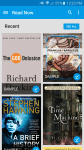
  • Read Now has a new look
  • A new default font, Literata, designed for book lovers
  • Sync notes and highlights to Google Drive – turn it on in Settings
  • Left-alignment is now available as a display option
  • Stability and performance enhancements


Booktrack Raises Another $5 Million, Still Can’t Explain Why Consumers Would Want a Sound Track in an eBook

Here’s a bit of news that has me scratching my head.

PW reports that Booktrack has raised another $5 million in a capital funding round led by investments from COENT Venture Partners and Sparkbox Ventures.  Counting the $3 million raised last April and in earlier rounds, that brings Booktrack’s total capital raise to $10 million.

There’s no word on how they plan to use the money, although:


Booktrack CEO Paul Cameron said, “our vision has always been to advance digital publishing and content to connect readers with an exciting and modern may to experience and e-book with a soundtrack.” The company has about 50 publishing deals and offers about 15,000 titles. Cameron claims Booktrack has attracted more than 2.5 million readers to its site.


That store opened in May 2015. The ebooks it sells feature annoying and repetitive soundtracks, and can only be read in Booktrack’s apps for iOS and Android or on its website.

I’m one of the many people who has never really understood the appeal of Booktrack’s product, and given the limitations of its platform (Booktrack does not distribute to other platforms like the Kindle Store, Kobo, or iBooks, and has a userbase on Android of under 100,000) I was frankly surprised to read this morning that it had raised another $5 million.

Okay, Booktrack is doing something unique; even the Kindle platform lacks soundtracks, but that is probably because consumers don’t want it.

What do you suppose they told/promised the VCs to merit the investment?

image by jenny-bee

Amazon Follow Lets Authors Connect With Fans

Whether it’s through an email list or social media following, one of the best ways for an author to pitch their next book is through direct promotion to their fans. And now Amazon has provided another way to do just that.

The retailer has quietly launched a new way for readers follow their faves. Not quite a blog’s RSS feed and not quite a social network account, Amazon Follow lets fans stay abreast of an author’s latest activity.

Readers can choose which authors to follow, and if one of those authors releases a new book (or makes it available for pre-order) the reader followers will be notified shortly thereafter. Amazon will also notify a reader if a person they follow publishes an article.

An author’s follow button can be found on their author page, and readers can manage their privacy settings as well as the authors they follow on each reader’s public profile page.

All in all, that’s not a bad tool – assuming you don’t mind that Amazon is going to have control of the connection between reader and author. That is a downside, but not everyone wants or is able to connect with author or fan via social network so it is good that Amazon is providing an additional option.

Self-Publisher Bibel


Macmillan Parent Company Holtzbrinck Opts for "Soft" DRM in Germany

The end of DRM is nigh.

Buch Report and Lesen.net are reporting on Monday morning that the Georg von Holtzbrinck Publishing Group is dropping encryption DRM from the ebooks it publishes in Germany.

Holtzbrinck is the parent company of Macmillan (which operates in the US, UK, and Australia), and in Germany it owns a number of publishers, including Droemer Knaur, Argon, Kiepenheuer & Witsch, Rowohlt and S. Fischer. According to my sources, all of Holtzbrinck’s German publishers will stop using "hard" or encryption DRM in August. They will replace it with digital watermarks, or what is often called a soft or "social" DRM.

Digital watermarks is the common term for adding customer-specific information to the metadata of a file so that a pirated copy can be tracked back to the original purchaser. Some would dispute whether  watermarks count as DRM, given that they do not prevent a user from sharing or pirating a file, but it still meets many of the same requirements and is equally effective at stopping piracy as encryption DRM like that used by Amazon, Adobe, and Apple.

Holtzbrinck’s announcement follows only a few short weeks after Bonnier made a similar decision to go DRM-free, and given Holtzbrinck’s  much larger size and the Tor-Forge connection it is arguably an even bigger story.

When Tor-Forge Books (a Macmillan imprint) went DRM-free three years ago today, many pundits hoped that the move marked the imminent demise of ebook DRM for at least one major global publisher. However, despite reports of no negative impact, Macmillan and its parent Holtzbrinck had shown no sign that they were going to expand the policy company wide.

But it turns out we were right; we had simply misjudged  the glacial pace of change in the publishing industry.

I have no info as of yet on Macmillan going DRM-free, but the most likely cause for delay (besides corporate inertia) would be making sure that the distributors offer digital watermarks as a DRM option.

For example, the Kindle Store does not offer this option yet, forcing publishers to choose between no DRM and Kindle DRM (there’s a similar issue in iBooks). In the long run this could lead some to decide to go with social DRM everywhere but the Kindle Store.

image by gruntzooki

Google Play Books v3.5 Lets You Sync Your Notes and Bookmarks to Google Drive

Google rolled out a new update to its Android ebook app on Thursday which delivered on new features that Google has been hinting about for the past couple months.

Google Play Books v3.5 has a whole new interface, a new book discovery page, tweaks to how your library is displayed, and more.

To start, the "read now" page is now based on a damnable carousel rather than a simple tile or list view. In order to see your ebooks, you’ll need to swipe left or right (or switch to the "my library" page). Google has also added a new prompt which asks you to "tell us what you like" so they can help you discover new works, and each book’s icon now integrates a progress bar which tells you how far along you are.

And inside the book Google has added a fit-width option for full-screen horizontal viewing, an image zoom mode, and the option to turn the page while zoomed in (useful for comics and large PDFs, I think).

And that’s not even the best part.

The new version of Google Play Books now lets you back up your annotations to Google Drive. You’ll need to first enable the option in the settings menu, but once you have done so the notes and highlights from each ebook will be saved as a Google Doc (one doc per ebook).

Here’s one example I threw together real quick just to show you that it works. As you can see, the text notes came through but the highlights did not. Each note or highlight is has a link to the page in the ebook where it was made.

It’s not clear why the highlights did not sync for that ebook, but the highlights did sync for another ebook, one which I uploaded to my Play Books account. I suspect that the publisher of the first book blocked this option behind the scenes.

In any case, Google has given us a new way to export or share our notes from ebooks in Google Play Books. That’s going to prove quite useful, don’t you think?

The app is free in Google Play.

Android Police

Comparison Review: Onyx Boox i86 HDML and Pocketbook Inkpad

Everyone and their life coach has released a 6″ ereader, but 8″ models are still the rarer than hen’s teeth. I have two different large screen ereaders sitting on my desk right now, and while they have the same screen size and share certain design elements, they could not be more different.

The Inkpad was released late last year by Pocketbook, runs Linux, is little more than an ereader, and is still hard to find,; while the Onyx Boox HDML Plus has been out for just over a month, runs Android, and thus offers the possibility of doing more than just displaying ebooks.

Table of Contents
[—ATOC—] [—TAG:h2—]

Hardware

The i86 and the InkPad use the same 8″ Pearl E-ink screen and they have similar lopsided designs, but that is about all they have in common.

The i86 has a black shell with page turn buttons to the left of the screen and a back button below the screen. Its power button, microSD card slot, microUSB port, and headphone jack are on the lower edge. It has a rubberized rear with a slight curve on the rear edges.

As I explained in my review of the InkPad, it has a brown plastic rear shell with a black front. Its page turn buttons are to the right of the screen under a rubber strip. The rear shell has rounded edges and a rubber pad which makes it easier for me to grip the InkPad.

Of the two designs, I’d say the InkPad is prettier for the subtle details. The rubber pads make for a more pleasant feel, and the frontlight is controlled by a swipe bar over the screen.

Speaking of the frontlight, the one on the InkPad is simply better. It’s brighter, whiter, and offers finer control. The frontlight on the i86 is splotchy to the point of being ugly.

With the frontlight off, the i86’s screen (with an IR touchscreen) is slightly more gray/brown than the screen on the InkPad (which has a capacitive touchscreen).  I know that sounds contradictory but it is true.

In terms of battery life, the InkPad lasted a week and the i86 lasted a couple weeks.

Software

The InkPad runs a proprietary version of Linux, while the i86 runs Android 4.0 and comes with Google Play.  In other words, the Inkpad is limited to what it can do out of the box, while with the i86 you have the option of installing apps.

The InkPad does have a few apps of its own, including a web browser, calculator, games, and Dropbox (more details here). But the i86 has Google Play, and enogh space for 14 apps (after that you’ll need to uses the settings menu to move the apps to another part of the internal storage).

Out of the box, both devices support the same basic range of ebook formats, although the InkPad does also have limited support for office doc formats (more details here).  The i86 supports more annotation and formatting options, and they are much easier to access, but on the other hand the i86 does not have a readily accessible TOC in the stock reading app. That’s really beginning to bug me.

They both offer font sizes which range from ones too small for me to read to 72 pt font and beyond, and while they don’t offer the exact same font sizes I did note that both offered specific numbered font sizes. The second photo below shows both ereaders with the font size set to 60.

Both devices can read an ebook to you. The Inkpad sounds pretty good, but the i86 uses the stock Android TTS and sounds terrible (but you can fix that by installing an app).

In terms of page turn speed, the i86 is noticeably faster in the stock app than the InkPad, and still somewhat faster in the 3rd-party apps.

Conclusion

Now that I’ve had the i86ML for a month, I find myself growing increasingly dissatisfied with it. It is in many ways a better device than the InkPad, but as an ereader I just don’t care for it.

The i86 is a little faster at turning the page and I can install more apps, it also has a key shortcoming. The frontlight is crap. It might sound silly to hang a review on such a minor component but I’ve really come to value how a frontlight impacts my reading.

And for that reason I like the InkPad over the i86.

Boox i86 HDML Plus Specs

  • 8” E-ink display
  • Screen Resolution: 1600 x 1200 (250 dpi)
  • Frontlight, IR touchscreen
  • CPU: 1GHz
  • RAM: 1GB
  • Storage: 8GB internal (about 6GB available), microSD card slot
  • Connectivity: Wifi, Bluetooth
  • Audio: 3.5mm headphone jack
  • Battery: 1.7Ah, lasts up to 2 weeks per charge
  • Supported ebook formats: PDF, TXT, HTML, EPUB, CHM, PDB, MOBI (Non-DRM), FB2, DJVU
  • Dimensions: 210 x 160 x 9mm
  • Weight: 340 grams

Inkpad Specs

  • CPU: 1GHz
  • RAM: 512MB
  • Screen: 8″ Pearl E-ink display, 1,600 x 1,200 resolution
  • Frontlight, Touchscreen
  • Storage: 4GB internal, microSD card slot
  • Connectivity: Wifi
  • Battery: 2.5Ah, one month runtime
  • Audio: headphone jack (TTS, MP3 supported)
  • eBook Format Support (more details here): Epub, PDF, FB2, DJVu, Mobi, PRC, CHM
  • Office and Other File Format Support: Doc, Docx, RTF, txt, HTML
  • Weight: 350 grams
  • Dimensions: 195.5 x 162.8 x 7.3 mm

Confessions of a Kindle Store Content Farmer

The internet has been blamed for killing off any number of categories of how to categories, but it doesn’t seem to be bothering "authors" like the following.

The Hustle has a piece up today that offers a behind the scenes look at one author’s ghost-writing operation. This unnamed author started out by writing his own nonfiction books, but then hit upon a sure-fire method to write books as quickly and cheaply as possible.

He sells 6,000 books a month, and nets $150,000+ a year, by using a low-rent James Patterson method to out-source the actual writing to someone in the Philippines.

For $150 per book, I send him a 2,000 word outline and 7 days later he sends me a 20,000-word book. I spend about a week editing those 20,000 words It’s that easy.

I make (net) around $1,000 each month per book. Again, I know what you’re thinking…too easy. Plus, having a ghostwriter allows me to publish books on virtually any subject. For example, after noticing a hole in the DIY market, I wrote an outline my ghostwriter turned into a 40-page book on gardening that started selling really well.

At this point I’m an outline creator, cover designer, copywriter, internet marketer, and editor.

Do I know anything about those topics? Hell no — but I make a hell of a lot of money pretending I do. Plus, even the best “authors” use ghostwriters…it’s just one of those dirty little secrets.

I hope this guy isn’t depending on Kindle Unlimited, because he strikes me as exactly the type who will take a hit now that the payment model has shifted from loans to pages read. But that is a post for another day.

The important story today is that what we have here is an entrepreneur who has hit upon a modern-day version of the Stratemeyer syndicate.

While some might be appalled by his gaming the system, I was struck by the similarity to the model that a prolific writer named Edward Stratemeyer pioneered in 1905. Stratemeyer was the founder of the Stratemeyer syndicate, a network of freelance writers and editors which was designed to produce as many books as possible as cheaply as possible.

The Hardy boys, Nancy Drew, and Tom Swift series were all invented by the Stratemeyer syndicate, and all the books were ghost-written (and they still are).

According to The Atlantic, the syndicate used methods very similar to the tricks mentioned in The Hustle excerpt above:

The Stratemeyer Syndicate helped prove that book packaging with ghostwriters could be incredibly profitable—for managers and owners, at least. Writers signed away their rights to royalties and bylines in exchange for a flat fee. (Early on, it was around $100 per book.) … It debuted Tom Swift in 1910, followed by The Hardy Boys in 1927, and Nancy Drew in 1930. That same year, Stratemeyer died in New Jersey, by then not so much a writer as a tycoon.

The Babysitter Club, the Boxcar Children, Sweet Valley High, and many other series are published on this same model today. So while Simon & Schuster may be paying a lot more for each Hardy Boys or Nancy Drew manuscript, the only real difference between S&S and the author mentioned in The Hustle’s excerpt is scale (and also quality).

Far from being appalling, this guy is just one of the  crowd.

images by nelly!,  Kaarina Dillabough

AAP Reports eBook Sales Down 7.5% in the First Quarter of 2015

The Association of American Publishers confirmed today that the major publishers are feeling the first stings of the mad rush back to agency pricing.

Trade sales (for the 1,200 odd publishers participating in the monthly report) were down 2.2% from the same quarter in 2014, to $1.49 billion. The adult segment rose 3.4%, to $1.05 billion, while the YA/kids segment dropped 15.9%, to $321.1 million. The religious segment dropped 5.5%, to $124.4 million.

In terms of formats, hardback sales dropped 6.7%, to $463 million. Paperback sales rose 8.6%, to $443 million, and ebooks fell 7.5%, to $374 million. Downloaded audiobooks continued its growth streak, with a 33.6% increase over the same quarter last year.  Physical audio, mass market, paperback and board book formats all experienced growth this quarter as well.

The AAP also reported today that total publisher revenues were down 6.6% in the first quarter at $2.22 billion, compared to $2.38 billion for the first quarter in 2014. That figure includes sales for all tracked categories (Trade, K-12 Instructional Materials, Higher Education Course Materials, Professional Publishing, and University Presses).

image  by miss.libertine


Facebook Wants a Cut of eBook Sales on Its Social Network

Authors and publishers have been selling books on Facebook for over six years now by setting up shops with 3rd-party services, and now Facebook wants to get into the act.

Buzzfeed reports that Facebook has finally woken up to the idea that commerce is possible any place where people congregate:

The company is building out shops within Facebook Pages, essentially mini e-commerce sites that give businesses a chance to set up second homes within its walls. The shops are still in the testing phase, but some already feature “buy” buttons that allow the entire shopping experience to occur within Facebook — from product discovery to checkout.

“With the shop section on the page, we’re now providing businesses with the ability to showcase their products directly on the page,” Facebook product marketing manager Emma Rodgers told BuzzFeed News.

If it works, bringing storefronts directly to Facebook Pages could have a transformative effect on online commerce, as retailers embrace the platform not just to inform their customers, but to sell directly to them.

That’s interesting, but not for the reason everyone thinks.

Facebook shops are not a new idea. As I’ve previously reported, people have been selling stuff on Facebook since at least 2009. They’ve been using services like Streetlib, Aerbook, and Gumroad to install shops on existing FB pages, and in some cases also using payment processors like Paypal to make the sale.

No one knows how much is sold on FB each year, but at this point it has to be in the tens of millions of dollars – if not more.

And now Facebook wants a cut of those sales.

The social network is under increasing pressure from stockholders to increase revenues. That’s why FB has gotten more aggressive in suppressing un-promoted posts, and why Facebook added buy buttons to updates last July.

And now Facebook has hit on the idea of becoming a marketplace portal to rival Amazon. I don’t see that happening, but more importantly Facebook is coming to the game at just the right time.

It’s 2015 and most web retailers, including Amazon, Walmart, Rakuten, and even B&N, have third-party sellers listing products on their respective sites. One could look at that fact and say that Facebook is late to the game, but it’s also worth noting that a lot of those sellers have a presence on multiple sites.

It shouldn’t be hard to encourage them to also set up shop on Facebook as well.

image by ell brown

How Google’s Blunder Was Apple’s and Facebook’s Opportunity (Google Reader)

Most of the coverage of Facebook’s Instant Articles has focused on the assumption that people want to get their news through their social networks. As a recently released report from the Pew Research Center shows, that is true to some degree but it’s not the only theory going nor does it explain all the facts.

Bob Lefsetz has a new post up today that argues that the real key to the impending success of Facebook Instant Articles is not just that Facebook has all the eyeballs but also people don’t want to have to go to multiple places to get their news. Aggregation and comprehension is the key:

We live in an era of chaos.

Zuckerberg is trying to deliver comprehension.

That’s what Facebook’s news play is all about. Turns out people don’t want to go to individual news sites for information, they want it all in one place. So, the “New York Times” is hurting, even with its soft paywall. Its goal is to get those already paying to pay more, which is positively fatuous, it’s like an indie bookstore trying to get fat cats to donate to ensure their survival. You don’t bleed those already invested, you find new customers, or you pivot. Facebook has cornered the users, that’s what it’s delivering to news outlets. It’s the old portal paradigm, but with a lot less investment.

That is the better theory; it explains why Flipboard and other aggregators rose to prominence in 2010 (and why Flipboard still has a decent userbase). It also implies a point I left unstated when I reported on Feedly yesterday, which is that the demise of Google Reader left an attention vacuum for Apple News, Feedly, and others to fill.

The rise of Google Reader and Feedly, as well as the announcement of Apple News and Facebook Instant Articles, all derive from people valuing aggregation and/or delivery. Convenience wins out every time, and web publishers are going to need to remember that.

It’s a shame Google didn’t figure that out in time to save Google Reader; they had all those eyeballs concentrated in one service and then turned them loose. Google’s mistake was that they thought social media was the key, so they killed Google Reader in favor of Google Plus.

And two years, later I’m glad they did.

Google Reader was free and so widely used that innovation had stalled in that market. The fact of the matter is, if Google Reader still existed then Apple News and Facebook Instant Articles would be dead in the water. You would be reading this in Google Reader, and Google would still have you by the eyeballs.

Instead we have a host of competing services, and even Facebook and Apple are throwing ideas against the wall to see what sticks.

Now would be a good time to thank Google for their mistake, don’t you think?

image by troyjmorris

Book Industry Hates Its Biggest Customer, Collectively Calls on DoJ to Investigate Amazon

Judging by the media circus that just came to town, something huge is about to happen in the book world.

The book industry has kicked off a massive coordinated media campaign today. The target?

Amazon.

Lead by Authors United spokesperson David Streitfeld, multiple groups in the book industry have simultaneously decided today to send letters to the US Department of Justice, asking that the Doj investigate Amazon for being a big meanie.

Just about every group is involved. Streitfeld has posted a piece in the NYTimes on behalf of Authors United. The American Bookseller Association has sent a letter, and so has Authors United (you can find both letters on the ABA website).

Yes, Authors United has finally followed through on the promise they made last November to pursue their vengeance against Amazon to the ends of the earth. According to the ABA, Authors United is joined in their effort by the Association of Authors’ Representatives, which has sent a letter. And finally The Authors Guild has added their voice to the chorus (PDF).

Wow. Now that is what I call a circus.

I plan to spend some time over the next couple days parsing the letters sent to the DoJ (I’m also going to watch for legal experts to have a go) but for the purposes of this post I would remind you of two small details.

The first is that Amazon was investigated by the DoJ during the investigation of the Price Fix Six (the Apple ebook price-fixing conspiracy). The Justice Dept did not find anything they could prosecute.

The two letters I’ve read so far mention details and behaviors going back a decade or more, and yet the activities did not lead to prosecutions. Do you really think that some ambitious young lawyer would pass on going after Amazon, when it could make their career?

I don’t.

The second detail is a notable absence.

Where is the Association of American Publishers? Its biggest members hate Amazon as much as anyone, and yet I don’t have any news of the AAP sending a letter to the DoJ (I’m waiting for a response to my query). Why hasn’t the AAP joined the party?

Update: My contact at the AAP was unable to respond to my query. She did not have a prepared statement because the AAP isn’t part of this circus (weird, but true).

Add everything together and it makes me wonder what is really going on here.

If there’s no merit to the letters, then all we have here is a huge noisy spectacle. Surely I’m not the only one to wonder why the spectacle suddenly broke out in the middle of July, why all these groups suddenly decided to send letters all on the same day.

What are they trying to distract us from?

I don’t have answers to these questions, but I do plan to start looking. Any time there is this much of a fuss about something, it’s a cover for the real story.

Any guesses what that could be?

image by RCB


How to Remove the DRM From Your Kindle, Kobo, and Nook eBooks And Rescue Them

This week’s news about B&N retreating from the international ebook market inspired me to make sure that all my Nook purchases are backed up in DRM-free form.

This takes very little effort, and I would recommend that you do the same. The process is more tedious than technically challenging, and if you can install an app or upgrade a piece of software then you can strip the DRM from your ebooks.

To get you started, this morning I dug out and refreshed the three posts I have written on removing DRM from Kindle, Nook, and Kobo ebooks.

I had already worked my way through the ebooks I bought from Amazon and Kobo, but curating my Nook library is proving to be far more work.

It’s not just that my Nook library is larger, but also that NookStudy has a broken search function and is slow to download and open ebooks. Also, its developers don’t seem to understand the concept of multi-tasking.

This is an annoying experience but at least I’ll only have to mess with it this one time.

P.S. If you happen to know of an easy way to get Nook ebooks off a Nook device so that the DRM can be removed, please leave a comment. I’ve had a couple of requests from readers who have had problems with NookStudy. Thanks!

images by plenty.r, Pitel