Nate Hoffelder

Nate Hoffelder

Patent Filing Reveals Smart Glasses from Amazon – Their Next eReading Device?

Between the Echo, Dash Button, and the Dash, Amazon is no stranger to novel gadgetry, and here’s one that could be turned into an ereading device.

Re/code has the scoop on a patent that describes Amazon’s take on augmented reality goggles like the Magic Leap or Sony Smart Glasses.

Originally filed in 2013,

The patent explains how the smart glasses might be wired or wirelessly connected to a device such as a tablet and display video or images from that device in front of the wearer’s eyes. Tapping on the tablet, it explains, transitions a surface in the display from opaque to transparent, making it possible to interact with the real world without taking the glasses off.

"On the one hand, a large screen is beneficial for watching movies, playing games and even reading email comfortably," reads the patent. It continues: "On the other hand, the larger the screen, the bigger the device, which may be less desirable for a light and portable product. Another problem consumers experience with portable devices, like tablet devices, is the lack of ability to immerse themselves in a tablet experience, such as watching a movie on an airplane."

Basically Amazon has a patent on a pair of glasses so smart that they can either block out the world around you or be transparent and let you see the display’s contents superimposed over the real world surroundings.

To be clear, the patent describes the glasses as a new form of display for video, but it also suggests that the same tech could be used as a HUD for displaying info (think Google Glass), or it might be used for augmented reality uses (like the Magic Leap or MS HoloLens).

But I wouldn’t expect to see it any time soon. Rather than release a commercial product, Amazon filed for the patent. That tells us that they’re interested in the tech and that they think it could be valuable one day – it’s just not ready yet.

And given the indefinite status of Magic Leap, the hottest player in this niche, that’s no surprise. This firm raised half a billion last fall to fund the development of cutting edge augmented reality tech very similar to the Amazon goggles mentioned above, but no one knows when it be on store shelves. According to the latest details shared earlier this week when the company announced it was shifting operations to CA,  Magic Leap isn’t saying when they will launch their first product (it is filing a lot of patents, however).

And so I wouldn’t expect to be reading your Kindle ebooks on the Amazon Embers any time soon.
Buck Rogers and the Copyright Trolls, Redux

With older stories and characters like Tarzan, Sherlock Holmes, Barsoom, and Buck Rogers increasingly protected by trademarks and not copyrights, it is becoming more and more important every day that anyone following digital publishing news understand the distinctions between these two parts of IP law, and how trademarks can be used to lock down works that have otherwise fallen into the public domain.

This is a nuance that Boing Boing missed yesterday when it covered the recent copyright lawsuit over Buck Rogers.

Earlier this year a filmmaker by the name of Don Murphy who had been hoping to make a movie based on the 87-year-old public domain story Armageddon 2419 AD filed a lawsuit against the Dille Family Trust, the legal entity that controls the IP of the author, Philip Francis Nowlan.

Murphy asked a judge to declare that the story was in the public domain (you can read more about this over at Boing Boing). Since you can find the story over at Project Gutenberg (it’s even appended to Murphy’s filing), he’s right.

But that’s not the whole story, and it’s also not the point I wanted to make. Instead, I want to point out an error in how Boing Boing framed the lawsuit:

Murphy responded by filing suit in court, asking for a judgment that the Nowlan novel is in the public domain. Furthermore, he asked (as Klinger did with Holmes) for a declaration stating that since the character of Buck Rogers has his origins in the public domain novel, the character itself is therefore in the public domain and all trademarks for it should be voided.

Yeah, that’s not what the Murphy lawsuit says, and that’s not what Klinger asked for when he sued the Conan Doyle estate over the Sherlock Holmes copyright.

The problem here is that Boing Boing has conflated copyrights with trademarks, and assumed that because the former is no longer valid then neither is the latter.

That is simply not true.

As I explained back in August, it is possible to hold a valid trademark on a work whose copyright has expired. For example, this is how the Burroughs estate maintains control over the Barsoom series.

Do you recall that terrible John Carter of Mars movie from 2012? After it bombed at the box office, the rights reverted from Disney to the Burroughs estate (or so the estate claimed; I am unconvinced that the IP claims are valid).

The trademark issue is important to this Buck Rogers lawsuit because while the copyrights may have expired, the trademarks might still be valid. A tv series based on Buck Rogers was produced in the 1970s, which means that there could be trademarks on elements from the stories.

This movie that Murphy wants to make might contain elements that violate the estate’s trademarks. We can’t know that for sure without seeing the movie, but we also can’t summarily discard the possibility.

As I pointed out earlier this year, there’s just too much we don’t know.

All I can say at this time is that when we hear of an author’s estate acting as a copyright troll, we can’t assume that only copyrights are involved. The trolls are now using trademarks to their advantage.

For example, in June 2015 Miramax settled a lawsuit over Mr Holmes, a movie based on Mitch Cullin’s book, A Slight Trick of The Mind. That lawsuit was brought by the Conan Doyle estate and alleged both copyright and trademark violations (this, even though the estate had never seen the movie in question nor sued over the book).

Similarly, The Dille Family Trust might also be able to exert control over Buck Rogers through trademarks. (This was mentioned in the BB post, but not given the emphasis it deserved.)

And for that reason, any reports which describe this type of lawsuit as an obviously bogus lawsuit should be taken with a grain of salt.

P.S. And to make things even more complicated, the copyright question is uncertain. Felix Torres has pointed out that "The original story has been adapted in newer novels that are still in copyright. There might be a valid claim on the basis of the newer stories." We won’t know for sure until and unless this case goes through discovery and a judge issues a ruling.

Amazon Files Suit Against a Thousand Fiverr Users for Selling Fake Reviews

In April of this year Amazon did something that it had never done before: it filed a lawsuit against four websites which had sold reviews to marketplace sellers on its site.

It was only the latest stage in Amazon’s years-long efforts to fight fake reviews, and today they’re going to court again. Geekwire reported on Friday that, following a months-long undercover investigation, Amazon has filed suit to unmask 1,114 anonymous Fiverr users who were selling their services as reviewers.

Fiverr is a marketplace where users can hire anonymous strangers to perform services which range from cover design, editing video, or crafting a business plan to the less palatable services like selling social media followers – or fake product reviews.

And yes, that includes Amazon reviews. There are around 680 people offering Amazon reviews on Fiverr at this time.  They’re so easy to find that you merely have to search and then scroll through the many listings promising five-star reviews.

There are so many review-sellers that you could wear out your keyboard just listing all the names, but Amazon doesn’t believe in half measures. Amazon didn’t just note the names of the sellers, it hired them:

Amazon has conducted an extensive investigation of the defendants’ activities on Fiverr, including purchasing “reviews” for products and communicating directly with some of the defendants. 

Many of the reviewers ask that the review text be added along with the payment, and some even promise a "verified review" where they faked buying the product in order to give the review more weight. Both of these tricks are ones we’ve seen before, and Amazon’s not happy.

"Defendants are misleading Amazon’s customers and tarnishing Amazon’s brand for their own profit and the profit of a handful of dishonest sellers and manufacturers. Amazon is bringing this action to protect its customers from this misconduct, by stopping defendants and uprooting the ecosystem in which they participate," Amazon wrote in the court filing. "Although Amazon has successfully requested removal of similar listings from Fiverr in the past, the removal of individual listings does not address the root cause of the issue or serve as a sufficient deterrent to the bad actors engaged in creating and purchasing fraudulent product reviews."

Amazon has been ratcheting up their fight against bogus reviews for several years, and in 2015 they got serious. In addition to that earlier lawsuit, in July Amazon radically changed their review policy to forbid any perceived relationship between reviewers and authors.

It might not look like it, but that policy change is the direct complement to this lawsuit.

That new policy is dependent on algorithms that track social media and other relationships, but the algorithms won’t help catch reviewers who launder their services through sites like Fiverr. And that means that if Amazon had changed the policy but not filed suit against Fiverr users, more of the disreputable reviewers would simply have shifted their activities to Fiverr.

Of course, this is as much a game of whack-a-mole as it is anything, so Amazon is probably already looking for the next site where the review sellers might take up residence.

Where do you think that will be?

image by robotchanter

Michigan’s Open Textbook Project Flunks Out With Critics

Advocates such as myself would like to believe that open educational resources are the panacea for the problem of ever rising textbook prices, but as we can see from Michigan’s open textbook project, publishing a textbook is harder than you might think.

Last year the Michigan Department of Education set aside a $600,000 grant to launch the Michigan Open Book Project. With half of the money spent, the first batch of textbooks commissioned under the grant were released in August and critics aren’t happy.

The critics contend that the four textbooks (history, economics, geography, and social studies) are rife with errors.

One Detroit school district reviewed the books and concluded that “all (the books) need significant editing and revision, if not complete re-writing", while the Oakland Intermediate Schools warned teachers in its social studies fall newsletter to avoid downloading the e-books.

"Despite the fact that these materials are free, Oakland Schools does not support the use of these materials with students,” the newsletter said, citing conceptual inaccuracies, poor grammar, factual errors, and other problems.

“It’s free, online, that’s awesome. But our kids deserve coherent, well-written materials,” says Darin Stockdill, a University of Michigan staff member and curriculum specialist, told the Detroit News. He said that the books he reviewed, on his own time, were "some of the most poorly designed social studies textbooks” he had ever seen.

And it’s not just the content; the textbooks are being distributed in a confusing manner.

The textbooks are available in PDF, Epub3, and in iBooks, but the supported platforms are not correctly or clearly identified.  The Epub3 format is described as the Chrome format (it requires Readium to function properly) while the PDF format is listed as the Windows format. Neither description is accurate, for obvious reasons.

And then there are the poor design choices. One of the textbooks I tried, for example, auto-played a tune each time I opened it. (Just imagine what that would be like in a classroom of 30 students.)

The textbooks' many problems stem from inexperience both on the part of the authors and the editors (assuming there were any).

Unlike other open textbook projects, the MOBP did not start with already available textbooks and then edit the books to suit its needs. Instead, the textbooks were written from scratch.

David A Johnson, a consultant with the Northern Michigan Learning Consortium, told me that the project "started with the Michigan Content Expectations and worked to build small introductory pieces to give students initial exposure to the state content".

He added that the writers are all social studies teachers from the grade levels that they represent with a history and background in the content. While that doesn’t sound bad, the Detroit News makes it clear that the teachers were under-trained and under-prepared:

The writers, who spent one day in a group training session, were selected from a large group of applicants, all of them Michigan social studies teachers. They were asked to design the materials “based on what they would want their dream resource to be,” Johnson said.

Creating the textbooks frm scratch isn’t necessarily a bad approach, but it is unnecessarily labor intensive  when compared to other projects. For example, I know of one elementary school teacher who developed his own textbooks based on the free and open textbooks published by the CK-12 Foundation.

Also, one Minnesota school district spent $15,000 paying three high school teachers to rework a stats textbook published by the CK-12 Foundation so they could use it in their classes.

To be fair to the  Michigan Open Book Project, many traditionally published textbooks have similar problems. That elementary school teach I mentioned above first got into rewriting the textbook because the books provided by his school district were written on a high school level.

And I am sure you recall the story from a few weeks back about the McGraw-Hill textbook that had a section on immigration that referred to slaves transported across the Atlantic Ocean as "workers".

So no, this is not a new issue, but it is a good reminder that when one commits to publishing a textbook, one can’t stop halfway.

When the Michigan Open Book Project set out to publish books from scratch, they should have gone through all the way and committed to a thorough editorial review, including beta readers.

Or better yet, the MOBP could have chosen the fiscally responsible shortcut and started with a previously published open textbook. The point of this project, after all, is to save the state money while providing the best quality textbooks to students. So far, this project has failed on both points.

image by mrpetersononline

E-ink Shows Off Smart Badges, 13.3″ Color Screens, and More (video)

Screen tech in the ereader market may have stalled after last year’s release of the Carta E-ink screen on the Kindle Voyage, but that doesn’t mean E-ink is standing still.

Charbax has posted a video of a recent booth tour where E-ink shows off its latest concepts. Watch carefully and you’ll see flexible smartwatch displays, a color 13.3″ E-ink screen, and an eBadge design that is powered by NFC.

There’s even a concept design for a dual-screen smartphone like the Yotaphone.

For the most part, what we see in the video are less products than they are potential products. I wouldn’t bet on seeing these devices hit the shelf any time soon, but this video does still give us a good idea on what E-ink could do if someone had the money.

Bots Learn How to Write Clickbait Headlines That Will Shock You!

Everyone from startups like Narrative Science to news orgs like the LATimes and the AP are using algorithms to automatically generate news articles, and pretty soon they’ll be able to get a bot that can write a clickbait headline.

The Stack reports that a Norwegian researcher and blogger by the name of Lars Eidnes has developed a clickbait generator by training a neural network to create sensationalist headlines.

As Eidnes explains in his blog post, he taught a recurrent neural network to create clickbait titles by feeding it a couple million headlines (scraped from Buzzfeed, Gawker, Jezebel, Huffington Post, and Upworthy) and asking it to guess the next word in the headline.

His bot got good enough that (once it also learned grammar) you could feed it a single word and have it generate multiple headlines.

The trick was in the recurrent nature of RNNs; each time the bot added a word to a headline, the new headline was fed back in to the bot as input, eventually resulting in a complete headline.

You can find the code on GitHub.

In addition to creating the bot, Eidnes has created a site as a proof of concept. Clickotron is perhaps the first "news" site where everything is written by a bot. It’s updated every 20 minutes with artificially-created news stories. Starting with the bot-generated title, the site finds a matching image by searching the Wikimedia API with the headline text, and selecting pictures that have the appropriate CC license.


The headlines are often nonsensical and the text is worse, but as a proof of concept it does work (mostly), and I think the complete lack of value may have been one of Eidnes goals.

As he explains at the end of his blog post: “In total, this gives us an infinite source of useless journalism, available at no cost. If I remember correctly from economics class, this should drive the market value of useless journalism down to zero, forcing other producers of useless journalism to produce something else."

Joking aside, Eidnes has shown us that it’s possible to teach a bot to write particular types of headlines. And since many news sites have their own pattern for headlines, it should be possible to adapt the idea Eidnes developed for his clickbait bot and use them to suggest headlines for other less evil purposes.

image by peyri

Kindle Unlimited Payment Dips Slightly in September 2015

Amazon has released the monthly stats for Kindle Unlimited, its access-based ebook service.

The total funding for September 2015 was $12 million, up slightly from August 2015. The average per-page payment was $0.00507, down ever so slightly from August 2015 ($0.0051). A total of 2.366 billion pages were read, worldwide.

Here’s the running tally of monthly funding pools:

  • May 2014: $1.2 million
  • June 2014: $1.2 million
  • July: $2.5 million (Kindle Unlimited launches early in the month)
  • August: $4.7 million
  • September: $5 million
  • October: $5.5 million
  • November 2014: $6.5 million
  • December 2014: $7.25 million
  • January 2015 – $8.5 million
  • February 2015: $8 million
  • March 2015: $9.3 million
  • April 2015: $9.8 million
  • May 2015: $10.8 million
  • June 2015: $11.3 million
  • July 2015: $11.5 million
  • August 2015: $11.8 million
  • September 2015: $12 million

Thanks, Morris!

Lufthansa Partners With Sobooks, Opens eBookstore at 30,000 FT

With Southwest, JetBlue, and many other airlines making ebooks available in-flight, 30,000 feet is the next-gold rush for ebook marketing, and now Lufthansa is getting involved.

Lesen.net has the scoop that the German national airline Lufthansa has partnered with the Hamburg-based social reading startup Sobooks to open an in-flight ebookstore.

Starting in 2016, readers on Lufthansa’s long-haul flights will be able to buy ebooks on their smartphones and tablets. Passengers will get destination-based recommendations, be able to read samples, and share and discuss passages online.

Passengers will be offered deals based on their destination (NYC guidebooks on a New York bound flight, for example). If a reader finds a book they like they can buy it mid-flight, but I’m not sure why they would want to. According to the press release, Sobooks platform is online-only, with the ebook readable on any Internet-enabled device (the FAQ confirms this detail).

The Sobooks platform has the convenience of working in any web browser but it also has the defect of not working offline. As a result, Sobooks and Lufthansa  customers are not only stuck with an ebook trapped in a niche platform, they’ll also have to pay for a data plan if they want to access the ebook on their trip.

Sobooks has said that they plan to release an offline reader in November, which means it should be available before the Lufthansa partnership kicks off next year. But even so, I think Lufthansa  should have found a different partner for this deal.

One of the things I like the most about Germany is that the major publishers have all opted for digital watermark DRM and thus removed one of the technical issues that sometimes trips up ebook sales.

It’s now easier than ever to sell and deliver ebooks, and Lufthansa should have found a partner who can do that in-flight, and not this half-assed online-only nonsense. A real ebook service would have been very useful to Lufthansa passengers, but instead they’ll be getting one that is recycling all the best ideas from 2012.

Oh, well. There’s always next year.

image by BriYYZ

Audible Brings a Graphic Novel to (a Very, Very Brief) Life With Virtual Reality

In addition to being an audiobook distributor, Audible is also a publisher. Its burgeoning original content dept has been producing podcasts, and Audible has also produced audiobooks with radio show quality sound effects, but nothing compares to the half-hearted attempt at a virtual reality experience which was developed for Joe Hill and Gabriel Rodriguez’s Locke & Key.

Originally published as a graphic novel series, Locke & Key is by its very nature not your average audiobook source material. In fact, one would assume that it’s impossible to turn a graphic novel into an audiobook. You would be wrong, but Audible did have its work cut out for it.

And that is why Audible partnered with digital creative agency Firstborn to create an immersive Locke & Key virtual reality experience which, according to Fast Company, was released last week during NY ComicCon and uploaded to Youtube as a 360-degree video.

Or at least that is what FC is saying; the 83-second video on Youtube doesn’t actually show much of a story. But from what I read on Techtimes, this video is exactly what was shown to the NY ComicCon attendees.

https://www.youtube.com/watch?v=ELF-dK8z5Dc

You can find Locke & Key as a more traditional audiobook production on Audible, where it’s free until 4 November. The audiobook is thirteen hours long.

The virtual reality experience requires an Oculus Rift or some other most of us don’t have. That pretty much torpedoed any chance Audible had of turning a profit on this project, but that hasn’t stopped them from touting the tech.

"From the beginning, Locke & Key was conceived to truly immerse listeners in the terrifying world created in the graphic novels, thanks to a cast of highly skilled actors, a soundscape that envelops you from all sides, and an original musical score, the audio drama succeeds in doing just that," Audible SVP Barbara Ward Thall told Fast Company. "Given the 360-degree sound design, we thought it only made sense to bring a scene from Locke & Key to life in VR. The fact that the audio drama was scheduled to launch the same week as NY Comic Con gave us the perfect opportunity to share this ambitious and exciting creation with some of its most ardent fans."

It doesn’t sound like Audible plans to complete the work, making this little more than a gimmick.

That is disappointing, but hey, the audiobook is free, and from the description this is one of those titles you should grab just because of the cast:

Featuring performances by Haley Joel Osment (Entourage, The Sixth Sense), Tatiana Maslany (Orphan Black), Kate Mulgrew (Orange Is the New Black, Star Trek: Voyager), Joe Hill, Gabriel Rodriguez, and Stephen King (The Stand, 11-22-63), as well as a cast of more than 50 voice actors, this audio production preserves the heart-stopping impact of the graphic novel’s astounding artwork through the use of richly imagined sound design and a powerful original score.

Amazon Has an Even Bigger Share of the eBook Market Than We Thought – Author Earnings Report

Conventional wisdom says that Amazon has 65% of the US ebook market. The folks behind the Author Earnings Report would disagree.

For your Friday reading pleasure, the latest edition of the Author Earnings Report explores which retailers control how much of the US ebook market.

Where past reports focused solely on the Kindle Store (or offered a similar single-store snapshot of a competing store), the October report offers a cross-sectional view of the US ebook market.

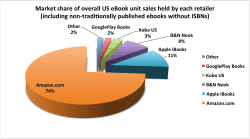
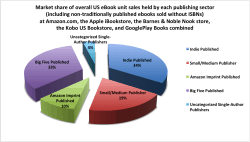
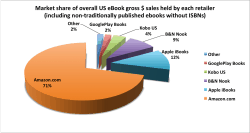
It’s the first new look at the market that I have seen in (I think) over a year, and it does not paint a heart-warming picture for those who hate Amazon. The report finds that Amazon can lay claim to 74% of the units sold in the US ebook market, and 71% of the dollars spent.

Something like 99% of consumer ebook sales are made through just five major ebook retailers. Amazon accounts for the majority of those sales, with iBooks coming in second with about 10% to 12% of sales.

Barnes & Noble has somehow managed to hold on to third place, with roughly 7% to 8%, followed by Kobo with 3% to 4% of sales. And rounding out the top five is Google Play Books, with 1% to 2% of the US ebook market.

The report goes on to analyze the smaller ebookstores in terms of units sold and revenue earned. The estimates are generated based on the same methods used for the Kindle Store (the best seller lists) and they lead to some surprising conclusions.

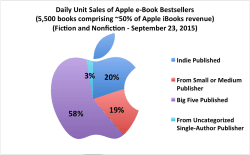
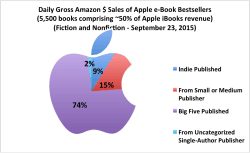
For example, Apple’s ebookstore is dominated by the Big Five. iBooks leans heavily towards the B5 both in terms of units sold and dollars spent. Indies make up 23% of units sold, but only 9% of revenue. The Big Five, on the other hand, account for 58% of units sold and 74% of revenue.

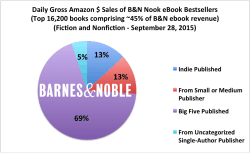
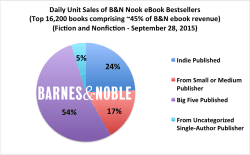
With 54% of units sold and 69% of dollars spent going to the Big Five, the Nook Store was almost as bad as iBooks.

Kobo (not shown here) displayed a similar prevalence for Big Five sales, but Google Play did not.

The report concludes with a look at the overall ebook market, which still leans heavily towards the Big Five. You can find that data, as well as an analysis of the Kindle Store, over on the Author Earnings Report website.

Germans Spent 95 Million Euros on eBooks in the First Half of 2015

Here’s an interesting follow up to the news earlier this week that every fourth German is now reading ebooks.

While the number of German readers may not have increased much in the past year, the German ebook market has grown.

GfK has released some results from its survey of German consumers. It has found that in the first half 2015, an estimated 2.9 million Germans over the age of ten paid for an ebook. They spent a total of nearly 95 million euros. This represents an increase of 13 percent compared to the same period last year, according to GfK.

Edit: Just to put that 95 million euros in perspective, the AAP reported yesterday that US ebook revenues (for the half of US publishing industry that the AAP tracks) totaled around $730 million in the first half of 2015.  That puts the total consumer spending at $2 billion and change. With a population four times as large, the US is spending twenty times as much on ebooks.

That estimated number of readers is far smaller than the ten plus million of Germans that read ebooks, according to the Bitkom survey earlier this week. While a discrepancy between readers and buyers is to be expected (a UK survey showed a similar albeit smaller discrepancy) I have no explanation as to why the so many more Germans want to read ebooks than buy them.

Could it be the price controls in the German book market are discouraging ebook sales but not discouraging adoption?

If so, that might explain why GfK found that 1.4 million German borrowed ebooks during the first half of 2015. This includes free laons as part of a membership with online sellers, borrowing ebooks from libraries, and  monthly flat rate models (like Kindle Unlimited).

These readers were heavily focused on loans, so much so that more than half didn’t buy books (neither print or ebooks) but only borrowed them.

Boersenblatt

image by Tommy Hemmert Olesen


Trade Book Sales Down 1.4% in First Half of 2015, AAP Reports

The Association of American Publishers just released a few dribblets of information on the US book industry. The publicly available stats are incomplete, but the news is not good for the legacy publishing industry.

Revenues for the 1,200 publishers providing monthly data to the AAP dropped 4.1% in the first six months in 2015 ($5.58 billion, vs $5.82 billion). That figure includes revenues for all categories tracked by the AAP (trade plus higher-ed, uni presses, K-12, etc).

Revenues from trade book sales were down 1.4% in the first half of the year ($3.09 billion vs $3.13 billion). Two of three trade categories were down, with kids/YA showing the steepest decline at 12.3% ($677.1 million vs $772.3 million). The adult category was up 3.1% ($2.17 billion vs $2.1 billion), while religious presses were down 5.1% ($244.5 million vs $257.8 million).

eBook revenues were down 10.4% in the first half of the year. Downloadable audiobooks were up 31%, while paperbacks were up 12.5%. Hardback books were also down (11%).

The AAP wasn’t specific as to the dollar amounts, but they did share this handy chart:

Edit: I asked and got the specific figures used in this chart. The following figures reflect the first 6 months revenues of each calendar year (hardback, paperback, ebook, All Other, and total trade).

  • 2011: $941.8M, $1,291.4M, $523.0M, $155.3M, $2,911.6M
  • 2012: $1,072.2M, $1,241.7M, $813.8M, $191.9M, $3,319.7M
  • 2013: $1,022.0M, $1,093.6M, $752.5M, $205.8M, $3,073.8M
  • 2014: $1,109.6M, $1,005.9M, $813.2M, $205.9M, $3,134.7M
  • 2015: $987.2M, $1,101.1M, $729.7M, $273.4M, $3,091.4M

That chart is frustratingly nonspecific, but it offers a different perspective on the recent NYTimes story. Far from showing that ebooks have peaked and print making a resurgence, it shows that the revenues are in flux.

The hardback segment is up and down (more the latter than the former), the paperback segment is down from a peak (but might be making a comeback), and ebook revenues for the 1,200 publishers that submit monthly data to the AAP are both up and down.

The above chart shows why you should not draw a conclusion based on a single statistic (the NYTimes' first mistake). If you pick the wrong year, you could argue that your preferred format is up, only to have that format decline the following year.

With the market in flux (as it has been for the past four years), it’s hard to draw any conclusions at all.

Google Wants to Speed Up the Mobile Web, But Their Focus is Too Narrow

Google’s highly-anticipated response to Facebook Instant Articles was announced today, and there’s something missing.

The WSJ, Android Police, Digiday, 9to5Google and a bunch of other sites are reporting that Google held a press event this morning to announce a new tech called Accelerated Mobile Pages.

AMP isn’t a new app like Apple News, or a distribution channel like Facebook Instant Articles. Instead it’s tech that web publishers might one day be able to integrate into their sites so they can improve your mobile browsing experience.

.

According to Google’s blog post, AMP is a new open framework built entirely out of existing web technologies, which allows websites to build light-weight webpages. It simplifies the HTML code for mobile Web content so that speed is prioritized over other functions. It also integrates caching tech that would show readers the latest updates of developing stories instead of older versions. Google said it would make its cloud service available for AMP caching.

AMP is launching today with 30 partner sites, and Google has said that Twitter, Pinterest, WordPress.com, Chartbeat, Parse.ly, Adobe Analytics, and LinkedIn have already signed up to participate.

You can read more about it on Google’s blog post, and you can also find the code on GitHub.

And if you’d like to try AMP, Google has (theoretically) made a demo available through Google search. I describe it as being theoretically available because I still haven’t seen it yet on any of my mobile devices.

I also haven’t seen it on my non-mobile devices, which to me is the more important issue.

While it’s great that Google is doing something about the mobile browsing experience, I think they’ve overlooked the fact that half of all web browsing is not on mobile devices. The non-mobile browsing experience isn’t too great either (this is why so many of us use black adverts and tracking scripts) and it could really benefit from any tricks to streamline pages and reduce loading time.

Sure, all the blame for bloated webpages falls on web publishers, but a lot of us are actively trying to fix the problem. We’d love to get another tool which could improve the browsing experience on our sites.

B&N Launches a ReBranded Samsung Galaxy Tab E Nook 9.6″ Tablet, Now Selling it for $249

As I predicted last week, B&N’s new tablet is the Samsung Galaxy Tab E Nook 9.6″ Tablet. The retailer has just sent out a press release email, announcing that the new tablet is available now for $249 (less if you take B&N up on its trade-in offer).

The Samsung Galaxy Tab E Nook sports a 9.6″ screen, just like earlier spec sheets said, but it’s not quite the tablet I lead you to expect. While many of the details I reported last week are correct, B&N is showing that the new tablet runs on a Qualcomm CPU, and not the cheaper Spreadtrum CPU used in previous variations of the Samsung Galaxy Tab E.

This tablet runs Android 5.1.1 on a 1.2 GHz Qualcomm Snapdragon 410 CPU with 16GB of storage (plus 128GB microSD card support),  and two cameras (2MP and 5MP). Its 9.6″ display has a resolution of 1,280 x 800.

This tablet has Wifi, GPS, and an accelerometer. According to B&N it weighs 547 grams, and comes with a battery which specced for up to 12 hours of video.

B&N hasn’t stated the amount of RAM, dimensions, battery spec, or whether the tablet has Bluetooth, but aside from that this is a better model than the unit I detailed last week.

It runs the same Samsung-flavored Android with a dash of B&N mixed in on much better hardware than I was expecting. It costs only $5 more than the Fire HD 10, it’s most visible competition, and bests that tablet in the CPU and OS categories.

The Samsung Galaxy Tab E Nook is available in stores today and on the Barnes & Noble website. It’s going to be kept as the larger but cheaper complement to the Samsung Galaxy Tab S2 Nook, which retails for $399.

image by JeepersMedia

PubSlush to Close on Friday as Acquisition Deal Falls Through

The last-minute rescue of crowd-funding site PubSlush has fallen through at the last second, and the site will be closing at the end of the week.

About two months ago PubSlush abruptly announced that it was closing, followed a week later by the news that the platform was being acquired by Colborne Communications, a Toronto-based editorial services firm that planned to keep PubSlush open and later turn it into a services marketplace.

That deal has through, and PubSlush will be shutting down in three days.

Authors who want to crowd-fund their next work should turn their attention to  crowd-funding sites like Kickstarter, Indiegogo, or Pozible, or maybe even Inkshares or Pentian (two crowd-funded publishers).

And if authors aren’t in a hurry, they could also wait for the launch of PubLaunch in February 2016.

Greg Ioannou, president and founder of Colborne, isn’t giving up on the idea of providing a crowd-funding service to authors. He’s moved on from his plans to acquire PubSlush, and he now plans to start a new crowd-funding site.

PubLaunch will fill the same needs as PubSlush, and it will also do so much more. From the website:

PubLaunch will be far more than a crowdfunding site. It will become THE hub that connects readers, writers and trusted industry professionals with the people and services they need to get books published.

PubLaunch has only one goal: getting books published.

PubLaunch does this in two ways:

  • Crowdfunding for books.
  • Connecting people: Putting writers in touch with professionals they can trust to produce their books, and connecting the professionals with each other.

Basically, PubLaunch will fill all the same roles that Ioannou planned to add to PubSlush after he bought it. In addition to crowd-funding, it will be a services marketplace where authors can hire the services they need to bring their manuscript to market.

image by Sundve