Nate Hoffelder

Nate Hoffelder

Pocket Moves Into Twitter Territory?

The Verge has a story that has me stumped (I don’t see why it’s newsworthy).

Pocket, the service for saving articles and videos to view later, is starting to look a bit more like a social network. The company is now testing a way for you to share your favorite items to a public profile, which others can follow to see your picks in a feed of recommended items. Your saved items are still private by default, but you can now choose to broadcast favorite pieces with your followers. …

Still, Pocket won’t show you everything your friends share. "This feed isn’t Twitter or Flipboard," Weiner says. "It’s not time-ordered, and it doesn’t include every possible article from the sources that you follow. The goal with recommendations is to bring you the very best of the web without the noise."

Pocket already had sharing options for all the major social networks, and it offers RSS feeds for unread/all items/archived links. And through IFTTT you can micromanage the link sharing to your heart’s content (forex: only sharing links with a certain tag).

So what does this new option ad, besides an algorithmic filter that is intended to only show me the best?

One, that sounds more like Facebook than Twitter, but in any case thanks, but no thanks.

I don’t need or want software to second-guess what someone chooses to share. They chose to share it, so I want to see it. If I want a filter I will set one up.

The new more social sharing option is being rolling out today in a public beta on Android and iOS. To use the features, you’ll need to join Pocket’s beta testing program.

image by GotCredit

Publishers Are Unhappy Over Facebook Instant Articles

Facebook’s Instant Articles has been variously described as the next stage of media consumption or a great threat to news orgs survival. But based on early reports, there’s one thing that Instant Articles clearly are not: a money-maker.

Citing persons familiar with the matter, the WSJ reports:

The product is still in its infancy, but publishers including The Washington Post, New York Times and LittleThings.com are finding it difficult to extract as much revenue per article from Instant Articles as they do from pages on their own websites, according to people familiar with the situation.

That is because of the guidelines Facebook has laid down on the type and volume of ads publishers are allowed to sell. For example,only one “large banner” ad sized 320 x 250 pixels may be included for every 500 words of content. On their own mobile properties, publishers such as The Washington Post would typically include three or perhaps four of those ads alongside a 500-word article.

Facebook is also restricting the type of ads publishers may place in Instant Articles. It will not allow so-called “rich media” ads, the animated or interactive ads that appear across publishers’ sites.

To put it simply, publishers are upset because Facebook won’t let them slather their articles with adverts. (For the record, I have 5 adverts on this page, so I am almost as bad.) In particular, Facebook won’t allow the rich media adverts which are simultaneously the most annoying and the most remunerative. (Instead, Facebook wants to sell those rich media adverts themselves.)

But sadly, that is going to change. Michael Reckhow, Facebook’s Instant Articles product manager, told the WSJ that Facebook would allow more adverts per article andad types which were previously verboten. He hasn’t shared the specifics, but he did say that: "We’ve made numerous improvements to the advertising capabilities over the past few months and will continue to iterate based on publisher feedback to improve the product".

Officially launched for all users of the Facebook iPhone app last month, Instant Articles lets news publishers and media companies publish content directly to Facebook feeds rather than posting links on Facebook to attract users to their websites.

Twenty publishers are currently participating in the program, which lets them sell adverts against their articles and earn 100% of the revenues, or 70% of the revenues from adverts sold by Facebook.

image by Richard Masoner

B&N Launches Nook Audiobook Apps for iPhone, iPad

Remember the audiobook service Barnes & Noble launched last year? Me neither, but it’s back in the news again today.

After a year of waiting, B&N has released Nook Audiobooks apps for the iPhone and iPad. They’re also finally launching a website where you can buy the audiobooks: NookAudiobooks.com.

“We’re thrilled to expand our NOOK Audiobooks offering to further our commitment to creating an easy way for customers to find and access their next great listen on their favorite devices,” said Fred Argir, Chief Digital Officer at Barnes & Noble. “Customers can discover their newest audiobook anytime, anywhere and dive in immediately on any NOOK by Samsung, iPhone, iPad or Android device.”

The new apps, which can be found in iTunes, let you listen to the audiobooks bought through either the Nook Audiobooks Android app, or the new website.  (Apple being Apple, there are no in-app purchases in the iOS app.)

B&N offers a catalog of 60,000 audiobook titles through a service that was developed in partnership with Findaway (and who is actually running the service). It’s not a particularly well-designed service or website, and it lacks basics like letting you play other audiobooks in the Nook Audiobooks app, or the option to sort the store listings by price.

But if a token presence in a niche market counts for something, then B&N is ahead of the game.

Kobo Promises to Refund All Orders From the Kobo Mini Sale Fiasco

Kobo has proposed a very adequate solution to the mess resulting from last week’s bungled Kobo Mini sale.

As I reported yesterday, Kobo briefly ran a sale last week where they offered a new Kobo Mini with a Pearl screen and a gray knit sleepcover for $50.

Unfortunately for everyone, what Kobo had intended to sell (and all they ahd on hand) were old demo units with pink rubber shells. Since Kobo doesn’t have the units it listed on its website, it has instead decided to give everyone a refund.

Here is the official statement:

The Kobo Mini eReaders that were sold from November 3 to 7 in Canada and the US were devices produced for retail store demo environments. Although the eReaders were unused and in original, sealed packaging, the description onKobo.com should have explicitly stated that they were demo devices. This was an error and it was not Rakuten Kobo’s intention to mislead customers. As such, those who bought the Kobo Mini will automatically receive a full refund for the device and shipping costs, and are welcome to keep the device if they wish.  Rakuten Kobo apologizes for this unfortunate error and is working quickly to get booklovers back to reading.

If you bought a Kobo Mini in last week’s sale, contact customer service so you can get your refund. You might need to reference this post.

Publisher eBook Revenues Down in First 7 Months of 2015

Numerous press reports over the past few months have informed us that the major publishers are experiencing a decline in ebook revenues, and based on the latest statements from the Association of American Publishers, that trend is not going to stop any time soon.

The AAP released new stats today for the first seven months of the year.

Or rather, the AAP released statements about sales stats. Since the AAP is reserving all the actual figures for paying customers, I can’t report on them. And without that data, I might as well simply repost the email as rewrite it.

When you read it, do note that trade ebook revenues among the major publishers declined 11.2%. That of course does not reflect the entire market, but only the revenues of the major publishers.

O O O

Publishers’ book sales for trade (consumer) books from Jan. to July were up 0.3% compared to the same timeframe in 2014.  July was a strong month for trade books, with Adult Books, Children/Young Adult Books and Religious Presses all showing double-digit growth over July 2014.

Despite the bump from July’s trade sales, overall publisher revenue for the seven-month period was $8.37 billion, down 2.0%. These numbers include sales for all tracked categories (Trade – fiction/non-fiction/religious, K-12 Instructional Materials, Higher Education Course Materials, Professional Publishing, and University Presses). Publishers net revenue is tracked monthly by the Association of American Publishers (AAP) and includes sales data from more than 1,200 publishers (#AAPStats).

Trade:

July was a good month for all categories of trade books with sales growth in  Adult Books (10.9%), Children/YA Books (11.5%) and Religious Presses (14.6%), compared to July 2014.

The trade category for Jan. – July 2015 showed slight growth for the first time this year as a whole at 0.3%, at $3.67billion.

Trade Formats:

Downloaded audio remained the fastest growing format, increasing 31.2% in July, compared to July 2014. This brings the year-to-date growth for this format to 37.0%, compared to the same timeframe in 2014.

eBooks were down for the first seven months of the year at 11.2% compared to the same timeframe in 2014. The bulk of the decline comes from Children/YA Books, which has seen a 44.7% decline compared to the first seven months of 2014.

Hardback books had an upswing in sales this July, growing at 43.1% for Adult Books and 6.9% for Children/YA Books compared to July 2014. However, the year-to-date growth for this format is still down 6.6% overall for the year compared to the same timeframe in 2014.

Paperback books also had sales growth in July for Adult Books (18.4%) and Children/YA Books (23.6%), compared to July 2014. From Jan. – July, this category has grown 13.2% compared to the same timeframe in 2014.

Educational Materials:

Despite having a positive July, with growth of 1.4%, revenues for PreK-12 instructional materials were down by 6.4% the seven months of the year. Higher Education course materials were down 6.0%.

Professional and Scholarly Publishing:

Sales for Professional Publishing, which includes business, medical, law, scientific and technical books and journals, are up 33.8% in July and 23.4% for the year-to-date. University Presses were down slightly 0.7% year-over-year compared to the same seven months in 2014.

Amazon Books is All About the Data

Amazon’s new bookstore is only four days old but it has already inspired more opinions than your average political debate. Some see Amazon Books for what it is, a wholly unremarkable bookstore, while others see it as either a threat to indie bookselling or as a replacement for the public library.

Rob Salkowitz, on the other hand, sees Amazon Books as being all about the data.  Describing Amazon Books as not "the grandiose retail book palaces that Barnes and Noble and Borders built in the late 1990s", Salkowitz hones in on the shopping experience and points out that Amazon might be interested less in selling stuff than in tracking what shoppers are doing in the store.


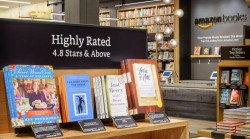
Under the hood, the Amazon store has a few unusual features. Every book has a shelf tag that includes a capsule review from the website, a star rating, and a barcode. There are no prices listed.

To get the price, you scan the code with the camera of your smartphone and the Amazon app. If you don’t have a smartphone or the app installed, an associate can do it for you. This brings up the product page for the item you’re looking at, with full reviews, specs and pricing. Pretty slick, eh?

But here’s where it gets interesting. If you are signed into the app with your account – as is likely – Amazon is immediately able to associate its online customer records with you, the customer browsing the shelves in its physical location. It knows your preferences, your buying history, your status as an Amazon Prime and/or Amazon credit card member, and who knows what else. Armed with that data, it can feed you recommendations, offer coupons and incentives, and do whatever it needs to do to close the sale as you are holding an item in your hand that you are considering purchasing.

…

It seems clear that the shelf pricing model in the Amazon store isn’t a feature – it’s the product. By pushing pricing to the app, Amazon enables every offer, every recommendation and potentially every price to be personalized to each customer and timed to optimize every transaction.

I don’t have inside info from Amazon that proves he’s right, but it would make a lot of sense.

For one thing, it would explain why Amazon went with a shelf-label that didn’t mention the price:

Amazon didn’t leave the price off because it is a variable; if that were the issue then Amazon could have invested in electronic shelf labels. (E-ink has red/black/white and yellow/black/white labels which would look great.)

No, Amazon left the prices off so they could use the Amazon app to track which book caught your eye while you are in the store.

When I wrote earlier this week that the store felt like a field experiment, I wrote that "Amazon is closely studying the wildlife to see how it interacts with the the test equipment".

I thought that meant that Amazon would respond by changing the equipment around, but now I see another possibility; the whole point of the exercise, from Amazon’s viewpoint, is studying the wildlife (as opposed to selling stuff).

Salkowitz says that it’s all about the data, and I agree with him. Amazon’s focus on the data also explains why Stacy Claflin reported that Amazon Books did not accept cash; they want your credit card so they can track you better.

To be fair, none of this is new; retailers have been using loyalty cards to track your shopping for decades. It’s just that in the case of Amazon Books, we have a store that takes it to the next level.

Where most retailers track your in-store buying patterns, Amazon is equipped to track your in-store browsing habits (just like retailers do online).

If I were a competing bookseller, I would be more worried now than I was before. Amazon didn’t just open a store; they are adapting their data-centric business methods to brick-and-mortar retail.

Those methods are why Amazon is the single biggest online retailer, and now they’ve set their sights on b&m.

Be afraid. Be very afraid.


SNCF’s New eBook Subscription Service Validates the Kindle Unlimited Model

In September of last year the French Railway SNCF launched a free digital library where passengers could read short public domain works with reading times ranging from 15 minutes to an hour long.

Evidently pleased with that program, SNCF expanded the program last week with the launch of a paid service that offers access to a catalog of 100,000 titles – and they’re taking a leaf from Amazon’s play book when they do so.

The paid SNCF e-LIVRE service costs 10 euros per month, and lets subscribers download and read ebooks on their smartphones and tablets. The service will be free until mid-December (for the first 45 days) after which subscribers will be billed monthly.

It is a freemium service; it still offers the 5,000 public domain titles and excerpts for free, but it also offers a catalog of 100,000 titles which includes best-selling novelists like Marc Levy, Amélie Nothomb, and Guillaume Musso.

SNCF will also run a book of the month promotion and promote books which could help a reader discover a region’s heritage and history, its stories and legends, and its authors.

Selection is limited, however, because publishers are reportedly put off by the funding model. According to eFigaro.fr, SNCF e-LIVRE will pay publishers 65% of its revenues, and divide the payments based on the number of pages read.

That, folks, is more or less the same model that Amazon adopted for Kindle Unlimited in July 2015, only with a more explicit split and a more specific cap on funding.

Kindle Unlimited, on the other hand, is funded based on Amazon’s arcane calculations. According to Amazon, the KU funding pool will total $12 million in November 2015.

While some have complained that Amazon was paying indie authors less than trad publishers (even though this isn’t strictly true), in SNCF e-LIVRE we have service that competes with Kindle Unlimited and uses the same model.

And that makes perfect sense. What with Scribd cutting back its service, and Oyster selling out to Google, it’s clear that paying the wholesale price for a book each time it is borrowed is simply not a workable idea.

The Kindle Unlimited model is clearly the future of the subscription ebook market (assuming, that is, that this market has a future at all).

HuffPost.fr, leFigaro.fr, The Bookseller


How to View Epub, Kindle eBooks in OSX Quick Look

Calibre is a great tool for managing your ebook library. It has a lot of cool tricks, but sometimes one wants to use the file system in one’s PC to manage files.

Neither Windows nor OSX natively understand Epub or Kindle formats (and why is that, I wonder) and that makes it hard for us to search through files, but luckily I have a solution for Mac users. (I’m still looking for a Windows solution.)

QLMobi and ePub-quicklook are two plugins for the OSX Quick Look feature that add support for Kindle and Epub files. They were released by two different developers and work very differently, but both should be added to the toolbox of any ebook developer.

According to its developer, QLMobi generates previews in Quick Look based on ebook contents, similar to the actual look in the ebook reader (you can see a preview in the lead post). It looks like this:

The other plugin, ePub-quicklook, does a lot more. According to the GutHub listing (which hasn’t been updated in over a year), ePub-quicklook has two parts.

One is designed to extract the cover images from Epub files to use as the file icon, and present a nice overview of the Epub in QuickLook. The other is designed to extract information from Epub files (metadata as well as text content) and index it so that Spotlight can search it.

Obviously neither plugins can read the DRMed contents of a file, but they should be able to read the metadata from those files and help you identify what file you’re looking at so you don’t have to guess based on the file’s name or open the file in another app.

P.S. Does anyone know of a similar solution for Windows?

MobileRead


New 13.3″ Onyx Boox eReader Revealed, Will Sport Higher Resolution Screen

Wednesday is rapidly turning out to be the day for product teases. Only minutes after I hit the publish button on the Noteslate hero post, word of a new large-screen ereader crosses my inbox.

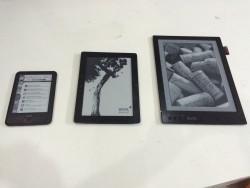
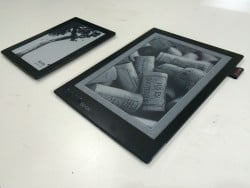
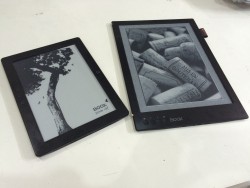
The Chinese ereader maker Onyx has been said to be working on a 13″ ereader, and today that rumor was confirmed by the release of the first public photos. Onyx’s retail partner in Germany posted a set of three photos on MobileRead. He also shared a few details on the specs, and revealed the projected ship date (spring 2016).

The new Onyx Boox ereader will feature an inductive touchscreen with stylus, rather than the capacitive or IR touchscreen found on many ereaders today. Or at least that is what Onyx is planning for the first model; that could change by the time it ships.

Edit: According to my source, Onyx will equip the first-gen model with a 1GHz Freescale imx6 CPU with 1GB RAM and 16GB internal storage. They’re also thinking about releasing an upgraded model 6 months later with a dual-core imx7 CPU, 2GB RAM, and either 16GB or 32GB internal storage.

Onyx is also planning to use a new higher resolution E-ink screen in their ereader. My source said that the new screen sports a resolution of  2200 x 1650 (207PPI). In comparison, the Sony DPT-S1 uses an E-ink screen with a resolution of 1600 x 1200, or 150ppi.

As a result, the new Onyx ereader is going to look considerably sharper if and when it hits the market. And since Onyx now uses Android for all of their ereaders, their device will also do more than just take notes on PDF files. You should be able to install your own apps, including for example the Kindle app, and use the new device as a multi-format ereader.

Or at least that is what we are hoping; we’ll have to wait for reports on the prototype before we know more. And given how long we’ve been waiting for the 13″ Pocketbook CAD Reader (whose prototype debuted two years ago), patience is very much in order.

Noteslate Unveils the Hero 13″ E-ink Writing Slate (video)

Noteslate is a company with a reputation for talking big and not following through. Their first product turned out to be vaporware, and so far their second product, the 6.8″ Noteslate Shiro, has proven to be an illusive creature which has already missed its ship date.

So when Noteslate posted a teaser video today for the 13″ Hero, I was suitably pessimistic.

Expected to ship next year, the Noteslate Hero is a digital writing slate with a 13.3″ E-ink screen and a stylus. Noteslate hasn’t revealed any additional specs, but they did post this video:

So what do you think?

It’s hard to say how the Hero compares to the Sony DPT-S1 in terms of features (besides the obvious that one is available and the other is not). Sony’s writing slate has two touchscreens (capacitive and electromagnetic stylus) while Noteslate has only shown off their devices working with a stylus.

Noteslate has also teased a 9.7″ model which will also be released next year, and they’re accepting names for beta-testers for a Noteslate sketch app for iOS and Android.

I think this is a neat idea, but given the cost of the 13″ screen I just don’t see the Hero shipping.

The 6.8″ Noteslate Shiro, on the other hand, might ship early next year. The Shiro will run the same software as the Hero, only with a screen the same size as on the Kobo Aura H2O or the Onyx Boox T68. The Shiro will also have a stylus, 3 weeks of battery life, and cost $199.

It’s up for pre-order now on the Noteslate website.

Do you plan to get one?

Why Publishers Should Embrace Google Books

Joe Wikert has recently espoused an idea well-known in certain book industry circles, that obscurity (and the challenges with being discovered) is the greater threat to authors and publishers.

Yesterday he published a post arguing that publishers should embrace (rather than fight) Google Books:

When I meet with publishers I always ask them about the biggest problems they face in today’s market. One of the most popular answers is “discoverability.” Most publishers fret about getting lost in a sea of other books and promotional campaigns.

…

That’s why I’m scratching my head about all the negative publisher and author reaction to the recent federal appeals court ruling on Google Books. If you’re not familiar with Google Books, it’s an extension of the search engine enabling discovery and sampling of digitized books. Many of those books are still protected by copyright, hence the delicate nature of the case.

…

Publishers, wake up and realize that the largest search engine on the planet offers a powerful way for your content to be discovered and purchased. Rather than getting all litigious about this, why not embrace it and find a way to fully leverage it?

The simple truth is that as technology evolves, the notion of “fair use” is also evolving. I think this is a very good thing, and not just for Google. History is littered with marketplace incumbents who crashed and burned as they tried to protect yesterday’s model. Tomorrow’s publishing leaders will be the ones who take advantage of services like Google Books, not those trying to make it go away in a courtroom.

He’s not the first to make this point about discovery; Eric Flint raised a similar issue as far back as December 2000, when he was touting free ebooks as a way to sell more books, and many authors (including Neil Gaiman) have said that they see piracy as helpful because it lets readers discover and try new authors without risk or expense.

And there are even publishers who see Google Books as a solution to the discovery problem, and are voluntarily participating in Google Books.

I know that Google Books is frequently described as a book scanning project, but there’s more to it than that. There’s also a lesser known second part to the project where authors and publishers can choose to upload their works so they can be indexed in Google’s search engine.

If you’ve ever come across a digitally perfect book in Google Books, that was probably a book which was uploaded by the copyright holder who had figured out that the books you can’t find are the books you can’t buy.

And that, in a nutshell, is the value of Google Books. It makes otherwise obscure works discoverable, and it does so at no cost to the author. It’s free advertising, and you can’t get a better deal than that.

image by Johan Larsson


Amazon Opens a New Chapter in its Retail History

Remember that bookstore that Amazon was rumored to be building in Seattle?

It officially launched today, and is opening tomorrow.

Amazon has sent out a letter to their Seattle area customers with the news that Amazon’s first bookstore, located at in the University Village shopping center at 4601 26th Ave NE, is no longer rumor or speculation (you can find the letter here).

Unlike Amazon’s past retail efforts, which focused on vending machines, delivery lockers, and pickup/dropoff unstores, the new Amazon Books has actual books in stock on its shelves, as well as Kindle ereaders, Fire tablets, and other Amazon hardware.

The Seattle Times got an early look at the store, and they report that the store won’t double as a pickup/drop-off location. It’s strictly a retail store, and according to Jennifer Cast, the VP of Amazon Books, the store won’t be stocked solely on data. "It’s data with heart,” she told ST. "We’re taking the data we have and we’re creating physical places with it."

The books carried in the 7,500 square foot store are chosen based on Amazon.com customer ratings, pre-orders, sales, popularity on Goodreads, and Amazon’s curators’ assessments. All of the books are face out on the shelf, and under each book is a presentation card with the Amazon.com customer rating and a review.

Amazon is also including a special staff favorites section that will change periodically. For the opening, the section includes a few of Amazon CEO Jeff Bezos’ favorite books, including The Five Love Languages by Gary Chapman, Traps by his wife, MacKenzie Bezos, and The Gift of Fear by Gavin de Becker.

The books will be sold at the same price as found online.

To put it simply, Amazon is taking what they’ve learned from twenty years of selling books online and is adapting it to the offline world. In a time where most bookstores arguably are no longer bookstores (just look at how much B&N floor space is devoted to toys), Amazon is going to show their competitors just how bookstores are supposed to work.

Or at least that is what Amazon is hoping; whether it will work out is a different matter.

Amazon has chosen an expensive location for its first store. University Village is an upscale shopping center that used to be the home to a Barnes & Noble store (it moved out four years ago when its lease expired and rent went up).

With the high rent, the odds are stacked against this store being a success based on the numbers, but Amazon has been known to run pilot operations before expanding.

Unfortunately for us, Cast declined to reveal Amazon’s plans, including possible locations. “We’re completely focused on this bookstore,” Cast told SA. “We hope this is not our only one. But we’ll see.”

German Publisher to Launch Wattpad-Like Oolipo Subscription Service in April 2016

For the past 8 months the German publisher Bastei Lübbe has been teasing that they were developing a subscription ebook service, and they formally announced that the service, oolipo, will launch in April 2016.

And yes, that is the name; while Bastei Lübbe also owns the Beam ebookstore, the new service will have a new name to go with its new international focus.

According to the press release, Oolipo won’t be the promised ebook subscription service but will instead focus on "short, multimedia reading content." It goes on to add that "new, mostly exclusive content and series are being conceived for this purpose."

The website does say that oolipo is recruiting writers, and the press release mentions the boast that:

Unlike all the previous streaming services in the field of reading, oolipo will follow an entirely novel concept. The portal will focus on short-form content in portions ideally suited to mobile reading, especially on smartphones and tablets. This is how oolipo is to reach its target group worldwide.

That sounds to me like a new take on the magazine concept, or possibly a paid alternative to Wattpad. Neither is exactly a new idea, but apparently it’s enough for The Bookseller to put oolipo up for an award (Book Tech Company of the Year).

Edit: According to @Jellybooks, "there is already a German Wattpad and it’s called Inkitt, but this looks more like Byliners". (That service did offer a subscription before it was bought last year.)

Oolipo is going to launch into a beta test in April 2016 in the UK, US, and German speaking countries. It’s scheduled to open to the public in July.

Or at least that is what Bastei Lübbe is hoping; will readers really be willing to pay for what they can find for free on Wattpad and a dozen different fanfiction sites?

Granted, the writing will be better, but Bastei Lübbe will still face the same problem that took down The Magazine last year and caused Byliner to close. People were willing to pay, only not in numbers large enough to keep the digital magazine going.

Boersenblatt

Culture and Relatability Are Why People Don’t Read Classic SF, Not Age

SF author John Scalzi published a post on Sunday where discusses why young readers of SF, including his daughter, just aren’t getting into the decades-old SF that he loved when he was a boy:

The surprise to me is not that today’s kids have their own set of favorite authors, in genre and out of it; the surprise to me is honestly that anyone else is surprised by this. As a practical matter, classic science fiction isn’t selling where today’s kids are buying (or where they are being bought for), namely, in the YA section of the book store. See for yourself: Walk into your local bookstore, head to the YA racks and try to find a science fiction or fantasy-themed book that more than fifteen years old.  …

Mind you, generally speaking, book stores stock newer books anyway; book stores, like other entertainment venues, rely on novelty (which in our line of work is called “front list”) to get people through the doors. If you’re doing well as an author, some of your backlist is on the shelf, too. But the shelf in a physical bookstore is only so long. These days, being someone who has been in a lot of bookstores recently, I note the shelf in science fiction and fantasy is mostly skewed to living, working authors, most notably their last couple of books. Some classic (i.e., now dead) authors are there but usually represented by two or three books rather than an extensive backlist.

While all the points he made are correct, I don’t think he gets at the root cause of the shift in reading tastes.

I have trouble accepting the point that commercial availability driving demand because when I was growing up (in the 1990s) I frequented used book stores just to get those older books. I also combed through the library stacks for those three-, four-, and five-decade-old books because I liked the authors and wanted to read them. (In fact, there were a few early Heinleins that I didn’t find for the first time until the early aughts, and I still read them when I found them.)

Instead, I have to agree with the several commenters who argue that culture in the older books and the relatability of the characters have a greater impact.

To name one example, Scalzi links to an older post where he talks about his daughter trying and losing interest in Heinlein’s Starman Jones. I’m familiar with the book, and I still like it even though it’s dated, but I bet I can also tell you why his daughter did not like it.

She couldn’t relate to the characters, or the culture, in the book.

The lead character in Starman Jones is a white male teen from a rural farm, and both of the female characters (that I can recall ) were shallow caricatures.

The female characters weren’t real people, not like what we would expect today. (This brings to mind the complaints concerning Black Widow’s role in the most recent Avengers movie.) And so Scalzi’s daughter just couldn’t bring herself to finish a book recommended by her father.

And she’s not the only one to feel this way.

When I first read Scalzi’s post this morning I was reminded of a post I read about 5 months back where one reader described her teen years and why she burned out on classic SF:

 It’s like this…

You’re fourteen and you’re reading Larry Niven’s “The Protector” because it’s your father’s favorite book and you like your father and you think he has good taste and the creature on the cover of the book looks interesting and you want to know what it’s about. And in it the female character does something better than the male character – because she’s been doing it her whole life and he’s only just learned – and he gets mad that she’s better at it than him. And you don’t understand why he would be mad about that, because, logically, she’d be better at it than him. She’s done it more. And he’s got a picture of a woman painted on the inside of his spacesuit, like a pinup girl, and it bothers you.

But you’re fourteen and you don’t know how to put this into words.

…

And then you’re eighteen and you’ve given up on classic sci-fi, but that doesn’t stop your brother or your father from trying to get you to read more.

Even when you bring them the books and bring them the passages and show them how the authors didn’t treat women like people.

Your brother says, “Well, that was because of the time it was written in.”

You get all worked up because these men couldn’t imagine a world in which women were equal, in which women were empowered and intelligent and literate and capable.

You can read the rest of the post here. (Kudos to @diversebooks and @michelle_gaudet for helping me find the post again.)

While the above quote is a very specific example of what drives people away from older books, I still feel it falls closer to the truth than Scalzi’s explanation.

Readers want to able to put themselves in a book, and they want to relate to the characters (hence why we need diverse books).

And if they can’t relate to the books, they’re just not going to read them.

image via Portland Mercury

Nook Glowlight Plus Review: If It Were Made By Anyone Other than B&N …

It’s been just over a week since Barnes & Noble released their latest (and probably final) ereader, the Nook Glowlight Plus. As I sit here, getting ready to box it up and take it back, I thought I would bang on the keyboard for a few minutes and express my opinion.

  • In spite of everything, I like this ereader.
  • If it belonged to anyone other than B&N, a company which we don’t know will be in ebooks this time next year, I would keep it.
  • If managing my Nook library on the device weren’t such a pain in the ass, I would keep it.

I know that the above sounds like damning with faint praise. but honest to goodness I seriously considered keeping my Glowlight Plus.

Physical Experience

With a gold colored metal rear shell and a cream-colored bezel, the Glowlight Plus doesn’t look like your average ereader (which is usually available in your choice of black, black, or black).

It runs Android 4.4 on a 1GHz Freescale i.MX6 CPU with 512MB RAM, 4GB internal storage (3.1GB available to the user), and Wifi. The 6″ screen sports a resolution of 1448 x 1072 with frontlight and touchscreen.Weighing in at 195 grams, the Glowlight Plus is certified to meet the IP67 standard for water and dust proofing.

All those specs could be found in the fact sheet (PDF) or in my post on hacking the Plus, but here’s a detail that you could only see first-hand.

The Plus has the same screen resolution as the new Kindle Paperwhite, the Kobo Glo HD, and the Kindle Voyage, so you would think that (after allowing for software differences) the Plus would have about the same reading experience as the other ereaders.

But it doesn’t, and we can attribute the difference to the Plus’s unique design. Where the Kindle and other ereaders have a black shell which is intended to emphasize the white on the E-ink screen, the Plus has a cream-colored bezel which was chosen for the subtle effect it has on the E-ink screen.

The cream-colored bezel, when combined with a frontlight set to 50%, give me the feeling that I’m looking at the yellowed page of an old book. This might not appeal to you, but I love it. It makes up for the gold-colored shell, which I don’t like (I find bare metal unappealing) and it’s a trick I would like to see copied on other ereaders.

Reading Experience

When it comes to ebooks, I am not your average reader. I have been buying ebooks for long enough that I have far more ebooks that have been set free of any platform than I do in any single platform.

In fact, Barnes & Noble is the one and only ebook platform where I have a huge native library thanks to my Fictionwise purchases having been migrated to the Nook platform. I have around 450 ebooks in the Nook system, and that’s a problem for B&N because it’s made me aware of just how horrible the library management is on the Nook Glowlight Plus.

It’s not just that the software lacks basic and obvious features like only showing the ebooks on the device, but also that simple acts like downloading an ebook doesn’t move said ebook to the front of the library. As a result, the ten or fifteen ebooks I want to read are lost in a cloud of ebooks that I have no interest in.

And that’s a shame because I do want to read on the Glowlight Plus. The ebooks don’t display consistently, but they are close enough that I am fine with it – if only they were easier to find and load.

There are three options for margins and three options for line spacing, but no option for justification (the Nook iOS app has this). But on the plus side, the Plus does have typography about on par with the new "improved" typography that Amazon is only now adding to the Kindle platform. And in fact, it’s had it for some time.

Speaking of loading ebooks, there have been numerous reports concerning USB issues. The Glowlight Plus doesn’t like working with the USB port on Windows or OSX machines. Most people have been able to resolve their problems, but the sheer number of complaints is unusual.

Furthermore, the Plus does not work with Adobe DE, which means no support for library ebooks or ebooks bought elsewhere. B&N swears there is a fix in the works, but that doesn’t do us any good.

Conclusion

Do you know what I wish?

I wish the Glowlight Plus was running a Kobo firmware.  That would combine the screen I like with software features I like, and it would allay concerns that the Plus might be turned off tomorrow.

This is a far nicer looking mid-range ereader than the Kobo Glo HD, which even though it was supplied from the same Chinese OEM (Netronix) looked and felt cheap compared to the Paperwhite or the Glowlight Plus. Combining the better aspects of the Glo HD and the Plus device would be the best of all worlds, but alas it’s just not going to happen.