Nate Hoffelder

Nate Hoffelder

The Evolution of Female Pen-Names from Currer Bell to J.K. Rowling

In August author Catherine Nichols went public with her account of sending her novel manuscript to literary agents under a male pseudonym. A writing sample sent to 50 agents in her own name resulted in only two manuscript requests. Seventeen out of 50 agents requested the same materials from “George Leyer”.

Were the agents exhibiting a subconscious gender bias that assumes the superiority of male authors? Or were they responding to the practicalities of a reviewing culture and audience that can overlook or even reject women’s literature?

Women’s fiction is reviewed less often than men’s in major publications. Even though women buy two-thirds of all books sold in the UK, they are much less likely to be reviewing books in male-dominated literary magazines.

And some audiences, such as young boys, are presumed to be entirely unwilling to read books written by women. J.K. Rowling’s publisher felt that an obviously female name like “Joanne” would dissuade boys from reading the debut Harry Potter novel.

The unpublished Rowling was simply happy to be published and said in an interview that “they could have called me Enid Snodgrass”. But Enid Snodgrass would have had the same sales handicap as Joanne Rowling—a woman’s name.

Most discussions of contemporary women writers who have adopted male pseudonyms or initials to mask their sex draw connections between these writers and a long line of literary women, such as the Bronte sisters and George Eliot (Mary Ann Evans), who have published under assumed names.

What is less recognised is that the cultural reasons behind women writers concealing their names have shifted dramatically since the nineteenth century.

Today female names vanish to avoid industry and reader perceptions of what women’s fiction is like. Historically, in the British tradition, female names were hidden because of the perceived inappropriateness of women writing novels. To understand this difference, it is important to know that the very act of reading novels was heavily policed for girls and women in the nineteenth century.

In The Woman Reader, Kate Flint shows how girls’ and women’s reading, especially of material deemed frivolous or escapist, was a subject of great public concern and debate. Any novel reading that might detract from a woman’s role as a wife and mother within the home was perceived as a threat to the very foundation of society.

Likewise, women authors challenged expectations of women’s domestic and maternal roles. Budding writer Charlotte Brontë received the following comments in a discouraging letter from English poet laureate Robert Southey in 1837:

Literature cannot be the business of a woman’s life, and it ought not to be. The more she is engaged in her proper duties, the less leisure she will have for it, even as an accomplishment and a recreation. To those duties you have not yet been called, and when you are you will be less eager for celebrity.

Jane Austen published her first novel in 1811. The four novels that were published during her lifetime appeared anonymously, as were those of many early women writers. Although women who wrote educative or didactic fiction, such as Maria Edgeworth, or less respected genres such as the Gothic romance, as in the case of Ann Radcliffe, were not similarly compelled to hide their gender or identity.

From the twentieth century onwards, women novelists’ use of pseudonyms seems to have acquired a more focused purpose: to avoid pre-judgement of women’s fiction as inferior. V.S. Naipaul has embarrassingly said that no woman writer is his equal and that “within a paragraph or two” he knows whether a work “is by a woman or not”.

Naipaul might have found a friend in Henry Lawson. Lawson read Miles Franklin’s My Brilliant Career in manuscript form and wrote to Franklin eagerly: “Will you write and tell me what you really are? Man or woman?” When the novel was published in 1901, in his preface Lawson rewrites history: “I hadn’t read three pages when I saw what you will no doubt see at once — that the story had been written by a girl”.

The most enduring fictions of literary history hold that a woman writer’s voice is readily detectable and less perceptive and sophisticated than a man’s. These ideas buttress more recent views about narratives by women about girls’ and women being of interest to female readers only.

The use of a male pseudonym or ambiguous initials removes the gender prejudiced lens through which much women’s fiction is viewed. Yet it does not help to transform that prejudice as it is exhibited in literary magazines and reader “preferences” in certain genres of fiction.

As the majority of books are read by women, there must be a way for us to influence the publishing industry and reviewing practices that shape literary culture.

Reposted from The Conversation under a CC license
ATTENTION: Amazon is Changing Kindle Unlimited Payout on 1 November

For as long as Amazon has been paying Kindle Unlimited publishers and authors from a pool of money, they’ve always paid the same no matter where the book was read.

Even after launching a discounted Kindle Unlimited service in India in September, Amazon still paid the same rate. But now that is going to change.

Amazon has sent out an email with the news that they’re changing the rules again in November:

As we’ve expanded KU to more countries, a number of the program’s elements – such as exchange rates, customer reading behavior, and local subscription pricing – now vary substantially by marketplace, making it clear that a ‘one size fits all’ approach won’t work. As just one example, we recently launched KU in India with a local subscription price of 199 rupees ($3.00) per month. As a result, starting with the November fund, we will work to take these marketplace differences into account and payouts per country will differ based on local country factors.

You will be able to see the amount you have earned in each country in your royalty report. Our long-term goal, as always, is to build a service that rewards authors for their valuable work, attracts readers around the world, and encourages them to read more and more often.

This isn’t the first time that Amazon has arbitrarily altered the payment terms for Kindle Unlimited.

In June Amazon abruptly announced that it would no longer pay authors and publishers for each time a book was loaned in Kindle Unlimited, but would instead pay based on the number of pages read. In spite of the uproar, that ultimately proved a popular move, so much so that publishers are signing under the same terms offered to authors.

But will this move prove equally beneficial? That remains to be proven.

What we do know is that Kindle Unlimited is now offered in ten countries with subscribers paying in seven currencies (US, UK, Italy, Spain, Brazil, France, Mexico, Canada, Germany, and India).

Depending on how you split things up, those ten countries are at least six different markets with different price expectations and different pressures, which is why Amazon wants to adjust prices to match local conditions.

So how will they respond to the markets?

We don’t know. I have queried Amazon and have yet to get a response, so the only advice I have is that authors who do not approve of the change should contact KDP support and see if you can use this as a reason to withdraw from Kindle Unlimited.

Thanks, Morris!

Boersenverein: The Resale of Digital Content Would be a "Blow to All Culture Industries"

The right to resell ebooks has broad support from activists, the Dutch courts, and German regulators, but publishers aren’t so happy.

Boersenverein, the German book industry trade group, has officially responded to the news that earlier this week that a German consumer protection ministry wants consumers to have the right to resell ebooks they buy.

Alexander Skipis , CEO of Boersenverein, told Actualitte:

It would be a blow to all cultural and creative industries if allowed by law to sell or move to other digital content 'used'. Digital books can be almost infinitely reproduced and distributed without ever wear. The primary market for e-books and audio books would be completely destroyed if there were a legal market opportunity. For publishers and distributors would be impossible to continue working together on sustainable downloading models and customer-friendly. This would mostly cultural offer and therefore consumers will suffer.

Apparently the CEO of Boersenverein thinks that the ebooks have no long-term value to readers, and that the readers will immediately sell an ebook once they finish reading it.

Or perhaps I am misinterpreting the translated text; maybe Skipis thinks that readers will pirate their ebooks and sell multiple copies. While that is possible, I would remind you that ebook piracy already exists and it has not yet killed off the ebook market.

Also, the used paper book market has been around for, what, a few centuries now? Do you know if it has killed off the publishing industry yet?

Frankly, the objections are absurd, and in a way that is good news. If this doom-and-gloom is the best argument that publishers can come up with then there is no good reason that consumers should not have the right to resell their ebooks.

image by J. Tegnerud

Updated: The Blloon is Deflating – It’s Shutting Down Its Subscription eBook Service

Do you know that report about ebook subscription services doing great in Germany? I think we need to take it with a grain of salt (also a couple shots of gin).

The news won’t be officially announced until tomorrow, but word has already leaked out on Twitter that a Berlin-based ebook subscription service is going belly up. Blloon subscribers are reporting and a rep has confirmed that Blloon, the subscription ebook service that spun off of txtr in 2014, is shutting down.

Edit: The official word, as of Friday, is that the service is on hiatus.

Blloon reps aren’t answering any questions at this time, so we are left with more questions than answers at this time, but we do know that:

Blloon launched last year with a limited ebook subscription service that more closely resembled buying credits at Audible than Scribd or Kindle Unlimited. Readers could pay so many pounds and get a credit that would let them read a book (this was not a sale – that would be Entitle). Subscribers could also earn additional credits through engaging with Blloon on social networks.

Update: But apparently that model didn’t work. The Bookseller reports that "in June this year Blloon moved to an unlimited model, allowing customers to read an unlimited number of books for £7.99 a month". That cost Blloon a couple publishers, which likely contributed to the decline.

Initially available in the UK, Blloon was supposed to expand into Germany and the US early this year. I can’t find any evidence that expansion occurred, which helps explain why Blloon is shutting down.

It just didn’t have enough customers to keep going. Even though it did get some coverage both in the digital publishing press and on tech blogs,Blloon just couldn’t attract enough attention.

Blloon was launched by the same folks that launched txtr in 2009 only to abandon txtr when it was in the early stages of bankruptcy last year. (Txtr went bankrupt in January 2015, and was acquired by a German media retailer in April 2015.)

There’s no news yet on what’s going to happen to Blloon. While there is a chance that it could be acquired like Oyster was by Google, it’s far more likely that the service will simply shut down.

Stay tuned.

lesen.net

image by Mount Rainier NPS

Pew: eReader Ownership Dropped by Almost Half in the Past Year

This blogger has been saying since 2013 that smartphones and tablets would drive consumer ebook sales, a trend that the WSJ confirmed earlier this year.

And now we learn that consumers aren’t just shifting their reading habits; they’re leaving ereaders behind. The Pew Research Center has a new report on device ownership in the US out today which tells us that ereader adoption hasn’t just leveled off; it’s cratering.

The survey found only 19% of respondents owned an ereader, down from 32% last year. Game console, PC, and mp3 player ownership also dropped, although not to the same degree.

Looking at ereading devices, we can see in the above chart that tablet ownership continues to grow slightly as it catches up to smartphone ownership. With 68% of respondents owning a smartphone, that category continues to outpace the adoption rate of any other mobile device, which makes sense given that smartphones (and to a lesser degree, tablets) have replaced your mp3 player, camera, and gaming device, and for some people serve as their primary source of web access.

This is especially true for younger adults, who are more likely to have a smartphone than a computer:

With 86% of this age group owning a smartphone, that category has effectively reach the saturation point and it won’t grow much further. But overall smartphone adoption will continue to grow as this age group grows older.

And from the looks of things, so will tablet adoption. eReaders, on the other hand, are yesterday’s news.

You can find the complete report, including data which breaks down along income, education, and gender lines, on the Pew Research Center website.

image by miniyo73

German Consumer Protection Ministry Calls for the Right to Resell eBooks

Not only are EU member nations questioning why ebooks are taxed at a higher rate than paper books, they’re also starting to ask why consumers don’t have the same rights over print and digital.

Buchreport.de  reports that Consumer Protection Ministry for the German state of Baden-Württemberg is now calling for consumers to have the right to resell the ebooks they buy.

The way things work right now is that consumers don’t buy an ebook so much as the buy a license to use the ebook. That license is defined at the whim of the ebook retailer, and often excludes the possibility that the consumer owns the file or can resell it (this, even though ebooks routinely cost more than paper books).

With a few exceptions, that practice holds true in most countries. (The exceptions include the Netherlands, where consumers won the right to resell ebooks in a court case this spring, and a few niche ebook retailers like O’Reilly which sell under a more permissive license.)

But the Verbraucherschutzministerium Baden-Württemberg wants to change that. They are proposing that the principle of exhaustion be applied to ebooks just like it is with books.

The exhaustion doctrine (as it is also known) is a limit on IP rights that basically says that an IP holder’s control ends when an item like a book is sold. That doctrine is why you can resell a paper book, and activists have long argued it should apply to digital content as well.

As you may recall from the Oracle v Usedsoft decision, we’ve had some luck in that direction. Consumers in Europe do have the right to resell software. With ebooks, on the other hand, German courts have said that retailers can make consumers give up the resale right when they agree to a license to buy the ebook.

You will find that clause in the ToS for many ebookstores, and you’ll find similar clauses in software licenses (said clauses aren’t valid in Europe, obviously). And now the Consumer Protection Ministry is arguing that consumers can’t be forced to give up the right to resell ebooks.

They have affirmed a legal opinion to that effect. It’s not legally binding until someone takes a case to court, but it does set a precedent and it moves us one step closer to the day one when German consumers can resell ebooks.

Buchreport.de

image by ButterflySha


Copyright as Brain Damage (video)

Copyright was originally born as a way to give creators a financial incentive to make more works, but over the centuries it has metastasized and grown into a very different beast.

Cartoonist and filmmaker Nina Paley gave a talk at TEDx Maastricht earlier this month where she described her experiences with securing licenses for the music she used in the 2008 film Sita Sings the Blues. She found that kafka-esque system she had to navigate to secure the licenses was far less successful at rewarding creators than it was at censorship – preventing ideas from being shared.

This lead Paley to liken the impact of copyright on society and the free flow of ideas to brain damage. (If people are neurons, then ideas flowing from one person to the next are neural impulses, and when copyright stops that flow it is causing damage.)

Paley isn’t the only one to have problems traversing the copyright licensing system.

Earlier today author David Hewson published a post on Medium where he details a similar experience when trying to license song lyrics so he could use them in his first novel.

His account proves Paley’s point about copyright’s main function is to stop the free flow of ideas.

Some copyright holders didn’t want to know at any price. Others just wanted a small fortune. A few settled for a few hundred quid and they were the ones I used. But it was a terribly slow process, and I was lucky that charming lady in Oxford didn’t charge half as much for her time as rock stars and their representatives wanted for six words, perhaps written in a drug-fuelled haze, twenty years before.

Hewson had a similar experience with another novel a few years later:

A few years later I wrote a standalone called The Promised Land which just begged for two little quotes, one from Fleetwood Mac, the other from a Bruce Hornsby song.

Fleetwood Mac eventually came back and said that while three of the band were cool with the idea one of them wasn’t and would never allow her words to be quoted in any book or movie under any circumstances ever. Her choice. I should point out however that is totally inaccurate to claim that thunder only happens when it’s raining. Quite often it’s not raining at all.

And he’s not the only one.

Techdirt has long been documenting the same problems in our modern copyright system that Hewson and Paley described above. They attribute the root of the problem to permission culture.

According to Wikipedia, permission culture is a "term often employed by Lawrence Lessig and other copyright activists to describe a society in which copyright restrictions are pervasive and enforced to the extent that any and all uses of copyrighted works need to be explicitly leased".

I have to disagree with that definition; I see permission culture less as pervasive copyright enforcement than as the _assumption_ that all uses of a work have to be licensed when in reality the fair use clause of US copyright law would cover nearly all situations.

But no matter how you describe it, it is a problem and Paley is right when she describes copyright as brain damage. As each new creation wiped from existence, or dies still born in the mind of an artist, society as a whole is diminished.

Our collective IQ drops with each lost work, leaving us all a little dumber with each blow.

P.S. In the second half of her talk, Paley describes how she’s training herself to break the permissive culture conditioning that we have all absorbed as part of modern culture. She also talks about her current project, Seder-Masochism, an animated video intended to serve a dual-purpose both as a movie and as a commentary on permission culture.

Inside the Nook Glowlight Plus (It’s Been Hacked)

Barnes & Noble’s latest ereader is less than two days old and it is already being hacked.

A Glowlight Plus owner over at XDA Forums has revealed that she has gained control of her Nook. She hasn’t rooted it yet, though.

The first step involved prying the back off of her unit. The front panel is simply glued into the rear metal shell, and it can be pried off – if you have the guts:

As you can see in the photo, the CPU is a Freescale i.MX6L, a single-core CPU intended for simple uses like ereaders. The hacker also confirmed that this Nook does run Android 4.4, and she told us that the Glowlight Plus had only 512MB RAM, and no Bluetooth.

That is disappointing news for those of us who were hoping it could be hacked and turned into an open Android ereader. Even if someone does develop an easy hack, the limited hardware (no card slot, limited RAM, slow CPU) would keep us from doing much with it.

As I pointed out on Wednesday night, there are better options for Android ereaders. They don’t have the 300ppi screen like the Glowlight Plus, but they make up for it in other ways. Icarus, for example, has 6″ ereaders which will let you install Android apps (no hacking required).

The Ellora’s Cave/Dear Author Lawsuit Has Been Settled

The defamation lawsuit that romance publisher Ellora’s Cave filed against the Dear Author book blog has come to a quiet end on Thursday.

Deirdre Saoirse Moen reports that a settlement has been reached this year-old case.  The details are obviously confidential (and so we’ll probably never find out what the settlement terms were) but Saoirse Moen did mention the settlement in her index for the case, and she quoted this email from Ellora’s Cave CEO Patty Marks:

We are pleased to announce that we have reached a settlement with Dear Author. The terms are confidential, so we will not be discussing that. We are very happy though to now put all of our time and efforts into Ellora’s Cave, the authors and staff without further distraction.

Thank you for your patience and support.

Patty Marks

To recap, in September 2014 the romance publisher Ellora’s Cave sued Jennifer Gerrish-Lampe, owner of the Dear Author book blog and the blogger we all know as Jane Litte. Ellora’s Cave alleged that Dear Author’s reporting on EC’s worsening financial state amounted to defamation. (Here’s the post in question.)

A year’s worth of legal maneuvers followed, ending today with a settlement.

You can find a complete rundown of the case on Saoirse Moen’s blog or on Courtney Milan’s blog; both have been following this case far more closely than I, although I have been listening closely enough to know that the story isn’t finished.

This case may be over, but Ellora’s Cave’s dire financial state persists. Authors and staff say that they’re still not getting paid, which means we could soon be hearing of a new lawsuit, bankruptcy, or both.

In fact, the situation is so bad that Ellora’s Cave is neglecting to pay their counsel. Or so a footnote in one of the filing suggests:

Further, Ellora’s may be planning for bankruptcy even at this time–but have refrained from doing so in the hopes that this SLAPP suit will bear fruit. In fact, Ellora’s counsel has reported to the undersigned on numerous occasions that Ellora’s has failed to pay his bills.

Saoirse Moen also noted that Ellora’s Cave is not in good standing with the RWA because it wasn’t paying its authors, and the tweets of numerous authors who say that they are only now getting their February 2015 royalty checks confirm the financial issues.

Ellora’s Cave still had (as of Tuesday) over 800 authors, so if they are all in that state then they have the makings of a class action lawsuit.

image by mrbill

First Nook Glowlight Plus Update Rolls Out – Did You Know That It Runs Android 4.4?

Barnes & Noble’s newest ereader has been on the street for less than a day and it’s already gotten its first software update.

My first impressions post for the Nook Glowlight Plus was interrupted this evening when it abruptly turned itself on and started downloading an update.

According to the changelog that popped up after the Nook restarted, the update added Readouts, B&N’s new teaser service. There’s a new icon in the menu bar at the bottom of the home screen, and it leads to a menu that wasn’t accessible before.

I’m not interested in that feature, but I am hoping that the update also fixes some of the software flaws I’ve seen. I’m not to happy about the hardware design (the bare metal shell and sharp edges do not appeal) but the software is a serious issue.

If I had to pick one word to describe the new Nook, it would be senile.

Every so often the Nook would suddenly forget the ebooks it was carrying, flash to black/white/black, and then remember the ebooks in its library. There have also been times where it would get confused about the command I just gave it, flash to black/white/black, and then go back to whatever menu I was just looking at.

It’s a little frustrating, but I hope that B&N can fix it in a software update.

O O O

In related news, discussions over at MobileRead have turned up an interesting detail about the Glowlight Plus. According to the media fact sheet, this Nook model runs a much newer version of Android than its predecessor.

Under the bland Nook software runs Android 4.4 KitKat. That’s not the latest cutting edge version of the OS, but it is a lot newer than the Android 2.1 running on the last Nook, or what is running on many Android tablet.

The Android version, as well as the 2.8GB accessible storage (I’ve tested it), has already drawn the attention of a couple members of XDA Forums. No one has stepped forward to say they’ve started hacking it, but it’s only a matter of time.

Given the relatively new version of Android and the 300ppi screen, this could make an interesting E-ink Android tablet. But the Glowlight Plus lacks a card slot or Android, two features which can be found on other Android ereaders, so that would make it less than ideal.

Instead I would recommend another model. Perhaps one from Icarus, which recently updated their firmware to integrate Scribd. Thee’s also the Inkbook Onyx, or the Boyue T62 (which I did not find appealing).

They don’t have the Glowlight Plus’s 300ppi screen, but they do have an open version of Android, a dual-core CPU, and a card slot. No hacking will be required to turn them into Android ereaders because they already are Android ereaders.

Pearson Reports Non-Specific "Weak eBook Sales" at Penguin Random House

Pearson has released its first quarterly report following PRH signing an agency ebook deal with Amazon (and adopting agency pricing), and it does not sound good.

You can find the press release on the Pearson website. Here’s the relevant section for Penguin Random House:

Penguin Random House had a solid third quarter performance, with the benefit from number one bestsellers which included The Girl on the Train by Paula Hawkins; Harper Lee’s Go Set A Watchman; Grey by E L James; and Lee Child’s Make Me; partly offset by weaker ebook sales. The company continues to make progress with the integration of its businesses, and remains on track to realise benefits in 2016 and in the long term. The fourth quarter will benefit from new fiction, nonfiction, and movie tie-ins across all formats from bestselling and prize-winning authors.

There are no other details mentioned in the publicly available documents.

UK-based Pearson owns a 47% stake in Penguin Random House, which is the largest trade publisher in the US and one of the largest publishing conglomerates in the world.  The other 53% is owned by Germany’s Bertelsmann.


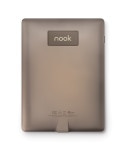
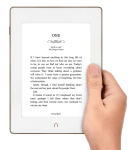
Nook Glowlight Plus Now Available – Waterproof, Dust-Proof, 300ppi Screen, and only $129

As I predicted last week, Barnes & Noble has launched its newest ereader, the Nook Glowlight Plus, and it’s a better device than I was expecting.

Barnes & Noble’s newest ereader may be hitting shelves about six months behind its competitors, but that doesn’t mean that B&N was letting the dust gather – in fact, just the opposite. The Nook Glowlight Plus can match the Kobo Glo HD and the new Kindle Paperwhite in many respects, and it can go one step better.

This $129 ereader features a 300ppi Carta E-ink screen (with frontlight and touchscreen), Wifi, a metal rear shell, and six weeks of battery life, but it does have one feature that its mid-market competitors lack.

B&N reports that this ereader meets the IP67 certification, meaning that it can be submerged in fresh water for up to 30 minutes at a maximum depth of 1 meter. It’s also dust-proof.

While the premium-priced Kobo Aura H2O can boast the IP67 certification, and Tolino’s new Vision can make a similar promise (albeit one without certification), the Nook Glowlight Plus is the only device at the $129 price point that goes above and beyond in guaranteeing that it can survive rough usage.

That said, I do think it’s a shame that B&N didn’t put similar effort into the storage capacity. The Glowlight Plus has no card slot and only limited storage. Of the 2.5GB internal storage, only 500MB is available to the user. The rest is reserved for B&N-sold content.

Update: While B&N’s website said that most of the storage was reserved, the Glowlight Plus I have in front of me says that I have access to 2.8GB of storage.

As I maintain my own ebook library, the storage problem is enough to turn me off of the  Glowlight Plus. But if it doesn’t bother you, this ereader is available in B&N stores today, and online at Nook.com.

Affordable Textbook Act Reintroduced in Congress

When it was first introduced in 2013, the Affordable College Textbook Act offered the promise of funding for universities that started open textbook pilots (like Virginia’s community colleges, or UMUC in Maryland).

Sadly, that bill died a quiet death, but The Cite reports that it has been revived. Congress is working on reauthorization of the Higher Education Act, and:

The act, sponsored by Dick Durbin (D-IL) and Al Franken (D-MN) in the U.S. Senate and Rubén Hinojosa (D-TX) in the House of Representatives, would encourage the use of open-access textbooks by providing grants to schools to make free or low-cost digital content available to professors, students, and researchers.

The grant process would allow schools to conduct pilots aimed at expanding the use of open educational resources as a way to lower college expenses to students. Applicants would have to provide estimates on the potential cost savings, with priority placed on programs that save students the most.

Publishers would be required to make all textbooks and educational materials available for sale as individual pieces of content, rather than as a bundle. It also requires the Government Accountability Office to provide updates on price trends of college textbooks.

That last detail is probably why the bill was killed before, and it will likely kill the bill this time around. Textbook publishers don’t want to stop exploiting students, so they’ll use some of their ill-gotten gains to hire lobbyists.

And that’s a shame, because we could use this bill now even more than in 2013. Textbook prices haven’t gone down any in the past couple years, and textbook publishers keep coming up with new ways to get schools to subscribe – and not buy – curricula.

Those are problems that open textbooks can fix, if only schools had the resources to experiment.

To be clear, you can already find free digital textbooks; organizations like the CK-12 Foundation fund support the development of CC-licensed textbooks and other open educational resources which can be customized to meet the specific  requirements of a school.

That gave the several states (including Calif., Wash., and more) with digital textbook archives a head start, and it also helps the efforts being led by the universities themselves, including the Open Source Textbook Initiative at the university of Illinois, or the two mentioned in the first paragraph of this post.

And if this bill passes, more schools will be able to launch open textbook programs, saving money both for the school and student.

images by Mike Licht, wecometolearn, gagilas


LibraryThing Launches an iPhone App

LibraryThing has long developed catalog apps for public libraries (including LibAnywhere), and now they’re making one for users.

Yesterday LibraryThing announced the beta launch of the official LibraryThing app:

We’re thrilled to announce the official LibraryThing iPhone App!

Free accounts. We’re giving away lifetime memberships to anyone who uses the app for the next month. Register for a new account using the LibraryThing App, or sign into the app with an existing account, and you’ll be automatically upgraded.

What it does. This is our first version, so we’ve limited it to doing the most basic functions you’ll need for cataloging on the go:

  • Browse and search your library.
  • Add books by scanning barcodes. Scanning to add is VERY FAST!
  • Add books by searching.
  • Browse and upload covers, using the iPhone camera.
  • Do minor editing, such as changing collections and ratings. Major editing sends you to LibraryThing.

The app is intended for the iPhone but you can install it on the iPad. (An Android app is in the pipeline).

iTunes

Authors, Nay, EVERYONE Will Get Screwed If The Authors Guild Wins the Google Books Lawsuit

The Authors Guild received a major setback in last Friday’s appeals court ruling over the decade old Google Books lawsuit, but they’re not giving up.

And that’s a shame, because if The Authors Guild wins then we’re all going to lose.

On Friday The Authors Guild announced that they were going to waste even more money by appealing the case to the US Supreme Court. You can read a fisking of TAG’s statement over on Konrath’s blog, or if you prefer the unfiltered version, you can find it at the end of this post.

That is, if you can stand the BS. The statement is chock full of ridiculous statements like "America owes its thriving literary culture to copyright protection."

That, my dear, is utter nonsense. Until the 1976 Copyright Act was passed, the US copyright law limited the copyright term to 56 years and required that a copyright be registered and renewed after 28 years, otherwise the work was in the public domain.

By modern standards, that would best be described as a lack of copyright protection, because it let publishers ignore foreign copyrights unless that copyright was also registered in the US, and it made every work more than 56 years old fair game.

The Authors Guild is wrong in almost everything they say in that statement, and they are also completely wrong to pursue this doomed effort to force Google to pay for the use of excerpts.

Speaking of which, The Authors Guild is also trying to do an end run around this case. Last April TAG went before Congress and proposed an ASCAP-like agency which would collect micro-fees from Google and other companies for the use of snippets (even though said use is completely legal).

That bit of lobbying hasn’t gone anywhere (yet), and that’s a good thing because that agency would be just as much of a fiasco for authors as if  The Authors Guild’s had won the Google Books case.

There are many reasons to argue against The Authors Guild’s position, but I have one which will trump every counter argument.

This is 2015, so one could argue that the book market is very different from the one in which TAG filed its lawsuit in in 2005, and thus the lawsuit no longer makes sense.

Or one could argue legal theory concerning fair use. One could also argue that authors and publishers benefit from the free advertising that stems from Google Play Books, and the way that it helps readers discover books that they’d never heard of before.

But never mind those arguments; here’s an argument that is irrefutable.

This lawsuit won’t succeed. Google will not pay the fees.

So far this story is being covered from the viewpoint of the book industry, but if we instead focus on the issue of Google then we are reminded that publishers have tried to force Google to pay for the use of snippets and/or links in the past.

And it was an utter failure. Every. Single. Time.

In Germany, for example, news publishers have been trying to get Google to pay for snippets since 2010. The publishers even went so far as to get a law passed which explicitly created a copyright over snippets.

Rather than pay, Google responded by changing its ToS, forcing German web publishers to agree to let Google use the snippets and links for free – otherwise Google would not list them in its search engine. (Those pubs even filed suit over that law, but the suit went nowhere.)

Google would not pay the German publishers.

In 2006, Belgian news publishers sued Google over its use of snippets and links in its search engines. The publishers won the copyright infringement suit, only to realize that they actually lost when Google complied with the ruling and removed those publishers from its search results.

The Belgian publishers ended up having to settle with Google and agree to let Google use their snippets and links for free – that is how much value it brought them.

Even a victory ultimately turned into a defeat.

And finally, in 2014, Spain passed a Google tax that made the payment of fees for the use of snippets compulsory. Google responded by shutting down Google News in Spain.

That closure has had a direct negative financial impact on Spanish news publishers. Furthermore, the shutdown disproportionately impacted smaller news publishers, forcing many to either close or curtail operations.

Google will not pay a fee for giving away free advertising – not to web publishers, nor to book publishers and authors.

If The Authors Guild gets what it wants then it will soon realize that it has still lost. And so will everyone else.

Mark my words: Google would rather shut down Google Books than pay authors and publishers.

And if that happens then we’re all going to be screwed. Authors and publishers will take a direct hit to the pocketbook, but the public will also lose a valuable tool for finding books.


Here’s The Authors Guild’s statement on the appeals court ruling:

Today, the Second Circuit Court of Appeals released its decision in Authors Guild v. Google. “The Authors Guild is disappointed that the Court has failed to reverse the District Court’s faulty interpretation of the fair use doctrine,” said Mary Rasenberger, Executive Director of the Authors Guild in New York. “America owes its thriving literary culture to copyright protection. It’s unfortunate that a Court as well-respected as the Second Circuit does not see the damaging effect that uses such as Google’s can have on authors’ potential income."

"Most full-time authors live on the perilous edge of being able to sustain themselves through writing as a profession, as our recent income survey showed, so even relatively small losses in income can make it unsustainable to continue writing for a living. We are disheartened that the court was unable to comprehend the grave impact that this decision, if left standing, could have on copyright incentives and, ultimately, our literary heritage. We trust that the Supreme Court will see fit to correct the Second Circuit’s reductive understanding of fair use, and to recognize Google’s seizure of property as a serious threat to writers and their livelihoods, one which will affect the depth, resilience and vitality of our intellectual culture.”

images  by Patrick Feller,