Nate Hoffelder

Nate Hoffelder

Amazon’s New Kindle Trade-In Program Includes a $20 Credit Toward a New Kindle

With Christmas come and gone, there’s an excess of Kindles in many households and Amazon is ready to help clean house.

The retailer has launched a new trade-in program where Amazon will pay you between five and fifty-five dollars for your old Kindle, working or not. That credit is yours to spend at Amazon however you like, and if you take Amazon up on its offer before 31 March you can also get a $20 credit toward your next Kindle.

That credit has to be used before 31 May 2016, and it’s only good for Kindle ereaders (and not Fire tablets), so it won’t be of much use to those who already got a Kindle upgrade for Christmas.

But if you have a spare Kindle and want to gamble that Amazon will launch the next model this spring, then this deal could be worth it – if the price is right.

Some of the trade-in values simply aren’t worth it, not if you have a perfectly functional device. The Kindle DX, for example, will only get you five dollars whether it is working or not (heck, I’d pay more than that for a working white KDX).

With some of the offers, you would be better off selling on eBay, but if you have a heavily-used and beat up old Kindle Keyboard, to name one example, you might not get more on Ebay than the $30 plus $20 offered by Amazon.

Do you see a good value?

image by michael pollak

GQ Goes After Ad-Block Users, Demands They Pay For Each Article

GQ magazine is joining the group of web publishers who would rather fight with their readers than do something about the terrible adverts that so many of its visitors don’t want to see.

Digiday reports (but I cannot confirm) that this Conde Nast magazine is now showing visitors who block ads this popup in place of its articles:

I haven’t encountered the pop up myself, but I did find confirmation elsewhere.  “Please Disable Your Ad Blocker” the notice says. “Turn off your ad blocker or purchase instant access to this article, so we can continue to pay for photoshoots like this one,” it concludes, pointing to an image of Amy Schumer dancing with stormtroopers (she was on the cover of GQ’s August 2015 issue).

The magazine is giving readers the option of either making micropayments for each article they read, or subjecting themselves to auto-playing video adverts that slow down your PC.

GQ is reportedly asking for fifty cents per article, which strikes me as a high price to pay for content which is all too likely to be another advert disguised as an article.

This is a classic example of a web publisher who would rather fight with its users than address the real problem of their ads being so terrible that users want to block them (or have to block them, for some visitors). Ad blocking isn’t the scourge of the advertising industry; instead ad tech like that used by GQ is the worst thing that the ad industry could do to itself. Between the punitive autoplay videos and the malware enabled by the wild west nature of the industry, this self-inflicted wound is hurting everyone.

And with more web publishers fighting the wrong problem, there’s no solution in sight.

Conde Naste joins the ranks of Washington Post, Axel Springer, Yahoo, Forbes, all of which are now blocking ad-block users and demanding that the users either pay or disable the ad blocking extensions.

While that demand might sound reasonable to the web publishers, let’s not forget that in objecting to ad blocking extensions they are also demanding that we lower our security and invite hackers into our computers. Forbes, for example, has been hacked twice in the past year so that its visitors could be attacked, and that is only one example of malvertising.

Is it any wonder that more people than ever before are blocking ads while browsing online?

image by Aunti Juli

Twitter is Switching to a 10,000-Character Limit, And That is (Potentially) Great News

Ask any of its hardcore users and they will tell you that Twitter is defined by its limits. The hard limit of 140 characters forces users to convey their argument as concisely as possible.

But according to re/code, that is going to change:

Twitter is building a new feature that will allow users to tweet things longer than the traditional 140-character limit, and the company is targeting a launch date toward the end of Q1, according to multiple sources familiar with the company’s plans. Twitter is currently considering a 10,000 character limit, according to these sources. That’s the same character limit the company uses for its Direct Messages product, so it isn’t a complete surprise.

There is no official launch date set in stone, these sources say. It’s also possible the character limit could fluctuate before it rolls out the final product, which people inside Twitter refer to as “Beyond 140.” Re/code first reported that Twitter was building a product like this back in September. A Twitter spokesperson declined to comment.

I know that the idea of a ten thousand character tweet sounds terrible; as TechCrunch showed, it’s longer than the average blog post.

But before we get into the yelling and vowing to flee to Facebook, let’s take a look at what Twitter CEO Jack Dorsey had to say. After the news broke yesterday, Dorsey tweeted a screensnap which explained why the change is a good idea. This screensnap is also an example of the problem Twitter is trying to fix, and it gives us clues about Twitter’s goals:

Tell me, did you have trouble reading the screensnap, perhaps because the text is too small or not in your language?

That is a problem I frequently have when reading screensnaps on Twitter, and I think it is the problem that Twitter is trying to solve with the 10k character limit.

If you don’t see the connection, then let’s consider the possibility that re/code got the story only half right, and that Twitter is not planning to switch to a 10k character limit on tweets.

What if Twitter is instead considering giving you the option of tweeting a 140-char tweet with a long text note attached, say 10,000 characters?

That would make more sense for Twitter, it would fix the screensnap issue, and it would also explain Twitter’s participation in Google’s Accelerated Mobile Pages project (hat tip to Wolfgang Blau for giving me the idea).

Google launched the project with the goal of delivering web articles faster on mobile, but what if Twitter’s interest stemmed from an interest in delivering a 10k-char attachment quickly?

Web publishers could use it to share an entire article (as Mathew Ingram points out at Fortune), but Twitterati could also use it to share the text they currently put into a screensnap (they also use Twitlonger, but screensnaps are more common).

That would be an improvement over screensnaps in terms of accessibility, search, and just about any other metric.

It would also improve discussions on Twitter. As Ben Thompson reminded us this morning, people don’t click links. So embedding a supporting argument as an attachment means that it is more likely to be read.

Edit: Also, this would no longer be a problem:

https://twitter.com/elliotpage/status/685060432059609089

Then again, Twitter has yet to officially confirm the news (not even to the WSJ), so all this is pure speculation.

And so I will leave you with a factoid.  Twitter’s proposed new limit is not nearly as long as Facebook’s 63,206 character limit on updates, and yet the average tweet is about as long as the average update (68 characters vs 65 characters).

So even when people have the option of posting longer updates, they’re generally not using it.

image by Johan Larsson,  tashmahal

Dell Has Been Hacked, and Scammers Have Its Customer Database

We’ve probably all encountered those bogus "Windows Support" phone calls, and I’m sure most know that the calls are a scam.

Dell customers, on the other hand, aren’t so lucky.

News is breaking this week that Dell’s customer service database is in the hands of scammers. There are numerous reports of Dell customers receiving phone calls from "support techs" that knew everything about a customer, including the customer’s name, email, account info, and everything down to the support tag and device serial number.

Those cold-callers ultimately proved to be scammers out to con Dell’s customers out of fake service fees, but that is not the scary part. No, the scary part is that these scam phone calls have been going on since at least May 2015, and Dell doesn’t seem to be able to stop it.

10 Zen Monkeys broke the story yesterday when they reported:

Scammers pretending to be from Dell computers phoned me in November — but these scammers knew things about me. They identified the model number for both my Dell computers, and knew every problem that I’d ever called Dell about. None of this information was ever posted online, so it’s not available anywhere except Dell’s own customer service records. (Even my e-mail account is secured with "two-step verification"…)

I called the (real) Dell, and spoke to a customer support representative named Mark, who tried to explain how the scammers knew my account history.

"Dell has detected hackers," he said. "They’re hacking our web site."

The story is only just breaking in the tech blogosphere, but the earliest reports are eight months old, and there have been over a dozen similar reports in June, July, September, October, and November.

The reports are frighteningly consistent. Many read like this:

I just got a call on my cell phone from someone with a foreign accent who knew my name and said he was from Dell, and that over the last few weeks they have been getting reports from my Dell computer that there is a problem.  Was Dell hacked and customer information stolen??  There is no other way the person would have my name, cell phone # and know I had a Dell computer if it didn’t come from your company.

It’s not clear whether Dell’s database has been hacked or whether the out-sourced tech support is making some extra money on the side, but we do know from the many reports that this is a widespread problem.

And to make matters worse, the scammers are using security flaws in Dell’s support software to take control of a victim’s computer:

They called my parents house from number 800-425-0090 they knew his model, his name, and account from Dell. They scared him into thinking his computer has viruses at which point they used Dell’s assistant program to take control of the PC. They also knew how to do this. When my father realized they were trying to scare him, he asked for them to leave a notepad message saying what was wrong with the PC. They left a notepad text file saying viruses, hacking. This is definitely a scam and furthermore they have information only Dell would have and used Dell’s program to gain access.

Dell keeps telling everyone that they are going to fix the problem; meanwhile the reports keep rolling in.

Clearly Dell’s customers are going to have to protect themselves, so here are five rules for handling a scam phone call:

One, get the caller’s name and extension number and call them back, but be sure to place the call to the toll-free support number listed on the Dell website. The goal is to verify the caller’s identity and relationship with Dell, so DO NOT call the number provided.

Two, if you  get a first and last name, try to look the caller up on LinkedIn. See if he has a profile which says he currently works at Dell. Not all valid support techs will, but if you find a profile then you can use it to judge the caller’s trustworthyness.

Three, make a note of the number they are calling you from and Google it to see if there are other reports of scammers. (And yes, you can make them wait while you Google the phone number. A scammer deserves it, and a real support tech will understand your caution.)

Four, treat every call as if it is a scam by asking probing questions that may or may not be true so you can gauge their response. You can also try to try to trick the potential scammer into making a mistake by providing false information.

Five, don’t hesitate to listen to your gut and simply hang up on the caller. If that proves to be a mistake, you can always pursue this through a secure channel like the Dell website.

found via Daring Fireball

images by MShades,

hypotekyfidler.cz,

Alexandre Dulaunoy

Amazon Updates Kindle eBook Embedding Feature

For several years now Amazon has offered the ability to embed Kindle ebooks in third-party sites, and now they’re taking it to the next level.

Geekwire reports that Amazon has launched a new embedding option called Kindle Instant Book Previews. Like the previous embedding option, this new feature lets web publishers embed a Kindle samples on their site just like they embed a video, image, or audio clips, thus giving a website’s visitors the option of browsing an excerpt from books without leaving the publisher’s site.

“We were inspired by other media types on the web and within applications that were giving people immediate access to content, and we wanted to do the same thing with books,” Mike Torres, director of product management for Amazon’s Kindle Reader, told Geekwire this week. “We think that by doing so, people will discover more to read, and they’ll be exposed more to reading.”

When this feature is finally rolled out the embed links will be found on the ebook listing pages in the Kindle Store (I don’t see them at this time). Web publishers will be able to embed an ebook, set the height and width of the window, and insert their Amazon affiliate ID.

The embedded ebooks will look like this:

The code, in case you are interested, is a lot cleaner than the old embedding option. But it is also more of a mess than Youtube or Twitter embeds, which in WordPress only requires a link and no code.

The feature is rolling out now, and Amazon says it will be available on the vast majority of Kindle ebooks. That’s great news; the older embed feature was never widely used because it never worked very well, and it’s good that Amazon updated it.

Penguin Random House Sells Vanity Press Author Solutions

Penguin Random House announced on Tuesday that it had sold its vanity press operation to Najafi Companies for an unknown sum.

The terms of the deal have not been disclosed, and in fact the deal has not been publicly announced, either. Instead it was announced in an internal email which then leaked to the press.

In the email, PRH CEO Markus Dohle wrote: "We thank the entire Author Solutions team for their hard work and dedication during their time as part of Penguin Random House, and we wish them all the best and much success under the new ownership. With this sale, we reaffirm our focus on consumer book publishing through our 250 imprints worldwide, and our commitment to connecting our authors and their works to readers everywhere."

Penguin bought Author Solutions (ASI) in the summer of 2012 from Bertram Capital, and paid around $116 million for the company. This was about three months before Random House and Penguin announced plans to merge, and long before that merger became a reality.

Following the sale, Penguin/PRH proceeded to integrate Author Solutions with several of its divisions, including launching vanity press operations in Spain and India, as well as forging a partnership between ASI and a for-profit university owned by PRH parent company Bertelsmann.

I have no info at this time on whether the deals will remain in place, but it is likely that they will continue. ASI also has similar deals with other publishers, as well as Barnes & Noble, Lulu, and other companies.

Styling itself a self-pub service, ASI has a colorful reputation. It gets most of its revenues from selling services to authors, and has been repeatedly accused of using high-pressure sales tactics to sell worthless marketing services. This has lead to several class action lawsuits, all of which have (so far) been either settled or dismissed.

And not only has ASI been the subject of much bad publicity over the past few years, it’s also doing less business than in past years. Writers Beware pointed out that  a report by Bowker showed a marked drop in ISBN usage in 2014 across all AS imprints, suggesting that ASI was processing fewer books than before (we do not yet have data from 2015). ASI also lost deals with The Authors Guild and with Harlequin, which closed its ASI front company in early 2015.

That decline could explain the sale, although it is too early to say for sure.

Speaking of which, the buyer is not  quietly known as a past investor in other parts of the book industry. Najafi Companies has in the past bought other Bertelsmann assets, including the book club operator Direct Brands which it bought in 2008 and later sold in 2013.

Najafi has not yet released a statement on the deal, or its plans for ASI.

PW, Bookseller

image by Jeffrey

Apple Raises iPad Prices in Germany to Cover a New "You Must be a Pirate" Tax

I hope German consumers got their iPad last year, because Apple raised the prices in Germany for its iDevices on Friday.

The gadget maker told the AP today that it had increased the prices to cover the cost of newly assessed private copyright levy. According to Bitkom, the new levy, or more correctly the new tax, adds between five and six euros to the price of smartphones sold in Germany, and between seven and nine euros to the price of a tablet like the iPad.

The private copyright levy is a tax charged to consumers when they buy media and electronics capable of making copies. The idea was pioneered in Germany in 1965, and has since spread to most of Europe, Canada, and other parts of the world. It originally applied to cassette tapes, but has since been expanded to include external hard disks, storage media like flash drives, CD-Rs, computers (in Germany, at least), and now mobile devices.

The amount collected, and the devices affected, vary from one country to the next. Spain, for example, repealed its private copying levy in 2012, only to decide to pay the tax out of its own coffers. Finland followed suit this year, and the UK does not collect a levy. The French private copying levy, on the other hand, raised €208 million in 2013, and represents almost 60% of the total collected in the European Union.

Also known as the "you must be a pirate" tax, in many countries the private copyright levy is paid to collection societies with the ostensible goal of compensating creators for the piracy copying that is assumed to be going on.

However, due to the archaic nature of the tax, in many places it is still intended to compensate music and film creators, and not book authors (probably because books were so late to go digital). Also, since the fees are sent to collection societies like Gema, there’s serious question as to whether creators actually benefit from the tax.

The many inconsistencies, as well as the dubious benefits, has emboldened some to push for the European Union to junk the private copying levy, or at least harmonize it across the EU.

That is still a work in progress, however.

Macrumors, AP

image by avaragado,  juanpol

Neil Gaiman Has Something to Say About Authors Promoting Used Bookstores

Over the past week the author blogosphere has been taken over with a debate on getting paid. Kristen Lamb sparked the discussion on  Tuesday when she wrote a post arguing that authors who want to make a living should only promote channels that get them paid, and that sparked a long debate on The Passive Voice as well as commentary on Teleread.

I had been sitting out the debate and simply linking to the coverage because I just wasn’t interested in arguing with someone who was haranguing me on the acceptable ways to support writers (and yes, Lamb does lecture readers after first "excusing" them). And that goes double when the post comes from someone who defines this issue solely in monetary terms.

But late on Saturday I came across a post that Neil Gaiman published on Tumblr. The post actually predates this discussion but it is also quite relevant.

Gaiman reposted a quote from some time back. His post was a graphic with text, but I went and found the text of the quote for you. Needless to say, Gaiman takes a very different view from Lamb on the topic of getting paid:

Don’t ever apologize to an author for buying something in paperback, or taking it out from a library (that’s what they’re there for. Use your library). Don’t apologize to this author for buying books second hand, or getting them from bookcrossing or borrowing a friend’s copy. What’s important to me is that people read the books and enjoy them, and that, at some point in there, the book was bought by someone. And that people who like things, tell other people. The most important thing is that people read.

Where Lamb is lecturing readers about the care and feeding of authors, Gaiman values fans (both current and potential) more as readers than as customers.

His position is similar to other authors who have said that obscurity, and not revenue, is the greater threat to authors. Tim O’Reilly was one of the first to put forward this argument in 2002 when he wrote that piracy was less of a problem than obscurity.

More than 100,000 books are published each year, with several million books in print, yet fewer than 10,000 of those new books have any significant sales, and only a hundred thousand or so of all the books in print are carried in even the largest stores. Most books have a few months on the shelves of the major chains, and then wait in the darkness of warehouses from which they will move only to the recycling bin. Authors think that getting a publisher will be the realization of their dreams, but for so many, it’s just the start of a long disappointment.

Sites like Amazon that create a virtual storefront for all the books in print cast a ray of light into the gloom of those warehouses, and so books that would otherwise have no outlet at all can be discovered and bought. Authors who are fortunate enough to get the rights to their book back from the publisher often put them up freely online, in hopes of finding readers. The web has been a boon for readers, since it makes it easier to spread book recommendations and to purchase the books once you hear about them. But even then, few books survive their first year or two in print. Empty the warehouses and you couldn’t give many of them away.

Many works linger in deserved obscurity, but so many more suffer simply from the vast differential between supply and demand.

With the rise of ebooks, self-publishing, and the re-release of so many backlists, his point is even more true today than it was thirteen years ago.

And this, folks, is the fundamental oversight that many of us seen in Lamb’s original post (this includes Lamb’s comment section). She devotes a lot of energy to, and gets very angry about, getting paid, in contrast to other authors who care more worried about getting noticed.

To be clear, I am not saying Lamb is wrong so much as her focus is too narrow. In that post Lamb focuses on money as the sole way for readers to support authors, when in reality the non-financial support could be worth so much more.

The used bookstore that Lamb rails against might not be generating any revenue for Lamb, but if it has her books then it is giving readers the chance to discover her work. Similarly, a tweet about a book, or a book shared between readers might not be a sale, but they too are a chance for a new reader to discover Lamb’s books.

My point is that getting noticed is the first step towards getting paid, and any author who discounts that step does so at the risk of their own peril.

images by nSeika,  linmtheu, steve greer

Kobo Launches a Kids Reading App for Android

For the past couple years Kobo has offered a Kids Store and kids accounts which provided a filtered reading experience which promoted safety at the expense of growth and convenience, and now the ebook retailer has released an Android app to compliment the store.

Launched in mid-December, Kobo Kids for Android has a limited catalog targeted at the six- to eight-year-old age group, and very limited account management options. Kids can browse the selection, and add titles to a wishlist, but they cannot buy. That is reserved for the parent, who can only buy the ebooks which the kid has added to their wishlist (a stupid limitation). The app is tied to the parent’s Kobo account, and the buying options are protected by a four-digit code.

The new app is in beta, and it is in many ways similar to the Kobo Kids Store, but one detail worth noting is that the app does not work with the limited Kids accounts that Kobo launched with the Kobo Kids Store in 2013. If you have ebooks in those accounts you will want to avoid this app, and instead use the regular Kobo app, and log into that app with the Kids account.

And that recommendation is only strengthened by this apps' beta status. I was unable to buy any ebooks from inside this app; instead I got error messages.

You can find the app in Google Play.

Soundtracked eBooks Are Still a Stunt, and Not (Yet) The Future of eBooks

The Independent has a puff piece up this week on Booktrack, the four-year-old startup that has been trying without much luck to promote the idea of ebooks with embedded soundtracks.

The rustle of paper and the musty aroma of tightly packed pages is key, for many readers, to the appeal of picking up a physical book rather than a digital one, but Brits may just have found something equally sensuous.

Soundtracked books – ebooks with sound effects – started appearing on sale four years ago, but exclusive research from the market leader, Booktrack, shows Britain is now the second-keenest nation, after the US, to wrap its eyes and ears around this revamped medium. The new study shows the total number of people in Britain using the medium has increased 13 times since July, and reveals the Booktrack app has 2.5 million users worldwide.

The piece asks essentially the same question that The Guardian asked in 2012 and The Atlantic asked in 2011: Is this the future of ebooks?

Given that we are debating the same question four years later, it’s safe to say the answer is no, or rather: not yet. Soundtracks in ebooks has gotten little attention from publishers, the major ebook platforms, or the public.

And most importantly, Amazon has not added this feature to the Kindle platform.

In the past four years Amazon has adopted fixed layout, PDFs, embedded audio and video, and Epub-like KF8 and KFX enhancements. Amazon has even gone so far as to add Whispersync for voice, which enables readers to sync an ebook with a spoken word audiobook. But they have not added soundtracks.

To be clear, I am not saying Amazon is the arbiter of the future of ebooks, although arguably they do set the standard. My point is that we won’t see widespread use until Amazon copies this idea and adds it to the Kindle platform.

Don’t forget, many of the features in the Kindle platform were first developed on other platforms before Amazon copied them.

  • Embedded audio and video, for example, was first used by Vook in iPhone apps in 2009. The Kindle platform didn’t get this feature until 2010.
  • Fixed layout children’s books, and audio synced with the text, were two features that we first saw in Baker & Taylor’s Blio platform in early 2010; Amazon didn’t add those features until over a year later (longer, for Whispersync for Voice).
  • PDFs have been around for a couple decades, and yet Amazon only made them part of the Kindle platform in 2012.

I could go on, but the basic point is that until Amazon copies this idea, it won’t be the future of ebooks.

As the single largest ebook platform, Amazon can drive adoption of an idea, or let it suffocate simply by ignoring it. And they have so far chosen to ignore the possibilities of soundtracks in ebooks.

Amazon has turned the Kindle platform into a three-ring circus with many sideshow acts that will never be the main show, but do at least get the attention of the public. Soundtracks in ebooks, on the other hand, are still very much the freakshow act at a little-known and little-visited circus.

So no, soundtracks in ebooks are not the future.

Thoughts?

images by TORLEY,  icyFrance,  cphoffman42

DoJ Asks Supreme Court to Deny Apple’s Appeal

The US Dept of Justice filed its brief in response to Apple’s Supreme Court appeal last week.

Arguing that the July 2013 antitrust ruling that concluded Apple was "a member of a horizontal price-fixing conspiracy was supported by overwhelming evidence", the DoJ asked the US Supreme Courts to refuse to hear Apple’s appeal.

You can find the brief attached to this post as a PDF (*).

Last week’s filing is the latest stage in a legal battle dating to 2010, when state and federal investigators started inquiries into allegations that Apple and five publishers (Hachette, Macmillan, Penguin, HarperCollins, and Simon & Schuster) had conspired to end Amazon’s dominance and control of the rapidly growing ebook market.

The Price Fix Six collectively negotiated contracts which would give the publishers control over their  retail ebook prices. It also included a most-favored nation clause which would require each publisher to set the price in the iBookstore to the lowest price found in competing ebookstores, thus giving the publishers an incentive to force Amazon to accept the new terms (which it did in early 2010).

The US Dept of Justice, as well as several state’s Attorneys General, investigated the conspiracy and filed charges against the Price Fix Six in 2012.  The five publishers settled in late 2012 and early 2013, but Apple chose to defend itself in court.

Following a three week trial in the summer of 2013, Judge Denise Cote issued a ruling in July 2013 which stated that Apple had committed a per se violation of US antitrust law when it acted as the hub for the publishers' conspiracy.

Following numerous petty appeals, that ruling was upheld earlier this year by the Second Circuit Court of Appeals, and Apple filed an appeal to the US Supreme Court in October.

Apple argued in its appeal that, under the rule of reason, it had not violated antitrust law. Several of the amicus echo that argument, and expand upon it.

Several parties have filed amicus briefs in support of Apple, including the ABA, B&N, and The Authors Guild, That brief showed a resounding lack of a valid legal argument, but the briefs filed by outside parties (including economists, a couple law professors, etc) presented better arguments that Judge Cote erred in her ruling, and that the appeals court was wrong to uphold that ruling (more on this later).

And last week the DoJ disagreed, arguing that price-fixing wasn’t a legitimate way to increase competition (which makes sense, given that it prevents price competition). The DoJ’s brief faults Apple for conspiring with the publishers to "to reduce Amazon’s dominance in the ebook market, not by introducing new goods or pricing policies that consumers would find more attractive than those that Amazon had previously offered, but by increasing the price (and thus reducing the attractiveness) of Amazon’s own wares".

P.S. A special thanks to Gary Price of InfoDocket for helping me get the filing.

MediaPost

image by Håkan Dahlström


Did You Know There’s a Franchised Chain of Used Bookstores?

With their lower costs and quirky selection, used bookstores are finding niches in markets where big-box bookstores either throw in the towel or stop being bookstores.

Used bookstores are doing so well that there are even a couple chains, Half-Priced Books and 2nd & Charles. The last is owned by Books-a-Million, and is more of a used media store than used books (one moved into the space vacated by my local Borders store).

And now there’s a franchise chain of used bookstores. The Washington Post reports:

Sierra, 38, is a former Navy officer with an MBA and experience in government contracting. His new store, in a small strip mall on Georgia Avenue NW in Park View, is called Walls of Books, a chain started by ­Gottwals Books in Georgia. The company has opened eight locations since 2012, including one in New Orleans, and offers a training program for owners. The investment is significant: Start-up costs can approach $85,000.

Shane Gottwals, the chain’s co-founder, said some franchisees are fulfilling lifelong dreams to sell books. Others are in it solely for the money. All of them see unmet demand. “One of the first comments we hear is that the bookstore down the road closed, and there’s no place to buy books anymore,” Gottwals said. “It’s like having a museum or a theater. It’s a cultural center. It’s a place people want to go. And that’s why it’s a good investment.”

You can find more details on the franchise here.

The WaPo sees this as an unlikely comeback, but I don’t see how that could be. Used bookstores are thriving in part because they’re going where the customers are (online) and also because they have better margins than new bookstores.

The more established accounts that sell books on Amazon’s marketplace are all commercial operations (sometimes with no actual storefront). And while used books often sell for a lot less than new, the stores buy their stock at an even steeper discount. That, when combined with the lack of expectation to waste space on the latest buzzworthy release, changes the ballgame.

Speaking of the latest buzzworthy releases, one often overlooked source of used books are remaindered titles that did not sell when first released. Half or more of the print run for blockbuster titles by Patterson, Crichton, and other big-name authors are often shipped back from bookstores when sales slow down, and are either remaindered or pulped.

Most of those returned/remaindered books are fully refunded to the stores, so they don’t have a materiel cost. This is an SOP across much of consumer book sales, but there are times that I wonder just how much manpower the booksellers waste on this process. It’s an operating expense that the used bookstores don’t have, giving them another advantage.

Thanks to the internet, there’s a larger supply of used books than ever before, so really the surprise here is not the resurgence of physical used bookstores but that someone turned the idea into a franchise.

Franchises are common in many industries, including retail (especially restaurants), and even bookstores. I think Waldenbooks/Borders passed through that phase, and I know of a couple franchise bookstore chains in Australia.

But a used bookstore franchise?

That’s new to me. Does anyone know of other similar franchises?

images by dweekly, Ben+Sam

B&N Applies for a Liquor Licence

Many people are using alcohol to cope with their in-laws this holiday season, and pretty soon you’re going to be able buy that alcohol at a Barnes & Noble bookstore.

Earlier this month B&N filed for a state liquor licence for their store in New Hartford, a small town located near Utica in upstate NY. The licence is part of a test by B&N to see how well customers would take to the sale of drugs in a bookstore. This particular licence is for beer and wine only.

According to Keven Danow, a New York City-based attorney who filed the licence application for B&N, it is not the first step in a plan to turn the bookstore into a bar or nightclub, or some other profitable business. "It’s not going to change the complexion of the neighborhood," Danow told the Utica Observer-Dispatch.

Barnes & Noble is likely getting the licence in order to sell alcohol at book signings or readings, Danow suggested. He also added that food menu offerings at store cafes would be tweaked to offer items better paired with beer or wine.

He could be right, but then again B&N has shown every sign that they no longer want to be a bookstore. B&N is removing bookshelves so they can stock pasta, 3d printers, dolls, and other merchandise, so this could just be another pilot to test a new product that B&N plans to add to all stores. B&N is also experimenting with print on demand machines, and has installed three of them in B&N stores in the northeast.

But if this is part of a plan to sell alcohol as a compliment to books, B&N is in good company. A number of indie booksellers have launched hybrid bookstores that combine bars (or a brewery) with a bookstore.

Books & Brews opened a bookstore themed pub in Indianapolis last March, and there’s also  The Spotty Dog Books & Ale, in Hudson, NY, or Krammer Books and Afterwords in DC.

The Quarter Barrel Brewery, opened in Oxford, Ohio in 2010, and then there’s Big Al’s, an adult bookstore in SF that closed in 2009.

So clearly there’s a niche here, but I don’t think it’s one that B&N can move into. All of the hybrid booksellers are smaller indies which can serve a niche customer base, while B&N is focused on larger big-box stores where they have to cater to general consumers.

If B&N starts selling open containers of beer in their stores then they will do so at the cost of customers who will no longer bring their kids to the store, or shop there. And so whatever B&N gains from alcohol sales could be canceled out by other losses.

image by galenwiley

London Trials E-ink Bus Signs

E-ink screen have low power requirements and are sunlight readable, making them idea for use as smart street signs. Now the tech is getting put to the test at scale.

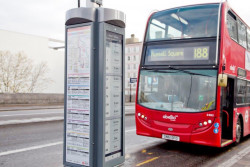
Transport for London (TfL) has begin installing new bus signs at a small number of bus stops.

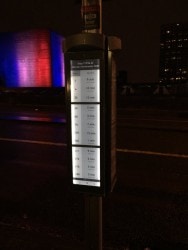
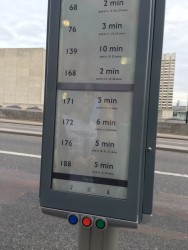
The signs have E-ink screens and offer timetables, route maps, and real-time travel info which the signs download over 3G. The screens used in these signs are based on a platform developed by Visionect, an E-ink partner based in Slovenia. They are about the same size as a conventional bus stop sign, and feature colorful buttons which change the contents of the screen or illuminate it.

Several tweets show the signs in place, including a night shot which confirms that the signs are frontlit. According to Technoframes, the company that designed and built the sign units, the first sign was installed in mid-November. Six addition E-ink bus signs will be installed next year as part of a systems test which will give TfL a better idea of the idea’s viability.

Engadget