How Produced Water Chemistry Affects Treatment, Reuse, and Disposal Decisions
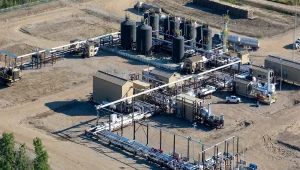
The water produced in a barrel does not qualify as a reuse feedstock and a disposal issue, simply because someone decided that it is. The chemistry decides. A fingerprint of the formation which the water has been in millions of years forms and which its rise with oil and gas carries a hard prophecy of its usability and the cost of reaching it gives a strict limit to what the water can be used to, and at what cost. Variability is made tangible by USGS data on tens of thousands of samples: streams of two wells one mile apart can be distinctly different at the treatment skid.
The new question that operators have now is not whether, in principle, it is possible to reuse produced water. Whether treating and recycle a particular stream, at a particular well, is cheap, compared to hauling and injecting that stream. The solution swings with the chemistry problem that is in the ascendant, and weakly sometimes with what two problems come into contact with each other.
Reuse Within the Oilfield and Reuse Without It Take Narco-Dissimilar Forms.
The less difficult win is to hold on to the produced water in the oilfield. Combining it into frac fluid to the following completion, or waterflood, sustains salinity and hardness which would kill a membrane. The chemistry is yet to be controlled as to bacteria, iron, scale tendency, relating to friction reducer compatibility, but it is a goal of does not ruin the next job, and not a goal of meets a discharge limit. Programs developed around that objective heavily depend on bio-cides, scale inhibitors, and oxygen scavengers, as opposed to desalination.
Reuse is another thing out of the oilfield. Irrigation, farm animal cooling, cooling in industry, and overland drainage all insist on taking the salt and certain elements to a level where the inside-the-field case never even had to consider. In their created water explainer, the American Geosciences Institute points out that less than one percent of water produced is currently reused not in the oilfield, and the cause is virtually always about economic considerations related to chemistry. A greater distance separating the end use and the wellhead, the more work the treatment train must perform.
Salinity Sets the Ceiling Before Anything Else
Pretreatment plays an important role in managing these challenges. Chemical treatment programs, including those offered by Imperative Chemicals, can help operators address water quality issues such as scaling, corrosion, and contamination before they interfere with downstream equipment.
The choice of the most appropriate treatment plan corresponds to the composition of the produced water and the needs of the desired reuse purpose.
The split is important since the capital decision is the output of the salinity and not the volume. High-TDS basin is not a problem that could be addressed by throwing more RO to the issue. Some low TDS stream is occasionally able to clean the bar without much beyond filtration, softening and a final polishing step.
Why Scale-Forming Minerals and Organics are Problematic to Treatment.
When it comes to the ceiling the salt alone is hardly sufficient to prevent the stream. The fouler of the equipment is the divalent cations (calcium, barium, strontium) or dissolved silica, as they form when the solution becomes concentrated. The other way organics and residual hydrocarbons take their toll against membranes, wetting the hydrophobic surfaces and deactivating flux. There are a few problems in chemistry which are likely to determine the fate of a given stream:
- Scale tendency. Barium and strontium combine with sulfate to form scales that are difficult to dissolve once they’ve set. These have to be dropped out upstream through chemical softening, pH adjustment, or precipitation, or inhibited continuously.
- Dispersed and dissolved organics. Residual oil, BTEX, and polymer carryover from completion chemistry attack membrane surfaces and clog adsorbents. Pretreatment usually leans on dissolved air flotation, oxidation, or coagulation before anything selective sees the water.
- Iron and sulfide. Both oxidize fast when the water sees air, dropping solids that blind filters and feed sulfate-reducing bacteria. Oxygen scavengers and targeted oxidants are usually cheaper than cleaning up the mess downstream.
- NORM and boron. Naturally occurring radioactive material and boron rarely stop a reuse project on their own, but they shape the disposal path for the brine concentrate and can gate agricultural end uses.
Reuse Braccheth Some Barrels and Disposal Braccheth others.
Reuse is rational in three situations: the chemistry can be handled, the latter use is not so far away that trucking swallows the gain, and the other option of deep well injection is restricted by cost, capacity or regulation. Math leans towards reuse in a basin where injection rate is constrained or discrete with regard to induced seismicity issues, since the disposal side continues to become increasingly expensive as well.
In hypersaline running uneconomical locations, where the nearest beneficial use is a long haul, and injection can be had at a modestly compensated tariff, disposal still prevails. Reuse and disposal are not in the abstract competitors. They race at the barrel stage, by well and the chemistry report resolves the argument. Whichever way it goes, operators who describe produced water first before they classify it are likely to make the lower priced call.