Why Process Chillers Sized on Paper Fall Short When the Ambient Finally Shows Up
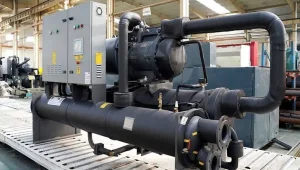
A chiller that sailed through selection in March starts tripping on high head by August. Why? The selection was run against a rated condition the plant never sees on a hot afternoon, and now the machine has to dump heat into air that’s 15 or 20 degrees warmer than the number on the datasheet.
The physics held steady. The weather moved. And the sizing worksheet assumed the two would track together.
What Does the Nameplate Capacity Actually Promise?
The nameplate promises a specific tonnage at a specific set of inlet conditions, and nothing more. For an air-cooled machine, the standard rating point is 85°F entering condenser air with 44°F chilled water supply and 54°F return. Every ton on the capacity curve was measured there.
Push the air up to 95°F and the compressor fights a higher condensing pressure. Push it to 105°F and the refrigerant side of the condenser has less temperature difference to drive heat across the coil. Capacity drops. Power draw climbs.
The nameplate didn’t lie. It answered a different question than the one the plant is asking in August.
Why Does the Paper Sizing Hold Up in Spring and Collapse in Summer?
Spring hides the problem. Entering air sits near or below the rated 85°F for most of the day, the chiller delivers close to full tonnage, and the loop holds setpoint without complaint. The margin everyone assumed is there appears to be there.
Then design-day heat arrives and three things stack up at once. Ambient blows past the rating. Process load is often at its own seasonal peak. Any recirculation around the condenser, hot exhaust from a neighboring unit, a wall too close to the inlet, a roof surface baking at 140°F, piles a few more degrees on top.
The derate isn’t small. A reputable industrial chiller supplier will quote capacity at the ambient your site actually sees, not just at the rating point.
How Hot Is 'Design Day' Really Supposed to Be?
This is where the sizing conversation usually goes sideways. The ASHRAE design-day values that drive most selections are percentile conditions, not maximums.
A selection built on a percentile design value will, by that same definition, be exceeded on some hours of the year. That’s not a flaw in the standard. It’s a design choice that assumes the loop can ride through a handful of out-of-spec hours each year. The question is whether your process can.
Precision injection molding, laser cutting, heat-treat quench, and reactor jacket cooling usually can’t. A few hours of elevated supply temperature during a run is scrap, rework, or a batch out of tolerance.
Where Does the Sizing Worksheet Go Wrong?
The GPM-times-delta-T calculation is correct. What gets missed sits around it. A short list of the usual suspects:
- Ambient derate skipped. The load is calculated carefully and then compared to a nameplate tonnage no one adjusted for the condenser inlet temperature on a July afternoon.
- Fluid correction missed. Glycol in the loop reduces heat capacity and raises pumping head, and a propylene mix can trim usable capacity meaningfully before ambient is even considered.
- Fouling allowance ignored. Condenser coils collect lint, pollen, and plant dust. A clean-coil rating degrades through the season, and the summer peak lands on the dirtiest coil of the year.
- Simultaneity assumed away. Several process loads were averaged instead of stacked. On the hot afternoon, they all run together, not in sequence.
- Installation effects unmodeled. Recirculation, short airflow clearances, and screened enclosures weren’t in the selection software because they’re site facts, not catalog facts.
How Should the Selection Actually Be Done?
Size to what the condition will be at the time the site is going to be, and not what the rating table thinks the state of the site will be. That is to draw local design-day temperatures of an existing climate database, and provide a realistic recirculation allowance of the install, and request the manufacturer to provide a capacity point of those numbers instead of AHRI standard capacity point.
Thereafter, the arithmetic is truthful. Choose between derating as installed headroom, increasing the frame size, requesting a high-ambient version or relocating the condenser to a shaded or water-cooled system. There is a cost attached to each of the options and a cost that is less than being caught up in a production run due to the shortfall.
The name-plate has not lost its value as an anchorage. No, read it as no promise in the case of August.