Motorcycle Quotes: Real Sources and Sayings Nobody Can Trace
The motorcycle quotes worth repeating sit in two piles. One pile has a name, a book or magazine, and a date attached — Robert Pirsig, T.E. Lawrence, Steve McQueen, Evel Knievel. The other pile has no owner at all.
Those lines traveled from CB radio to forum threads to back patches, and nobody ever signed them. Both piles are worth knowing. They just need different labels.
So every one of the motorcycle quotes and biker sayings below comes with what the record shows: the chapter, the issue, or the earliest place anyone has found it. The line you put in a card or a caption gets the right credit. And it holds up when somebody looks it up.
Lines From Riders Who Wrote Them Down
The signed motorcycle quotes start with a book. Robert M. Pirsig’s Zen and the Art of Motorcycle Maintenance came out from William Morrow in 1974. Its first chapter holds the passage riders reach for when someone asks why they don’t just take the car:
"You see things vacationing on a motorcycle in a way that is completely different from any other. In a car you’re always in a compartment, and because you’re used to it you don’t realize that through that car window everything you see is just more TV." — Robert M. Pirsig, Zen and the Art of Motorcycle Maintenance, chapter 1
Much later, in chapter 26, the machine turns into a metaphor: "The real cycle you’re working on is a cycle called yourself." That’s the sentence that makes a road book a philosophy book. It’s also short enough to fit almost anywhere.
T.E. Lawrence — Lawrence of Arabia — wrote The Mint about his years in the Royal Air Force ranks. He finished the manuscript in 1928. Doubleday printed just 50 copies in 1936 to protect the American copyright, and general readers got the book in 1955.
In Part III, chapter 16, "The Road," he takes his motorcycle, which he calls Boa, out on the Newark road:
"A skittish motor-bike with a touch of blood in it is better than all the riding animals on earth, because of its logical extension of our faculties, and the hint, the provocation, to excess conferred by its honeyed untiring smoothness." — T.E. Lawrence, The Mint
Short versions stop at "earth." The rest of the sentence is the part that explains it. Lawrence died in May 1935, six days after crashing his Brough Superior SS100 near Clouds Hill in Dorset. He’d swerved to avoid two boys on bicycles.
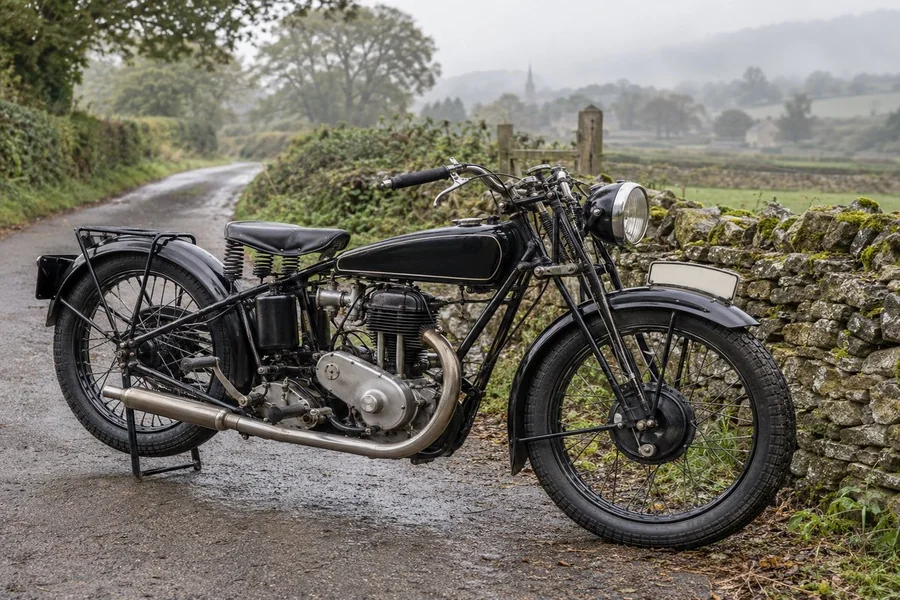
Illustration: a 1930s-style British touring machine on an English lane, the kind of road Lawrence was still riding in 1935.
Steve McQueen’s line is real, and the source is easy to find. LIFE put McQueen on the cover of its July 12, 1963 issue. The magazine’s own archive quotes him: "I’d rather wake up in the middle of nowhere than in any city on earth."
Evel Knievel summed up his job for Esquire’s "What I’ve Learned" interview in July 1999: "Anybody can jump a motorcycle. The trouble begins when you try to land it."
Hunter S. Thompson reviewed a Ducati 900SP for Cycle World in March 1995. The piece was called "Song of the Sausage Creature," and he opened by admitting a bright-red cafe racer was something nobody needs — "but I want one anyway, and on some days I actually believe I need one. That is why they are dangerous."
Ted Simon left London on October 6, 1973, on a 500cc Triumph Tiger and spent four years covering 64,000 miles through 45 countries. His book Jupiter’s Travels made the idea famous, and his own website still sums it up in five words: "The interruptions ARE the journey."
Ride Safe: Sayings With No Known Author
Most of the motorcycle quotes riders trade at a fuel stop have no author. Anonymous doesn’t mean fake. It means nobody signed it, which is normal for road talk. The useful question is how far back each saying goes.
"Four wheels move the body, two wheels move the soul." No author is known. Quotation researcher Barry Popik’s earliest find is a post on the Sportbike Motorcycle Forums dated October 2, 2000.
"Dress for the slide, not the ride." The gear rule in six words. A rider was already using it in passing on a BMW owners' forum in February 2004, and in April 2026 the U.S. Army’s safety magazine ran an article under that exact title.
"There are two kinds of riders: those who’ve been down and those who are going to go down." One early printed version is about police. On February 7, 1978, the Daily Pilot in Orange County, California, ran a story on the California Highway Patrol’s motorcycle officers. Sgt. Ron Berry, a former supervisor of the Santa Ana motor squad, told the paper: "There’s a saying that there are two kinds of motorcycle officers: those who have been down and those who are going to go down." Even then, he called it a saying.
"Keep the shiny side up and the rubber side down." This one came out of CB radio. The April/May 1976 issue of World of CB Radios printed it as "Keep your rubber side down, shiny side up, the bugs off your glass and the bears off your tail." In that magazine’s glossary, a "bear" is the state highway patrol.
"You never see a motorcycle parked in front of a psychiatrist’s office." Folk wisdom, author unknown. A rider’s blog was already arguing with it in April 2011 — the psychiatrist at the writer’s health center rode a Harley.
"Ride safe" has a physical version, too. The winter 2025 newsletter of a Harley Owners Group chapter sets out the guardian bell rules as riders tell them. Don’t buy your own bell, because it’s meant to be a gift. Let the person who gave it hang it.
Mount it at the lowest point of the frame, since road gremlins stay close to the ground and the bell catches them first. And a stolen bell loses all its power.
None of that has a documented origin. It’s folklore, and no bell stands in for gear or training. But the gift rule explains why the custom pairs so naturally with a "ride safe" wish. Done by the book, it ends up as a small silver bell hanging low on the frame, hung by the friend who chose it.
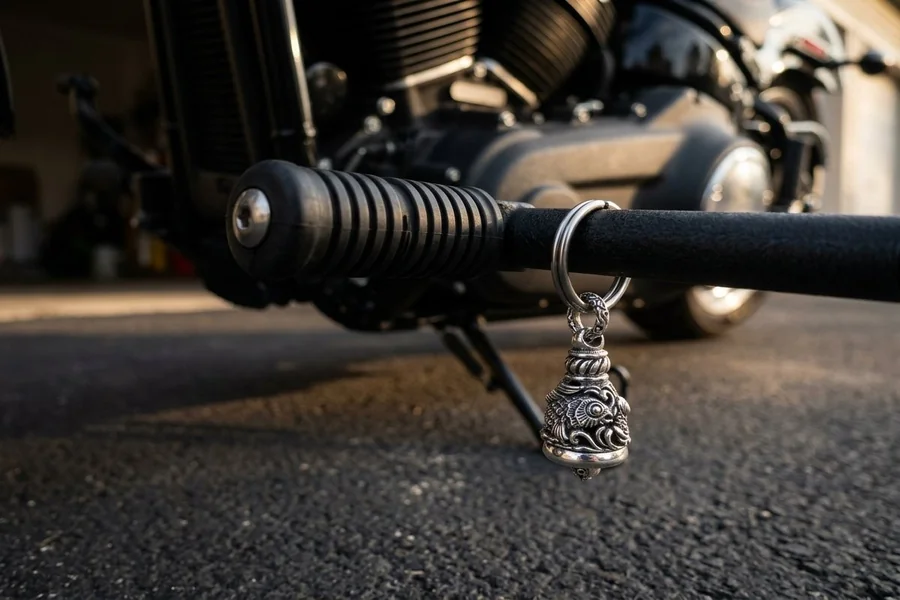
A sterling silver guardian bell clipped near the footpeg, low on the bike where the legend says road gremlins strike.
What Should You Write in a Rider’s Birthday Card?
A quote in a card does a different job than a quote on a poster. It has to fit one person. It should also carry a credit line, because the person reading it may well look it up. If the card travels with a present, Bikerringshop keeps a guide to gifts riders actually use, from silver rings to leather wallets, along with the ones to skip.
Illustration: the card comes first, the credit line goes underneath in smaller handwriting.
| If the rider… | Try | Credit it as |
| Reads more than they post | "The real cycle you’re working on is a cycle called yourself." | Robert M. Pirsig, Zen and the Art of Motorcycle Maintenance (1974) |
| Just bought a bike nobody thinks they need | "…but I want one anyway, and on some days I actually believe I need one." | Hunter S. Thompson, Cycle World, March 1995 |
| Has a long trip coming up | "The interruptions ARE the journey." | Ted Simon |
| Is back on the bike after a spill | "Anybody can jump a motorcycle. The trouble begins when you try to land it." | Evel Knievel, Esquire, 1999 |
| Is heading out tomorrow | "Keep the shiny side up and the rubber side down." | CB radio send-off, no known author |
Two habits keep these motorcycle quotes honest in a card. Write the credit in smaller letters under the quote. For the anonymous lines, write "rider’s saying" instead of borrowing a famous name.
Short lines win on a gift tag, too. "Keep the shiny side up" fits on one. Pirsig’s car-window passage doesn’t.
Hollywood Lines vs. Poster Taglines
Movies hand out motorcycle quotes too, and film dialogue is easy to check as long as the quote stays inside the film. In Easy Rider (1969), Jack Nicholson’s George Hanson says, "This used to be a helluva good country." The sentence after it turns up two ways online, with "gone" and with "going," so the safe quote stops there. Near the end, at the campfire, Peter Fonda’s Wyatt tells Billy, "We blew it."
The Wild One (1953) is trickier. Its famous exchange starts when Brando’s Johnny is asked what he’s rebelling against. His answer gets transcribed several ways online, from "Whaddaya got?" to "What’ve you got?" If it’s going on anything permanent, check a licensed copy of the film first.
Then there’s the poster. "Let the world change you… and you can change the world" is often shared as a Che Guevara quote. Focus Features calls it the tagline for Walter Salles’s 2004 film The Motorcycle Diaries. Credit it to the film’s poster, and leave Guevara’s name off.
The trip itself is documented. In January 1952, Guevara, then a 23-year-old medical student, left Buenos Aires with his friend Alberto Granado. They rode a 1939 single-cylinder Norton 500 nicknamed La Poderosa.
Patch Lines and Brand Mottos
"Live to Ride, Ride to Live" belongs to Harley-Davidson. The company’s own shop calls it "the motto of the Harley-Davidson nation." Its product copy also says the Live to Ride logo started out as a belt buckle design in 1979 and had become a rallying cry for riders by the early 1980s.
"If I have to explain, you wouldn’t understand" is a different case. It reads like a slogan, but no author or first use has been traced, so it goes in the anonymous pile with "rider’s saying" underneath.
Famous Lines Credited to the Wrong Place
Some favorite motorcycle sayings carry the wrong credit, or a story that’s grown in the retelling. Here’s what the record shows.
| The line | Usually credited to | What the record shows |
| "Life is like riding a bicycle. To keep your balance, you must keep moving." | Albert Einstein, on motorcycle lists | A letter to his son Eduard dated February 5, 1930, written in German and about a bicycle. Quote Investigator’s trace of the letter gives the Einstein Archives translation: "It is the same with people as it is with riding a bike. Only when moving can one comfortably maintain one’s balance." |
| "Faster and faster until the thrill of speed overcomes the fear of death." | Hunter S. Thompson, Hell’s Angels | The wording changes from list to list, and none of them gives a page. Treat it as unverified. |
| "Let the world change you… and you can change the world." | Che Guevara | The tagline for the 2004 film The Motorcycle Diaries |
| "Rejected by 121 publishers" | The usual story behind Pirsig’s book | Publishers Weekly’s 2017 obituary repeats it. The St. Paul Dispatch told it differently on April 23, 1974: he sent letters about the idea to 121 publishers and got 22 positive responses. |
Motorcycle Quotes FAQ
Who said "four wheels move the body, two wheels move the soul"?
Nobody knows; the saying has no identified author. The earliest appearance quotation researcher Barry Popik found is a post on the Sportbike Motorcycle Forums from October 2, 2000. If you use it, credit it as a rider’s saying rather than attaching a famous name to it.
Did Steve McQueen really say "I’d rather wake up in the middle of nowhere"?
Yes. LIFE credits the line to McQueen from its coverage of him in the July 12, 1963 issue, which put him on the cover. So the magazine, the date and the speaker are all on record, and you can print his name under it with confidence.
What does "keep the shiny side up" mean?
It’s a send-off that means "drive safely": keep the paint and chrome up and the tires down, so the vehicle stays upright. It came out of CB radio and trucker talk. A 1976 CB magazine printed it as "Keep your rubber side down, shiny side up," and its glossary defined a version as "drive safely."
Is "Live to Ride, Ride to Live" a Harley-Davidson motto?
Yes. Harley-Davidson’s own online shop describes "Live To Ride, Ride to Live" as the motto of the Harley-Davidson nation. Its product copy says the Live to Ride logo began as a Harley-Davidson belt buckle design in 1979 and had become a rallying cry for riders by the early 1980s.
The biker quotes with no author have one advantage over the signed ones. Nobody can say you misquoted them. They belong to whoever’s riding, and "rider’s saying" is an honest credit.
Put Pirsig’s name under Pirsig’s sentence and Knievel’s under Knievel’s. Then the card, the caption or the patch holds up the first time someone checks.
Author bio: Tepparit Kacha has worked with sterling silver for over a decade and curates the biker range at Bikerringshop, including the guardian bells riders give each other. The research behind this piece started with one question: who actually said it?