Johannes Gottwald
Senior Editor

Why People With Plenty of Luxury Bedding Options Still Choose Pure Parima

With luxury sheet shopping now having as much choice as consumers have ever had, searching online will provide you with hundreds of luxury bedding brands making claims about being softer, having higher thread counts, using premium cotton, etc. While there are more luxury bedding brands than ever before trying to get your attention, finding the best luxury bedding brand can still be very difficult.

Many times after comparing several luxury bedding brands, some consumers find themselves coming back to Pure Parima. It is not due to fancy packaging, glossy advertisements, etc. Typically, when consumers decide to purchase luxury bedding and are willing to pay the price, they play their part as well. The process typically includes reading the description of each item, researching the material used to make each item, reading customer reviews from other consumers, looking for reputable manufacturers or brands to shop with, etc. In addition, if a consumer has dozens of luxury sheet options to consider, their decision-making may also focus on long-term performance. 

For those consumers who want authentic high-quality products, regardless of how many luxury bedding options exist, Pure Parima stands out. This is based on the fact that Pure Parima creates their collections by focusing on building a product collection centered around values that most experienced consumers truly appreciate. Specifically, this includes authenticity in the use of certified Egyptian cotton; thoughtfulness in craftsmanship; classic designs; and providing consumers with accurate information about their product offerings. Therefore, let us look at some reasons why many consumers prefer purchasing Pure Parima regardless of how many luxury bedding options they have available.

Customers Want Authentic Materials, Not Marketing Claims

As a result of being overwhelmed by different marketing claims when it comes to luxury bedding, customers are frustrated by the inability to determine the authenticity of product descriptions. Most companies make the same claims regarding their products. Almost all of these claims include phrases such as luxury, soft, or premium. Therefore, an experienced shopper will typically focus on the specific attributes of the bedding, including what type of material it was created with.

As such, Pure Parima has earned significant customer trust in this regard. Each of Pure Parima’s collections is created from certified Egyptian cotton instead of utilizing generic terms for consumers' benefit. Consumers appreciate the knowledge of exactly what they are buying because clarity creates an opportunity for easier comparisons. In comparison to other luxury bedding options available to consumers, when there are multiple choices available, clarity of information can be equally as important as the product itself. Trust occurs before receiving bedding at your home.

People Prefer Consistent Quality

People do not normally purchase luxury bedding on a regular basis. If you spend money on top-quality bedding, then you would be surprised how long you should get from it. The time is spent finding out if your new bedding will last comfortably for you for many years. A customer’s initial impression may have been based on how soft the bedding felt for the first few days. Once the bedding has worn down enough over a period of time, consistency plays an equally large role as comfort does with their bedding.

Most of the customers who are shopping for bedding understand what type of brand consistently produces similar quality. In other words, customers will find the confidence to know that the product they purchase will match the information provided about it and provide them with the comfort they had hoped for when purchasing the item. Consistency helps reduce buyer uncertainty. Instead of trying to determine which product may be better in terms of quality among the choices available, buyers can select the design or weaving method that appeals to them best and still know that all of the products offered by this company contain the same level of detail and care as all other products.

Comfort Matters Long After the First Night

Comfort doesn’t end after the initial night. Many sheet sets will be comfortable right away after taking them out of the box. But the big issue at hand is how well these sheet sets perform once you’ve washed them multiple times and have used them in all the varying temperatures as the seasons pass. Will it remain as soft? And will the fitted sheet continue to fit snugly over the top of the mattress even after a couple hundred nights resting there?

Luxury buyers usually take into consideration that bedding is going to be something you’ll be using each day and sleeping on, and therefore lasting comfort matters significantly more than just short-term satisfaction. Each night of rest contributes to the overall value of your purchase. Because certified Egyptian cotton gets softer with each passing night yet maintains its natural durability, many consumers choose high-end bedding over cheaper alternatives, which may need to be replaced every 1-2 years. There is another aspect of quality bedding, as it provides an experience many consumers enjoy very early on. Pure Parima has built their own reputation on providing this type of long-lasting comfort. Instead of focusing only on how the bed feels for a week or so, Pure Parima designs bedding that remains appealing to users for years to come. That is generally what luxury shoppers look for when comparing products.

Customer Trust Is Earned Over Time

What consumers are actually purchasing when they buy high-quality or luxury bedding isn’t simply the sheets. Consumers have placed their trust in a brand to meet the expectations of comfort, quality, and durability, which were promised on the product webpage. The value of this trust increases due to the fact that luxury bedding is expected by many consumers to last for years rather than months. Many consumers will take the time to read the comments and feedback left by previous customers before making a purchase. Prior to making a purchase, many consumers will also compare different luxury bedding products.

What consumers will be looking for in these reviews includes, but is not limited to, how well the sheets hold up after being washed multiple times; How vibrant the colors look throughout the lifespan of the bedding. Does the overall quality match what was stated? The same way that product descriptions can help make a decision. When comparing two or more luxury bedding companies, it may be trust that makes your final decision. If you believe that one of the companies you are considering has established a good name for itself, then you will feel better about your decision to purchase from them.

Conclusion

Having many options does not necessarily make shopping simpler. While there are an increasing number of luxury bedding manufacturers, which can prompt consumers to be even more discerning when researching products prior to making decisions, the number of available options may also cause consumers to take too much time to decide. Consumers will research the materials from which the bedding is made, as well as review comments from other consumers who have purchased the product.

Pure Parima has established their reputation by concentrating on the aspects that matter most. Some of the aspects that matter include certified Egyptian cotton, dependability and consistency in its quality, classic designs, and a complete focus on transparency. So, if you are really looking for luxury bedding that contains genuine materials and provides long-lasting comfort, then Pure Parima should definitely be considered. Visit the official website to place your order and get access to Luxury bedding that is made from quality materials.

FAQs

Why do people choose Pure Parima over other luxury bedding brands?

Most consumers have chosen Pure Parima as one of their luxury bedding brands primarily due to the focus on using certified Egyptian Cotton. Consumers also know that they can expect a high level of consistency with respect to quality and craftsmanship when it comes to each piece of Pure Parima’s luxury bedding. This allows consumers to purchase luxury bedding items with an expectation that the pieces will remain in good condition for years to come.

Is Pure Parima bedding made with genuine Egyptian cotton?

Yes. Pure Parima manufactures all their luxury bedding products with Genuine Certified Egyptian Cotton. Therefore, their customers are able to be confident that they are actually buying Genuine Premium cotton products instead of a product whose materials are unknown.

What makes luxury bedding different from regular bed sheets?

Generally, Luxury Bedding is produced from a combination of superior quality materials and superior craftsmanship. Therefore, Luxury Bedding will generally be softer, more breathable, and more durable than most standard sheet sets over time, while offering greater long-term comfort.

How do I know if a luxury bedding brand is trustworthy?

Look for brands that clearly define what they use to manufacture each item so you know exactly what you’re sleeping on; brands that describe each item with clear, concise language so you know what you’re getting; and brands that have good ratings from customers and produce high-quality products consistently throughout their collection.

Does Pure Parima offer bedding for different sleep preferences?

Yes. In addition to providing bedding made with Certified Egyptian Cotton, Pure Parima also provides bedding with a Percale weave option as well as a Sateen weave option so their customers can select which type of feel they prefer when they go to sleep, but still get to enjoy the high quality of their certified Egyptian Cotton.

Best Green Comforter Sets For Every Budget – Bebejan Top Picks

There shouldn’t be anything keeping you from having a comfortable bedroom based on your budget. As many consumers are now desiring bedrooms that feel as peaceful, comforting, and aesthetically pleasing as possible, they do not need to spend excessively on interior design. The right bedding can actually give a consumer more identity and warmth in their bedroom, especially after long, tiring days at work. Consumers love using green comforter sets due to how calming and refreshing a green color palette feels within most bedroom designs.

While some green colors may be more earthy and cozy, other green colors will give a cleaner and lighter feel to the room, depending on the room layout. The mission of Bebejan is to provide consumers with affordable comforter sets that meet both their aesthetic needs and their financial constraints. In this article, you will see the best available Green Comforter sets from Bebejan that could work for every budget.

Bebejan Rose on Misty Green 5 Piece Reversible Comforter Set

This product is one of the best-selling products online. It is suitable for use in most bedroom settings. The soft base color has a gentle, misty green hue, featuring small pink flowers. This comforter has two sides: a floral arrangement and the opposite side is a single tone of green. As it’s made entirely from 100% cotton sateen fabric, this is a great feeling right away and will continue to soften after every wash.

The price of this Bebejan product can be found on their website, usually priced at £250.00. However, you can find this item discounted to approximately £125.00 through sales events. The extra-large dimensions of this product will provide full coverage on a queen bed or king bed. And the matching pillow cases are also provided. Customers have complimented the fact that this product can easily be changed from a romantic floral arrangement to a simple, solid green when flipped over.

Bebejan Sage Serenity 5 Piece Reversible Comforter Set

The Sage Serenity reversible comforter set by Bebejan is an excellent example of great value for money. The soft sage green color provides a soft base and has a calming freshness and relaxing effect. The two sides have a very comfortable 100% cotton, which can be flipped over to retain the same level of comfort and quality.

This set is frequently discounted at Bebejan; therefore, it represents one of the best value options for incorporating green into your bedroom on a budget. It will work nicely with several decorating styles, such as minimalist Scandinavian, to cozy traditional. In addition to being able to resist pilling and fading much better than lower-cost options, the fabric will maintain its appearance of serenity longer. Additionally, the throw pillow adds some nice texture without increasing the overall price of the set. For anyone who wishes to purchase green bedding that will perform well over time but also remain affordable, the Sage Serenity is typically ranked among the top picks.

Bebejan Tropical Fusion 5 Piece Reversible Comforter Set

This comforter is perfect for those who want a strong personality. A rich green background with a lot of bold botanical designs creates a statement. There are two sides to this set. One side has vibrant tropical designs, and the second side has a simple green background to provide balance. Like all Bebejan comforters, this one is made of 100% cotton sateen material. This creates great breathability and softness. This option will work best in large master bedrooms or spaces where you would like the bed to be the attractive point of the bedroom. Although this is a very bold design, due to the reversible construction, it remains versatile. Bebejan often discounts this collection, providing high-quality materials at discounted prices. The fabric drape of this comforter is nice, as well as the retention of colors after washes help keep the bright tropical green tones active over time. 

Bebejan Peach Leaves on Sage 5 Piece Reversible Comforter Set

The Peach Leaves on Sage is a softer approach to green. It has a soft sage as its base color with peach and green leaves printed delicately upon it. As it is reversible, if you prefer to have a cleaner tone on your bed at times, you can flip over to a lighter tone. The reversible comforter features 100% cotton sateen and is best suited for small bedrooms or rooms with plenty of natural light, due to the fact that the lighter green tones will keep the room feeling open and bright. Due to competitive pricing by Bebejan, this product usually appears in their discount rotation. The fabric of this product is breathable, which helps prevent overheating. 

Bebejan Antique Flowers Ivory 5 Piece Reversible Comforter Set

Budget-conscious shoppers may find a nice balance of color using the Antique Flowers collection. Although there are no pure green items in this collection, it has both soft green tones and ivory background pieces. The combination of these two colors creates a soothing, calm atmosphere at an affordable cost. When on sale, the price drops significantly, because Bebejan frequently runs special deals on this item. In addition to being reversible and made of 100% cotton, the quality of the materials will provide good comfort.

Use this type of product in guest bedrooms or first apartments where you want some green influence but do not wish to purchase a complete green bedroom set. After multiple washings, the designs remain visible, and they continue to be soft. Many customers have used this as a way to get started with Bebejan bedding and then upgraded to a larger green bedroom collection. It shows how you can have a serene bedroom setting on a lower budget if you select a well-designed bed sheet collection.

Conclusion

The perfect green comforter set depends on how well you find a balance of what makes your bed comfy, what quality of product you are looking for, your own unique style, and finally, where you want to spend your money. Bedding has to make you feel welcomed every time you lie down at night, as it also needs to support the entire ambiance of your bedroom.

The reason why green comforters have been able to stand out over so many other decorating styles and even bigger rooms is that green creates both an element of calmness and an element of warmth by nature. There is no need to break the bank if you just want affordable bedding; there is a wide range of beautiful mid-priced Green comforter sets that provide long-lasting comfort and last for years, and then there is a luxury option if you want to treat yourself or your home to a softer and cozier bedding collection. Bebejan continues to design a variety of bedding collections that combine the elements of artistry, materials to be used in bedding, quality, and price that fit within a budget to fit a variety of budgets. You can check out their collection on their website.

Solving 'Zoom Fatigue': How Vidnoz AI Streamlines Internal Corporate Comms

Global and Hybrid working has completely changed business communications, but continuous virtual meetings can make staff feel drained, distracted and unproductive. The pandemic is forcing companies to evaluate how they deliver information internally, because this increasing burden, known as ‘Zoom fatigue’, is driving them to reconsider. Businesses can use AI-powered video communication tools when they need to make changes, updates or trainings without a meeting. Vidnoz AI offers a practical way to create engaging corporate videos from scripts, helping teams deliver information clearly without adding another meeting to employees’ calendars. From company announcements and onboarding to training and team updates, Vidnoz AI can make internal communication faster, more flexible, and easier to consume. 

Part 1: What is Vidnoz AI? 

Vidnoz AI is an AI-driven video editing software that aims to enable companies and content creators to make high-quality-looking videos without necessarily having to use advanced editing tools. Through this tool, users are able to transform text or scripts into videos with the assistance of AI avatars, realistic voiceovers, customizable templates, and multilingual options. It is also equipped with an user-friendly online video editor enabling its users to customize scenes, add images, background music, subtitles, animations, etc. Among the most prominent characteristics of this tool is the certification under ISO/IEC 27001:2022, proving their zeal in terms of information security management and safeguarding of organizational data.

Part 2: How Vidnoz AI Helps Reduce Zoom Fatigue 

The program offers impressive sets of features that can help businesses reduce their dependence on unnecessary video meetings. Here are the top features of this program: 

  • Customizable Video Templates: Vidnoz AI offers 2800+ video templates, allowing users to create various types of videos, such as employee announcements, training materials, onboarding videos, business presentations, company updates, and internal tutorials. Plus, users can add their company logo, brand elements, text, images, music, and subtitles. 
  • Lifelike AI Avatars: The program includes 1900+ AI avatars, each from different industries and roles. It includes avatars of doctors, nurses, teachers, students, trainers, and more. Plus, users can create digital twins using Avatar Lite, and Avatar Pro offers deeper customization features. The Expressive Avatar features add natural features to avatars, such as facial expressions and more. 
  • Natural-Sounding AI Voices: One of the best parts of Vidnoz AI is that it provides 2000+ AI voices in different accents and styles. All voices available on this program are powered by ElevenLabs, Google, and Microsoft. In addition, multilingual voice options can further help organizations communicate effectively with employees across different regions and language preferences. 
  • Free Version: Vidnoz AI offers a free version, allowing companies to create high-quality videos without spending a single penny. The free version includes 30 free credits and powerful AI tools, such as Text-to-Video, Image-to-Video, AI Video Enhancer, Online Video Editor, Customizable Templates, Natural-Sounding Voices, and more. 
  • AI Video Wizard: The program enables users to create engaging videos with a simple text prompt or any source material. Simply enter the text prompt, choose the AI avatar, template, and voice, and click on the “Generate” button. Within seconds, your AI video will be ready. 

Part 3: How to Create Internal Communication Videos With Vidnoz AI

Creating internal communication videos with Vidnoz AI Video Generator is a straightforward process, even for users without professional video-editing experience. Here’s how to do it: 

  • Open your web browser and go to the Vidnoz AI official site. Click on the “Create Free Video Now” button. Choose the Video Template and AI Avatar. 

  • Now, enter the video script or upload any source material. Select the desired AI voice and language. The program offers 140+ languages, including English, Chinese, and Spanish. 
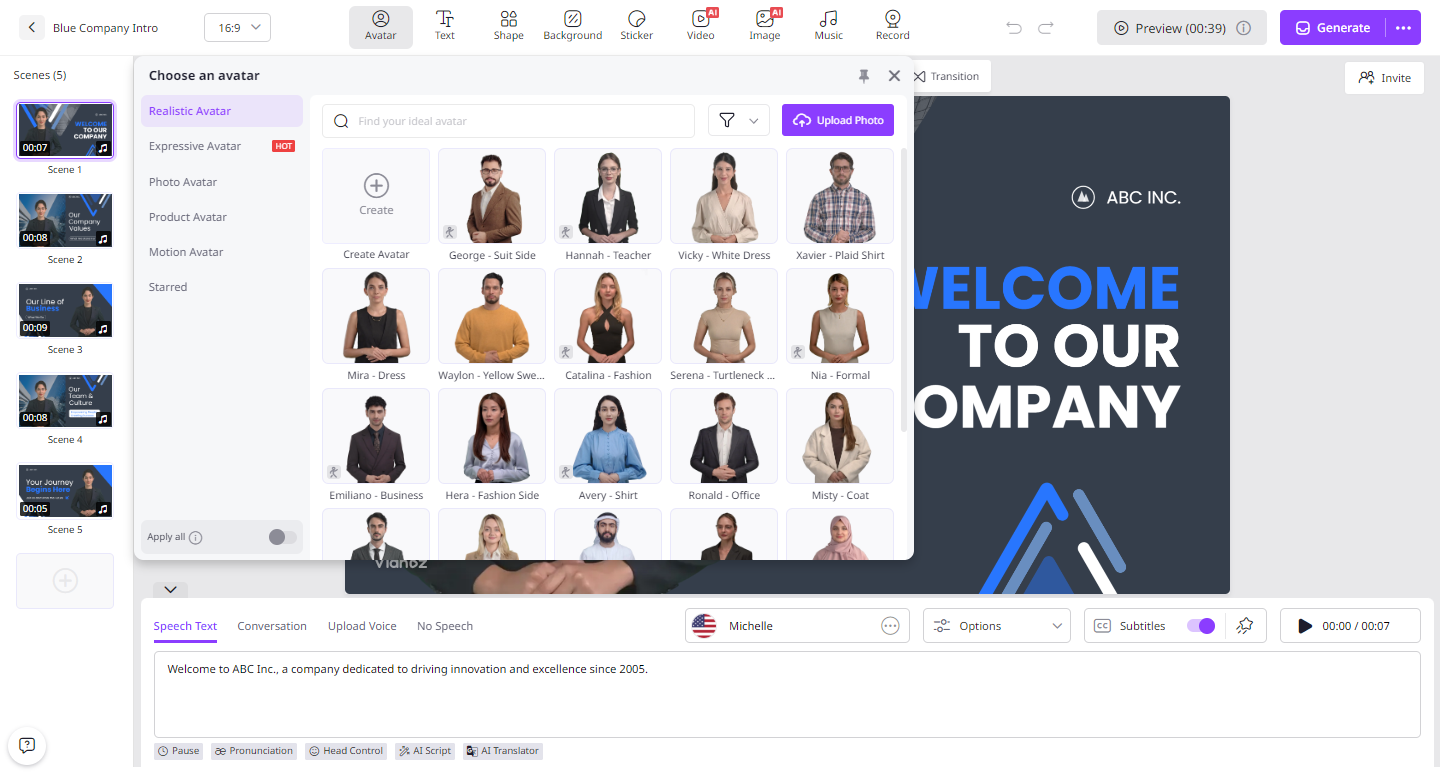
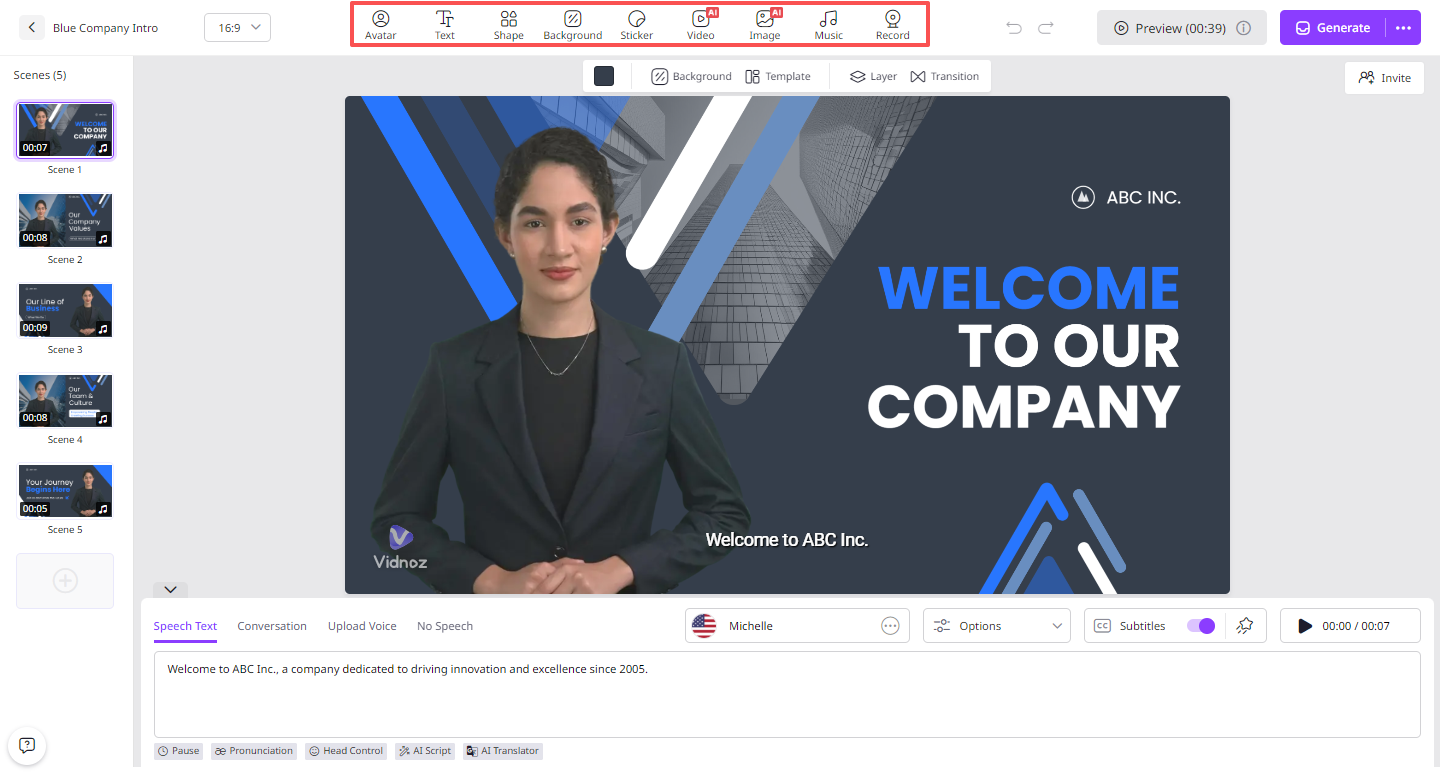
  • Next, use the Online Video Editor to customize the AI video according to your requirements. Users can change the background, insert text, add music, and more. 

  • Finally, click on the “Generate” button to begin the video creation process. Within seconds, your AI video will be ready. Preview the results and click on the “Download” button to save the video in MP4 format. 

FAQs 

Can Vidnoz AI replace corporate meetings? 

Yes, Vidnoz AI can replace corporate meetings, particularly those focused on routine announcements, employee updates, training, onboarding, and information sharing. 

Does Vidnoz AI support multiple languages? 

Yes, Vidnoz AI supports 140+ languages, allowing users to create videos for worldwide audiences. The program supports languages such as English, Chinese, Turkish, Italian, Spanish, French, and more. 

Can Vidnoz AI create internal training videos? 

Yes. Businesses can use Vidnoz AI to transform training scripts into videos featuring AI avatars, voiceovers, and more. This makes it easier to create reusable training materials for employees. 

Final Thoughts 

Zoom fatigue has become a growing challenge for companies that rely heavily on virtual meetings for everyday communication. Vidnoz AI offers a practical way to reduce unnecessary meetings by transforming routine announcements, training materials, and employee updates into engaging videos. 

The Problem With Reading Too Much Before You Remodel

There is a strange thing that happens when people start planning a remodel.

They begin with a real problem. The bathroom feels old. The shower is too small. The lighting is bad. There is never enough storage. Maybe the room is not falling apart, but it is annoying every single day.

So they search online.

At first, that feels helpful. A few articles explain what to expect. A video shows a smart layout. A contractor website gives an idea of the work involved. Then the search gets bigger. More tabs. More opinions. More photos. More “must-have” features that nobody was thinking about ten minutes ago.

By the end of the night, the homeowner is not more confident. They are more confused.

This is the part of digital research people do not talk about enough. Reading more does not always make a decision better. Sometimes it just gives you more reasons to delay.

The internet is useful for remodeling. Very useful. But it needs to be handled the same way we handle any other kind of digital information. Read enough to understand the basics, then stop before the research becomes noise.

A Saved Photo Is Not a Real Plan

A remodel does not begin with the prettiest photo. It begins with the room you actually have.

That sounds obvious, but it is easy to forget when every bathroom online looks calm, bright, and perfectly styled. Real bathrooms are not like that. They have awkward corners, old fans, strange lighting, bad storage, and pipes that may not be where you wish they were.

This is why copying a photo rarely works.

A dark tile bathroom may look expensive online, but it might make a small room feel tighter. A floating vanity may look clean, but it might not hold enough towels or daily products. A huge walk-in shower may look perfect in a video, but it may not fit the space without moving plumbing.

When homeowners search for bathroom remodeling Sacramento, the useful part is not only seeing design ideas. It is learning what a bathroom remodel can involve: layout, waterproofing, plumbing, ventilation, lighting, flooring, and storage.

That kind of reading helps. Random scrolling usually does not.

The Best Clue Is What Annoys You

Forget trends for a minute.

The best starting point is the thing that bothers you every day.

Maybe the mirror fogs up because the fan is weak. Maybe the drawer hits the door. Maybe there is no place to put clean towels. Maybe the room feels cold in the morning. Maybe two people cannot use the space at the same time without getting in each other’s way.

Those small annoyances are more useful than a folder full of inspiration photos.

A homeowner who knows the real problem can read online advice with a sharper eye. They can ignore ideas that do not solve anything. They can ask better questions. They can tell the difference between “this looks nice” and “this would actually make my bathroom better.”

That is the whole point of research.

Not to collect every idea. To understand the right problem.

Reviews Are Not Just Stars

Most people check reviews before they hire anyone. That is smart, but star ratings are only the surface.

The useful part is the detail.

Did people mention clear communication? Did the crew protect the home? Was the timeline realistic? Did the company explain problems when they came up? Did the final work match what was discussed?

A five-star review that says “great job” is fine. But a review that explains the process is more useful.

The same rule applies to articles and videos. Do not trust one source too much. Look for patterns. If several sources keep saying ventilation matters in bathrooms, believe them. If several homeowners complain about poor planning, pay attention.

Good digital research is not about finding one perfect answer. It is about noticing what keeps coming up.

Contractor Websites Should Do Some Work

A contractor website should make things clearer.

It should explain the services, project types, locations, process, and next steps. It should not make homeowners guess what the company actually does.

That matters because most people do not want to call with zero context. They want to understand the basics first. A clear website helps them decide whether the company fits the project.

A company such as GVD Renovations gives homeowners a place to review remodeling services before they decide whether to reach out.

That does not replace a real conversation. But it makes the first conversation better.

Short Videos Can Lie Without Meaning To

Remodeling videos are addictive because they make progress look instant.

Old bathroom. Fast demolition. New tile. New vanity. Finished room. Done.

The problem is not that the video is fake. The problem is that it skips the parts where decisions actually happen.

It skips the measuring. It skips the budget changes. It skips the old plumbing. It skips the waterproofing. It skips the waiting. It skips the moment when someone realizes the original plan will not work exactly as expected.

That is why short videos should be used for ideas, not expectations.

A bathroom is small, but it is not simple. Water, electricity, ventilation, flooring, and layout all sit close together. A mistake can be expensive later.

The Internet Is Bad at Knowing Your Budget

Online budget advice can be useful, but only as a rough starting point.

The cost of a bathroom project depends on the room, the location, the materials, the labor, the age of the home, and whether hidden problems appear after work starts.

Two bathrooms can look similar online and cost completely different amounts.

This is where people get frustrated. They read one article, expect one number, then get a quote that feels much higher. Sometimes the quote is too high. Sometimes the online estimate was just too simple.

A real budget needs a real room.

Save Fewer Things

Here is a better way to collect ideas.

Do not save fifty photos. Save ten.

Under each one, write why you saved it.

“I like the storage.”

“I like the light.”

“I like that the shower looks easy to clean.”

“I like the warm tile, not the layout.”

This makes the folder useful. Otherwise, it becomes a pile of nice images that do not agree with each other.

The same goes for articles. Keep the ones that answer a real question. Skip the ones that only repeat the same general advice.

Research Should Have an Ending

This is the part most people miss.

Research should stop.

Not forever, but at some point you need to move from reading to asking real questions. Once you know the main problem, the rough style, the must-haves, and the budget range, more scrolling may not help.

It may only make you doubt everything again.

The internet is good for preparation. It is not always good for decisions. At some point, the real room has to matter more than the screen.

Better Reading, Better Remodeling

Digital research has changed how people plan home projects. That is mostly a good thing. Homeowners can learn more, compare options, and avoid walking into a project blind.

But more information is not the same as better judgment.

The smarter approach is simple. Start with the real problem in the room. Read enough to understand the work. Use photos as references, not rules. Read reviews for details, not just stars. Then speak with professionals before turning ideas into a plan.

A remodel should not be built around whatever looked best online at midnight.

It should be built around the home, the budget, and the people who use the space every day.

How to Watch the US Open 2026 – A Comprehensive Guide

Inaugurated in 1881 as the US National Championship, the US Open is one of the most celebrated and oldest tennis tournaments.

From icons like Arthur Ashe and Andre Agassi to living legends like Roger Federer, Novak Djokovic, Andy Murray, and Rafael Nadal, some of the best tennis players of their eras have featured in this prestigious tournament.

The 146th edition of the US Open is underway, and this year, all eyes will be on prodigies like Alexander Zverev and Carlos Alcaraz, the defending champion. Another highlight is the return of the Williams sisters, who’ll be competing in the women’s doubles category.

From August 30 through the mid of September, this year’s US Open 2026 schedule brings in some matchups that you shouldn’t miss. If you’re a die-hard tennis fan, you wouldn’t want to miss some quick aces and breathtaking returns on a hard court. So, to ensure that you don’t miss any live action, we’ve created this detailed guide on how to watch the US Open 2026.

Without further ado, let’s get started:

Where to Watch the US Open 2026?

The US Open 2026 is offering $108 million in player compensation, the largest in a tennis tournament’s history. While it’s great to see how players are compensated for their hard work, it also highlights the fact that tennis’s popularity has peaked in the US.

Also, with so many top-seeded US players featuring, broadcasters like ESPN took keen interest in the US Open and secured its broadcasting rights. Fortunately, most internet providers include ESPN in their channel lineup, and you can also bundle TV to get multiple services under a single bill.

In addition to ESPN, ABC will also broadcast select matches, including the first round, round of 16 (RO16), and men’s title match.

For tennis fans who’ve cut the cord, streaming platforms like Fubo, Sling TV, YouTube TV, and Hulu+Live TV will carry ESPN’s live coverage.

Cable TV Streaming Apps
ABC YouTube TV
ESPN Sling TV
ESPN2 Fubo
ESPN Deportes DirecTV
  Hulu+Live TV

On a side note, if you want to enjoy every match without hopping from one channel or streaming app to another, subscribing to an ESPN Unlimited Plan is the best choice.

ESPN Unlimited Plan includes all ESPN networks, including Deportes (for Spanish speakers), so you can watch any match or individual court you want.

As for streamers, they can check out reliable aggregator platforms like LocalCableDeals and explore high-speed providers offering streaming bundles with internet. This way, tennis fans enjoy high-voltage clashes between arch rivals without missing a beat.

How Much Internet Speed Is Required for Streaming?

Internet speeds don’t matter if you’re planning to enjoy the US Open 2026 on a TV channel. But if you’re going to stream this epic tournament or catch the live action on the go, make sure to meet the minimum speeds required for smooth streaming.

Wondering how much internet speed you should aim for to watch the US Open 2026 on a streaming app? Here’s what FCC speed guidelines recommend:

Resolution Quality Download Speeds Upload Speeds
Standard Video in 480p 3-4 Mbps 1 Mbps
HD Video in 1080p 5-10 Mbps 1-5 Mbps
Live Streaming in 1080p 10-15 Mbps 5-10 Mbps
4K Video 15-25 Mbps 5-10 Mbps
Live Streaming in 4K 25+ Mbps 25+ Mbps
Virtual Reality or 8K Video 50+ Mbps 20-25 Mbps

Keep in mind that actual speeds may depend on the streaming platform. Also, consider your household’s online activities or number of users. This is because every connection has limited bandwidth, which is shared among the connected devices or online activities.

So, choose an internet plan offering more speed than what your streaming quality needs for a lag-free experience.

How to Optimize Your Connection for Streaming

Optimizing your connection for streaming is important, especially when you’re planning to watch multiple games on different devices.

To make sure your internet connection is up to the challenge, follow the tips below:

  • Choose a Fiber Internet Connection: Among all connection types, fiber internet exclusively offers symmetrical speeds, i.e., similar upload and download speeds.

It’s the fastest internet connection type and offers a great streaming experience. However, fiber’s availability is limited to metropolitan areas in the US, and if this connection type is not available in your ZIP, your next best option is a cable internet service.

Although you might not get symmetrical speeds, a cable service offers affordable bundle deals and sufficient speeds to support your streaming needs.

  • Fix Your Router: Your router delivers the internet signals to the connected devices via radio waves. If it’s faulty or imperfectly positioned, it might impact the strength of the internet signals and lead to slower speeds.

Here, make sure to install software and firmware updates on your router. Besides bridging existing security loopholes, such updates also set up new features to improve the overall performance of your router.

As for the router’s placement, position it away from thick walls or heavy furniture, as such items may hinder the movement of the internet signals.

  • Disconnect Idle Devices: Idle devices connected to the internet consume bandwidth. As mentioned earlier, every connection has limited bandwidth, which is distributed among connected devices and activities performed on them.

So, it’s best to free up bandwidth by disconnecting idle devices and closing background apps. This way, your connection can provide the required bandwidth for streaming and ensure a lag-free experience.

Top Players in US Open 2026 to Watch Out For

Before we wind up, let’s remind you which top-seeded players will be in action in the US Open 2026:

Men’s Category:

  • Alexander Zverev – Germany
  • Carlos Alcaraz – Spain
  • Felix Auger-Aliassime – Canada
  • Novak Djokovic – Serbia
  • Flavio Cobolli – Italy

Women’s Category:

  • Aryna Sabalenka – Belarus
  • Elena Rybakina – Kazakhstan
  • Jessica Pegula – USA
  • Coco Gauff – USA
  • Mirra Andreeva – Russia

FAQs

Who won the US Open men’s singles title in 2025?

Carlos Alcaraz defeated Jannik Sinner and won the US Open men’s singles title in 2025.

Who won the US Open women’s singles title in 2025?

Aryna Sabalenka won the women’s singles title in 2025 by defeating Amanda Anisimova.

Where can I watch the US Open 2026 in Spanish?

You can watch the US Open 2026 in Spanish on ESPN Deportes in the United States.

Creating Boundaries Around Financial Comparison

Financial comparison is often treated as a confidence problem. We assume that if we felt better about ourselves, another person’s salary, house, vacation, or investment balance would not bother us. Confidence helps, but comparison is also an information problem. We are constantly exposed to other people’s visible results while missing their debt, family support, timing, tradeoffs, and private stress. We then use that incomplete picture to grade a life we know in painful detail.

Comparison Is an Information Problem

The same mistake can affect major financial choices. Someone researching settlement vs consolidation may hear that a friend chose one route and assume the same answer should work for everyone. Yet financial options depend on personal details such as balances, income, payment history, credit, costs, risks, and realistic goals. Another person’s outcome can begin a useful question, but it cannot replace your own careful review.

Stop Comparing Different Stories

Two people can be the same age, live on the same street, and earn similar salaries while having completely different financial realities. One may have student loans. The other may have received help with college. One may support a parent. The other may split expenses with a partner. One may spend freely because retirement is already funded. The other may simply be spending money they do not have.

Comparison ignores these differences because visible wealth is easier to notice than invisible context. A new car appears in the driveway. A family loan does not. A promotion gets announced. The extra care expenses at home do not.

Before using someone as a financial reference point, ask whether you actually know enough about the story. In most cases, you do not. That does not make the person dishonest. It means their life is not a clean measuring stick for yours.

Build a Private Reference Group

You do not need to avoid every comparison. Some comparisons provide useful information. The goal is to choose a better reference group.

Compare your current habits with your habits six months ago. Compare your emergency savings with your own likely expenses. Compare a planned purchase with the goals already in your budget. Compare an investment decision with your time frame and tolerance for risk, not with a stranger’s exciting result.

When you do learn from other people, choose examples that share relevant conditions. Advice from someone with a steady salary may not fit a worker with seasonal income. A housing budget for a person without dependents may not work for a caregiver. The closer the circumstances, the more useful the comparison becomes.

Even then, treat the result as information rather than a command. Someone else’s strategy can give you an idea. Your numbers decide whether the idea belongs in your plan.

Give Comparison Office Hours

Trying never to compare yourself is unrealistic. The mind notices status quickly, especially when money represents safety, freedom, or respect. A stronger boundary is to decide when comparison gets your attention.

You might review financial progress once a month instead of checking balances after every conversation about money. You might research salary ranges before a negotiation, then stop looking once you have enough information to act. You might discuss finances with one trusted friend rather than joining every group conversation about property values or investment wins.

Think of comparison as a visitor with office hours. It can come in when it has a clear purpose. It does not get unlimited access to your evenings, purchases, or sense of worth.

Edit the Inputs That Distort Your View

Some financial comparison is created by the environment rather than by a deliberate choice. Social media can place luxury purchases, business success, and dramatic savings milestones in front of you before breakfast. Even useful personal finance content can become harmful when every post implies that you are behind.

The American Psychological Association discussion of achievement culture describes how social media can intensify comparison with peers and polished ideals. If certain accounts reliably create panic, envy, or impulsive spending, muting them is not avoidance. It is an information boundary.

Notice how you feel after consuming financial content. Do you leave with a practical idea, or with a vague sense that everyone is doing better? Does the content explain tradeoffs, or only display results? Does it help you make a decision, or encourage you to buy something so you can feel caught up?

Keep sources that increase understanding. Limit sources that mainly create urgency or shame.

Replace Status Goals With Functional Goals

Status goals depend on how your life looks beside someone else’s. Functional goals depend on what money needs to do for you.

“Own a more impressive home” is a status goal. “Have enough space for my family without making the monthly payment stressful” is functional. “Reach the same salary as my friend” is status based. “Earn enough to cover expenses, save consistently, and have time for people I care about” is functional.

Functional goals are easier to measure because they connect money to an actual purpose. They also reduce the temptation to keep moving the finish line. There will always be a larger house, a higher salary, or a more expensive trip. A goal based on function can eventually become complete.

Write down what you want money to provide. Common answers include stability, choice, rest, education, care, privacy, generosity, and useful experiences. These words give you a better target than appearing wealthy.

Turn Envy Into a Specific Question

Envy is uncomfortable, but it can contain information. The mistake is treating it as proof that another person is more successful. Instead, ask what exactly you want.

A friend’s vacation photos may not mean you want their income or lifestyle. You might want more rest, adventure, or uninterrupted time with your family. A colleague’s promotion may reveal a desire for recognition, greater authority, or more challenging work. Once the desire becomes specific, you can pursue it in a way that fits your circumstances.

Sometimes the honest answer is that you want the symbol itself. That is useful to know too. You can then decide whether the price is worth paying, rather than pretending the purchase is necessary.

The goal is not to shame yourself for wanting things. It is to separate a real preference from the fear of being left behind.

Measure Direction Instead of Rank

Rank asks where you stand compared with other people. Direction asks whether your own financial life is becoming more stable and intentional.

Choose a few personal measures. You might track whether bills are paid on time, whether high interest balances are shrinking, whether savings are becoming more consistent, or whether money arguments at home are becoming less frequent. These measures may not look exciting online, but they reveal meaningful progress.

For a concrete savings target, the Investor.gov Savings Goal Calculator can estimate the monthly contribution needed for a particular goal. A personal number like that is more useful than hearing how much someone else claims to save.

Keep the list short. A financial plan with twenty measures can create another form of comparison, this time against an impossible version of yourself. Three useful signals are often enough.

Create Scripts for Money Conversations

Boundaries are easier to maintain when you know what to say. You do not owe everyone details about your income, debt, savings, or spending choices.

If a conversation becomes uncomfortable, try a simple response: “We are focusing on a different goal right now.” You can also say, “That is not in our budget,” or, “I would rather not compare numbers, but I am happy to talk about how we plan.”

These replies are clear without being hostile. They prevent you from inventing an excuse or spending money just to avoid embarrassment. A boundary does not require the other person to agree. It only requires you to state what you will and will not participate in.

You may also need an internal script. When comparison begins, remind yourself: “I am seeing one part of their story. My plan is based on my whole life.”

Review the Boundary After a Trigger

A comparison trigger can expose a weak spot in your plan. Maybe a discussion about retirement creates panic because you have avoided checking your account. Perhaps seeing home renovations makes you anxious because your own repair fund is too small.

Respond by separating the emotional reaction from the practical issue. First, let the feeling settle. Then ask whether your plan needs attention. If it does, choose one action. Review the numbers, adjust an automatic transfer, research realistic costs, or schedule a conversation.

This process keeps another person’s life from controlling your next move. The trigger becomes a reminder to care for your own plan, not an order to copy theirs.

Your Financial Life Does Not Need an Audience

Creating boundaries around financial comparison is not about pretending other people do not exist. It is about refusing to let incomplete information determine your worth or direct your money.

You can learn from people without ranking yourself against them. You can admire a result without purchasing the same lifestyle. You can change your plan because new facts matter, not because someone else’s success made you panic.

A healthy financial boundary brings attention back to your values, responsibilities, and next useful step. Over time, the question changes from “Am I ahead?” to “Is my money helping me build the life I actually want?” That question is quieter, but it leads somewhere real.

Why Internet Feels Slower in Busy Hispanic Homes & How to Fix It

The internet is an inevitable need in today’s time as everything is done online. For the many Hispanic families that live in the U.S., the internet is not just a convenience but a lifeline.

It supports all online activities from working remotely, online learning, streaming Spanish content, video calls with grandparents or family abroad, and daily communication. The Hispanic community is knit together, and that is why we call having the internet a lifeline.

However, despite paying for what seem like solid internet plans, the households still experience slow speeds, buffering, and dropped connections. This, combined with complaints from larger multi-device households, typical of Hispanic homes, leads to these issues.

To back it up, the average Hispanic household size in America is larger compared to non-Hispanic homes, the average household size being 2.51, according to Statista. This is also backed by data gathered from the U.S. Census Bureau’s 2023 Current Population Survey and American Community Survey.

So, with more people under one roof means more devices, simultaneous connections, and a network load. And as families try to find a solution to these issues, they face the challenge of getting fast support or help due to language barriers. That is why many Spanish households look for services that offer help in their language.

Meanwhile, well-known internet providers cater to Spanish speakers to make them feel inclusive and heard. One such example is of Xfinity, which offers Servicio al Cliente support in Spanish to customers so they can inquire about internet plans in their preferred language.

Let’s read on to find out why the internet speeds feel slower in these Hispanic homes and what people can do to fix this issue.

5 Reasons Internet Speeds Feel Slow in Busy Hispanic Homes & Its Solutions

1. Many Devices Connected Simultaneously

In many Hispanic households, it is common to have the grandparents, parents, and children living under the same roof. It also isn’t uncommon among the community to have large family gatherings with cousins and extended family to come and stay over.

It is also typical of Hispanic homes to have parents working remotely, running small home-based businesses, children taking online classes, and a grandparent on TV or YouTube. This means various devices are connected, including smart home gadgets.

The problem?

When several devices (above your bandwidth) are connected to stream, video call, work, game, etc., at the same time, the speeds slow down for everyone. In an article by Consumer Affairs, the average number of devices in a household in the U.S. is about 21 connected devices, ranging from Smart TVs, speakers, streaming devices, and smart tech.

How Can You Fix It?

  • Disconnect unused devices from Wi-Fi
  • Pause large downloads during busy hours
  • Use router settings like Quality of Service (QoS) to prioritize work or school devices

Note: If these don’t work, this would ideally mean upgrading your plan, since your current plan is not suitable for the type of usage in your home.

2. Internet Plan Not Matching Online Usage

Our note in the first point brings us to giving it a center stage. It’s asking you to spend more, we know. But, there really isn’t much that can be done about your initial plan not matching your needs. It is better to upgrade, or it might cost you overage fees.

Though most brands now offer unlimited plans that are capped at 1.2 TB, it is still not a good situation. Many families choose a plan based on affordability, forgetting their actual bandwidth needs. Plans that worked before might not work now as you move to working from home, kids have grown up, and the wife has some online business, etc.

The change in activities and then having multiple devices calls for upgrading. It is the best bet for a hassle-free online experience.

How Can You Fix It?

  • Review current download and upload speeds.
  • Match speed to household size and daily usage
  • Optimize Wi-Fi first before upgrading plans

General Usage Guide Table:

Speed Best For
10–20 Mbps Browsing, social media, HD streaming (1 device)
20–40 Mbps 4K streaming, video calls, light gaming
40–100 Mbps Multiple devices, HD/4K streaming
100 to 300 Mbps Gamers, heavy streaming, large downloads, smart home, video calls
500 Mbps + Power users, heavy streaming, video conferences, and running an online home business
1000 Mbps + Large households 10+, heavy smart home tech, ultra-fast downloads, pro gaming, etc.

3. Weak Wi-Fi in Apartments and Multi-Room Homes

Many of the families live in apartments, duplexes, or homes that are multi-story. These homes have thicker walls, which weaken a shared network, even if it is placed in the center of the home.

For homes like these, the internet works well in the Living room but poorly in rooms on the corners or top floor, some even basement rooms with zero signals.

How Can You Fix It?

  • Placing the router in a central, open area
  • Avoid closets, cabinets, or areas near appliances
  • Use Wi-Fi extenders or mesh systems for larger/multi-story homes

4. Updated Tech Needed

Your home may have a good internet plan, but an outdated router can’t handle the usage of a modern Hispanic household. From video calls with abuelos in Mexico or cousins in Puerto Rico, kids taking classes on Duolingo, and parents working from home, the old routers can’t manage it all.

Routers older than five years can’t take simultaneous connections, HD or 4K streaming, or video calls, plus pro gaming. This calls for a change, so everyone in a busy home can get equal signals and not slow down.

How Can You Fix It?

  • You can upgrade to a modern dual-band or tri-band router
  • You can choose models designed for bigger homes and multiple devices
  • You should learn to clear routers by restarting once a day to have peak performance

5. Peak Hours and Neighborhood Congestion

Busy Hispanic homes are usually in the busy Hispanic neighborhoods, which leads to usage at peak hours. Kids may be attending online classes or streaming, mothers may be cooking while watching videos, and parents are working online, all at the same time.

People in one neighborhood tend to follow a similar lifestyle, which makes sense for this peak hour usage. This is especially when the kids want to watch something, or a live match is going on, and everyone needs the internet at the same time (think, weekends). This congestion reduces speeds even further.

How Can You Fix It?

  • Schedule large downloads earlier in the day
  • Limit background streaming during peak hours
  • Restart the modem and router occasionally

Bonus Point: Another issue that may occur is that smartphones, smart TVs, and computers often update automatically. These background updates quietly use large amounts of bandwidth, slowing down everything else. You can schedule these at night, disable auto updates to save time on busy hours, check usage, and clear cache on all devices to remove load.

Final Thoughts

The problem of a slow internet, especially in a busy larger home, isn’t just one thing but a mix of larger things at hand. These can be the size of the family, outdated tech, peak hours, and even communication gaps with the provider. The good thing, many of these issues, as we detailed above, are fixable.

But if the issue persists, it’s better to call your provider and get an upgraded plan. If you feel the communication is the issue, it is better to choose a provider with Spanish support for ease. But overall, by resolving the issues above, you’ll likely find your internet faster and smoother to work with. 

Why Do Veterans Wait So Long Before Asking for Help?

Ask anyone who works with veterans in recovery and you’ll hear the same thing: almost nobody comes in early. They come in after the divorce, after the DUI, after the third job. Years of the problem, then one week of finally doing something about it.

Helping Veterans Find Help starts with making sure they know that support is available and that asking for help is not a sign of weakness. Understanding the barriers veterans face and connecting them with appropriate resources can make the first step feel more manageable.

That delay isn’t stubbornness. It’s the predictable result of training, fear about benefits, and a system that’s genuinely hard to navigate. Each of those has a workaround.

The Training That Kept Them Alive Works Against Them Now

The military teaches you to absorb pain quietly, handle your own problems, and never be the weak link in the unit. Those instincts are useful downrange. They are terrible instincts for a man or woman sitting alone in a garage at 2 a.m. with a bottle.

There’s also the ranking problem. A veteran who did two deployments will look at the guy who did four and decide he hasn’t earned the right to struggle. It doesn’t work that way clinically, but it works that way in their head, and it costs years.

The Fear About Benefits Stops More People Than Anything Else

The belief runs deep: getting treatment will cost me my disability rating, my clearance, my job, my kids.

Most of that fear doesn’t survive contact with an actual benefits navigator — but "most" isn’t good enough when someone’s whole life is the stake, and this is exactly why generic advice fails. What works is getting a specific answer about a specific situation before anyone commits to anything. Resources like VeteranAddiction.org exist for that step: verifying what VA benefits or TRICARE actually cover, checking Community Care eligibility, and getting the answer from someone who does it daily instead of from a forum thread.

The Drinking Is Almost Never the Whole Story

Research cited by VeteranAddiction.org puts it at roughly 11% of veterans meeting criteria for a substance use disorder — but the number that matters more is how rarely it shows up alone.

Underneath it there’s usually PTSD, a traumatic brain injury nobody documented, chronic pain that started with a legitimate prescription, or moral injury that no amount of therapy about "coping skills" will touch. Treat the drinking by itself and you’ve removed the only thing that was managing the rest. That’s why co-occurring care — PTSD, depression, anxiety, and ADHD handled alongside the substance use by the same clinical team — isn’t an upgrade. It’s the baseline.

Why the Room Matters

Put a combat veteran in a civilian group and watch what he shares. Then put him in a room where three other guys have the same look, and watch the difference.

It isn’t about exclusivity. It’s that certain things only get said in front of people who don’t need them explained. A program built specifically around addiction treatment for veterans — VeteranAddiction.org’s Salute to Recovery track is one example — does this deliberately: military-informed trauma work, veteran liaison staff who speak the language, and a peer group that functions the way a unit does.

For families comparing options, this is the question to ask first. Not "do you treat veterans," which everyone says yes to, but "how many veterans are in the group he’d actually be in."

If You’re the One Trying to Get Them There

Keep it short and specific. "You’ve been drinking every night since March and you haven’t called your brother back. I’m scared." Not "you need help."

Do the legwork before the conversation, not after. Have the benefits question already answered and a phone number already in your hand, because willingness in this population tends to last hours, not weeks.

And expect to bring it up more than once. The first conversation almost never ends in a yes. It ends in the idea being planted.

Questions Families Ask Most

Will treatment hurt his disability rating or clearance?

This is the single most common reason veterans don’t call, and the assumption is usually wrong — but it depends on the specific situation and shouldn’t be guessed at. Get a real answer from a benefits navigator before letting the fear decide.

What if he says the VA already failed him?

That’s a common and often earned frustration. It’s also why VA Community Care exists — eligible veterans can receive treatment through approved community providers rather than only through a VA facility. Ask about it directly.

Can family start the process without him?

Yes. You can verify insurance, ask about programs, and understand the options before he’s agreed to anything. Most people find it far easier to say yes when the work is already done.

Do the Next Small Thing Today

Nobody needs to decide on treatment this afternoon. Someone just needs to make one call and find out what’s actually available — the benefits question, the wait time, what a first week looks like.

If a veteran you know is in crisis right now, the Veterans Crisis Line is available 24/7: dial 988 and press 1, or text 838255.

Why Does Mental Health Care So Often Fail Young Adults?

Someone turns 18 and the system that was watching them stops. Pediatricians hand them off. School counselors vanish at graduation. Parents lose access to records. And the person now responsible for booking the appointment is a 19-year-old who has never booked one in their life.

That handoff is where a lot of young people get lost — right at the age when serious mental health conditions tend to surface for the first time. It’s also the gap that programs like New York Center for Living, an OASAS-licensed nonprofit that has worked with this age group in Manhattan for more than 15 years, were built specifically to close.

The 18–25 Window Has Its Own Rules

This stretch isn’t late adolescence and it isn’t settled adulthood. The brain’s prefrontal region is still maturing, which shapes impulse control and long-range judgment. At the same time, nearly every external structure — curfews, class schedules, a family dinner table — disappears at once.

Anxiety, depression, and first-episode symptoms cluster in these years. So does the first serious relationship with alcohol or drugs. Treatment built for a 45-year-old rarely fits, and neither does treatment built for a 15-year-old. That’s the reasoning behind a dedicated 18–25 track rather than dropping young adults into general adult groups.

Young Men and Young Women Often Arrive Looking Different

These are tendencies clinicians see, not rules. But they matter, because they change what families notice.

In young men

Distress tends to point outward. Irritability, anger, recklessness, heavy drinking, disappearing into work or gaming for weeks. It reads as a behavior problem, so it gets handled as one — and the depression underneath goes unnamed for years. Young men also wait longer to ask for help, often until a job or a relationship is already on the line.

In young women

Distress tends to point inward. Anxiety, rumination, harsh self-criticism, wrecked sleep, stress that centers on relationships and performance. They’re more likely to seek help, and more likely to leave with a prescription but no therapy attached to it.

Mental Health and Substance Use Usually Show Up Together

A young adult drinking heavily most nights is rarely just drinking heavily. Underneath it there’s usually something being managed — panic, social anxiety, an old trauma, undiagnosed ADHD.

Treating one and ignoring the other is the most common reason care doesn’t hold. The symptom quiets for a while, then returns with the original problem intact. This is why the clinical team at New York Center for Living treats co-occurring anxiety, depression, trauma, and substance use together rather than routing them to separate providers who never speak to each other.

What a Program Built for This Age Actually Looks Like

Peer community does heavy lifting. A 22-year-old will hear something from another 22-year-old that they’d dismiss coming from a clinician, which is why the Center for Living model leans on peer-driven groups and an active alumni network instead of a lecture-style curriculum.

Skills-based therapy fits the age too. DBT gives concrete tools for emotional regulation and hard conversations. CBT targets the thought patterns feeding the spiral. Motivational interviewing meets ambivalence without a fight — useful, since most young adults arrive at least partly because someone else pushed them. Exposure work handles the trauma and anxiety triggers sitting underneath.

Structure has to bend around real life. Their intensive outpatient program runs six to nine clinical hours a week so someone can stay enrolled in school or keep a job while getting real treatment, and that flexibility is often the difference between starting and stalling. It’s a working example of what mental health treatment for young adults in New York looks like when a program is designed around this age group instead of adapted to it.

Questions Families Ask First

Do they have to drop out of school or quit their job?

Usually no. Outpatient and intensive outpatient care exist for exactly this reason — treatment several days a week, with life continuing around it.

What if they don’t think anything is wrong?

That’s the norm, not the exception. Reluctance isn’t a reason to wait. Plenty of young adults show up unconvinced and stay because the group turns out to be worth showing up for.

Should parents still be involved at 22?

Yes, when the young adult agrees to it. Family programming at New York Center for Living includes separate sessions for parents and partners, because at this age the work isn’t oversight — it’s renegotiating the relationship into an adult one.

Start Before the Next Crisis Makes the Decision

Most families wait for something undeniable. A hospitalization, a failed semester, an arrest. You don’t have to wait for that.

If the person you’re worried about has been off for months rather than days, make the calls now — while there’s still a schedule to work around instead of a mess to clean up.

Why Real Mental Health Recovery Takes More Than a Weekly Chat

Picture the average person’s idea of mental health treatment. Odds are it involves a quiet room, a couch, and someone talking through their week for less than an hour. That picture used to be fairly close to the truth, and honestly, it still helps a lot of people. But it also left a gap. A person can spend an hour a week unpacking their emotions and still spend the other 167 hours running on no sleep, skipped meals, and a body locked in constant tension. Facilities offering a holistic wellness retreat in South Carolina are part of a growing recognition that this gap matters — and that physical wellbeing isn’t a nice bonus to recovery; it’s part of the foundation.

None of this argues against therapy. It argues for widening the lens. Someone running on exhaustion, poor nutrition, and unrelenting stress simply has less capacity to do the hard emotional work therapy asks of them — regardless of how good the therapist is. Mind and body aren’t two separate departments that occasionally check in with each other. They’re constantly feeding information back and forth, shaping each other’s condition whether or not treatment ever accounts for it.

Distress Doesn’t Stay in the Mind

Psychological struggle almost never stays psychological. Ongoing stress disrupts sleep and eating patterns. Depression frequently shows up as physical exhaustion, muscle tension, or a total lack of drive to get up and move. Anxiety often lives as much in a tight chest or racing heart as it does in looping thoughts. When treatment addresses only the emotional layer and ignores the physical one, it’s tackling half the problem. That’s a major reason serious addiction and mental health programs are folding wellness work directly into the treatment plan, rather than leaving it as an optional afterthought. It also mirrors how people genuinely experience distress — rarely as a clean, purely cognitive event, and almost always as something the whole body feels too.

What Wellness Actually Contributes to Treatment

The Physical Side of Healing

In serious programs, physical practices aren’t downtime or filler — they’re treated as clinical tools with real purpose. Typical elements include:

  • Yoga and meditation, which build body awareness and ease the physical tension that chronic stress creates
  • Fitness sessions, which strengthen the body while restoring a sense of accomplishment that supports self-esteem
  • Guided breathwork and time outdoors, both shown to calm the body’s stress response
  • Wellness coaching, which helps people set achievable, personally meaningful goals
  • Group and outdoor activities that build connection while delivering physical benefits
  • Nutrition education and well-prepared meals, since what someone eats directly shapes mood, energy, and their ability to engage in difficult emotional work

Sleep, Nutrition, and the Basics That Get Skipped

The National Institute of Mental Health notes that physical and mental health are tightly linked, and that caring for the body — through movement, food, and rest — can genuinely strengthen mental health treatment and recovery. That’s precisely why wellness programming has stopped being treated as a pleasant extra and started being treated as clinically necessary.

Recovery Is a Long Game, Not a Single Event

Both addiction and many mental health conditions are now widely understood as chronic, ongoing conditions rather than problems that get solved in one intensive stretch of treatment. That shift changes what "good care" actually means. Rather than a brief, crisis-driven intervention, it calls for a sustained, personalized approach that keeps reinforcing healthy habits well beyond the initial treatment window. Smaller group sizes and truly individualized care plans — built collaboratively before treatment even starts — make that level of attention realistic. A program serving fifteen people can adapt in ways a program running fifty people through an identical schedule simply cannot, especially when staff need to know each person’s history well enough to shift course the moment something isn’t working.

Environment and Connection Matter More Than People Expect

Healing rarely happens in a vacuum, and the physical space someone recovers in carries more weight than most people assume. A calm, deliberately designed setting reduces the background noise and stress that make emotional work harder. Shared activities with others facing similar struggles build genuine connection, cutting into the isolation that so often accompanies both addiction and mental health conditions. Treating mind, body, and environment as one connected system — rather than addressing any single piece in isolation — is what gives this kind of wellness-based care its real strength.

The Bigger Picture

Recovery was never confined to what happens inside a therapy session. It’s shaped just as much by how well someone sleeps, how they move through their day, what they eat, and who and what surrounds them. Treatment that takes all of that seriously — instead of narrowing its focus to conversation alone — gives people a far sturdier base to rebuild a healthier life on, one that supports the mind by first supporting everything the mind actually depends on.

How Pollo AI MiniMax H3 Max is Transforming Digital Marketing for SMBs

In the fast-evolving world of digital publishing and e-commerce, the demand for high-quality visual content has reached an all-time high. For small-to-medium businesses (SMBs) and independent creators, staying visible on platforms like TikTok, Instagram, and YouTube often feels like a full-time job in itself. The "content treadmill" requires a constant stream of high-fidelity videos and eye-catching graphics, yet traditional production cycles are often too slow and expensive to keep up with viral trends.

This is where the next generation of AI creative suites is stepping in. We are moving away from simple, disjointed tools toward integrated ecosystems that prioritize marketing efficiency and professional aesthetics. Leading this revolution is a platform that empowers users with studio-grade capabilities, allowing even the leanest marketing teams to produce world-class content in a matter of seconds.

The Powerhouse Behind High-Fidelity Creation: Creative Studio

For any digital brand, the quality of your visual output is your first handshake with a potential customer. In the past, achieving "cinematic" quality required a heavy investment in hardware and software. However, with the launch of the Creative Studio, Pollo AI has effectively democratized high-end production. By utilizing the Pollo AI MiniMax H3 Max engine, this studio offers an all-in-one "creative toolbox" that ranks #1 for overall quality, prompt understanding, and aesthetics in recent evaluations.

What truly sets this apart is the sheer speed of execution. In an industry where rendering can take hours, the Creative Studio—powered by the Pollo AI MiniMax H3 Max—can generate a high-fidelity 5-second video in under 3 seconds. This speed doesn’t come at the cost of quality; the model is specifically tuned for realistic textures and fluid motion, making it a "creative superpower" for those who need to push the boundaries of visual storytelling. Whether you are creating a cinematic book trailer for a digital release or a high-concept brand teaser, the ability to iterate almost instantly allows for a level of creative experimentation that was previously unthinkable.

Marketing Studio: Turning Ideas into High-Converting Ads

While the Creative Studio focuses on the art of the visual, the Marketing Studio is where the business happens. For an SMB, the goal is clear: convert attention into sales. This studio is specifically engineered for marketers who need to produce professional video ads without the professional price tag. It deconstructs successful ad frameworks, allowing users to build everything from TVC-style commercials to UGC (User Generated Content) style reviews with ease.

The most impressive aspect of the Marketing Studio is its "URL-to-Video" capability. By simply providing a product URL or a basic script, marketers can generate a ready-to-deploy video ad in as little as one minute. This is a game-changer for e-commerce brands that need to create bulk content for diverse audiences. You can quickly generate:

  • Unboxing and Review Videos: Perfect for building trust with new customers.
  • Virtual Try-on Experiences: Highlighting products in realistic settings.
  • Dynamic Product Showcases: Transforming static product photos into engaging motion assets.

The synergy here is vital. You can take a high-fidelity scene generated in the Creative Studio and seamlessly move it into the Marketing Studio to wrap it in a high-converting ad scaffold, ensuring your brand looks consistent and professional across all marketing channels.

Visual Consistency Across Platforms with an AI Poster Generator

Pollo AI MiniMax H3 Max

Marketing is a multi-sensory experience, and your static assets need to be just as compelling as your videos. A high-quality video ad often requires supporting elements like social media banners, YouTube thumbnails, and website listing images. This is where the Design Studio provides a massive advantage, acting as a bridge between motion and design. By utilizing the Pollo AI AI Poster Generator, creators can ensure that their entire visual identity remains cohesive.

The Pollo AI AI Poster Generator is built to handle the high-velocity needs of social media. Whether you need an "INS-style" aesthetic for a lifestyle brand or a professional-grade poster for a festive sale, the generator provides a "one-click" solution for high-end design. It allows SMBs to create:

  • Ad and Promotion Graphics: Perfect for holiday sales and special events.
  • Social Media Covers: Keeping Facebook, YouTube, and LinkedIn profiles on-brand.
  • Listing Pages and Banners: Ensuring your e-commerce storefront looks as premium as the products you sell.

This "All-in-one" approach is supported by a shared credit system, meaning your marketing budget isn’t fragmented across multiple tools. You have the freedom to allocate your resources where they are needed most, whether that’s a cinematic video or a suite of promotional graphics.

Mastering Brand Assets with the Pollo Agent

One of the biggest hurdles in AI content creation is maintaining brand consistency. Most AI tools treat every prompt as a brand-new start, forgetting your previous style, characters, or products. Pollo AI solves this through its innovative Pollo Asset system and the Pollo Agent.

The asset system allows you to store and categorize your Uploads, Elements (like specific product models or brand characters), and your favorite Creations. These assets become a "living library" that you can call upon for any project. The Pollo Agent then acts as an intelligent creative assistant, recognizing your intent and helping you stitch together complex videos or solve creative dilemmas. If you’ve defined a specific "brand look" in one studio, the Agent ensures that the style is carried over when you use the Marketing Studio or the Design Studio. This "asset-first" workflow is essential for building a recognizable brand in a crowded digital marketplace.

The Future of the Interactive Creative Agent

As we look toward the future, the integration between these studios is only going to deepen. We are moving toward a world where an "Interactive Creative Agent" can manage a brand’s entire content pipeline—from identifying a trending topic to generating the script, producing the video, and designing the supporting social media posts.

For the modern marketer or digital reader who is also a creator, Pollo AI represents a major step forward. It isn’t just about the raw power of the models—though being powered by the industry-leading MiniMax H3 Max certainly helps—it’s about the practical application of that power in a marketing context.

By leveraging these specialized studios, SMBs can finally compete with the creative output of major corporations. You no longer need a massive production budget to tell a compelling story or launch a global ad campaign. The tools for professional storytelling and high-velocity marketing are now unified in a single, accessible ecosystem. Whether you are aiming for viral success on social media or building long-term brand loyalty, the ability to generate, iterate, and scale with such speed and quality is the ultimate competitive advantage in the digital age. Now is the time to embrace these "creative superpowers" and turn your brand’s vision into a reality.

Why Learning a Second Language Can Be Good for the Brain and Your Sense of Progress

The vast majority of adults do not want to transform their lives. They desire something that can fit into their hours they already possess and not to be nothing a year later. Changing jobs, going to school again, relocating to another country: we all switch those levers at least once in our lives. What to do on an average Tuesday evening is the more difficult question.

One of the few things that are able to work on both scales is studying another language. It makes some demand of you each time you take it on your knees, and it leaves a record which you can consult.

The mental work of an unfamiliar system

There is no single task to learn a language. One of them runs parallel, and they drag in opposite directions.

You store new words in your memory long enough to retrieve and use them, build sentences with grammar that organizes meaning differently from your native language, and listen to speech that often moves too quickly for you to process every word or phrase. You must also learn to recognize where one word ends and another begins, as native speakers rarely mark word boundaries with pauses. Switching languages, you have to work with conflicting vocabulary, grammar and pronunciation patterns. To most learners, such combination of activities can make an hour of study mentally tasking than reading in their own language.

The question that researchers have been asking over decades is whether or not this type of lifetime work produces any long-term imprint. Other observational studies have established relationships between lifelong bilingualism and subsequent development of dementia symptoms. Researchers dispute those results, replication efforts have produced skewed findings, and the compared groups differ in many factors beyond language, including education, migration history, income, and social contact. An association is not a mechanism and none of it demonstrates that the assumption of Spanish at fifty inoculates anyone against anything.

What may be said with greater confidence is less. The study of language is challenging and free-ended, and has no inherent limit. Its long-term effects which may be measured are yet to be established.

Progress you can see

Adults do not fail to engage in self-directed learning due to difficulty but because of fog. Six months into an endeavor where there are no checkpoints, you are unable to distinguish what is truly being improved merely because it is a state of what you recognize. Activities that you do not know whether you are improving deplete motivation.

This works well with language learning, as the intermediary stages have already been charted. The Common European Framework of Reference outlines six levels A1 through C2 each with specifications of what a person can do at that level, reading a menu, following a telephone call, arguing a point in a meeting. They are behavioural observations and not grades of an abstract nature.

Someone who has been studying for a while can take an online English proficiency test to find out where they currently sit on that scale, which turns a vague sense of "getting better" into a specific starting point and a realistic next target. Knowing you are at B1 tells you something useful: the gap to B2 is a defined body of work rather than an unmarked distance.

The measurement orients you. It does not do the learning, and the number matters less than what you decide to do with it.

Some learners need more than a private read on their own level. When an employer or an admissions office asks for documentation, a formal English certificate records the result in a form other people can check, which serves a different purpose from tracking your own progress.

A routine that survives a bad week

Laziness is not the failure mode of adult learners. It is a calendar that will only work provided that all the other factors play along with it, and thereafter using the entire week that you have missed as an excuse that you were never serious.

Small chunks may be simpler to maintain than ambitious courses of study. You can spare twenty minutes on a bad day (when two hours seem to pass silently in the deferent list): when you can afford the thing you are going to defer. Five brief sessions each week are not equal to the one depleting three-hour session and then two weeks of avoidance.

Select material that you would like to drink. The football podcast will not capture you in any way, even in addition to the grading of the language, were you not interested in football. Cooking videos, true crime, local news in a city you prefer: interest will see you through the sections that you are yet to grasp.

A few habits that tend to hold up over time:

  • Track sessions rather than scores. A calendar of days you showed up tells you more than a running average of quiz results, and discourages you less.
  • Set milestones at the level of behaviour. "Watch one episode without subtitles" is checkable; "get better at listening" is not.
  • Plan the rest periods instead of collapsing into them. A week off is recovery, a week that turns into three is drift.
  • Return to material that defeated you a month ago. Re-reading a text you once found impenetrable is the clearest evidence available that something changed.

The plateau nobody warns you about

A significant number of learners simply tend to level off, somewhere in the area where initial progress is more difficult to discern. The rate of learning which was vigorous at the beginning, where each week brought a new portion of practical vocabulary, levels off into the period when months of labor bring a difference that you could hardly notice. There are many who pull up here and it is not much about commitment.

The path will be a transition most of the time and not an increase in quantity of the same activity. Passive input ceases paying at that point and individuals who get beyond that point are likely to begin to produce language in some form of pressure: writing something a person is going to read, talking to someone who is not going to hold them back.

Plan now that wall, in case you take up a language this year. Determine how you will proceed when you will no longer see progress because the version of you who will be standing on the plateau will not desire to decide to do so.

5 Simple Steps to Get Started at Online Games Malaysia in 2026

In case you have not played at an online casino before, the entire process may appear confusing at the beginning. Where do you start? What do you require to know? What is the way you put money in your account? All these are absolutely normal questions and the best thing is that it is so easy to start as compared to what you may be thinking.

I have compiled this simple tutorial to take you through the steps of joining and playing in an online casino site. We will work on the steps you are required to utilize in a practical manner, starting with creating your account and all the way to the process of making your first bet. You will have a clear idea of what to expect by the end.

Step One: How to create your account.

The first thing that you will have to do is the registration of an account. This is a fast procedure and normally takes a few minutes. You will be required to give certain basic personal details, like, full name, date of birth, email address and phone number.

The majority of sites will require you to use a username and a secure password. Ensure you pick something that you remember yet it is not too apparent. A combination of letters, numbers and symbols is most effective in security. You will also need to have an email address you visit regularly, because in that email address, important notifications of your account will be sent.

Other players fear their privacy because they will be posting personal information on the internet, however, some of the reliable casino websites encrypt your information. Your account remains safe and prevents any fraudulent activities because the information you provide helps to confirm your identity. This is normal practice within the industry.

Step Two: Authentication of Your Identity.

Once you have completed your registration information, you are normally subject to a verification procedure. It is here that the casino identifies you to be who you are. It is not a question of complicating life by you. It is, in fact, a legal provision which takes care of yourself and the platform.

You will be required to submit a picture of your ID document. This might be your MyKad, passport or driving licence. The casino could also request an address confirmation, such as a recent utility bill or bank statement. There is no need to concern yourself that this is a lot. When you have done it, you will not have to repeat it.

Depending on the platform, the verification may take between a few hours up to a couple of days. Certain casinos allow you to immediately play with some limits and some may not allow you to make deposits until after verification has been done. 

Step Three: Making Your First Deposit

Now comes the exciting part. You’re ready to add funds to your account. When you visit Siti88, you’ll find several payment options available to Malaysian players. These typically include online banking, e-wallets, and sometimes prepaid cards.

Online banking is popular because it’s direct and familiar. You transfer money from your bank account to your casino account using the same interface you’d use for any other online payment. E-wallets like Touch 'n Go or GrabPay offer another convenient option, especially if you already use them for other transactions.

Each payment method will have a minimum deposit amount. This is often quite low, sometimes as little as RM10 or RM20, which makes it easy to start small whilst you’re still learning. The money usually appears in your account within minutes, though bank transfers can occasionally take a bit longer.

Pay attention to any welcome bonuses that might be on offer when you make your first deposit. Many platforms give new players extra funds or free spins as a way of saying hello. Just make sure you understand any terms attached to these offers before you claim them.

Step Four: Finding Games You Enjoy

You have money in your pocket; it time you come out and see what is out there. Most online casinos categorize their games in order to make browsing the games easier. Common ones will be slots, table games, live casino and in some instances specialty games.

Should you be entirely new to casino gaming the slots are normally the easiest to play. They do not need a particular knowledge or plan. All you need to do is to select the size of your bet, press the reels and cross your fingers. They are easy to play, and a majority of games have an informative screen that guides one to grasp how everything functions.

Table games, such as blackjack and roulette are also easy to learn as long as you know the fundamentals. The channels will offer free versions of the games or a demo version of the games; this way you get a preview of the games without playing them with your real money. Have a little time first on these demo versions, and then play.

The live casino games take live dealers to your screen. They are bright enough so that you can have a more real casino feel, just that can be somewhat in an initially daunting experience. There’s no rush to try them straight away. Distinct time to become accustomed to platform.

Step Five: Managing Your Bankroll and Withdrawals

Once you start playing, it’s important to keep track of how much you’re spending. It is important to determine your budget before you go out there and make sure you use it. This is not concerning being negative or having to lose. It is also about gaming in moderation and making sure that the gaming experience is not scary but rather is fun.

The majority of sites have tools that aid you to regulate your expenditures. You are able to put deposit limits, session time reminders or even have a break with your account in case you require one. These functions are to support you, not to curtail your fun.

You may merely go and draw your winning when you have to, and the operation is as simple as executing a deposit. Go to the cashier or banking section of your account, select the option thereof withdrawal and select which of the options you would prefer to have the money paid. You will be required to give the quantity you want to withdraw.

What you withdraw and the withdrawal method you use have different withdrawal times. E- wallets are the fastest and most likely take less time than 24 hours to be processed. The process of transfer of money among banks may take a number of business days. After receiving the approval of a withdrawal, the platform will normally email you to confirm that it is in progress and so.

Remember, you will usually have to withdraw with the same method that you used to deposit. This is an additional high-security developed to secure your account. In case you have deposited through online banking, the money will be withdrawn to the very bank account.

Getting Comfortable Takes Time

It always feels somewhat intimidating when you begin to do something new but then in a couple of sessions you can see that everything is second nature. The interface will be logical, you will see where your favourite games can be found, and the entire procedure will be more comfortable.

You also can contact the customer support at any time as you need it. Every casino has a support system which may be reached through live chatting, email or calling. They are around to help, when you are just beginning and putting your mind up.

The greatest thing is that things should be done slowly. It is not that there is a need to bet big amounts of money or to bet in all the games simultaneously. Begin small, progress along the way and make it fun. That’s what online casino gaming is all about.  

How Oracle Release Advisory Helps Businesses Stay Update-Ready

Oracle ERP system is frequently updated to address problems, increase functionality and boost efficiency. These updates, which are often called Release advisories, help organizations prepare for upcoming changes in advance. Instead of being surprised, businesses have time to prepare in advance, test features and train employees ahead of time. If your organization uses the Oracle software system to run daily operations, you’ll need to understand how Oracle Release Advisory works. The following key points provide clear, understandable explanations of the function and importance of release advisories.

  1. Understanding What a Release Advisory Means

Simply put, an Oracle Release advisory informs you that something about your system will change. It explains what will change, when, and how it may affect your everyday operations.

Instead of reacting, technical teams and business users may plan thanks to this advance notice. Abrupt changes could cause staff confusion or interfere with workflows in the absence of such recommendations. Oracle Release advisory facilitates a more seamless transition between old and new system versions by outlining what to expect. By being upfront like this, vendors and the businesses who use their software develop a sense of trust.

  1. Reviewing New Features and Enhancements

Any new features that are designed to improve your experience are typically listed here as well. Even non-technical workers may easily appreciate these improvements thanks to Release advisories. This makes it possible for business users to see how impending improvements could improve their daily jobs or operations. Teams can choose which elements are most pertinent to their needs by going over these aspects in advance.

  1. Identifying Potential Risks and Impacts

Not all updates are entirely advantageous; some may have an impact on current procedures or necessitate modifications. Oracle Release warnings draw attention to possible hazards, like the removal, and modification, and reconfiguration of functionality. Organizations can assess how the upgrade will impact their specific configuration. Discovering risks early prevents unpleasant surprises that can result in downtime. Action can be taken to update internal documents, workaround, or change processes. Maintaining stability while still reaping the benefits of continuous system enhancements brought forth by frequent upgrades requires thorough risk assessment.

  1. Supporting Smooth Communication Across Teams

Oracle Release advisories facilitate departmental collaboration in addition to being technical documentation. By disseminating this information to the appropriate teams, it is ensured that everyone is aware of the impending changes as well as how to get ready. This lessens misunderstandings along with promoting cooperation between technical personnel and regular users. Clear communication sets expectations early on so there will be less disappointment when systems don’t work the same way after the upgrade. By keeping everyone in the loop, you can help create a single change management strategy for your organization.

Conclusion

You can’t successfully deploy, minimize disruption, and maximize your Oracle applications’ value without knowing what’s in every Oracle Release Advisory. But with Opkey’s AI-driven Cloud Application Lifecycle Management platform, you can manage releases smarter. Opkey automates change impact analysis, testing and configuration validation, as well as training updates throughout the lifecycle with Argus AI and over 20 individual AI Agents. This comprehensive approach reduces risk of downtime by 92%, accelerates time to go-live by 30% and reduces manual effort by up to 80%. By simplifying Oracle Release preparedness with Opkey, your enterprise can adopt changes faster and with confidence.

Advanced Hearing Loss Treatment in Germany: Technologies and Clinical Leadership

Advanced hearing loss is an ever-increasing clinical and organizational challenge as the population ages, complicated by more involved diagnostic procedures. In cases of severe or progressive impairment, traditional interventions frequently fall short, leading to a greater focus on technologies that can more reliably restore hearing function. Germany has become a center of excellence where these developments have come together in high-volume surgical practice with research-driven innovation in cochlear implants, hybrid systems and digital fitting protocols. Structured clinical pathways with reproducible results based on specialist knowledge, such as that of Prof. Dr. Thomas Lenarz, put the country at the leading edge of modern auditory rehabilitation. 

Clinical Challenge: Managing Advanced Hearing Loss

Hearing loss is common among older adults and often is not noticed until communication becomes very difficult. The European Hearing Health Report 2025 shows that more than 5% of people aged over 65 in high-income countries have severe to profound hearing loss. This is a major challenge for the diagnosis and organization of health care systems.

Traditional interventions, such as acoustic amplification and standard surgical options, often provide limited benefits to patients with progressive or complex hearing deficits. They are also more likely to present for treatment at a later stage and may have other health problems or anatomical variations that make treatment planning more difficult and standard approaches less effective.

Such problems have led to the emergence of more advanced technologies that can provide more reliable hearing restoration. Modern cochlear implants, hybrid systems, and fitting protocols with digital support make it possible to overcome the limitations of traditional treatment, which leads to more stable results in complex cases.

Technological Landscape in Hearing Restoration

Modern cochlear implant systems form the core of current hearing‑restoration technology.  They use multi-channel stimulation and sophisticated signal processing to give you better cues for speech. German registry data show excellent performance, with most adults achieving speech recognition scores >80% in quiet.

Hybrid electro-acoustic implants provide a solution for patients who have some residual hearing. These devices combine acoustic amplification for low frequencies with electrical stimulation for higher frequencies. It helps to preserve natural sound perception when possible. They are becoming more common in situations where conventional implants might lead to the unnecessary loss of remaining hearing function.

Now, a robotic tool is used to help the surgeons reach the cochlea. Micro-navigation systems guide the electrode along a steady path, easing stress on tissue during insertion. Early evidence suggests that robotic assistance can increase the consistency of results in challenging anatomical situations.

Electronic tools are now the standard of care post-op. Cloud platforms allow clinicians to change settings remotely, and automated fitting helps to keep consistency in results between centers. These systems also make it easier to track long-term follow-up.

Developments in the science of materials have led to more durable and biocompatible implant components. New coatings reduce inflammation. Flexible electrode arrays can be inserted more softly. The motivation of the updates is to preserve cochlear structures and improve the device performance in the long run.

Neurophysiological monitoring and individual audiogram modeling are useful for planning treatment more accurately. Intraoperative measurements verify electrode placement, and neural response and computational audiograms help to customize programming strategies for each patient.

Germany’s Role in Advanced Hearing Loss Treatment

Germany’s methodical approach to clinical work has put it at the forefront of advanced hearing restoration. Annually, more than 3,500 cochlear implant surgeries are performed in university hospitals and specialized centers. This provides medical teams with a lot of practice to refine their protocols and monitor outcomes. The sheer volume of surgeries allows trends to be detected early and ongoing improvements to surgical and post-operative practices.

The work of the German centers is based on a consistent approach. Standardized procedures for diagnostic steps, selection of electrodes, intraoperative monitoring, and postoperative fitting reduce variability and ensure predictable outcomes even with complex anatomical situations. These guidelines are updated by national working groups and multicenter reviews.

Teamwork is the foundation of everyday care. Audiologists, otologists, radiologists, speech-language specialists, and biomedical engineers contribute perspectives that influence surgical planning and follow-up. This model is similar to multidisciplinary boards in other complex fields and helps to combine anatomical, functional, and technical considerations into one coordinated plan.

Research is closely linked to clinical practice. Many centers have joint clinical-research units, where they test new implant designs, robotic tools, and digital fitting methods in patient care. This setup accelerates the uptake of new technologies and enables ongoing quality enhancement.

Modern implant systems and digital instruments are easily accessible. Centers routinely employ updated electrode arrays, gentle insertion techniques, cloud-based programming platforms, and intraoperative neurophysiological monitoring. Germany provides a strong environment for managing complex cases of hearing loss due to this combination of infrastructure, expertise, and technology.

Expert Focus: Prof. Dr. Thomas Lenarz

Prof. Dr. Thomas Lenarz is a pioneer in modern hearing restoration in Germany. He has experience in cochlear implantation, hybrid electro-acoustic systems, and development of less invasive surgical techniques. He played a key role in shaping electrode design, stimulation methods, and post-operative programming in high-volume centers over the years.

He uses detailed imaging, real‑time nerve monitoring and clear decision steps to guide surgery in patients with complex anatomy. This helps place the electrode consistently and get stable results. Lenarz has also worked on early tests of robotic cochlear access and reviewed micro‑navigation tools designed to make insertion paths more predictable.

Research activity is a significant part of his work. He has led and taken part in multicenter studies on implant performance, long-term auditory outcomes, and residual hearing preservation. International projects include collaborations in signal processing, the miniaturization of devices, and the interface between biological and electronic components. Such activities help to translate technological advances into clinically validated protocols.

Lenarz is also active in national groups working on the standardization of diagnostic and surgical methods across Germany. His work creates guidelines to help major centers get on the same page and to advocate for evidence-based practices. Germany has developed the capacity to manage complex hearing loss cases with structured, technology-assisted care pathways through this combination of clinical experience, research involvement, and formal protocols.

Clear, verified information about specialists helps referrers to feel they know who is leading care in major auditory centers. Platforms like Airomedical collate this information so referrers can easily see the expertise on offer.

Clinical Pathways and Outcomes

Technology has altered the clinical pathways for the management of advanced hearing loss, bringing more predictability to the treatment of a range of patient groups. High-resolution imaging, personalized audiogram modeling, and structured decision algorithms now become part of the pre-operative planning process in an effort to help determine the type of electrode, the insertion strategy, and the expected functional range. These elements reduce variability between centers and support more consistent preparation of complex cases.

Design of pathways is key to multidisciplinary coordination. Audiologists, otologists, radiologists, and biomedical engineers provide complementary assessments to improve the surgical and postoperative strategies. This collaborative approach is similar to approaches used in other highly complex fields and allows assessment of anatomical, functional, and technological factors within a united framework.

Intraoperative procedures have also been more structured. Neurophysiological monitoring provides real‐time feedback on electrode position and neural response, and robotic navigation allows gentle insertion for difficult anatomy. They are tools that help to protect the cochlear structures and reduce the risk of complications.

Postoperative results are a reflection of the stability of these pathways. Clinicians can use digital fitting protocols to more accurately adjust device settings, and auditory performance can be monitored over time using remote monitoring systems. Centers have reported consistent improvements in speech perception, device reliability and long-term functional stability, especially when preservation of residual hearing is incorporated into the treatment plan.

These developments show how structured workflows, coordinated expertise, and technology-supported decisions may result in more predictable results of hearing restoration. The German pathway model shows how complex interventions can be embedded in routine care with consistency and quality.

Future Directions in Hearing Restoration

Miniaturization of implant components is one of the key drivers of next-generation device design. Smaller electrode arrays and compact internal units are designed to reduce the surgical footprint, permit atraumatic insertion, and broaden the eligibility criteria for patients with anatomical limitations. Such developments also allow integration with sophisticated signal processing modules without increasing the complexity of the device.

Recent progress in sound processing has been the use of adaptive models that can adjust to changing acoustic environments. Such systems can improve speech perception by real-time modifications of the stimulation pattern. But background noise is still a problem. Current research is investigating processing strategies that merge environmental analysis with individual auditory characteristics.

It is expected that artificial intelligence will play an increasing role in device fitting and long-term monitoring. Machine-learning models can detect trends in user performance, predict settings that are not optimal, and suggest changes to parameters for clinicians to consider. The first AI-assisted fitting platforms seek to reduce the inter-center variability and to decrease optimization cycles.

Surgical navigation tools are also progressing. Robotic micro-guidance and improved imaging help surgeons gain access to the cochlea more accurately, particularly in narrow or abnormal anatomy. Researchers are testing these systems to increase the consistency of electrode insertion and decrease physical stress on neighboring tissue.

Personalized audiology is emerging as a broader framework for the future of care. Computer models incorporating anatomical data, neural responsiveness, and behavioral outcomes could support more personalized programming strategies and long-term pathway design. This is consistent with trends in other areas of precision medicine and the growing use of data-driven decision-making in auditory rehabilitation.