Johannes Gottwald
Senior Editor

Cybersecurity for kids: 9 rules to stop online predators and scams

When parents ask what is cybersecurity for kids, the answer goes far beyond just installing basic antivirus software. Equipping your child with fundamental digital defense skills prevents hackers from using their personal devices as an easy gateway into your family’s financial network. Handing a child an unsecured tablet is financially equivalent to leaving your front door wide open while you go on vacation.

When older students face crushing deadlines, they might look for an academic help service to pay for homework and write my essay for me with professional writers just to save precious time. Younger kids exhibit this exact same desire for shortcuts online, constantly searching for free game hacks, cheat codes, or follower boosts. Unfortunately, cybercriminals heavily bait these exact digital shortcuts with aggressive malware and phishing links.

Proper cybersecurity for kids transforms your child from a passive screen watcher into a skeptical, highly aware digital citizen.

Here is a quick overview of the 9 essential safety protocols we will cover:

  • building unbreakable passwords
  • identifying phishing links
  • managing social media privacy
  • using public networks safely
  • keeping personal data out of chats
  • securing devices with routine updates
  • creating a safe reporting environment
  • enabling multi-factor authentication
  • managing digital footprints

Understanding how hackers target younger audiences

Cybercriminals explicitly target youth accounts because children frequently use shared family devices connected to sensitive banking apps. They know a child’s compromised tablet offers a highly vulnerable backdoor directly into a parent’s smartphone or work laptop. Hackers view children as the weakest link in any household’s digital security chain.

In 2026, automated bots scour kids' gaming servers looking for easy targets to manipulate. These bad actors do not need advanced technical skills to steal data. They rely almost entirely on social engineering, tricking kids into willingly handing over their passwords.

Rule 1: Building unbreakable password habits early

Teaching cyber security for kids starts with replacing simple, everyday words with long, mathematically complex passphrases. A passphrase strings together four or five unrelated words, creating complexity without being difficult to memorize. "PurpleMonkeyDancesFast" is infinitely harder for a computer to crack than a simple word like "Password123" or their pet’s name.

You must also enforce a strict rule against reusing the exact same password across multiple gaming or social platforms. If a massive data breach exposes their Minecraft login, hackers will immediately try that same password on their email and social accounts.

Using a dedicated family password manager removes the burden of remembering dozens of complex phrases. These encrypted vaults auto-fill login screens, completely eliminating the risk of a child typing their credentials into a fake website.

Estimated brute-force cracking times by password complexity

Password length and type Estimated cracking time Primary vulnerability
8 characters (lowercase only) Instant Easily cracked by basic software
10 characters (mixed case and numbers) 1 month Dictionary attack susceptible
12 characters (mixed case, numbers, symbols) 200 years Generally secure for standard accounts
16 characters (passphrase style) Billions of years Highly resistant to current technology

Source note: Standard cryptographic estimates based on modern GPU processing power benchmarks.

Rule 2: Identifying phishing links and fake downloads

One of the most practical cybersecurity tips for kids is teaching them to verify every single download before clicking. Cybercriminals use fake login screens and malicious game mods to steal credentials directly from unsuspecting kids. Phishing relies entirely on creating a false sense of extreme urgency or promising an unearned reward.

Spotting malicious gaming mods

Third-party websites offering free virtual currency or custom character skins are almost always disguised malware delivery systems. Kids download these files expecting a game upgrade, but silently install keystroke loggers in the background instead. These hidden loggers record every single button they press, including their passwords and your credit card numbers.

Teach them to only download apps and expansions directly from official, verified storefronts. If a YouTube tutorial tells them to disable their antivirus software to install a game mod, it is an absolute scam.

Avoiding fake social media giveaways

Scammers routinely create duplicate celebrity accounts to message children with fake contest links that harvest their personal login data. If a child clicks the link, they are taken to a cloned website that steals their password the second they type it.

Teach them to look out for these immediate danger signs whenever they receive a direct message:

  • terrible spelling errors
  • intensely urgent deadlines
  • unknown or private senders
  • weird links with strange symbols

Rule 3: Managing social media privacy settings

Building strong cybersecurity awareness for kids means showing them how public profiles actively attract dangerous strangers. Switching a child’s profile from public to private instantly blocks predators from tracking their daily location or scraping their photos. Social media platforms default to maximum data sharing because their entire business model relies on selling user information.

Disabling hidden location metadata

Every photo your child takes on their smartphone contains hidden EXIF data that permanently records the exact GPS coordinates of where they took the picture. When they upload these images to a public forum, predators can easily extract that data to find your home address. You must disable location tagging within their camera app immediately.

Managing friend requests from strangers

Kids often equate their social worth with their follower count, driving them to accept friend requests from complete strangers. You must explicitly teach them that online popularity is never worth sacrificing their physical safety. Their follower list should strictly mirror their real-world friendships.

Critical mobile app permissions and their associated risks

Permission requested Malicious exploitation risk Recommended setting for minors
Exact location tracking Real-world stalking and routine mapping "While using the app" or disabled
Microphone access Covert audio recording and eavesdropping Ask every time
Background data refresh Silent malware communication Disabled completely

Rule 4: Recognizing the dangers of public Wi-Fi networks

To truly understand what is cybersecurity for kids, you must explain how invisible threats operate on public networks. Unsecured networks at coffee shops and airports allow nearby hackers to intercept unencrypted data your child sends from their phone. Anyone with basic software can perform a man-in-the-middle attack to read their private messages or steal their active session cookies.

Hackers also set up "evil twin" networks, which are fake hotspots named after a local business to trick people into connecting. If your child connects to "Free Library Wi-Fi 2," the hacker instantly controls their entire internet connection.

Many affordable family VPN plans cover up to ten devices simultaneously for just a few dollars a month. Installing a VPN encrypts their data, making it completely unreadable to anyone trying to spy on their connection in public.

Rule 5: Keeping personal data out of online chats

Effective cyber security for kids requires strict boundaries regarding what information is shared during multiplayer gaming sessions. Predators use casual gaming conversations to slowly gather enough tiny personal details to identify a child’s real-world identity and location. This strategy is called the mosaic effect, where seemingly harmless puzzle pieces eventually reveal the full, dangerous picture.

Children naturally want to make friends in multiplayer lobbies and often overshare to build rapid trust with strangers. You have to roleplay these scenarios with them so they know exactly how to deflect probing personal questions.

They must understand that these specific details are strictly off-limits in any public text or voice lobby:

  • their real first or last name
  • the name of their school
  • their specific neighborhood
  • the times their parents leave for work
  • their upcoming family vacation plans
  • their exact date of birth

Rule 6: Securing devices with routine software updates

Routine software updates are a big part of cybersecurity for kids because they immediately close known security loopholes. Ignoring a software update notification is like leaving your front door wide open after the lock manufacturer explicitly warned you about a design flaw. Hackers constantly scan the internet for older devices running outdated software because they are incredibly easy to breach.

Kids frequently hit the "remind me later" button on updates because they do not want to interrupt their gaming sessions. You must teach them that these minor delays drastically increase their risk of losing their entire account to a hacker.

Switching all household devices to update automatically overnight solves this problem completely. When they wake up, their tablet is fully patched, secure, and ready to use without any frustrating downtime.

Common software patch classifications

Update classification Average release frequency Threat addressed Action required
Zero-day patch Extremely rare Actively exploited, highly critical flaw Install immediately upon notification
Security rollup Monthly Multiple known vulnerabilities Enable automatic overnight installation
Feature release Bi-annually General software bugs and UI updates Schedule during downtime
Firmware update Yearly Hardware-level exploits Plug device into power source and install

Rule 7: Creating a safe reporting environment at home

The most powerful cybersecurity tips for kids involve fostering an environment where they feel completely safe reporting their mistakes. Children will only report clicking a malicious link if they know they will not lose their device privileges for making an honest error. If you react to a digital virus with explosive anger, your child will simply hide the next security breach from you entirely.

Kids often feel immense shame when they realize they fell for a scam and accidentally downloaded a virus. You must frame digital safety as a team effort, assuring them that even adults get tricked by sophisticated phishing emails sometimes.

When your child admits to a digital error, immediately take these calm remediation steps together:

  • disconnect the compromised device from the home network entirely
  • run a comprehensive anti-virus scan to isolate the malware
  • change passwords for any exposed accounts using a clean device
  • monitor your family credit cards for unauthorized charges
  • thank them for being honest and acting quickly

Rule 8: Enabling multi-factor authentication on all accounts

Promoting cybersecurity awareness for kids includes teaching them how to use secondary verification methods to protect their favorite accounts. Multi-factor authentication requires an extra step, like a text message code or an authenticator app, before granting access. This simple barrier stops remote hackers dead in their tracks even if they manage to steal the primary password.

Children often complain that this extra login step is highly annoying when trying to play their games. You must explain that a minor five-second delay is entirely worth protecting hundreds of hours of digital progress.

Common multi-factor authentication methods

Authentication method Security level Setup difficulty for kids
SMS text message codes Moderate Very easy
Authenticator apps High Moderate
Hardware security keys Extremely high Hard

Rule 9: Managing digital footprints and online reputation

Fostering proactive cybersecurity awareness for kids ensures they understand that everything they upload becomes a permanent part of their digital footprint. A seemingly funny video posted today can easily be weaponized by cyberbullies or scammers in the future. They must learn to think critically and review their content carefully before ever hitting the publish button.

Review their accounts quarterly to delete old posts, inactive friends, and unused applications. A smaller digital footprint gives cybercriminals significantly less data to use in social engineering attacks.

Fostering lifelong digital citizenship

Educating your children about digital safety builds a foundation of critical thinking that will protect them in the workforce later in life. You cannot supervise their internet usage forever, so you must equip them with the deep skepticism needed to navigate the web independently. The digital world is permanent, and their early habits dictate their future online reputation.

Make digital safety an ongoing conversation at the dinner table rather than a one-time lecture. Discuss news stories about recent data breaches or popular social media scams so they see real-world applications of your rules.

By prioritizing proactive defense, you empower your child to enjoy technology without becoming an easy target for malicious actors.


How to create a Telegram bot: Exact steps and zero-code tools

Before learning how to create Telegram bot, you must understand what is a Telegram bot. Simply put, it is an automated software program that runs directly inside the Telegram messaging app to answer questions, handle requests, and perform tasks automatically. Building this custom digital assistant takes less than ten minutes and requires zero programming experience.

For example, an online tutoring platform or a professional writing service can deploy a bot to instantly respond to students who type "write essay for me" late at night. Instead of forcing human staff to monitor messages around the clock, the software automatically collects assignment details, calculates a price quote, and guides the student through checkout.

As of 2026, over 900 million people use Telegram monthly. Creating a bot allows you to reach this massive audience directly inside their favorite messaging app without building a costly separate mobile application. This step-by-step guide shows you exactly how to create a Telegram bot by claiming your username, connecting a visual builder, and launching your project today.

Step 1: Claiming your API token through BotFather

The first step in building your bot is registering its name with Telegram’s official system manager, known as BotFather, to receive your unique API token. This token acts as a secret master password that connects your software to Telegram’s network. Never share this string publicly, as hackers can completely hijack your account to spam your subscribers.

To generate your secure credentials, you simply need to follow this specific messaging sequence:

  • Search for the verified "@BotFather" account
  • Click the blue start button at the bottom of the screen
  • Type the exact "/newbot" command
  • Reply with your desired public display name
  • Provide a unique system username ending in "bot"

BotFather will instantly reply with a congratulatory message containing your API token formatted in plain monospace text. You will copy and paste this code into your building platform in the next step.

Step 2: Choosing a zero-code visual builder

Once you have your API token, the next step is linking it to a visual drag-and-drop builder so you can design your workflow without writing code. If you want to learn how to make Telegram bot workflows interactive, these visual platforms allow you to build a full Telegram chatbot by simply connecting pre-made logic blocks. They handle all backend programming and cloud hosting automatically.

Visual builders save beginners dozens of hours of frustrating debugging.

Comparison of popular visual bot builders

Platform name Monthly pricing in 2026 Primary target audience Drag-and-drop interface
Chatfuel $39 starting tier Customer support teams Yes
SendPulse Free up to 500 subscribers Marketing agencies Yes
Make $10 for basic automation Advanced data routing Yes

Source note: Pricing and tier limits gathered from official platform service pages.

Most visual platforms offer a generous free tier that perfectly covers your first few hundred active users (SendPulse, for example, allows up to 10,000 monthly messages on its free plan). You only need to upgrade to a paid plan when your daily traffic spikes significantly.

Step 3: Setting up custom slash commands

Configuring standard slash commands like "/start" gives users a reliable way to trigger specific actions instantly without navigating through complex conversational trees. You configure these shortcuts directly inside BotFather by typing "/setcommands" and sending him a formatted text list.

Once configured, a small menu icon automatically appears in the user’s chat box. Tapping this icon reveals all your registered shortcuts.

You should always program these fundamental commands to ensure a smooth user experience:

  • /start to trigger your main welcome message
  • /help to provide emergency contact information
  • /settings to let users adjust their notification preferences
  • /stop to allow users to opt out of your messages

Step 4: Designing interactive inline menus

Creating a clickable inline keyboard menu prevents users from typing confusing responses that your software cannot understand. Instead of forcing visitors to guess what specific keywords to type, they simply tap a visual button to navigate through your services.

You should always provide a clear "Main Menu" button at the end of every interaction. Whether you are building simple bots for Telegram or a complex Telegram search bot, effective welcome menus usually feature these specific navigation options:

  • View product catalog
  • Read frequently asked questions
  • Contact human support

Keep your button text incredibly short and punchy so mobile phone screens do not cut off long labels, leaving the user confused.

Step 5: Processing secure digital payments

Telegram allows you to accept credit card payments directly inside the chat interface using approved, built-in global payment providers. The customer never has to leave the application to buy your digital products or physical merchandise.

You connect a verified merchant account to your project through the BotFather settings menu. The chat application itself does not charge any commission fees on these financial transactions.

Supported native payment gateways

Provider name Best regional use case Payout speed
Stripe North America and Europe 2 to 3 business days
PayU Eastern Europe and India 24 to 48 hours
Smart Glocal International cross-border sales Varies by bank
Tranzzo Ukrainian and regional markets Next business day

Source note: Gateway availability verified through official developer API documentation.

Always test your payment flow using a "dummy" credit card number provided by your gateway to ensure your checkout process works flawlessly before real customers arrive.

Step 6: Selecting hosting options for continuous uptime

Visual zero-code platforms host your bot automatically on their cloud infrastructure, meaning you do not need to manage servers or write code to keep your service running 24/7. However, if you choose to write custom script files in languages like Python instead of using a visual builder, renting a virtual private server guarantees continuous uptime even when your personal computer is turned off.

Cloud hosting for custom scripts sounds expensive, but basic bots require very little processing power. You can easily run a high-traffic custom project for less than five dollars a month.

Budget cloud hosting options for custom scripts

Hosting provider Server type Setup difficulty
Heroku Platform as a service Extremely beginner-friendly
DigitalOcean Virtual private server Requires command line experience
PythonAnywhere Cloud script environment Built strictly for Python
AWS Lightsail Virtual private server Moderate learning curve

To keep your custom cloud server secure, always enable two-factor authentication on your hosting account.

If you opt for custom coding over zero-code tools, ensure these items are installed on your server before launching:

  • The latest stable version of your programming language
  • Your primary script files and required libraries
  • Your secret API token saved securely as an environment variable

Once your setup is active on a zero-code platform or custom server, perform one final test from a separate phone to verify everything works. You are now ready to share your digital assistant with the world.

Houston’s Most Trusted Injury Firm: The Qualities That Matter

Evaluating a law firm online works a lot like evaluating anything else you’d research before committing to it, you’re reading reviews, checking credentials, and trying to separate real signal from marketing noise. The difference is that a bad read on a law firm can cost tens of thousands of dollars in a mishandled settlement, which makes knowing what to look for worth the extra few minutes.

Start with credentials that are hard to fake

Board certification is one of the more objective credentials a prospective client can check because Texas does not allow every attorney to describe themselves as a specialist. Personal Injury Trial Law certification requires substantial experience in the field, examination, peer review, and continuing legal education through the Texas Board of Legal Specialization. Only a small percentage of Texas attorneys hold board certification in any specialty.

That makes the credential useful when comparing lawyers whose websites may otherwise make similar claims about experience. For example, Sutliff & Stout co-founder Hank Stout is Board Certified in Personal Injury Trial Law by the Texas Board of Legal Specialization. For someone evaluating an Automobile accident lawyer in Houston, that provides a credential that can be independently verified rather than relying solely on how a firm describes its own experience.

Read past the star rating

A 5-star average with three reviews tells you almost nothing. What’s more useful is reading the actual text of reviews for specifics: did the reviewer mention a settlement outcome, response time, or how their case was handled? Vague five-star reviews ("great lawyer, highly recommend!") carry far less signal than a review describing a specific case detail, because the latter is much harder to fabricate or incentivize.

Check what percentage of the practice is personal injury

Many firms list personal injury as one of several practice areas alongside family law, criminal defense, or estate planning. That’s not necessarily disqualifying, but a firm that devotes the bulk of its practice to injury and accident cases will generally have deeper, more current experience with how local insurance adjusters and courts handle these specific claims. Board certification requirements formalize this idea directly, requiring a minimum percentage of an attorney’s practice to be devoted to the specialty area before they can even sit for the certifying exam.

Look for outcome data, not just claims of success

Survey research on what people look for when hiring an injury lawyer backs this up directly. In a 2025 study of 1,274 people, 27% specifically cited wanting to see evidence of success, settlement numbers, case results, verdict history, as a key decision factor, second only to general experience and track record, which was cited by nearly 40% of respondents. A firm’s published case results, when they’re specific and verifiable, function as a much stronger trust signal than generic claims like "aggressive representation" or "fighting for you."

Understand how the fee structure works

Misunderstanding of legal fees is still prevalent. A fifth of the surveyed (around 20 percent) also made price a significant consideration, and much of that anxiety can be traced to the failure to understand pricing methods in personal injury litigation where the attorney receives a fraction, contingent amount, of the verdict or settlement, and only in case of success. An honest company must be capable of detailing this in a precise and clear manner, both with regard to the percentage prevailing prior to and subsequent to a litigation being instituted, devoid of ambiguous use of language.

Take into account the way the company interacts.

A major cause of client dissatisfaction is communication issues, though a number so small (less than 5 percent of survey respondents) actually considered it one of their top reasons when selecting a firm in the first place, that they did it in advance. One such test: how fast the firm was to respond to a preliminary request and whether they gave direct responses to individual questions or avoided the issue by stating that they can talk about it in a consultation.

How rigorous is the certification process,?

Texas Board of Legal Specialization requirements for Personal Injury Trial Law certification go well beyond a written test. Applicants must have litigated at least 10 contested civil trials as lead counsel to a trier of fact, with a minimum of 5 of those as Texas civil jury trials, and logged at least 20 total trial days. On top of that, candidates undergo peer evaluation from other attorneys and judges who’ve observed their work, and must complete continuing legal education specific to personal injury law on an ongoing basis to keep the certification current, it isn’t a one-time credential. Out of roughly 100,000 licensed Texas attorneys, only about 7,200 hold board certification in any of the 20-plus recognized specialty areas combined, which puts the rarity of personal injury-specific certification in sharper context.

Does firm size matter, or is that the wrong question?

It’s a common assumption that bigger firms with heavy advertising budgets get better results, but the research doesn’t clearly support that. Personal injury is one of the largest legal markets in the country, U.S. revenue in the category hit $61.3 billion in 2024, with more than 50,000 personal injury attorneys practicing nationwide. That scale means advertising budget and actual courtroom or negotiation results are two different things entirely. A firm’s willingness to publish specific, verifiable case outcomes tends to be a far more reliable signal than the size of its billboard.

Does hiring an experienced firm change outcomes?

The figures indicate yes much. According to Insurance Research Council, claimants who have an attorney occupying a case settled on at an average of 3.5 times higher than the unrepresented claimants. Industry data presented separately by each individual plaintiff depicted that the plaintiffs who were represented compensated an average of 77,600 US dollars as opposed to 17,600 US dollars given to the self represented plaintiffs; a 4.4 times increase. That disparity is not necessarily one of negotiation strategy, but it is the skill of the attorney to properly consider the cost (long-term damages) that may be missed by the unrepresented claimant entirely such as the potential medical expenses, and loss of earning capacity.

Does years in practice correlate with better results?

It’s a reasonable proxy, but not a guarantee on its own. Board certification requires a minimum of five years of practice with at least three substantially devoted to personal injury work, which sets a real floor, but a firm operating since 2007, for example, has also had two decades to accumulate case history, refine relationships with local medical providers and expert witnesses, and build a track record that a newer firm simply hasn’t had time to establish yet. The useful question isn’t just "how long has this firm existed," but "how much of that time has been spent specifically on cases like mine."

What’s a reasonable first question to ask in a consultation?

Beyond credentials, asking directly how many cases similar to yours the attorney has personally handled, not the firm in general, but the specific attorney who’d be assigned, tends to surface useful information quickly. Some firms operate on a model where a well-known named partner handles marketing and initial consultations while a different, less experienced attorney manages the actual case day to day. That’s not automatically a red flag, but it’s worth knowing upfront rather than discovering it midway through a claim.

Why Quality Matters

Trust, in the context of choosing an injury firm, isn’t a feeling. It’s a checklist. Board certification, specific and verifiable case results, a clear fee explanation, and consistent communication are all things you can verify before signing anything, and the research shows they’re exactly the factors that correlate with better outcomes.

How Real-Time Feeds Power Digital Media Platforms at Scale

Over the decades, digital content publishing was based on stagnant HTML rendering, and even more basic request-response loops. Web browsers would periodically submit requests to central web servers, and send back compiled HTML or Jerusalem payloads, and re-render pages. Although this model was extremely successful with the long-form editorial content, e-books and the non-interactive news articles, the development of interactive digital media has put pressure on the need to synchronize the content within the minds of the readers in real-time with millions of parallel reader sessions.

In modern days, printing networks and digital platforms bridge more and more continuous live streams of data as directly integrated with their user interfaces. Be it live event coverage, dynamic financial market monitoring, sports telemetry, or collaboration in topic-based editing tools, current web architectures are expected to share state changes with thousands of other connected clients each in sub-second timeframes. To achieve this, it is necessary to go beyond the old system of polling of traditional HTTP to embrace event-based stream processing, resiliency socket connections and edge computing networks.

Principles of architecture of Low-latency content broadcasts.

To create a system of infrastructure capable of supporting live telemetry, there has to be a paradigm shift in the approach to client connections within applications. With a typical web application, a client makes all the contacts, which involves establishing a temporary TCP connection that is close as soon as it receives a reply. The media feeds that are live need full-duplex communications that work all the time so that the servers are able to feed the clients on fresh data every time there is a change in state that will occur inside the server, and request overhead will be eliminated fully.

Modern web applications achieve this persistent connectivity through protocols such as WebSockets and Server-Sent Events (SSE). Platforms offering live sports tracking and interactive odds feeds, such as this website, demonstrate how modern dynamic web hubs aggregate fast-moving event data like ball-by-ball updates and live market shifts for users who require zero-delay information. In such systems, when an event occurs on the field or within an automated simulation, backend message brokers process the incoming telemetry, update distributed datastores, and push delta updates over active socket channels to thousands of connected browser sessions simultaneously.

Behind these rapid visual updates lies a multi-tiered ingestion and broadcasting pipeline. Raw telemetry enters an API gateway, which validates incoming data packages before publishing them to high-throughput streaming platforms like Apache Kafka or Redis Pub/Sub. Worker services consume these messaging queues, calculate state differences, and pass formatted payloads to dedicated socket gateways. By decoupling data ingestion from socket broadcasting, engineering teams ensure that sudden spikes in client traffic do not bottleneck incoming data verification processes.

Overcoming Performance Bottlenecks in High-Concurrency Media Streaming

There are the technical challenges of scaling measures to make real-time web applications able to serve large numbers of users concurrently, which are unlikely to be seen in non-streamlined publishing platform situations. Tens of thousands of users having active WebSocket connections at the same time makes memory footprint and open file descriptors on edge servers critical operational metrics. To support hundreds of thousands of open sockets simultaneously, operating systems need optimized kernel parameters not to consume all the available RAM or CPU time.

The other significant barrier is the consumption of bandwidth in the network. Sending out whole objects of JSON on each change in state quickly clogs network adapters and consumes more and more mobile data on the end-user side. As a remedy, binary serialization systems like Protocol Buffers (Protobuf) or MessagePack are used in high-performance real-time applications together with JSON patch protocols. When a single value is changed the server does not resend the entire state object, but rather sends a lightweight delta patch that describes the keys that have been changed since the last message sequence.

Data Transport Protocol Connection Type Directionality Ideal Use Case Server Overhead
HTTP Long Polling Ephemeral TCP Unidirectional (Simulated) Legacy client support High CPU/Memory
Server-Sent Events (SSE) Persistent HTTP Unidirectional (Server to Client) Live text tickers & news feeds Low Memory
WebSockets Persistent TCP Bidirectional (Full-Duplex) Interactive dashboards & live odds Moderate Memory

In addition to protocol optimization, during high-volume live broadcast, the database performance is one of the key bottlenecks. Achieving thousands of writes per second concurrently in battery of telemetry lines proves challenging to traditional relational databases. As a result, real-time architectures use key-value stores in memory such as Redis as first tier caching layers, and consolidated snapshots of state are periodically modified in the background worker threads in persistent disk storage.

User-interfaces and interface strategies on fast updating interfaces.

Providing the low-latency server updates is not the only engineering task, but showing smooth client-side rendering of the updates on the browser is also important. New front-end implementations that are inexperienced will frequently prompt a large number of DOM reflows and repaints whenever new data is received over a socket. Optimizations in Dom When new information is received by the point of sale several times a second unoptimized Dom manipulation induces apparent interface lag, battery usage, and flicker on the display of cell phones.

To maintain steady visual performance, modern front-end frameworks use specialized state management techniques:

  • Virtual DOM diffing combined with throttled render queues to batch multiple micro-updates into single browser paint operations.
  • Web Worker offloading to handle data parsing, decompression, and state calculations off the main browser UI thread.

Handling Network Disconnections and State Reconciliation

Users on mobile web often have short network outages, tower lost connections or degenerated signals. A robust real time media engine should be able to cope with sporadic disconnections and not corrupt interface state or leave users with aged data. To avoid the loss of dozens of connections on backend servers when a socket connection fails, client-side scripts begin reconnection schemes that backoff exponentially to reestablish connection upon service recovery.

Once the socket reconnects, the application executes a state reconciliation protocol. Rather than requesting a full historical event log, the client sends the sequence number of its last verified update packet. The server compares this sequence identifier against its short-term message log and transmits only the missed delta packets, restoring full client state within milliseconds of reconnection.

Security, Rate Limiting, and Data Integrity in Open Live Feeds

Exposing open socket endpoints for real-time broadcasts introduces unique security vulnerabilities that standard web firewalls may overlook. Unlike traditional REST APIs, which evaluate authentication tokens on every incoming HTTP request, long-lived socket connections evaluate credentials primarily during the initial connection handshake. If an active socket session remains open indefinitely, invalidating revoked user credentials or applying updated access policies requires specialized session termination hooks.

Furthermore, public data feeds require strict rate limiting at the API gateway layer to prevent distributed denial-of-service attacks aimed at exhausting server socket memory pools. Modern edge protection services inspect incoming WebSocket handshakes, enforcing connection limits per IP address and verifying cryptographically signed connection tokens. Data integrity is maintained by signing broadcast payloads with lightweight message authentication codes, ensuring that malicious actors cannot inject unauthorized updates into open client connections.

The Future Landscape of Distributed Real-Time Digital Publishing

The merging of low-latency data streaming is an irreversible change in digital media distribution. Readers are becoming more demanding of interactive content, so publishers need to keep switching publication platforms out of their existing page-load based mechanisms in favor of event streaming based architectures. Modern media applications can provide sub-second data sync to audiences around the world with WebSockets, binary data serialization, in-memory caching layers, and render loops with high optimization without losing stability or visual quality by providing fast data synchronization.

Image hint: On a dual-monitor system, an editorial technology dashboard is portrayed with live telemetry pipelines of data inflows/outflows, real-time metrics of WebSockets connections, and on-the-fly events feeds and front-end browser performance profiles.

Turning Portraits Into Dynamic Video Scenes with AI

A portrait holds a person in place — one expression, one glance, one breath caught mid-moment. But people are never actually still, and now neither do their portraits have to be. With the image to video technology, a single headshot can turn into hair drifting in the wind, eyes shifting to meet the camera, light moving gently across a face.

Dreamina, running on its most advanced video generation model, Seedance 2.5, makes that shift from portrait to scene feel almost effortless.

From frozen expression to living scene

There’s a reason portraits feel intimate — they capture a single, deliberate moment of a person. Animating that portrait doesn’t erase that intimacy; it extends it. A slight head tilt, a breeze moving through hair, a soft blink — small motions like these make a portrait feel like a person you’re actually watching, rather than a photo you’re simply looking at.

The emotional pull of a moving portrait

There’s a reason people linger longer on a video than a photo of someone’s face — motion signals presence. A slight shift in gaze or a soft exhale-like movement of the shoulders makes viewers feel like they’re sharing a moment with the subject, not just observing one. This is part of why dynamic portraits perform so well in emotionally driven content, from wedding highlight reels to tribute videos: the animation doesn’t add drama, it adds presence, and that’s often what makes someone stop scrolling.

Pairing portraits with sound and voice

A portrait that moves but stays silent can feel slightly unfinished, like watching someone through glass. Adding sound — ambient audio, a soft musical score, or a narrated voiceover — closes that gap.

Dreamina’s soundtrack generation tool makes this simple: after your portrait video renders, you can layer in music that matches the mood of the scene, whether that’s something quiet and reflective for a memorial piece or upbeat and warm for a personal brand reel.

If you’re pairing the portrait with spoken narration, Seedance 2.5’s improved voice/tone reference consistency helps keep that narration sounding steady and natural across the full clip, rather than drifting in tone halfway through.

Setting up your scene with Dreamina in three steps

Step 1: Upload your portrait and describe the scene

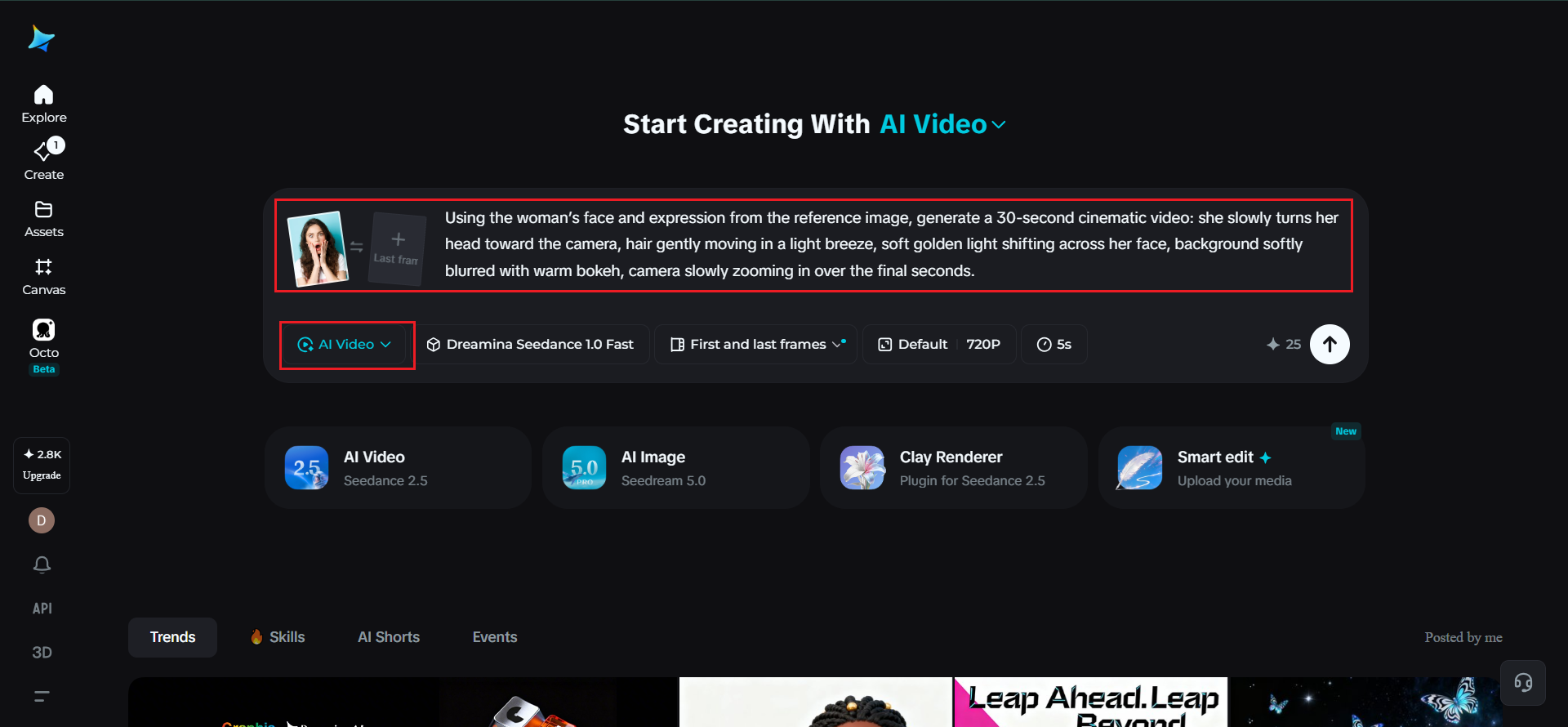
Sign in to Dreamina and open the "AI Video" section. Click "Add reference image" and upload your portrait, then write a prompt describing the motion and setting you want built around it.

For a 30-second clip, try: Using the woman’s face and expression from the reference image, generate a 30-second cinematic video: she slowly turns her head toward the camera, hair gently moving in a light breeze, soft golden light shifting across her face, background softly blurred with warm bokeh, camera slowly zooming in over the final seconds.

Portraits

Step 2: Generate with Seedance 2.5

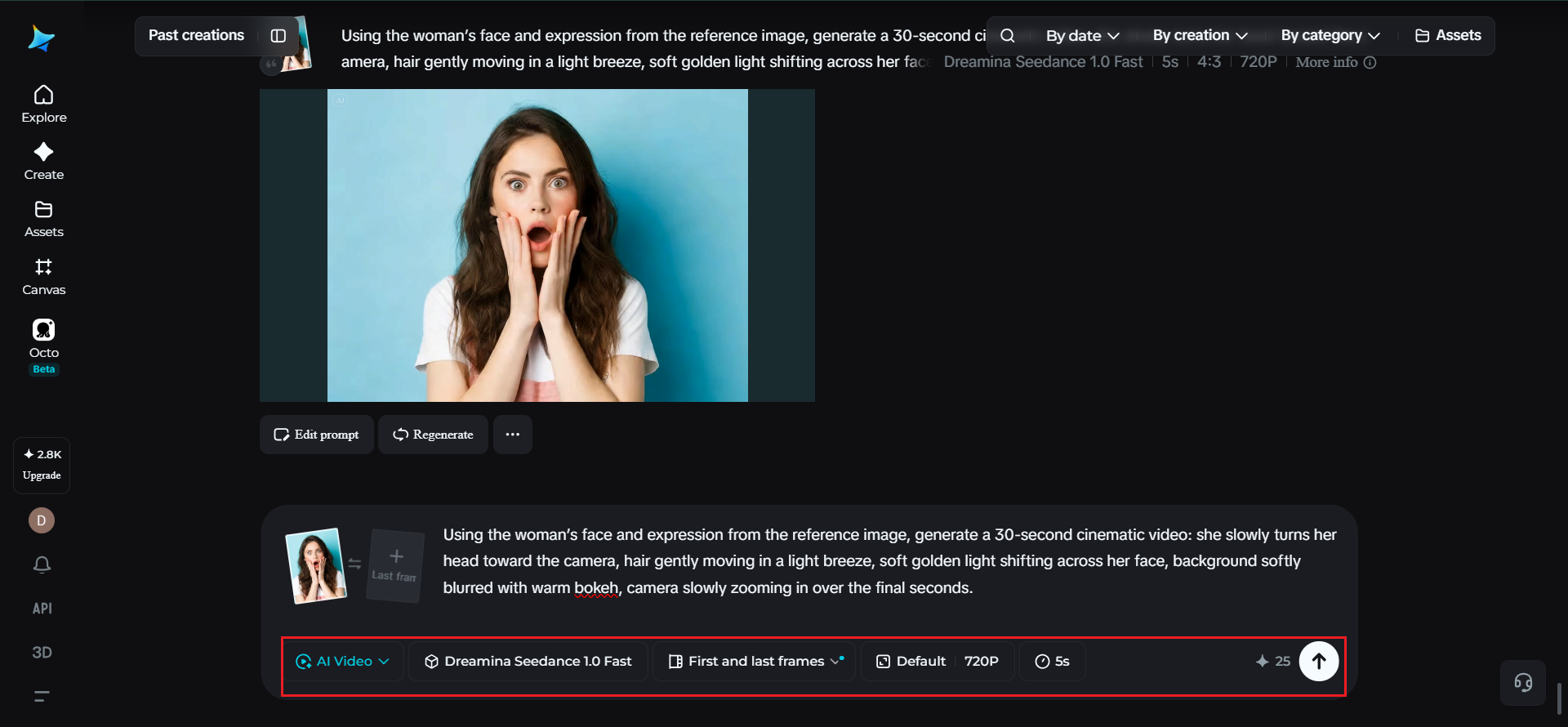
Choose the Seedance 2.5 model, set your desired video length, and pick an aspect ratio suited to your platform — 16:9 for a cinematic YouTube feel, 9:16 for Instagram or TikTok. Tap Dreamina’s generate icon and let it render.

Portraits

Step 3: Refine and export

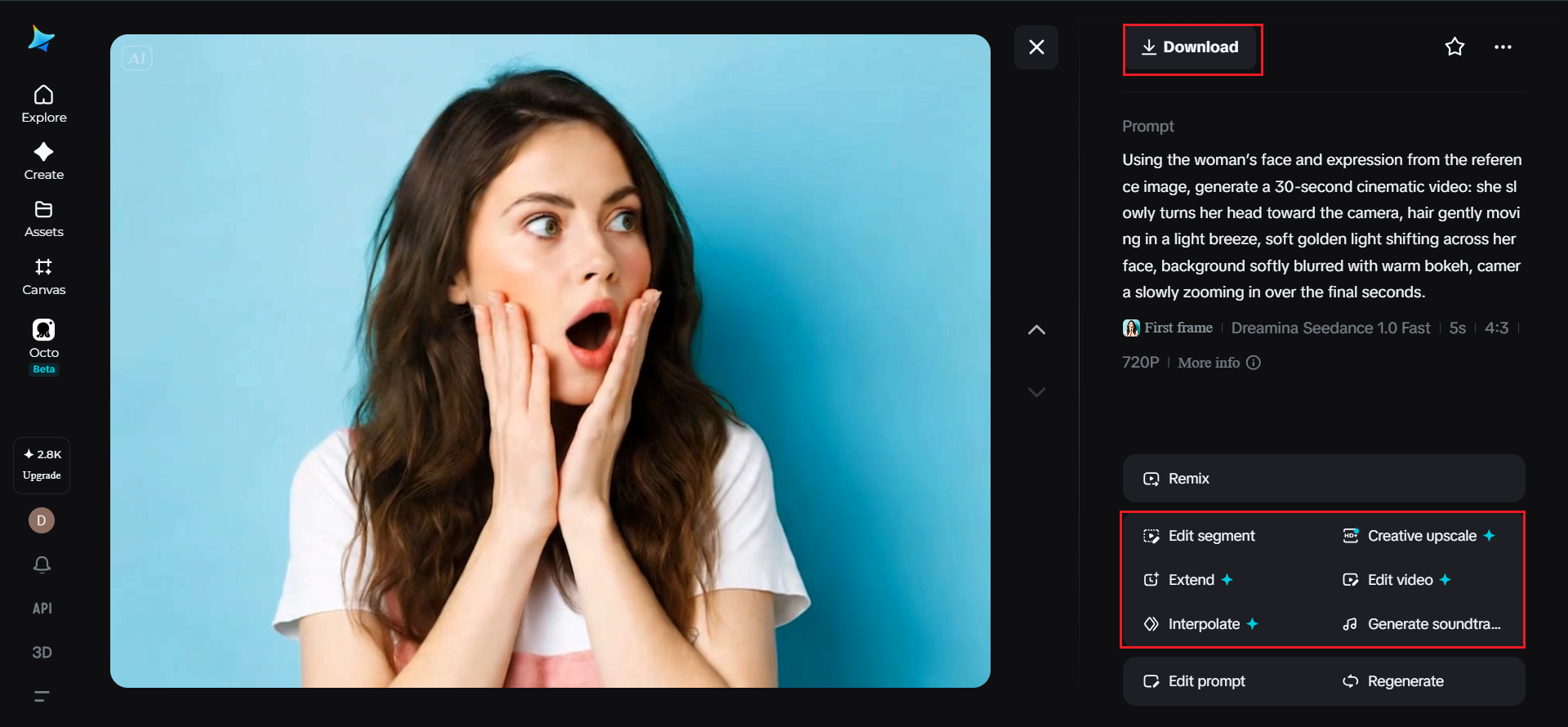
Polish the finished clip using Dreamina’s editing tools — Upscale for crisper detail, Generate soundtrack for mood-setting audio — then export and share it wherever your audience is watching.

Portraits

Why portraits specifically benefit from AI video

Faces are one of the hardest things to animate convincingly, which is exactly why strong portrait-to-video results feel so impressive. A few reasons this format works so well:

  • Subtle facial motion reads as deeply human, even in short clips
  • Portraits already have strong lighting and composition, giving the model a clean foundation to build on
  • Small, believable movement holds attention longer than static images in feeds and ads

Inside Seedance 2.5: the model doing the heavy lifting

Keeping faces consistent, not "twinned"

One of the trickiest parts of animating a person is making sure they stay recognizably them throughout the clip. Seedance 2.5 specifically resolves the duplication issue where a single subject could oddly split into look-alike figures, keeping the portrait’s identity intact from first frame to last.

Longer takes for fuller scenes

Clips can run natively up to 30 seconds, with an "Ultra-long Video Generation (beta)" mode extending that to a full 180 seconds — enough time for a portrait to shift through several small, natural movements rather than one quick gesture.

Realistic texture over the "AI look"

The model has meaningfully reduced the artificial, plasticky quality that used to give AI-generated faces away, favoring more natural skin texture, lighting behavior, and motion.

Voice and tone reference improvements

For portraits paired with speech or narration, Seedance 2.5 offers improved voice/tone reference consistency, which is a quiet but meaningful upgrade if you’re building talking-portrait content.

Common pitfalls when animating a portrait

A handful of details can make or break the result:

  • Vague prompts like "make her move" without specifying what kind of motion
  • Backgrounds that are too busy, pulling attention away from the face
  • Skipping the enhance step, leaving skin texture or resolution looking soft

Choosing the right portrait to start with

Not every headshot is an equally strong starting point. Portraits with clear lighting, a relaxed expression, and minimal background clutter tend to animate more convincingly than heavily posed or shadow-heavy shots. If the eyes and light direction are clear in the original, the model has an easier time keeping motion believable.

Portraits

Where dynamic portrait videos fit best

This style of content shows up naturally in personal branding reels, about pages, memorial or tribute videos, and social profile content that wants to feel more personal than a static photo. A single strong portrait, animated once, can carry an entire campaign’s worth of warmth.

Final thought

A portrait was never meant to stay perfectly still — it was always just one frame of a much longer moment. With Dreamina and the quiet precision of Seedance 2.5 behind it, that moment can finally keep going, turning a single face into a scene worth watching twice.

Dorset Gardens: A Landmark Residential Triumph on Dorset Road

In a stunning revelation of market confidence and strategic acquisition, the UOL Group, in collaboration with Singapore Land and Kheng Leong, has successfully clinched Dorset Gardens through an impressive $524.3 million bid. This landmark deal not only underscores the premium value of real estate along Dorset Road but also highlights the potential of Dorset Gardens as a pivotal residential hub near the vibrant Farer Park MRT Station.

Poised to transform the luxury lifestyle in the region, Dorset Gardens will offer an unmatched city living experience, which best combines modernity with a sense of accessibility. This strategic location together with the expertise of UOL Group and its partners makes sure that this new development will be extraordinary.

Dorset Gardens: A Strategic Masterpiece by UOL and Partners

The $524.3 million bid by UOL Group, in conjunction with Singapore Land and Kheng Leong is not only a financial bid but also a visionary project to turn the Dorset road into a luxurious residential enclave. With its strategic location and design flair, Dorset Gardens will emerge as a symbol of high-end living and a valuable property in the portfolios of both high-market and high-class investors and homebuyers.

The cooperation of such well-known designers is the insuring factor that Dorset Gardens will be the perfect place to where a person who wants to live the life of rich and comfortable living. Its easy accessibility to the rest of the city by the closeness to Farer Park MRT Station adds more strengths to it.

The Investment Appeal of Dorset Gardens

Not only a choice of high-quality living, Dorset Gardens will be a sensible investment. The kind of foresight that UOL Group and its partners have demonstrated by identifying the potential of the Dorset Road could be seen in their large bid which shows confidence in the growth potentials of the location as well as commitment to build quality residential space.

Dorset Gardens will be of interest to investors seeking to take advantage of Singaporean strong real estate market. Its strategic location, as well as the experience of the developers, will yield a high investment payoff in terms of capital gains as well as rental income.

Enhanced Connectivity and Lifestyle Choices at Dorset Gardens

The residents of Dorset Gardens will be well connected to the shopping, dining and entertainment facilities through the easy accessibility of Farer Park MRT Station within the development. The accessibility of key transport connections implies that there is nothing outstanding and interesting about the bustling city of Singapore that will not be within the short reach.

Dorset Road is a place with a rich blend of cultural heritage and modern comforts giving the place an enriched urban lifestyle. Dorset Gardens is at the intersection of a dynamic lifestyle; between local restaurants and international restaurants, small boutiques and large shopping malls.

A Commitment to Quality and Sustainability

UOL Group, Singapore Land, and Kheng Leong are not concerned only with the provision of luxury but also strive to make it sustainable, as well as, pay attention to quality. Dorset Gardens should be a prototype of the ecologically friendly lifestyle, loaded with the newest in the realm of sustainable building technologies and smart house designs, making sure that its environmental footprint would be minimal, even as it would be making the residents more comfortable.

The attention to detail and the fact that these developers are expected to meet high standards in building the buildings imply that the Dorset Gardens will be a beacon of quality. The development is focused on the most efficient and environmentally conscious use of the materials, the incorporation of green areas and water features, all elements of the work are created with the greatest attention and concern to nature and the quality of life of the inhabitants.

Dorset Gardens: Your Ultimate Destination for Luxurious Urban Living

The fact that UOL Group and its partners have acquired Dorset Gardens at a staggering cost of 524.3 million is a sure sign that the project is rated as one of the best residential developments. The development will not only enhance the profile of Dorset Road but also offer an exemplary living experience that is luxurious, convenient and sustainable.

Its strategic position, emphasis on quality and support of some of the most reputed developers in the locality make Dorset Gardens an important destination that is likely to be among the most desirable addresses in Singapore. As either a house or an investment the Dorset Gardens presents a unique chance to enjoy a life of unrivaled comfort and ease.

Glass Deck Railings in Canada: Style, Safety & Design Trends

Outdoor spaces have become an important extension of the home, especially in Canada where decks are often used for relaxing, entertaining, and enjoying the surrounding landscape. As homeowners look for railing options that combine safety with a clean appearance, Glass Deck Railings in Canada have become an increasingly popular choice.

Glass also is able to accommodate open sightline as opposed to traditional railing material which may form a strong visual barrier and can be used to complement various architectural styles and decking types. Glass railing can be used on cottages and suburban homes as well as on modern buildings and it offers a useful and modern appearance, without dominating the exterior area.

Quick Answer: What Makes Glass Deck Railings a Modern Choice?

Glass deck railing is a middle way between sight, safety and contemporary design. Clear panels also enable the homeowners to have a view of the gardens and landscapes or water bodies, without the visual barrier that solid and highly structured railings cause.

They also have the capacity to work with wood, composite, stone, PVC, among other decking materials. Since the glass appearance is not that neutral, it can be applied to both the modern and the traditional house and help keep the overall outdoor space unobstructed.

Popular Glass Deck Railing Styles

Glass railings are not designed in a specific pattern. The style is adaptable to the architecture of the home, the deck design, the appearance one would desire and the mounting specifications.

Frameless Glass Deck Railings are the favourite type of railings to be used by homeowners who prefer a minimal appearance. Having fewer visible structurals, they can make things appear seamlessly and maintain the focus on the surrounding landscape.

The alternative is a glass railing system which includes posts, clamps, spigots, channels or handrails. These elements can be structural and at the same time a substantial part of openness that is attributed to glass remains.

In the case of conventional homes, glass may add a discrete modern touch without compromising the nature of the materials, like brick, wood and stone. Glass may be incorporated in the exterior of the houses with clean lines and minimalism.

Safety & Strength: What to Know About Glass Railings

Safety should always be a priority when selecting a deck railing. For railing applications, tempered safety glass is commonly used because it is designed for greater strength and safety than ordinary annealed glass.

Glass Deck Railings

Nonetheless, it does not just have to do with picking the thickness of the glass. The size of the panel, the way that it is mounted, the structure and the overall setup of the railing must be taken into account.

To give an example, RF Transparent provides tempered glass in 12mm thickness and use as glass railing. The correct glass specification may not be exactly the same as the application and system design intended, therefore, homeowners should consider the entire system and not just the panel set-up.

Modern Glass Deck Railing Design Trends

Designing of modern decks is moving towards development of outdoor spaces, which are related to the house and the landscape around the house. This is among the reasons why glass is still being used in modern railing designs.

Open sightlines is one of the trends. Elevated decks can be made to feel less enclosed with clear panels that can still allow views to be a key feature of the design.

The other trend is the application of broader glass panels and minimisation of unwarranted visuals. A smaller number of supports can result in a cleaner look and well though-out panel layouts can be used to ensure consistency around corners and transitions.

Stair railing is also getting integrated and is a consideration. Homeowners can extend the same glass railing to the staircase as to the deck to appear more like a single feature instead of using the staircase as a distinct element.

Another design consideration is the issue of privacy. Clear glass will be best in areas where the view is valued, and it is not necessary to open up all of the deck. Glass can be used with landscaping, privacy screens, furniture placement as well as deck orientation to make an outdoor experience comfortable.

Understanding Glass Railing Systems

A glass railing is more than just a collection of glass panels. A Full Glass Railing System may consist of panels, mounting hardware, posts, spigots, clamps, channels, handrails and other structural elements.

Every element adds to the overall look and functionality of the railing. As an example, a design will have a minimal look when having fewer visible supports, but more posts or hardware could give the design a different appearance.

This is the reason why homeowners who are comparing railing systems must consider the entire system rather than comparing glass panels individually. The final result can be influenced by the mounting approach, hardware finish, the deck structure, panel arrangement and even the installation requirements.

How to Choose the Right Glass Deck Railing

The first step to select the appropriate railing is to comprehend the utilization of the deck. The homeowner must take into account the aesthetic nature of a space as well as the functionality needs when choosing a system.

Glass Deck Railings

A few important factors to consider include:

  • Deck style: Choose a railing design that complements the home’s architecture and existing outdoor features.
  • Visibility: Clear glass is ideal when maintaining views of gardens, landscapes, or waterfront areas is a priority.
  • Deck material: Glass can complement wood, composite, PVC, stone, and other decking surfaces.
  • Privacy: Consider the deck’s location and whether additional privacy features may be needed.
  • Hardware: Spigots, clamps, posts, channels, and handrails can influence both appearance and system configuration.
  • Stairs and layout: If the deck includes stairs or multiple levels, make sure the railing design works consistently throughout the space.
  • Maintenance: Consider how often the glass and hardware will need cleaning based on the property’s surroundings.

Looking at these factors together can help homeowners choose a railing system that fits both the property’s design and the practical needs of the outdoor space.

Simple Maintenance Tips for Glass Deck Railings

A benefit of glass is that it does not need to be frequently stained, painted or sealed as it is with other traditional materials used in railings. But it should still be cleaned regularly to ensure that it has a clean and good look.

The glass used outdoors can be dusty, polluted by wind, elements such as rain, snow-related dirt and water spots. Frequent cleaning will maintain the appearance of the panels and retain the open look of the railing.

An easy maintenance process can involve wiping the glass down frequently, checking on water spots and exterior residue, and maintaining hardware clean. Depending on the environment of the property and exposure to the outdoor factors, the frequency of cleaning may vary.

Glass Deck Railing Solutions from RF Transparent

RF Transparent offers glass railing products and system components to the residential and commercial glass railing market in Canada to homeowners, contractors and builders looking to add glass railing to a new or existing structure.

It offers the following products: Glass railing systems, glass panels, railing hardware and handrails and accessories. The company provides 12mm tempered glass panels as well to use in railing works as well as spigots, clamps and other hardware.

Planning a project can be simplified by going through the entire system and knowing how the glass, hardware, mounting method and the overall design will be cooperative.

Create a More Open & Modern Outdoor Space

Safety of a deck can be affected by a lot more than the right railing. It can influence the way the space appears to be visible within the home, the ease with which the surrounding landscape can be viewed, and the connection of the deck to other home property.

Glass Deck Railings in Canada provides an opportunity to unite these priorities in a flexible manner. Glass can serve to give the exterior the impression of an open space, whether it is a modern backyard deck, cottage overlooking the water, or a remodeling of a traditional home.

The deck layout, glass specs, hardware, stairs, privacy, and maintenance requirements should be considered before selecting a system. A structured railing can be both a functional feature of the outdoor environment- it can offer security and at the same time enable the deck, house, and landscape to collaborate aesthetically.

FAQs

Are glass deck railings safe?

Yes. Tempered safety glass is commonly used for railing applications, with the complete system selected according to the project’s requirements.

What type of glass is used for deck railings?

Tempered safety glass is commonly used. The appropriate thickness depends on the application, panel dimensions, mounting system, and requirements.

Are frameless glass deck railings durable?

They can be durable when the glass, hardware, mounting method, and overall system are appropriately selected for the application.

Are glass deck railings easy to maintain?

Yes. They require routine cleaning to remove dust, pollen, water spots, and other outdoor residue.

Can glass railings be used with different deck materials?

Yes. Glass can complement wood, composite, PVC, stone, and other decking materials.

What is included in a glass railing system?

Depending on the design, a system can include glass panels, spigots, clamps, posts, channels, handrails, and other mounting hardware.

How do I choose the right glass deck railing?

Consider your deck design, architecture, views, privacy needs, stairs, glass specification, hardware, and complete system requirements before choosing.

Why is Project Management Important in Today’s Business Environment?

Ever wondered how successful businesses keep projects moving when priorities and market conditions keep changing? Strong Project Management gives organisations the structure needed to turn plans into measurable results. PRINCE2 Courses can help professionals understand structured approaches for planning and controlling projects effectively.

Businesses today must manage limited resources and growing customer expectations. Effective project planning helps teams stay focused while responding to change. It also improves communication and accountability. In this blog, we will explore the key reasons Project Management is essential in the modern business environment.

Why Project Management is Essential in Today’s Business Environment

The following are the key reasons why Project Management is important for helping businesses achieve their goals, manage resources effectively and deliver successful outcomes:

Turns Business Goals into Clear Action

Although a company objective may seem ambitious, it requires a workable path to be realised. Project Management transforms general goals into precise assignments and deadlines. Supervisors can define what needs to be done and who is in charge of each work. Teams then comprehend how their daily responsibilities contribute to more general business goals. Everyone is kept focused on significant results rather than disparate tasks thanks to this clarity. Additionally, it facilitates monitoring the project’s progress.

Keeps Projects Focused on Priorities

Priorities in business can shift rapidly. Project progress may be affected by changing market conditions and customer expectations. Teams can easily waste time on low-value activities without clear guidance.

Good project planning helps teams identify the most important activities and focus resources accordingly. Managers can review priorities as circumstances change. This allows organisations to remain flexible without losing sight of the original project objectives. Clear priorities also help employees make better everyday decisions.

Makes Better Use of Time and Resources

Every project works with limited resources. These may include people, money, technology and time. Poor resource management can create delays and unnecessary costs.

Effective resource management helps businesses understand what is available and where it should be used. Project Managers can assign tasks according to individual skills and availability. They can also identify resource gaps before they create serious problems.

This approach reduces wasted effort and helps teams work more efficiently. PRINCE2 Courses can help professionals develop structured Project Management knowledge to handle these responsibilities.

Helps Businesses Control Project Risks

Unexpected problems can affect almost any project. A supplier may miss a deadline. Costs may rise. A technical issue may interrupt progress. The important question is how prepared the business is to respond.

Risk management helps teams identify possible problems before they become difficult to control. Managers can assess the potential impact and prepare suitable responses. Regular risk reviews also help teams notice new concerns as the project develops. This preparation can reduce disruption and support more confident decision-making.

Keeps Costs and Deadlines Under Control

Missing a deadline can affect customers, budgets and future business plans. Cost increases can create similar problems. This makes project cost management and schedule control essential to successful delivery.

Project Managers can create realistic budgets and timelines before major work begins. They can then compare actual progress against the original plan.

Teams can respond sooner when delays or additional costs arise. Making small changes at the right time can prevent bigger problems later. Senior executives can make better company decisions with clearer information thanks to improved control.

Improves Quality and Customer Satisfaction

Finishing a project on schedule means little if the outcome falls short of expectations. Instead of reviewing quality only at the end of a project, businesses should consider it throughout.

Effective quality management establishes clear criteria for project deliverables. Teams can review work regularly and correct issues before delivery.

This approach supports stronger customer satisfaction because the result is more likely to match customer requirements. Consistent quality can also strengthen the organisation’s reputation and encourage long term customer relationships.

Supports Business Growth and Change

Doing everything the same way is not a viable strategy for modern businesses to be successful. Businesses frequently must adapt their operations due to new technologies and competition.

Read More: Four Filipino-American Businesses to Watch Out for This Year

Project Management abilities offer a methodical approach to implementing new services, systems, and operational procedures. Teams can plan changes carefully and track their impact.

This makes Project Management valuable for business growth and everyday delivery. Organisations gain greater control over the journey from concept to delivery. They can also apply lessons from completed projects to future initiatives.

Conclusion

Strong Project Management helps businesses turn ideas into results while controlling costs, deadlines and expectations. It also gives teams the clarity needed to respond confidently when business conditions change.

Professionals looking to strengthen these skills can explore PRINCE2 Courses with The Knowledge Academy, one of the best training providers, to build practical knowledge that supports successful project delivery and stronger business performance.

Comprehensive Gets Used a Lot in Insurance Marketing. Here’s What It Should Actually Mean

Almost every insurer advertises some version of the best health insurance, and "comprehensive" is one of the most overused words in that marketing. Stripped of the marketing gloss, the term should describe a specific, checkable set of features, not just a vague promise of broad protection.

What Comprehensive Coverage Should Actually Include

A genuinely comprehensive health insurance plan typically covers pre- and post-hospitalisation expenses, daycare procedures that don’t require a 24-hour admission, ambulance costs, and modern treatment methods that may not fit the traditional inpatient model. Checking a policy against this checklist, rather than accepting the label at face value, reveals how comprehensive a plan actually is.

Room Rent Clandestinely Corrosive Takes Over Comprehensive Asserts

Policy may promote a generous amount insured, and at the same time limit room rent to an amount that brings down the effective pay out on all other lines in a hospital bill. This fact is subtle when used in marketing text but plays a disproportionate role in the amount that a policyholder gets when making a claim.

Add-Ons transform a Base Policy into a Policy that is more like a comprehensive one

Perks such as maternity cover, critical illness protection and OPD cover take a base policy to a whole new level; however, they increase the premium. The selectivity in deciding what add-ons really pertain to the circumstances of a particular household, instead of throwing all available options into the basket, makes the policy affordable, on top of which the gaps that are most relevant in this context are closed.

Network Breadth Is on the Total Equation, Too

On paper coverage won’t help much when the cashless network does not cover hospitals near the home. To ascertain that one has access to the network that is known to local needs and not presume that there is some nationally large network that would cover local needs is typical of what makes a policy comprehensive in practice, and not merely in name.

Before Thinking the Label, read the Exclusions Section

A policy document exclusions section is the part that tells the most accurate story than any marketing summary does. An apparently comprehensive plan may exclude a number of treatments, impose limits on the coverage of a particular condition, or introduce longer waits than anticipated. It is better to read this section prior to making purchase rather than finding out about these limits after making a claim.

Why Marketing Nurse Often Does Not go with Policy Wording

Landing pages and brochures are composed in a manner that needs to sell a policy, which naturally presupposes the focus on the strengths and glossing of limitations. The policy itself, in contrast, is a piece of legal writing, which articulates the exact limits of what is and is not contained, so it is the only sure place to check whether a label of any given policy can indeed be considered comprehensive or not.

An experimental Pre-test Before Believing the Label

A helpful exercise is to take two or three real-life situations, an intended surgical procedure, a chronical condition exacerbated, a maternity incident, and examining precisely how the policy document handles each. Such a scenario reading in the form of reading shows much more about what real comprehensiveness would ever be in the form of skimming a list of features.

Evaluating the Processing of Contemporary Treatment Approaches by a Policy

Medical care has changed significantly, and robotic surgery, day-care chemotherapy and other procedures based on the technologies are the routine that could be observed in the majority of hospitals. Any policy that merely covers traditional and extended-stay treatment models may open a real gap to anyone whose treatment model depends on these more recent approaches, so it is best to clarify rather than generalize that modern treatment is under the umbrella heading.

Extensive Doesn’t Have to be Costly

The general belief is that an actually comprehensive coverage necessarily implies a much larger premium, though the correlation does not always work in the straight line direction. Making a good choice of the relevant add-ons and comparison among the various insurers offering the same core can usually point to a plan that goes through the checklist above with paying plans that are not so expensive as opposed to more basic plans.

Returning to the Renewal Comprehensive Checklist

A policy covering all the items in a thorough checklist when you buy them might not be continually reflective of the new terms or of your own evolving personal situation through time. Checking the same checklist every time one is renewed instead of assuming that nothing has changed makes the comprehensive label apply instead of being old-fashioned.

In the Areas where People are caught most

Most frequently complained policyholders are not the cost of the premium, rather finding one of the many sub-limits or exclusions after a claim has been made. One of the easiest methods to have a pleasant surprise later is to read the policy language regarding room rent capping, disease specific limits, and time spent waiting before joining up, instead of joining up after a hospital bill has been received.

The Bottom Line

Comprehensive Comprehensive is a subject that has to be checked on the particulars and not a mere word which was conducted on your faith as seen on the brochure. Comparison of room rent limits, network breadth and exclusions with the claim provides a much truer sense of whether a policy really matches up to the title.

From Massive FPS Drops to Stable Gameplay: How I Used Smart Game Booster to Save My Session

Hardly anything can be more irritating than having entered the good gaming process only to realize the FPS was dropped.

That occurred with me recently. The game was running effectively, however, after some time frame rate began swinging up and down. Movements were less responsive and at crucial points, the abrupt stuttering proved so frustrating.

The initial thought that came to my mind was that my PC was just getting too old to play the game. One thing that I had to determine before committing money on the purchase of new hardware was what was actually causing the problem.

The Problem Wasn’t Always Low FPS

One of the things which I immediately observed is that my FPS was not always low.

There were occasions when the game would just be running fine, but then the game would occasionally be choppy.

When the game was running, I opened Task Manager and examined what was occurring in the background.

Some of my applications were using both the CPU and memory, though I was not using them. Others were copying files, whilst others were merely executing background jobs.

I opened and closed unnecessary programs and restarted the game.

It became a little better, however, the frequent FPS drops remained.

I Decided to Try Smart Game Booster

That’s when I started looking for a simpler way to optimize my PC before gaming. I came across Smart Game Booster and decided to give it a try.

Smart Game Booster

I wasn’t expecting it to magically make my hardware more powerful. My goal was much simpler: I wanted to reduce unnecessary system activity and prepare my PC for gaming without manually checking multiple Windows settings every time. The gaming-focused approach was what interested me most.

Features I Like Most

The Smart Game Booster 6 has some significant performance gains and tools that aim to optimize the gaming experiences:

Brand-New Network Acceleration: Includes a network acceleration service driven by more than 500 servers across the world to lessen the time and connection delay when playing online games.

Smart Game Booster

Enhanced Super Boost: Overspeeds the GPU and the VRAM to provide up to 30 performance improvements on new releases.

Re-engineered PC Boost: Has one-click background application control to release exhibited system resources.

Optimized Auto Boost: Maximizes system performance used in gaming automatically without the need to do it manually.

CAN I RUN IT Tool: Improves compatibility checks with hardware to ensure that users can check the compatibility of their system with a game.

How I Tested It

I wanted to judge the difference based on my own experience rather than simply assuming the software would help.

First, I played the game normally and paid attention to the situations where the FPS dropped.

Then I closed unnecessary background applications and checked my system again. After that, I used Smart Game Booster to optimize my PC before launching the game.

I kept my expectations realistic and didn’t change every available setting.

Instead, I focused on the options that were relevant to my gaming session.

The Difference I Noticed

The biggest improvement wasn’t a massive increase in the average FPS. What I noticed more was consistency. The game felt smoother during busy scenes, and the sudden stutters happened less frequently.

That was more important to me than just having an increased rate on an FPS meter. Constant oscillation between low- and high-FPS is worse than a consistent frame rate which makes a game more enjoyable.

That is also why I was interested in using an FPS Booster as a part of my gaming system. I did not expect the performance increases, which are impractical. I desired a more reliable experience to the hardware that I already owned.

I Also Checked My Graphics Driver

While troubleshooting the FPS problem, I realized that system optimization isn’t the only thing worth checking.

Graphics drivers can also affect gaming performance and compatibility.

I checked whether my graphics driver was up to date and installed the latest appropriate update.

This was an important step because I didn’t want to blame Smart Game Booster for a problem that could actually be caused by outdated software.

I also reviewed the game’s graphics settings and made sure I wasn’t asking my hardware to do more than it could comfortably handle.

My Gaming Routine Became Easier

After that experience, I developed a simple routine before playing demanding games.

I close applications I don’t need.

I check whether anything is downloading or syncing in the background.

I make sure my graphics drivers are updated.

I review the game’s graphics settings when necessary.

Then I use Smart Game Booster when I want a quick way to optimize my PC before starting the game.

This takes much less time than manually checking different Windows settings.

Why I Like the FPS Booster Approach

What I appreciate about an FPS Booster is the idea of improving the experience through optimization rather than expecting software to replace hardware.

If my graphics card simply isn’t powerful enough for a particular game, no booster can completely solve that problem.

But if unnecessary background processes, system settings, or other software activity are affecting performance, optimization can help make better use of the hardware that’s already available.

That’s the approach that makes sense to me.

Pros

  • Gaming-focused interface that’s easy to understand.
  • Helps prepare the PC before demanding gaming sessions.
  • Can reduce unnecessary background activity.
  • Makes routine optimization more convenient.
  • Useful for players who want a simpler FPS optimization process.

Cons

  • It cannot overcome genuine hardware limitations.
  • Results can vary depending on the game and PC configuration.
  • Some FPS problems require driver or hardware troubleshooting.

Final Verdict

My FPS drops initially made me think that my PC was no longer capable of handling my games.

After investigating the problem, I realized there were several other factors worth checking first.

Background applications, graphics drivers, system resources, and game settings were all contributing to the overall experience.

Using Smart Game Booster gave me an easier way to prepare my PC before gaming, while the FPS Booster approach helped me focus on smoother and more consistent gameplay rather than simply chasing the highest possible FPS number.

It wasn’t a miracle fix, and I wouldn’t expect it to be. But it helped reduce the amount of manual troubleshooting I had to do and made my gaming routine much easier.

For me, that’s the real benefit: spending less time trying to figure out why my game is stuttering and more time actually enjoying the game.

How K2view Enhances Mainframe Data Masking

Mainframes are still at the heart of many critical businesses. Banks, insurers, airlines, governments – a lot of their most important systems still run on those big iron boxes. They’re stable. They’re fast. And they’ve been around for decades.

But they carry a lot of baggage. One of the biggest pieces of that baggage is sensitive data.

Think about what lives on a typical mainframe: customer records, account details, transaction histories, social security numbers, and health information. It’s a gold mine for attackers and a constant headache for security and compliance teams. 

Most organizations know they can’t just leave that data wide open. So they try to mask it, especially in non‑production environments. Test, dev, QA, training. Anywhere real mainframe data is copied and used by people who don’t need to see the real thing.

On paper, that sounds straightforward. In reality, it’s messy.

Why mainframe masking is hard

Mainframes aren’t simple relational databases with nice, modern schemas. You’re dealing with COBOL copybooks, VSAM files, IMS hierarchies, packed fields, custom encodings, and decades of layering.

Often, no one person fully understands the entire data model anymore. The original designers may have retired. Documentation is patchy. And yet, you still have to protect that data without breaking the applications that rely on it.

Traditional masking approaches tend to fall into two camps:

  • Homegrown scripts that do just enough to get by
  • Point tools that treat mainframe like any other data source

Both have limits. Scripts are fragile, hard to maintain, and usually cover only part of the landscape. Generic tools may not really “get” mainframe structures, so you end up flattening data, exporting it, transforming it, and hoping it all lines up when you push it back.

This is where K2view takes a different route.

From files and fields to “business entities”

K2view doesn’t start with files and tables. It starts with business entities – customers, accounts, policies, claims, and so on.

Instead of saying, “Mask column X in file Y,” you define a data product for something meaningful, like a single customer. That product bundles everything related to that customer across the mainframe and any connected systems. Not just one file, but every place the customer appears.

Once you have that, you can define masking rules at the entity level. You don’t just randomize a name in one file. You mask the customer’s identity consistently wherever it shows up – in COBOL records, in DB2 tables, and in downstream analytics platforms.

That matters a lot for Mainframe data masking. You still want tests to behave realistically. You need the same “fake” customer to appear across multiple applications, so workflows, reports, and end‑to‑end scenarios continue to work.

Understanding mainframe formats

Mainframe data is not always intuitive. Fields can be packed decimals, binary flags, or encoded in ways that don’t survive naive masking.

K2view puts effort into understanding those structures properly. It can work directly with copybooks and mainframe formats instead of forcing you to export and reshape everything manually. That means when you mask a field, you preserve the format and length, so applications don’t crash or behave strangely.

For example, you can mask an account number but still keep the right number of digits and a valid check digit pattern. You can mask dates while keeping them in acceptable ranges. You can anonymize names and addresses but still maintain valid character sets and lengths expected by legacy programs.

So you protect the data, but you don’t destroy its usefulness.

Consistent masking across environments

Most organizations don’t have just one mainframe environment. They have a chain: production, QA, system test, user acceptance, training, maybe more.

Each environment needs data. And that data needs to be safe.

With K2view, you define your masking policies once, tied to those entity‑based data products. When you provision data into a non‑production environment, the masking happens as part of that provisioning process. Not as an afterthought. Not as a separate script that someone has to remember to run.

This does two things:

  1. It makes the process repeatable. You can refresh test data more often without reinventing the wheel every time.
  2. It makes compliance easier. When auditors ask how non‑production mainframe data is protected, you can point to a single, consistent framework instead of a mix of one‑off jobs.

Keeping relationships intact

One of the biggest complaints about masking is that it “breaks” the data. Relationships disappear. Scenarios don’t work. Testers lose confidence.

K2view’s entity model helps avoid that.

Because it treats something like a customer as a single data product, it masks all the related pieces together. The customer’s accounts, transactions, claims, and related parties all get transformed in a coordinated way. Keys and relationships are preserved, even if the underlying values change.

So you can still test things like the following:

  • Multi‑account customer flows
  • Cross‑system reconciliation
  • End‑to‑end transaction journeys

You’re working with safe data, but the structure and relationships still feel real.

Speed and automation

Mainframes often sit at the center of complex release cycles. When you’re pushing changes, you can’t afford to wait days for test data to be prepared.

Once K2view is in place, provisioning masked data becomes part of an automated pipeline. Extract from production (or an approved subset), assemble by entity, apply masking rules, then push to the target environment.

You can schedule this, you can trigger it as part of CI/CD. You can refresh more often, with less manual effort from the mainframe team.

That means fewer bottlenecks, fewer late‑night jobs, and less reliance on a handful of experts who know how to run the old scripts.

Visibility and control

Masking decisions aren’t just technical. Security, privacy, legal, and business owners all care.

Because K2view centralizes the rules, it also centralizes visibility. You can see which attributes are masked, which methods are used, and where those rules apply. Changes are tracked. Policies can be reviewed and agreed on by the right stakeholders.

This is much easier to manage than a scattering of JCL jobs, shell scripts, and custom code. It also creates a cleaner story for regulators and auditors.

Beyond the mainframe itself

Modern architectures rarely keep mainframe data locked up on the mainframe alone. Data flows out to data warehouses, cloud analytics, CRM, and other systems.

K2view’s data products can extend beyond the mainframe boundary. Once a customer or policy is modeled as an entity, the same masking policies can apply as that entity is provisioned into other systems.

That gives you a more coherent protection model. You’re not safe on the mainframe and exposed everywhere else. You’re applying one set of rules across the broader landscape.

A more practical approach to mainframe data protection

Mainframes are not going away any time soon. They’re too valuable, too embedded, and too reliable. The challenge is to bring modern data protection practices to that world without breaking what already works.

K2view helps by changing the unit of work. Instead of thinking in files and columns, it thinks in people, accounts, and policies. It masks at that level, with an understanding of mainframe formats and constraints, and carries those rules across environments and systems.

The result is safer non‑production data, more realistic test scenarios, and a clearer governance story. You still get the resilience and performance of the mainframe, but with a more modern, controlled way to handle sensitive information.

The Changing Role of Technology in Modern Digital Publishing

Technology has changed the way people write, edit, publish, and share content online. What once took many people and a lot of time can now be done faster with the help of digital tools.

The use of technology as part of daily writing, publishing, and business work is now of major importance to all. 

All there is to do is use the tools effectively to facilitate a less time-consuming process without losing the content that is clear, convenient, and naturally written.

Professionals who want to develop practical skills for interpreting this type of information can consider a data analyst course online to build foundational knowledge in data analysis, visualization, and data-driven decision-making.

Technology Has Made Publishing Faster

In former times, the process was an immense task, and writers generated content; editors would check, designers would design, and finally the publishers would publish.

Today, many of these steps can be managed online.

Writers can write drafts, check spelling, enhance grammar, add images, format text, and publish all these things from one device. This has made it quite an easy process to write.

Editing Tools Help Improve Content

Digital editing tools are now widely used by writers and publishers.

Tools checking for grammar could possibly locate spelling errors in the sentence. Tools showing how easy the text is to read can identify clarity or lack of clarity in the text. The tools might tell you that you need to make your sentences more concise and natural.

AI tools are also becoming common in writing and editing.

They can give you ideas, outlines, change sentences, and write the initial draft. The downside is that some AI-generated material can sound stiff, monotonous, and robotic.

This is where an AI humanizer can be useful, especially when exploring options like AI humanizers tested and ranked to find the right tool for the job. It can help make AI-generated text sound more natural and easier to read. This can be helpful for writers who use AI for support but still want their final content to feel more human.

Even with these tools, a human is required. A human should always look over any generated content before it goes live.

Digital Publishing Is Easier to Access

Technology has also made publishing possible for more people.

Publishers in the past required the large, established entity of a big publishing firm, whereas at present any number of new technologies and outlets are available, from blogs and personal websites to online magazines, newsletters, eBooks, and social networking.

Small businesses and independent writers can now share their work without needing a large team.

Cloud Tools Make Teamwork Easier

Cloud-based tools allow writers and editors to work together from different places.

For example, several people can open the same document, make changes, leave comments, and review updates in real time.

This saves time and reduces confusion.

Team members share and edit one document, which simplifies publishing. That reduces sharing and emailing many different versions.

Data Helps Publishers Understand Readers

Another major change is the use of website data.

Publishers can now access statistics about what content their readers are consuming. It will be possible to track which articles are being read, what headlines will spark an immediate click, and how long someone is remaining on a particular page.

This information helps publishers understand what readers enjoy.

Better Content Suggestions

Many websites also use technology to suggest related content.

For example, if someone reads an article about eBooks, the website may recommend another article about digital reading or self-publishing.

This can help readers find useful information without searching for it themselves.

It can also help publishers keep visitors on their website for longer.

Content Is No Longer Only Text

Modern digital publishing includes much more than written articles.

Publishers can now use:

  • Videos
  • Podcasts
  • Images
  • Infographics
  • Audio clips
  • Interactive features
  • Downloadable guides

These formats can make information easier to understand.

For example, a long article can include an infographic that quickly explains the main points. A guide can also include a short video to help explain a difficult topic.

Using different types of content can make a website more interesting and useful for readers.

Human Skills Are Still Important

Technology can help with many publishing tasks, but it cannot replace people completely.

Writers and editors still need to understand the audience, choose the right tone, check facts, and make sure the message makes sense.

A tool may suggest a sentence, but a person still decides whether that sentence is right for the reader.

This is why the best publishing process combines technology with human judgment.

Conclusion

Technology has made digital publishing faster, easier, and more flexible. Writers can now use AI tools, grammar checkers, cloud platforms, website data, and different content formats to improve the way they work.

Still, using more tools does not always mean better content.

The focus should be on tools that help to save time, enhance quality, and enhance clarity for the readers. Writers and publishers alike should analyze their process and implement technology where it clearly enhances productivity.

Digital publishing provides more utility, efficiency, and pleasure for creators and readers when technology enhances, rather than displaces, our own conceptions.

Add Multiple Voice Effects To Your AI Music Video Narration with Pippit

Narration can provide an AI-generated music video with context, personality, and enhanced storytelling capabilities. It can depict a scene, present a product, evoke emotions, or even direct viewers towards a specific action. Voice effects can also help distinguish speakers, sections, and creative moments. But sometimes the uncontrolled impacts cause narration to become inconsistent or hard to follow. Pippit offers AI video creation, audio, and video editing capabilities. A structured approach can be used to blend multiple effects without sacrificing the balance and clarity of the soundtrack.

Why Voice Effects Matter in AI Music Video Narration

Voice treatment can help set the mood and differentiate the various moments of a story in an AI music video. A warmer tone can enhance a story; a more pointed tone can add to a promotion. Variation can be used to differentiate product information from hooks, offers, and CTA’s in marketing content. This is also true for social videos that require quick transitions between scenes and require a distinct voice. Additionally, AI dubbing can incorporate various vocal effects if the localized narration includes different speakers or tones. Effects can be used to highlight and support introductions, transitions, hooks, and key points, but should not be a substitute for good delivery. Creative effects should not be the same as corrective processing to enhance intelligibility or listening comfort.

Voice Effects

Plan Voice Effects Before Editing the Narration

Before making edits, look for narration parts that really need to be treated vocally. Don’t apply effects at random, but in order of the purpose of the scene. Maintain the main narration in a fairly straightforward manner when information demands full attention. Correlate changes of voice with music structure, visual transitions, and changes in storytelling intensity. Repeat speakers in the same way, so the listeners understand the function of the storytellers. It also ensures that the voice does not sound out of place between scenes with a consistent approach. When using SeedAudio 2.0 references or related generation workflows, specify the vocal roles at the outset of a project.

Steps to Add Multiple Voice Effects To Your AI Music Video Narration with Pippit

Step 1: Set Up Your Voice-Enhanced Video

  1. Sign up for Pippit using your Google, TikTok, or Facebook account info.
  2. Open the "More" tab on the left menu and select "Video generator".

3. Choose an AI model, such as Dreamina Seedance 1.0, Dreamina Seedance 2.0, Dreamina Seedance 2.0 Fast, Dreamina Seedance 2.0 Mini, or Dreamina Seedance 2.5.

4. Write a detailed prompt covering narration, voice effects, angles, ambience, music, voice changes, speaker, and text.

5. Select the video length, language, subtitles, and aspect ratio if needed.

6. Click "+" to upload reference audio or videos from your device, phone, Dropbox, or a link. You can also select assets.

7. Click "Generate" to start.

Step 2: Generate the Voice Effects

  1. After clicking " Generate, " Pippit’s AI video generator creates the music video from your prompt and reference media/audio.
  2. The AI manages transitions, pacing, captions, avatars, voice, lyrics, and visual enhancements.
  3. Review the draft and check each narration section and voice effect.

Lastly Step 3: Fine-Tune and Export

  1. Click "Download" on the top right to save the video. Use "Regenerate" if needed, or select "Edit more" below the video for further customization.

2. Edit captions, add text, and adjust size, color, alignment, filters, voice, and effects.

3. Add background music, remove backgrounds, control emotional timing, edit sync, and fine-tune visuals. Adjust voice effects where needed.

4. Click "Export" when ready.

5. Choose "Publish" for TikTok, Instagram, or Facebook, or "Download" the video with your preferred format, resolution, frame rate, and quality.

Combine Different Voice Effects With Purpose

Start processing slowly for main narration, keeping words intelligible and natural. Only use more powerful effects at times when they are required to make a creative point. Different treatments can be used to differentiate speakers, characters, memories, announcements, or layers of narrative. Transition effects can link the large areas of the story and can indicate a significant change in the story. A darker treatment could complement a dramatic moment, and a lighter one could enliven a promotional hook. For an AI MV concept, effects can also be used to distinguish between the performance narration and explanatory commentary. Switch back to cleaner processing when viewers require optimum clarity for names, features, instructions, prices, or calls to action.

Synchronize Voice Changes With Music and Visual Movement

Wherever possible, voice-effect changes should match big musical changes. Vocal transformation can happen at a natural point such as a chorus, beat shift, or instrumental break. Sync narration emphasis to key visuals such as product reveals, scene transitions, close-ups, and text transitions. Do take care to adjust audio speed, as it may sound unnatural or change timing unexpectedly if done too aggressively. It is important that captions do not get out of sync with every significant timing change. Pauses can give room for significant visual or lyrical moments, and make sure that narration doesn’t clash with them. Pippit allows audio, caption, transition, and visual changes that can be used to tweak these relationships during editing further.

Protect Narration Clarity While Using Multiple Effects

Over-processing can create distortion, echo, unnatural pitch changes, or too much ambience and affect the intelligibility of speech. Narration must be prominent enough, but not just louder than background music. Instead, use music and ambience to give space to the speech in the overall mix. Subtitles can help to emphasise challenging dialogue, particularly where creative effects are used to change the voice character intentionally. Don’t change effects too often, as it can divert the viewers' attention from the message. Watching the full video and not just individual clips. Pay attention to vocal consistency, volume, clear transitions, accurate captions, and clear storytelling throughout the sequence.

Common Voice-Effect Editing Mistakes to Avoid

  • All effects: Choose effects for the narration, and not just for novelty’s sake or for experimentation.
  • Increase narration without increasing music: Make things clear by using the proper sound balance, not a louder voice.
  • Abrupt changes in voice(s): Link effect changes to scene shifts, music changes, or significant moments in the story.
  • Maintain recognizable vocal treatment when the same speaker returns: Changing one recurring speaker’s sound.
  • Ignoring captions after speed changes: Double-check subtitle timing after changing narration time during editing.
  • Don’t miss the final sync check: Observe the entire export and verify the voice, captions, music, and picture match up.
  • Overprocessing important information: Avoid creative treatment when the viewer needs to understand precise names, details, or instructions.

Conclusion

AI music videos can benefit from multiple voice effects to provide structure, personality, contrast, and storytelling. The best results are obtained through deliberate positioning, not by endlessly experimenting with your voice. When information needs to be understood immediately, clean narration should be dominant. If there are significant creative variations, differences in speakers, or music moments, stronger treatments should be used. Pippit integrates AI generation with post-generation audio and video editing, streamlining the entire process. With careful planning, synchronization, and a final review, it can yield narration that sounds distinctive but does not overwhelm the soundtrack. The rule of thumb is to keep it simple: use each voice effect to aid rather than overpower the story.

Four Filipino-American Businesses to Watch Out for This Year

Filipino-American entrepreneurs have long made an impact across wellness, food, beverages, and specialty retail. Here are four businesses gaining attention for their innovation and ability to bring Filipino-inspired products to wider American audiences. 

Many of these founders built their businesses online first using digital platforms for customer outreach, operations, and market research, which means security habits matter. Entrepreneurs who frequently work remotely or access business accounts while traveling often rely on tools, including a free VPN download, to protect sensitive business data on the go.

COCOLAB

Cocolab was founded by two sisters Dr. Chrystle Cu and Catherine Cu and began as a dental frustration business and emerged to be one of the most rapidly expanding oral care brands nationwide. Chrystle is a dentist in San Mateo who is fed up with seeing so many avoidable cavities, so in 2015 she combined with her sister Cat to start the company with a sponge-like woven dental floss that is recycled polyester and covered by both flavored to taste so strongly of freshness (wax and coconut oil) and its flavor (strawberry, coconut, mint, orange), offered in bright packaging and flavors, which are concepts that had not been used by legacy oral care brands before. 

The brand has since expanded into a full product line, made the Inc. 5000 list of fastest-growing private companies in 2025, and now sells in two-thirds of CVS stores and on Target.com. 

Goldilocks USA

One of the most recognized Filipino food brands in the United States, Goldilocks has spent decades introducing Filipino baked goods and traditional dishes to American consumers. Its long-standing retail history (especially in states where Filipino-Americans are significant in population) and ongoing national growth ensure it remains a reliable brand to observe with mainstream appetites toward Filipino foods rising. 

Goldilocks is the concept of the cultural resonance of diaspora-based businesses which remain culturally authentic, yet on its part, changes to fit American markets.

Sanzo

Sanzo was established by its founder and CEO Filipino-American queen Sandro Roco who had the realization that the sugar, preservatives and artificial flavors were used in high amounts in old Asian beverage brands. His answer was in the form of Asian-inspired sparkling water, which is prepared using fresh flavours, calamansi, lychee, mango, yuzu and ginger with no sugar.


Since then, Sanzo has expanded to Whole Foods, Sprouts Farmers Markets, over 2,000 outlets of Panda Express and Target stores, and is one of the more commonly used references to Asian-American entrepreneurship redefining the aisle of beverages. Another commonality between Roco and other Filipino founders has been the idea that the new generation of Filipino founders should also be mentored, a trend that has seen the brand extend its tentacle beyond the product. 

Obet & Del’s Coffee

Obet and Del Coffee was started by Filipino-Americans in Los Angeles and has gained recognition by Filipinos focus on Philippine coffee beans grown in their homeland and the hidden heritage of coffee in the Philippines. 

Because the desire of consumers to enjoy specialized coffee and branded products by the place of origin has not yet reached a peak, Obet and Del positions itself in a fascinating place: it is a culturally-specific tale, a story that appeals directly to the overall specialty coffee market.

A Practical Way to Create Order in Your Life

If you want to create order in your life, begin with clear financial habits. Whether you recently used a Texas title loan in New Braunfels to handle an urgent expense and regain momentum, or you are simply improving everyday money management, practical planning brings confidence. If you organize each dollar before you get it, you lower stress levels, fortify savings, and establish a reliable system that supports immediate needs and future goals without feeling beset by uncertainty. Here’s a practical way to create order in your life.

Build a Zero-Based Budget

With a zero-based budget, each incoming dollar gets a specific assignment before the month begins. Rather than wondering where your money went, you deliberately direct it toward housing, groceries, utilities, insurance, transportation, debt repayment, long-term goals, charitable organizations, or entertainment. Your income less your planned expenses should equal zero. Why? Because every dollar has a purpose – not because your bank account has run dry. 

This strategy promotes thoughtful spending, underscores unnecessary costs, and keeps financial priorities front and center throughout every month. When each expense has a place, it’s easier to manage financial surprises. Instead of impulse decisions, your spending reflects deliberate choices. And if you have a written budget, household members can readily understand shared priorities and responsibilities.

Automate Your Savings 

With automation, good intentions become steady progress. Before you get an opportunity to spend the money elsewhere, schedule an automatic transfer to a high-yield savings account for each payday. Even small deposits can build up because consistency is more impactful than perfection. Rather than something funded only with leftover cash, treat savings like any essential obligation.

Automatic transfers also mitigate decision fatigue, making it easier to remain committed during unexpected situations or busy weeks. When you watch your balance grow, it encourages positive habits, builds confidence, and creates a financial cushion that can handle emergencies without exceeding your monthly budget or forcing you to use a credit card.

Review Spending Regularly 

An operating budget can never be a completed one. At the end of each week, check what you have spent on to ensure your spending is in line with what you had initially planned to spend. Small changes can keep you out of larger issues and can also enable you to act quickly in response to evolving circumstances. When the cost of transportation or grocery prices go up, then you can refocus spending in other less-important categories rather than reducing your budget completely.

Give oneself a pat on the back, like meeting emergency fund goals, clearing debt or not having to make unnecessary impulse purchases. By checking your expenses on a regular basis, you develop the awareness, establish greater disciplines, discover patterns of spending, and make subsequent decision-making less difficult. Why? Since you have the knowledge of how your money is spent – and why.

Be Adaptable and attentive.

When you want to establish a long-term order, it is better to be patient than carry out a drastic overhaul. With unexpected costs, changes in income and even seasonal expenditures, your budget structure will bring a sense of stability. 

Keep allocating each dollar purposely, automate savings and repeatedly check progress. Eventually, such financial habits reduce financial pressures, increase confidence, and promote meaningful objectives like buying a home, investing, traveling or investing in retirement.

Practical organization involves offering a purpose to your money and less about confinement. This can enable all the financial choices in your life to live the life you desire. Stability, wise planning and frequent evaluation will provide a consistent financial system that not only serves as an extension of your present life but also your future possibilities.

Keep in mind that financial organization is a life long habit – not a project. Following your zero-based budget consistently, automating savings, and making considerate changes as the situation evolves, you establish a more formidable financial platform that can enable greater security, flexibility, and peace of mind over the upcoming years.