Nate Hoffelder

Nate Hoffelder

OverDrive Carries Self-Published eBooks, but Don’t Worry – They’re in a Ghetto

When OverDrive and Smashwords announced a deal last month which made hundreds of thousands of self-published available to public libraries, I was thrilled. Besides the potential increase in revenues and ebook sales, indie authors were gaining access to a whole new market with opportunities to find new readers.

Unfortunately, the deal between Smashwords and Overdrive isn’t working out as well as one would like. In fact, I’m not sure how it could be worse.

Maria Schneider, an author who self-publishes under the Bear Mountain Books imprint, writes over on her blog about her dismay over  the hassle of finding self-published ebooks at OverDrive:

I was pretty excited the other day to learn that Smashwords, an ebook distributor, would be distributing books to Overdrive. Overdrive supplies libraries with ebooks. I made sure my books were all signed up. Yesterday I saw they had shipped and were available for libraries to order!

I immediately contacted my librarian friend to make sure they could be seen in the overdrive library system. I’ve had several requests from fans who want their library to order my series. I wanted to make sure the books showed up in the system before I shared the news.

Well. Smashwords does ship the books to Overdrive. HOWEVER, in order for the librarian to even FIND the books in the list, she had to spend a lot of time researching. None of the usual methods worked: Title, nope. Author name, nope. OH. Turns out there is a box on overdrive underneath some other menu…labeled “Self-published.” Once she FOUND that menu and clicked that box and did a search, well THEN the titles would show up. The button was not obvious and had she not known me personally and asked someone else about it…they would never have found my titles at all.

No, you did not read that wrong. Overdrive has put self-published ebooks in their own ghetto.

One could argue that this is justifiable based on certain assumptions about quality, but that argument tends to fall apart when you consider the average quality of the latest celeb bio, or the latest – never mind, I’m not going to tear others down just to build up self-published ebooks.

I would suggest that any argument in favor of a ghetto for self-published ebooks tends to fall apart once you recall that ebooks accounted for half of the growth of the UK ebook market in 2013. People are clearly willing to pay for self-published ebooks, and yet at OverDrive they’re in the ghetto.

And if that doesn’t convince you, just remember that ebooks distributed by Smashwords have been hitting the NY Times best seller list since 2012.

Take a look at the August 5 edition of The New York Times Fiction Ebook bestseller list, out yesterday.  Lightning struck multiple times this week.

Congrats to Colleen Hoover (Slammed at #8, Point of Retreat at #18), R.L. Mathewson (Playing for Keeps at #16), Lyla Sinclair (Training Tessa at #17) and Bella Andre (If You Were Mine at #22, Can’t Help Falling in Love at #23, and I Only Have Eyes for You at #24).

All the credit for these results go to the authors who wrote the books, the readers who purchased them and the retailers who connected these books with readers.

Yes, OverDrive has put New York Times best sellers in a ghetto. And according to the statement I just got from OverDrive, they seem to think it’s a good idea:

We value self-published works and are proud to make them available to the library. We think it’s a benefit to give the Smashwords and other self-published titles their own tab in our Marketplace catalog portal. This was a direct request from librarians to make their selection process easier by splitting off this important and valuable collection. It’s not because the collection is any less valuable, but instead because it is a large selection it’s much more efficient to search and find what you’re looking for. This is similar to other special collections, like simultaneous use titles.

Horse manure. A ghetto is a ghetto is a ghetto, no matter what you call it.

And it really doesn’t matter what OverDrive says or why they think they did it; the result is the same. By setting self-published ebooks apart (they’re not even in the same search indices as the rest of OverDrive’s catalog) OD is inherently labeling self-published ebooks as inferior.

OverDrive is also making it inherently difficult for libraries to find and buy the ebooks. How does that serve anyone’s purposes?

image by uvw916a

Apple is Now Discounting eBook Pre-Orders that Amazon Won’t Sell You

Remember the good old days when Apple didn’t want to compete in the ebook market?

I hope you remember them well, because they’re long gone.

Apple has joined Walmart, Books-a-Million, and Zola Books in making hay from the ongoing Amazon-Hachette contract dispute.

Re/Code has noticed that Apple has reorganized the iBookstore and brought a new section to the front of the store. The gadget maker is now highlighting a new section called"Popular Pre-Orders: $9.99 or Less". There are 26 titles in this section, and they are all published by Hachette, including Invisible by James Patterson, The Silkworm by J.K. Rowling, The Burning Room by Michael Connolly.

Apple is encouraging pre-orders of these books while at the same time Amazon has disabled the pre-order buttons from Hachette titles as a pressure tactic in its 8 month long contract fight with Hachette.

Re/code has confirmed with Apple that the promotion is ongoing, but no one is talking about the prices or exactly who authorized the discounts. At this point it’s not clear whether Apple is eating the cost or if Hachette is footing the bill in order to tweak Amazon’s nose, but I would say that this is point is unimportant.

IMO the important point is that Apple, a company that wasn’t going to have to enter the ebook market if they had to compete on price, is now discounting ebooks. Apple, a company known for making the $14.99 price point an industry standard, is pushing ebooks which cost under $10.

Sure, Apple has been discounting ebooks ever since the major publishers negotiated their post-agency contracts in late 2012 and early 2013, but those discounts were relatively mild. Today Apple is discounting ebooks like there is no tomorrow.

Black is white, folks. Up is down. Left is right. Dogs and cats, living together. And Apple is discounting ebooks while Amazon won’t let you order them.

We live in a mad, mad world. Pass the absinthe; I think I might be going sane.

$574 Pocketbook CAD Reader Delayed Until Next Year, Will Have a 13.3″ Mobius E-ink Screen

Pocketbook’s 13.3″ ereader has been delayed again, and that’s a good thing. New reports are coming in today from Russia that Pocketbook has changed the design of CAD Reader.

The tech blog Mobile-Review.com (found via MobileRead user fgdas) got their hands on the CAD Reader, and they revealed that this ereader is now going to use a flexible 13.3″ Mobius display like the one on the Sony Digital Paper DPT-S1.

When it was initially announced last December, the CAD Reader was to be built around a 13.3″ Fina E-ink display. The Fina display is the same size and resolution as the Mobius display (1600 x 1200), only instead of the flexible and rugged plastic backplane found in the Mobius display, the Fina display uses a glass backplane similar to that found in many ereaders, including the Kindle Paperwhite.

As everyone knows, E-ink screens like the one on the Kindle Paperwhite are prone to breakage simply through ordinary usage. The Fina display, with its enormous size, will likely be extremely fragile. This led Pocketbook to revise the design of the CAD Reader and replace the screen.

As someone who has broken his share of ereaders, that’s great news. Unfortunately it also comes at a price; the CAD Reader is going to be delayed again. The release date has been bumped from late 2014 to early 2015.

On the plus side, Pocketbook is saying that the price in Russia will be around  20,000 rubles. According to Google, that comes to roughly $574, which is simply wonderful news.

Yes, the Pocketbook CAD Reader is going to be the second most expensive ereader on the market if and when it ships, but it is still going to cost $500 less than the Sony Digital Paper (which has a US list price of $1,100).

While it won’t be sold at retail and is primarily intended for displaying blueprints in the construction market, the CAD Reader is still a far more capable device than the Sony Digital Paper. The latter device only reads PDFs, while the CAD Reader is expected to run a modified version of Android 4.0.4 on a dual-core 1 GHz CPU with 2 GB RAM and 16 GB Flash storage.

We don’t know yet just how many Android apps will be compatible with the CAD Reader, but this blogger is nevertheless hopeful that the Kindle and other reading apps will work.

Springer Sued in Germany over Adobe DRM

In the US consumers are used to thinking of fixed book prices only in relation to the actual retail price, but in countries where fixed prices (resale price maintenance) are mandated by law there’s more to it than just the retail price.

For example, Germany’s book pricing laws prevent Amazon from offering free shipping on books sold there, and those same laws are why Apple cannot sell you a discounted iTunes gift card and let you buy ebooks.

And now it looks like the laws might also force publishers to go fully DRM-free. A bookseller based in southwest Germany is suing a publisher over its DRM policies, and the resulting ruling could affect ebook sales in many market.

Springer, one of the larger publishers in Germany and globally, sells ebooks both on its website and via 3rd-party retailers. The ebooks sold directly are only encumbered by digital watermarks, while the ebooks distributed through booksellers are locked down with Adobe DE DRM (and Kindle DRM). This puts the booksellers at a disadvantage, and naturally they’re not too pleased.

An ebook protected by a digital watermark can easily be transferred from one ebook reader to the next or converted from one format to another, but the same can’t be said for an ebook encrypted by Adobe DE DRM. Adobe’s DRM complicates a task as simple as transferring an ebook, and as for converting the ebook to another format? Don’t bother – not unless you want to first strip the DRM.

Osiander, a chain of 29 bookstores located in Baden-Württemberg, Rhineland-Palatinate, and Bavaria, is suing Springer over DRM. While both Springer and Osiander are selling ebooks at the same price and under the same ISBN, the bookseller argues that thanks to the differences in DRM it is forced to sell an inferior product.

It is illegal under German law for a publisher to put one retailer at a disadvantage in favor of another. True, this legal principle has never been applied to DRM, but it is arguably valid and that is going to cause problems for Springer and other publishers.

If Osiander wins this lawsuit then Springer is going to have a problem on their hands. They’ll either have to start using Adobe DRM on their website or they will have to distribute ebooks without Adobe DRM (or Kindle DRM). Springer can still require digital watermarks and get a minimum of protection, but that won’t help everywhere.

Unfortunately for Springer, not all ebook platforms offer digital watermark DRM. The Kindle Store, for example, doesn’t offer this option to authors who use KDP (I don’t know if Amazon offers it to major publishers). I’m also not sure how many other ebook retailers and distributors support digital watermarks (aside from txtr and Centraal Boekhuis), but I suspect it is a minority.

Edit: Curiously enough, Osiander’s ebook distributor, Libreka, offers the option of digital watermarks (source). This raises the question of whether Springer is either unwilling or unable o use this option.

Update: It’s been explained to me that Springer has already complied with this request. Nevertheless,  Osiander is still pushing the issue with the goal of getting it officially decided as to whether publishers can offer different levels of DRM in different ebookstores.They’ve filed a complaint with regulators.

As a result, Springer is between a rock and a hard place (and so are the other publishers who have chosen to adopt friendlier forms of DRM). They can either choose to be nice to readers, and have to go DRM-free in the Kindle Store, or they can adopt a stricter DRM policy.

Needless to say, no one likes that second option but I can see why publishers might choose it. Most publishers who opt for digital watermarks want at least a limited form of DRM, so I doubt that they would be willing to forgo DRM entirely.

On the other hand, this lawsuit could result in publishers pressuring ebook distributors to add support for digital watermark DRM. And that would be a win all around, I think.

BuchReport.de, lesen.net

image by marc kjerland

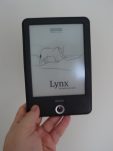
My Onyx Boox T68 has Arrived – What Should I Do With It?

After waiting nearly 8 months, I finally got my hands on the Onyx’s 6.8″ ereader.

The Onyx Boox t68 Lynx marries the 6.8″ screen from the Kobo Aura HD with Android 4.0 running on a 1GHz CPU with 512MB RAM. It has a screen sharper than on the Kindle Paperwhite, a capacitive touchscreen, frontlight, 4GB storage, and a headphone jack.

I pre-ordered mine from Arta Tech, Onyx’s retail partner in Poland, and it arrived today.

At $250 (prices plus shipping to the US), it’s a very pricy ereader. So rather than put readers in my position of taking an expensive gamble on an unknown device, I would like to help everyone make an informed decision about this ereader.

In short, what would you like me to try and comment on?

The T68 ships with Google Play, so if you suggest an app I will try to install it and then report back. I can also answer questions about Onyx’s software.

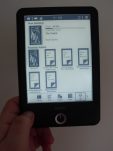
So far I have only set up the Lynx, added a few ebooks, and configured my Google account, and my first impressions are not favorable.

Update: But that changed as I figured out more of the settings and quirks of the T68.

I don’t think this will prove very useful as an E-ink Android tablet, and it’s a good thing I had already tried the Sony Reader PRS-T1 and found that device workable as an E-ink Android tablet. Otherwise the poor performance of the Lynx would be enough to make me give up on the idea.

  • The stock settings on the Onyx reading app combine illegible text with badly rendered images. And while I fixed the issues with the text I don’t see a way to get the T68 to render images properly (see below).
  • Google Play and a lot of other basic Android features are nearly unusable due to poor graphics; apparently no one at Onyx thought that it was necessary for color menus to be legible on grayscale E-ink.
  • The Kindle app crashed. I also cannot get it to sync correctly or download ebooks. Update: Changing the refresh mode fixed the issue with the Kindle app.

Onyx has been making ereaders for 5 years now and working on Android on E-ink since 2012, but I can’t see that technical expertise in the T68 Lynx. The software is best described as rough. If you plan to get one I would wait until after the next major update.

Video Review of Onyx Boox C65 AfterGlow eReader

I’ve been Youtubing today, getting ready for my new ereader, and I came across a related model which isn’t strictly available in the US but can be ordered online.

The Onyx Boox C65 AfterGlow is a 6″ Android-equipped ereader which can be bought from one of Onyx’s retail partners. It’s a little pricy for the US market, but on the upside it ships with Google Play, a feature which few ereaders can boast.

I found a couple videos for this ereader.  Neither is in English, but they show enough detail that they give a good idea of how well this device works. The first is a short silent demo which takes you through a few features.

The AfterGlow sports a 6″ Pearl HD E-ink screen with a resolution of 1024 x 758. It runs Android on a 1Ghz CPU with 512MB RAM. It has 4GB internal storage, a microSD card slot, Wifi, and unlike some of Onyx’s cheaper models, the AfterGlow has both a frontlight and a capacitive touchscreen.

Weighing in at 186 grams, the AfterGlow has a 1.7Ah battery with an estimated battery life of around 8 weeks. It also has page turn buttons and ships with a case. And well it should, given that it retails for 100 euros (plus VAT and shipping).

In terms of software, the AfterGlow runs Android and ships with Google Play, giving users access to a broad range of reading apps. It also ships with Onyx’s own reading app, which includes broad support for ebook formats, extensive annotation abilities, and TTS from Ivona.

Google Play Books Expands into 11 Countries in Latin America

Google inadvertently and prematurely announced their next round of expansion today.

According to a Google+ post (which went a little earlier than it should), Google has announced that Google Play Books is launching in Luxembourg and whole host of countries in Latin America:

  • Paraguay
  • Bolivia
  • Uruguay
  • Guatemala
  • Honduras
  • Panama
  • Dominican Republic
  • El Salvador
  • Ecuador
  • Nicaragua
  • Costa Rica
  • Luxembourg

Counting Norway (whose local Google Play Books went live last week) and Luxembourg, Google  has launched Play Books in 13 countries in the past week, bringing the total to 57.

It looks like I was right when I guessed that the hiatus was over, which means that in the coming months we can expect to see Google launching Google Play Books in 6 to a dozen countries every  6 weeks or so. I would not be surprised to see Google Play Books available in 100 countries or more.

Android Police

Macmillan is Testing the eBook Subscription Market – Adds Titles from Tor Books to Skoobe

Only two of the 5 major US trade publishers have shown an interest in the ebook subscription market, and Macmillan is showing signs that they could be the third.

Late last week Macmillan announced, via their German parent company Verlagsgruppe Georg von Holtzbrinck, that 1,500 Macmillan titles are now available through Skoobe, the German ebook subscription service.

The 1,500 titles are drawn from the US- and UK-based SF publisher Tor Books. All of the titles are in English, including Ender’s Game, Mistborn, and Children of the Mind. As the first and (so far) only Macmillan imprint to go DRM-free two years ago, this publisher is Macmillan’s guinea pig for testing new markets and new ideas, and now that includes subscription ebooks.

This deal represents Macmillan’s first foray into this market, and while it might sound odd to see Macmillan sign with a German service it makes sense once you look at Skoobe. The ebook company was launched in 2012, and it is owned by Holtzbrinck and Bertelsmann (which also owns Penguin Random House).

Far from being one of the major services, Skoobe offers a relatively small catalog of around 40,000 titles from 900 publishers, and its service is limited to Germany, Austria, and Switzerland. Readers can pay between 10 and 20 euros per month to read as many titles as they want, albeit with some restrictions on the lower service tiers.

Skoobe is no Oyster or Scribd, and that could be what attracted Macmillan in the first place. Both of those larger services offer catalogs with hundreds of thousands of titles, and they both serve the US market (and they charge a heck of a lot less than Skoobe). Oyster and Scribd both offer titles from HarperCollins and S&S, along with many other publishers and distributors, and they get the most attention in the press.

Macmillan likely declined to sign with one or the other out of concern for lost ebook sales. (Or possibly because Scribd could not afford the advance that some publishers are rumored to be demanding.)

This is a hopeful sign from Macmillan, but I would not read too much into it. Macmillan also experimented in letting Tor Books titles be sold DRM-free. This started in 2012, and even though the past two years have shown that there’s no downside to the move Macmillan has shown no indication of plans to remove DRM from the rest of their imprints.

image by melenita2012

Did Amazon Just Ban Suggestive eBook Covers from the Kindle Store?

There is an unconfirmed story going around today that Amazon has issued new standards and guidelines for cover images for ebooks in the Kindle Store.

According to one cover designer, Amazon has banned a long list of human anatomy from appearing on covers in the Kindle Store.

Erin Dameron-Hill, writing on her Facebook page, reports that Amazon has changed what they will allow in cover images:

 Hey there! Amazon has made a few changes to their rules on accepting covers.

  • No model can be handcuffed (this will instantly flag you), blindfolds are okay for now (but I don’t expect them to be in the future).
  • Handcuffs are allowed if they are separate–not on the models . The model can hold the cuffs.
  • No side boob or big cleavage.
  • No upper butt. (No nudity, obviously).
  • No lower hair patch for men (or women).
  • No sexual positions–no doggie style, missionary (or any position that implies penetration).
  • No hands on boobs or private areas.
  • No women on their knees in front of men (even fully clothed).
  • No men between women’s thighs.
  • No men’s faces on breasts (resting, etc–even fully clothed).

For those of you with erotic, dark erotic, or BDSM romances, I would highly recommend a symbolic cover otherwise your books are likely to be flagged. I hope this has been enlightening.

It looks like Amazon may be taking a drastic response to the erotica brouhaha which blew up last year. Last October Amazon and other ebook retailers responded to the hysteria instigated by the Daily Mail and other "news" organizations by removing vast swaths of content based on little more than keyword searches.

On the other hand, maybe not.

This story currently only has a single source, and has yet to be confirmed by Kindle PR (I queried Amazon a couple hours ago) or the several authors I asked. Also, I briefly checked the Kindle Store and can tell you that there are any number of cover images which violate the new policy.

But most importantly, I cannot find any similar reports from forums where authors gather. I checked Absolute Write and KBoards and I didn’t find any authors commenting, complaining, or even mentioning the new rules. If this new policy was real then there would be dozens of comments by now.

Folks, without the confirmation I don’t think we can assume that this really is a new policy from Amazon. Instead, this could well be another case of some mid-level drone making up the rules as they go along.

It’s happened before.

Last April a similar story went around concerning Amazon banning works under 2,500 long. That story also lacked confirmation and turned out not to be true at all. As I pointed out at the time:

While Amazon is in the habit of suddenly enforcing new rules with little notice, they also make sure to tell everyone about it. In May 2012 Amazon got serious about banning public domain and junk ebooks from the Kindle Store, and they sent out an email to all KDP authors and publishers. The email highlighted Amazon’s content rules, which said in part:

Some types of content, such as public domain content, may be free to use by anyone, or may be licensed for use by more than one party. We will not accept content that is freely available on the web unless you are the copyright owner of that content. For example, if you received your book content from a source that allows you and others to re-distribute it, and the content is freely available on the web, we will not accept it for sale on the Kindle store. We do accept public domain content, however we may choose to not sell a public domain book if its content is undifferentiated or barely differentiated from one or more other books.

Without confirmation from another source or explicit confirmation from KDP, I would lay odds that this story is not as true as it appears.

If anyone can confirm or deny this story, the comments are open.

Update: Dameron-Hill has since backpedaled, explaining in a follow up comment that the list was her own creation and not an official list from Amazon. The list is based on what her clients had told her concerning ebooks rejected or pulled by Amazon. So basically I was right; this is a case of unnamed drones establishing policy by fiat.

image by kodomut

References to New Nvidia Shield Tablet Leaked Online

Rumors have been circulating for about a month now that Nvidia was planning to release a tablet to complement its Shield handheld gaming device, and I think I found the first evidence to show that the rumors are true.

A new page was uploaded to Nvidia’s TegraZone.jp website over the weekend. The page, which is actually listed under games and not as a device, doesn’t tell us anything about the Shield tablet beyond the name, but I may have found a few interesting details hidden in the metadata.

While the page content may not say anything about the tablet, the keywords list says a few things:

SHIELD Tablet, SHIELD Tablet android, SHIELD Tablet app, SHIELD Tablet tegra, SHIELD Tablet review, SHIELD Tablet video

TBH, I’m not sure whether that tells us anything; it looks to be the same keyword list auto-generated for every page. What’s more, the TegraZone site is focused only on apps which have been customized to take advantage of Nvidia’s Tegra CPUs; the site doesn’t even have pages for Nvidia’s own hardware (the Tegrra Note 7″ tablet and the Tegra Shield handheld).

Or at least, the site doesn’t have the pages yet; this could be a sign that Nvidia is planning to add such pages. This would make some sense, but it’s just as likely that I am grasping at straws.

At this point, folks, we really don’t know anything. But even so, this is the first time we’ve seen the words “Shield” and “tablet” next to one another on an Nvidia website, and that gives us the hope that there is some truth to last month’s rumor.

—

For those just tuning in, the Shield is Nvidia’s name for a cutting edge handheld gaming device which launched last year. It runs Android on a Tegra 4 CPU, and offers near-desktop quality graphics on a 5″ screen.

The rumor which circulated last month alleged that Nvidia was going to release a tablet to complement the handheld. According to the rumor, the tablet is going to be powered by the new and super powerful Tegra K1 chip. This is Nvidia’s best CPU, and it’s only been used in a couple devices so far (the Google Project Tango tablet and the Mi Pad from Xioami).

On a related note, there was also a set of benchmarks for an "Nvidia Mocha" tablet, and while that device does have a Tegra K1 CPU there’s also a good chance that the Mocha tablet is a reference design which has since been announced as the Mi Pad.

There has been speculation that the Mocha tablet is going to be the Shield tablet, but given that the Mocha appears to have already launched with Xioami’s brand I don’t think the Mocha is the Shield tablet.

But TBH no one knows for sure at this point. While I think it is very likely that Nvidia will release the Shield tablet, at this point that is pure speculation.

Qualcomm Announces New Mirasol Screen Tech at Display Week 2014

Qualcomm unveiled its next-generation version Mirasol display at SID Display Week 2014 last week. The new screen tech is called SMI (single mirror IMOD), and if/when it hits production it promises to offer richer color than Qualcomm’s existing Mirasol screen tech.

IMOD, or Interferometric modulator display, is a type of reflective display that creates color not by shining light through a pixel but by manipulating a micro-cavity in the display. Changing the shape of the cavity makes different colors appear.

While the existing Mirasol screen (like the one found on the Toq smartwatch) requires 3 different micro-cavities to display a single pixel, the new screen tech only requires a single micro-cavity which can display an entire range of colors.

I didn’t get to see the new screen tech; Nikkei says that there was a demo, but it must have been shown off privately because I did not see a new screen in the Qualcomm booth.

In the demonstration, Qualcomm MEMS Technologies switched among several still images. But the new display can show video, depending on the backplane, the company said.

That is better than what Qualcomm showed off last year, when the high point of the Mirasol display was a nonfunctional 5.1″ screen. I saw that 5.1″ dummy again this year, and I also saw the Toq smart watch, but I didn’t see a new screen tech demo. Perhaps I happened to visit at the wrong time.

On a related note, Qualcomm also showed off the 7″ Pixtronix screen which they had on display at last year’s SID Display Week; it’s still not in production and they could not say when it would be available on consumer devices.

Is the Hiatus Ending? Google Play Books Launches in Norway

Google quietly launched a local ebookstore in Norway last week, ending a 6 month long drought. The new store sells ebooks in krone, and it has been customized for Norwegian (mostly):

This launch ended a 6 month period of me wondering what the bleep was going on with Google Play Books.

Last year Google was launching ebookstores left and right. Every month to 6 weeks Google would quietly add anywhere from five to a dozen local ebookstores to Google Play Books at a single go, but that ended in December 2013 with a push into Latin America.

They were up to 44 countries when their expansion stalled in December, making Norway the 45th country to have a local Google Play Books.  I can’t tell you why Google stopped, but this was an issue which I was watching carefully and I was planning to comment on the stoppage at some point.

In Norway, Google faces local competitors as well as Amazon, Nook, and iBooks. (Amazon has not launched a local Kindle Store in Norway, but they do support the language.)

P.S. Does anyone know the size of the Norwegian ebook market, or who the leading ebook retailers are? I lack the info, and I would like to know.

Android Police

Verso Books Shows That it is Possible to Use Customer-Friendly DRM While Still Calling Customers Pirates

I have long been a supporter of milder types of DRM like digital watermarks. This DRM is more customer-friendly than encryption DRM schemes like Adobe Adept while still being equally effective at stopping piracy.

I used to see digital watermarks as a way for publishers to show that they don’t see all of their customers as potential ebook pirates, but apparently some are using the DRM and still regarding their paying customers as untrustworthy.

Verso Books, which opened their own ebookstore in March, is one such publisher.

As you may know, digital watermark is a term for a type of DRM which (usually) involves subtle additions to a file in order to mark it with identifiable info which can be traced back to the original owner. Verso Books uses a digital watermark platform provided by Booxtream, a Dutch company which also provides DRM to the Pottermore eboosktore, the official Harry Potter site.

Yesterday a reader (who for obvious reasons will not be named) forwarded a copy of an ebook purchased from Verso Books. This ebook is so full of notices that it contains DRM that it implies that the customer is needs to be constantly reminded not to pirate the ebook.

In addition to a notice at the back of the ebook (which claims there is no DRM, LOL), Verso Books also defaced the ebook with a huge splash image right after the cover that includes the buyers name and email. Also, the end of each chapter includes a footer which identifies the email of the buyer.

And that’s not all.

That footnote is also present on the title page, copyright page, TOC, bibliography, forward, the about page, and every other page in the ebook. That footnote is so prevalent that it is a slap in the face of legitimate customers. It says that customers are too stupid to be honest and have to be constantly reminded that the ebook has DRM.

Or as my source put it:

Personally, I felt like I was constantly being sent a stalker’s note saying, "I know where you live." It put me off reading the books entirely.

What I find sickening is that while they do state their use innocuous sounding and (sadly for me) not as eye-catching "watermarking," Verso’s site repeatedly makes statements such as, "Verso ebooks are free of Digital Rights Management (DRM-free)." That sample is from their ebook license.

It very much reminds me of listening to an NSA official saying that data is only "collected" when they decide to officially look in the vast collection they’ve made, that they didn’t "collect" data when they collected all our data and stored it vast digital data storage centers.

Verso Books stands as an example of how not to use DRM and how not to treat their customers. This publisher is so fearful of piracy that they have harmed the reading experience. No matter whether you are for or against the use of DRM, I am sure that we can all agree that this is not a good outcome.

image by Kris Krug

Barnes & Noble Commits to Selling 1 Million Nook-Branded Galaxy Tab 4, Including Both 7″ and 10″ Models

Barnes & Noble has set itself a difficult goal for the next phase of its hardware business.

Earlier today they announced a deal to sell a Nook-branded tablet from Samsung, and a few hours later they spelled out the Samsung contract in a new SEC filing. I’m still working my way through the filing, but it’s already revealed quite a few details not mentioned in the press release.

For example, B&N has committed to buying a million tablets from Samsung in the first year:

NOOK Media has agreed to a minimum purchase commitment during the first twelve months after the launch of the initial co-branded NOOK devices of 1,000,000 devices; provided that if NOOK Media does not meet certain sales thresholds of the initial co-branded NOOK devices by December 31, 2014, the twelve month period referred to above shall be extended to fifteen months.

The B&N-Samsung deal is going to commence with the Galaxy Tab 4, but the filing hints that it might expand to other models in the future.  This agreement also includes a marketing fund which will be supplied by Samsung, as well as joint efforts to promote both Samsung hardware and the Nook platform. The co-branded devices are going to be unavoidably tied to the Nook platform; the filing says that this is a registration step which cannot be skipped.

And most importantly, this deal initially includes rebranding both the Galaxy Tab 4 7.0 and the Galaxy Tab 4 10.1:

For the initial Co-Branded Devices, NOOK Media hereby selects Galaxy Tab 4 7” and Galaxy Tab 4 10” Tablets, each in two SKUs (black and white). Samsung shall use its best efforts to make the 7” initial Co-Branded Device available for a commercial Launch during the week of [***] (the “ Initial Availability Date ”), with the 10” initial Co-Branded Device to follow sixty (60) days after the Launch of the Galaxy Tab 4 7”.

The 7″ model is expected to ship in August, according to B&N, which would mean the 10″ tablet will likely ship in October 2014. Both devices have largely the same specs.

Given B&N’s previous lack of success, in selling tablets, do you think they will do better in selling Samsung devices?

I don’t think so, but that could be my pessimism talking. I just don’t think of B&N as a place to buy a tablet – not when BestBuy, Walmart, and Amazon are all carrying multiple models.

Publishers Lunch


Samsung Scores New eBook Coup – Will Develop Co-Branded Samsung Galaxy Tab 4 Nook Tablet

Barnes & Noble has long been promising to launch a new tablet in partnership with a major device maker, and today that promise came true. The bookseller has just announced that they will be partnering with Samsung to produce a new Nook-branded Galaxy Tab 4 tablet.

The new tablet will be released later this year (in early August) and feature the Nook software and access to more than 3 million books, magazines and newspapers.

The tablet will be displayed along with the Nook Glowlight and sold at Barnes & Noble’s 663 bookstores across the U.S. and online. Barnes & Noble, which is facing mounting losses in both hardware sales and ebooks, has also said that they will continue to offer the Nook GlowLight, which launched last Fall.

B&N hasn’t released specific details on the specs of the Nook-branded Galaxy Tab 4, but based on the specs posted by Samsung I would say Nook is aiming for a lower market tier. The last Nook devices, the Nook HD and HD+, were premium quality enhanced ereaders when they launched in late 2012. They had screens and CPUs comparable to the best mid-level and premium tablets – for 2012.

The Samsung Galaxy Tab 4, on the other hand, is more of a budget tablet. It runs Android 4.4.2 KitKat on a 1.2GHz quad-core Snapdragon CPU with 1.5GB RAM, Wifi, and Bluetooth. It has a 1.2MP front-facing camera and a 3MP rear camera. Screen resolution is 1280 x 800. The Galaxy Tab 4 retails for $199, or about $80 more than  comparable tablets that don’t carry a Samsung brand.

This deal is Samsung’s second major ebook partnership in only 4 months; in April Samsung partnered with Amazon to release a Kindle for Samsung app. A short time later Samsung retired their ebook app in favor of the Kindle app.

The partnership with Samsung is very much the type of deal that many pundits expected when Microsoft and Barnes & Noble announced the launch of Nook Media more than two years ago. Between the initial payment and performance terms built into the contract, Microsoft has invested upwards of $600 million in Nook Media. In exchange they got B&N’s help with a Microsoft reading app which is expected to launch this year, and 30 localized Nook Stores in Europe and Australia. B&N has also announced that they will be retiring the Nook app for Windows 8 in favor of Microsoft’s not-yet-launched reading app.

In related news, over the past year B&N has trimmed Nook staff, and on Thursday the company announced that Nook Media will relocate from their existing Palo Alto offices as another cost-cutting measure. Moving to offices in new technology campuses in Santa Clara and Mountain View, California are expected to save the company about $10 million in annual occupancy expenses, reducing its future lease commitments by about $102 million, the company said.