Nate Hoffelder

Nate Hoffelder

Wikipedia Expands Auto-Translate Feature

The foreign language editions of Wikipedia have long proven to be a useful way for me to research background details for posts on this blog, and now more Wikipedia users are going to enjoy similar access.

Wiki Media announced over the weekend that they are expanding the (currently beta) auto-translate feature to include support for more languages:

Encouraged by the feedback we have received in the last 6 months, we are now happy to announce that the tool will soon be available in 8 Wikipedias as a beta feature. Users of Catalan, Danish, Esperanto,Indonesian, Malay, Norwegian (Bokmål), Portuguese, and Spanish Wikipedias will be able to use Content Translation from mid-January 2015. The tool will also be enabled on the Norwegian (Nynorsk) and Swedish Wikipedias, but only to facilitate their use as sources for Norwegian (Bokmål) and Danish respectively.

Wikipedia users who read one of those languages will be able to translate any article on a Wikipedia site to one of languages mentioned above. The translations will be handled by Apertium, a GPL-licensed machine-translation platform.

It should look like this:

This is great news, but to be honest I’ve never actually used this feature. I usually use Google Translate to convert from other languages to English. That translation feature is built into Chrome, and it is honestly the one thing keeping me coming back to an otherwise frustrating web browser. (If someone could get Bing translate working equally well in another web browser I wold consider switching.)

How do you translate text (asks the monolingual American)?


Declining Nook Revenues Could Impair B&N’s Split Up Plans

When I reported on Barnes & Noble’s latest revenue report yesterday I noted that the drastic decline in digital revenues could impair B&N’s plans to spin off Nook Media, and apparently I’m not the only one to think that way.

The WSJ reported that several analysts are expressing doubts:

The decline in digital content sales suggested Nook owners were “abandoning” the Nook e-bookstore, said James McQuivey, an analyst with Forrester Research. “Otherwise, you’d have seen stabilizing digital content sales,” he said. Mr. McQuivey said the best move for Barnes & Noble might be to fold the Nook business into its online arm, BN.com.

John Tinker, an analyst with the Maxim Group, said the Nook losses are so bad that Barnes & Noble may not be able to move forward with the split. Selling off the Nook business to a third-party buyer, he said, could be equally challenging.

“There is still value but it’s a lot harder now with these numbers,” he said. Mr. Tinker said Barnes & Noble would still be able to take the college bookstore group public, since it is performing well.

With Nook revenues dropping by over half from the same period in 2013 (which was itself down almost 60% from 2012), I have to agree with that analyst’s suggestion that customers are abandoning the Nook platform in favor of other ebook retailers.

Just to give you an idea of how much holiday revenues declined, B&N reported that the 2012 9 week holiday revenues were $311 million. This year they were $56 million.

That’s going to be a serious problem when B&N follows through on their plan to spin off Nook Media later this year into its own publicly traded company.

In spite of Nook revenues dropping every quarter since spring 2013, B&N is showing every sign of plans to spin off its troubled digital sub. B&N has bought out both Pearson and Microsoft’s investments in Nook Media, and late last year B&N also added new services (POD, Author Solutions) to Nook Media which were intended to make the company look better to investors (the services were certainly not designed to appeal to authors).

The spin off is scheduled to happen some time before August 2015. Absent any new announcement from B&N, I think it’s safe to assume that the plans are moving forward.

And that has me puzzled. Am I the only one who wonders who exactly would want to buy stock in Nook Media?

The only position I would take would be to short the stock – to assume the price would go down and bet accordingly. I sure as heck would not consider it a long term investment.

But perhaps B&N has a trick up their sleeve. We’ll just have to wait and see.

images by Martin Cathrae, dybarber

Hands On With Netronix 6.8″, 13.3″ E-ink Android eReaders (video)

One of the high points for my trip to CES this year was finding the DaSung E-ink monitor hidden in the back of the  E-ink booth, and the other high point for this trip was _finally_ finding the Netronix booth and getting some one on one time with their latest prototypes.

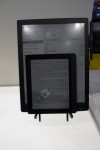
The above picture shows netronix’s 13.3″ prototype with my 8″ InkPad in front so you can see the difference in screen size.

Anyone who follows ereader news for long enough can tell you that Netronix is an old hand in the industry. They’ve been designing and building ereaders for years, and past and current partners include Kobo, B&N, Bookeen, and others.

Netronix was at CES 2015 to show off a couple new prototypes. They had a 13.3″ ereader and a 6.8″ ereader. Aside from the screen sizes, they had largely the same specs. Both ran Android 4.0.4 on a Freescale chip, and they had identical touchscreen tech: an IR touchscreen plus a stylus-friendly digitizer touchscreen. (For reference, the Sony Digital Paper DPT-S1 has a similar dual touchscreen.)

Update: There’s conflicting info on the touchscreens; I was told that there was an IR touchscreen, while Charbax was told that it was a capacitive touchscreen.

Both devices were also missing a silo for the stylus, which I see as a serious defect.

I found the Netronix booth via Charbax, who shot this video:

As you can see in the video, Charbax focuses on just the larger of the two devices. That’s okay; I got to play with them both.

The 13.3″ device has the same screen resolution as on the DPT-S1 (1,600 x 1,200). I’m told it is very much a prototype, and that it was assembled only last week. At 300 grams, it was surprisingly light.

Because Charbax focused on the larger unit in the video, I didn’t take very many photos.

The 6.8″ unit was also surprisingly light. As you can see in the photos at the end of the post, the smaller model bears a striking resemblance to the Kobo Aura H2O, only without the waterproofing and with a second touchscreen tech, Android 4.0.4, Google Play, and the stock apps (all of the apps were unfortunately inaccessible).

The accessible software included just a couple sketchpad apps, the reading app, and the settings menu. It was pretty basic. I thought the devices were a lot of fun to play with. I liked having two touchscreen options, although I am still bothered by the lack of a silo.

And BTW, I actually have quite a few photos of the settings menus; I’m not going to upload them right away (my mobile data plan isn’t very fast). Remind me later and I’ll get to it.

Hands On With the Hemingwrite

The Hemingwrite retro word processor is one of the more unusual gadgets to launch this year, and today at CES I finally had a chance to put my hands on it.

I spent some time today with Hemingwrite co-founder Patrick Paul, and he let me play around with one of the prototypes. It was a fun device, and even though the software was obviously in a state of flux and the prototype used components which may not make it into the final product, I could see that a lot of thought went into it.

The Hemingwrite is actually designed to be a far simpler device than I had been expecting. While I call it a word processor and it is running software which is similar to what you might find on one of those outdated devices, the Hemingwrite is actually intended to be closer to an even more outdated device: a typewriter.

The Hemingwrite is running complex software, yes, but the software is being designed to limit the operations. For example, the three "folders" indicated by the switch on the left side would better be described as "stacks". There’s no actual folder structure nor can you view the file names; instead you get to tab through each of the open files in one of the folders, just like you would flip through a stack of paper notes.

The other software features show a similar design intent to intent to limit what you can do with the Hemingwrite. For example, there’s no way to move back and make a correction short of using the backspace key to delete everything (and they’re not planning to add one). I was told that the idea was that the Hemingwrite is intended for _writing_, and not editing, and so the user was limited to going forward rather than going back.

I could write more about the software features, but since the software is described as being incomplete I won’t go into further detail here.

Edit: But I should probably note that one or more of the upper KS tiers do entitle you to an SDK. You can write your own software for the Hemingwrite.

Physically, the Hemingwrite is as blocky as it looks. The prototype  I used had a shell made from milled aluminum, so it was considerably heavier than the production units will be, but since I didn’t have an opportunity to vamoose with the prototype that doesn’t really matter.

It is a very simple design with a switch on the left of the 6″ E-ink screen (folders), a switch on the right (Wifi), a power button, and the keyboard. This last was sourced from another device (the spacebar was scratch built, which is why it looks different), and was still labeled for functions not supported by the Hemingwrite.  In addition to the number row and the qwerty keys, there are several keys which might end up being mapped to various functions, but aside from the one print/send function key that is still up in the air.

In use, the keyboard was as nice as you would expect from a mechanical keyboard (although small). I usually type on a full-sized USB keyboard which feels mushy in comparison to the Hemingwrite, although mine might be healthier for long term use.

I noticed while typing that the design of the Hemingwrite is likely going to cause wrist problems. Due to the thickness of the Hemingwrite’s base, the keyboard is position in such a way that my hands were angled upwards while I was typing. That is a position you’re supposed to avoid because it puts stress on your wrist and could lead to carpal tunnel syndrome.

I would expect that Hemingwrite owners will want to buy a wrist pad to place in front of their unit, if they don’t already have one for their computer’s keyboard.

All in all this was a fun toy, but I’m not sure that the problem it is trying to solve justifies the $500 price tag.

If you think it does, you can pre-order one on Kickstarter for $400.  It is expected to ship in September, although I would bet for one reason or another (FCC, manufacturing delays, redesigns) it won’t ship until next March at the earliest.

P.S. I’m betting that the Hemingwrite will be redesigned to include a protective shell for the keyboard and screen.  As I sit here thinking about it, I don’t think anyone is going to want to carry it around loose like it is. That’s not how we carry laptops today, and it’s not how portable typewriters were carried (they had cases) for the simple reason that these devices are easy to damage.


Is Waterstones Getting Ready to Walk Away From Amazon?

Everyone was shocked when Waterstones partnered with Amazon in 2012 to sell the Kindle, but I don’t think we should be surprised if that relationship ends.

The Telegraph published an article yesterday which cites Waterstones director James Daunt as saying Kindle sales had disappeared. While that article is meaningless in and of itself, as I sit here reading it this morning I wonder if there’s a subtext to the quote.

snippet:

Waterstones has admitted that sales of Amazon’s Kindle e-book reader had "disappeared" after seeing higher demand for physical books.

The UK’s largest book retailing chain, which teamed up with Amazon in 2012 to sell the Kindle in its stores, saw sales of physical books rise 5pc in December, at the expense of the popular e-reader.

Kindle sales had “disappeared to all intents and purposes”, Waterstones said.

James Daunt, chief executive, told the Financial Times that the resurgence in popularity of hardback and paperback books was due to Waterstones refurbishing some of its 290 shops.

Given that people give books as gifts, and that people  give gifts in December, it’s not a surprise that book sales were up 5%. But to suggest that the increase in sales of books caused the decline in in sales of the Kindle is simply ridiculous.

One could just as sensibly claim that an increase in sales of cereal caused a decline in sales of milk, or that an increase in sales of gasoline caused a decrease in the sales of electric vehicles. To put it simply, the products are not competitors in the same market.

One has to wonder why The Telegraph tried to make the connection, but more importantly we need to ask why Daunt gave the quote in the first place.

To be completely fair, he might not have intended to imply a connection. In fact, he may have innocently answered two unrelated questions, only to see his words twisted into making a claim he did not intend. (Honestly, I think this is the most likely possibility.)

But if he was cited accurately then we need to ask why.  His motive could be as simple as getting press attention for Waterstones with a juicy story, but he might also be creating a context for Waterstones to end its partnership with Amazon.

Waterstones announced its partnership with Amazon in May 2012, and if they have a three year contract then it could be coming up for renewal some time this summer.

The quote in yesterday’s article could have been intended to offer a context for Waterstones ending the relationship with Amazon.  After all, if Kindle sales have "disappeared" then why would Waterstones continue to carry them?

They wouldn’t.

I know what you’re thinking; yes, I could be reading too much into this article, but that doesn’t mean my speculation is over the top. I’m not sure I’m right, but if I turn out to be correct then I won’t be terribly surprised.

Should Waterstones break ties with Amazon, it will likely continue to sell Epub ebooks from its own bookstore (which is supported by OverDrive). The retailer might also sign with the Tolino consortium and sell Epub ebooks as well as the Tolino Shine ereader (also, tablets). Depending on the finances, that last option could be a sensible move.

It was a widely known secret in 2012 that Waterstones was going to sign with B&N to sell the Nook. That never happened (possibly because Amazon offered Waterstones a better deal), but if Waterstones wanted to make a deal in 2015 similar to the one hinted at in 2012 then I believe they would likely sign with Tolino.

What do you think?

image by HHA124L

E-ink Demos a 13.3″ Second Screen E-ink Monitor at CES 2015 (video)

E-ink’s fancy looking wall hanging got a lot of press this morning due to their press release but that’s not the most interesting gadget in their booth.

In addition to the Yotaphone 2, a new messaging platform, and that aforementioned wall hanging, E-ink also had a prototype 13.3″ USB monitor on display. It’s called the PaperLike (I think).

In case you were wondering , yes, the stripe down the center of the E-ink screen is a defect.

The monitor was on loan from DaSung, one of E-ink’s Chinese partners. It was launched late last month in China but only came to my attention today. It uses a 13.3″ Fina E-ink display (screen resolution 1,600 x 1,200) to mirror what you see on the paired laptop.

It’s powered by the USB connection to the laptop, and is surprisingly fast. As you can see in the video below, the monitor has several display modes. In addition to the standard 4-bit 16 level grayscale mode found on your ereader, there is also a mode with only 5 shades of gray as well as a mode with 2 (black and white, basically). The faster modes sacrifice detail for speed, resulting in a refresh rate which is almost as fast as an LCD monitor.

I was told by E-ink that it is still under consideration, but according to what I read on Chinese language sites, the monitor is available now with a retail price of 4,999 yuan, or about $804.

Allow me to take a moment and express what we are all feeling: Damn.

I don’t know about you but if this were offered for $400 I would have ordered one already. But at this price I’m going to have to lean on E-ink to get DaSung to lend me one.

Well, at least it looks pretty.


Txtr Beagle Gets Second Lease on Life – Launched in Japan as the Honto Pocket

Here’s a story I’m only catching about a month late.

ITMedia reported close to a month ago that Dai Nippon Publishing, one of Japan’s larger publishers, has officially launched the Honto Pocket. This 5″ device has been showing up at Japanese trade shows on and off since July 2013, and it has finally arrived.

The Honto Pocket sports a 5″ E-ink display, Bluetooth, and runs on a pair of AA batteries. If that sounds an awful lot like the txtr beagle, it should; numerous sources say that this device is based on that design, and the earliest demo units used the same hardware as the beagle. And like that older device, the Honto Pocket lacks a touchscreen or frontlight.

Curiously, the Honto Pocket retail unit has a slightly different shell than the beagle, and possibly different electronics (we won’t know until someone cracks it open.)

The beagle has never had much luck in Europe, possibly due to txtr’s decision to market it as a smartphone accessory and get it bundled with new contracts, but it might be more successful in Japan.

Dai Nippon plans to sell this not as an accessory but as a bundled ereader.  Consumers will be able to buy a Honto Pocket with the complete works of Agatha Christie, the complete Guin saga, Christie’s Hercules Poirot books, or other bundles. I can also see a mention from July that the Honto Pocket would be offered with bundles including first-aid info, but I do not know that that unit is available.

Prices range from 9,800 yen to 74,800 yen (about $81 to $620) (for Christie’s collected works). Buyers will also be able to buy ebooks in a related ebookstore and sideload content from their PC, and DNP is supposed to have released a smartphone app which would enable users to transfer ebooks from their smartphone (I’m not sure if it is out yet).

As much as I would like to be more optimistic about the Honto Pocket, I don’t expect it to sell very many units. The basic Kindle can be had in Japan for 6,980 yen, or $58. It has a touchscreen and Wifi, and I think that makes it the better choice all around.

Of course, it is also a lot bulkier than the Honto Pocket, but you can’t have everything.


Infographic: Just How Powerful is that eReading Device in Your Pocket?

Between our smartphones, tablets, and ereaders, many of us carry one or more mobile device around without realizing just how powerful it is.

Sure we may joke about how a graphing calculator has more processing power than the entire world had in 1950, but it turns out that the quip is even more true than I had realized.

The following infographic breaks down how the devices we have today compare with supercomputers of the past.

For example, the iPad 2 would be one of the 5 most powerful computers in the world if it fell through a wormhole to 1994. (Of course, that would only be true if measured in terms of sheer numbers, not actual computing ability, which raises a whole different issue of general-purpose vs restricted computing.) And that tablet isn’t even all that impressive by the standards of 2015; there are plenty of $100 tablets that are more powerful.

via Lone Wolf Librarian

Kindle Unlimited, the Content Glut, and the New eBook Market

As 2014 draws to a close indie publishing finds itself at a crossroad. There’s a growing consensus that the supply of indie ebooks is beginning to exceed demand, leading to the textbook microeconomics result.

The idea that indie revenues were falling was brought to the fore a month ago by HM Ward when she revealed that she was pulling out of Kindle Unlimited, and why. This lead authors both in and out of KU to say they were also taking a hit in the pocketbook.

This led many who didn’t look too closely to conclude that KU was a bad idea for indie authors, but it wasn’t until this week that some, namely me, started a public discussion about the underlying causes. On Sunday I raised the question about what this meant in terms of consumer behavior, and within minutes Bob Mayer suggested the explanation which had been staring us in the face all along:

To me the bigger problem than KU is the content flood which isn’t going away. I think most authors, indie and trad, are going to see a flattening of sales as readers simply have so many more choices.

I still don’t feel that I have enough market data to prove it, but I think he’s right.

And so does Mike Shatzkin, who posted on this topic today:

What a long list of indie authors has proven in the years since Kindle was invented is that there is a substantial market willing to try storytelling from unknown writers if it is offered at a relatively low price. As a result of that and of Amazon — joined by all the other ebook platforms and a legion of service-providers like Bob Mayer — making it relatively easy to “publish” a manuscript, many tens of thousands of authors have published hundreds of thousands of ebooks that way.

… Ever-growing supply and stable demand is a toxic formula for the prospects of each successive ebook published for that market. My own hunch is that Kindle Unlimited is simply the straw that broke the camel’s back.

 Yes, I did agree with Mike Shatzkin, and no, the sun won’t be rising in the west tomorrow.

So where does the industry go from here?

I don’t know, but I do have a few thoughts.

One, the days of releasing the first title in a series as permafree have passed. All that accomplishes now is to flood the market and make it harder to sell ebooks.

Two, the idea of writing and publishing your next book as the best marketing strategy is also going to have to be reconsidered.

Three, getting in to or out of Kindle Unlimited isn’t nearly as important as some thought it was a few weeks ago. As I noted when I first reported on this story, this problem is affecting authors both in and out of KU.

What do you think?

images by net_efekt, solarisgirl

A Fake Product Listing Inspires Rumors About Xiaomi’s First Laptop

Xiaomi is already one of the largest makers of mobile devices in the world, and now some are claiming that the  smartphone and tablet maker is adding a laptop to their lineup.

GizmoChina has uncovered details this morning about a new laptop from China’s largest smartphone maker, and reported that Xiaomi has slapped their logo on what looks like a reference design ultrabook with an Intel Core-i7 Haswell CPU.

That would be a hot news story and well worth reporting, but I’ve done some work of my own (3 minutes with Google) and I don’t think this story is legit.

Update: And now Xiaomi has denied the accuracy of the initial report.

After a few minutes of sleuthing, I found a product listing on Banggood.com for a Xiaomi laptop which uses the same stock photos and has the same specs as mentioned in the GizmoChina article. That listing shows the  "Xiaomi  Ultrabook" as being up for pre-order with a price of $710, but I don’t think it’s real.

Here’s the photo from Banggood (aside from the lack of a watermark, it is identical to the photo found by GizmoChina this morning):

Looking at the questions asked by Banggood customers, we can see that the retailer has admitted to not having any actual information on the laptop. They do insist at one point that Xiaomi  has said that it’s coming, but this listing has been  up since at least August 2014 – with no formal announcement from Xiaomi.

While it is entirely possible that Xiaomi is working on a laptop, I think this report is a fake.

Aside from the fact that this listing has been up since August, the other way you can tell that it’s a fake is that the images used actually belong to a reference design laptop. As Liliputing pointed out, someone (in this case Banggood) simply photoshopped Xiaomi logos onto existing pictures and called it good.

And while I would normally simply ignore a fake story, I thought it might be useful today to instead debunk it.

eReader and Screen Tech Pioneer IRX Goes Bankrupt, is Dissolved

As 2014 draws to a close so does the final chapter on Irex Technologies, one of the early ereader makers.

Yesterday a reader tipped me to the news that the Dutch screen tech startup IRX Innovations has gone bankrupt. IRX was formed in 2010 from the remains of ereader pioneer Irex Technologies, and was for all intents and purposes the same company with new investors and a new name. (Thanks, Zetmolm!)

Public documents confirm that IRX was handed over to a receiver in October 2014. According to reports filed about a month later, the company is kaput. It’s not clear what will happen to the assets, but the company won’t be coming back under a different name. (Thanks, Huub!) Its website has been turned off, and all of the employees have probably found jobs elsewhere.

And that’s a shame, because IRX was working on some interesting screen tech.

I haven’t had reason to write about them recently, but I have been following the details shared by the IRX marketing dept. According to one of IRX’s suppliers:

Currently, the IRX team is developing a new innovative color solution built on their electro-osmotic technology for electronic paper displays, that places three switching layers on top of each other. Each layer can electrically switch to its required color (cyan, magenta or yellow) or be 100% transparent. So for example, for a white image, all three layers become transparent. Light passes through all the layers and is reflected by a reflector placed behind the layers creating extremely high brightness, far greater than is possible for current systems. When creating a certain color, the technology controls the required amount of color particles in each of the layers. The result is a color performance comparable to printed paper.

That sounds neat, but I haven’t found any evidence that IRX ever got beyond displaying a single color (that’s why I haven’t written about them).

While there was some talk of 3-color screens at SID Display Week 2013, the only videos posted to Youtube show show grayscale screens which look similar to E-ink screens.

For example:

So at this point it’s really not clear whether this 3-color electro-osmosis screen tech ever actually existed in the lab, much less had any practical value.

And thus ends the second life of an ereader pioneer.

***

In its first life, IRX got its start as a project at Royal Philips (aka Koninklijke Philips, or simply Philips).

Philips was instrumental in developing the 6″ E-ink screen for the Sony Librie, which launched in Japan in 2004. That R&D effort also led to the development of an 8″ display which had a screen resolution of 1024 x 768 (the same resolution as on the Cybook Ocean). Irex was spun off of Philips with the plan to develop an ereader based on that screen.

The Irex Iliad ran an open version of Linux on a 400MHz CPU with 64MB RAM and 256MB internal storage. It didn’t have a frontlight (this simply wasn’t possible in 2006) but it did have a Wacom touchscreen and Wifi. According to Wikipedia, the Iliad cost 599 euros when it shipped in 2006.

Here’s a short video from 2007 which shows some of its features:

While it had software ahead of its time, the Iliad was in some ways a clunker with a hardware design that didn’t quite live up to its promises (battery life, for example), although the later models with revised hardware did come close.

I can recall from the user reports in 2007 and 2008 that it was much more of a hacker’s project than a consumer product; the more interesting reports all came from the developers who added their own software or tweaked Irex’s software to improve performance.

Irex’s later products were much better, although I’m not sure they were as popular.

Irex released several more ereader models before going bankrupt in 2010. In what would be better termed as a reorganization, the assets were bought by IRX Innovations and all of the existing employees keeping their jobs.

They weren’t so lucky the second time around.

Kindle Unlimited Under Fire in France

Kindle Unlimited is quickly becoming a contentious issue among indie authors, and now it looks like the service could be illegal in France.

AFP reported on Monday that Fleur Pellerin, the French Minister of Culture, wants to have ebook subscription services investigated. The minister is quoted as saying that "La loi de 2011 établit une règle: c’est l’éditeur qui fixe le prix de vente du livre numérique. A ce titre, l’offre proposée par Kindle Unlimited ne semble pas conforme à la loi", which in English roughly translates to:

The 2011 law establishes a rule it is the publisher that sets the digital book sales price As such, the offer proposed by Kindle Unlimited does not seem consistent with the law.

She could well be right, but you’ll have to get a French lawyer to confirm that interpretation is valid. I can’t see any reason it wouldn’t be, but there are nuances to any country’s laws which are only obvious to an expert.

Kindle Unlimited launched in France two weeks ago with around 20,000 titles in French and over 700,000 titles in English and other languages. The vast majority of the titles are drawn from KDP Select, and while you might think that contract would cover Amazon’s legal ass I am not so sure.

The fact that KDP Select requires exclusivity may itself present a roadblock in Europe. Many countries in western Europe have a fixed price book law. I’m not up to date on the nuances of each country’s laws, but I wouldn’t be surprised if some of those laws forbid exclusive deals.

Can anyone answer that question?

image  by danielbroche

B&N Buys Out Pearson Stake in Nook Media for $28 Million

Barnes & Noble has reached an agreement to buy out textbook publisher Pearson’s stake in Nook Media for around $28 million dollars in cash and B&N stock. Pearson paid $89.5 million for their 5% stake in December 2012.

Today’s deal follows only a couple weeks after B&N announced a similar deal to buy out Microsoft’s stake in Nook Media for $120 million in cash and stock. Curiously, it looks like MS got the better deal; the tech company recovered 40% of its investment, while Pearson got about 32 cents on the dollar. To be more exact, the Pearson deal included $13.7 million in cash and 602,927 shares of B&N stock.

Shut of outside investors, B&N is now free to spin off Nook Media and let the ebook company sink or swim on its own. B&N had previously said that Nook Media would be spun off by August 2015. And while there is still time for someone to step forward and buy Nook Media, I don’t expect that to happen.


Boyue Teases a Dual-Sided 8″ LCD/E-ink Tablet

Do you like the idea of Yota Devices’s dual-screen smartphone but feel that a 5.5″ screen is too small? Then I have just the thing.

The Chinese gadget maker Boyue is now showing a concept design for a hybrid 8″ ereader on its website. They haven’t released any specs and I’m not entirely sure it will ever see the light of day, but I still want to laud Boyue for for being either bold enough or crazy enough to come up with this:

The Boyue D81 features an 8″ IPS display on its front and an 8″ E-ink display on the back, and if it is ever built it will run Android 4.2 Jelly Bean on a quad-core CPU. It will probably also cost a lot of money, somewhere in the neighborhood of $300 (by my guesstimate).

I don’t know that Boyue has worked on a dual screen design before, but they have developed a couple Android tablet as well as a couple ereaders which run Android. So even though this device presents twice as many technical issues as a single screen tablet, it’s entirely possible that they could pull it off.

I’m going to go start bugging them for a review unit. Yes, I know it doesn’t exist but sometimes it pays to get an early start.

MobileRead

Is Palm Going to be Resurrected As an Alcatel OneTouch Brand?

Palm is a name which hasn’t been heard much since it was bought by HP (and then strangled following the death of the Touchpad) but it looks like it might be making a comeback of some kind.

WebOS Nation notices on Friday that www.Palm.com, the old home of Palm, now redirects to MyNewPalm.com. 

It’s not clear who owns the website domain (it leads to an offshore shell company out of the British Virgin Islands), but it looks like that offshore shell company, or possibly one with a very similar name, also owns a bunch of other Palm related trademarks (the TMs were transferred from HP in October).

I’m not sure what this means, but one webOS fanblog has turned up a surprising connection to a Chinese smartphone maker. According to MakaPalm, the Chinese tech company that owns the Alcatel OneTouch brand might be about to resurrect the Palm brand:

TCL Communication may be the company behind the new webpage that has been teasing loyal fans of the mobile-computing pioneer Palm.

“Smart move”—a slogan that appears in a looped video on mynewpalm.com along with the orange Palm logo—is the brand platform of Alcatel One Touch, TCL Communication’s mobile brand.

The name of TCL Communication’s senior vice president Nicolas Zibell also appears on a document formalizing the transfer of Palm trademarks from HP to another company in October.

I would bet he’s right.

There have been absolutely no rumors on this topic, so it is hard to guess what Alcatel, or actually its parent company TCL, will do with the Palm brand. But I would tend to agree with Mike Cane’s speculation that we’re probably going to see an Android smartphone bearing the Palm logo.

It might even make an appearance next month at CES 2015, so I would keep your eyes peeled. I plan to stop by the Alcatel booth and ask about it. (I also sent an email, but I’m not sure my press contact info is still valid.)

TCL Alcatel makes some cheap but decent smartphones and tablets under the Alcatel brand, and a commenter told me that they’re also a leading tv maker (thanks, jjj!).  I have one of the smartphones, and it’s not good as Palm used to make but it’s not bad.  It’s not great, but I got it because it was cheap and I’m mostly satisfied.

Assuming you set realistic expectations, the new Palm phones will probably be about as satisfactory.