New Study Shows eBooks Don’t Cannabalize Print Sales

One common justification for high ebook prices is the claim that ebook sales tend to increase at the cost of sales of paper books. While that is certainly true in my case, a study which was recently released by the University of Hamburg suggests that I might be an outlier.

This study, which was released with the Frankfurt Book Fair this week, shows that 22% of digital readers also buy 3 or more hardback books a year. That is more than the average readers who don’t use ebooks; only 15% buy those 3 or more hardbacks a year. The report also showed that the digital reader tended to buy as many paperbacks as they did before adopting ebooks, though there was slightly more purchases among some digital readers.

This report also revealed that digital readers spent around 50 euros a year on ebooks, while the survey group as a whole spent about 115 euros on paper books. And while it was not the preferred site, almost everyone had bought from Amazon at least once (79%). The most shopped bookstore, much to my surprise, was Thalia (24%), followed by Weltbild/Hugendubel (20%), iTunes/iBooks(19%), Project Gutenberg (7%), and Libri.de (7%) .

I don’t have many more details from the study (I’m still looking for it), but I do have one interesting detail. This study is based on a survey of 2,500 German readers, and 1157 read ebooks. That’s a remarkably high percentage. The latest data in the US dates from this Spring, and that showed that only about 30% of US readers had adopted ebooks.  Hopefully this is a sign that ebooks are catching on and catching up in Germany.

via Welt.de

image by stu_spivack

Sony Reader PRS-T2 Hacked – Not Yet Stable Enough for Prime Time

Remember how I wrote yesterday that a hack was in the works for Sony’s new ereader? It turns out that I was about 12 hours ahead of the actual hack being released. I think I should have waited.

The complete multi-step hack was posted this morning on The-eBook.org. It requires updating your T2, jailbreaking it, and then installing a new set of apps (here). The process takes a bit of time but it does work, as you can see from the image at right.

But I’m not sure it is worth doing just yet. My T2 is surprisingly unstable. Virtually every app from the web browser to the search widget to the Amazon Appstore client has crashed at one point or another. I have not even tried to install any new apps and I’m not planning to do so.

The set of apps i installed are basically the same set of instal files as used on the earlier PRS-T1. It includes the Zeam launcher, CoolReader, FBReader,  Dropbox, and other apps. These apps work, so at the very least I have a minimum function tablet- not that it is worth much.

Now that I have hacked it I know that this ereader is running Android 2.2. That’s rather disappointing considering that the previous model, the T1, is also running Android  2.2. Sony cares so little about this device that they didn’t even bother to update the OS it is running on. Okay, the average user wasn’t going to be able to use the features of the newer versions of Android, but they would still benefit from the under the hood improvements found in newer versions of Android.

If you have the T2, I would recommend waiting for a more stable version of the hack. And if you’re thinking about getting this ereader, I’d go for the earlier model instead. It’s cheaper now and has a headphone jack, which the T2 does not.

But if you are dead set on hacking your PRS-T2, here are the instructions.

  1. Update your Sony Reader to the latest firmware.
  2. This will take a will to download and run, so go get this ZIP file and this ZIP file while you are waiting.
  3. Reboot.
  4. Plug your T2 back in to the USB. Click yes on the screen.
  5. UnZIP the jailbreak file. Find the file labeled flash_reader. Run it.
  6. Reboot.
  7. Plug your T2 back in to the USB. Click yes on the screen.
  8. UnZIP the minimal-root-zeam file. Find the file labeled flash_reader. Run it.
  9. Reboot.
  10. When asked to choose between "Home" and "Zeam launcher",

At this point you should be looking at a standard Android home screen. If not, make sure you updated the ereader and then repeat steps 3 through 9.

The txtr beagle Takes a Great Idea and Turns it into Crappy Hardware

When txtr unveiled the Beagle ereader yesterday I fell n love. It’s a great looking minimalist device with a 5″ screen which is going to be sold cheap, run on a pair of AAA batteries, and not require any cables at all. It’s a smartphone companion which connects via Bluetooth.

The device was based on a great idea, but as yesterday wore on one of my readers noticed that the Beagle had a couple serious shortcomings. These were details which I missed because I was insufficiently pessimistic about how txtr would screw up the new ereader.

It turns out that the Beagle is limited to only storing 5 ebooks at a time and it is not an ereader so much as it is a page viewer. It’s running on a very weak (and cheap) CPU which can do little more than show page images. This explains part of the reason why txtr’s Android app is required to transfer ebooks; that app has to convert the text into page images before they are transferred to the Beagle.

On a related note, this means that this device, which is not actually an ereader, does not support the Epub and PDF claimed in the press release and product page.

While this is the first time I have seen this type of conversion on what was intended to be a mainstream device, it is not exactly new. In the past I have come across projects to turn portable DVD players and digital picture frames into faux ereaders. The first step in loading the ebooks was to convert them to page images which could then be viewed on the device via some type of image viewer. This is an old trick which I think dates back to the late 1990s.

So why is this an issue?

First, the so called Beagle ereader is missing a lot of the basic features we have come to expect like a TOC, resizeable text, and so on. But the greater issue here is that txtr could have released a real ereader for only $15 to $20 more – a negligible increase in price considering what would be gained.

While that might seem like a lot, given that the Beagle sells for under 10 euros, it’s really not. That 10 euro price is going to be subsidized by carriers, and the actual parts cost for the Beagle is somewhere above $50. While I don’t have actual figures, I do know something about the cost of the screen, and if we take the estimated costs for Amazon’s $79 Kindle as a guide we have enough info for a back of the envelope calculation.

That Kindle was estimated to cost $85 to make, but for now lets ignore most of the items on the list and focus on just 2 details: the screen and the logic board.

Amazon reportedly paid $30 for each E-ink screen. That figure is off, but I cannot say by how much (it’s confidential). But I can say that txtr will likely be paying a lot more for the 5″ screens. They’re not buying in as high of a volume as Amazon so they won’t get the same discounts as Amazon. And that means txtr could be paying at least $40 a screen, and the cost might be above $50.

That screen is the single largest cost for the Beagle – or for any other E-ink ereader for that matter. Another major cost is the logic board. This contains the CPU, Flash storage, and other chips which make the ereader go.

Amazon’s $79 Kindle was estimated to have $30 in chips inside, all packed on a single board the size of a laying card. Assuming that the Beagle went with cheaper components, it likely used a logic board which cost $10 to $15.

And that means, folks, that the Beagle could have been a real ereader like the cheap Kindle had txtr spent an extra $15.

The decision to not use the more expensive chips might make some sense given how txtr expects the Beagle to be used but it is still a false economy. They pared the costs down to the point where the lost abilities outweigh the savings.

If you still don’t agree with my conclusion, let me give you a counter example. The Pyrus Mini, a new ereader with a 4.3″ screen, is going to cost 50 euros. This is a very basic ereader, but unlike the Beagle it actually supports Epub and PDF. Admittedly, Trekstor has earned the epithet Dreck-Store in Germany, suggesting that they make awful products, but it is still cheap.

If Trekstor can afford to make and sell the Pyrus Mini for 50 euros then txtr could have made the Beagle into a real ereader. And that is why I am pissed with txtr. While they have great ideas, apparently one of the steps in bringing those ideas to market involves screwing up on a simple and basic point.

This is something they seem to do with all their hardware. For example, the original txtr eReader never made it to market because txtr couldn’t figure out how to get the costs down. That thing stayed at a price above 300 euros, and that just wasn’t practical in 2010 (or any time since).

P.S. If you’re thinking that transferring the images over Bluetooth is slow, you might be wrong. These will be grayscale images with a minimum of data. The file sizes should be quite small and thus quick to transfer.

Updated: New txtr beagle eReader to Cost Less than 10 Euros (video)

A few minutes ago I showed you the new ereader from Bookeen, the one which was following the trend of lighted higher resolution screens.

Txtr, a German ebook developer, went in the other direction. They’ve just unveiled the Beagle, their new cheap ereader. This baby has a 5″ (800×600) E-ink screen and measures less than 5mm thick. It’s being pitched as the smallest ereader in the world, and for once that marketing hype might be true.

This ereader fills a volume of only 100CC, so while it might have a larger footprint and weight than the 111 gram Trekstor Pyrus Mini, it very likely has a smaller volume.

The Beagle doesn’t have Wifi or a touchscreen, but it does have something almost as good.  It has Bluetooth, and that means you should be able to pass ebooks from your Android smartphone or tablet – no cable required. That is a really smart move; txtr just made it easy for anyone to add the Beagle to their existing stable of mobile devices without having to worry about the hassle of another set of cables. But the press release does say that this is Android only (the app requires Android 4.0), and that could be an issue.

Update: A txtr rep has shown up in the comments and he says that the txtr iOS app will also soon get support for transferring ebooks to the Beagle – PCs too.

Power is supplied by a couple AAA batteries, and txtr is boasting that you can read for a year on a single charge. The Beagle also comes with 4GB of storage (no card slot), and the pared down hardware has resulted in the Beagle weighing in at only 128 grams.

Final Update: And here’s the catch. One reader noticed (and txtr has confirmed) that the Beagle can only carry 5 ebooks at a time. They have to be pre-rendered by the Android app before being transferred over. (Thanks, Flobber!)

As for price, the 10 to 20 euros mentioned before is the subsidized price; I don’t know what the actual retail will be. If you want the lower price you will need to contact a cell network which carries it and buy it from them – with contract, probably.

Second Update: txtr’s promo video is finally live on Vimeo. it had been locked when this post was published.

txtr beagle from Yvan Go on Vimeo.

There had been previous attempts to sell ereaders via the major mobile networks, including Amazon’s ongoing partnership with AT&T,  but so far as I know none had been all that successful in selling lots of devices. I think the txtr Beagle could change that.

Txtr has come up with a device which complements most any Android smartphone in size, weight, and function. It practically sells itself.

New Digital Library Launched in Romanian Transit Station

I’ve always been a fan of libraries, whether they are built into the flatbed of a truck in Mexico D.F. or whether they’ve grown to cover the entire city of Klagenfurt, Austria. Today’s library can be found in Romania, where Vodaphone has converted a subway station into a digital library.

Throughout the month of October, riders who visit the Pia?a Victoriei metro station will be able to scan QR codes and dwonload ebooks and audiobooks. This project, which was launched in collaboration with Editura Humanitas, offers readers samples of 49 ebook titles in Epub and PDF as well as 10 audiobook titles. You can find the ebooks here, The selection is a mix of original and translated works.

As clever as this idea is, it is really nothing more than a marketing ploy. I think it would have been better served if they had offered free public domain titles instead of a limited number of samples. Now that would have had a positive effect by getting people to read.

Universign.ro via eBookFriend.ly

It’s Official: Kobo Screwed up the Launch of the Kobo Mini, Kobo Glo

On Monday I reported that you could find Kobo’s 2 new ereaders in some stores in the UK and in Canada.  Like I noted at the time, the new devices are not available on the Kobo website nor can you find them in US stores (they’re not even listed on some sites).

Kobo has confirmed today that they screwed up the launch. They have cheerfully announced over on their blog that both the Kobo Mini and Kobo Glo are available in some stores in the UK and Canada.

That’s basically what I reported 4 days ago, but do you see what is missing?

Kobo hasn’t released any details on when their retail partners in the US, NZ, Australia, or elsewhere will get the ereaders (though I am told Fnac has them in stock). Nor has Kobo said when we will be able to order the ereader via their website.

Can you believe they’re not even available on Kobo’s own website? Sure, they’re listed, but the website still says "coming soon". And that, my dears, is a sign that something, somehow, got screwed up.

I have reached out to Cerys Goodall of Kobo for an update on when US buyers will have a chance to get the Kobo Glo and Kobo Mini. If she replies (LOL) I will update this post.

So, do you think they are having supply issues or distribution issues?

eReader, eBook Sales are up in Germany

The Frankfurt Book Fair is coming up next week and it looks like there’s going to good news to share about the German ereader market.

BITKOM, a German IT trade group, has just released their estimates for ereader sales in Germany. They’re expecting to see over 800,000 units sold in 2012, more than triple (334%) the estimated sales in 2011. The sales value is believed to be more than last year (obviously), with an increase of 163% to 78 million euros.

Interesting how the sales volume doesn’t match the unit volume, isn’t it? That’s because Germany is seeing the same drop in retail prices which is being experienced in the US. Prices are being drive down by the introduction of cheap LCD based ereaders and tablets as well as cheaper and smaller ereaders like the Trekstor Pyrus Mini, which has a 4.3″ screen, or the 6″ Pyrus, which retails for 59 euros. The average price for an ereader in Germany is currently 97 euros, or down about a quarter from last year.

The German ebook market is also expected to grow significantly this year and the next, with 1.4 million units expected to be sold in 2013, an increase of 78%. The total sales volume will lag slightly behind, growing by only 65% to 128.5 million euros.

Study: E-ink is NOT Better for Your Eyes Than LCDs

If you’ve been reading ebooks for any length of time then you’ve probably heard about how E-ink screens are nicer on the eyes than LCD screens. It’s simply common sense that not having a light shine in your face must be better for you, and that is why E-ink Corp wants everyone to switch their reading over to devices with its screens.

But like some common sense assumptions, this one doesn’t stand up to scientific scrutiny. A paper published in Ophthalmic and Physiological Optics last month reveals a fascinating study which suggests that it’s the resolution more than the screen tech which has a harmful effect.

The paper discusses the results of a laboratory study. A group of 10 test participants were asked to read on either LCD or E-ink for several hours, and they were then tested through several objective methods (letter search task, reading speed, and pupillary light reflex) as well as subjectively queried about eye and general fatigue. The devices used in the test were the original iPad and the Sony PRS-600, and that is a detail which might influence the subjective questions (the iPad is bigger and heavier).

This question of the damaging effect of LCD screens is a chronic one, given the rise in tablets and smartphones as reading devices, and it is long past time that it was moved beyond subjective arguments to a discussion which includes real data.

And now we have it.  The results of the study didn’t show a significant difference in reading on the two types of screens, and in fact that the effect of reading on the two display types is very similar in terms of both subjective and objective measures.

The objective tests resulted in a mix data points, with some subjects scoring higher after reading on E-ink and others scoring higher after reading on LCD. The results from the visual fatigue query were fairly close, though the LCD did rate marginally higher. Even the reading speed was virtually identical. In fact, the only major difference was when the test subjects were queried about general fatigue. LCD test subjects reported a higher general fatigue level than did E-ink test subjects, but that could be due to the size and weight of the iPad.

E-ink is often described as being just like reading on paper, and that’s why the scientists were surprised to discover that the results were so similar. They were also somewhat surprised because this study contradicted many of the studies listed in the bibliography. It has long been documented that reading on screens is more tiring than reading on paper, and the bibliography cites any number of papers from the past 30 years which prove this is true.

So yes, all those assumptions about reading on screens being bad for you had a basis in fact.  But here’s the catch: many of those older papers might not be relevant to how we read in 2012. As the authors point out in the paper, screen technology has improved a lot in the past decade, even more so in the past few years.

What if the reason this study couldn’t find a difference in was that the subjects read on an iPad? Even today, that is a high quality screen. What if the subjects in those older studies were affected more by the poor quality of the tech than the tech itself?

If this pans out then it means the screen fetishists were right all along. A higher resolution screen really is better, and each step up in resolution is a boost in the user experience. It’s not just marketing hype, anymore; pixels do matter.

image by Bitterjug

Kobo Touch, Kobo eBookstore Launches Tomorrow in Italy

A reader has just tipped me to a tweet from the official Mondadori account. As you probably recall, this publisher and bookseller is Kobo’s retail and ebookstore partner in Italy, so when they say something like this:

It’s big news.

For those not equipped with Google translate, the above tweet says that starting tomorrow the Kobo eReader will be available in Mondadori stores (350  of them) as well as on the inMondadori.it website. My source has checked with a couple stores in Milan and Padua and the store clerks confirm that they’ll have the hardware in tomorrow.

What’s more, the official press release has been released, though it doesn’t seem to add any more details. But my other sources with Mondadori have told me that the new Kobo ebookstore will stock 60 thousand Italian language titles, with a reported 3 million total titles available in all languages.

This news of course only applies to the 99€ Kobo Touch, not the still-unreleased Kobo Glo or Kobo Mini. Those won’t be coming until mid-October, when they are expected to sell for 129€ (Kobo Glo) and 79€ (Kobo Mini).

Kobo announced this partnership in July of 2012, just under 3 months ago.  This ebookstore, which they had been planning to launch last fall, is going to face stiff competition. Google launched an Italian ebookstore in June and Amazon launched a local Kindle Store there way the hell back in December of 2011. Basically Amazon has had nearly a year to run wild in Italy without anyone hampering their efforts; I’m looking forward to seeing what Kobo does to compensate for Amazon’s lead.

Thanks, Luca!

Kindle Paperwhite User Manual Confirms the Rumored Japanese, Chinese Kindle Stores

Amazon has long been rumored to be planning to launch Kindle Stores in China and Japan (this rumor is 2 years old) but until today I had very little proof that these supposed plans were real.

I’ve just been reading the user manual for Amazon newest ereader. We’re still a few days away from the first Kindle Paperwhite getting into the hands of consumers, but Amazon has already posted the user manual for this ereader.

And as per my usual habit, I made time this week to read it in the hopes that it would explain technical questions which haven’t been answered yet. I still haven’t finished reading it, but I have already come across a couple interesting details in the back of the manual.

There was a set of addresses buried back in the warranty info.  Amazon wanted to make it clear exactly where you could send broken devices. There were addresses for the US, Canada, Europe, India, and, for Kindle owners who bought from Amazon.cn or Amazon.co.jp, 2 more addresses for China and Japan.

Yes, Amazon wants to make sure that customers of their Japanese and Chinese websites can return the Kindle. Here’s the fun part: Neither of those websites sell the Kindle. I did check, and while I found all sorts of accessories for the Kindle I did not find a single Kindle ereader.

If there was ever any doubt that Amazon planned a Kindle Store in either of those countries, I would say that it has been removed. Amazon clearly plans to sell the Kindle Paperwhite in both those countries.

And in case you were wondering, that is something they hadn’t planned to do with the Kindle Touch – at least, not when the user manual was written.

P.S. Did you notice there was no address for Brazil? While that does not disprove a Kindle Store in that country, it does suggest where Amazon has their priorities. Asia comes first.

Amazon

Library eBooks Now Available on the Nook Tablet, Nook Color

When B&N decided to limit app installs the Nook Color and Nook Tablet they cut the media devices off from some of the more basic reading activities like easily checking ebooks out of the library.

While you still could transfer library audiobooks and ebooks to the Nook, the easiest trick is to use OverDrive’s own Android app to find and download the content. This is the singlt most widely used library ebook distributor, and they have over 19 thousand partner libraries around the world. That’s why I have been wanting, for nearly a year now, to see this app available in the Nook App Store.

And today it is. I just got a Facebook update from a B&N insider with a link to the new listing in the Nook App Store.

I have not tested it yet, but it should work just like the OD Android app. You can search for libraries, find content you want to checkout, log-in, and download it – all from inside the app.

B&N Nook App Store

Barnes & Noble Launches a Family Friendly Media Tablet, Pt 1

It’s 1am when this post goes live, and B&N has just released the embargo on their new tablets.

Those who follow me on Twitter may have noticed that I was in NYC on Monday. I went up to see B&N’s dog-and-pony show so I could write this post. I saw a couple new tablets, a bunch of cool features, and now that I’ve written it up I must say that I am impressed – by the software, at least.

Last fall I came out of B&N’s press event having swallowed the line of BS they were selling and it took a couple weeks for the effect to wear off. So on Monday I was careful to disbelieve every claim and slanted detail. Even so, today I am impressed.

First, the hardware news.

Like I posted yesterday, there are no new E-ink Nooks this time around. But there are details about the UK prices for the current Nook Glow and Nook Touch, and you can find my post on them over here.

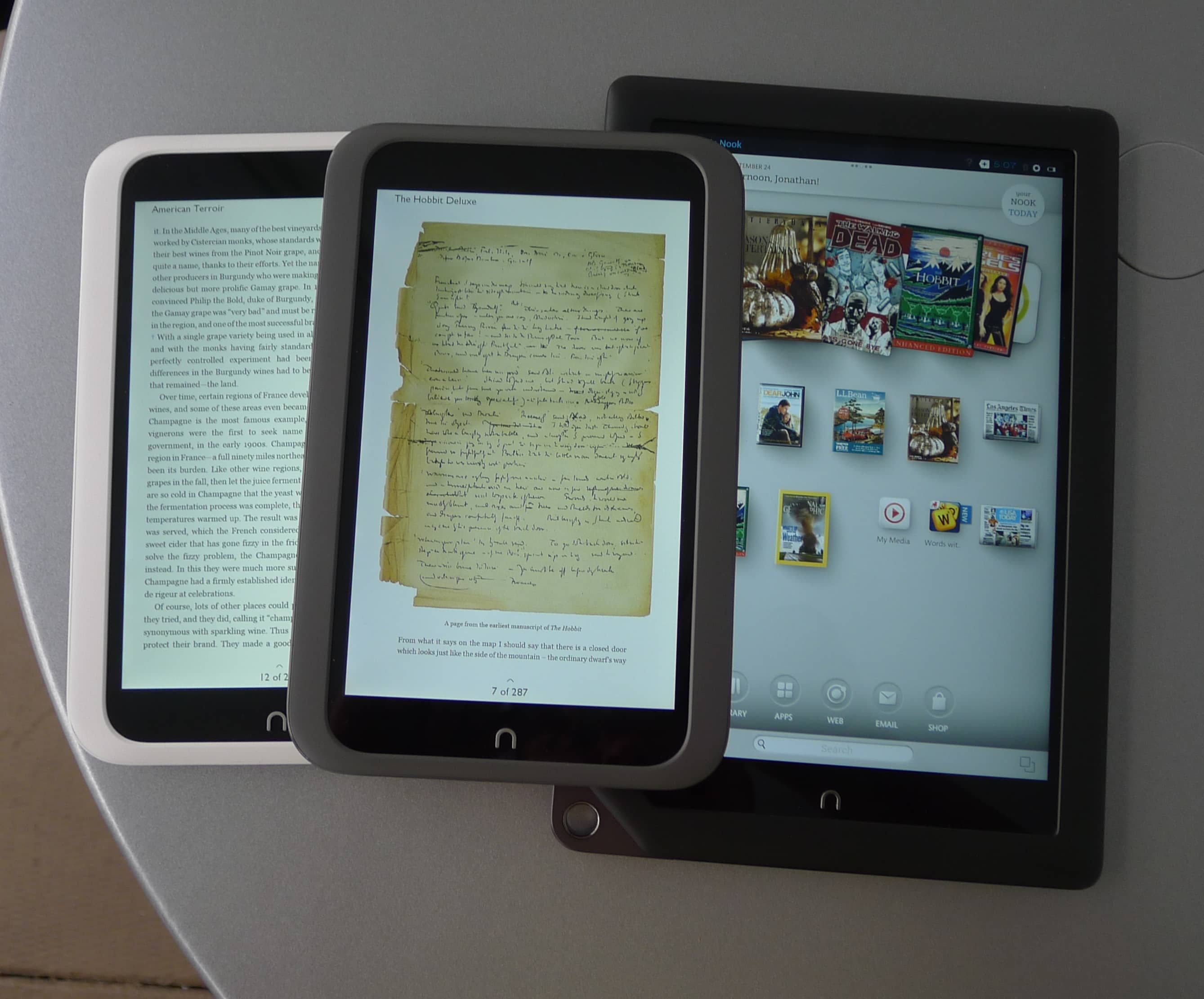
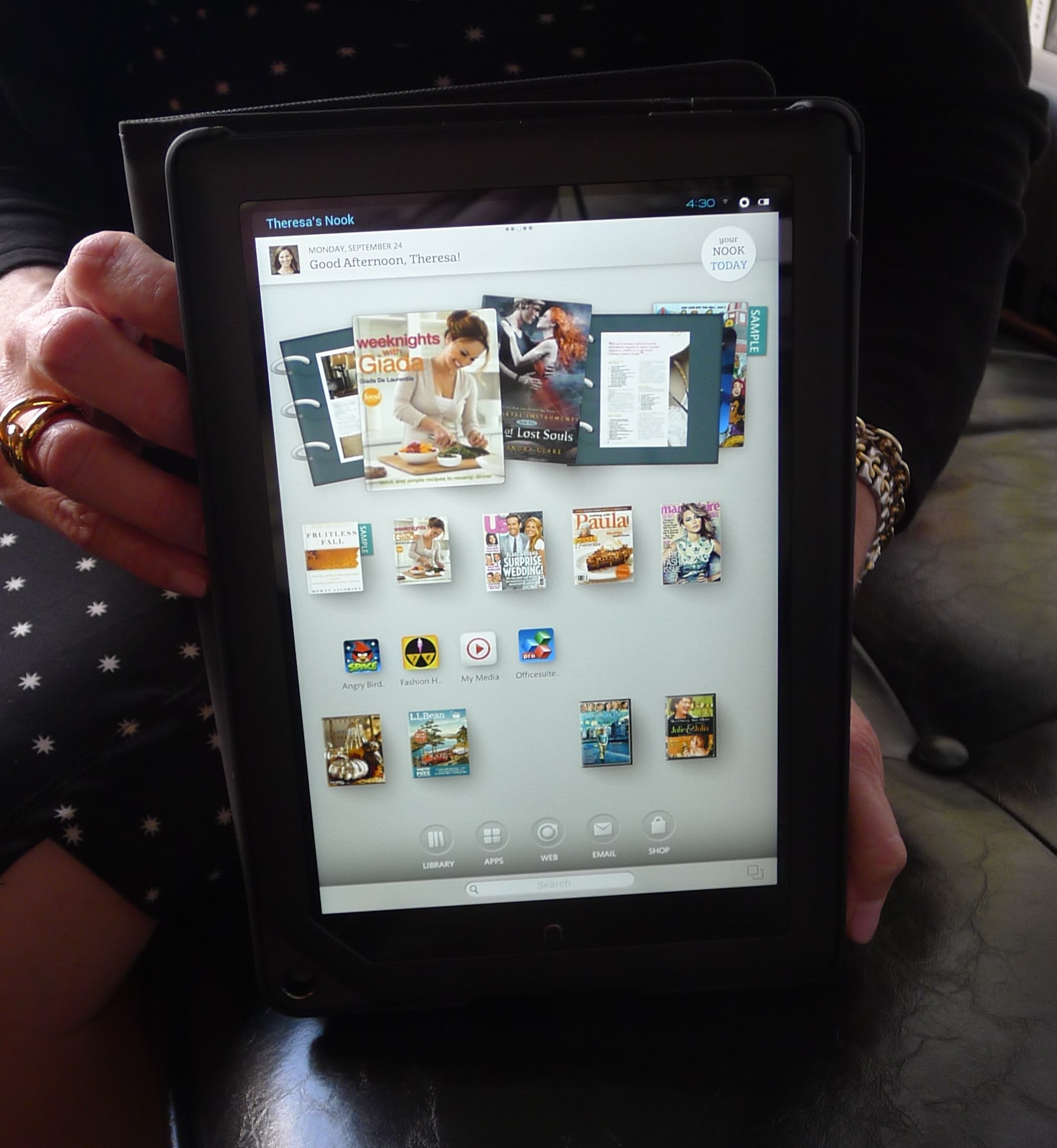
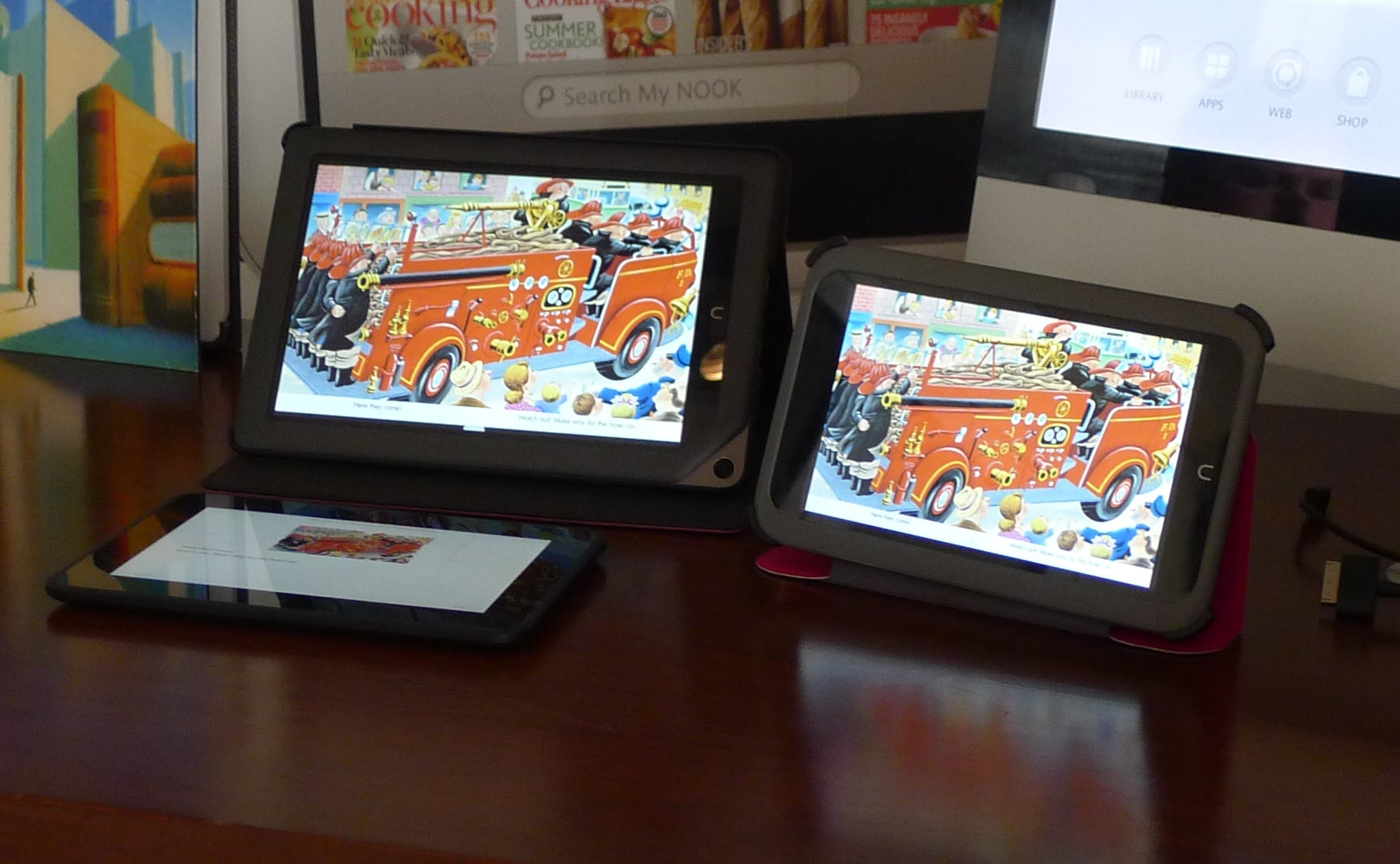
But there is quite a bit of news for the 2 new tablets. B&N showed off the Nook HD and the Nook HD+ on Monday. We’re not going to get a chance to buy these tablets any time before mid-October, but I think they’re going to make anyone who had settled on the 8.9″ Kindle Fire HD at least pause to rethink the purchase.

But before I cover the specs, here is the fact sheet. (I figure if I post it I can save the effort of posting the nitpicky details about the size and weight.)

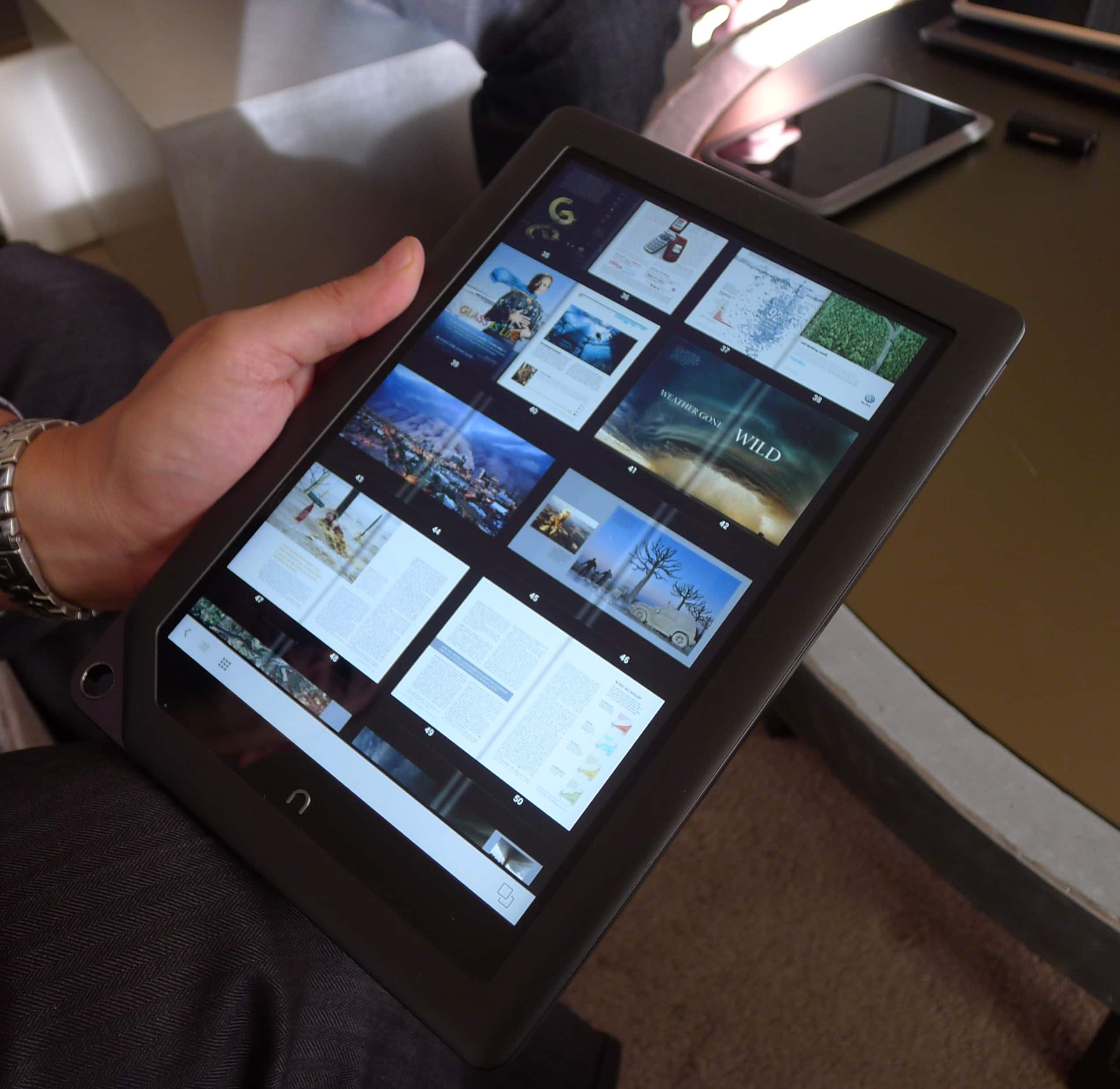
This week B&N has arguably outdone Amazon, Kobo, Google, and possibly even Apple on the hardware front. They just unveiled a pair of new tablets, one with a 7″ screen and another with a 9″ screen. The Nook HD and the Nook HD+ have new higher resolution screens and will be sold alongside the Nook Tablet (they are finally retiring the Nook Color).

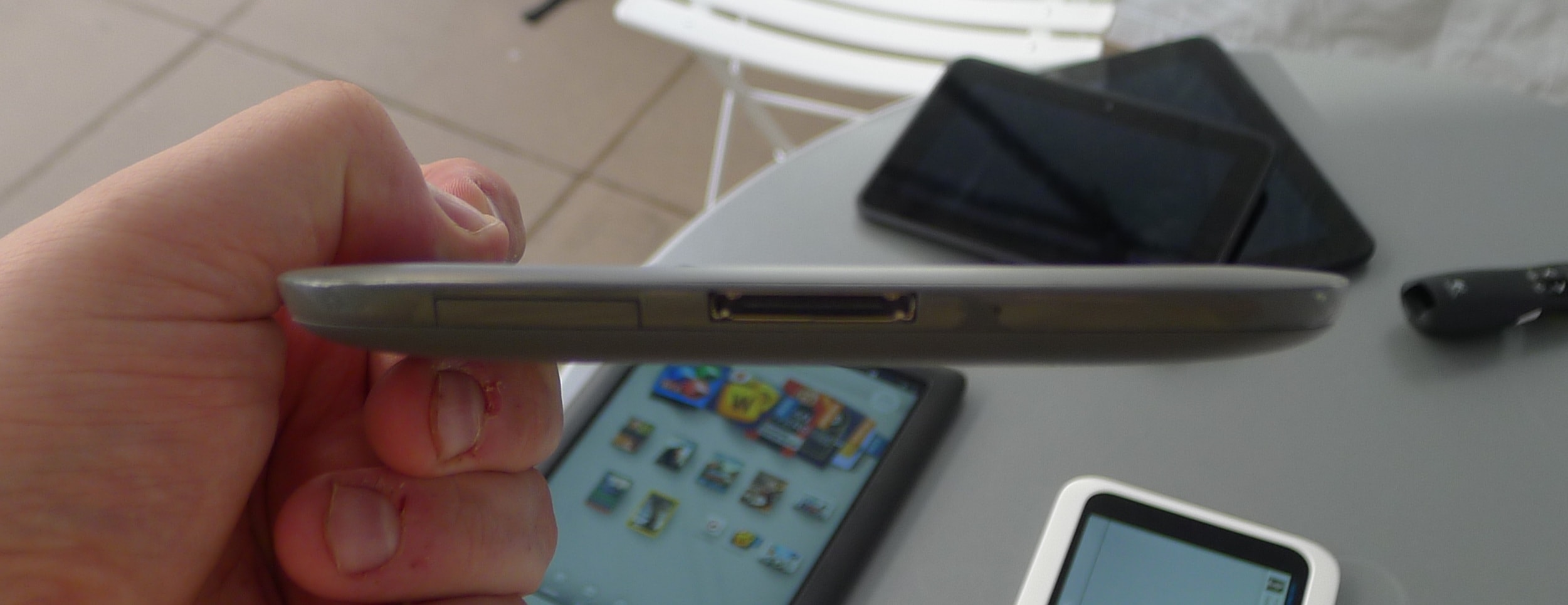
The 2 new tablets have a few details in common like no camera, no NFC, Bluetooth is enabled (finally) and instead of a USB port they have a 30 pin docking connector. They also each have 2 speakers, Wifi, a microSD card slot, and an optional dongle which brings out a full HDMI port. I’m told they’re running Android 4.0 ICS under the hood.

The Nook HD has a 7″ screen with a screen resolution of 1440×900, beating the screen on the Kindle Fire HD and on the Nexus 7 by a comfortable margin. The Nook HD is running on a dual-core Omaps 4470 CPU from Texas Instruments, with a clock speed of 1.3Ghz.

This model is going to be coming in 2 flavors, 8GB and 16GB, and the prices will be $200 and $230. (And the UK prices are £159 and £189.) That’s going to make this tablet priced at right about the same price as the Kindle Fire HD – once you factor in the cost to remove the ads and to add the power supply which Amazon sells separate.

Given that the Nook HD has a better screen resolution and a slightly faster CPU, I have to say that I am impressed at what B&N pulled off.  I personally don’t give a damn about the hardware differences, but B&N still managed to outpoint Amazon when it comes to 7″ tablets.

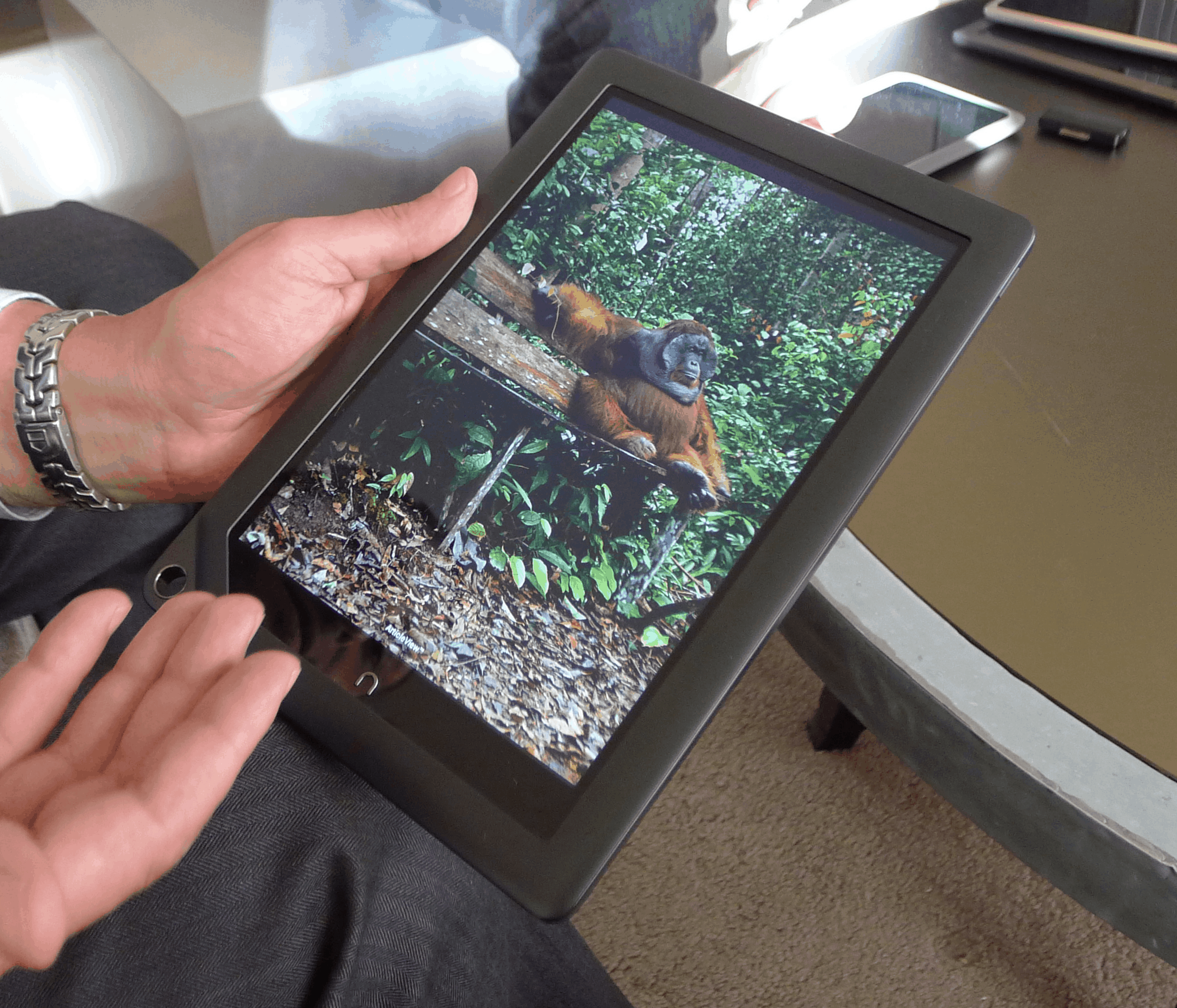
The same can also be said for the Nook HD+. This is a 9″ tablet with virtually the same screen resolution as on the KFHD 8.9, same CPU (1.5GHz Omaps 4470), storage (16GB and 32GB), and pretty much everything but perhaps the sound quality and the camera.  (Of course, the camera on the KFHD is pathetic so I don’t see how the lack would be important.)

The Nook HD+ has a 1920×1280 resolution screen and will be priced at $270 for the 16GB model and $300 for the 32GB model. If nothing else it beats the Kindle Fire HD 8.9 on price – by a considerable margin.

The UK prices for the Nook HD+ are £229 and £269.

But as impressive as the hardware is, these are still locked down devices to being not much more than consumption devices, and you’re limited to the types of consumption allowed by B&N. That doesn’t suit me, and it really puts a damper on B&N’s gadgets.

But that’s just the hardware. The software, on the other hand, now there I found something cool. I won’t cover all the features and services in obsessive detail, but there were one or 2 points which I liked and which I find compelling enough that I could see why someone would want to buy the tablets.

And you can find those details here.

Google eBookstore, Nexus 7 Android Tablet Launch in Japan

Someone is going to make a major hardware announcement later this week and it looks like Google plans to steal at least a little of their thunder. Yesterday afternoon Google announced a new local ebookstore in Japan as well as several major feature updates for the Google Books app for Android.

The ebookstore in Japan is accessible via Google Play, and it launched on the same day as the Nexus 7 became available in that country. The tablet is available now from the Play store at 19,800 yen (~ $254) for the 16GB model. Starting early next month the Nexus 7 will also be available at major Japanese retailers such as Bic Camera, Yodobashi Camera, and Joshin.  The ebookstore includes access to most of the same ebooks available elsewhere as well as a number of Japanese publishers.

This new launch makes the Google eBookstore available in Japan, the UK, U.S., Canada, Australia, Italy, France, Germany, Spain, and, like I reported yesterday, South Korea. Amazon is rumored to launch in Japan in October, and Rakuten/Kobo launched there back in July.

Given the difficulties that Japanese presents in terms of properly showing text, Google also quite wisely chose to update the Google Play Books app. This app is getting a number of new features that you cannot yet find in the iOS app, including  support for vertical text as well as right to left page turns. These 2 features are expected by Japanese readers, and the only platform which I know supports them is Kobo.

The app also adds improved annotation options, including highlights and the ability to add notes.The app can also now translate words when you select them and also show definitions. Google is also going a step beyond basic dictionary support by integrating new Wikipedia and map search into the dictionary look up. Now of you search on a place you might get a map result along with a snippet of Wikipedia text talking about it.

Yesterday’s update also includes a couple new reading options like a sepia background, and sliding page-turn. Both are great if you use them but I don’t.

All in all, Google is making a great software play for ebooks, video and music. Luckily for them theyu don’t have to make the same effort in hardware as Amazon, B&N, and others; Google already has Android tablets galore, including their own official one.

via

Google Play

The Chinese eBook Market is Finally Taking Off

Right now everyone in the English speaking blogosphere is focused on Brazil and Japan, but China could be where the interesting story is happening. China Daily is reporting that that the Chinese retail giant Jingdong Mall is pursuing aggressive discounts  with their ebookstore.

This company was a latecomer to the ebook market when they opened the ebookstore in February with around 80 thousand titles as well as reading apps for Android, PC, and more. They were facing competition from Hanvon, Dangdang, and Shanda, a Chinese media conglomerate as well as a buying public which was reportedly resistant to the current average ebook price of 5-8 yuan. (And if  you think there’s a disconnect between what US publishers charge and what  the US ebook buying public wants to pay, that’s nothing compared to China where that average price of 5-8 yuan converts to $.80 to $1.26.)

And so Jingdong Mall had to come up with a better offer to attract consumers. That could be why they hit upon the idea of offering subscription access to ebook content. They recently announced a plan to offer 1 thousand titles for a single fee of  30 yuan ($4.7) for three months, or less than half a cent per download.

The incredibly low price is dismaying both authors and publishers,  who fear cheap ebooks will threaten their livelihood, as well as Jingdong Mall’s competition. And that includes the ereader makers.

Hanvon, the leading Chinese ereader manufacturer, is finding itself in much the same position that Sony encountered in 2007.  Hanvon had launched their ereaders with the goal of making a profit by selling content, but due to a general failure to stock enough titles they’re finding themselves swept aside in the content market. This company had planned to follow Amazon’s ebook model, but unfortunately could not match Amazon’s wide catalog of ebooks and relationships with major publishers.

Hanvon is now dependent on device sales for most of their income and only offer a lackluster ebookstore to support them. In the long run that could hurt them because it now appears that the Chinese ereader market is jumping over the ereader-focused phase which the US ebook market outgrew in 2011 directly to the next phase of the market: apps.

As the quarterly statements from E-ink have shown, people are buying fewer ereaders today than they used to. And in fact the Chinese ereader market never was all that large, with some estimates putting it at around 300 thousand units sold in Q2 2011. That detail is confirmed by market surveys, including one survey conducted in China which showed that in 2011, far more people read ebooks on line or on a smartphone than on ereaders. Just under 12% of respondents read books on the web and 9.4% on smartphones, while only 2.5% favored ereaders

This is going to put Amazon in a curious position if and when they launch in China. And based on some leaked Kindle help pages discovered on Amazon.cn in April of this year, I think they will. Amazon will likely find themselves having to face stiff competition from experienced local retailers.

via

image by Arian Zwegers

How Technology Has Changed Stories In My Life

In the first of a series of monthly essays on The Literary Platform, Professor David Trotter ponders the question of what technology can do for stories. A lot of people seem to fall into the trap of considering “interactivity” to be the holy grail of the technological enhancement of stories (even otherwise visionary author Vernor Vinge famously thought hypertext was going to be the wave of the future), but Trotter isn’t quite so convinced. He discusses some “dazzling projects” that have brought interactivity to fiction, though admits he does not believe interactivity is either the be-all and end-all of technology for fiction or even all that technology can do for fiction.

I think that we need to find a way to put the vertigo back into the original question about what technology can do for stories. That will involve a history of the uses to which electronic communications media have been put. How, and why, did interactivity emerge from more than a century’s worth of innovation as the (technological, social, moral, political) principle to which we now so widely subscribe? There was interactivity before digitalisation, not just in life (where would the species be without it?), but in some forms of mediation, and, to a degree, in literature.

Over the last couple decades, I’ve watched technology do a lot for storytelling both in the world, and in my personal everyday life. In my opinion, “interactivity” is really only the tip of the iceberg, and not even a necessarily very interesting one at that.

There are really lots of ways technology is changing stories. For just one example, John Scalzi posted on his blog today about the experience of writing fiction on his iPad. (I’ve been doing some of that myself lately—scribbling story chapters with pen and paper while I work, then typing them into my iPad via a Bluetooth keyboard clamshell case and copying and pasting into Google Docs via my MiFi. Dig me, the wireless writer of the future!) And recently Charlie Stross wrote about how the new story processing program Scrivener (which I also use myself) has changed his writing process. (Stross also once composed an entire novel on a smartphone as a writing stunt.) Those are examples of technology affecting the way stories are told, aren’t they?

Perhaps my first encounter with technology changing storytelling came when I got to college in ‘91 and found some amusing story files collected from the Internet on a local BBS. They were early posts by creative college students to a mailing list called Superguy, where writers wrote and posted stories involving humorous and parodic takes on super heroes. And every so often, they’d get together for crossover events in which characters from several stories would meet up and work together.

And these people were from all over the country, and in many cases had never even met in real life—but here they were, working together on stories that got written and posted to an audience of hundreds, possibly even thousands of readers at their height—using nothing more than e-mail and maybe the occasional long distance phone call.

As my college years went on, I ran into more and more shared writing universes, and participated in a lot of them. And Internet writers weren’t the only ones who found benefits in collaborating. Shared universe anthologies like Thieves’ World, Wild Cards, and Liavek all sprang up around this time, though they were forged mostly from old-fashioned pre-Internet communication media.

Perhaps the next great advance in technological benefits to storytelling came with the invention of Hydra, which was renamed to SubEthaEdit, a shared editing space on OS X computers in which multiple people could have their own cursors and write on the same document at the same time. I’d never seen anything like this before. Not too much later, someone else came up with a fairly primitive but still functional Windows/Linux implementation of the same basic idea, called MoonEdit, which I used to great effect in writing shared-universe City of Heroes fanfic with a great bunch of writers including professional fantasy novelist Mercedes Lackey.

Later on, EtherPad developed a web-based version of the same tech before being bought by Google, whose Google Wave subsequently fizzled but now Google Docs offers much the same flexibility and a lot more reliability in real-time updating. And it’s amazing the globe-spanning reach the Internet has brought to this instant collaboration. The other day, I realized I was sitting in a Google Document with people from three other time zones (California, New Brunswick, and Britain, with me in Missouri) watching a Briton write on a story. I remember when I couldn’t even have afforded the long distance phone bills to talk to them all, but now I could Skype them very easily if I wanted sound or even video—but why bother when we can communicate well enough in text without?

If you want to talk about “interactivity” in stories, well, reading a story interactively is really pretty pointless, because no matter what you do all the choices you’re allowed to make are already plotted out for you. If you’re given the options only to turn left or right at a fork in the road, you can’t choose to go back the way you came—the choice isn’t there. But there are few thrills to compare with writing a story interactively, with your friends. It’s like playing a game where there are few rules, or a form of roleplaying where you have the ability to jump into each other’s characters and even go back and redo things if they didn’t come out right the first time. What a rush!

And shared text editors aren’t the only form of interaction in writing the ‘net brought about, either. An AoL employee founded Ficlets, to great fanfare and five minutes of attention from Internet celebrities John Scalzi and Wil Wheaton, then re-launched it as Ficly after AoL killed it. This site let people write collaborative stories round-robin style in chunks of 1024 or fewer characters, and was likewise a blast when you managed to get into a storytelling chain with other fun writers.

Fan and Internet writers aren’t the only ones to have discovered the benefit of Internet technology for collaboration, of course. In recent years there have been several groups of professional writers involved in doing this either as a hobby or professionally. Mercedes Lackey’s City of Heroes fanfic grew into a new shared-universe superhero novel series, Secret World Chronicle. Neil Stephenson and Greg Bear came up with their Mongoliad. Elizabeth Bear (no relation to Greg) had her Shadow Unit. So Amazon’s doing serials? Writers on the Internet have been doing serials for decades.

It’s also made it possible for more specialized types of stories to find their niches. For example, if you look for almost any minor fandom, fetish, or following, chances are you can find a fiction repository for it somewhere on the Internet. Interests so rare or obscure that it simply wouldn’t have paid to try to publish works involving them can suddenly build entire village-sized communities where people post and read stories for free just by putting everyone in the entire world who shares those interests together in one virtual place. It’s sort of the flip side of the way Amazon made making a living in self-publishing more feasible by creating a single storefront to sell your self-published books or e-books to anyone anywhere.

As I write this on the right-hand monitor on my desktop, I can look across to the left and see in my main Google Docs window two other writers in a shared setting in which I work discussing background material for one of the continents on a distant-future colony planet. I might never even have met these people without technology—and, indeed, I still haven’t met either one of them in person. But we’re writing hundreds of thousands of words of story together—not for professional publication at the moment, but who can say where things will go in the future? If a Twilight fanfic can become the next best-selling novel, anything can happen.

So, what can technology do for stories? Make it possible to create them, collaborate in them, and find them in ways that we couldn’t have dreamed of before we had it, for one thing. But I’ll be interested to see what Trotter’s series of monthly essays comes up with.

Image by Josef Stuefer.