Nate Hoffelder

Nate Hoffelder

Infographic: Reader Sutra

What’s your favorite reading position (he asks suggestively)?

The ebook subscription service 24Symbols took that question and ran with it. A few weeks ago they posted a chart which showed 24 reading positions inspired by famous books.

The titles for each image are in Spanish, but with most of the titles I don’t think that will be an issue.

24Symbols

Amplify Launches New Tablet, Will Ship it this Fall

With an entire 15,000 unit order recalled after only a few months, Amplify’s first educational tablet was one of the more spectacular tech fiascoes of 2013. This resulted in quite a few disappointed and frustrated students, and that is a mistake that this 2 year old startup is not looking to repeat.

Amplify has just unveiled their second tablet, and it’s pretty clear that they’ve learned a thing or two. This tablet was developed in partnership with Intel, and it’s based on the reference designs that Intel has been developing over the past few years.

The new Amplify tablet takes the 10″ reference design Intel unveiled in January and improves upon it. Like the reference design the Amplify tablet has a rugged shell and is running Android 4.2 Jelly Bean, but Amplify boosted the CPU, stepping it up to a 2GHz dual-core Z2580. This tablet also has twice the RAM, 16GB of storage, a microSD card slot, and Bluetooth.

The 10″ screen still has a resolution of 1280 x 800, but on top of the screen you’ll find a layer of Gorilla Glass. There’s also 2 cameras (5MP and 1.3MP), Mimo Wifi antennas for increased reception, stereo speakers, and a microphone. And finally, the battery life is listed as 8 plus hours; according to the spec the battery is rated at 8.1Ah.

In terms of accessories, the new Amplify tablet will have the integrated stylus as well as headphones and an external keyboard.

As you can see from the specs, the new Amplify tablet is going to be faster and more rugged than the one it replaced. That tablet was based on an Asus consumer tablet which has proven to be less than sturdy in the hands of schoolkids. Counting the 15,000 rented to the Guilford School District, about 20 thousand have been distributed so far. They will be recalled and replaced by the new model, which is expected to ship in the Fall and be in students' hands in time for the new school year.

Like their predecessor, the new tablets will be rented for $199 per year for 3 years.  It will come with device management tools as well as a suite of CC-licensed content. The previous tablet shipped with content from Khan Academy, CK-12 textbooks, and more, but the new tablet will have a slightly different bundle. You’ll also find public domain ebooks as well as a number of useful educational apps, including the Desmos graphing calculator, Encyclopaedia Britannica, EverFi’s digital literacy curriculum, Geogebra, Google Apps for Education, Merriam Webster Dictionary, Project Noah science tools, etc.

Amplify will also be licensing additional academic content separately. The first of the new content launched today, and it focuses on Language Arts curricula for 6th, through 8th grades. it  will set schools back $45 per student per year.

BookBaby Launches Bookshop

The indie ebook distributor BookBaby launched a new tool this week that could help self-published authors connect potential readers with ebookstores where an author’s book can be found.

Bookshop is designed to help authors connect directly with readers in ways they’ve never been able to before. This new service enables authors to create easy-to-use landing pages which contain links to an author’s website as well as links each ebookstore where an author’s work can be found, making it easier for authors to promote each of their books directly to potential readers.

Each landing page will feature an elegant design and all a book’s vital info, starting with an over-sized version of the book cover as well as relevant metadata, the book description, and details about the author and related books.

And most importantly, each page will include links to sites where readers can buy a copy. “Having a page on BookBaby is free for everyone, even if they don’t want to use us for distribution,” says director of marketing Kevin Breuner. “Their pages have links to the places where people can buy their work. And with BookShop, authors can market their work directly from their pages to readers, setting their own prices, as well as going through all the other outlets. We’ve learned a great deal running CD Baby, and we’re applying it to this. We’re working for the authors.”

To find out more, check out the BookBaby website.

Russian Author Releases Custom eBook Reader, Targets Fans and Readers Alike

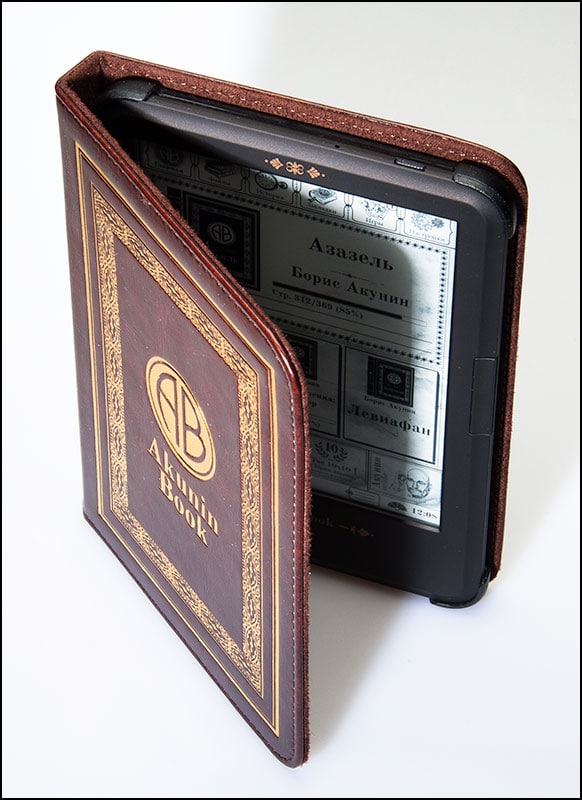
Publishers and authors have long sold limited edition books to fans in order to raise revenue, and Russian author Boris Akunin has taken that idea in a new direction. A few weeks ago he launched the AkuninBook, a limited edition 6″ ebook reader that comes bundled with a selection of his works and other content.

Boris Akunin is a pen name for Grigory Shalvovich Chkhartishvili. According to Wikipedia he writes detective and historical fiction, but he’s also an essayist and literary translator.  On his blog he says that the AkuninBook contains both his works as well as several lists of titles he recommends, a bibliography of all his other works including links to where they can be bought in Russia, and samples of audiobooks as well as links to where those can be bought.

The AkuninBook is also configured to receive updates from the author, including his Facebook updates.

This ereader is running software that was customized beBook Applications, and underneath the custom work you will find a regular ereader from the Chinese company Onyx. The AkuninBook is actually a customized version of the Onyx Boox C63ML, one of the ebook readers Onyx sells in Russia. It has a 6″ HD E-ink screen, frontlight, touchscreen, and Wifi.

The C63ML runs Android 2.3 on a 1GHz CPU with 512MB RAM, 4GB storage, and a microSD card slot. It weighs in at a svelte 169 grams. In addition to a broad range of ebook formats, it also supports mp3 audio.

The AkuninBook costs the same as the regular C63ML, but readers get a lot more. As you can see in the gallery below, this ereader comes in a pretty cardboard box and includes a beautiful leather cover. And since this is regular ereader users can also read other ebooks on it.

You can buy the AkuninBook on Onyx Russia’s website. Retail is 6990 rubles, or about $126 USD.

If that’s too much you can also find an AkuninBook app in Google Play. (A similar app for iPad and iPhone is in the works.) The Android app features color illustrations and the same content found on the ebook reader.

The-eBook.org

AkuninBook website

Pocketbook to Launch Waterproof eBook Reader, the Aqua

New ereader launches might be few and far between in the US but not in Europe. The Ukrainian ebook company Pocketbook has just revealed that they are planning to launch a water and dust resistant ebook reader called the Aqua.

The news came to light via an accidentally leaked press release, so details are still limited. But I do know that the Aqua will have a 6″ E-ink screen with a resolution of 600 x 800. It has a touchscreen but no frontlight, and it’s going to ship with 4GB Flash storage, Wifi. It will run Pocketbook’s reading software with its broad support for a variety of ebook formats.

I don’t have any details yet on the screen (and whether it too has been ruggedized), but early reports say that this ereader has a slightly modified design and is not just a regular model that has been dipped in a sealant. For one thing, the Aqua lacks a microSD card slot. This was sacrificed in order to reduce the number of weakpoints where water or dust might enter. The lack of a card slot will probably not be an issue for most readers – not unless you like to carry around a lot of PDFs.

With luck Pocketbook will also have seen fit to replace the standard 6″ screen with one that is more impact resistant. Most ereaders ship with a E-ink screen built on a glass backplane, which as I’m sure you know is easy to damage. A few, like the Earl back country tablet, use a slightly more expensive E-ink screens based on a plastic or  metal foil backplane. This makes the screen much more resistant to impact damage, and I am hoping that the Aqua will be equally rugged.

The Aqua is reportedly scheduled to ship in March 2014. There’s no information yet on the price or availability, but Pocketbook has revealed that the Aqua will meet the IP57 standard for dust and water resistance. This means that you should be able to submerge the Aqua in up to a meter of water for 30 minutes, and should the Aqua come in the way of a high pressure stream of water, the ebook reader will continue to function.

The-eBook.org

Patent Awarded on System for Libraries to Sell eBooks

The USPTO awarded a new patent last week for a system which will enable libraries to sell ebooks to patrons. For the past several years publishers have been pushing libraries to sell ebooks, and now a couple Canadians have a lock on the idea.

US Patent No 8,655,739 was awarded to Ronald Dick and Gordon Freedman of Ottawa Canada, and it describes one way that one way for libraries to generate revenue from ebooks. Here’s how it could work.

A borrower would check out and download an ebook. Once the ebook was opened in the related reading app, the system would track how much of the ebook had been read.  As the lending period ran out and the patron is about to lose access, the system determines whether the reader is going to finish the ebook.  If not, the borrower receives an on-screen offer to buy the ebook on the spot and keep it permanently.

Amazon operates on a similar basis, though their methods are different. As you know, they have partnered with OverDrive to enable their customers to read library ebooks on Kindles and in Kindle apps, and I can speak from first hand experience that Amazon has tried to sell me a copy of the ebook I checked out.

The system discussed in the patent is built on the assumption that borrowers might want to pay for the ability to complete the book at their leisure. There’s also the option for patrons to buy the ebook for another, or even donate it to the library.

That’s a pretty safe assumption for some titles in a library’s collection, but I wouldn’t necessarily expect it to happen all that often. What this patent describes is a digital equivalent of browsing in a bookshop, and I’m sure I’m not the only one who browses more titles than I buy.

USPTO

The Cite

image by Wiertz Sébastien

B&N Reports Digital Sales Down 50%, But It’s Okay Because They Have a New Tablet in the Works

Barnes & Noble released their latest quarterly financial report today, and the news is as bad as one could imagine. Sales were down slightly in the retail stores and in the college bookstores, which is bad enough, but sales in the Nook Store dropped through the floor.

B&N reported their third quarter earnings (for the quarter that ended January 25, 2014). Overall revenue fell 10% to $2.0 billion, and EBITDA increased to $173 million from $74 million a year ago.

According to the press release, the B&N the retail unit, including the bookstores and BN.com, had revenues of $1.4 billion for the quarter, decreasing 6.3% over the prior year. B&N College, the 600 odd college bookstores which are operated under contract, had revenues of $486 million, decreasing 6.0% as compared to a year ago.

And that brings us to the Nook division. You might want to sit down for this.

According to the B&N press release, revenues for the Nook segment dropped by half as compared to the same quarter last year.

The NOOK segment (including digital content, devices and accessories) had revenues of $157 million for the quarter, decreasing 50.4% from a year ago.  Device and accessories sales were $100 million for the quarter, a decrease of 58.2% from a year ago, due to lower unit selling volume and lower average selling prices.  Digital content sales were $57 million for the quarter, a decline of 26.5% compared to a year ago, due primarily to lower device unit sales.

In spite of the terrible news, it’s not all bad; B&N also reported that they took a smaller loss on the Nook last quarter; their money pit only cost them $60 million EBITA, and not the $190 million loss in the same quarter last year.

One could argue that this is actually good news in that B&N isn’t losing quite so much money, but the losses are going to have to eventually be covered by revenues. What with Nook revenues continuing to decline for the 5th straight quarter, there’s a good chance that revenues will cancel out the losses at about the point that both reach zero.

But never mind that; B&N has also shared today that they are planning to release another tablet this year. "The Company is actively engaged in discussions with several world-class hardware partners related to device development as well as content packaging and distribution." said Michael P. Huseby, Chief Executive Officer of Barnes & Noble, Inc. said in a released statement. "As a result, we plan to launch a new NOOK color device in early fiscal 2015."

Rumors of said tablet have been circulating since at least last August; at last report it had a model number of BNTV800 and was running Android on an Nvidia Tegra 4 CPU. These details were revealed in a leaked benchmark test in November, and have yet to be confirmed by B&N or by other leaks.

At this point I would think this is another mistake on the part of B&N; as has been pointed out at MobileRead B&N has already lost nearly 1.4 billion dollars investing in hardware. This is not their strength, and since they cannot afford to keep throwing money away I think it would be better for B&N to focus on apps and content.

IMO tablets were B&N’s single greatest error. If they had stuck with Nook ebook readers, and never released the first Nook Color,  B&N could have saved themselves the money invested in the Nook Tablet and Nook HD/HD+, 3 devices no one wanted to buy – not even after the latter two were cheap and shipped with Google Play.


Next Windows 8 Update Coming This Spring, Includes Improved Support for Mouse

If you’ve been avoiding Windows 8 because of the horrible Metro interface then I have some good news for you. Microsoft held a press conference today where they shared a few details about the next update for Windows 8 and Windows RT, and it looks like MS is finally bowing to market pressure.

Microsoft is in Barcelona this week for MWC, and they kicked off the week with a press conference where they share details about new updates for Windows and Windows Phone.

The new version of Windows is due out in the next few months, and Microsoft says that it will expand the options for hardware makers to tablets for the budget market, include compatibility for use in schools and large business, and improve the non-touch user interface controls.

According to Joe Belfiore, VP of operating systems for Microsoft, the updates adds a new mouse user interface, giving users new ways to access Start and to close apps. It will also be easier to launch and switch between apps through the task bar, and Microsoft is also adding search, power, and settings icons on the Start screen. Those icons can currently be found on a menu accessed by swiping from the right of the screen, making them difficult to access if you have a mouse and not a touchscreen.

When Microsoft announced Windows 8 at CES 2011, many looked on with a sense of dismay as MS showed just how obsessed they were on pushing the touch-focused Metro interface.

Unfortunately for MS, the market doesn’t seem to have liked the idea nearly as much as MS. Today’s presentation also revealed that only 40% of Windows 8 devices are equipped with a touchscreen, meaning that MS developed an interface that won’t function properly on 60% of the devices it’s running on.

The Metro interface is so unpopular that dual-boot Android/Win7 devices made an appearance at CES 2014, close to 18 months after Windows 8 shipped. Metro is in fact so unpopular that in the past few months several laptop makers brought back Windows 7 as an alternative.

In other news today, Microsoft is also making moves to go after the budget end of the device market. A few days ago they lowered the license fee for Windows 8 and Windows RT, and today they lowered their minimum hardware requirements.

According to reports,Windows 8 devices that retail for less than $250 have had their license fee slashed by 70%. The new minimum requirement is 1GB of RAM and 16GB of storage. That’s not exactly a budget device when compared most of the bottom of the barrel Android tablets, but it is considerably cheaper than Microsoft’s previous standard.

Many are viewing these changes as a move against Chromebooks, which have made some headway in the educational market. That’s probably true, which might explain the new IE8 compatibility mode for Internet Explorer 11.

SlashGear

Confirmed: New Yotaphone Dual Screen Smartphone to be Unveiled Next Week at MWC

If you’ve been thinking about buying the dual-screen Yotaphone smartphone, you might want to hold off. A Russian tech blog has reported, and Yota Devices has confirmed, that a new model Yotaphone will be unveiled at Mobile World Congress next week.

Update: Here is the announcement (link).

The new Yotaphone is said to have larger screens and a more polished design.  Yota Devices isn’t sharing any other info, but they did confirm that a new device will be announced next week. They will have it in their booth for everyone to see.

The current Yotaphone is an odd looking beast with 2 screens: an E-ink screen on the back and an LCD screen on the front. The screens measure 4.3″ diagonally, and have resolutions of 720 x 1280 (LCD) and (E-ink) 360 x 640. It runs Android 4.2.2 Jelly Bean, non a 1.7 GHz dual-core Qualcomm SparDragon CPU with 2GB RAM and 32GB Flash storage.

The phone has been under development since 2010 and was first unveiled in late 2012. Thanks to the dev costs and the extra screen it’s a rather pricy device. It retails in Europe for 500 euros. That’s a rather high price for a new device from a relatively unknown company, but it has found a market. Kommersant reports that 12 thousand Yotaphones have been sold since it shipped in early December 2013.

And now, just over 2 months after the first model shipped, Yota Devices is ready to announce a new model.


Private Equity Firm Wants to Buy B&N for $22 a Share

Barnes & Noble has just received a buyout offer from G Asset Management, a little-known private investment firm. This firm is looking to acquire a 51% stake in the bookseller, and they’re willing to put up $672 million, or about $22 a share.

The firm has stated that they plan to spin out the Nook division as a separate venture apart from the retail stores and the college stores. If G Asset Management cannot buy B&N, they made a second offer for the just a controlling interest in Nook Media at $5 a share.

Barnes & Noble stock price jumped at the news, but it is still trading below $18 a share at this time.

If you’ve been following bookselling news for any length of time then G Asset Management is a name you might recognize; they made a similar offer in 2012. At that time they wanted a 51% interest in B&N College, the division that runs college bookstores. That deal fell through, with B&N instead choosing to form Nook Media by combining the Nook unit and B&N College, and selling a chunk to Microsoft and Pearson.

And last November, G Assett Management proposed separating the Nook business in a deal that would have valued the retailer at $20 a share. That deal also fell through.

Len Riggio, chairman of B&N, made his own attempt to take control of B&N and split the company in 2013.  he wanted to take the retail stores private and let the rump of B&N go its own way. He later withdraw his plans after winning some unknown internal power struggle.

B&N has yet to comment on the offer, but they have confirmed that they received it.

IMO, they would be fools not to accept. I think they should have take the earlier offer. This would have set them free from their most toxic asset, the Nook platform, while also giving the retail chain an infusion of much needed capital.

B&N’s revenues have continued to decline over the past few years, with the most recent holiday season showing a 6.6% decline in sales, with the digital sales showing an even steeper decline.

But B&N being B&N, I am also going to put money on their declining to sell the Nook unit. I also don’t think that G Asset Management has much of a chance of gaining a controlling interest in B&N; Len Riggio is the single largest stockholder and at one point last he controlled around 45% of the company. That’s going to make it really easy for him to block this deal.

Update: And it looks like Riggio might not have to offer. According to Bloomberg, GAsset Management only has a few million in assets, not the nearly $700 million it would take to carry out this deal.

Readium Epub3 App for Chrome Gets Major Update

As far as the wider ebook market is concerned Epub3 is a dead format, but it still has its uses. That’s why I was pleased to read yesterday the the Readium for Chrome extension received a major update.

Readium for Chrome builds on the work of the open source Readium Foundation, and it enables readers to view Epub3 ebooks in either ChromeOS or their Chrome web browser. The new update brings behind the scenes improvements, including updates to the codebase, as well as  a more modern user experience.

There are in fact many apps which will let you read an Epub ebook in Chrome, but Readium is the only way to read an Epub3 ebook (so far as I know).

And BTW, the post which announced the update also reminded me that this extension, like the Readium project as a whole, is still in pre-release development. This latest version of the plugin, like previous Readium for Chrome  should be considered alpha-level software that’s not suitable for the end user. if you encounter bugs, they would like you to report them here.

P.S. If you’re looking for a source of Epub3 ebooks to read in Readium, you can find an archive collection here.

Readium for Chrome

Infographic: Top Ten Reasons for Choosing a Paper Book over an eBook

A cursory glance at the statistics for the US ebook market will tell you most people are sticking with paper, and there’s a good reason for that. As the following infographic will show you, paper books fill many uses which ebooks cannot.

The infographic is based on a poll conducted recently by Fatbrain, a UK-based used book marketplace. Over 1,000 Fatbrain users responded, and they revealed that the most popular reason for staying with paper reflected their emotional attachment, and not any practical use.

However, right behind there are two down-to-earth reasons: learning (61%), and sharing (58%), and those are 2 answers that I can fully understand. Paper textbooks are still more useful that digital textbooks; even I will say that.

eBookFriendly

Kobo Revenues Up 44% in 2013, Userbase up 50%

Amazon might not be releasing any interesting details about Kindle Store sales in 2013, but luckily for us Rakuten is more generous. This international retail conglomerate held their annual stockholders meeting on Friday, and they released a few details about Kobo.

Rakuten bought Kobo in late 2011, and while they’ve always been somewhat cagey about financial details they have in the past shared a few nuggets of info. For example, in their 2012 annual report Rakuten told us that Kobo revenues were up 143%, and that at the end of 2012 Kobo had 12 million users.

On Friday Rakuten revealed that Kobo’s Q4 content revenues were up 44% over 2012.  They also shared that Kobo now has 18 million users.  This we already knew from the news a couple weeks ago about longtime Rakuten exec Takahito Aiki taking over as CEO of Kobo, but it is good to have confirmation that the stat is current.

You can find the annual report online, as well as a copy of the video of the meeting. (Thanks, Fbone!)

The 2013 year end stats may not have been as impressive as what Kobo shared in 2012, but they’re still a sign that Kobo is seeing enough growth that they want to boast about it. That’s better than what Amazon has seen fit to share.

And that’s not all Rakuten shared with us on Friday; they also revealed why Takahito Aiki stepped in as CEO of Kobo earlier this month. I speculated at the time that Aiki was brought in because he was Japanese and because he had experiencing in running a not too dissimilar international company, but it turns out that Rakuten had a more specific purpose in mind.

The tl;dr version is that Mr. Aiki is viewed as a turnaround specialist. He previously ran Fusion Inc, one of Rakuten’s telecom subs, but we knew that from the press release. What we didn’t know at the time (no one reported it, so far as I can tell) was that Fusion was a money pit when it was acquired by Rakuten, but by the time Mr Aiki left it had generated over 1 and a half billion yen a year in operating income (aka operating profit) in 2012, and 1.9 billion yen in the first 9 months of 2013.

That’s only about $19 million dollars, which is chump change to Rakuten. It’s probably even chump change compared to what Kobo generates in term of revenue, but if Mr. Aiki can have a similar effect on Kobo it’s potentially very good news for Kobo’s customers (as well as anyone who hates Amazon’s dominance of the ebook market).

Kobo is believed to have a negligible share of the US ebook market, but they’ve always said that they had an international focus and as you can see from the year end stats that focus has continued to pay off. Can you name another ebook vendor who can boast of similar growth?

With Mr Aiki at the helm, Kobo’s healthy growth rate has an excellent chance of continuing.

Barnes & Noble Discontinues the Nook Touch

Don’t look now, but Barnes & Noble has retired the Nook Touch. This ebook reader, which initially launched in 2011, is no longer mentioned on the B&N website, and according to my sources all mentions of it are being removed from B&N stores today.

The Nook Touch is still available on the Nook UK website, and you can still find it via 3rd-party retailers and on Ebay, but so far as B&N is concerned this model has been discontinued here in the US.

On a related note, the 2012 Nook Glow is also gone, but that should come as no surprise. That ereader was replaced in late 2013 by a newer model, and was subsequently retired.

The Nook Simple Touch was B&N’s second ebook reader, and it was released in late May 2011. It ran Android 2.1 on an 800MHz CPU with 256MB RAM, Wifi, a 6″ E-ink screen, and an IR touchscreen. It had 1.2GB of internal storage, and a microSD card slot.

For a while there the Nook Touch proved quite popular among hackers; once B&N’s interface was bypassed hackers quickly began to appreciate having a 6″ E-ink Android tablet, and they came up with new ways to use it including by playing Angry Birds, running a MacOS emulator, reading Kindle ebooks, playing videos, and some truly weird tricks like word processing and wireless printing.

The Nook Touch hadn’t received significant updates in some time the 3 years since it launched, so I am not surprised that it’s now gone, but I do wonder whether this was the best move.

This model was priced to compete with the basic Kindle, and now that it’s gone B&N won’t have an ebook reader for the budget conscious consumer. Sure, there are any number of models on the market which will work with the Nook Store, but I was under the impression that one goal for the Nook hardware was to try to lock readers in to buying their ebooks from B&N.

Perhaps B&N isn’t so interested in the bottom of the market any more? Given that they were probably losing money on each Nook Touch sold, that would make some sense.

In any case, the Nook Touch is still available at a variety of retailers, including Walmart, Target, and Ebay.

New Job Listing at Microsoft Confirms Earlier Hints that MS has an "Xbox Reading" App for Windows 8

Microsoft might be boringly monolithic at times, but their sheer size often lets them throw several teams at a single market.

Take ebooks, for example. In addition to investing in Nook Media and developing a textbook-focused Reader app for MS Office, Microsoft is also working on another ebook app as part of the Xbox division.

The hot story this morning comes via a Chinese gadget blog. LiveSino discovered that Microsoft is looking to hire a developer to work on "a groundbreaking interactive reading app on Windows, which incorporates books, magazines, and comics." The engineer hired in this position would join the same Music, Video, and Reading (MVR) team that has already shipped two Xbox branded apps for Windows 8.

It’s not clear why Microsoft is investing in a third ebook parallel ebook effort, but I’m not surprised to learn that they have. As I pointed out in October 2013, the acronym in the title of the Xbox MVR unit stands for Music, Video, and Reading. That unit had already released a music app and a video app, so at some point I was expecting it to spawn a reading app on Windows 8, and possibly the Xbox.

If I had to guess, the Office and Xbox reading apps are going to be targeted at 2 different markets. The still-unannounced Office Reader will likely focus on academic, technical, and educational content, while the Xbox MVR app will more likely focus on fiction, including both novels and graphic novels. There is also a possibility that this new job posting is a sign that the work on the Nook Windows 8 app will be shifting to MS, but it’s too early to say.

I know that many refer to the ebook market as a single unit, but in reality it is still segmented based on content. It might make sense for Microsoft to develop a couple different apps which each focus on a different segment and have different features and abilities.

If nothing else, this new job listing shows that Microsoft is getting their money’s worth from their  $300 million (plus a promised $300 million) investment in Nook Media in 2012. They already got the international Nook Store, which launched in late 2013 in 32 countries (including Australia) – but is only available for Windows 8.

The Verge