Nate Hoffelder

Nate Hoffelder

The Txtr Beagle Hits the Market in Hungary, Will Cost 30 Euros

It’s been well over a year since txtr first unveiled the beagle (and about 3 months since I incorrectly proclaimed its death) and txtr has found a telecom willing to take it on.

I have just learned that txtr has signed a deal with the Hungarian subsidiary of Deutsche Telekom. txtr has a long history of providing ebookstores for Deutsche Telekom’s various divisions, and now txtr is going to provide hardware as well.

The beagle will be bundled with certain new smartphones (Samsung Galaxy Young, Sony Xperia M, or LG L7 II) as part of a 2 year contract. The subsidized price will be 30 euros (3 times the price that txtr had originally planned to charge).

And for those who don’t want a 2 year contract the beagle will be available separately with a retail price of 60 euros. That  price is going to make it more expensive than a number of ereaders on the German market, so I am not sure that there will be much interest.

But I could be wrong. The beagle was briefly available from txtr earlier this year, and it was selling for 59 euros (the same price as the Amazon Kindle). Sales were reportedly good enough that they were the deciding factor in the decision to carry the beagle in Hungary.

The beagle, which is really more of a smartphone accessory than an ereader, is equipped with a 5″ E-ink screen, Bluetooth, and is powered by a couple AAA batteries. It’s capable of holding 5 titles at a time, and is designed to work in partnership with the txtr app for Android and iPhone. The beagle cannot work without the txtr app, and that is because it cannot actually display ebooks. Instead txtr’s reading app has to convert an ebook from an Epub or PDF file to a collection of page images.

The Inkcase E-ink smartphone case I reviewed last month uses basically the same trick, albeit with a different set of hardware. The trick does work, to a limited degree, but it also comes at the expense of any of the more useful features found in most ebook readers like annotation, book marks, and a TOC.

Deutsche Telekom will be supporting the beagle in Hungary with an ebookstore that has a catalog of over 900,000 titles, including 3,000 titles in Magyar (the Hungarian language).

BuchReport.de

Kindle for Android Updated with Collections, New Option to Enable/Disable Publisher Formatting

Amazon rolled out a new update for the Kindle Android app yesterday. In addition to the usual bug fixes, the app also gained a couple new features, some improvements which you might not notice, and at least one feature that took me several minutes to find.

The Kindle Android app now supports the collection feature which lets readers organize their ebooks, magazines and documents into directories (I’m old fashioned). The app also gained better support for the accessibility features in later versions of Android, including both Talkback and Explore by Touch.

The changelog also mentions a prompt that asks you to rate an ebook when you’ve finished it. I’m not sure what Amazon changed, but I do know that some version of this feature was already present in a previous version of the Kindle app; I remember writing about it.

And then there’s the biggie. According to the changelog, the Kindle app will now let you choose to turn on or off the publisher’s font choices. that’s not quite true. I’ve been playing with this feature this morning; it’s the one that was hidden and it took me some time to figure out that I had to press the Android menu button to see the menu where this option had been placed.

Edit: And now the option appears to have vanished after I reset the Kindle app. Weird.

Update: If you don’t have the menu button I mention, look in the upper right corner of the Kindle app. If you see an icon resembling 3 dots, press it. That is the menu where I found this option (confirmed on a Sero 7 Pro).

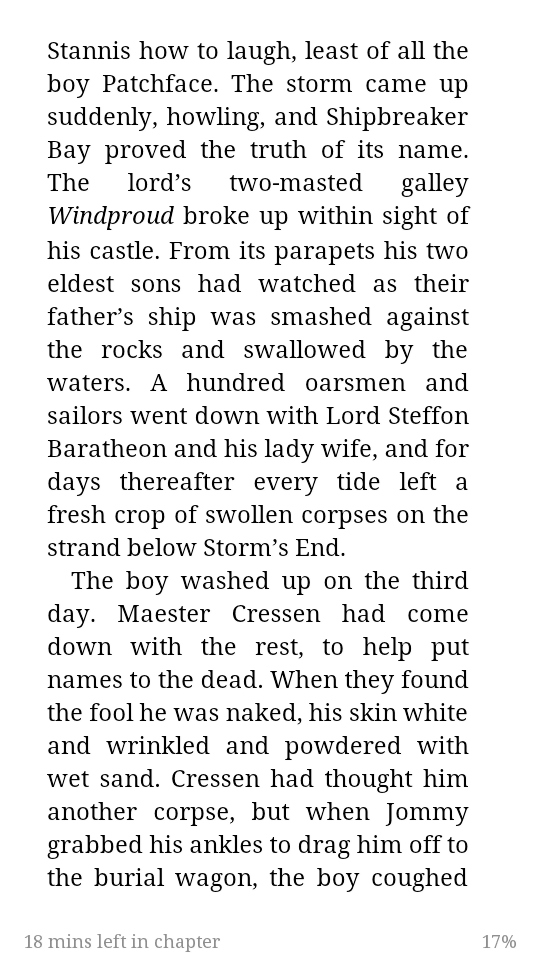
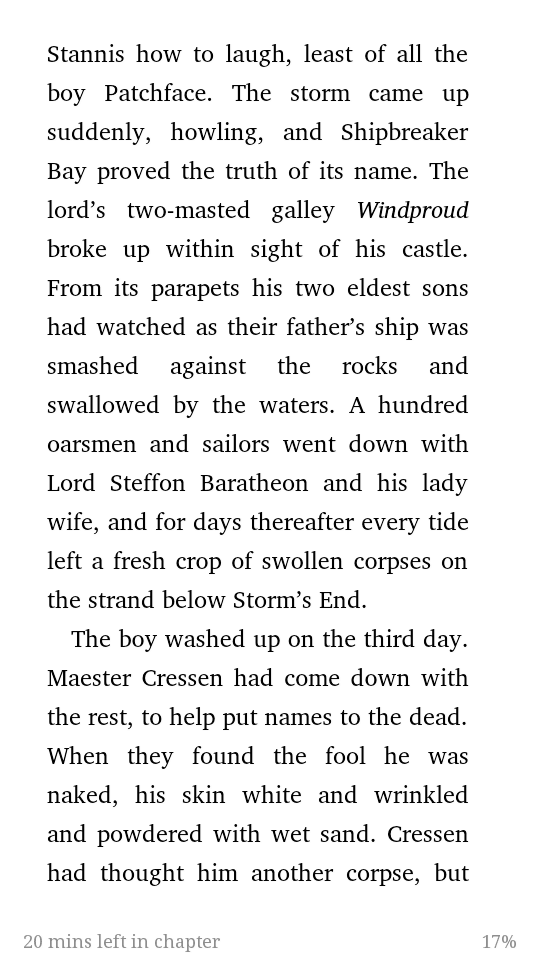
This option doesn’t just enable a publisher’s font; it also turns on and off the publisher designed formatting. Turning it on radically changed  the formatting of A Song of Fire and Ice.
The font changed, of course, but the screen margin also got wider and the the line spacing increased.

Here is a pair of before and after screenshots:

Someone please correct me if I’m wrong, but this is a new feature. And while I don’t care to use a publisher’s formatting (it often gets in the way of reading fiction), it’s still a good addition to the app.

Judging based on how often the topic comes up over at MobileRead, lots of readers want to use publisher formatting.  I can’t recall how many times I have read a complaint about Aldiko or some other reading app not supporting publisher formatting (or rather the reader didn’t know the option had to be enabled), so I am sure that Amazon has had similar requests.

Edit: And as a reader reminded me, controlled is often very useful for nonfiction where the text and illustrations have to fit just so or the reading experience could come up short.

You can find the app in Google Play and other fine establishments.

Changelog:

• Organize your books, magazines and documents into collections
• Accessibility improvements for Talkback and Explore by Touch
• Turn publisher fonts on or off
• Rate the book before you go


New Estimates Show That Amazon’s eBook Market Share is Shrinking in Germany

Ask most publishing industry pundits and they’ll tell you that Amazon dominates 4 ebook markets: US, UK, Germany, and Australia. If current trends continue that list could be knocked down to 3.

The market research firm GfK has released a few details from their latest report on the German book market. I don’t have the full report, sadly, just the driblets shared with the German-language press, but it does not present a pretty picture for Amazon.

GfK is estimating that Amazon’s share of the German ebook market slipped to 43% in the third quarter from 48% in the second (source). Their report also says that ebooks accounted for 5% of the German book market in the first half of 2013; this is over twice as much as 2012, when ebooks accounted for an estimated 2.4% of the market.

There is also mention that ebook prices are averaging 20% lower than print book prices, and that more consumers are starting to buy directly from publishers. There weren’t any specific details on that point, though.

The Tolino consortium, which is the second largest ebook platform in Germany, has siezed on this as great news. Deutsche Telekom has an article posted on their website which boasts that Tolino accounts for 37% of the German ebook market. They don’t explain where they got this detail and I’m not sure that GfK released it, so we probably want to take it with a grain of salt.

Tolino initially launched in March of this year with a generic looking ereader and a plan: to beat Amazon. Four media retailers and Deutsche Telekom decided to combine their ebook efforts and share a single ebook platform while still operating competing ebookstores. At the time they had an estimated 35%  to 40% of the ebook market (it depends on who you ask).

In the nearly 9 months since launch, Tolino has sold a reported half a million Tolino Shine ereaders, released a pair of tablets, and managed to hold on to their market share as the ebook market nearly doubled in size. But one thing they have not managed to do was take market share away from Amazon. Someone else is doing that, but I don’t have specific details as to who it was.

The leading candidates include Apple, Google, and Kobo, and it is difficult to guess which one is coming out ahead.

Any thoughts?

Amazon Drops Minimum Payment Threshold for Indie Titles

Amazon has an early Christmas present for indie authors, and like most of Amazon’s innovations it is going to gall some legacy publishers.

The retail giant sent out an email yesterday to KDP authors and publishers with some good news. According to the screen shot I saw (and confirmed online), payments for ebooks sold in the Kindle Store will now be sent out on a monthly basis, 60 days after a given month ends. Amazon is no longer going to require a minimum payment threshold. Instead payments from each of the Kindle Stores will be processed automatically (with the exception of the Brazilian Kindle Store).

Amazon has always managed more timely payments than legacy publishers, some of which make royalty payments to authors twice a year (if you’re lucky), and now Amazon is going a step better.

My only puzzlement today is why this took so long. Amazon announced a similar change to their publishing division’s payment processing back in March 2013. That was when Amazon Publishing announced that they would be sending royalty checks monthly instead of quarterly, in much the same way that I get my Amazon affiliate payments on a monthly basis.

Amazon has confirmed the change in payment processing on the KDP website.

Thanks, Tristan!


eReatah Relaunches as Entitle – Still Won’t Let You Download the eBooks They "Sell" You

When eReatah launched their book club style subscription service in early September they promised that users would be buying and owning ebooks rather than paying for access in the likes of Spotify, Oyster, and the like.

This service is leaving beta this week with a new name and a redesigned website (the old one was horrendously bad), but sadly they are still no closer to keeping that promise than they were 3 months ago.

Entitle, as eReatah is now known, has raised $5.3 million in capital, and it offers a subscription plan that more closely resembles Audible than Oyster. This startup has a catalog of more than 100,000 titles, including both backlist and frontlist works from HarperCollins, HMH, IPG, Ingram Content Group, and Simon & Schuster.

It sells a subscription plan that lets customers add 2 to 4 titles per month to their library. Prices start at $15 per month, and the ebooks can be read on Entitle’s apps for Android, iPad, or iPhone.

Entitle is boasting that they offer recent releases from major authors including the likes of Stephen King, Dan Brown, Doris Kearns Goodwin, Walter Isaacson, and Janet Evanovich. This is a claim that Oyster and Scribd  will have trouble matching with their Netflix-style subscription plan, so I’m sure that it’s going to appeal to a lot of readers.

Unfortunately, this service suffers from the same limitation of Oyster and Scribd. Like its competitors, Entitle doesn’t actually sell you the ebooks. Sure, you can access the ebooks after your subscription expires, but you are stuck with using Entitle’s apps.

Update: Entitle now supports downloading ebooks and transferring them to ereaders.

Want to read on your ereader? Sorry, that’s not possible. Want to download a copy for safekeeping? You can’t do that either. Would you like to read on your Windows smartphone? You can’t because Entitle hasn’t released an app for that platform yet.

Do you want to remove the DRM? Sorry, that’s not possible, which means that Entitle isn’t really selling the content. Like Oyster and Scribd, Entitle is selling access to the content.

And as recent events have shown us, so long as the vendor controls access to the content you don’t actually own it. it was only yesterday that Boing Boing informed us about an Amazon Video customer that lost access to a video when Disney yanked the rights.

The customer was under the mistaken impression that he had bought the video, but apparently that was not the case:

Bill sez, Last "December I bought some favorite Christmas specials for my kids with the idea they could watch them every year. Went tonight to watch one ('Disney Prep and Landing 2' if you’re curious) and it was gone from our library and couldn’t be found on the site at all. Amazon has explained to me that Disney can pull their content at any time and 'at this time they’ve pulled that show for exclusivity on their own channel.' In other words, Amazon sold me a Christmas special my kids can’t watch during the run up to Christmas. It’ll be available in July though!"

Update: Amazon has worked to restore access to the content they took away (AllThingsD). That’s good, but it doesn’t change that they took it away in the first place. Also, this is not the first time that Disney has taken back previously purchased content (AppAdvice).

Like Entitle, content in Amazon Video is trapped inside the vendor’s apps. That’s what made it possible for Disney to take back the content that was "sold", and Entitle is stuck in a similar position.

I’m not saying that Entitle is going to have the same problem, but I am saying that until you can get the content out of their apps, until you gain control, you don’t actually own it. This issue is why I don’t "buy" videos from Amazon, iTunes, or most other services, and it is why I am avoiding Entitle.

What about you? Do you think this is a good value, given the risks?

TechCrunch

German Newspaper Bild Launches eBookstore, Now Sells Tolino eBook Readers

The Tolino ebook consortium gained a new retail partner today.

Germany’s leading tabloid Bild announced that they are expanding their content store. Bild.de already sells video and offers a subscription music service, and as of this morning they launched a new ebookstore at ebooks.bild.de.

This store is being operated in partnership with the media retailer Buecher.de, and it draws its ebook catalog from the Tolino platform. The site stocks millions of titles, and is already selling the 99 euro Tolino Shine. The Bild catalog includes bestsellers, novels, biographies, guidebooks and photo books, as well as a line of reissued public domain novels by authors such as Daniel Defoe, Alexandre Dumas, Mark Twain and Jules Verne, with prices starting at under 1 euro.

The ebooks are sold in Epub, and they can be read on the Tolino Shine, as well as on any ereader or reading app which supports Adobe DE DRM. On a related note, Bild is also selling paper books.

So how did a German tabloid come to launch an ebookstore?  This initially confused me, but after I asked Johannes Haupt of lesen.net he explained the connections between Tolino, Bild, and Bluecher.

The first thing you should know is that Buecher.de has been part of Tolino since that platform launched in March of this year, and has been selling ebooks for all of that time. That name has not come up before on this blog, but it turns out that it is owned in part by Weltbild, one of the original 5 Tolino partners.

Buecher.de is also owned in part by Holtzbrink (which also owns Macmillan and the Skoobe ebook subscription service). And Buecher’s third owner is the publishing conglomerate Axel Springer, which also owns Bild.de.

Once you know who owns whom it makes a lot more sense, doesn’t it?

The Tolino consortium, when viewed as a group and not nearly a dozen different ebookstores, is either the first or second largest ebook platform in Germany. It’s not clear at this time whether the Kindle has a larger market share, but I suspect that it does.

The Tolino platform was announced in March along with the Tolino Shine ereader, which has a 6″ Pearl HD E-ink screen. Tolino has since launched an updated Shine as well as a couple Android tablets.

Are Deep Discount Sales Blasts Like Bookbub’s Still Effective Sales Tools?

What with the growing concern that indie authors are facing more price competition from traditional publishers, many authors are looking to get the most bang for their promotional dollar. That’s why when a post came across my desk last night which questioned the effectiveness of Bookbub, a book-focused promotional mailing list, I immediately started looking into the matter.

Renée Pawlish, writing over at her indie publishing blog To Become a Writer, raises questions about Bookbub and hints that there are behind the scenes rumblings. She doesn’t get into specific figures, but it was enough of a teaser to get me interested:

By now I’m sure just about every indie author has heard about Bookbub.  I seemed to have heard about them later than others, but I’ve used them a few times now for advertizing.  And although their results are better than anywhere else, I believe that there are some concerns with their site.

This isn’t the first time I have read someone questioning the value of Bookbub or the service they offer. Jane Litte, writing over at Dear Author, noted about a month ago that discounted ebooks (like the ones that Bookbub often promotes) aren’t getting her attention (as a reader and buyer) quite so much anymore. She’s simply seeing too many good deals:

A few on the Kindleboards have reported more diminished success with Bookbub, a newsletter that broadcasts sales and freebies to an audience of hundreds of thousands of subscribers. I’ve come across a couple of author posts that suggest that free and even 99c promotions aren’t working as well as they might have in the past even though promotional pricing is more popular than ever.

To me that confirmed my own reading habits of buying and then hoarding at 99c. At some point, I wonder about the 99c efficacy. But price promotions like this will continue unabated.  Even more stingy publishers like Random House and Penguin have started discounting the first in a series to promote an upcoming book and readers are beginning to learn the signs. A recently reduced book signals a new release.

But as more and more books are being discounted including ones by big publishers are discounts teaching readers to wait and diminishing the likelihood readers will take a chance on full priced books by new authors?  In other words, is a discounted book the only way to introduce a new author?

So is Bookbub becoming less effective? I’m not an author and I’ve never used the service, so I can’t speak from experience. But I can note that the service still has its proponents over on KBoards.

Bookbub had its supporters among indie authors, with several on KBoards noting that their book had placed high on the Kindle Store’s best-seller list as a result. Jack Killborn has even shared actual sales data; he reported that in the 4 days following a promotion on Bookbub (and a related promotion on the competing BookBlast service) he "cleared an extra $2460" after an investment of $600.

Even the major publishers like it. BB Griffith points out that at least one email last week included authors with major publishers like Penguin Random House and HMH. Heck, even the occasional Amazon author has made an appearance (though it’s not clear to me whether the promoted title was indie or published by Thomas & Mercer).

Okay, so discounts are working and everyone is using them. So what’s the problem?

That, actually, is the problem: both indies and traditional publishers are using discounts. The excess of discount offers is encouraging readers to, in the words of Jane Litte, buy and then hoard their purchases. It’s encouraging the purchase of a book but not encouraging readers to connect with authors. Or as a friend told me on Twitter:

The point I am trying to get at is that long-term success is dependent on making a real connection between the author/series and the reader. Many people (including both readers and publishers) are saying deep discounts sales are failing in this regard.

Arguably this is a sign that services like Bookbub are only short term solutions, and not a tool which authors and publishers should rely on in the long run.

Thoughts?

image by normanack

Indie Authors Are Getting Clobbered by Big Name eBook Discounts – But Not For The Reason You Think

If you’ve been following ebook news over the past 6 months then you’ve noticed that ebook prices have tended to drop. In fact, the average prices of ebook bestseller lists have shown a fairly consistent downward trend for the past year as more and more titles exit agency price controls and enter the free market.

Indie authors are beginning to notice, and one in particular blogged about it last week. That blog post crossed my desk yesterday, and while it’s interesting and factually correct I don’t the author reached a valid conclusion.

Toby Neal wrote this over on her blog:

The DOJ price-fixing case with Apple and the Big 5 publishers was settled awhile ago, but September was when Amazon began really discounting big name books. I get several email lists of discounted books daily in my inbox, and I’ve been agog to see big names like Janet Evanovich, Louise Perry, Michael Connelly, Patricia Cornwell and most recently, Donna Tartt’s Goldfinch, one of the Best Books of 2013, going for 2.99 or less.

…

And in September, my sales went to half of what they’d been. They’ve stayed at half what they’d been in spite of doing active marketing, ads on Kirkus Reviews, giveaways, promos in those same lists I get in my email inbox, and launching two new books.

Toby Neal blames her drop in sales on Amazon heavily discounting agency titles. That could be true, except that such heavy discounts are probably more than Amazon could do on their own. The new post-agency contracts limit Amazon’s ability to discount ebooks, so if heavy discounts are dropping prices for titles from legacy publishers enough to affect cheap indie titles then there is probably another cause.

And just to be clear, all signs point to ebook prices dropping and indie ebooks facing more price competition; I just want to offer a more nuanced explanation.

Edit: I’m not sure that this is related, but Dear Author posted in mid-November that free and deep discounting is not as effective of a promotional tool as it used to be:

In the early days of digital publishing, free was one of the most powerful tools that could be used to elevate the profile of a book.  In a self publishing world, the price is probably the number one promotional tool of an author.  But is it still working?

A few on the Kindleboards have reported more diminished success with Bookbub, a newsletter that broadcasts sales and freebies to an audience of hundreds of thousands of subscribers. I’ve come across a couple of author posts that suggest that free and even 99c promotions aren’t working as well as they might have in the past even though promotional pricing is more popular than ever.

As anyone in publishing can tell you, the Big 5 publishers release most of their Fall titles in a tight window starting in late September and stretching to early December. That’s a huge influx of content from popular and best-selling authors, and it’s pretty obvious that the major ebookstores are going to push the hot new releases. So of course indie authors might see a noticeable drop in sales  as readers spend their limited budget on more expensive ebooks.

But that only accounts for the time since the end of September; Toby Neal saw a drop in sales early in that month, and that was probably due to the major publishers putting their older titles on sale in anticipation of the Fall releases.

That sounds like a good promotional model, but you don’t have to take my word for it; check out this best-seller price index from Digital Book World. Note the severe dip extending from late August to late September:

I’m not usually one to put any weight into best-seller lists but this graph, simply as a price index, fits too closely to be ignored.

At this point I’m sure that some are wondering why this year is different. After all, some agency titles were already ex-agency around this time last year so why didn’t indie authors see a similar effect?

For one thing, the above chart tells us that there is increasing price competition in the best-seller lists now that the major publishers no longer get to set the price and shove it down consumers' throats. The effect appears to be cumulative over time (so far), and if it continues it could have an interesting effect next Spring and Fall.

The other possible reason why indies didn’t see price competition last Fall is that, according to Kristine Rusch, the publishers were still coordinating their release schedules:

Events in traditional publishing are Event Novels. Until 2012/2013, it was common practice for the editors in chief of traditional publishing houses to have a polite, if off-the-record, discussion with cohorts at other publishing houses. The editors would scatter their Event Books throughout the fall season—which is the big season in publishing.

…Book publishers have had that same attitude too, but they don’t announce their lists that early. They announce the fall lists in January, sometimes even in March, of the same year. And all of the book publishers announce at roughly the same time.

So, until last year, they would have “informal” discussions, designating September 24 Stephen King week, and October 22 John Grisham week, and so on. No one would schedule a tent-pole book—a blockbuster, if you will—against another tent-pole. Unless those tent-poles were in radically different genres. Sure, a romance publisher might release a sweet contemporary romance blockbuster on September 24, under the assumption that romance book-buying dollars are different than horror book-buying dollars. In other words, the romance reader wouldn’t be buying the King, and the King reader wouldn’t be buying romance.

I think part of the reason why indies are taking a hit in the wallet is the general uncoordinated nature of the major publishers' sales promotions. They’re promoting all the titles heavily due to the more intense competition, and while that does help their sales it also hurts anyone that doesn’t have the huge marketing budget.

If that is true, and if  book prices continue their downward trend, then the problems that Toby Neal reported last week are only going to get worse. Can you imagine what is going to happen next April, when the major publishers start their Spring release schedule? I think indie authors might want to consider getting a day job just in case.

On a related note, I think we may be looking at practical proof of Mike Shatzkin’s argument that high agency prices reduced the amount of direct price competition that indies might face:

But I want to argue here that all authors, including those who self-publish for $0.99 or $2.99, should be applauding the big publishers’ efforts to keep the perception of value for branded books high by keeping prices high and stopping retailer discounting. Authors should be vocally supporting price maintenance and the agency model, even if they are not “in the union”. There are several reasons for this.

…

3. If big publishers reduced their prices sharply, the key marketing distinction that fostered the discovery of such writers as Amanda Hocking and John Locke would be eliminated. On the comment stream of a blogpost I read on this subject (can’t find it so can’t link it), one person posted a string of suggestions for major publisher survival strategies that included “cut all your prices to $2.99.” Why? Because it would eliminate all the competition from the self-published riff-raff that is using price as a marketing tool. So not only would the publishers and branded authors make less money, the aspirants would find their path to success cut off as well.

That’s now going away, and indie publishing might wither with it.

Oh, I don’t think that indie publishing is going to die, but I do think we’re going to go into a brutal Darwinian period where the weak and the merely unlucky will be slaughtered. The next 6 months to a year could be a major upheaval in indie publishing as indies have to face more direct competition from the majors.

If I were an author, I would follow the advice of Toby Neal and start aggressively developing pursuing new options. I think she’s right when she says that it will be necessary.

P.S. I would like to thank Kristine Rusch for sharing the details about the Fall and Spring launch windows and Will Entrekin for pointing me in the right direction.

Law Firms Now Piling on to SEC Investigation into B&N

Upset that they had not reached their quota for billable hours for 2013, four different law firms (so far) have issued press releases and announced plans to investigate Barnes & Noble. All 4 firms are piling on to the investigation which the SEC is conducting into possible financial irregularities.

That SEC investigation was revealed last week, but has yet to actually uncover any wrongdoing. But now that the SEC is going to be assisted by these 4 firms I am sure that any wrongdoing will be uncovered (assuming B&N actually did anything wrong, which I still doubt).

At this point I have no information beyond what B&N shared in the 10-Q report they filed last week:

On October 16, 2013, the SEC’s New York Regional office notified the Company that it had commenced an investigation into: (1) the Company’s restatement of earnings announced on July 29, 2013, and (2) a separate matter related to a former non-executive employee’s allegation that the Company improperly allocated certain Information Technology expenses between its NOOK and Retail segments for purposes of segment reporting. The Company is cooperating with the SEC, including responding to requests for documents.

Nevertheless, the law firms of Bronstein, Gewirtz, & Grossman, LLC; Levi & Korsinsky; Johnson & Weaver, LLP; and Pomerantz, Grossman, Hufford, Dahlstrom, & Gross are all investigating claims on behalf of investors of Barnes & Noble, Inc. They are seeking B&N shareholders who might be interested in signing on with the investigations and share in the settlement shakedown should any wrongdoing be uncovered.

Should the law firms join forces I understand that their efforts will be lead by Dewey, Cheatem, and Howe.

Feedly WAS (is) Hijacking Shared Links And Cutting Out Original Publishers

Feedly is known as the leading replacement for the now deceased Google Reader but they are also beginning to get a reputation for making absolutely bone-headed decisions.

Last month Feedly had the bright idea of forcing all their users to have a Google+ account in order to use Feedly, and today Feedly has found a way to piss off bloggers everywhere.

I have just discovered that Feedly has rolled out an unannounced update that changes how users share links.

Instead of sharing a link which leads to a publisher’s website, Feedly users are now sharing links that lead to the same content, only now it is hosted on Feedly’s website.

This change happened sometime around midnight Friday night. Any link shared from Feedly before midnight links to the original source, but any link shared after about 10am links to Feedly.

Update: As of midnight Saturday, Feedly has suspended the hijacking of links. All links (including the one below) now lead where they should.

For example, the following link leads to a copy of one of my blog posts which Feedly is hosting and distributing:

http://feedly.com/e/dCAnCBil

It looks like this:

Just to be clear, I don’t know of any other service that pulls this kind of stunt. This is very much not okay with me and I would bet that I am not the only one.

This bothers me both as a publisher and as a reader. And just to add insult to injury the "open site" button at the top of the screen won’t actually take you to my blog. It takes you deeper into Feedly.

I’m not sure how many of my readers remember but a similar problem occurred last year when the save-for-later service Readability was criticized for having users share links that led to the Readability website and not the source publisher’s website (AppAdvice).

Readability was roundly criticized and quickly changed how their sharing option worked, but before that happened ReadWrite spelled out exactly why one is always supposed to share a link to the source:

I’m not moaning about page views here. That’s not my point. I’m a blogger, but I don’t care about blogging nearly as much as I care about reading and sharing.

The problem with this is that it breaks sharing. It forces mobile users to use Readability instead of their link-saving app of choice, which might be Instapaper, a service that does treat publishers with more distance and respect. It might be Pinboard or another bookmarking service. A shared link should always, always, always be the original URL, so that users can do with it as they please.

Instead, Readability skipped ads for publishers and showed ads for itself instead. Even on the desktop, though it loads the original page below, it puts the linked story in a Readability.com frame, so the URL still isn’t right.

And that’s not the only reason why one should be allowed to share a link to the original source.

I have contacted Feedly and confirmed that this is a new feature they are testing (and not a bug). Instead, they think it will boost engagement:

This is a tool we are building to help publishers increase the engaged readership in feedly. This also helps mobile users consume content a lot faster. This is still experimental but I will be happy to completely opt you out.

I really have to wonder about Feedly; it’s almost as if they don’t realize that publishers want to engage with readers directly and not have Feedly engage with readers at our expense.It’s kinda the reason I have a website rather than posting everything on (for example) Facebook. Furthermore, what if said reader wants to engage via email, Twitter, Facebook, or in the comments section?

Feedly can’t help in those areas, and in fact by changing the way their links work Feedly has actually hurt my ability to engage with readers.

Why they would think this was a good idea escapes me, but I have high hopes that Feedly will drop this publisher hostile policy.

New Promo Video Offers a First Look at the PocketBook CAD Reader

Pocketbook’s 13.3″ ebook reader might not have a price or release date yet but it does have its first commercial.

As you can see in the video below, Pocketbook is targeting the ?AD Reader at small builders who might find a 13.3″ Android tablet with an E-ink screen appealing. Like many tablets, the CAD Reader offers AutoCad integration and Wifi/3G connectivity, making it a useful tool for displaying digital blueprints.

The PocketBook CAD Reader, which debuted last week at the Autodesk University trade show in Las Vegas, NV, is going to be the speediest ereader on the market when it ships. It runs Android 4.0.4 on a dual-core 1 GHz CPU with 2 GB RAM, 16 GB Flash storage, and an 8Ah battery.

It has 2 touchscreens (Wacom and capacitive), not one. Sony’s writing slate is similarly equipped with dual touchscreens.

This ereader/tablet’s claim to fame is its one of a kind screen. The CAD Reader is the first device to use E-ink’s new Fina screen tech, which is both lighter and thinner than Pearl or Carta E-ink screens. Of course, the 13.3″ with its resolution of 1600 x 1200 also packs in fewer pixels per inch (150ppi vs 265ppi on the Kobo Aura HD), but you can’t have everything.

There’s still no info on price or release date, but I am hoping to have those details soon.

The-eBook.org

Google Play Books Launches in Argentina, Chile, Colombia, Peru, And Venezuela

It’s been about a month since Google last opened a new branch of Google Play Books and you know what that means: it’s time for another expansion.

Google Play Books is now live in an additional 5 countries in South America. Readers in Argentina, Chile, Colombia, Peru, And Venezuela can now join Brazilians in buying ebooks from Google and reading them on their iDevice, Android, or ereader (except the Kindle).

In keeping with Google’s past low key announcements, the Google Play team tweeted the news, which was confirmed by Google Play’s help pages. This brings the total number of countries supported by Google Play Books to 44, including a broad swath of Europe, southeast Asia, Australia,most of North America, and now most of South America.

Google Play Books is now available in more countries than any other type of content which Google is selling, and at this point Google is far in the lead in terms of local ebookstores, with over twice as many local sites as the Kindle Store but still fewer supported countries than the 51 supported by Apple. What’s more, Google’s pace appears to be accelerating. The intervals between launches is getting shorter, having shrunk from several months down to 5 or 6 weeks and now under a month. At this rate Google will launch local ebookstores in most of the world by the end of 2014.

Android Police

Amazon Doubles Down on Short Fiction Publishing With the Launch of StoryFront

Flush with the early success of their Day One literary magazine, Amazon  announced today that they are expanding their efforts with the launch of a new publishing imprint which will focus on short fiction.

StoryFront is going to publish a variety of works, including new previously unpublished titles and translated works as well as stories originally published in Day One for purchase a la carte. This imprint is launching today with 43 stories, including:

  • Sheila by Rebecca Adams Wright, the first story published in Day One
  • A Bite of Strawberry by William Lashner, featuring the long-awaited return of defense attorney Victor Carl
  • Museum of Literary Souls by John Connolly, a page-turner that blurs the lines between fact and fiction
  • Farmer One by Christian Cantrell, a dystopian adventure set in a future gone utterly awry

“Based on the continued success of short fiction on Kindle as well as the enthusiastic response to Day One—we received thousands of subscriptions in the first week—we know readers are hungry for short stories and excited about exploring new genres,” said Daphne Durham, Publisher of Adult Trade and Children’s Group. “With StoryFront, we’re feeding that enthusiasm by offering a wide range of stories curated by a team of editors who are committed to the craft.”

As I see it, StoryFront is going to be taking over from Amazon’s Kindle Singles imprint, which had been publishing short stories since it launched. While Kindle Singles is best known for longform essays and other works that are too long for a magazine article but too short for a book, a significant number of the titles in the Kindle Single section were actually fiction.

In a way Amazon has been publishing short fiction for quite some time, it just occurred under most people’s radar.

StoryFront joins sister imprints Jet City Comics, Kindle Worlds, Lake Union, 47North, AmazonCrossing, AmazonEncore, Amazon Publishing, Grand Harbor, Little A, Montlake Romance, Skyscape, Thomas & Mercer, and Two Lions in the Amazon Publishing family.

StoryFront

E-ink Introduces the Thinner and Lighter Fina E-ink Screen

A belated press release has crossed my desk today with the news that E-ink is ready to manufacture a new and thinner screen.

The Fina screen module, which is being used in the recently announced Pocketbook CAD Reader, features a lighter and thinner glass backplane. This screen replaces the glass TFT backplane used in many E-ink screens with a very thin glass substrate that promises to deliver screens that are much lighter and thinner than in standard LCD screens. It is now available to be built into E-ink screens of all sizes from 5″, to the 13.3″ screen used in the Pocketbook CAD Reader. According to the press release, a Fina screen weighs less than half as much as an E-ink screen which uses an existing backplane, and it is less than half as thick.

As a result the Fina screen in the Pocketbook CAD Reader weighs only 60 grams. This device, which was only announced a few hours ago, runs Android 4.0 on a dual-core 1GHz CPU. It runs software designed to display blueprints  from AutoDesk as well as other construction documents.

"Fina adds to E Ink’s portfolio of innovative display products which enable unique consumer and engineering products," said Giovanni Mancini, director of product management for E Ink Holdings. "The extremely low power requirements, thinness, lightweight and readability under all lighting conditions truly enable design engineers to display information where they never thought possible before."

That’s great and all but it’s not like there was any technical reason preventing larger screens from going on the market; the roadblock is that there isn’t much of a market for larger screens due to development and manufacturing costs.

And given the relatively low density/sharpness resolution of the Fina screen (150ppi, compared to 265 PPI on the Kobo Aura HD or 212 ppi on 6″ Pearl HD E-ink screens) I don’t expect to see very many small devices use it either.

But once you filter out the hype this is still a fascinating technical achievement (confirming once again that I am a nerd.).

Is the Internet a Greater Threat to Publishers than Self-Pub eBooks?

Did you catch the article in The Telegraph today?

The well-known British horticulturist and author, David Hessayon, is retiring at the age of 85. While this would not normally rate a post, I was intrigued by one of the quotes.

Dr Hessayon laments that the internet is having a negative effect on the market for non-fiction titles:

“My The Bedding Plant Expert was in the top 10 of all non-fiction books but that won’t happen again. People don’t have time for books when they’re always on Google, Twitter or Facebook.

“The garden reference book market has declined because of the internet. In the future I’ll offer people gardening advice but I won’t write any more. If you have a problem you go on the internet. I pity anyone new coming into writing. Five years ago, all the bestselling gardening books were how-to-do-it books. Now it’s look at my garden or look at other people’s gardens.

“The how-to-do-it book has lost its absolute supremacy. To write a bestseller now you need to choose something that you can’t look up on Google.”

I’m not sure how much weight I would put a critique of the publishing industry from someone whose 40 plus books aren’t available digitally (with a single exception), but it is an interesting premise is it not?

It’s an idea that I have not heard mentioned very often but it has been rattling around publishing circles since at least 2000, when a prescient literary agent wrote:

I’ve done a lot of work lately researching the impact the Internet is having on writing and publishing. And, in doing so, I see a trend that could hurt the nonfiction writer’s income. I don’t have a lot of hard data to back up what I’m going to say here, but I think for many authors it may have the sting of recognition.

The free availability of information on the Internet may dilute the earning potential of nonfiction books. The Internet itself has become a competitor.

A similar criticism was expressed in Andrew Keen’s 2007 book, The Cult of the Amateur. Working from a viewpoint that had much in common with Robert Levine’s Free Ride,  Keen argued that web companies didn’t actually create anything but instead were decimating the culture businesses (to use Levine’s phrasing) :

“What you may not realize is that what is free is actually costing us a fortune,” Mr. Keen writes. “The new winners — Google, YouTube, MySpace, Craigslist, and the hundreds of start-ups hungry for a piece of the Web 2.0 pie — are unlikely to fill the shoes of the industries they are helping to undermine, in terms of products produced, jobs created, revenue generated or benefits conferred. By stealing away our eyeballs, the blogs and wikis are decimating the publishing, music and news-gathering industries that created the original content those Web sites ‘aggregate.’ Our culture is essentially cannibalizing its young, destroying the very sources of the content they crave.”

Sidenote: If you’re not familiar with either author, let me add that I have yet to read Keen’s book but I was struck by how the quote (copied from an NY Times review) shared Levine’s viewpoint that culture is created not by people but by companies. Naturally I disagree.

Getting back to the main topic, I have come across yet another version of this lament on a blog post by Alan Canton dating to 2010:

Publishing was so, so, so much easier in the 80s and 90s before the internet killed off so much of non-fiction publishing. Back then if you wanted to fix your bicycle or plant a garden you bought a book on bike repair or gardening. Not anymore. Today you go to a website where you will find a video on how to take apart your exact bike or a website with an interactive fill-in-the-form program on how to design and plant a garden in the exact amount of space you have.

Everyone is sitting on the edge of their chair hoping and praying that ebooks will be their salvation. I too am hopeful, but not as optimistic as others.

Four different industry insiders have made the same argument over the past 13 years; is there any truth to it?

Yes and no – but mostly no.

Yes, the internet has made it easier and cheaper to find new info on a wide range of topics. While this has been to the detriment of some publishing entities, it has also enabled experts of all stripes to share what they know.

The technical expert with the Youtube channel, the hobbyist with a website, and the community of enthusiasts are all examples of expertise that the publishing industry used monopolize but cannot any more. (They also stand as examples of Levine and Keen being wrong when they argue that businesses create content, but that’s not strictly relevant here.) Many of these folks would never have made it through the old gatekeepers. Some don’t have time to write a book, while others don’t have the skills. But that doesn’t mean they’re not experts.

So yes, the internet has broken up the distribution monopoly, but that’s not necessarily a bad thing nor does it mean that existing publishing entities can’t survive or thrive in the new publishing industry.

Please note the distinction I made in the above paragraph; like indie authors those unpaid experts who are sharing their knowledge via Youtube, websites, or Wikipedia are arguably just as much a part of the new publishing industry as existing publishing entities.

And that’s why there are startups (and even legacy publishers) which are already looking for bloggers who are technical experts and might, with enough support, write a book. Hyperink is one such startup, and I’m sure there’s more. (For more details on how to go about it, check out Laura Matthews' post on Joel Friedlander’s The Book Designer blog.)

Since I have wandered far afield, let me restate the original question:

Is the internet harming nonfiction publishing?

In some ways, yes, but in other ways it can help. A web presence can compliment book sales both as a promotional channel and a new revenue channel (and not just from sales or distribution). Some in publishing, including Seth Godin, have already figured that out.

Take F+W Media, for example. This thriving non-fiction publisher is divided into multiple business units, each of which focuses on a single topic or interest. All (most?) of the units include an online presence (blog and/or community) which compliments the content which is being sold to readers and to advertisers. They don’t show any sign of being harmed by competing sources of free information.

In conclusion, I really have trouble accepting the argument that the internet is ruining publishing. It is changing publishing, yes, but I predict that the long term effect will be closer to the what we see happening in the music industry.

All those experts I mentioned above are like the musicians who no longer have to go through a record label to reach an audience. While that is detrimental to the recording industry, the music industry as a whole has benefited.

Similarly, in the long run the experts will be able to make more from working around the legacy gatekeepers than they could by working with them. We are already seeing that happen with some indie authors and I expect the trend to strengthen.

And that’s why I think publishing will also gain more than it loses. Or at least that’s my 2 cents; what do you think?

P.S. I’d like to extend my appreciation to Mike Shatzkin and Brian O’Leary for helping gel my thoughts on this topic. Thanks, guys!

images by Penn Provenance Project,

Seattle Municipal Archives,

Jamison_Judd,

Politics and Prose Bookstore