Nate Hoffelder

Nate Hoffelder

Gutenberg, WordPress, & You: the What, the Why, and the How

If you have a WordPress site, chances are you have heard of something called Gutenberg. You could have seen one of the posts written about it over the past 18 months (such as mine), or you may have seen the notice when you updated your WordPress site to v4.9.8.

Either way, if you are the average user you are probably wondering what Gutenberg is and how it will affect your site.

The following post is a short explainer that will delve into what Gutenberg is, why it matters, and how it will affect you. I’ll explain the motivations that drove Gutenberg development, lay out your options, and point you to sites where you can learn more.

What

Gutenberg is a new official part of WordPress. It is currently in beta, and is scheduled to launch with the release of WordPress 5.0.

I have been following the development of Gutenberg for over a year, and in that time I have learned that the easiest way to explain what Gutenberg is to ask whether you are familiar with one of the mailing list services like Mailchimp or Mailerlite. Have you used one of their newsletter builders?

If you have used one then you will better understand Gutenberg when you see it for the first time.

Gutenberg replaces the existing post and page editor menu in WordPress with one that behaves more like Mailerlite’s newsletter builder. Where the existing editor resembled old word processor apps (think MS Word, circa 2002) and was designed on the concept of typing out paragraphs of text, the new Gutenberg editor is built on the idea of blocks.

It is not supposed to affect your existing content, but I cannot guarantee that will be true 100% of the time. (A WordPress site is just too complex to make that promise.) What I can say is that Gutenberg is intended to let you make new richer content, not force you go fix your existing content.

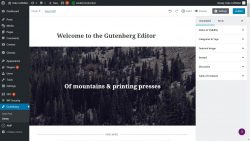
It looks like this:
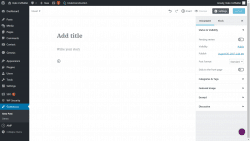
Each paragraph of text,image, quote, or what have you, is treated as a separate block in the Gutenberg editor. This is a concept similar to what you would find in one of the aforementioned newsletter builders, although they do look very different.

Mailerlite and other services give you a limited selection of blocks to build a newsletter, and they usually show you the options in a panel on the right. Gutenberg, on the other hand, has a pop-up menu where you can select a block. You can open that menu by clicking the plus sign icon (see the screenshot above for an example) and then selecting one of the options.

Once you chose the next block, you can style it with settings that only apply to this one block, add content, etc. That custom styling is perhaps the biggest difference between Gutenberg and the existing content editor.

But you don’t have to take my word for it; you can test Gutenberg itself.

If you want to play around with Gutenberg before installing it on your site, there is a public demo over on WordPress.org. If you want to try it on your site, you can install the Gutenberg beta app.

And if you would like to learn more about the options for styling blocks, Kinsta just published a post that goes into this in considerable depth.

Why

The why question I have heard the most in re Gutenberg is why Gutenberg is being added to WordPress.

The answer will vary depending on who you ask, but in my opinion it all comes down to a desire to give users a tool so they can make prettier blog posts and pages.

If we wanted to get into web industry insider gossip, someone would tell you that Gutenberg is a response to WordPress competitors such as Squarespace who already have this type of content editor. That has the ring of truth, but it’s also true that the WordPress editor hasn’t significantly changed since it was released in 2003. It looks and functions like a 20-year-old word processor app, and that outdated design limited what you could write and publish on a WordPress site.

The content editor was sorely in need of an update, but did it need to be replaced? Well, that depends on why you are using WordPress.

The typical blogger is fine with banging out paragraphs of text, but WordPress is much more than a blogging platform. It hosts all kinds of sites which are used for all types of purposes, and designers who are building those sites need the more sophisticated content editor.

While that sounds like a good justification, it is also true that those designers had their choice of sophisticated content editors; this type of tool is called either page builder or site builder, and there are a double dozen different competing tools to choose from. I use one from a company called SiteOrigin to build pages on this blog, and some of the more popular options include Beaver Builder, Elementor, and Divi.

This has lead some to argue Gutenberg is designed to fill a need that has already been met, but that debate is beyond the scope of this post.

How

The how question has two parts; how do you use Gutenberg, and how to do avoid it and keep using the old editor.

Gutenberg will be a part of WordPress 5.0, which will be released some time in the next few months. But if you want to use it now, you can install the Gutenberg beta plugin. Activating this plugin will replace the current content editor, giving you a chance to play with Gutenberg on your site.

Be sure to back up your site before you install the plugin. I don’t think it will break anything on most sites, but I operate under the assumption that about 1% of the time things will go awry. We have no way to tell who is the 1% this time around.

If you never want to use Gutenberg, ever, you can install a plugin called "Classic Editor". This will guarantee that the current editor will not be replaced when Wordpress 5.0 is released.

O O O

I have installed the Classic editor, and I plan to regard Gutenberg as a project rather than a tool for the time being. I’ll learn how to use it and how to support sites that use it, but I won’t use it on my site. I’ll wait until it is out of beta and is a reliable tool; then it will be safe to use.

image  by NYC Wanderer via Flickr

How to Upload a PDF to the Kindle Store, and Sell It

In my morning coffee link post this morning I included a post on The Book Designer where a so-called "expert" made various claims about PDFs, including that PDFs aren’t ebooks and that PDFs "can’t be uploaded to any of the major ebook commercial retailer sites". 

Sidenote: This guy has a long-running FUD campaign about PDFs. He has been bad-mouthing PDFs for years, and he is just as wrong today as he was two years ago.

My first inclination is to retort that any well-informed publishing industry insider could tell you that neither statement is true, but then I realized that if The Book Designer could publish a post rife with factual errors, maybe it was time for an explainer post that set the record straight.

Yes, you can upload and sell PDF in the major ebookstores – some of them, anyway. Amazon accepts PDFs, and so does Google. Barnes & Noble used to accept PDFs, but according to their current help pages they no longer do so.

And there are even times where you should sell a PDF. For example, there are certain types of non-fiction that just work better in a fixed layout format, and frankly a PDF is still more versatile and accessible than a fixed layout Epub.

Also, there are markets – such as O’Reilly technical manuals – where a sizable part of the audience insists on PDFs. You will need to find a way to provide what the market wants.

Here’s a summary of where and how you can sell PDFs in the major ebookstores.

Google Play Books

Google will let you upload a PDF through its publisher portal. Play Books users can also upload a PDF and read it in the Play Books app for Android or iOS.

It is not clear at this time, however, whether you can sell a PDF in Play Books and have it arrive in that format. (While I was trying to test this, I discovered that the Play Books web app is no longer compatible with Chrome.)

I will investigate further and update this post at a later date.

Nook / B&N Press / Nook Press

At one time B&N was so committed to PDF that they gave their Android app a PDF renderer that had been customized  for B&N’s hardware.

Alas, that was a different time. Now, B&N Press no longer lists PDF as a format you can upload.

Kobo Writing Life

You cannot upload a PDF to Kobo Writing Life; it is not listed as an accepted format.

But even if it were allowed, no one could buy your PDF. Kobo stopped selling and supporting PDFs in November 2017. The PDF would need to be converted before it could be sold, so you might as well submit an Epub instead.

eBooks.com

This is not a major ebookstore, no, but it is one of the best places to find PDFs for sale.

When O’Reilly shut down its ebookstore and found that the market demanded PDFs, their solution was to sell the PDFs through eBooks.com. The O’Reilly PDFs are sold DRM-free, but I have also bought DRMed PDFs from that site. The PDFs came with Adobe Digital Editions DRM at that time.

I do not know how authors can sell their PDFs at ebooks.com, but I am listing the site here so that those who want to sell PDFs can pursue the matter. (I am also hoping that ebooks.com will reach out and give me the details we need.)

Kindle

Here’s something I thought everyone knew: Amazon sells PDFs. Amazon calls their PDFs "Kindle Print Replicas" but that is just a fancy name for a PDF in a proprietary wrapper.

Authors can sell PDFs in the Kindle Store, and Amazon has even provided a couple apps for that purpose.

You will need to use one or the other app to prep your PDF so you can upload it to KDP. Simply load your PDF in either KC or KTC, make your finishing touches, and then save the ebook. The apps will give you a project file that you can upload to KDP.

If you try to upload a PDF itself, Amazon will try to convert it to Mobi.

BTW, you will probably want to use Kindle Textbook Creator; I am told that it makes smaller PDF files than Kindle Create. Since Amazon charges for the delivery of ebooks, reducing file size can significantly increase your earnings.

A Kindle Unlimited Content Mill Has Been put up for Sale – Got $2.5 Million?

How would you like to be the next Hardy Boys?

A friend has brought my attention to a new listing on the Empire Flippers business marketplace (thanks, Isobel!). It seems one of the content mills responsible for producing novels in the Kindle Store is up for sale.

We don’t know the name, but the listing describes a 5 year old operation that only really started to succeed after the launch of Kindle Unlimited.

This listing is for a Kindle Direct Publishing by Amazon business created in November 2013 in the romance niche. While most of the revenue comes from selling 100+ ebooks, the business also has 20+ print books and 10+ audiobooks, providing multiple income streams on Amazon. A USA Today Bestselling Author pen name is included in the sale. The books are highly rated and the business has very strong year on year growth.

The business regularly receives KDP All-Star Bonuses ($) which Amazon awards to books and authors that are read the most. There is also a small Amazon Associates affiliate income on their own products gained from Facebook ads. The target audience is adult females. The Seller has recently started translating books into foreign languages. This is a large area of potential growth as Kindle is scaling quickly overseas.

The Seller spends time each week studying the market and overseeing the content creation. The business has a planned content schedule which is carried out by in-house writers and launches 2 to 3 books per month. The team, based in various locations in the US, includes two writers, an editor, and an assistant who takes care of promotions and customer service. Currently, the Seller takes care of social media and email promotion, though this could be outsourced.

With two branded websites, an email list of over 70K+ subscribers, and several social media channels in place for the brands and authors, this business has been set up with expansion in mind. The email list subscribers receive daily newsletters and some automated sequences and segmentation are in place. The business also has multiple Advance Reading Copy teams that get early access to read the books and leave hundreds of honest reviews.

If this looks to you like one of the infamous KU book stuffers is getting out of the business before they too get banned, you’re not alone.

I think this is someone who was exploiting loopholes to cheat in Kindle Unlimited, but now that Amazon has changed the rules they have decided to get out. Alas, we do not know the name, so all we can really say is that this was a content mill.

And while that has negative connotations now, the practice is widely accepted in the industry and has been around for as long as Nancy Drew and The Hardy Boys  have been in print.

Walmart and Kobo Are Launching Their Joint eBookstore on 21 August

Kobo is keeping mum about the official launch of its joint ebookstore with Walmart, but all signs point to the launch happening in the second half of August.

Initially announced in January, the new ebookstore was going to be located on Walmart.com and would feature both audiobooks, comic books, and ebooks sold through Kobo as well as Kobo ereaders.

That was about all we knew at the time, but in the past few days I have managed to glean a few additional details.

For example, I can now point you to a couple new pages on Walmart’s website where you will shortly find Kobo’s ereaders and ebooks. The pages currently contain dummy images, but the section headings and the page URLs give away a lot of the detail.

I checked the source code for the pages, but I could not find any clues about the launch day.

I do know, however, that Kobo is currently recruiting authors through Kobo Writing Life in preparation for a big marketing push. It is all very hush-hush, but getting ready for the launch and checking details like book description length has been absorbing so many work hours at Kobo that Kobo Writing Life has stopped answering emails.

What we do know is that the marketing campaign will coincide with the launch of the ebookstore on Walmart.com. Kobo has even set the date for the launch, and sworn everyone to secrecy.

I think I am now up to seven people who know the date but cannot tell me.

Unfortunately for Kobo, the ebook distributor Streetlib has let the cat out of the bag. The big day is 21 August, but I have doubts about whether Kobo and Walmart will be ready.

If  the ebookstore on Walmart.com were more complete, I would say that the launch is happening sooner rather than later. But in its current state I don’t see the site being ready in three weeks.

If you have inside knowledge about the launch day or any other inside info, I’d love to hear from you.

Publisher eBook Revenues Fell 3% in First Four Months of 2018

Publisher ebook revenue continued to decline in the first third of this year, while trade revenues fluctuated upwards, increasing by 7.3% over the same period in 2017.

Same song, different verse.

press release:

Publishers’ revenue increased by $172.8 million (+5.5%) for the first four months of 2018 (Jan – April) compared to the same period in 2017. Publisher revenue in April 2018 was up by 4.4% over April 2017. These revenues from AAP’s StatShot Monthly Report, which tracks publisher revenue comparatively each month, represent all tracked categories (Trade – fiction/non-fiction/religious, PreK-12 Instructional Materials, Higher Education Course Materials, Professional Publishing, and University Presses).

Trade books had the greatest gains in April 2018. Compared to April 2017, revenue was up by 12.2% for Adult Books, 8.3% for Children’s/Young Adult, and 9.8% for Religious Presses. Overall, Trade was up 11.1% in April. Looking at the year-to-date (Jan – April), revenue for Trade was up 7.3% compared to the same time in 2017.

January to April: Trade Book Revenue (in millions)


Jan. – April 2018

Jan. – April 2017

Percent Change

Adult Fiction/Non-Fiction

$1,519.0

$1,415.5

+7.3%

Children’s/YA

$536.8

$503.3

+6.6%

Religious Presses

$144.6

$131.6

+9.8%

Total

$2,200.3

$2,050.7

+7.3%

Trade Book Formats

Revenue for all print formats was up in April 2018, compared to April 2017. For the year-to-date, print formats comprised $1.6 billion of revenue, up 7.4% from the same timeframe in 2017. Downloaded audio continued its significant growth and revenue for eBooks declined slightly.

Total Trade Net Revenue by Format (in millions)


Jan. – April 2018

Jan. – April 2017

Percent Change
Hardback

$769.6

$688.5

+11.8%

Paperback & Mass Market

$789.8

$759.1

+1.4%

eBooks

$358.7

$373.0

-3.8%

Downloaded Audio

$137.0

$100.6

+36.1%

Physical Audio

$12.5

$14.1

-11.4%

Board Books

$36.9

$39.0

-5.5%

Other

$95.9

$76.4

+25.5%

January to April 2018: Education and Scholarly Publishing (in millions)


Jan. – April 2018

Jan. – April 2017

Percent Change

Higher Ed Course Materials

$552.1

$527.8

+4.6%

PreK-12 Instructional Materials

$344.8

$365.3

-5.6%

Professional Books

$176.4

$161.9

+9.0%

University Presses

$17.4

$15.9

+9.5%

Total

$1,090.8

$1,071.0

1.8%

Publisher net revenue is tracked monthly by the Association of American Publishers (AAP) and includes revenue from about 1,100 publishers, with participation subject to change over time. AAP also measures the revenue of the overall publishing industry with AAP’s StatShot Annual Report, which was released July 20, 2018 and can be purchased here.


image by pheezy via Flickr

Createspace DVD/CD Production is Shutting Down, With Accounts Moving to Amazon Media on Demand

Amazon just hammered another nail into Createspace’s coffin.

The retailer sent out an email this morning to select Createspace users, informing them that Createspace’s  disc production unit was shifting over to Amazon.

From a thread on KBoards:

Hello CreateSpace Video and Audio Content Provider,

We are excited to announce the launch of Amazon Media on Demand and are letting you know the important steps you need to take with your CreateSpace account. Amazon Media on Demand is a new portal where our disc content providers can sell their video and audio assets as physical media products on Amazon. In addition to current CreateSpace product options, you’ll have access to exciting new features, such as the ability to create multi-disc titles and a simplified product setup workflow. Please click here to learn more.

As part of our improved service to media creators, we are moving all CreateSpace’s Disc on Demand services to Amazon Media on Demand. To prepare for this move, you will want to take the following steps:

1) Make sure that your payment/banking and tax information is up to date.

2) If you are receiving payments by check, update your payment information for electronic payment (Electronic Funds Transfer (EFT) or wire transfer) if you’re able to receive payments in this manner (click here to learn more).

3) If you’re planning to request proof or member orders, place your orders before August 1.

In the next few weeks, we will begin transferring your existing CreateSpace disc titles to Amazon Media on Demand. You will no longer be able to access your CreateSpace account or create new disc titles after August 31. Titles manufactured via Amazon Media on Demand will continue to be manufactured in the same facilities, on the same machines, and by the same people. Focusing our efforts on the Amazon Media on Demand portal will allow us to innovate faster on your behalf. Because of the size of our catalog, we will move all CreateSpace CD, DVD, and Blu-ray titles over to Amazon Media on Demand over the course of several weeks. During this time, your titles will remain available on Amazon.com.

You will receive an email with next steps on how to access your Amazon Media on Demand account by September 15. If you would like to move to Amazon Media on Demand earlier, please contact us.

To learn more about the great things Amazon Media on Demand has to offer, click here.

Best regards,
The CreateSpace Team

Bit by bit, Amazon has been shutting down different parts of Createspace. First they launch KDP Print, a competing/replacement POD service, then they shut down Createspace’s publishing services unit, and now they have shifted the DVD and CD production to another part of Amazon. As a result, there isn’t much left in Createspace besides the book POD service.

All of a sudden my report earlier this month about Amazon merging Createspace into KDP Print suddenly looks less like a rumor and more like a leak that revealed Amazon’s future plans, doesn’t it?

That merger is supposed to be announced in another couple weeks, and be complete by the end of the summer. I still expect that to happen but it’s also worth noting that there are certain similarities between today’s news and that two week old leak. There’s an excellent chance that the leak I reported two weeks ago was actually supposed to refer to today’s news, but was garbled at some point before it got to me.

Even if that is the case, I still expect the rest of Createspace to shut down by the end of the year at the latest.

Investment Group Buys 5.7% Stake in B&N, Demands Replacement of Len Riggio’s Taxidermist

A serial Barnes & Noble investor has just re-invested in the company. Their presence will add strife and make it harder to turn the company around.

From PW:

An investment group led by Richard Schottenfeld, head of New York City-based Schottenfeld Management Corp., has acquired a 5.68% stake in Barnes & Noble.

According to a filing made with the Securities and Exchange Commission, Schottenfeld began buying B&N shares on May 29 and made his most recent purchase July 16, accumulating 4.2 million B&N shares. Schottenfeld paid between $5.32 and $6.57 per share for his stake. B&N’s shares began the year trading at $6.70, and closed at $5.65 per share on July 23.

In its filing, Schottenfeld said it purchased its stake believing B&N’s shares are “substantially undervalued and represent an attractive investment opportunity.” The filing further stated that representatives from Schottenfeld have already talked to B&N about ways to increase shareholder value, and intend to continue to hold discussions with B&N management and its board to review strategic alternatives the company might pursue.

You can find the SEC filing over here.

It’s worth noting that Schottenfeld last invested in B&N in 2012, and then sold off its stock in 2015 after B&N spun off B&N Education. One of the things Schottenfeld wanted back then was for B&N to spin off the Nook division.  They made this proposal only a few weeks before Nook imploded and began its permanent decline into irrelevance.

Then, as now, Schottenfeld was driven not by making B&N healthier but by getting the biggest return for stockholders. After Schottenfeld sold its stock, B&N continued to decline both in value and revenue.

Whatever Schottenfeld is proposing this time around isn’t going to kill B&N but it certainly will not help the retailer any in the long run.

Really, what we have here is a light version of the vulture investment funds that buy up retailers like Toys R Us, load them up with debt, and sell them off. While Schottenfeld isn’t quite that bad, they certainly aren’t out to help the company, either.

image by Angel Xavier Viera via Flickr

How to Download Audiobooks from Google Play Books – DRM-Free!

When Google started selling audiobooks in Play Books back in January I was quick to dismiss their service because the audiobook experience was simply awful. It was so bad that I concluded "Google clearly does not" care about selling audiobooks.

It looks like I will have to revise that opinion.

Boing Boing has brought my attention to the fact that Google will let you download your purchased audiobooks as DRM-free files.

You can find the download option in the audiobooks tab in the "My Books" section of the Google Play website. Simply click the 3-dot menu icon for a given ebook, and then select the export option.

I checked, and I can confirm this is true. I was able to download both of the audiobooks I bought from Google, and play them in VLC. I got the complete file, and not just a sample.

This is great news for anyone who wants to protect their investment, and it also gives Google a competitive advantage. Amazon refuses to let you download DRM-free audiobooks from the Audible website; when I try, they give me a file that is intended to be opened with their abysmal Audible Windows app. (I gave up in despair a while ago.)

I know where I will buy my audiobooks in the future; how about you?

Updated: Amazon Books Should Replace Local Libraries, and Other Publisher-Serving "Solutions"

Do you know how companies sometimes like to buy editorials that support their position (I see this a lot in the WSJ), or even go so far as to fund think tanks to produce position papers to order?

I think Forbes just gave us another example. A coupel days ago Forbes published an editorial that subtly reinforces Macmillan’s current anti-library policy.

Amazon should open their own bookstores in all local communities. They can replace local libraries and save taxpayers lots of money, while enhancing the value of their stock.

There was a time local libraries offered the local community lots of services in exchange for their tax money. They would bring books, magazines, and journals to the masses through a borrowing system. Residents could borrow any book they wanted, read it, and return it for someone else to read.

They also provided residents with a comfortable place they could enjoy their books. They provided people with a place they could do their research in peace with the help of friendly librarians. Libraries served as a place where residents could hold their community events, but this was a function they shared with school auditoriums. There’s no shortage of places to hold community events.

Libraries slowly began to service the local community more. Libraries introduced video rentals and free internet access. The modern local library still provides these services, but they don’t have the same value they used to. The reasons why are obvious.

This piece was written by a professor of economics, and it is so lacking in facts or any real connection to reality that the writer gives other ivory tower intellectuals a bad name.

Edit: This piece was so bad that Forbes actually deleted the article.

There is literally not a single sentence in this piece that stands up to scrutiny. Not only has the writer never used a library, he is equally unacquainted with Amazon Books – a cursory visit would reveal it cannot provide half the services we get from libraries.

And that is just the beginning of the ignorant nonsense he spouted.

Here are my favorites:

  •  There’s no shortage of places to hold community events – says the guy who has never tried to organize one. I have a Meetup group that is on hiatus because it is so hard to find meeting spaces; if not for libraries, we would not meet at all.
  • streaming services such as Netflix and Amazon Prime have replaced video rentals – but they only work in the about half of the country that has fast internet. And guess what? People who live in rich parts of the country still have slow internet; until I got service through Comcast, I had Verizon DSL. It was barely capable of streaming one SD video at a time, and only if you stopped all other web activity.
  • streaming services (cont’d) – Furthermore, streaming services are great if you can afford to pay for all of the upgrades to get all of the content. I can’t even afford to do that; can you?
  • streaming services (cont’d) – Another problem with streaming services that the Forbes writer didn’t mention is that the services are great right up until a studio decides to pull its content. You can’t watch what isn’t there, but you can borrow DVDs from the library (hat tip to Michael Carusi for making this point on Twitter).
  • Technology has turned physical books into collector’s items, effectively eliminating the need for library borrowing services – for rich people like the Forbes writer who can afford to collect them, this is true. It is not true for the rest of us.
  • Amazon have created their own online library that has made it easy for the masses to access both physical and digital copies of books – Again, if you can afford it. Sadly, many of us are not as rich as the Forbes writer.
  • Amazon Go basically combines a library with a Starbucks – no – just no. (If I had allowed myself to become emotionally involved, this is where I would be gibbering in anger.)

And finally:

The problem with market "solutions" to public services is that it conveniently ignores the realities of market economics. There are many places that do not have bookstores because the local market will not support one. Many of those places do have libraries, however.

Furthermore, the other problem with so-called market solutions is that it frequently makes sense for a business to ignore, say, 90% of a market and instead concentrate on the 10% that is profitable.

Edit: I can phrase that better.

The other problem with so-called market solutions is that they depend on businesses that are motivated by profit rather than serving the public good. If it makes sense for a business to ignore, say, 90% of a market and instead concentrate on the 10% that is profitable, then the company will do so.

I should not have to point this out to a professor of economics, but a market solution to a public program that ignores 90% of the public is by definition not a solution, but that is academia for you.

Anyone who thinks that Amazon Books can replace a library is just as wrong as the fools who argued in 2013 that libraries could be replaced by Kindle Unlimited.

My local library serves a population of 463 thousand at a cost of $37 per resident in FY2017. It used those funds to:

  • give 92 thousand people internet access,
  • answer over 600 thousand questions,
  • loan 3.6 million books, media, and other item, and
  • host 5,152 special events and programs where 186,273 attended.

That is only a tithe of what my local library does. I have left out at least a dozen other services, none of which I could get from an Amazon Books store.

image by holisticmonkey via Flickr

AAP Estimates US Book Publishing Industry Generated $26 Billion in Revenue Last Year

The Association of American Publishers released its annual StatShot estimate on Friday. You can buy the report from the AAP, or find the press release below.

There isn’t much detail in the public press release, so I won’t be adding much commentary.

However, as I have previously reported, the AAP’s annual estimates are not considered reliable, so you should take these figures with a grain of salt.

Press release:

The Association of American Publishers (AAP) issued its 2018 StatShot Annual Report today which found, among other things, that the U.S. book publishing industry generated an estimated $26.23 billion in net revenue for 2017, representing 2.72 billion units. All figures represent publishers’ net revenue from tracked categories (trade, higher education course materials, preK-12 instructional materials, professional books, and university press), in all formats, from all distribution channels. These are not retailer/consumer sales figures.

Publisher revenue for trade books (fiction, non-fiction and religious presses) were flat (0.3%) increasing by $45 million in 2017 over 2016. Since 2013, publisher revenue for trade books increased by around $820 million.

StatShot Annual is based on a unique methodology that combines annual data submitted by publishers, along with market modeling, to estimate the total size of the U.S. publishing industry. It is a different report than AAP’s monthly statistics reports, which track publisher revenue comparatively on a month-to-month basis. Below is a top-level summary of the data, but the entire report is available for purchase.

Publisher Revenue in Billions 2013 – 2017

Year Trade Higher Ed PreK-12 Professional University Press Other Total
2013 $15.13 $4.81 $3.84 $2.97 $0.30 $0.02 $27.07
2014 $15.43 $4.85 $4.27 $3.09 $0.30 $0.00 $27.96
2015 $15.82 $4.53 $4.11 $3.05 $0.29 $0.00 $27.80
2016 $15.90 $3.96 $3.73 $2.37 $0.28 $0.04 $26.27
2017 $15.95 $3.98 $3.62 $2.35 $0.29 $0.04 $26.23

Some highlights from the report:

  • Non-fiction books for adults is the category with the largest growth for publishers, with a 5.4% increase in publisher revenue from 2016 to 2017. Since 2013, revenue for the category has grown 28.4% to $6.18 billion. Nearly 150 million more adult non-fiction books were sold in 2017 than in 2013.
  • Publisher revenue for adult fiction declined slightly, by -1.2% to $4.38 billion. From 2013 to 2017, this category saw only one year of revenue growth (2015).
  • Both fiction and non-fiction books for children and young adults saw more units sold in 2017 than in 2016, up 1.1% and 4.4% respectively. Over the past five years (2013 – 2017) publisher revenue for children’s and YA fiction has grown by 11.3% to $3.67 billion and non-fiction has declined by -2.3% to $652 million.
  • Downloaded audio remained the fastest growing format, with 28.8% year-over-year growth from 2016 to 2017 and 146.2% growth over the past five years (2013 – 2017).
  • More than 1 billion paperback books were sold (more than any other format in 2017) comprising 36.9% of books sold in all categories.
  • For the first time publisher sales to physical and online retail channels were approximately equal at $7.6 billion and $7.5 billion respectively in 2017. Within online retail channels, 43.2% were print formats, 27% were eBooks, 16.3% were instructional materials, 10.5% were downloaded audio, and 3.1% were physical audio or a different format.
  • Revenue from higher education was flat (0.5%), revenue from pre-K-12 and professional books declined in 2017 by -2.9 and -0.7% respectively.

About StatShot Annual:

AAP member and non-member publishers provided data in response to a 2018 statistical survey that covers revenue and units by categories, channels, and formats. Survey participants in StatShot Annual may not be the same as those who participate in AAP’s monthly surveys. Since the annual survey does not include all known industry publishers, estimates are used for publishers who do not participate directly in data collection. These estimates are based on sales data included in company financial reports, trade and news media reporting, government filings, BooksinPrint, press releases, third party research services, and private sources.

StatShot Annual Distribution:

Participants receive a complimentary copy of the full StatShot Annual Report. Otherwise, the report is available for purchase here. For more information about the report, email Syreeta Swann at [email protected].

imag  by jon_a_ross on Flickr

Updated: Tor Books is Now Windowing Library eBooks

Tor Books has just demonstrated that the decision makers at Macmillan are surprisingly ignorant on the basic principles of microeconomics in general.

Earlier this weeks Tor Books informed libraries that it was windowing library ebooks. Starting this month, ebooks would be delayed by as much as 40 months.

Here’s the statement, as reprinted by one of the Upper Arlington Public Library:

Tor Books, a division of Macmillan Publishers and a leading global publisher of science fiction and fantasy will be changing our eBook lending model to libraries as part of a test program to determine the impact of eLending on retail sales. Our current analysis on eLending indicates it is having a direct and adverse impact on retail eBook sales.

Effective with July 2018 publications, all new titles from Tor Books will become available for library eBook distribution four months after their retail on-sale date rather than the current program which allows libraries to purchase the titles on their retail on-sale date. During the test period, we will work closely with our library vendors who service this channel to evaluate the results and develop ongoing terms that will best support Tor’s authors, their agents, and Tor’s channel partners.

In addition, Macmillan will actively participate in the recently launched “Panorama Project,” the first large-scale, data-driven research project focused on understanding the impact of library holdings on book discovery, author brand development, and retail sales (panoramaproject.org).

With data from both programs, we will be in a better position to analyze and understand the impact of eLending on our publishing program. The timing of the test period is open-ended.

OverDrive also sent a message to libraries, but I don’t have it yet.

Edit: It has been added to the end of the post, along with the ALA statement.

I do, however, have the statement that Macmillan sent to PW. "We have been seeing an adverse impact on our ebook sales over a period of time," Macmillan said, "and are using this test to determine if library ebook lending is one of the contributing factors."

This is so bizarre that I had to read it twice before I could beleive that Macmillan could say something this clueless. (I also have to wonder what drug Andrew Albanese is on, that he did not react to the quote – Xanax?)

The thing is, I know why Macmillan has poor ebook sales, and so do you.

Macmillan  has poor ebook sales because they have adopted a policy of discouraging ebook sales in favor of print sales. Macmillan adopted this policy in late 2009 when they conspired with Apple and 4 other publishers to violate antitrust law by forcing Amazon to accept what is called agency pricing, a system where the publishers set the price and retailers are prohibited from deep discounts and sales.

That is established historical fact, and so is the antitrust suit brought by the DOJ, Macmillan settling the lawsuit,  its punishment, and Macmillan’s return to agency in 2014.

Everyone knows this; you could even ask Mike Shatzkin and he’ll tell you pretty much the same thing. To pretend that Macmillan’s poor ebook sales are a result of anything other than Macmillan’s own policies shows a basic lack of awareness of consumer behavior.

Pretending that the cause might be library ebooks, on the other hand, is reminiscent of Animal Farm (or possibly 1984, but either way Orwell nailed it).

It almost makes you wonder if this is really just a smokescreen for something else, doesn’t it?

Update: Here’s the ALA’s statement:

At the beginning of July, Tor, a division of Macmillan, announced without warning that it was immediately beginning to embargo ebook sales of new titles to libraries for four months. Today American Library Association (ALA) President Loida Garcia-Febo issued the following statement:

“The American Library Association and our members have worked diligently to increase access to and exposure for the widest range of ebooks and authors,” said Garcia-Febo. “Over years, ALA made great strides in working with publishers and distributors to better serve readers with increasingly robust digital collections. We remain committed to a vibrant and accessible reading ecosystem for all.

“I am dismayed now to see Tor bring forward a tired and unproven claim of library lending adversely affecting sales. This move undermines our shared commitment to readers and writers—particularly with no advance notice or discussion with libraries. In fact, Macmillan references its involvement with the Panorama Project, which is a large-scale, data-driven research project focused on understanding the impact of library holdings on book discovery, author brand development, and sales. For this reason, this change by Tor—literally on the heels of Panorama’s launch—is particularly unexpected and unwelcome.

"The ALA calls for Macmillan to move just as quickly to reverse its course and immediately lift the embargo while the Panorama Project does its work.”

The American Library Association (ALA) is the foremost national organization providing resources to inspire library and information professionals to transform their communities through essential programs and services. For more than 140 years, the ALA has been the trusted voice of libraries, advocating for the profession and the library’s role in enhancing learning and ensuring access to information for all. For more information, visit ala.org.

And here’s the email OD sent to libraries

Dear ****

On behalf of **********, your account manager, I am writing to let you know we received notice from Tor Books, a division of Macmillan Publishers, regarding a change in policy for eBook lending availability for libraries.  Tor Books titles will now be delayed for library availability for four months from their retail release date, beginning with the July 2018 releases.  As your library has placed pre-orders for titles affected by this change, we are cancelling orders for these titles.  You can see affected titles in your “Recalled Content” report in Marketplace.  We have attached Macmillan’s notice of this policy change.

OverDrive is dismayed and disappointed in Macmillan’s decision.  We take issue with Macmillan’s conclusion that library availability has an adverse impact on retail sales and Macmillan has not shared the data or analysis that supports this statement.

We are in ongoing and active dialogue with Macmillan to provide data and information to advocate a change of this policy.   Macmillan plans to participate in the Panorama Project, which is undertaking a series of pilot programs and research projects to provide objective evidence of the impact of library catalogs and lending as it relates to book discovery, author brand, and retail sales.

We encourage you to contact Macmillan directly to provide your feedback at [email protected].

Thank you,


image by khawkins04 on Flickr

Audiobook Distributor RBMedia Has Been Sold – And Not to Rakuten

Along with Findaway and Blackstone Audio, RBMedia is one of several small audiobook distributors operating in the shadow of Amazon’s Audible.

RBMedia was sold yesterday to private equity firm KKR. The terms of the deal were not disclosed.

From WSJ:

Investment firm KKR has agreed to acquire RBmedia, a major producer of digital audiobooks and spoken content, from investment firm Shamrock Capital, the latest sign of the growing popularity of audiobooks as a consumer-entertainment format.

The deal is expected to close by early fall. Terms weren’t disclosed.

Audiobooks have emerged as the fastest-growing segment of the U.S. book-publishing industry, in part because they can be accessed through a range of mobile digital devices. Consumers can listen while commuting or working out.

“We love the industry sector and its growth, and we think it will continue,” said Richard Sarnoff, chairman of media, entertainment, and education for KKR, in an interview. “Audiobooks create incremental time for enjoying great books, and one thing we lack today is time. We think this type of content will continue to take up more mind share, especially among younger consumers.”

KKR estimates that consumers will spend $900 million on audiobooks in 2018, up about 20% from the year before.

RBmedia owns Audiobooks.com, making it a retailer as well as a publisher and distributor. According to the press release, both parts of the company are included in this sale.

Do you know what surprised me the most about this sale? It wasn’t that it took place but the fact that Rakuten wasn’t the buyer.

Rakuten owns Kobo, OverDrive, and the ebook app developer Aquafadas. One would think that an audiobook distributor and retailer would be a good match for Rakuten’s existing ebook subsidiaries, but apparently Rakuten did not find that to be the case.

Do you suppose they were outbid?

image by davidmulder61

Kindle Unlimited Funding Pool, Per-Page Rate, Rose Slightly in June 2018

Amazon announced on Monday that the Kindle Unlimited funding pool totaled $22.6 million in June (plus bonuses), up from $22.5 million in May 2018. At the same time the per-page rate royalty rose to $0.0046 in June, compared to $0.00454 in May and $0.00456 in April 2018.

  • US: $0.0046 (USD)
  • Germany: €0.0031 (EUR)
  • Netherlands, France, Spain, Italy: €0.0046 (EUR)
  • Canada: $0.0045 (CAD)
  • Brazil: R$ 0.0111 (BRL)
  • Japan: 0.5702 (JPY )
  • India, UK, Mexico, Australia: unknown

Here’s a list of the monthly funding pools. It does not include the bonuses paid out each month.

  • July 2014: $2.5 million (Kindle Unlimited launches early in the month)
  • August 2014: $4.7 million
  • September 2014: $5 million
  • October 2014: $5.5 million
  • November 2014: $6.5 million
  • December 2014: $7.25 million
  • January 2015 – $8.5 million
  • February 2015: $8 million
  • March 2015: $9.3 million
  • April 2015: $9.8 million
  • May 2015: $10.8 million
  • June 2015: $11.3 million
  • July 2015: $11.5 million
  • August 2015: $11.8 million
  • September 2015: $12 million
  • October 2015: $12.4 million
  • November 2015: $12.7 million
  • December 2015: $13.5 million
  • January 2016: $15 million
  • February 2016: $14 million
  • March 2016: $14.9 million
  • April 2016: $14.9 million
  • May 2016: $15.3 million
  • June 2016: $15.4 million
  • July 2016: $15.5 million
  • August 2016: $15.8 million
  • September 2016: $15.9 million
  • October 2016: $16.2 million
  • November 2016: $16.3 million
  • December 2016: $16.8 million
  • January 2017: : $17.8 million
  • February 2017: : $16.8 million
  • March 2017: $17.7 million
  • April 2017: $17.8 million
  • May 2017 :$17.9 million
  • June 2017: $18 million
  • July 2017: $19 million
  • August 2017: $19.4 million
  • September 2017: $19.5 million
  • October 2017: $19.7 million
  • November 2017: $19.8 million
  • December 2017: $19.9 million
  • January 2018: $20.9 million
  • February 2018: $20 million
  • March 2018: $21 million
  • April 2018: $21.2 million
  • May 2018: $22.5 million
  • June 2018: $22.6 million

via Self Publisher Bibel

Amazon Updates KDP Rules to Discourage Book-Stuffing

Amazon has finally taken steps to squash the cheating in Kindle Unlimited once and for all. They just updated the KDP content guidelines with new rules about compilations, collections, and other multi-work ebooks:

If you’re publishing multiple stories as one book, ensure the contents of your book are accurately reflected both in the title field and on the cover, by including terms such as "Boxed Set," "Bundle," "Collection," "Compilation," or "Series." Stories that are part of a series must be in sequential order within a book and collections of individual stories must have all stories listed in the metadata.

Collections of works and numbered series may include content you’ve previously published in your catalog. However, in order to provide an optimal customer experience, the same content may not be excessively reutilized across multiple books. We consider "excessive" any amount of content repetition that would create a poor shopping or reading experience.

Multi-work books must meet all program guidelines (e.g., you must have exclusive publishing rights for all content enrolled in KDP Select). For more information, see our content guidelines and Terms and Conditions.

These rules were added some time in the past month and apply to all content in KDP, which means that the cheaters who were stuffing books to boost page count in KU no longer have a place to hide.

For those just tuning in, here’s a little background.

The story starts a little over a month ago when one of the problems Amazon was ignoring in Kindle Unlimited was promoted to a full-blown scandal. That’s when bloggers such as myself started bringing everyone’s attention the the "authors" like Chance Carter who would stuff multiple stories into a single ebook and then upload it to Kindle Unlimited.

Their goal was to get their fans to click through each book to the end, thus collecting up to $15 for each reader (a 3,000 page limit, time a half a cent per page, is a nominal $15) . But after all the public criticism, Amazon changed the rules to limit the duplicate  content in KU, and then banned Chance Carter and other cheaters from the Kindle Store.

And now Amazon has changed the rules to make it clear that this practice is not welcome in the Kindle Store (finally).

image  by Jonathan Gross

KDP Print Expands Its Distribution Network to Include US Bookstores

Amazon just eliminated one of the few differences between its two POD platforms. Yesterday they announced that authors and publishers who use KDP Print can get their print books distributed to US bookstores.

KDP now offers Expanded Distribution to bookstores in the United States. Through Expanded Distribution, you can distribute and make your paperback book available (this doesn’t guarantee that your book will be ordered) to online retailers, bookstores, and distributors. Learn more about how Expanded Distribution works.

If you enable Expanded Distribution for your paperback, the royalty rate is 40% of the book’s list price effective in the distribution channel at the time of purchase, minus printing costs and withholding. Learn more about paperback royalty rates.

Launched in 2016, KDP Print is Amazon’s intended replacement for Createspace, one that gives authors and publishers a single dashboard where they can manage both their ebooks and POD books.

They haven’t announced a specific date when KDP Print will replace Createspace, but Amazon is expected to reveal that information in a couple months.