Nate Hoffelder

Nate Hoffelder

The Entourage Edge Lives Again – This Time as a Notebook from Lenovo

For almost a decade, companies have been trying to marry an LCD screen and an E-ink screen into a single mobile device. B&N tried the idea with their first ereader, Microsoft and Intel each demoed concept designs, and a mostly forgotten company called Entourage released not one but two dual-screen digital textbook readers.

Now Lenovo is trying the concept in their next notebook.

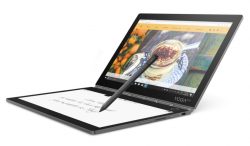
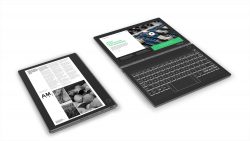
The Yoga Book C930 has a pair of 10.8″ screens, and weighs 1.7 pounds. It combines 2560 x 1600 resolution IPS touchscreen display with a 1920 x 1080 resolution E-ink.

It is designed so that you can use that E-ink display for writing, drawing, or typing (due to its faster refresh and color, the IPS screen would probably be better for drawing). There’s also a Wacom active pen with 4096 levels of pressure-sensitive input.

It is a pricy little bugger (around $1,000), and it should be available in October for $1000. It’s is rather under-powered for the price:

  • CPU: Intel Core M3-7Y30 or Core i5-7Y74 processor
  • RAM: 4GB
  • Storage: Up to 256GB SSD
  • Battery: 35.8 Wh
  • Connectivity: Wifi, Bluetooth, and optional LTE
  • Optical fingerprint reader
  • Stereo speakers

I for one would pass on this. It costs more than a typical laptop but has a smaller screen and half the RAM of the laptop I’m using right now.

It’s almost as if Lenovo is trying to bring back the era where we were expected to carry around a laptop and a netbook – only now Lenovo wants to charge a premium for the idea. Why would anyone want that?

Amazon is Merging Createspace Into KDP Print

I called it.

Amazon has just taken the step that I am sure many saw coming. A new notice has been posted to Createspace user dashboards, informing them that CS is merging into KDP Print. Amazon has also launched a new page in the KDP help pages that explains how this merger will affect authors, and how they can move their titles from Createspace to KDP Print.


Acquired by Amazon in 2005, Createspace started life as a DVD and CD production service, but later added book POD services after it merged with Booksurge (which Amazon also bought in 2005). Judging by the website, Createspace has operated essentially unchanged since that merger, right up until Amazon started shutting it down earlier this year.

The author services dept was the first to go, and then in July Amazon announced Createspace’s DVD production had been merged into a new Amazon unit, and now book POD is getting swallowed by KDP Print.

Launched in July 2016, KDP Print is intended to give authors an easy to to manage both their print and digital books in a single location. In its early days access was quite limited, but the service opened for a public beta test early last year, and Amazon has been adding features ever since.

The newer platform doesn’t have as many features as Createspace. For example, KDP Print only offers expanded distribution in the US, while Createspace supported Australia, Japan, and Europe. Also, KDP Print charges authors full retail for author copies, while Createspace  gave authors a wholesale discount.

Update: Amazon PR disputes the point about expanded distribution, insisting that KDP Print has the same reach as Createspace. That’s not what their last announcement said, however.

Unfortunately, we’re just going to have to live it, because Amazon has made it clear that soon there will be nothing more left of Createspace than there is of Lexcycle, Booksurge, Mobipocket, or the many other companies Amazon has consumed.

Barnes & Noble is Removing Nook Kiosks From Stores

A couple sources have told me, and I have confirmed first hand, that B&N has removed the Nook kiosks that used to occupy prime square footage in most Barnes & Noble stores.

Existing Nook hardware has been moved to the customer service desk towards the rear of the store, and the Nook kiosks have been replaced by a display featuring new releases.

I have seen this myself in a couple stores, including my local B&N in Manassas VA, which used to have a Nook kiosk right where this island now sits.

My local B&N has had that kiosk since at least 2011. It was installed back when the focal point of B&N’s digital strategy (when it had one) was to put the Nook front and center in all of its stores.

They installed honking huge kiosks directly in front of the entries to most of its stores which looked something like this:

This was a great idea right up until the Nook imploded during the 2012 holiday season, and ever since then the kiosks have been an embarrassing reminder of B&N’s failure.

Now the kiosks are being removed, and the Nook relegated to an afterthought on the customer service counter.

Frankly, at this point, that is where it belongs.

B&N’s ebook division has been mismanaged for so long that it only generated $111 million in revenue last fiscal year. At its peak it saw revenues of over a billion and a half dollars each fiscal year and thus deserved being the center of attention, but that hasn’t been true for a long time.

images by B&N, me, and CandyTX via Flickr

Amazon is Going to Pay Authors the Retail Rate for Audiobooks Borrowed in Kindle Unlimited

For the past several months authors have been objecting to Amazon adding their audiobooks to Kindle Unlimited without permission or payment.

No one understood why that was occurring, not even the various parts of Amazon, but numerous authors have observed that if an ebook was in Kindle Unlimited, somehow the matching audiobook (if it existed) was added to the program as well.

It took us the longest time to convince Amazon there was a problem, but once we did, they promised to fix it.

And it looks like they have.

Today Amazon sent out an email to affected authors, informing them that the audiobooks had been removed from KU, and that the authors will now be paid for the borrowed audiobooks.

We are contacting you today with regard to an update to your ACX earnings. We recently found that due to a technical issue, your audiobook(s) were included in the Kindle Unlimited program in error. We have removed your audiobook(s) from Kindle Unlimited and apologize for the mistake.

For each Kindle Unlimited subscriber who downloaded your audiobook, you will earn the same royalty as you would earn for an a la carte (ALC) sale at list price on Audible. Your earnings from the inclusion in Kindle Unlimited and related download data will be provided to you alongside your July Earnings Reports, which you will receive no later than August 31.

We sincerely apologize for any inconvenience this has caused.

Did you get the email? Were you surprised?

Update: A lot of authors are angry that Amazon didn’t offer greater compensation for the "theft" of their work, which some others think was intentional.

While I can understand why they feel that way, it’s worth noting that Amazon is paying authors for their audiobooks on terms similar to those offered to traditional publishers when those publishers' ebooks are added to Kindle Unlimited. The Harry Potter ebooks, for example, were added to KU without permission, and Amazon covered for that by paying Pottermore based on the set retail price – as laid out in the KDP terms of service.

It is really hard for me to criticize Amazon on this point, not when they compensating authors at a reasonable rate.

Walmart’s eBookstore is Launching Today

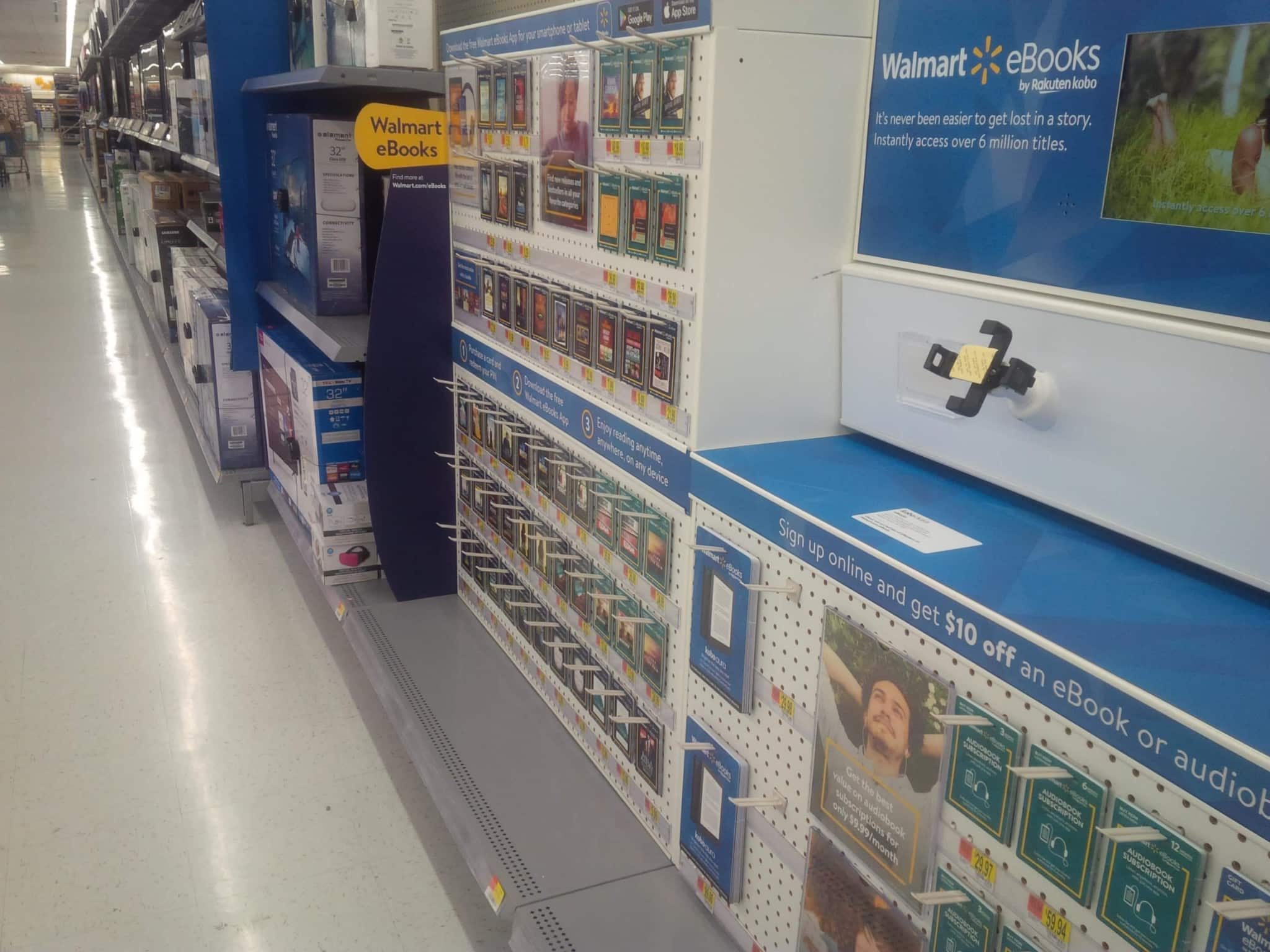
Walmart is in the process of setting up new ebook sections in the book departments of its stores, Kobo has let slip a promo video for "Walmart eBooks", and multiple references have been found in Walmart’s help pages.

While there is no sign of the Walmart eBook apps, I did report a few weeks ago in an exclusive scoop that this would launch on the 21st, and here it is.

Walmart is going to be selling ebooks both on its site and in stores. The ebookstore will be located at www.walmart.com/ebooks when it goes live, and it will be managed by Kobo and supported via a subdomain on Kobo’s website.

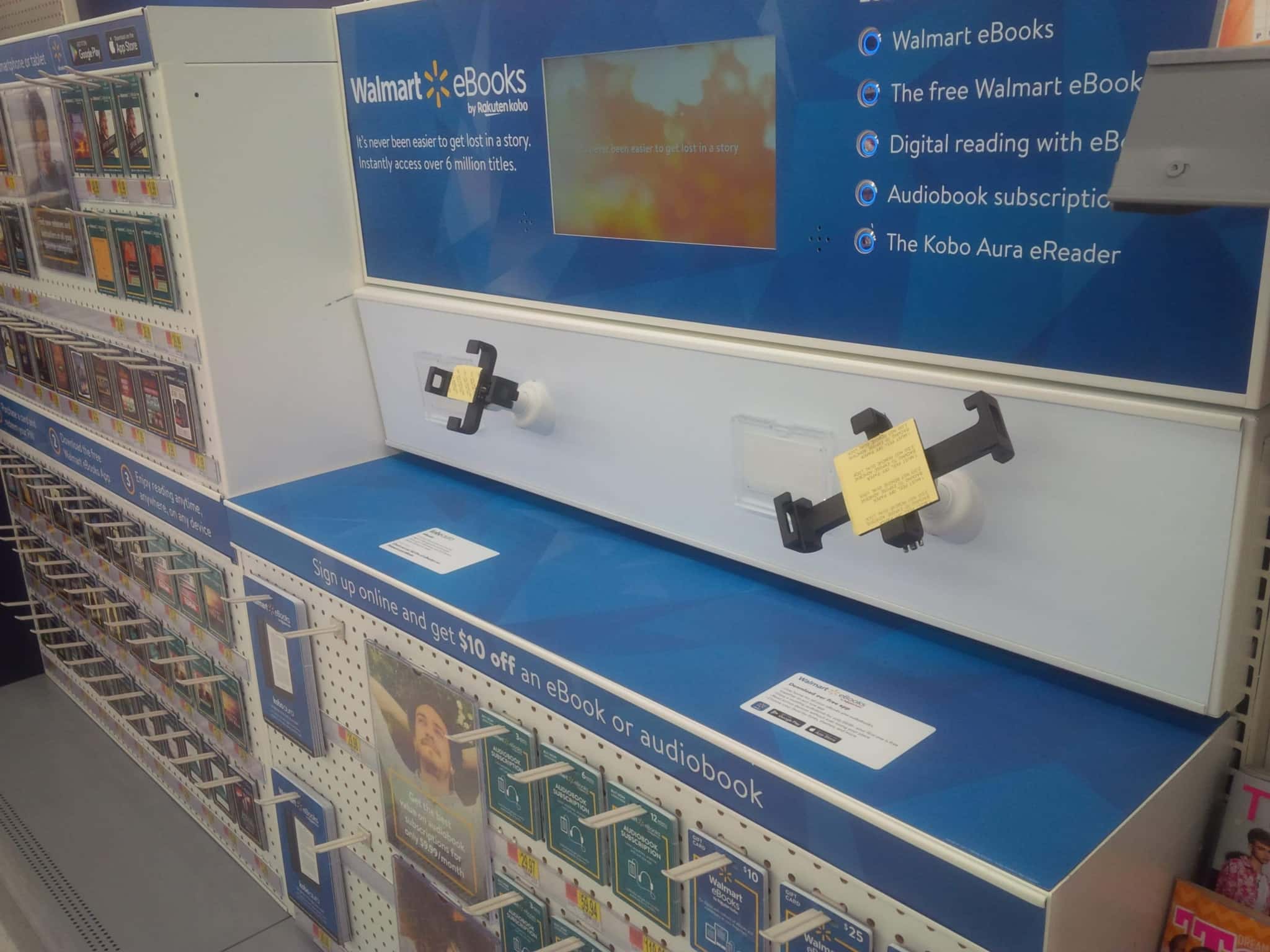
Walmart will sell just one Kobo model in stores at launch, the $99 Kobo Aura. (While the ebook display has clamps for two devices, the second one is sized for a tablet and has a label that mentions the ebook app, not a Kobo device.)

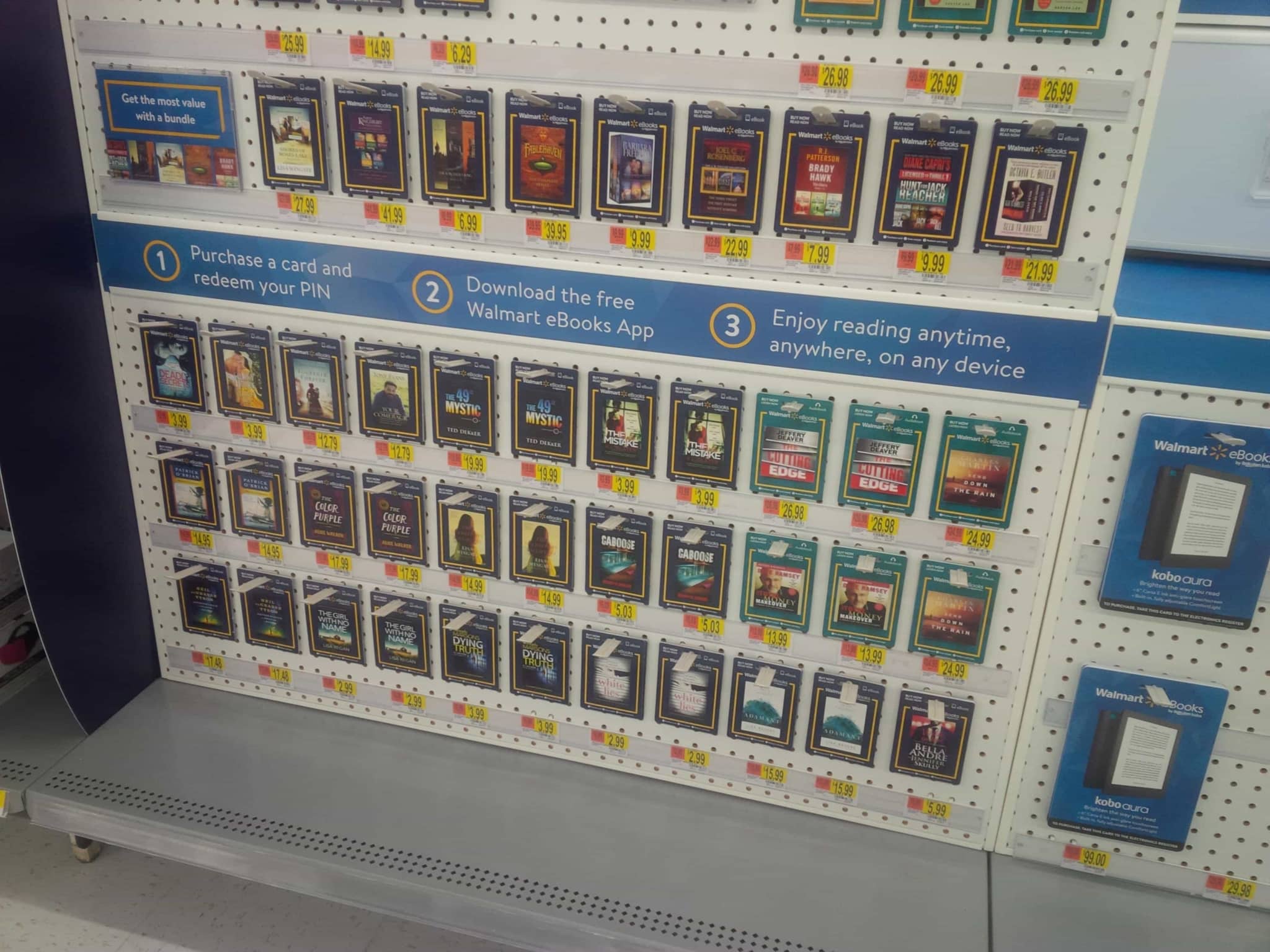
I know there’s a report that Walmart will sell 3 models, but there is just the one card and one price tag for the one model. The Kobo Aura will not be on the display itself; instead, customers will take a hang card from the display, use it to buy the Aura, and then collect the ereader afterwards.

Customers will use a similar process for buying ebooks in a Walmart store.

The display has hooks for a little over 60 gift cards. They will be used to show off a selection of ebook and/or audiobook title cards. The price tags have already been applied, and range from $2.99 to $26.99.

On the other half of the display there are 18 more hooks which will be used for cash value gift cards and cards for audiobook subscriptions.  The gift cards come in increments of $10, $25 and $50, while the audiobook subscriptions come in increments of $30, $60 and $120, for three month, six month and one year subscriptions.

Customers will be able to take the cards up to the cashier to buy/activate them, and then either scan a code on the back of the card to add the ebook to their Walmart eBook app, or type a code into their account online to add the ebook to their account.

Walmart used a similar ebook gift car system for its ebookstore in Canada, but shut that down in 2016. I was told by Walmart’s tech partner that the program ended after the market dried up. That partner later sold off its tech to a 3rd party. Also, Target partnered with Livrada to sell ebook gift cards in stores in 2012, and Amazon ran a similar pilot in drug stores in 2016. Both programs were shut down for unknown reasons.

To put it simply, Walmart is now reviving a sales model that has failed three times in the past 6 years. Do you think they’re going to get it right this time, or are they repeating the same mistake as before?

images via MobileRead member rcentros

Kobo’s Next eReader Clears the FCC

Kobo’s next ebook reader showed up on the FCC website today, and the listing raises far more questions than it answers.

With previous Kobo models, we have usually been able to at least glean the device’s name, but the new device is identified only by its model number, N782. Kobo not only took steps to obscure interesting specs such as the dimensions, screen size, etc, they also decided that this time they would hide even the model name.

Since Kobo won’t tell us the name, I’ll make one up.

I’m going to call this the Kobo Aura Two.

The Aura Two was tested for Wifi, and they used a microSD card during the test, which means the Aura Two could have an external card slot. It was not tested for audio or Bluetooth.

A careful reading of the test reports doesn’t reveal any other details, leaving us to speculate about the device’s specs, functions, and launch date.

For example, there is a 50-50 chance that the Aura Two will launch with the Kobo-Walmart partnership. That was scheduled to happen tomorrow, which means we could find out more about the Aura Two in as little as 24 hours.

On the other hand, we might have to wait a few weeks or months for the official launch.

What would you like to see in Kobo’s next ereader?

FCC

Making Your First Infographic Is Easier Than You Think

A reader left a comment on last night’s infographic post, and I thought it deserved its own post. Mark Williams asked:

The possibilities are endless, but can you point us to any beginner’s guides to actually making these things?

That is a good question; while I know of any number of comprehensive guides to making infographics (The Creative Penn has a good one) I have never been able to find a post that helped me figure out how to make infographics.

I had always had the requisite tools at hand; for example, Canva is free, online, and has dozens of infographic templates you can take apart and modify, thus learning by doing.

But all the tools and all the guides were useless because I struggled with the first step in making anything, which is understanding the concept of the activity.

I made my first infographic in January, and once I did I realized what no one had told me before. I already had the requisite skills and knowledge, but what I lacked was the understanding how to apply them.

In fact, most of those who are reading this post have the skills you need to make an infographic, you just don’t know it yet. Luckily, I can help you make the conceptual leap with a single word.

Are you ready?

Powerpoint.

If you can make a Powerpoint presentation, you can make an infographic. The skills are that similar. (Coincidentally, you can also make an infographic using Powerpoint, but that is not what I am talking about.)

Infographics can look intimidating uninitiated, but the process of making one can be broken down into two simple parts: researching and writing the content, and then laying it out in an interesting manner.

Those are essentially the same steps as making a Powerpoint presentation, only instead of a slide deck, you make one really detailed graphic.

The trick to writing the content for an infographic is to take notes for a 1,000- to 1500-word blog post and then summarize the notes as 15 to 20 tweet-length factoids.

No, seriously, an infographic really is that light on content.

One of my activities over the 2017 holidays was making handouts for Valiant Chicken, my WordPress support business. Those weren’t infographics but what that that project taught me was that if you want to cover 10 to 15 points in a three page handout then you had to be as brief as possible.

One handout consisted of 9 ways to speed up a WordPress site (PDF). The handout’s text consisted of 260 words, which I later expanded into an 800-word blog post.

When you make an infographic, you should take whatever blog post you were thinking of writing, and plan on paring your text down by at least a factor of three. That’s all the room you’ll have in the infographic.

Luckily, you can combine a lot of stats into charts or graphs, reducing your word count while still conveying a lot of information.

But to do that you will need to learn a thing or two about layouts – just not from me.

To be perfectly honest, I am still learning about infographic design myself, which is why I am still using the stock designs at Canva as the basis for my custom infographics.

As someone who is just past the beginner phase, I think you should start there and learn as you go. That’s what I am doing.

Any questions? Did this help?

Infographic: How Authors can use Infographics to Connect with Readers

Infographics are a popular marketing tool in the business world because they are a great way to get a company’s name out in front of potential customers. A popular infographic could be shared widely, giving a company both an SEO boost and adding to its brand recognition.

We don’t see infographics used much in the book world, but they could be a boon for authors who are willing to invest the time and energy. They’re really not that hard to make once you get over the first hurdle.

Here are five ways authors could use infographics. If you have another use for them, we’d love to hear about it in the comments.

1. Reveal background details for setting, characters, or events

There’s no better way to keep fans coming back for more than to reveal how a character got their scar, or explain the history of a royal guard, a gang of cutthroats, or a secret society.

JK Rowling, for example, even has a whole site built on background details for the Harry Potter books, and has published several spin off books.

2. Show how your book is similar to popular books

Readers are always looking for books similar to their favorites, If your book shares themes and tropes with popular series like the Foundation, Narnia, or with a famous author’s books, you should point that out.

The more connections the better.

3.  Share what you found while conducting research

If a reader likes your stories, chances are they will enjoy it when you reveal the work that went into the stories but never made it into the text.

If you had to consult with a bladesmith or herbalist in order to write your book, share the more interesting details you learned from the expert.

4. Create a timeline for the events in your book

When fans are reading book eight in a series and you reference events in book three, they’re going to appreciate a timeline that makes it clear the order of events, and what sudden but inevitable betrayal lead to war.

5. Build a relationship graph

If you are writing books with a large cast of characters and multiple plotlines, chances are your readers will appreciate the help in identifying who did what to whom.

You can use a relationship graph to explain details referenced in the text, such as political alliances, familial connections, or dynastic inheritance.

P.S. If you do decide to make an infographic, please let me know.  I am not a good enough artist to charge for making an infographic, but I still get a kick out of them and would be happy to give you feedback on your work.

P.P.S. The infographic is licensed CC-BY, and can be shared freely.

Amazon to Open Two Bookstores in Denver, Could Buy a Movie Theater Chain

Brick and mortar retail is dead, they say – so dead that Amazon continues to open bookstores, and is now rumored to be bidding on a small chain of movie theaters.

Business Den reports that Amazon has chosen a second location for an Amazon Books in the Denver region.

Amazon has settled on a spot in Cherry Creek for its bookstore.

The online retail giant plans to open Amazon Books on the ground floor of Financial House, the eight-story office building under construction at the northwest corner of 2nd Avenue and Detroit Street, according to tenant finish permit applications submitted to the city.

The company will occupy the building’s sole retail unit, which is approximately 5,000 square feet.

When rumors first broke about Amazon opening a bookstore in Denver, the location was said to be in Cherry Creek. A few months later Amazon announced they would open an Amazon Books in a different part of Denver, but now it seems the earliest rumors were true all along.

When it opens, the second Denver Amazon Books location will be either the 19th or 20th Amazon Books store.

That will hardly be a newsworthy event; however, the same cannot be said for today’s other rumors.

Bloomberg says Amazon is looking to acquire Landmark Theaters.

Amazon is in the running to acquire Landmark Theaters, a move that would vault the e-commerce giant into the brick-and-mortar cinema industry, according to people familiar with the situation.

The company is vying with other suitors to acquire the business from Wagner/Cuban Cos., which is backed by billionaire Mark Cuban and Todd Wagner, according to the people, who asked not to be identified because the discussions are private. The chain’s owners have been working with investment banker Stephens Inc. on a possible sale, the people said. No final decisions have been made, and talks could still fall apart.

Pushing into movie theaters would follow Amazon’s expansion into myriad other forms of media, including a film and TV studio and music service. With Landmark, it gets a chain focused on independent and foreign films with more than 50 theaters in 27 markets, including high-profile locations in New York, Philadelphia, Chicago, Los Angeles and San Francisco.

Landmark’s theaters are known for art-house fare, and some high-end locations include coffee bars or lounges, setting them apart from the typical movie experience.

Landmark is a relatively small chain whose purchase matters less for the market share than for how Amazon might use it.

If Amazon owned Landmark it could bid on movie projects and make the promise that the film would be shown in theaters. Amazon might also offer free movie tickets as a benefit of Amazon Prime, thus encouraging more consumers to sign up.

In financial terms, this deal is chump change, but the indirect effect could be huge.

German eBook Market Estimated to Exceed 100 Million Euros in First Half of 2018

GfK Entertainment and the German publishing trade group Boersenverein  have released their estimates for the German ebook market in the first half of the year. The projections are based on a GfK consumer survey with a total of 25,000 respondents.

The results for the first half of 2018 include:

  • Rising unit sales:  Sales of ebooks  increased by 16.4% to 16.7 million units.
  • Falling prices:  The average e-book price drops by 4.3%.
  • Increasing sales volume:  The higher demand with falling prices resulted in an estimated sales growth of 11.3%. At 100.6 million euros, sales for the first half of the year exceeded the 100 million euro mark.
  • Growing number of ebook buyers:  The number of customers who purchased at least one ebook increased by 6.1% to 2.7 million in the first half of the year.
  • More frequent purchases:  eBook buyers bought  an average of 6.2 ebooks, an increase of 9.7% from the same period last year.

There is currently no publicly available data on which retailer has what market share. Tolino used to release new estimates on a regular basis, but they stopped a few years ago when their market share started to decline.

The current best guess is that Amazon has the largest share, with Apple and/or the ebokstores that make up the Tolino consortium accounting for most of the rest of the market.

BuchReport.de

image by shinya via Flickr

Kindle Unlimited Funding Pool Grew in July 2018 While the Per-Page Rate Fell

Amazon announced on Wednesday that the Kindle Unlimited funding pool grew to $23.1 million in July (plus bonuses), up from $22.6 million in June 2018. At the same time the per-page rate royalty fell to $0.00449 in July, compared to $0.004460 in June and $0.00454 in May 2018.

  • US: $0.0045 (USD)
  • UK: £0.0034 (GBP)
  • Germany: €0.0029 (EUR)
  • Netherlands, France, Spain, Italy: €0.0045 (EUR)
  • Mexico: 0.0748 (MXP)
  • Brazil: R$ 0.0111 (BRL)
  • Japan: 0.5569 (JPY )
  • India, Canada, Australia: unknown

Here’s a list of the monthly funding pools. It does not include the bonuses paid out each month.

  • July 2014: $2.5 million (Kindle Unlimited launches early in the month)
  • August 2014: $4.7 million
  • September 2014: $5 million
  • October 2014: $5.5 million
  • November 2014: $6.5 million
  • December 2014: $7.25 million
  • January 2015 – $8.5 million
  • February 2015: $8 million
  • March 2015: $9.3 million
  • April 2015: $9.8 million
  • May 2015: $10.8 million
  • June 2015: $11.3 million
  • July 2015: $11.5 million
  • August 2015: $11.8 million
  • September 2015: $12 million
  • October 2015: $12.4 million
  • November 2015: $12.7 million
  • December 2015: $13.5 million
  • January 2016: $15 million
  • February 2016: $14 million
  • March 2016: $14.9 million
  • April 2016: $14.9 million
  • May 2016: $15.3 million
  • June 2016: $15.4 million
  • July 2016: $15.5 million
  • August 2016: $15.8 million
  • September 2016: $15.9 million
  • October 2016: $16.2 million
  • November 2016: $16.3 million
  • December 2016: $16.8 million
  • January 2017: : $17.8 million
  • February 2017: : $16.8 million
  • March 2017: $17.7 million
  • April 2017: $17.8 million
  • May 2017 :$17.9 million
  • June 2017: $18 million
  • July 2017: $19 million
  • August 2017: $19.4 million
  • September 2017: $19.5 million
  • October 2017: $19.7 million
  • November 2017: $19.8 million
  • December 2017: $19.9 million
  • January 2018: $20.9 million
  • February 2018: $20 million
  • March 2018: $21 million
  • April 2018: $21.2 million
  • May 2018: $22.5 million
  • June 2018: $22.6 million
  • July 2018: $23.1 million

via Self Publisher Bibel

Amazon Changes Payment Terms for German Distributors

Amazon has quietly changed the terms offered to several German ebook distributors, bringing them into line with most other ebook distributors.

SelfPublisherBibel.de reports that ebooks distributed to the Kindle Store via Bookrix, Neobooks, or BoD will now earn royalties similar to the rates offered through KDP. eBooks priced under 2.99 euros or over 9.99 euros will receive 35% of the net sales price, while ebooks priced between 2.99 and 9.99 euros will earn 70% (less Amazon’s fictional "transmission costs" fees).

The rates mentioned above are what is paid to the distributors; authors will get less. Bookrix, for example, takes a 30% cut of an author’s earnings.

image by aresaubur via Flickr

Millennial Reading Habits Have Changed the Definition of a Classic , and Other Lazy Writing

Millennial-bashing is popular among the media, and this is a problem not just because it’s lazy writing but also because sometimes it distracts from what is actually going on.

Quartz, for example, published a clickbait piece last month where they claimed that adults under 40 had killed off the "classic novel" (found via The Passive Voice).

he era of the ubiquitous classic is behind us. The Wind-Up Bird Chronicle, Ragtime, and Slaughterhouse-Five have had their time in the sun. What would their modern equivalents be? The reason it’s harder to name such tomes is because there’s quantifiably less options to choose from, despite having more books to read.

Since its first publication in 1951, The Catcher in the Rye has sold over 68 million copies, roughly moving a million copies for every year it has lived. In 2007, A Thousand Splendid Suns was published to great acclaim, similar to the reception of J.D. Salinger’s magnum opus. But by comparison, Khaled Hosseini’s novel has only moved nearly 6 million copies, averaging over 500,000 copies per year—half that of Salinger’s.

So what sends J.D. Salinger’s 69-year old novel still flying off the shelves and shrinks a novel that was just as well-received upon publication?

The answer could be adults under 40.

Adults under 40 may be the death of classic books. In 1982, a year after adults under 40 began being born, the top of bestseller lists were shared by seven or more authors. By 1988, Tom Wolfe’s Bonfire of the Vanities could only manage eight weeks. A year later, Salman Rushdie had just nine for The Satanic Verses. By 1994, 10 writers were sharing top spot, each book averaging four weeks. And by 2000, 33 authors were sharing time at the top of the list, ensuring no one stayed longer than a week.

First, I should probably point out I have a Chrome extension that changes "adults under 40" to "adults under 40". (I could fix this but I think it’s better this way.)

This piece has multiple problems, most of which stem from the decision to go for clickbait rather than delve into the real cause.

The thing is, the best-seller lists have changed significantly over the past three decades. Books are staying on the lists for shorter and shorter periods, this is true, but adults under 40 aren’t the cause.

No, that would be the internet.

The single biggest cultural, social, and technological difference between now and the 1980s is that back then communication channels were limited as compared to today. This enabled gatekeepers to control the flow of information. They could choose what got promoted, and essentially make something a classic simply by choosing it.

In 2018, things are very different. Now, we have this thing called the Internet, a communication medium where everyone can talk to everyone. It has its problems, but one upside is that it’s really easy for readers to find new books to read.

Readers don’t have to accept the gatekeepers' choices in 2018; they’re free to listen to other readers, reviewers, or even authors. What’s more, readers have infinitely more options than we did 30 years ago. There are a whole lot more books being produced, all competing for the same few spots on the best-seller lists.

(And yes, I could also make the point that these lists can be gamed and thus don’t actually tell us anything about the quality or value of a book, but I’ll leave that for you to make in the comments.)

So no, "adults under 40" didn’t kill the classic; the internet did. This, folks, is an example of why millennial bashing is such a waste. It is lazy writing that distracts from what is really going on, diverting attention with a cliche.

Next!

image by BryanAlexander via Flickr

Amazon is Still Banning Authors for No Reason

Remember how I’ve been telling you for years and years that Amazon’s bots have been banning authors for inexplicable reasons and giving them no recourse to reverse the malicious actions?

Much to no one’s surprise, it’s still going on.

Yahoo Finance has found more examples of Amazon’s automated algorithms punishing the innocent.

In recent weeks, Amazon (AMZN) has taken down e-books written by at least six self-published novelists who say they did nothing wrong and depend on the platform to make their living, those six novelists told Yahoo Finance.

The six authors published many of their books through Amazon’s online self-publishing platform Kindle Direct Publishing Select, and they expressed shock and frustration over losing their livelihoods without understanding why.

Amazon, for its part, has been cracking down on KDP Select authors who supposedly game the system in order to get paid more. But the authors Yahoo Finance spoke to insist they haven’t engaged in this kind of fraud, and that Amazon banned them without sufficient explanation of wrongdoing.

Jason Cipriano, a self-published author in Bakersfield, California, known to his readers as J.A. Cipriano, says he has sold 143,000 copies of his novels through KDP — enough for him to leave his job as an electrical controls engineer in 2016 to write full-time.

…

Cipriano says he has yet to receive a clear, detailed explanation from Amazon beyond the assertion that he manipulated KDP services — services that include Amazon’s all-you-can-read $9.99 Kindle Unlimited — despite reaching out to customer support to explain the situation. Feedback from Amazon largely came in the form of a generic form letter via email.

I’ve written about this several times since 2016. In almost all cases, the authors don’t know why they were banned, can’t get an explanation from Amazon, and are unable to break past Amazon’s automation and make contact with an actual human.

That is because Amazon doesn’t have any humans running the Kindle Store any more It’s all run by bots, and the only way to reach a human being is to go around Amazon’s system and come in through the side – either by getting the attention of Amazon PR, or Jeff Bezos.

This may sound like histrionics but let’s not forget that the only reason book stuffers were kicked out of KU, and the only reason Amazon changed the rules to ban the practice, was because of all the bad publicity.

Conversely, Amazon’s bots are running amok in the Kindle Store because there hasn’t been enough negative coverage yet. But with Yahoo Finance raising the story’s profile, that could soon change.

Amazon was queried before this post was published, and did not respond.

image by westy48 via Flickr

Updated: Indie Authors' Audiobooks Were (Are) Getting Dragooned Into Kindle Unlimited

If you are an indie author with ebooks in Kindle Unlimited and audiobooks sold through Audible, you should check to see if the latter have been pressed into Kindle Unlimited when you weren’t looking.

Over the past several months a number of authors have noticed that their Audible audiobooks have been showing up in Kindle Unlimited alongside the matching ebook without the authors' permission.

Update: This issue has been fixed, and the affected authors have been compensated.

For example:

I just heard from a fan who signed up for KU because she noticed she could both listen and read my book for 'free'. This was news to me as I independently produce my audiobook and then upload the finished product to ACX. I am the producer and copyright owner and have never given my permission for KU to give my audiobook away for free.

This is a problem because first, the authors never gave permission to add the audiobook to KU, and more importantly because there’s no clear mechanism for authors to be compensated for audiobook listens in Kindle Unlimited.

According to a thread I am following on KBoards, this problem has been going on for at least three months, with no part of Amazon seemingly able to solve it.

KDP Support said it was beyond their control, and passed the buck to Audible. Audible customer service brushed me off with form emails, and ACX (Audible Creation Exchange) ignored one author for at least a month, ruining his audiobook sales, before finally telling the author they had fixed the problem.

I do not know that this has been fixed, but I did get an email this morning from ACX in which they said they had resolved the issue.

Thank you for reaching out to ACX. We apologize for any inconvenience this has caused you.

A technical issue caused some audiobooks to be offered in Kindle Unlimited in error. ACX has removed your title and will provide you with an update on royalty credits for any of your audiobooks that were offered in the program in error. ACX Is carefully reviewing this matter and will reach out with more information soon. We’re sorry for the inconvenience this caused.

In the meantime, please let me know if we can provide additional information or assistance. We’re here to help. Thank you for your patience.

I do not know that I beleive them when they say this has been fixed, but I do think they are trying, and so I would like to give them a little more motivation.

If you have ebooks in KU, check to see if your audiobooks are there as well. If you find them then you should go complain to ACX and demand that they remove your audiobooks from KU and compensate you for the unauthorized borrows.

Then, after they do pay you, can you come here and tell us what you got?

This will help other authors get a fair rate and not get low-balled or even worse, brushed off with no compensation at all.