New Leaked Benchmark Confirms New BNTV800 Nook Tablet With Tegra 4 Chip

Remember that new Nook Android tablet that my sources said would be launched in October but B&N said would not be launched this year? B&N might not be planning to ship the tablet this year, but they do have it under development and it just showed up on a benchmark website.

According to GFX Bench the new Nook device, which I am calling the Nook X, will have the model number BNTV800 and run Android 4.2.2 on an Nvidia Tegra 4 chip.

There’s very little other information available, but I can tell you that the CPU speed registered at 1.8GHz. I also know that the screen resolution is 1620 x 1080, but I can’t tell you about the screen size.

That’s not a standard resolution, so there’s really no way tell how big B&N’s new tablet really is. While it is possible that B&N might have a tablet with a nominal screen size of 1620 x 1200 and decided to reserve the missing 192 pixels for onscreen buttons, I would not bet on it.

And I wouldn’t bother trying to guess the screen size from the model number; one has nothing to do with the other. The new Nook Glow, for example, has a model number of BNVR500-A, even though it has a 6″ screen. in fact, the only relevant detail I can deduce from the model number is that this is a tablet (bnTv800, the T is for tablet).

The Nook X has yet to be confirmed by B&N but past leaks have given us a few hints. I know that B&N has commissioned a for Dummies book, and I know that a product listing for a BT keyboard showed up on the B&N website. I still haven’t managed to get my hands on either item but they tended to support B&N’s past statements that they had a new tablet in the works.

Update: That B&N branded BT keyboard is now available on the B&N website.

This new model hasn’t shown up on the FCC website yet, and I have not found it on any other resource website like Google’s list of supported Android devices. But I am sure it will show up in short order.

The Droid Guy

Rumor: New Kindle Paperwhite to Gain 300ppi Screen Next Spring

Techcrunch is reporting that they have seen a prototype of the next Kindle Paperwhite:

 The marquee feature of the new device is a high-resolution 300 ppi screen that will bring the company’s e-reader displays back into technical parity with devices from competitors like Kobo.

In addition to a higher resolution screen, the new Paperwhite will be getting a few more hardware improvements. We’ve seen a prototype of the device which has a front screen that is flush with the edges of the device, rather than recessed, and is made out of very matte glass of some sort, not plastic. Despite moving to glass, the new units are said to be lighter than this year’s models.

The device is reportedly code named "Ice Wine", and it is going to launched sometime in the second quarter of 2014 (assuming nothing goes wrong).

There’s no word on the screen size, but I can point out that the new screen is going to increase the sharpness from 212 ppi on the current Kindle Paperwhite to over 300 ppi. That is a sharper screen than on the Kobo Aura HD, which comes in at 265 ppi.

If this part comes to pass then the new Paperwhite will have to cost considerably more than the current model. That higher resolution screen is going to require a higher resolution backplane, and that will cost more to produce. This could result in a premium priced Paperwhite which would be sold alongside the lower cost current model.

On a related note, the higher cost of higher resolution screens is part of the reason why so many ereaders have an HD E-ink screen with a resolution of 1024 x 758. That is a stock size offered by E-ink, which means it is already being mass produced and thus cheaper than a higher resolution screen would be.

The new device is reportedly going to have a new shell which looks like the back of the Kindle Fire HDX, and a new power button on the back. It’s also going to have page turn buttons.

Yes, Amazon is going to go against the design trend embodied in their last 3 touchscreen-equipped Kindles. The new model will have page turn buttons similar to that of the Nook Touch; the buttons will be flush with the case and be "squeezable".

There’s also a report that the new device will have a new font and improve typography, but I’m not going to put much weight into this claim. Apparently whoever wrote this post for TechCrunch knows very little about Amazon’s ongoing efforts to improve typography, because he wrote:

Typography has long been one of the Kindle’s big failing points.

Yeah, so the improved fonts and improved typography that Amazon has debuted with the 2012 Kindle and other Kindle launches is all crap? Not in comparison to other ereaders on the market or what was possible 5 or more years ago, no.

Update: I need to correct myself. It seems I was the one not keeping up on the latest opinions of typography experts, because a number of them do think the Kindle fails at typography. Needless to say, I don’t agree.

Readmill Could be Amazon’s Next Acquisition Target

The mobile reading app Readmill is back in the news again today with a new retail partner, and it’s going to make them an even more tempting prize for Amazon.

Readmill has signed a deal with Penguin UK so that customers of the Penguin UK ebookstore can quickly and easily send their purchases to Readmill, and then read the ebooks in the Readmill apps for Android, iPad, and iPhone.

In the near future that ebookstore will be updated with new "Send to Readmill" buttons on the download page, removing yet another speed bump that has made it difficult for readers to concentrate all of their ebook purchases in one location.

Penguin UK is something like the 70th retailer to sign up with Readmill since it launched 2 years ago. Readmill’s partners are a motley bunch of companies including ebookstores like eBookmall, publishers like Wizard Tower Press, and even self-pub services like Bibliocrunch. All of these sites sell or give away ebooks (including DRMed ebooks), and they have all elected to help their customers use Readmill.

As a result Readmill is becoming a focal point in a growing decentralized network of indies, and that is going to make Readmill a worthwhile acquisition for Amazon. (And the fact that Readmill’s revenues are based on tracking their user’s reading behavior and selling the data doesn’t hurt either.)

Amazon has a policy of trying to buy any of their smaller competitors before they can grow into a serious threat. That’s why Amazon owns Zappos, Diapers.com, and The Book Depository (3 niche retailers that were beating Amazon in their niches), and at some point Amazon is probably going to apply the policy to ebooks – if they haven’t already done so.

Edit: I was just reminded on Twitter that Amazon has already bought ebook competitors – remember Stanza?

Now, if you’re thinking that Amazon’s only competitors are the big ebookstores then it’s time to start thinking laterally.

For one thing Amazon would probably never be allowed to buy a major competing ebookstore (the SEC wouldn’t allow it). And for another the major publishers are never going to let a single major ebookstore grow up and replace Amazon; they would be replacing one ruthless behemoth with another.

In short, the only competition Amazon could be interested in buying would be one or another indie startup.

This opinion was inspired by a comment left yesterday on a post about breaking Amazon’s monopoly (such as it were). David Haywood Young argued that centralized systems (like Amazon) could be taken down by a network of indies:

There’s no obvious reason these centralized systems have to dominate internet sales at all. Set up an easy-to-use system for content owners to offer their wares from wherever they choose to host ‘em, and handle sales by at least one common protocol, and the only central system of use will be an index…which will really only be useful to most insofar as it is also a recommendation engine.

If we expand upon that idea, this indie network could include independent startups that each specialized in one or more task: production, distribution, payment processing, marketing, reading, or discovery. Rather than trying to do everything and failing to do any one task well (like Kobo, B&N, Google), each startup would try to be the best at just one task. Customers and creators would ideally be able to navigate the network seamlessly, with much of the work done automatically behind the scenes.

Now, this indie network doesn’t really exist yet; it’s more of a concept than any type of actual coordinated effort to grow the ebook market. But it could exist, and they way that Amazon is acquiring startups will work to either control it or at least control the most important parts.

Amazon is going to want to look for the startups that are becoming the major nodes in the indie network, and then try to buy them. Readmill could be on its way to becoming one of these nodes; they already have dozens and dozens of connections, so if Amazon bought them then Amazon would be in the middle of everything.

Do you know another company that was already on its way to becoming a major node?

Goodreads.

This book community had developed expertise in book discovery. They had invested in a discovery engine, and by encouraging users to assemble their own virtual bookshelves Goodreads had also managed to introduce an organic discovery component.

That’s why Amazon bought Goodreads earlier this year, and for a similar reason I think Amazon is probably looking at Readmill.

Thoughts?

P.S. I would also add Smashwords to the list of potential nodes, but it isn’t one yet. At this point Smashwords has only the most tenuous connections to ebook production services, and their ebookstore is too focused on their own website (it can’t be embedded in author websites, for example). Right now Smashwords is a major node in a network with major ebookstores, and not an indie network. But Smashwords could also become a node in that indie network if they tried.

Plastic Logic Expands Into the Construction Market With a New 21″ eReader for Blueprints

Remember that dual screen ereader concept design that Plastic Logic demoed at CES 2013?  It’s found a home.

A startup called Printless Plans is working to develop a new platform for the construction industry. They’re looking for a solution which would avoid having to print out the voluminous blueprints needed anything more than a basic construction project, and they think PL’s dual screen ereader is a perfect fit.

They’re calling it the Zephyr.

It combines two of Plastic Logic’s 10.7″ screen panels to produce a surface area that measures 15.4″ when laid flat. Each panel has a resolution of 1280 x 960 pixels, giving the Zephyr an impressive 1280 x 1920 resolution (minus a pixel or 2 for the fold).

Correction: A reader noticed that there is an extra seam in the device shown below. The Zephyr has 4 screen panels, not 2, making this a 21.4″ ereader with a resolution of 1920 x 2540. Thanks, Tom!

Okay, that’s not so impressive when compared to say the Kindle Fire HDX 8.9, which has a screen resolution of 2560 x 1600 in under 9″, but the Zephyr is still larger than any previous ereader. And at 150ppi, the sharpness of the screen(s) on the Zephyr matches that of Sony’s 13.3″ writing slate.

Update: I ran this idea by a construction engineer I know and she would never buy it. It’s too fragile, too costly, and everyone has already gone digital. They’re using pro grade tablets to display blueprints, so there is no need for this funky device.

There aren’t any details yet on connectivity, but the Zephyr will be equipped with a touchscreen to make manipulating blueprints easier. I for one would love to see how they managed a touchscreen with a fold down the center; that is probably the most technically complicated part of the design.

There’s also no firm details on price or release date (nor would you expect any at this point), but according to Plastic Logic the Zephyr prototype will be on display later this month. Printless Plans and Plastic Logic will have the Zephyr on display at the GreenBuild trade show in Philadelphia, Penn. It should be possible for attendees to play with it and try to kill it.

AAP Reports eBook Sales Down 1% in August, Down for the Year

The latest monthly sales figures from the American Association of Publishers are going to add grist to the mill for those who say that the ebook market is leveling off.

The AAP reported that the book market as a whole was up nearly 6% in August 2013 ($633.5 million from $598.4 million), and it was also down 4.8% for the January to August period ($4.26 billion from $4.47 billion).

The combined digital sales (audiobook and ebook) for the first 8 months of 2013 totaled $882.8 million, down 3.5% from $915 million during that period last year. In the adult segment, downloadable audiobooks were up 14.4% in the first 8 months of 2013 while ebooks increased by 4.8%. Religious ebooks were up 2.6%, while kid’s ebooks dropped by 40%.

The ebook segments are just beginning to get out of the shadow of last year’s sales, with YA ebook sales slowly recovering to where they were last year. Digital sales (ebook plus audiobook) for August 2013 alone totaled $144.4 million, up about one and a third percent from August 2013.

Update: Publisher’s Lunch has caught me in a math error. The August figures show that the total digital sales were down 1.7%, not up. (My mistake was that I accidentally swapped the August 2012 figure with the August 2013 figure, and thus the ratio was inverted.)

The YA ebook segment was down 7.6% ($13.3 million from $14.4 million), while religious ebooks were up 4.9% ($4.9 million from $4.7 million). Curiously enough, adult ebook sales broke with their previous trend of steady growth and took a dip in August; they were down 2.9% ($114.8 million from $118.2 million).

Adult audiobooks, on the other hand, were up 18.3% ($11.4 million from $9.6 million). Along with religious ebooks, this was one of only 2 digital segments that increased in August.

Like we have seen in previous reports, last year’s release of The Hunger Games movie resulted in a volume of ebook and paper book sales that could not be repeated in 2013. But the shadow also appears to be wearing thin, so with luck in the next few months we should have a better idea of whether the market is growing, shrinking, or holding steady.

Or rather we will know how well the 1195 publishers who share data with the AAP are doing; the above data does not reflect the entire market.

P.S. As always, here are the charts from the AAP.

Txtr Beagle Scheduled to Ship Before Christmas

Remember last year when txtr unveiled their smartphone accessory, the beagle? It may have taken well over a year but this faux ereader with a 5″ E-ink screen might finally be about to hit the market.

I have just gotten an email from txtr which said, in part:

It will be available before Christmas, but we are not at liberty to say where and with whom.

This is good news; after txtr started and then stopped selling the beagle themselves earlier this year I was convinced that it had been discontinued. I am surprised to see that I am wrong.

The txtr beagle has a 5″ E-ink screen with a resolution of 600 x 800. It comes with 4GB of internal storage and Bluetooth. It’s powered by 2 AAA batteries, and it has no rechargeable battery or USB ports. eBooks are loaded onto the beagle via one of txtr’s apps for Android or the iPhone. The app is needed to convert from the Epub ebook format to the page image format which is used by the beagle.

The beagle launched last October with the billing of being a 10 euro ereader, so naturally some corners have been cut to achieve that price. This device was originally intended to be sold by telecoms and bundled into contracts with a new smartphone. The 10 euro price tag was supposed to be bundled into the monthly cost of the contract.

I have no information on whether that plan is still in place, but given the limited hardware and functionality I am not sure that this device has a shot in any other market.

Stumblary Wants to be the StumbleUpon for eBooks

Every so often I come across a new and novel way to promote books. In June I found No Names, No Jackets, a site that focused on serving up blind excerpts as a way of drawing the attention of readers, and today I have just come across Stumblary.

Billed by its creator, Raimonds Plavenieks, as the StumbleUpon for books, Stumblary is a minimalist website that serves up book teasers. At the moment it’s drawing the teasers from Hacker News with links to Amazon, but long term plans include encouraging submissions via the related @stumblary twitter account (see the Stumblary website for more details).

Many of the teasers are complete non sequiturs or at best only tenuously related to the book in question, and that tends to detract from the discovery process. Each teaser looks something like this:

What you see in the screenshot is the total sum of the website, so I would say that calling this a StumbleUpon for books is somewhat inaccurate (and there already is one of those: Goodreads). The only actions that a user can take are to click the next button, the title, or the source. There’s no real sorting or ranking options, and there’s only a single sharing option (Twitter).

The site has been public for just over a day, and it’s already gotten some flack on Hacker news. Many commuters expressed criticism for the book teasers, with many of the comments resembling this one:

Fetching books from HN threads is IMO a really good idea, but using the submission title seems to produce completely inaccurate teasers for me. I’d recommend fetching the title from Amazon too, and also somehow weighting the books by comment upvotes.

I have to agree with the dissenters. I found the site novel but not terribly useful. Infact,I have yet to actually discover something I wanted to read, which is kinda the point of a site like Stumblary. The teasers come from far too many genres but primarily focus on nonfiction, and there’s no way to limit the suggestions to a single genre or downvote the bad ones.

But in spite of its faults, I hope Stumblary sticks around longer than No Names, No Jackets. Due to a general lack of interest from authors and publishers, that book discovery site shut down in less than 6 months after it launched

Stumblary

Hacker News

Review: Gajah InkCase Smartphone Case – 4.3″ ePaper Screen, Bluetooth

Over the past year a number of gadget makers ranging from Alcatel to Pocketbook have debuted smartphone cases that added a secondary E-ink screen to a smartphone (there’s even a failed Indiegogo campaign to produce one). Out of all of those companies, only one has brought a product to market (so far).

Gajah is a Singapore based device maker which has extensive experience in designing ereaders and tablets. They have used that experience to quickly develop the InkCase, a line of half-shell smartphone cases.

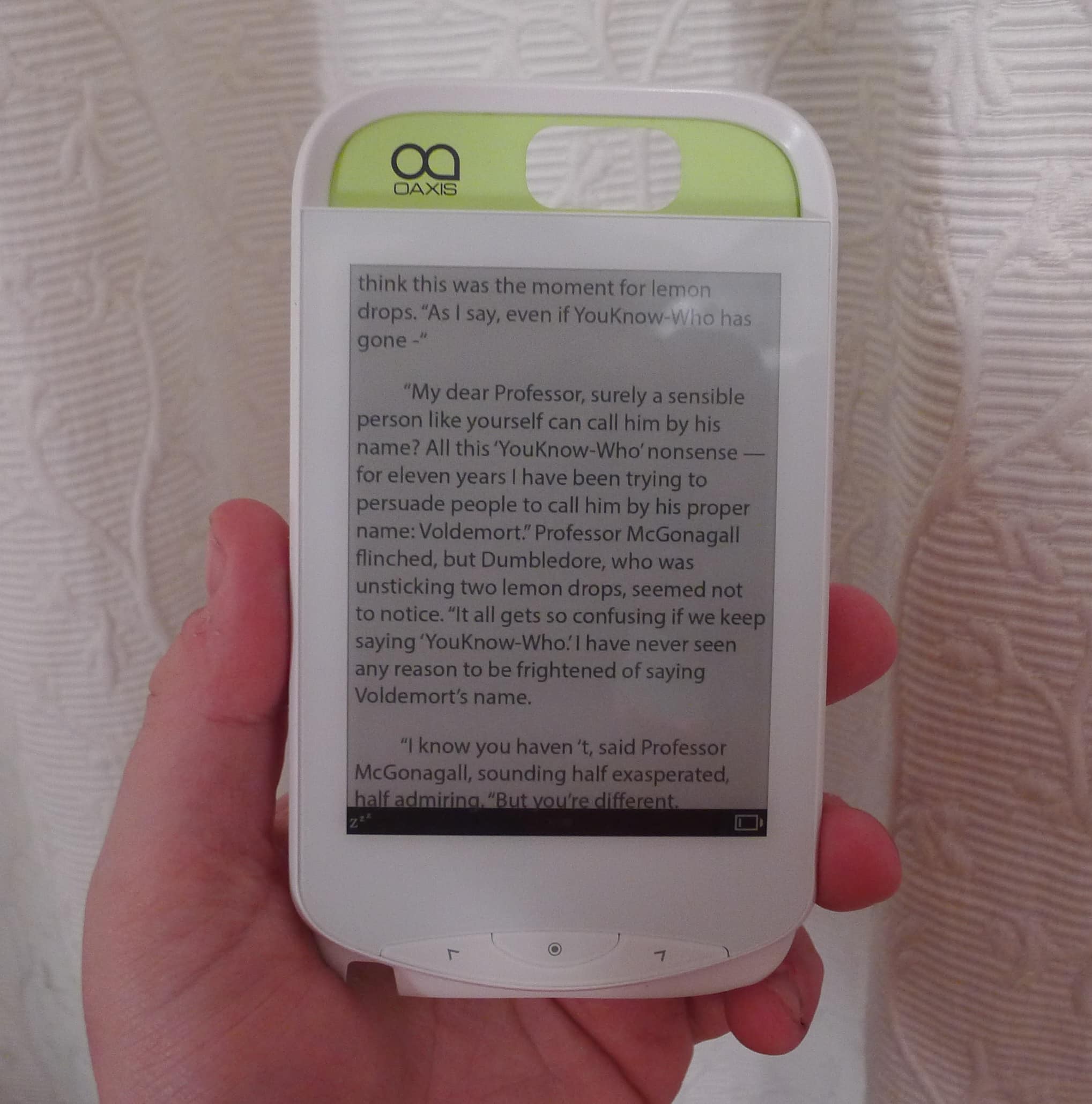
I first reported on the InkCase when it debuted in June, and today I am the first blogger to get my hands on one and post a review.

Sidenote: I am in fact the first to get my hands 6 InkCase review units. Do you want one? If anyone reading this is a gadget blogger with a decent readership, drop me a line and ask if I still have any to give away.

Update: All I have left are a couple cases for the Galaxy Note 2.

There are 2 InkCase models at the moment, the i5 and the N2. One (i5) fits the iPhone 5/5S, and the other (N2) fits the Galaxy Note 2.

I don’t have either smartphone, but I was able to successfully pair the N2 with my Kindle Fire HD and test it. I was also able to pull the cover off and see the innards, so I have more details to share than just a basic user review.

Verdict

Don’t bother getting the InkCase.

While this is a great idea and it shows great potential, the InkCase is hobbled by limited software and a poor implementation of the concept. There’s not a whole lot that the InkCase can do at the moment, and I don’t think it is worth the $99 MSRP.

Hardware

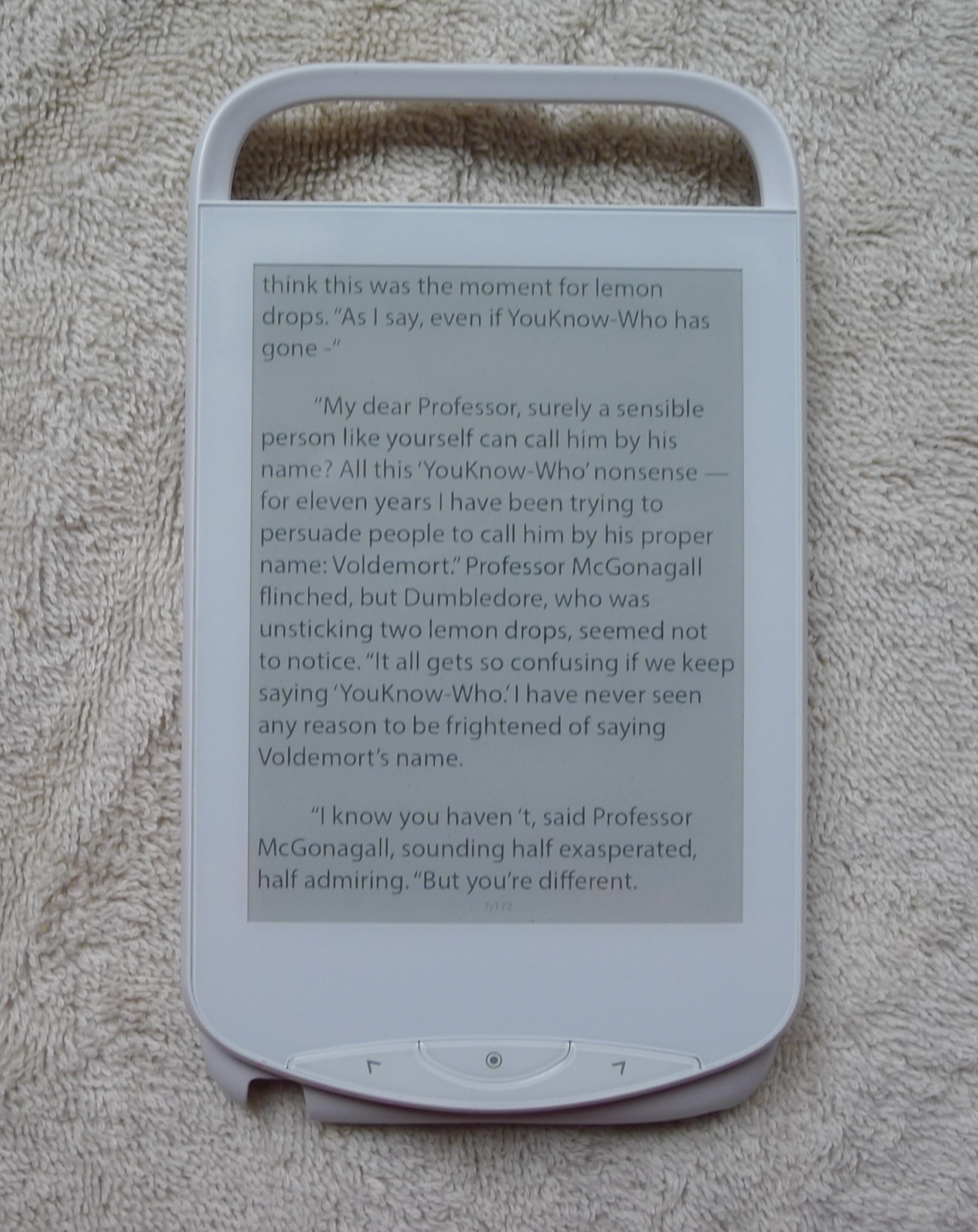
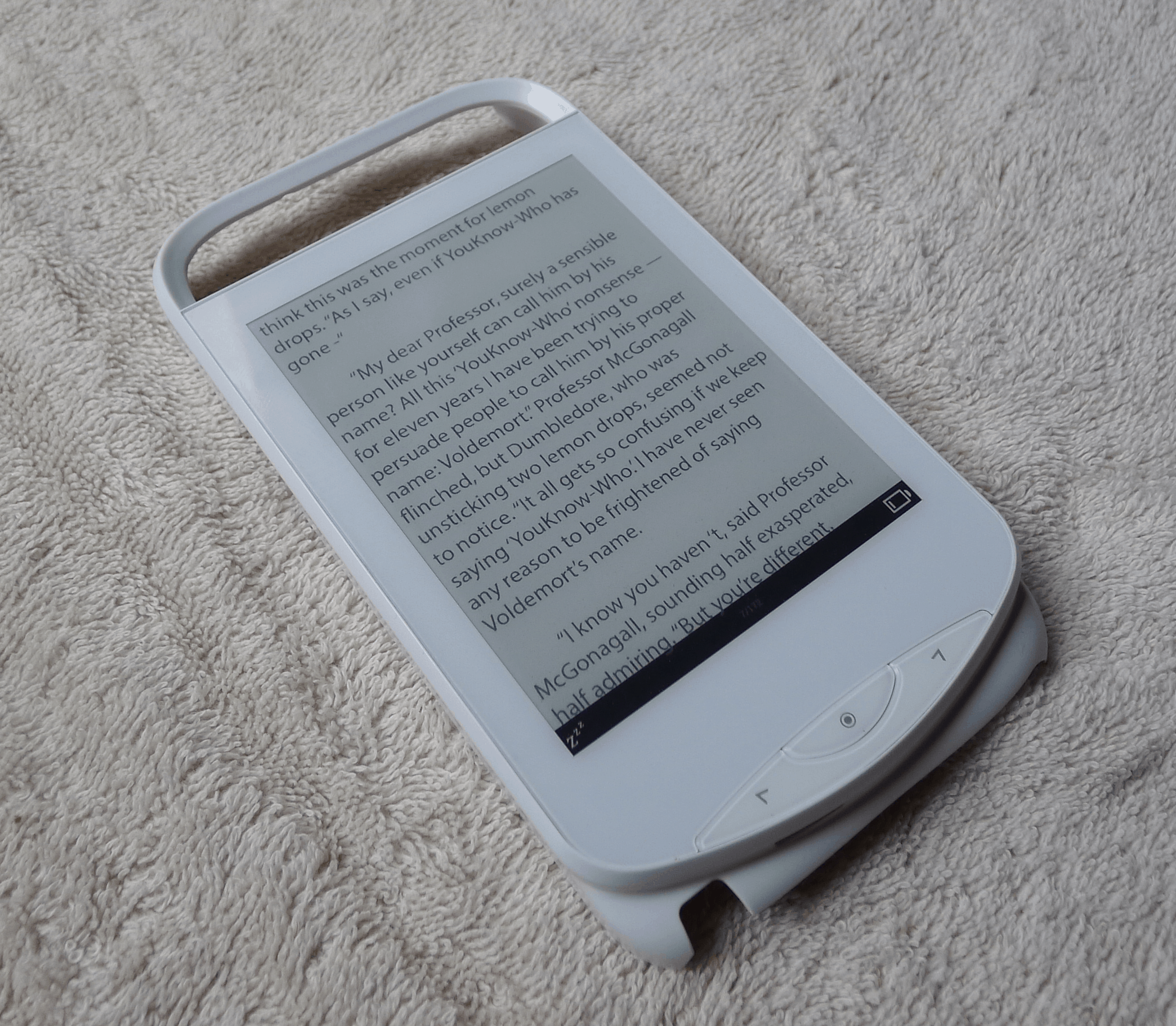
The N2 case has a 4.3″ epaper screen (600 x 800 screen resolution), 1.6GB of usable storage, 830mAh battery, microUSB port, and 3 buttons on the front.

It’s running om a reasonably capable CPU (Allwinner E200) which was designed to be a CPU for an ereader (and is used to run a couple ereader models). The N2 is intended to pair with the Galaxy Note 2 over Bluetooth, and the USB port is currently only used to charge the battery.

I have the white N2 (there’s also a black model). My unit is the same size as the Note 2, and about 4 mm thick. It’s made from a solid feeling plastic which I would describe as being higher quality than the Apple supplied cases for the iPhone 5c. In general I would describe the build quality as good. (Just don’t ask me about the inner shell, which is painted neon green.)

But while the hardware is good, the software leaves a lot to be desired. The N2 cannot do anything on its own besides cycling through a gallery of promo images. If you want to do anything useful you will need to run an app on the paired smartphone.

Software

The InkCase was launched with the promise that you would be able to use the epaper screen for reading, displaying notifications, showing images, weather updates, and more.

At the moment there are only 2 apps available: a reading app and an image gallery app. The former is rather basic, but the latter has a few interesting features including filters.

There are no other apps, nor are is there any useful system shortcuts like "send this screenshot to the InkCase". That would be useful for transferring a boarding pass, shopping list, or other data which you might want to use while your smartphone is asleep.

There’s also no way to simply load a folder of images or ebooks in the InkCase’s Flash storage and then access them; each image or page from an ebook must be sent over USB – one at a time.

I was really only interested in the reading app, but it did not live up to my expectation. First of all it doesn’t do a very good job of displaying an ebook on my KFHD (it frankly doesn’t look very good), but more importantly I am disappointed and frustrated by how the app worked with the InkCase.

The InkCase has just the power button and the page turn buttons, so there’s not a lot that can be done on the case itself to manipulate the text – no changing the font size, skipping around inside an ebook, nothing.

I am perfectly fine with having to manage the ebook from the app, but I was hoping that the app would simply send an ebook to the InkCase (which would then display the ebook). That is not the case. Instead the app controls the screen on the paired InkCase while running on my Kindle Fire HD.

Each page of text is sent one at a time, and the InkCase doesn’t seem to be able to store more than a handful of pages at once. This means that the app has to be running and paired with the InkCase at all times. Whenever my KFHD went to sleep the connection was lost and the InkCase was useless.

I’m pretty sure that won’t be a problem with the Galaxy Note 2; my regular (non-Amazon) Android devices can ping me with notifications while asleep, so it should be possible for the reading app to continue to function even when the Note 2 appears to be asleep. Of course, it’s going to draw power for the Bluetooth and the CPU, so even if the app is running that is still a sub-optimal solution.

I find this immensely frustrating. The InkCase has the guts of an ereader, so it is capable of operating independently but unfortunately the software isn’t set up to do that.

And to make matters worse, the screen on the InkCase used a double refresh on every page turn. This tended to slow down my reading speed. I also noted that the screen regularly appeared to be blotchy; some text on the screen looked more faded than other text, while some parts were more bolded. This was a real turn off, and it made it a lot harder to read.

Conclusion

Even though it has significantly more capable hardware, the InkCase is effectively more limited as an ereader than the txtr beagle. That device would at least display page images on its own while the InkCase cannot.

I would not buy the InkCase until it either gets a major firmware update or until after it has fallen into the hands of a hacker. Someone needs to liberate the InkCase so it can live up to its full potential.

Seriously, the InkCase is the next best thing to strapping an ereader to the back of a smartphone. I know that might sound like a crazy idea, but given the already high cost of high end smartphones I think the extra cost is worth it. If the inkCase were as capable as the hardware suggested, I would want one.

This case only adds minimal bulk to a smartphone in exchange for a potentially significant increase in function. That is worth the tradeoff, IMO.
Biological Tests Show that 50 Shades is a Dirty, Dirty Book

Coming out of left field, here’s another reason why ebooks are better than paper books: they’re hygienic.

A pair of Dutch university professors have just finished a new study in which they took the 10 most borrowed books in the Antwerp lending library and ran them through a battery of toxicology and bacteriology tests. The results make me want to go scrub my hands.

The professors found that all 10 books tested positive for cocaine, unfortunately in concentrations that aren’t high enough to get you high but will result in a positive result on a drug test (all the downsides but none of the fun). They also found that 2 of the books, including 50 Shades, tested positive for the herpes virus.

I know you’re saying ewww right now, but I would hold off on that emotion. This result, as gross as it may be, should come as no surprise to anyone who has had Bio 101.

When I took the class years ago there was one section where we swabbed a wide variety of surfaces and grew cultures. If you had seen how many things were growing on a door handle you would probably want to douse yourself in antibacterial soap.

Herpes may be attention getting, but please note that there’s no mention of whether they found Herpes A or B (not even in the original Dutch (Flemish?) sources). For all we know someone might have a serious problem with mouth sores, not an STD.

Also, I can’t find any sign that the professors tested for other bacteria or viruses, and that makes me think that they went for this one detail just to shock us. The original source was a Dutch TV show after all, not an academic paper.

But just to be safe, I suggest that everyone start practicing safe reading. At the very least you could wear gloves and a mask when handling a library book, but I think it better to follow your mother’s maxim: "Don’t touch that. You don’t know where it’s been."

P.S. This post is brought to you by DuPont, maker of HazMat suits, and Trojan, maker of condoms.

Flanders News


France Passes New Law With Higher Tax Rate for DRMed eBooks

Hardly anyone likes DRM on their content, and its various opponents respond in various ways, whether by public advocacy or by voting with their pocketbook. And then there is France, which decided to express their displeasure with a new tax law.

France has amended their tax laws with a new lower tax rate for DRM-free ebooks (or a new higher rate for DRMed ebooks, depending on how you look at it). The new law won’t go into effect until 2015, but once it does Amazon, Apple, Kobo, and all the other major ebookstores will all be penalized for selling DRMed ebooks to French customers.

Update: The law has been unpassed.

Under France’s new tax laws, DRMed ebooks will be taxed at a higher rate (currently 19.6%), while DRM-free ebooks will be taxed at the lower 5.5% rate.

As I am sure many already know, ebooks are already sold in France with a 5.5% VAT, or value added tax, bundled into the list price. Technically that is illegal under current EU regulation; ebooks are defined as a service and thus should have a higher VAT applied. But no penalty has been applied (so far) so at this point it is really a matter of opinion.

And just to add extra confusion to the matter, EU tax law will itself be changing in 2015, and under the new rules ebooks will be taxed at the lower rate (the one that France is not supposed to be charging right now). The new EU tax laws will also require retailers to collect taxes based on the customer’s location and not based on where the retailer is based.

As you can imagine, this is going to close the Luxembourg tax loophole enjoyed by Amazon, Kobo, and a lot of other ebook retailers, but just as importantly this new tax law will create an opportunity for France to penalize the sale of DRMed ebooks.

DRMed ebooks will cost more – theoretically. Speaking as someone who has long been an advocate of DRM-free, I think this is great news, although I’m not sure how much of an effect it will have.

Given that ebook prices vary wildly based on market, publisher, popularity, and sales status, I’m not sure that anyone will notice the difference. Also, France is one of the countries with a fixed price law for books (and ebooks), which further complicates the pricing situation.

There has been a growing movement among French and other European publishers to go DRM-free, and this will likely inspire some to make the switch. But a good part of the French book market is controlled by major publishers who could be immune to the financial pressure.

On a related note, I have to say that I wish they had thought to include audiobooks as well. They could have deDRMed that market as well. It might be relatively tiny at the moment but that’s no reason not to apply the same tax laws to it.

What little info I have on the French ebook market says that it is a 3 way race between Amazon, Kobo, and Apple, with Amazon slightly in the lead.

Actualitte

images by Kimberly Vardeman, Mike Licht


Earl, the "Back-Country E-ink Android Tablet", Now has a Flexible Mobius E-ink Screen

Update (26 October 2014): Here’s the latest on the Earl.

When the Earl tablet was announced earlier this year it got a lot of attention for its rugged design and for its focus on a unique market niche. It has a 6″ flexible epaper screen, long battery life, and runs Android, making it a rare device indeed at the time.

Today I have learned that this back country tablet  is getting even more rugged. There’s a status update on the Earl website with new details about the tablet, and it says that the Earl is losing a few sensors and gaining a better screen.

This tablet is going to be the first to use a 6″ flexible E-ink screen based on E-ink’s recently announced Mobius screen tech. It uses a flexible plastic backplane just like the one found on Sony’s 13.3″ writing slate.

Now, if you’ve been following the news about the Earl then you probably know that it already had a flexible screen (made by LG Display, in fact); this one is better. The Earl developers are reporting that it is more rugged, and they have also mentioned that this panel also integrates the latest Regal waveform refresh tech. That should reduce the number of full page screen refreshes somewhat, although at the expense of a slightly grayer screen.

And that’s not the only change the Earl has gone through since it was announced in May.  The developers tell me that they have swapped out the touchscreen, modified the design to remove components, worked to reduce cost.

This tablet now has a capacitive touchscreen, not IR. The developers made this change because they weren’t sure that the IR sensors could be made rugged enough to meet the IP67 standard. Sure, an IR touchscreen is glove friendly (an important detail), but so is the replacement capacitive touchscreen (or so the developers report).

The Earl has also lost a few sensors. The infrared blaster is gone, a victim of its general uselessness in the outdoors. The developers have also dropped the d-pad found on the Earl prototype; with a larger touch area due to the new capacitive system used in Earl, along with the additional buttons built into Earl’s shell, they thought the d-pad was unnecessary.

The anennometer (wind speed sensor) was removed from the design because it was unreliable and a little power hungry. And finally, the eye-catching kickstand has been droped from the design; the developers decided it wasn’t sturdy enough.

This 6″ Android tablet was announced in May and was supposed to ship by the end of the summer. It has unfortunately been delayed until (at least) early 2014.

You can find more details on the Earl website.

Thanks, Nom!

If the eBook Market is Flattening Out Then Why Are eBook Sales Up at HarperCollins and Hachette?

Ask anyone from DBW to Nick Carr to the BISG and they’ll insist that the ebook market is leveling out here in the US, but something tells me that the major publishers didn’t get the memo.

Two different major publishers have reported in the past couple days that their ebook revenues have increased in the past quarter, and I would say that tends to cast a lot of doubt on the idea that ebooks have leveled off.

Yesterday HarperCollins mentioned in their quarterly report that their ebook revenues for the first fiscal quarter increased significantly over that of the same period last year. They cited that ebooks now made up about 22% of revenue ($72 million, by my calculations) up from 15% last year ($53 million, again by my calculations).

I already have a reader who quite reasonably pointed out that a single point doesn’t make an argument; it’s merely anecdotal. This is true, but 3 points make a line. And that’s why I am pleased that Lagardère released a quarterly financial statement today.

Guess what they said about ebooks?

They’re still seeing strong growth.

Hachette, Lagardère’s US sub, saw a revenue increase of 11%. That’s a damned good report for a recession, and part of it was probably due to ebooks. According to Lagardère, ebooks represented 27% of adult book sales in the third quarter, up from 20% in Q3 of last year. They also reported that ebooks accounted for 30% of adult book sales in the UK, up from 20% last year.

Neither publisher released any info on the number of units sold, so we don’t know (for example) whether the end of agency may have affected ebook sales.We also don’t know for sure the actual increase in revenue, but I’m fine with that.

Two major publishers are still seeing excellent growth in ebook revenue year over year. I have 3 data points that suggest that we have yet to hit peak ebooks, so reports that the market has flattened should be taken with a large grain of salt.

image by freetrader57

Kno Sold for $15 Million – Does This Doom the Rest of the Digital Textbook Market?

Intel didn’t mention how much they paid for digital textbook startup Kno when they announced the acquisition last week but inside sources are now saying that the digital textbook startup was picked up for a song. GigaOm reported earlier today that their sources told them that Kno sold effectively for pennies on the dollar:

Well placed sources who were in the know told us that the company sold for $15 million with some retention bonuses for the employees. Intel bought the company mostly for its hardware-related intellectual property and the employees. Intel also was one of the largest investors in the company — having pumped in $20 million via its Intel Capital arm.

Just to put that sale price into perspective, Kno had raised $73 million in venture capital since it was founded 4 years ago, and it picked up another $20 million in debt.

This deal was nothing less than a fire sale, and that does not bode well for the digital textbook market or other startups in this niche. Inkling, for example, just raised $20 million dollars this summer in order to compete in a market that murdered one of their competitors.

GigaOm notes that the death of Kno was a long drawn out affair. The startup almost managed to revive itself with a merger with Coursesmart, but that deal fell through because Coursesmart was reportedly even less healthy than Kno. That digital textbook distributor is supposedly being propped up by the publishers who own it; if that is true then it is news to me.


While I didn’t technically predict the demise of Kno I have been writing about how the digital textbook is a worse value for students than paper textbooks. I wrote that close to 3 years ago and I am still correct today. To put it simply, students are avoiding digital textbooks because buying and then reselling paper textbooks offer a better value. And even when students did use digital textbooks, they tend not to use the flashier components.

I’ve also written that the ongoing trend of students buying fewer textbooks, which I have been tracking for a couple years now, was not a sign of a healthy market. That trend has shown up time after time.

With all that in mind I am not surprised that Kno failed. And given the general lack of growth in that market (only 7% of college students use digital textbooks) I would also bet that they will not be the last.

 images by hackNY, vancouverfilmschool

Amazon Now in Talks With Swedish Publishers, Plans to Launch Swedish Kindle Store

Several Swedish language sources have reported that Amazon has been quietly negotiating with Swedish publishers, and that the retail giant is planning to launch a local Kindle Store in Sweden in early 2014.

I called it.

Late last month Svenska Dagbladet broke the news that Amazon was interested in the Swedish market. They posted a stump of an article which cited the trade magazine Svensk Bokhandel, and its source Claes-Håkan Johansson. They don’t include much in the way of details, but they do report that it is a widely held belief that Amazon was interested in that market.

And in addition to Svenska Dagbladet, there was a new article in Dagens Nyheter on Saturday. The article cites numerous sources in the Swedish publishing industry, including Christer Perslöv, the CEO of the publishing services company Bokrondellen. All are saying that Amazon is negotiating with publishers and distributors, with Perslöv stating that negotiations with his firm had been ongoing for a year.

Update: A reader left a comment with a better translation: "Bokrollenden is owned by all the biggest publishers and therefore has a monopoly-like position for book data there. They say Amazon has come closer in negotiations to Bokrollendens demands, before that Amazon had set “tough demands”. Both p and ebooks have been discussed." Thanks, Jussi!

While no one has any solid info on when Amazon will launch in Sweden, the general consensus is that it will happen early next year. And from the way some of the sources are talking, Amazon might also be interested in selling pbooks as well as ebooks.

Aside from that last detail, none of this comes as a surprise to me; back in September 2013 I was the first to report on Amazon adding new language support to KDP, including Swedish. I suggested that the new support indicated that Amazon was interested in launching more local Kindle Stores.

Right now there are exactly 2 international ebookstores in Sweden, iBooks and Google Play Books. Apple launched there in September 2011 and Google expanded into the country in July 2013.

According to the latest stats, Sweden has a population of around 9.7 million. While that is a relatively small market (compared to the English speaking world), Sweden is probably higher on Amazon’s list than you might think. This is one of 4 countries in the EU that have the highest percentages of consumers who buy paper books online according to a recent poll. With 38% of respondents buying books online, Sweden is right between Germany (41%) and the UK (36%).

Tell me, which are the 2 most developed ebook markets in Europe?

Sweden is also one of a handful of European countries that doesn’t have a fixed price law for books, so if Amazon does launch in Sweden there will be no law to stop aggressive discounting. Publishing contracts might block it, though, so I would not assume Amazon is going to be their usual rapacious self.

images by clunkygirl, axmai

Intel Acquired Kno (for More Than Just Their Digital Textbooks)

The hot ed tech story of the week is something of a shocker.

Looking to boost their academic division, Intel bought digital textbook provider Kno for an unknown sum. An early report from TechCrunch says that the Kno staff will be integrated into Intel’s existing ed tech division – with the exception of the CEO Osman Rashid, who will be leaving the firm.

While tonight’s news is a shocker, it’s a well-known fact that Intel has been interested in Kno since at least April 2011. The chip maker led the Series C funding round and invested $20 million out of the $30 million raised. All in all Kno has raised just over $73 million in financing; I don’t know whether they were self-supporting yet.

TechCrunch is pitching this deal as being focused on the educational content market, or more specifically the 225,000 interactive textbook titles that Kno sells on behalf of 75 publishers. I don’t think that is quite what Intel is interested in.

It’s my guess that Intel has a broader interest than just textbooks. Look over their website and you’ll see that they aren’t just focused on selling hardware; they pitch a complete solution. Their educational division is akin to NewsCorp’s Amplify,  which is a platform consisting of hardware plus software plus a half dozen different types of academic content besides textbooks.

I think it’s the software that has Intel interested, not the textbooks. Or I could be wrong; I will admit that I am basing that on a couple sentences in the official statement:

… We are working to create an ecosystem of hardware, software and digital content specifically designed to help students learn and to offer educators the tools to effectively integrate technology into the classroom. …

… Even more, the Kno platform provides administrators and teachers with the tools they need to easily assign, manage and monitor their digital learning content and assessments. …

Kno was initially launched in 2009 with the goal of launching a custom tablet as a digital textbook platform. They went public with their dual 14″ screen tablet in late 2010 and then scrapped in in early 2011 after realizing that it wasn’t competitive against the iPad.

Ever since then Kno has been focusing on developing digital textbook apps (first for the iPad and later Android, Windows 7, Windows 8, and web browsers) and the back end to support them, and it is probably that back end that has Intel interested.

I think Intel is interested in kno’s abilities to do things like:

Kno for Schools enables districts to seamlessly deploy and manage devices, engage students with enhanced digital textbooks and empower every teacher and administrator with analytics and insights to make informed decisions.

Whether you’ve moved 1:1, are deploying a BYOD program, or simply helping teachers and students integrate digital content into their classroom activities, Kno provides the end-to-end solution to support the unique needs of every learning environment.

Intel probably feels that they have the hardware end nailed down (or if not then they have an acquisition in mind) and today they moved to strengthen the software components of their complete solution.

Intel, as you may or may not know, has been directly interested in the academic computing market since at least 2006. That’s when they unveiled the first Classmate PC reference design. This was also about the time that OLPC first started showing off their idea for a low-cost, low power educational computer, the XO-1. At the time it seemed pretty clear that the Classmate PC was inspired by the much hyped XO-1.

Since 2006 Intel has released several new educational laptop designs, each one an improvement on the last, while also improving the software they bundled with it. And over the past couple  years Intel has also been dabbling in developing tablets for the educational market. They announced one tablet in April 2012 and released it in early 2013, at which point it was overpriced and under-specced.

And then in August 2013 they announced a couple new tablets (7″ and 10″); no release date has been set. These tablets have relatively unimpressive specs compared to say, the new Nexus 7 or the Nexus 10, but I guess they meet Intel’s standards.

Today’s deal combines Kno’s software with Intel’s hardware, and that has the potential to create a major player in the ed tech market.

But before that can happen Intel is going to have to get serious about this market for its own sake and not as a way to sell more computer chips. They need to stop looking at it from the viewpoint of a chip maker, and until they do I don’t think they’re worth taking seriously.