Sony Releases New Sony Reader App for iPad, iPhone With Epub3 Support

Sony launched a new version of the Sony Reader app for iOS earlier this week, and for the first time the app now offers limited support for Epub3. But only if you buy ebooks in Japan.

As odd as it may sound, Sony has released a new reading app which is only available in iTunes Japan, and it appears to only work with the Sony Reader Store in Japan. If you try to download the app from the US iTunes you will get the older app, which was made by Bluefire.

While the Sony Reader Android app has had limited support for Epub3 since early 2013, their iOS app has lagged behind and was only updated this week. According to my source (and confirmed in iTunes), the new app only added support for the Epub3 fixed layout spec.  This is going to enable readers to buy from a catalog of 20 thousand manga and magazine titles.

I don’t have any info yet on when Sony plans to release this app in other markets or add more support for Epub3, but I do know that the new app offers less support for Epub3 than Sony’s Android app. That app supports media overlay, fixed layout, and javascript interactivity.

Sony has been pursuing their own ebook agenda for the past several years, and that includes opening several ebookstores in more markets (Australia and Germany, for example) and continuing to invest in developing their reading apps. But it does not include joining in the ereader arms race with Amazon, Kobo, and other companies; instead Sony has released basically the same ereader for 3 years running.

iTunes

ITMedia

The 2013 Kindle Paperwhite Shows a Solid Improvement Over Last Year’s Model

My 2013 Kindle Paperwhite arrived yesterday and now that I have spent a few hours with it I can confirm that the early gushing reviews weren’t wrong; this is a nicely improved ereader.

I would not go so far as to say that it is now great and wonderful, but I can see that Amazon polished some of the rough edges and refined the design.

I have both model years sitting on my desk, and when they are sitting there powered off it’s almost impossible to tell the difference. Last year’s model is more scuffed but that is merely age and use; had they come out of the box on the same day it would be easy to confuse them. The new model has a slightly blacker shell and the word Kindle is printed in a less-bold font, but just about the only way to tell the difference is to flip them over.

The 2012 model says Kindle on the back while the 2013 model says Amazon (the FCC statement is also different).

But while the differences aren’t visible at first once I turned them on I immediately knew which was which. You turned on last year’s model by pressing the power button; the new KPW requires that you also swipe the screen.

Update: A reader pointed out that the extra swipe was probably due to one device having ads and the other not having ads. Thanks, Anne!

And once they’re on the differences are more obvious – except for the screen. The 2013 KPW has a screen that is at times slightly whiter and slightly grayer than the screen on last year’s model. I know it sounds weird but that’s what I am seeing.

I think whatever new tech E-ink added to the 4th-gen Carta might still need the bugs worked out because it is not a clear and obvious improvement over the previous generation.

Update: I’m told that the issue I was seeing before was the result of a partial screen refresh. I turned it off and now I think that there is very little difference between the screens.

But once I got to using the new KPW I was able to see how it had been improved. The biggest difference is in the speed. The 2013 KPW is noticeably faster to turn the page, and it is also more responsive in the menus. How much faster?

Well, when I was testing it I noted that the new model was done turning the page before the old model even started to turn the page. It’s that much faster.

And then I turned on the frontlight and the difference became even more clear. My 2012 KPW has a very splotchy frontlight, while the 2013 model has a much more evenly lit frontlight. It was also visibly brighter.

These details might not be visible in the photo but they can be seen with the naked eye.

Opnion

All in all, this is a nicely improved ereader. If you were thinking about getting last year’s KPW I suggest that you get this one instead – even if you have to wait for it. I also feel that the new model is worth upgrading to (assuming you can resell or rehome last year’s KPW).

Update: My competition isn’t all that impressed with the KPW, and he can’t really see any improvement to the Carta screen. He recommends against upgrading.

P.S. In the long run the 2 models will probably have the same software features thanks to Amazon’s policy of updating old Kindles long after they’ve been replace. That means the cool new features like Goodreads integration and Freetime (for kids) aren’t affecting my decision.

P.P.S. It is very nice. But do you know what would make it better? A 6.8″ screen.

I Believe We Will See a Kindle Smartphone Sooner Rather Than Later

Rumors have been circulating for well over a year now that Amazon is working on a smartphone. I’m not sure how many of the rumors true or even vaguely accurate but I do think that even the untrue rumors are circling around a real product.

Yes, I think Amazon is working on a smartphone.

This topic came to my attention today as a result of new rumors posted by Techcrunch. They say they found and verified an anonymous Hacker News post from some Amazon insider. I’m still not convinced that the technical details are real, but they’re saying that:

Amazon is planning two devices, the first of which is the previously rumored ‘expensive’ version with a 3D user interface, eye tracking and more. Both devices were under the ‘Project B’ moniker before the news was leaked on WSJ earlier this year. The expensive model’s code-name has since been changed to ‘Duke’ and now ‘Smith’ — and a release is not planned this year.

…

The ‘Smith’ project includes a device that sounds like a bit of a hardware beast. The screen itself is not 3D but the device features four cameras, one at each corner of the device that will be used to track eye and head motions in order to move the interface around to ‘give the impression’ of 3D. Instead of using the phone’s internal sensors, like Apple does with iOS 7, it would base the movements off of the user’s point of view. Theoretically, this will provide a more accurate 3D representation of the screen’s contents.

The Smith smartphone sounds like the hardware is so complicated that it might never see the light of day. And if that doesn’t kill it, the anonymous Hacker News source says that the development team has been having problems with retaining staff:

They wanted to have it launched already but had difficulties with both software and hardware, and then lots of key players left the company – a common problem at Amazon is retention, having the lowest record of any tech company.

But even if that smartphone never sees the light of day I still think we’ll see a Kindle smartphone. That’s what the original anonymous source says and I believe it.

My belief in a Kindle smartphone stems not from rumors but from 2 widely available facts:

  1. Amazon sees their gadgets as a means to sell more stuff, and
  2. More and more stuff is being bought from smartphones than ever before.

Tell me, have you ever read an interview of Jeff Bezos? One thing you’ll find in almost every interview is a statement along the lines of:

Bezos said Amazon does not make money on the devices themselves, but the company does hope they will usher users toward Amazon’s main business: creating and delivering digital content, like Kindle e-books, movies, TV shows, and music.

"We think we’re better aligned with our customers if we make money when people use our devices, not when they buy them," he said. (source)

That’s been Amazon’s policy ever since they dropped the price of the Kindle in mid-2010, though I don’t know for sure that it was an expressed policy until the Kindle Fire launched in late 2011.

And when you combine that policy with the latest news about mobile purchases the conclusion is obvious:

Mobile transactions on Adyen’s third-party payment platform grew 27 percent from May to August, as the Amsterdam-based company reported that such transactions now account for 17.5 percent of all worldwide digital purchases processed via its global payment solution.

Worldwide purchases originating on mobile devices represented just 13.8 percent of all digital purchases on the Adyen platform at the end April, the company said.

Amazon is working on a smartphone. In fact, I’m kinda surprised that we haven’t seen one already.

After all, it wouldn’t take much effort for Amazon to license a smartphone design and slap their logo on it. It might not work too well, but that didn’t stop the Kindle Fire, did it? Furthermore, Qualcomm is on good terms with Amazon and they are used to licensing their smartphone designs to hardware companies. I’m sure they would be happy to help Amazon build a decent cheap smartphone.

And yes, I know that in the past I have denied or disbelieved the rumors. That was before I knew for sure that Amazon could make money by selling stuff via the smartphone. It was the piece of the puzzle that was missing.

I half expected to see a Kindle smartphone at last year’s launch event, but was disappointed. I couldn’t quite put my finger on the reason why I expected to see it but now I think I know.

It just makes too much sense.

Sainsbury’s Gets Serious About UK eBook Market – Launches 99p Sale

Sainsbury’s, a UK grocery store chain, made their interest in ebooks clear in June of last year when they bought a controlling interest in the social ebookstore Anobii, and today they started making their presence felt.

They’ve just launched a 99p ebook sale. It’s not quite as ambitious as the book price war that Overstock launched here in the US a couple months ago but it should still draw in prospective customers.

Over 100 popular titles in a variety of genres are included in the sale, which will go on until the end of the month. It will consist of a mix of 1-day specials and month-long offers. Some titles, including The Racketeer and several other ebooks by John Grisham, will only be offered as a 1-day sale.

Based on today’s offering (12 mystery and suspense titles) I think Sainsbury’s might be planning to focus on particular genres for each of the one day sales.

Sainsbury’s bought Anobii in June 2012 but it wasn’t until Jan 2013 that they renamed Anobii’s ebookstore to eBooks by Sainsbury’s. The acquisition and rebranding was a smart move on their part because it offers Sainsbury’s a shot at earning a better return on ebook sales than WHSmith or Waterstones, 2 UK bookstore chains that partnered with Kobo and Kindle, respectively. Those chains are earning an affiliate commission, while Sainsbury’s has the potential to earn up to 30% or more of an ebook’s sale price.

Along with Tesco, this is one of the ebookstores to watch in the UK market, IMO.

The Bookseller

Scribd Just Launched a Global Netflix for eBooks

Scribd has come along way since they launched as a document storage site in 2007. First they added better anti-piracy measures, then they launched a content marketplace in 2009, and today they launched an ebook subscription service.

Scribd’s new ebook subscription service costs $8.99 a month and promises to offer a selection of ebooks from a number of publishers, including HarperCollins, E-Reads, Kensington, Red Wheel/Weiser, Rosetta Books, Sourcebooks, and Workman.

That’s not quite as broad of a selection as the recently launched Oyster (HMH isn’t mentioned, for example), but Scribd is charging less and they’re offering better platform support. While Oyster is only available on the iPhone, Scribd has apps for for Android, iPhone, iPad, and (if press reports are correct) you can read the ebooks in your web browser.

That’s great news for me; I loved Oyster but like a lot of its detractors I don’t own an iPhone and abandoned the service for that reason alone. I can’t wait to try Scribd. I have not yet had a chance to do so, and I plan to head over today and start my free trial.

Scribd’s service is reportedly available globally, though it’s not clear how many titles will be available internationally or even in the US. A global launch was a smart move for Scribd; it let Scribd benefit from their existing userbase.

Scribd boasts that they have amassed more than 80 million active users in 100 countries and 80 languages worldwide who have built up a global library of more than 40 million books and documents. The existing users give Scribd an advantage that makes them potentially a first-tier competitor in the ebook market.

Further Reading:

  • The New Scribd (The Scribd Blog)
  • Scribd Launches E-book Subscription Service (PW)
  • Here comes another ‘Netflix for books,’ this time from Scribd (PandoDaily)
  • With HarperCollins Deal, Scribd Unveils Its Bid To Become The Netflix For Books (TechCrunch)
  • Scribd launches digital book subscription service (CNET Reviews)

ComiXology Hits 200 Million Downloads

ComiXology maintained their position as the leading digital comics platform last week when they reached a new milestone. According to Crain’s NY, the iTunes of comics passed 200 million downloads.

ComiXology got its start in 2007 not in digital comics, but in proving technical services to comic bookstores and fans. The first comiXology reading app didn’t launch until July 2009. It took just over 3 years to reach 100 million comics downloaded (October 2012) and just short of a year to double that figure.

 ComiXology grew out of Mr. Steinberger’s love of comic books and the enormous collection he told his wife he would finally sell. A Juilliard graduate enrolled in NYU’s Stern School of Business at the time, he decided first to catalog the copies, and found there was no software available to help him.

Comics' disconnect with technology struck him as a business opportunity. He and two fellow M.B.A. students put together a proposal that won a Stern School business-plan competition in 2007.

ComiXology soon launched as a website that kept readers abreast of new releases and forged relationships with publishers, such as Manhattan-based giants DC Comics and Marvel, that would come in handy when it rolled out its iPhone e-reading application in 2009.

ComiXology was not the only digital comics reading app on the market when it launched in 2009 (nor are they alone in the market now). There were other comics apps for the iPhone with similar features, and other companies were experimenting on other platforms. Sony, for example, launched a digital comic app in late 2009 for the Sony PSP.

But comiXology came out on top, and that can probably be attributed to their relationships with comic book publishers. The 6 year old company now dominates a market and offers a catalog with more than 40,000 titles, including a number of exclusives. Marvel, for example, is under contract to distribute their single issue comics only through comiXology.

Pocketbook to Launch Send-to-Pocketbook Delivery Service

The Ukrainian ereader and tablet maker Pocketbook announced yesterday that they will soon be copying one of the Kindle’s more clever features.

They’re calling it Send-to-Pocketbook, and it is going to be available starting in October. According to Pocketbook:

The feature will allow users to send documents to their PocketBook eReaders as an email attachment. The documents will be downloaded to the device over Wi-Fi.

Send-to-Pocketook supports a large number of formats such as PUB DRM, EPUB, PDF DRM, PDF, FB2, FB2.ZIP, TXT, DJVU, HTM, HTML, DOC, DOCX, RTF, CHM, TCR, PRC (MOBI), JPEG, BMP, PNG, TIFF.

The service will also include security features such as “White List”, which is a list of e-mail addresses from which the eReader will receive documents to avoid spam mails.

When Amazon launched the Kindle in 2007 their automated email conversion service was one of the many useful and clever features that helped the $400 ereader succeed. It saved inexperienced users from having to bother with converting documents and transferring them to a Kindle. It made the Kindle easier to use for the non-tech-savvy and is a feature that I am frankly surprised that (almost) no one else copied.

I say almost because a number of smaller ebookstores added a Kindle-centric email delivery option for DRM-free ebooks. Fictionwise, for example, added it in late 2007, and Baen also supports a similar delivery option. Also, Smashwords just announced a beta-test for a send to Kindle/Dropbox service.

And Pocketbook’s service isn’t quite a copy; they won’t convert to or from any formats. But that’s okay because their ereaders already supported enough formats that conversion is not required.

In fact, I like the fact that Pocketbook doesn’t convert the content to Epub; the main reason I stopped using the Kindle’s automated conversion service was that it kept converting a Kindle ebook to a Kindle ebook and mucking up the formatting. This is immensely annoying when you are sending a carefully crafted ebook.

The Pocketbook Touch Lux will be the first device to get the new feature. Pocketbook will release an update for the Touch Lux in October, and other Touch ereaders will receive similar updates in the coming months.

Pocketbook has indicated that their Touch ereaders will be getting this update; I do not yet have any info about their other models.

The-eBook.org

LA Schools' 1:1 iPad Program Faces Serious Hurdles in Funding, Training, & Infrastructure

When the LA Unified School District announced back in June that they were going to deploy millions of dollars worth of iPads this Fall, I had the sneaking suspicion that they were rushing things and hadn’t worked out the bugs nor thought everything through.

Yesterday’s news about students easily bypassing security confirmed that suspicion, and today a new report has come to light that shows that this program has even more problems than just clever students outsmarting the IT dept.

For example, funding is a serious issue. To be more exact, there isn’t any.

Rather than buy the iPads with the cash they don’t have, the LAUSD is financing the iPad’s purchase price and infrastructure costs with bonds. Each iPad costs $678 and comes with a 3 year warranty (plus a case and apps). I’ve heard elsewhere that Apple’s warranties for schools are a good value, so the selling price is probably a better deal than it first appears.

The problem comes from the way in which the LAUSD is paying for the iPads. These gadgets, which are going to be dead within  5 years (at most), are being purchased with funds raised by selling 25 year bonds.

And it gets worse:

The district is using school construction bonds, approved by Los Angeles voters, which didn’t mention the purchase of iPads. This factor raised questions among members of the appointed Bond Oversight Committee.

School bonds typically pay for construction. The permanent installation of a wireless network, for example, would certainly qualify. And computers installed in a lab conform to spending rules, in the view of many, since they aren’t removed from school grounds.

So not only is the LAUSD going to be paying off the iPads long after they’ve gone to the landfill, they’re also going to be cutting back on building maintenance and improvements in order to do so.

And that’s not the only problem. The LA Times reports that teachers only received 3 days of training in how to use the iPads, and that includes the entire amount of time in which they were taught how to teach with the iPads.

Many of these teachers have never previously used an iPad for more than a few minutes, and now they are going to be expected to be able to use them in the classroom effectively. Frankly, I don’t see that happening – not this year.

And even if this program does get off the ground, there are still serious doubts as to whether it will be a positive contribution to the learning experience. One reader who commented on yesterday’s story about the security issues is a parent whose kid has had an iPad in school for a couple years now. They have doubts about the iPads were worth the expense:

We’ve had iPads in my kid’s school for about three years now. In my opinion, it’s not only been a huge mistake but an incredible waste of the school’s money. Students pay less attention to teachers and in many ways, the engagement is less. The school has tried to lock them down more and more each year and the kids keep finding ways around it. But honestly the best response to the whole issue was from my 15 year old daughter when they first issued the iPads. She said she would rather have had air conditioning than an iPad.

And he’s not the only one. There’s new evidence which was just reported today which shows that access to tablets could actually decrease the amount of time spent reading:

"Understanding the Children’s Book Consumer in the Digital Age", Nielsen Book’s latest research project, has found a significant fall in the number of children who read or are read to on a weekly basis, with the proportion of occasional and non-readers among children aged under 17 now at 28%, rising from 20% in 2012.

The research shows that children’s reading is being affected by alternative activities, such as playing games, watching videos on websites like YouTube, and texting. During the past year, children’s access to tablets more than doubled over the previous year. The devices are being used for a range of activities, but reading is considered one of its least important uses. Only 20% of children use tablets for reading e-books, while 6% use them to read magazines and comics.

Furthermore, similar large-scale 1:1 programs have been tried in the past in other school districts with mixed results. Some school districts, including the Liverpool Central School District, have ended their programs after realizing that the program was a failure:

“After seven years, there was literally no evidence it had any impact on student achievement — none,” said Mark Lawson, the school board president here in Liverpool, one of the first districts in New York State to experiment with putting technology directly into students’ hands. “The teachers were telling us when there’s a one-to-one relationship between the student and the laptop, the box gets in the way. It’s a distraction to the educational process.”

And that wasn’t the only issue:

The students at Liverpool High have used their school-issued laptops to exchange answers on tests, download pornography and hack into local businesses. When the school tightened its network security, a 10th grader not only found a way around it but also posted step-by-step instructions on the Web for others to follow (which they did).

Scores of the leased laptops break down each month, and every other morning, when the entire school has study hall, the network inevitably freezes because of the sheer number of students roaming the Internet instead of getting help from teachers.

That program was ended in 2007, but there’s no reason to assume that the maintenance, security, and infrastructure issues won’t also affect the LAUSD.

I will not claim that the LAUSD will face all the same issues experienced elsewhere, but given their lack of advanced preparation and the limited training I don’t see how this program will prove to be worth the expense.

images by Bob Chamberlin / LATimes, nooccar

It’s Official: Sony Won’t be Launching the PRS-T3 in the US

If you’ve been holding off on your next ereader purchase while waiting to see when Sony would release the next Sony Reader in the US market, you can stop waiting.

Sony has confirmed that the PRS-T3 will not be sold in the US. This ereader had launched in Canada, Europe, and the rest of the world earlier this month and has even cleared the FCC, but Sony has chosen not to sell it in the US.

This news was first reported on MobileRead a couple days ago when one disappointed reader shared the response from a Sony CS rep:

Hi – I was just notified that the Sony PRS T3 is not coming to the US anymore. Please let me know if there is anything else I can assist with or if you’d like to consider other E-Reader options.

The change in policy was later confirmed by Sony’s pr dept, which said that rather than sell the ereader Sony plans to instead focus on selling ebooks via apps for iOS and Android:

Sony will not be offering the Reader PRS-T3 in the United States. In response to the region’s market changes, Sony will be focusing instead on mobile and tablet devices, including the Xperia Tablet Z and Xperia Z smartphone. Digital reading and eBooks remain an important priority for Sony. Reader Store will still help book lovers find and read their next story, anytime and anywhere, and customers can continue to expect new and exciting features and discovery tools. Reader Store will continue to support previous Readers as well as other compatible devices via the free Reader apps for PC, Mac, Android and iOS.

In a way, this comes as no surprise.When I visited the Sony booth at BEA 2013 I saw that they were as much interested in the apps on their smartphones and tablets as they were interested in ereaders.

Sony has largely been treading water in the ereader niche for a couple years now. Their last innovative device was the PRS-T1, and that was interesting more for what hackers did with it than what Sony did.

Both last year’s PRS-T2 and this year’s PRS-T3 are largely the same ereader as the T1, only less capable and more locked down. The T1 had sound and was easy to hack; the T2 and T3 don’t have sound and the T2 was harder to hack.

The eBook Reader

Google Play Books' Expansion Plan Picks Up its Pace – Expands to the Philippines And 8 Other Countries in Asia

Google has never been one to toot their own horn when they’ve expanded their ebooksttore and today is no exception. I have just learned that Google quietly expanded Google Play Books this week.

This ebookstore is now available in Hong Kong, Malaysia, New Zealand, the Philippines, Singapore, Taiwan, Thailand, and Vietnam, bring the total number of supported countries to 36. Curiously enough the ebookstore is available in Hong Kong and Taiwan but not China.

Google is going to face competition from Kobo in the Philippines, New Zealand, and Hong Kong (edit: and Singapore), but as far as I know the other 6 countries don’t have any major international competition – aside from iBooks, which may or may not count as serious competition (opinions vary).

This launch is Google’s third major expansion in the past 4 months. They also expanded into Portugal and 3 other European countries in June and then came back and added Hungary, the Netherlands, and 7 more European countries in July.

At this point I think there might be a pattern to Google’s expansion. They are adding new local ebookstores in regional clumps, and they also have accelerated their rate of expansion. Google has launched their ebookstore in 22 countries in the past 4 months. In comparison, they only launched in 14 countries in the 30 months since Google opened their ebookstore in December 2010.

I think Google may have worked the bugs out of their system (mostly, anyway). In recent months they’ve updated their acceptable format list to include Epub3, revamped the publisher’s portal,and launched a new section of Google Play Books to sell and rent digital textbooks.

Android Police

Amazon Launches 3 New Kindle Fire Tablets – Will Ship next Month

Amazon pulled a fast one on us this morning.

The tech blogosphere was waiting with bated breath for invites to a showy launch event, and instead Amazon simply sent out press releases announcing the new gadgets.

They’ve just launched 3 New Kindle Fire tablets today including a new Kindle Fire HD which will sell for $139 and a couple new Kindle Fire HDX tablets. The 3 tablets represent completely new hardware and are up for pre-oroder today; they will be shipping at staggered intervals over the next month and a half.

First up is the new Kindle Fire HD. Amazon is retiring last year’s Kindle Fire and the new KFHD is taking its place as the budget tablet option in Amazon’s stable.

Kindle Fire HD (2013)

The Kindle Fire HD (2013) has much in common with last year’s model but it also looks to be a slightly different piece of hardware. It’s running on the same dual-core 1.5GHz with dual-band Wifi, either 8GB or 16GB of storage, and Dolby Sound, but it is also lighter and slightly smaller than last year’s model.

The new KFHD is also missing the front-facing camera and HDMI port found on its predecessor and it has the headphone jack and other ports in different places.  It’s also going to come with less storage (8GB, not 16GB) at the lowest price point. It boasts 10 hours of battery life.

The new KFHD costs $139 and ships next week.

It’s priced at $10 less than the not-yet-released Kobo Arc 7 and 10 bucks more that the Hisense Sero 7 Pro. All in all it’s a pretty decent piece of hardware for the price, so the new software (like the MayDay customer service feature or the new Mojito OS) is just the cherry on top.

But that’s not Amazon’s only new tablet today.

Kindle Fire HDX 7″

Amazon has decided that it’s not enough to simply call their tablets HD; they need to make sure that we know the tablets are extreme, and thus the Kindle Fire HDX is born.

These tablets keep the existing 7″ and 8.9″ screen sizes but have higher resolution screens, faster CPUs, more storage and connectivity options, and cameras. Both tablets are a little bit smaller than their predecessors as well as lighter, and they also boast increased battery life. Amazon has also confirmed that the new-new Kindle Fire tablets will have quad-core CPUs running at 2.2GHz.

The Kindle Fire HDX 7″ has a 1920 x 1200 resolution screen (same number of pixels as on last year’s KFHD 8.9), a front-facing HD camera, 16GB/32GB/64GB of storage, dual-band Wifi, the same great sound as on last year’s model, and optional LTE.

It weighs in at 10.7 ounces, or about 3 ounces lighter than last year' KFHD. It’s also slightly smaller but not much thinner while also boasting more battery life (11 hours mixed use and up to 17 hours when reading).

Like the new KFHD, the Kindle Fire HDX 7″ is getting the new software (like the MayDay customer service feature or the new Mojito OS).

Kindle Fire HDX 8.9

Amazon’s other new tablet today takes everything wonderful about the Kindle Fire HDX and increases it.

The HDX 8.9 features a better-than-Retina screen resolution of 2560 x 1600. It too is running the new Mojito OS on a quad-core CPU running at 2.2GHz with 2GB of RAM, 16GB/32GB/64GB of storage, and aa pair of cameras (HD and 8MP rear camera). It also has the same high quality Dolby Sound as on other Kindle Fire tablets, dual-band Wifi, optional LTE,  and a familiar shape:

It weighs in at 13.2 ounces, or about 7 ounces lighter than last year' KFHD 8.9. It’s also slightly smaller but not much thinner while also boasting more battery life (12 hours mixed use and up to 18 hours when reading).

It’s also considerably more expensive than last year’s model, which is still listed on Amazon’s website. The Kindle Fire HDX 8.9 is going to start at $379 for the Wifi plus ads model, while the KFHD  8.9 starts at $269.

Like the new KFHD, the Kindle Fire HDX 8.9″ is getting the new software (like the MayDay customer service feature and the new productivity software).

Amazon Slayed a Negative 77 Indie Bookstores in 2012

In certain circles Amazon enjoys a reputation as a slayer of all that is right and good and true. It doesn’t matter whether the topic is publishing, bookstores, or literature, Amazon is responsible for its imminent death.

For example, there’s been a growing urban legend that Amazon is out to kill all bookstores (and doom themselves, LOL). It’s been reported on time after time after time over the past few years. It has been repeated so much that many are taking it as the truth.

Pity there’s no actual evidence to back it up.

I was inspired this morning (last night for many of you) to go dig up a chart that has been floating around. The chart offers clear evidence that Amazon is clearly failing in their role of the Reaper of Bookstores:

Amazon is so effective at killing bookstores that there are actually more indies today than there were 3 years ago.

Update: Or maybe not. A reader on Twitter pointed out that the ABA has been accepting used bookstores as members since February 2011. That tends to undercut my argument. On the other hand, Forbes has documented the growth in indie bookstores so I don’t think I screwed up all that badly.

I don’t know who made it originally, but I do know that it is based on ABA data. I also know that the 2012 figure is still a far lower number than ABA’s membership count in past years. That peaked at 5500 members in 1995 and then proceeded to decline to a mere 2191 members in 2002. The decline continued until 2005, when the ABA says they started gaining members again.

The ABA membership stats are not interchangeable with the real number of indie bookstores, but the decline in membership tells its own tale about why indie bookstores died.

The thing is, Amazon wasn’t nearly big enough in the 1995-2002 period to be responsible for killing indie bookstores. No, that honor goes to the big box bookstore chains like B&N and Borders.

Are you familiar with the movie You’ve Got Mail?

One subplot in that love story was the death of an indie children’s bookstore at the hands of a chain bookstore. Picture that on a national scale and you have a not too inaccurate depiction of the era.

The big-box bookstore chains came along and killed off some indies by being being equally accessible and cheaper, and then Amazon came along and killed off some of the weaker national chains by being even cheaper and nicer to do business with.

And now indie bookstores are making a comeback. Did you ever wonder why?

One of my commenters hit upon the reason yesterday. We rarely see eye to eye, and when he posted a list of reasons to support indie bookstores in their fight against Amazon I realized that he had explained why indie bookstores are going to make a resurgence:

Amazon doesn’t do author events or signings, their discoverability is still atrocious compared to a physical location, and their promotions with smaller publishers are nearly nonexistent. If Amazon is successful in driving physical bookstores out of business (which is their ultimate goal, let’s be realistic), it is highly likely that a smaller-name author would see a drastic drop in sales.

In short, indie bookstores are thriving because they’ve regained and/or relearned the abilities that Amazon can’t match.

And I’m not the only one saying that; Forbes has noticed the resurgence of indie bookstores and proposed the same explanation:

To survive in the age of Amazon, many bookstores are emphasizing what e-commerce has a tougher time delivering: community and a personal touch. It’s not exactly a new strategy. But it has gotten far more attention in recent years.

Amazon’s automated recommendations — couched on its site as "customers who bought this item also bought …" — aren’t quite the same as getting advice from knowledgeable bookstore staff. Nor is Goodreads, the Amazon-owned book recommendation and community site, a substitute for attending an in-store reading by a prize-winning author.

Indeed, many bookstore owners are trying to create a sort of community center amid their shelves. They’ve filled their store calendars with events like author lectures, writing workshops, and children’s camps. Adding cafes also helps to create a scene while also diversifying revenue beyond just selling the latest bestsellers.

Forbes also noted that ABA membership now stands at 1632 members, meaning that Amazon has killed a negative 70 indie bookstores in the past 9 months. This includes booksellers like Copperfield’s Books, an independent chain with six stores in Northern California. Co-owner Paul Jaffe plans to open a 7th store later this year.

And he’s not the only one. "For us who are in the trenches, it’s funny reading about how we’re disappearing when we’re really growing," said John Evans, co-owner of Diesel, a chain of four bookstores in Calif.

Part of the reason for the revival and resurgence of many of these bookstores is that they have branched out from simply selling books to also selling items like greeting cards and candles. And for some stores this includes selling ereaders and POD books. I myself noted this trend in December of last year when I blogged about Harvard Book Store being:

one of a handful of bookstores which have an Espresso Book Machine. That puts this store in a  select group of a dozen US booksellers (including Powell’s, McNally Jackson, and Politics & Prose) which are selling both ereaders and POD books.

You know, for a company that is out to kill bookstores Amazon really sucks at it.

If this trends bears out then there won’t be a need to make up stuff about Amazon killing indie bookstores in order to inspire support for the bookstores. It’s simply not going to be necessary – not IMO unless Amazon learns radical new ways of doing business.

What do you think?

image by Soul Pusher
5 Free Feed Reader Apps for Your Kindle Fire

The drawn out death of Google Reader earlier this year inspired the tech blogosphere to write any number of blog posts about possible alternatives, beit AOL, Digg, one of the magazine style agregators, or some newly launched service.

An awful lot has been written over the past 6 months, but I noticed today that almost all of the posts missed an important part of the topic. They all talked about apps you could find in Google Play or iTunes, but hardly any thought to mention the Amazon Appstore.

I couldn’t find any info posts on the news reader apps available for the Kindle Fire, so I set out to write one. Here are 5 apps for reading news feeds on your KF. Three of them tied into specific platforms, but the other 2 can work with any number of news reader services.

  1. JustReader
  2. gReader/NewsPlus
  3. Pulse
  4. Feedly
  5. Digg Reader

This list is rather thin, I know. It turns out that there isn’t a terribly large selection of news reader apps to chose from. While the Amazon Appstore does offer a few of the major names it doesn’t have much more than that (not that I could find).

Opinion

Of the 5 apps, I have to say that I like JustReader the best. It’s the only paid app, but it is also the most feature rich and it works with my preferred service (BazQux). I looked at it a couple months ago and it’s the best of the 3 Android apps I tried. I use it for my news reading whenever I am away from my computer. I have also tried gReader, but I didn’t care for it.It just wasn’t as polished.

Feedly, Digg, and Pulse have been covered extensively, so I won’t duplicate work done elsewhere. Here’s what I thought of JustReader and gReader.

JustReader

This is a free/paid app which syncs with Feedly and BazQux. The free version is ad-supported. The paid version cost $3 and offers a few more offline reading options and support for multiple accounts.

When I used this app before it was on my Nook HD+, and since I bought the app at the time I did not buy it again so I could try it on my KFHD.

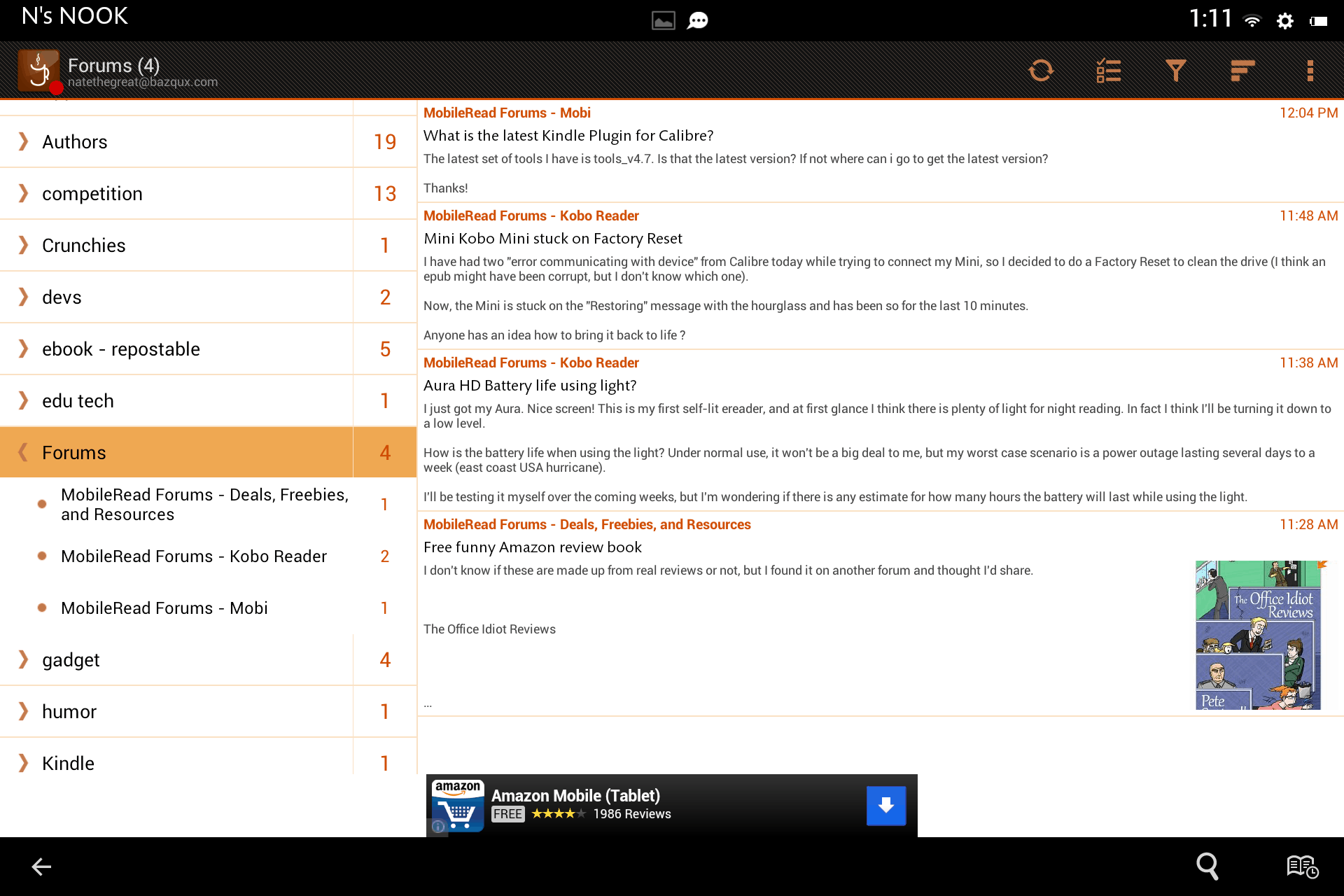
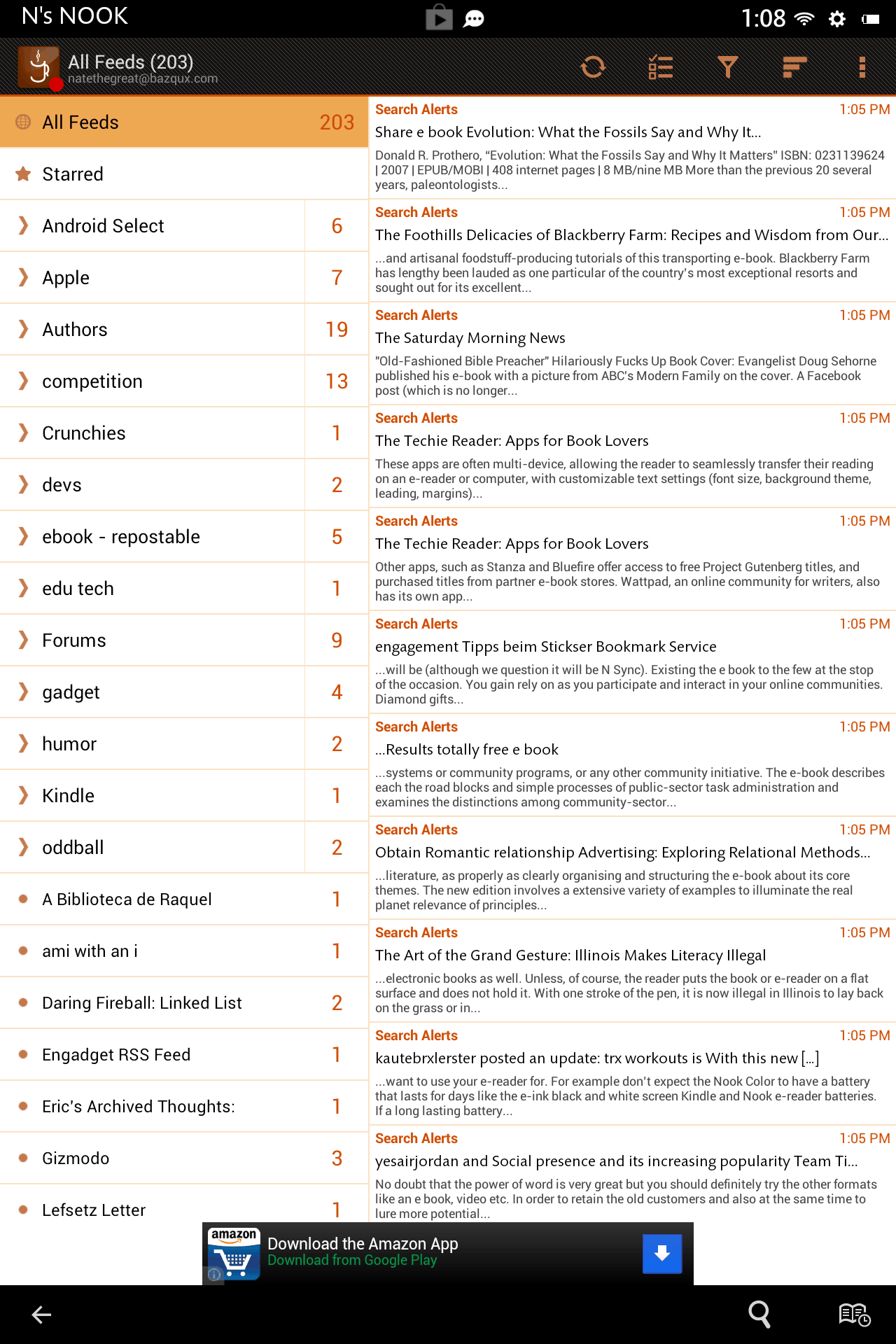
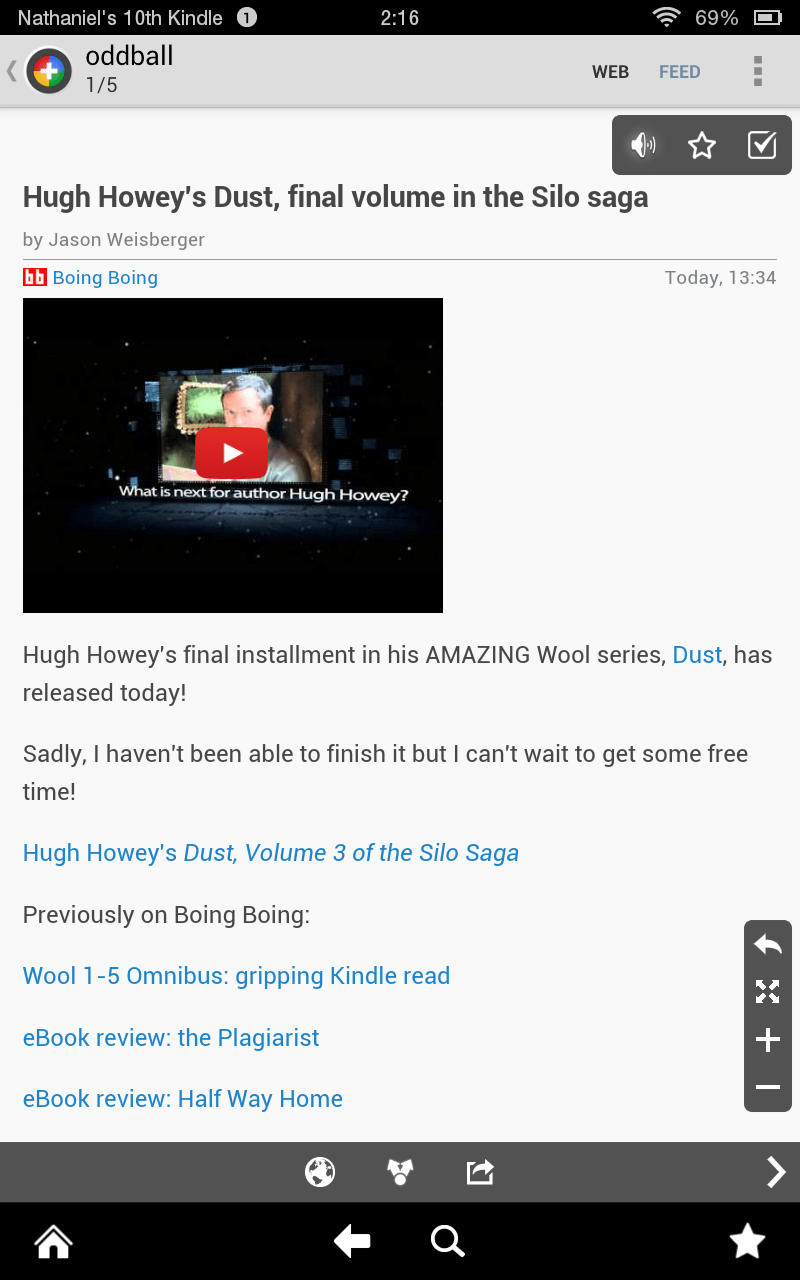
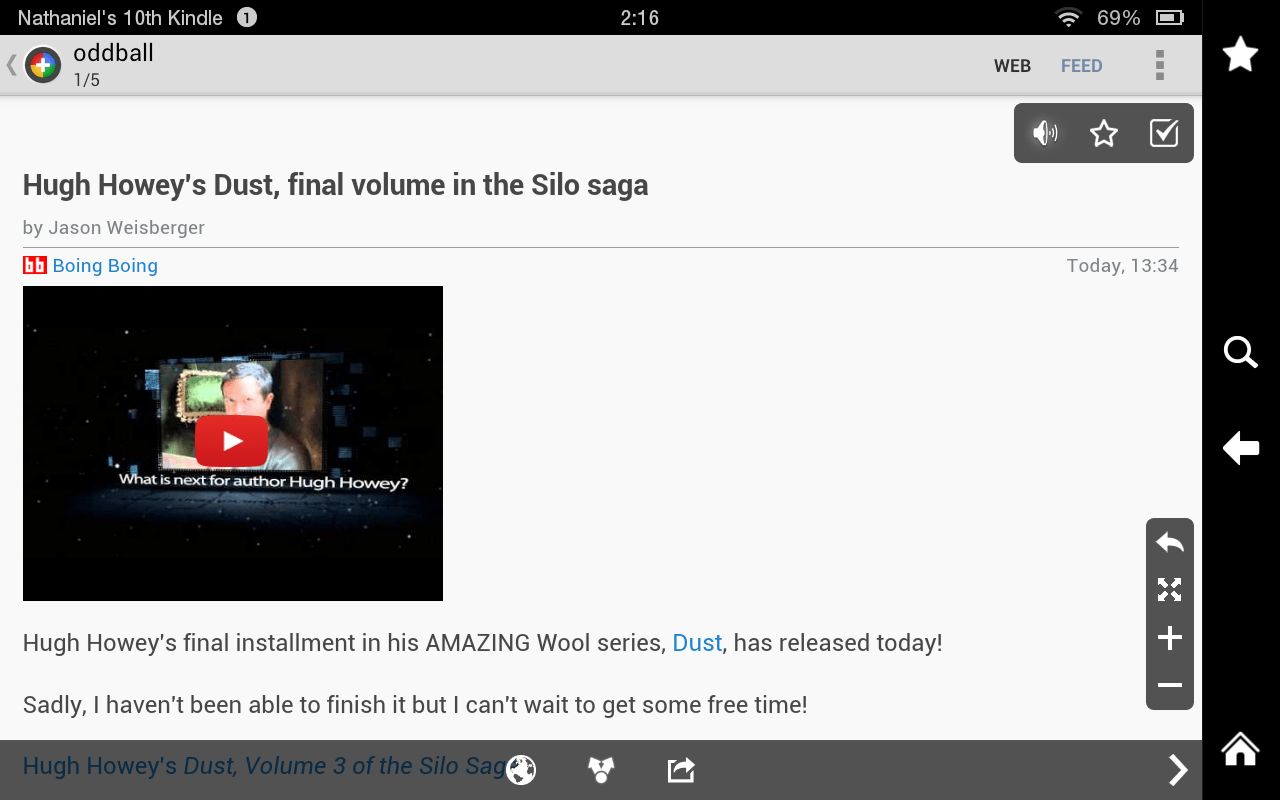
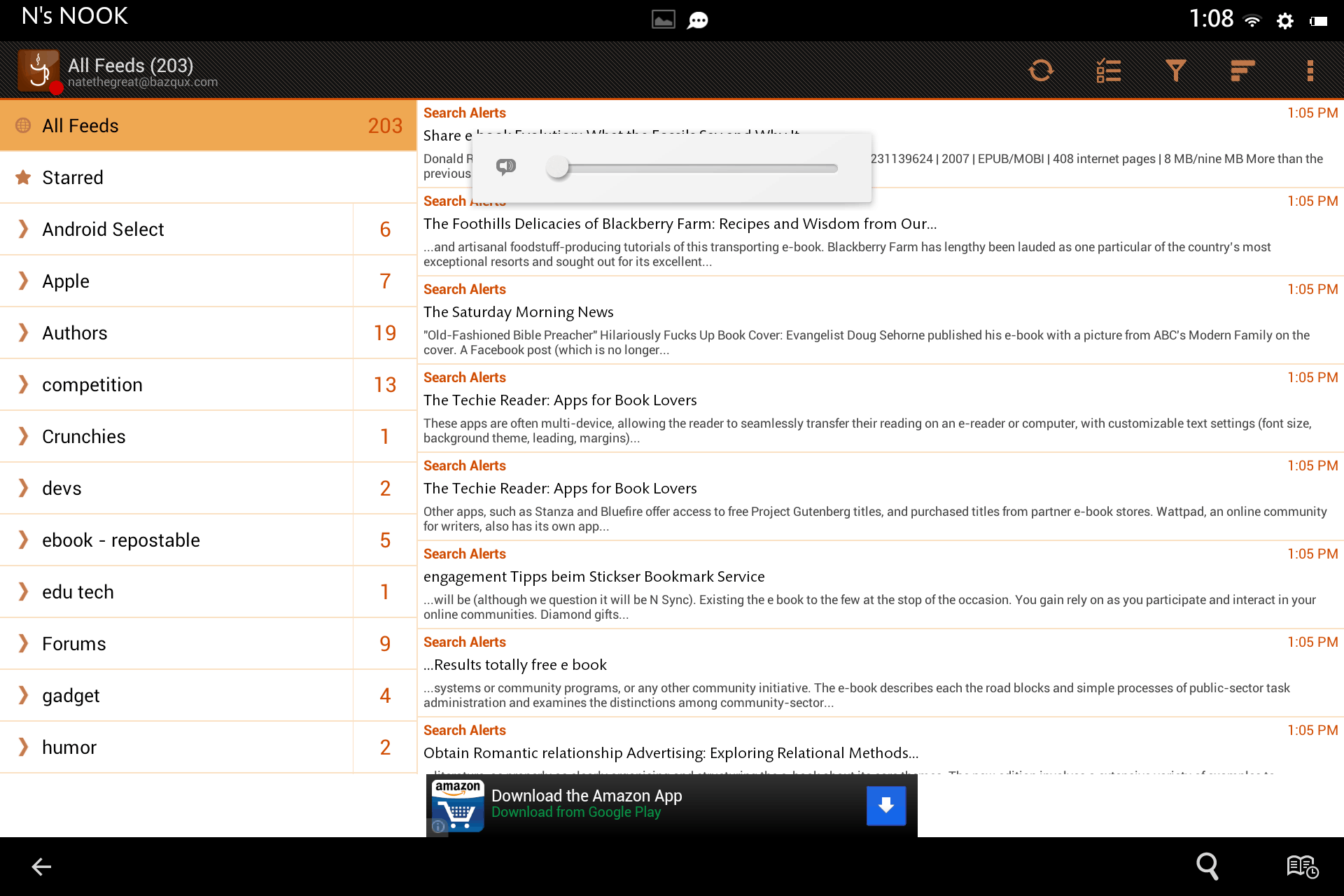
I used the tablet mode to make use of the screen size, but there is also a more linear layout designed for smartphones and smaller screens. The layout and behavior was a little confusing at first, and I discovered that there were numerous ways to view a folder full of feeds.

The screen shots above show just one of the themes available. If burnt orange isn’t your thing (I think it’s ugly) there are less garish options.

Another detail I didn’t show but feel is worth mentioning is that this app can grab the full article (sans ads) from the original source.  I’m reading it with the text bolded (it’s a formatting option) and I like it.

In spite of the confusing design, I think this is a usable app. The ads are not that annoying, IMO, and this app does offer most of the formatting and layout options I want. They are a little hard to find in the settings menu, but once this app was configured it works for me.

NewsPlus

This is an expansion on gReader, the well-known news reader for Android. It is still in beta at the moment, so there is no guarantee that it will work for you. Current news reader support includes BazQux, CommaFeed, NewsBlur, TinyTiny RSS, and there’s a generic extension for Google Reader clones (I don’t know what that is for).

I tried this app on my KFHD. That was good for me because I got to test out the Ivona TTS option (provided by Amazon), and it sounded a lot better than the usual Android TTS.

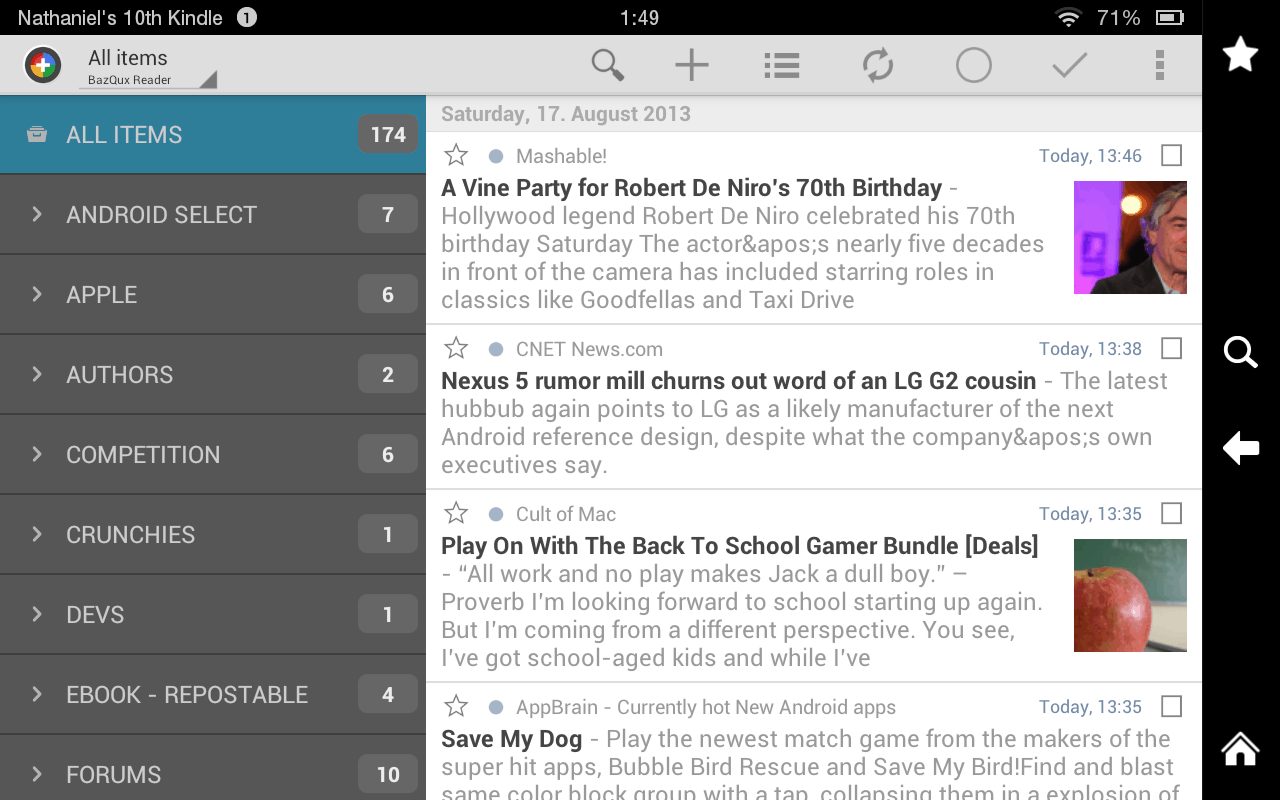
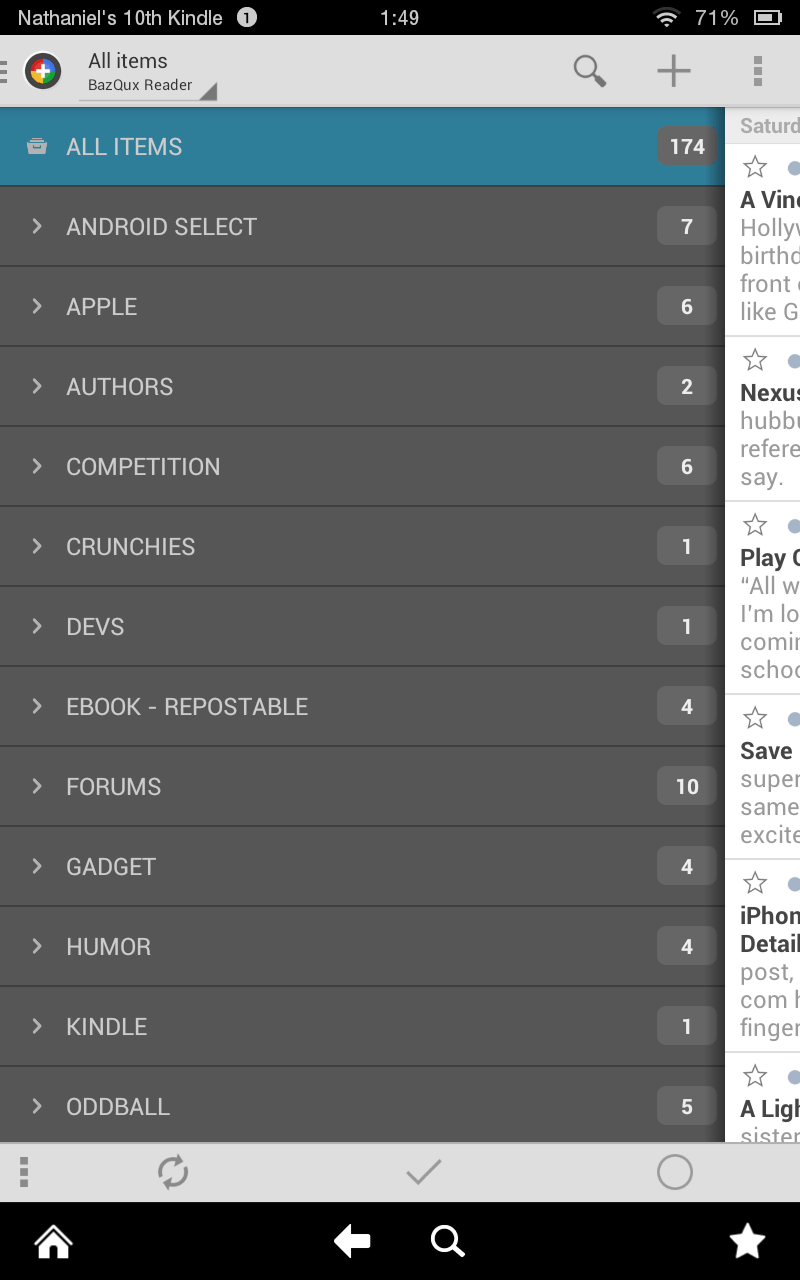
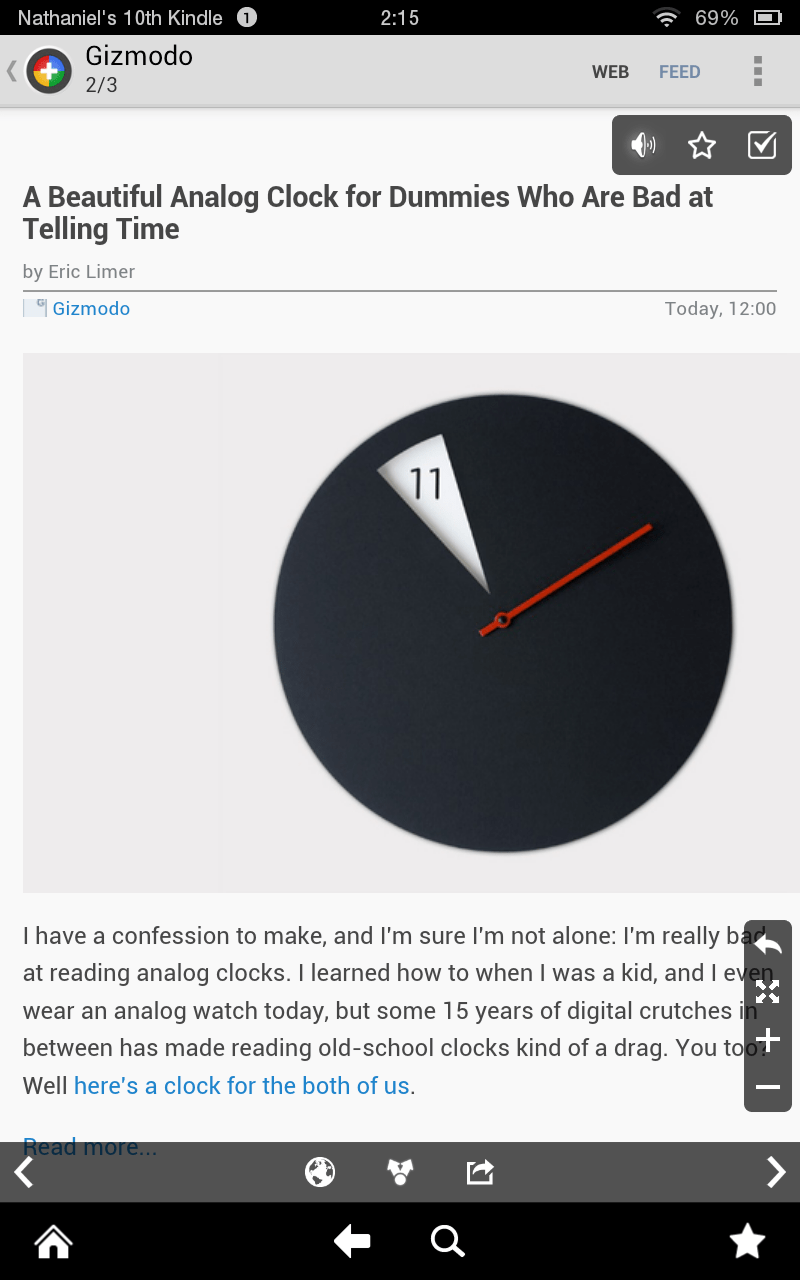
Here’s what it looks like on the KFHD:

There’s also a title only view which isn’t shown, and a "web" reading mode which can pull in the source webpage, ads and all.

This app is still rough around the edges, but it worked fine for me – mostly. Not all features worked.

For example, there’s a checkbox in the settings menu for Google Translate but I don’t see a way to actually use that feature. There’s also a limited variety of themes (including a night mode). And the folder/article list layout in portrait mode doesn’t seem to be a good design (you can’t have both on screen at the same time).

But the offline reading mode appears to work, so there is that.

P.S. If you’re more interested in a magazine style news agragator then you might want to try Taptu, Flipboard, or Zite.

Looking for a Replacement for Goodreads? Try Booklikes

Whether you agree with the new review policy or not, the latest dust-up at Goodreads is inspiring a number of members to go look for an alternative. Some are ending up at LibraryThing, others at Shelfari, and a few are trying a relatively new community called Booklikes.

Booklikes is best described as a Tumblr inspired online book community. In the words of the LATimes, which interviewed the founder back in June:

Its interface is part Tumblr, particularly in two aspects: each user has a blog within the site, and the main dashboard page includes a Tumblr-like feed from other blogs. And it’s also part Goodreads, with a visual bookshelf that users can fill with books they’ve read and add reviews.

I have not had a reason to use Booklikes yet, but LitReactor had this to say when they covered the launch back in May:

The biggest difference between this and the many similar sites out there: BookLikes is geared more toward book blogging and reviews. When you sign up, your Dashboard page features a slew of Tumblr-style posts from various users, who you can decide to follow or hide. I saw a few internet-mandated gifs and pithy blurbs, but this Literary Explorations person offers some astute analysis of book covers and classic reads, so it seems there’s some quality there.

I’ve looked over Booklikes once or twice since it launched and I can see the value in an explicit blog focus – and that goes double after Goodreads latest policy change. Many people are defending the new Goodreads policy against reviewers discussing author behavior by arguing that the topic is beyond the purview of a book review. This is true, but thanks to Booklikes' focus more on blogging and less on book-related reviews it doesn’t matter.

On Booklikes a book reviewers is more of a book blogger, and there is very little that is beyond the purview of a blog post.  If a member wants to write about a theme that shows up in a half dozen unrelated novels, or point out how a character in author’s book is arguably the same character as one in another author’s book, they can.

Booklikes is in effect giving reviewers tools that Goodreads reserves for authors (who can start blogs), and that is probably the first and biggest difference between the 2 sites. If you are a reviewer or reader and you value independence and/or not being a second-class member, I think you should look at Booklikes.

More Reading:

SingTel to Shut Down Skoob eBookstore on 5 November – Back Up Your eBooks

The leading telecom in Singapore announced this week that they are getting out of ebooks.

Singtel is going to stop selling ebooks in their Skoob ebookstore on Tuesday, and they will be turning off the servers on 5 November. Customers are advised to download their ebooks to Adobe DE before the hammer comes down. (And while you’re at it, remove the DRM so your purchases will be safe).

No details have been released to explain the closure, but a SingTel spokesman did say: "Although we have seen steady response to skoob since its launch in Nov 2011, we have decided to focus our resources on other parts of our business where we see stronger growth potential."

Singtel also didn’t offer an explanation to their customers. "Despite a challenging market, we had a great run, and it wasn’t an easy decision to make. We would like to take this opportunity to thank you for your support," said Skoob, in an e-mail to customers.

Skoob was launched a little under 2 years ago, but it never amounted to much.  According to Google Play the Android app has under half a million downloads, a rather small figure when compared to Singtel’s 3.5 million customers in Singapore.

I haven’t mentioned Singtel or Skoob on this blog before; I wrote about them elsewhere. But in retrospect Singtel was an example of a company that would have been on my watch list (along with Sony, Samsung, txtr, Tesco, and others) had they taken a different path into ebooks.

Singtel has 3.5 million customers in Singapore and over 400 million customers in 25 countries around the world. If Singtel had followed the same path as Samsung and launched an ebook subsidiary of their own, then they could have been able to scale its operations to support Singtel’s partners and subsidiaries in a couple dozen countries. This could have put Singtel on the top ten list of global ebookstores, but getting there required foresight and a significant investment.

But as we look at Skoob it’s pretty clear that Singtel didn’t pursue the opportunity. Instead they set up a basic white-label eboosktore. Skoob was powered by Mobcast, the Tesco subsidiary, and that might offer a hint as to why Skoob didn’t take off. Past reports have indicated that Mobcast’s own ebookstore only had around 130 thousand titles. If Skoob had a catalog as limited then I can see why readers went elsewhere.

Skoob probably also failed due to incredibly bad marketing, promotion, or pricing policies.

How bad?

Skoob is pitched in Google Play, iTunes, and elsewhere as offering ebooks "at up to 20% cheaper than hardcopy versions". That alone would stop me from downloading the app, much less browsing the ebookstore.

ZDNet

Straits Times