Goodreads Announces New Content Policy – Now Deletes Reviews Which Mention Author Behavior

Goodreads has long been struggling to decide between the opposing needs of reader/reviewers and of authors, and today the latter group has finally won out.

Goodreads announced a new content policy on Friday. In addition to a few token gestures in support of an anti-bullying policy, this Amazon-owned online community has announced that they will now delete bookshelves and reviews that focus on author behavior:

We have had a policy of removing reviews that were created primarily to talk about author behavior from the community book page. Once removed, these reviews would remain on the member’s profile. Starting today, we will now delete these entirely from the site. We will also delete shelves and lists of books on Goodreads that are focused on author behavior. If you have questions about why a review was removed, send an email to [email protected]. (And to answer the obvious question: of course, it’s appropriate to talk about an author within the context of a review as it relates to the book. If it’s an autobiography, then clearly you might end up talking about their lives. And often it’s relevant to understand an author’s background and how it influenced the story or the setting.)

The reviews  and bookshelves with titles like "Authors Behaving Badly" will be deleted without warning or notice, which IMO as a moderator of Mobileread Forums (since December 2007) is in and of itself unprofessional.

Update: I’ve realized that some parts of this post were written in the heat of the moment and are a tad hyperbolic. I have crossed some sections out because they are a little over the top.

This policy is so one-sided as to be actively hostile to the reader/reviewers that used to be the very reason that Goodreads existed. It won’t have the least effect on authors behaving badly, but it will make it harder for reviewers to tell everyone about the abusive behavior.

This new policy gives abusive authors carte blanche to be jerks elsewhere (twitter, FB, email, blogs), but it removes one of the better ways that reviewers can share knowledge about authors behaving badly.

In fact, let me give you an example of the shenanigans that an author can now pull outside of Goodreads.

Back in April I wrote a post about Anne Rice siccing her fans on a reviewer. My post would not be allowed on Goodreads because it discussed an author’s behavior, but it is entirely relevant to whether you or I might want to read Anne Rice’s novels.

And if that doesn’t convince you, consider some of the comments left on this page on Goodreads. The commenters point out that the author was using the book to stalk a girl he was obsessed with. If these were reviews, they would be deleted even though they validly influence my buying decisions.

And in case you’re thinking that this will stop authors from being bullied, you’re wrong. This content policy will have only the slightest effect on reviewers bullying authors; at best the negative behavior will be moved offsite.

Also, there is an order of magnitude difference between deleting bullying reviews and deleting all reviews that focus on an author’s behavior.  One could be covered under a general anti-bullying policy, while the other oddles authors goes too far.

Update: Here’s a comment I left in response to a reader. I think it offers a more reasoned argument.

This new policy throws the baby out with the bathwater.

It is an orthogonal solution that solves a small part if the bullying issue but then continues on to mess with all sorts of other unrelated issues that aren’t problems. This policy affects more content than just what the bullies post to harass authors, and I object out of principle.

Does GR have a bullying problem? Clearly. But the root of the problem is that GR isn’t moderating the behavior of the community and the site has turned toxic. Fix the lack of moderation and fix the toxic nature of GR and GR won’t have to remove reviews that comment on author behavior. Or if they do it will be because a particular example was bullying, and not just a commentary on an author’s behavior.

I am all in favor of fixing the bullying problem but that would involve real work in making GR members behave. That means more staff which would require more money than simply deleting reviews.

And to make matters worse, Goodreads has already started deleting reviews and bookshelves with absolutely no notice or warning. The very fist comment on the announcement, which was posted a mere 13 minutes after the announcement, reported that:

Goodreads has already started deleting reviews and shelves they deem to go against this new rule without giving any warning whatsoever. No one has been given a grace period to perhaps save their reviews or move them. GR just outright deleted them.

Even if your shelf can be misconstrued to be negative towards authors, it will be deleted.

TBH, I am not surprised. Goodreads has been moving towards a pro-author/anti-reviewer policy for well over a year now. I can recall reading criticisms of it as early as last July. Here’s an excerpt of a blog post I published at the time:

But I’ve lately been looking over a series of blog posts (one, two, three, four) by Dear Author reviewer and blogger VacuousMinx concerning some friction that arose in recent months between reader-reviewers and the authors who are also encouraged to use the site. As a result of this friction, Goodreads has recently issued new guidelines, which are unabashedly a lot more favorable toward writers than readers. It seems Goodreads has a pretty clear idea on what side its bread is buttered, and if you’re a reader that bread is always going to land buttered-side down.

…

In short, the reviewer guidelines seem rather harsh, filled with “thou shalt nots”. The author guidelines are filled with friendly suggestions. Where reviewers are warned that Goodreads will delete reviews that are not “appropriate or a high enough level of quality” (though without any specific details supplied as to what criteria they use for judging), authors are told that it’s “not advisable” to spam the people who read or added your book because that might result in getting flagged as a spammer. And if authors are flagged as spammers, Goodreads “will have to take action.”

In light of last year’s policy changes, today’s news really comes as no surprise.

It’s sad, disappointing, and makes Goodreads considerably less useful as a resource for readers, but it is not a surprise.

P.S. Does anyone want to take a bet on how long it will be until Goodreads decides to delete comments that discuss an author’s behavior? I say 6 months.

image by danxoneil

Notion Ink Quietly Releases New Android Tablet, And It’s No Adam II

Many a tech blogger is eagerly awaiting this high profile gadget maker’s second Android tablet, and I think most will be disappointed by what I just found.

A new Notion Ink tablet has shown on Indian retail websites. It looks nothing like the Adam II tablet with its 10″ LCD screen and an auxiliary  grayscale screen; in fact the new tablet looks like pretty much every other generic Chinese Android tablet I’ve seen.

The NIMBX tablet is running Android 4.1.1 on a dual-core 1.5GHz CPU with 1GB of RAM, 8GB of storage, microSD card slot, Wifi, and Bluetooth. It also has a pair of 2MP cameras, a 10.1″screen (1280×800), speaker/mike, USB host, HDMI out, and a 6Ah battery.

All in all this is a rather unimpressive tablet, and it is going to be selling for an unimpressive 10999 rupees, or about $177 USD.

This tablet looks nothing like Notion Ink’s first tablet, the Adam, nor does it look like the Adam II. That tablet has a much blockier design with sharp corners, squared off edges, and a cool secondary display.

But the NIMBX does have very similar specs to the Adam II.  It has the same screen resolution, CPU, storage, and cameras. In fact, aside from the shell this is essentially the Adam II.

The similarities in terms of hardware specs make me think the tablet shown above could be a design that Notion Ink licensed with the intention of turning it into the Adam II. If it is then it was going to get a new shell and would likely also have customized software.

The Adam II will also have a secondary display. I still don’t know the resolution but the screen will be based on STN screen tech (an old monochrome type of LCD):

But I’m not so sure that the NIMBX is going to become the ADAM II. Notion Ink’s flagship tablet has gained its CE certification, bringing it one step closer to being sold in Europe, only I don’t think it’s going to have specs similar to the NIMBX.

I don’t have any current info on the Adam II, but I would bet that Notion Ink will upgrade the specs before they ship it. The Adam II was announced in May 2013 and at the time it had so-so specs, but now the hot tablets all run quad-core Tegra CPUs or Snapdragon CPUs. they also have screen resolutions twice as sharp as the 1280×800 mentioned above.

Adam II used to be a hot name, but the specs now place it firmly among the budget tablets. Notion Ink will have to do better if they want to charge a premium price for the Adam II.

MobileRead

Bookeen to Launch 8″ eReader – the Cybook Ocean

The French ereader maker Bookeen is back in the news again today with new details about their next ereaders. In addition to a lower priced Cybook Odyssey, Bookeen also plans to launch a new 8″ ereader.

The new device is going to be called the Cybook Ocean, not the Cybook XL (the name Bookeen teased on their blog some months back). It won’t have the Ultra-HD E-ink screen that I suggested might exist, and in fact it won’t even have an E-ink screen.

Details are still limited on the Cybook Ocean, but I do know that it has an 8″ screen with both a touchscreen and a resolution of  1024×768. My source indicates that this is not an E-ink screen at all, and that suggests that the Cybook Ocean is using a screen from Ganzhou OED technologies.

A similar 8″ screen is being used on the Pyrus Maxi, teXet TB-138, and the Icarus 8. I don’t have any performance details yet, but I can see from the E-ink website that 8″ is not a screen size that E-ink has on hand for sale.

The Cybook Odyssey Ocean will have 4GB Flash storage, Wifi, a touchscreen, and a frontlight. It is expected to ship in November with a retail around 160 euros, and weigh 295 grams.

That retail price is 20 to 30 euros more than the competing 8″ models on the European market, neither of which have a frontlight or a touchscreen.

—

In other news, Bookeen is also going to launch a cheaper version of the Cybook Odyssey. This ereader will have 4GB of storage, not 2GB, and it will have a touchscreen and an improved frontlight. But it won’t have the HD- E-ink screen on the current Odyssey. It’s also projected to cost 99 euros.

lesen.net

eBook Sales Down Almost 4% in the First Half of 2013, AAP Reports

Here’s a story I never wanted to write.

The AAP has just released a new sales report today. The report covers the first half of this year and is based on data provided by 1196 US publishers, and it shows that the overall US book market was down 6%, largely due to kid’s books and adult paperbacks, while the ebook market dropped by 3.6%.

Participating publishers reported a total of $3.1 billion in book sales, down from $3.3 billion for the same period past year. This includes a 1.1% drop in adult book sales ($2173.6 million vs $2196.8 million), a 22.1% drop in the YA segment ($644.5 million vs $827.2 million), and a slight increase in sales of religious books ($276.3 million vs $274.7 million).

The drop in sales in the kids segment is probably due to the lack of a blockbuster title on the same scale as last year’s The Hunger Games; the release of the movie caused a spike in book and ebook sales that distorted the market. That spike had affected previous reports and is still distorting the market.

Moving on to digital, total ebook and audiobook sales (across all segments) decreased by 3.6%  for the first 6 months of 2013 ($828.4 million vs $860 million). Audiobook sales were up, and ebook sales were up in most segments, but thanks to The Hunger Games the total reported ebook sales dropped.

Seriously, the YA ebook segment dropped by almost half ($83.7 million vs $153.7 million) and dragged down the total report.

But in spite of the bad news there is a silver lining. The spike in sales last year was caused by kids seeing the movie and then reading the ebook. That represents millions of kids reading, and I can live with that.

On a related note, ebooks continue to account for a larger percentage of the adult segment than paperback books ($635.1 million vs $647.7 million). That trend has been around since at least the first quarter of this year, and possibly even earlier.

P.S. Here is the source data I worked from. Enjoy.


New Tax Rules in the EU Will Wipe Out Amazon’s Tax Loophole

Starting in 2015 the European Union is going to change the rules for tax collection, and the new rules are probably going to help level the playing field in the European ebook markets.

According to the Luzme ebook blog (and confirmed on an official EU website), European web retailers are going to have to change how they collect VAT for electronic services (this includes ebooks) sold to EU customers. The retailer is now going to have to charge customers based on where the customer lives, and not where the retailer operates.

That is going to make things more complicated for a lot of small businesses by requiring that they track and collect numerous tax rates, but it is also going to eliminate one of Amazon’s advantages in the European ebook markets.

As you probably know, Amazon has been running their EU ebook operations out of Luxembourg so they could take advantage of the low tax rate that the Grand Duchy collected on ebooks and digital services. Luxembourg only collects a 3% VAT on digital services like ebooks – far less that the 15% to 20% tax rate found in most EU member countries. This tax rate is in fact low enough that it has been described as illegal under EU regulations, though I don’t know that any action has been taken against Luxembourg.

Amazon has been taking advantage of that tax loophole for a couple years now, and so have a number of other companies including Kobo, Apple, Google Play, Bilbary, etc. If the new rules take effect then they all will lose this advantage in another 15 months.

TBH I’m not sure Amazon will be impacted all that much; they’ll just pass the costs along to customers. But Amazon’s smaller competitors might feel the weight of extra paperwork. Luzme reflected on this, and they raised several good points:

And at the end of the VAT quarter, do we pay those amounts separately to each countries’ equivalent of our HMRC? Or pay it just to the UK HMRC? Who knows? Apparently, full guidance on this hasn’t been issued yet. Which makes it rather hard to implement…

What madness is this! Wasn’t the point of the EU to make it easier to do business with each other? not more complicated?

In which case, why have they decided to make it so much easier for a non-EU company to sell into the EU market; than for someone to do it from within?

Updated: Where Amazon Will Expand the Kindle Store Next

Amazon has gotten a lot of criticism over the past year as a result of the limited language support in the Kindle Store and they’ve taken it to heart.

I’ve just learned that Amazon has quietly added new languages to the supported languages list. They haven’t added every language nor the most widely read ones, but Amazon has added numerous languages spoken in some of the Kindle Store’s core markets as well as ones spoken in markets where Amazon could be planning to expand.

For example, the Kindle Store is going to better support the UK with the addition of Scots, Scottish Gaelic, Welsh, Cornish, Manx, and Irish. No, Ireland largely isn’t part of the UK but I would think that this language is read in Northern Ireland. Also, support for Irish might be a sign of Amazon’s expansion plans.

France is also going to be better supported by the addition of Breton, Corsican, and Provencal, while Germany benefits from the addition of Alsatian as well as Frisian, Northern Frisian, and Eastern Frisian (unless this refers to the language spoken in Scotland). And of course the Kindle Store already supported Basque, Catalan, and Galician, 3 languages spoken in Spain.

Amazon has also taken the opportunity to fill in some of the gaps in the Kindle Store’s support for European languages. The Kindle Store now supports Luxembourgish, Danish, and Romansh. This last is one of Switzerland’s 4 official languages, which just goes to show that it is not as dead as everyone says.

Amazon has also added support for Dutch, Swedish, Finnish, and both Nynorsk Norwegian and Bokmål Norwegian. And moving beyond Europe, Amazon has also added support for Icelandic and Afrikaans (spoken in South Africa).

All in all, this is rather spotty coverage that leaves out Italy, eastern Europe, and large swaths of Asia, Africa, and South America. But for an unannounced expansion it is still a good first step.

Adding support for more languages is more difficult than simply flipping a switch, and that’s part of the reason why I would have sided with Amazon when they were criticized earlier this year. Before the Kindle Store can sell an ebook in a language, Amazon has to first guarantee that the Kindle platform will display it properly. Amazon also has to set up a procedure for verifying customer complaints about formatting and other content issues. The technical issues can be resolved, but it takes more than waving a wand.

And when we accept that Amazon had to make an effort to add more language support it brings up a related question: Why these languages in particular?

I think Amazon may have tipped us to their expansion plans. The last time Amazon added support for new languages was with the Kindle Paperwhite in 2012, which was shortly followed by the launch of the Kindle Store in China and Japan. And in 2011 the addition of Portuguese, Italian, and Spanish presaged the launch of Kindle Stores in Italy, Brazil, and Spain.

I think the new support for Dutch, Danish, Swedish, Finnish, Icelandic, and Norwegian is an indication that Amazon sees growth potential in the related countries. The addition of Afrikaans only reinforces that impression. It’s not clear that Amazon will launch local Kindle Stores in those countries, but I do think that Amazon sees growth potential that no one else has noticed yet.

—

Update: A reader called me on that last sentence and inspired me to go look at where Amazon’s competition is already selling ebooks. There’s an interesting correlation between the list of languages below and where Kobo and Google Play Books already have local ebookstores.

For example, Kobo is the only international ebookstore to have a presence in South Africa, where Afrikaans is spoken. Kobo has a Dutch ebookstore, and Google Play Books is available in Belgium, Netherlands, Ireland, Sweden, Denmark, and Finland. (It’s available in quite a few more countries but I am only looking at the ones that Amazon now supports via a local language.)

Just about the only countries on this list where Amazon doesn’t already have a local competitor are Iceland and Norway, and I think those 2 were added so Amazon could make a clean sweep of Nordic countries.

I am now convinced that the new supported language list in KDP tell us where Amazon plans to launch local Kindle Stores that will sell ebooks in local currency. While that might sound crazy, I think Amazon will launch local Kindle Stores in all of those countries for the same reason they launched in Brazil, India, and Mexico: because a competitor was either already present or about to launch.

Amazon launched in Mexico about 5 months after Google Play Books. Amazon, Kobo, and Google all launched in Brazil on the same day. And in India Amazon launched a local Kindle Store in Amazon.in about 4 months after Google Play Books launched in India.

I will not make a claim that Amazon is copying or that its smaller competition is launching in anticipation of a local Kindle Store; I think both possibilities are true in one case or another. But I do think all of these countries will get local Kindle Stores.

—

P.S. According to the IA’s Wayback Machine, the list of supported languages was updated some time in the past month. Here’s the complete list:

• Afrikaans
• Alsatian
• Basque
• Bokmål Norwegian
• Breton
• Catalan
• Cornish
• Corsican
• Danish
• Dutch
• Eastern Frisian
• English
• Finnish
• French
• Frisian
• Galician
• German
• Icelandic
• Irish
• Italian
• Japanese
• Luxembourgish
• Manx
• Northern Frisian
• Norwegian
• Nynorsk Norwegian
• Portuguese
• Provençal
• Romansh
• Scots
• Scottish Gaelic
• Spanish
• Swedish
• Welsh

Hands On With the Alcatel One Touch Hero’s E-ink Cover

When Alcatel announced the  One Touch Hero smartphone a couple weeks ago everyone wrote about the E-ink cover accessory but no one had photos to show off – not even me.

But that’s okay, because today I have something better. Charbax spent some time with an Alcatel rep and he caught the E-ink cover on video. The rep showed off a functional prototype, and it’s pretty cool.

As you can see in the video, the E-ink cover attaches to the phone with a magnetic "smartcover" type of connection. The phone and cover communicate over that connection as well as Bluetooth.

The One Touch Hero has a 6″ LCD screen, and the E-ink screen is 5″ in size. That second screen isn’t plastic backed, but the rep did say that it is coated with an impact resistant acrylic called PMMA.

The rep tells us that Alcatel is planning to add support for third party apps but that is still in the future. At the moment the cover works with a reading app, iReader, that can push ebook contents to the E-ink screen. There’s also a clock and weather app that will work with the E-ink screen, but they doesn’t quite work yet.

The cover doesn’t have a touchscreen, so you would have to use the volume buttons to turn the page. As you can see in the video, the page turn speed is reasonably fast.

This phone is going to run Android 4.2 when it is released later this year. In addition to the E-ink cover, the One Touch Hero also has a 1.5GHz quad-core CPU with 2GB of RAM, a 13MP rear camera, a 2MP front-facing camera, a microSD card slot, an optional pen, and either 8GB or 16GB Flash storage.

The One Touch hero is expected to ship in October with an undisclosed price tag.

B&N to Ship New Tablet, eReader in October, Sources Say

Aside from constantly lowering the price and changing their minds on production decisions, Barnes & Noble hasn’t gotten much press for their hardware these past couple months. But that is about to change.

Two different sources inside B&N have independently told me that Barnes & Noble has new hardware launching next month. For obvious reasons I cannot tell you their names, but I can say that the reports agreed with past leaks and included enough detail to convince me.

One of my sources works at a B&N store, and they said that a new tablet is launching in October. He caught sight of a memo which mentioned specifically a tablet (and not just a device). The memo didn’t include details on the launch date, unfortunately, but my source also told me that their store was projected to have higher digital sales in October than previous months.

I was also told that the expected increase in sales was large enough that it very likely indicated a tablet. Past ereader launches didn’t generate as large of a jump in sales, or so I was told.

Or perhaps I should say that an ereader launch alone wouldn’t be enough to generate the expected spike in sales, because my other source has indicated that B&N is launching a tablet and an ereader in the next few weeks.

Again, I don’t have specs (yet), but I was told that the launch is expected to happen before 1 October, which would tie in quite well with past leaks.

As you probably recall, in early August I posted about 3 leaked product listings for accessories for new Nook models. Those leaked product listings said that the accessories would be available by 1 October which is only 2 weeks away. My source at the time expected them to be called the Nook SW and Nook AV, but I thought those were code words – SW being short for Nook Simply White and Nook AV (audio/video) indicating that it was a tablet.

That is just speculation, but at this point I think there is a greater than even chance that the rumors are true. Even B&N has said that they will launch new hardware; the only thing we didn’t know for sure was when or what kind.

But now that I have 3 different sources of info, I would say that the launch is a near certainty.

Nook Aura HD, anyone?

P.S. If anyone has info they would like to leak or rumors they would like to share, feel free to leave an anonymous comment. As you can see I do not reveal my sources.

E-ink Equipped Yotaphone to Ship in Europe in November, Will Cost 500 Euros

It’s been some 9 months since we got our first look at the Yotaphone, the first smartphone to sport an E-ink screen and an LCD screen, and finally I have a firm ship date for this device.

A couple German gadget blogs are reporting that the Yotaphone will cost 500 euros when it ships some time in November. This smartphone was somewhat delayed from its initial planned release of Q3, but this is not unusual for hardware launches.

This smartphone caught everyone’s attention back in December because it has not one but 2 screens. On the back of the device is the usual LCD screen found on most smartphones, while on the front you will find an E-ink screen.

The production model (not to be confused with the demo units shown off in videos) is going to run Android 4.3 on a dual-core 1.7GHz Snapdragon S4 Pro CPU. It will ship with 2GB of RAM, 32GB of storage, Wifi, BT, GPS, a 12MP camera, GLONASS, and LTE. The 4.3″ LCD screen will have a screen resolution of 1280 × 720, while the E-ink screen will also measure 4.3″ and sport a resolution of 640 × 360.

The Yotaphone has been one of the hot gadget stories of 2013, but it’s not the only device of its kind any more. Over the past 6 months we have seen several aftermarket smartphone cases that offer an E-ink screen feature similar to the Yotaphone, including ones from Gajah, Pocketbook, and Alcatel. The Gajah case should be on the market by now, but it is only available in China.

Or, if you wanted to forgo the LCD screen, you might want to wait for the Onyx Boox smartphone. This is the product of a Chinese gadget maker which has turned its expertise with E-ink equipped ereader to developing a smartphone with an E-ink screen. The Boox smartphone is still under development, and it is expected to be available for license later this year.

golem.de

techstage.de

I Really Like Oyster (But)

So a new Netflix for ebooks launched last week. Oyster promises access to a 100,000 title catalog for only $10 which includes titles from some major publishers.

Oyster delivers on that promise. I finally got around to trying it today, and I love it.

In the course of one afternoon I found several months (at least) worth of reading material, and I was perilously close to committing to subscribe for the indefinite future. But I won’t. In spite of all its greatness Oyster still has a single huge shortcoming:

There’s no Android app, nor any firm plans to release one.

There’s also no iPad app, though the iPhone app will run (poorly) on my iPad. The iPad app is scheduled to be released "this Fall", but since I don’t own an iPhone I really have no way to use Oyster.

But a lot of people own an iPhone, so rather than simply write off Oyster abruptly I will take a deeper look at the service. When you look at this kind of service, you need to evaluate it on 3 criteria:

  1. Selection
  2. Cost
  3. Platform Support

When Juli Monroe wrote up her review of Oyster yesterday she put cost first, but I am largely skipping it because the cost of Oyster is not a major stumbling block.

Content

The selection of reading material is great. I mostly read SF, and I found months and months worth of reading material. I spent about an hour this afternoon adding content to my account, and I quickly put together a reading list of more ebooks than I could read in several months. And I wasn’t even done trolling the SF section, so even assuming I got bored with everything half way through I would still have plenty left to read.

Sure, about 5% to 10% of the selection was public domain titles, but I still managed to put together a long reading list. I found the $10 a month to be well worth it, given the selection.

Of course, just because I put together a reading list today doesn’t mean I will still have the entire list tomorrow. This is a Netflix for ebooks, and that means there’s a good chance it will suffer the classic Netflix Problem at some point when one publisher or another decided to pull a title.

Disappearing content might not be an issue today but 6 months from now, who knows? This is what eventually led me to cancel my Netflix account, and it’s not impossible that Oyster mught have similar problems.

Platform Support

I would be paying the $10, if only the Oyster website and app were better designed. Oyster is only available on the iPhone, which is a serious problem given that I am wedded to Android. While I was able to test the iPhone app on my iPad, I don’t really like reading on my iPad. I want to read on Android.

But it’s not just that the reading app isn’t available on Android or in your web browser (I don’t see why not). There’s a second issue with Oyster which turns me off, and that is the fact I cannot manage my reading list via the Oyster website. It can only be done via the iPhone app. I think it would be better all around if we could manage our reading lists on the website. Being able to read on the Oyster website would also be a plus, though I won’t be greedy.

I also don’t like the design of the iPhone app. The interface for searching its catalog is not well designed and not obvious. Sure, I was able to guess how to navigate, but at first I sat there baffled before touching different elements at random to see what would happen.

That is a symptom of a bad design, and while the flaws are subtle they are going to be a subconscious nuisance to users.

And then there is the limited support for reading features. Oyster chose to develop a custom reading app (unlike their competitor Entitle, who licensed apps from Bluefire).  It’s a very basic app. It’s so limited that you can’t even change the page turn gesture. Your choices are either an upswipe (that’s weird given that I have never seen another reading app using a similar gesture) or tapping the lower corners.

The Oyster app is limited to 5 color themes and changing the font size. There’s no bookmarks, dictionary, annotation ability, or sharing options, and that is going to further limit the usefulness of this service.

Then again, there’s no Android app so this doesn’t really matter to me.

Thoughts?

Narrative Science raises $11.5M – Wants to Put Tech Bloggers, Content Farms Out of Work

Tech pundits often write about how a new tech disrupts an existing industry, and if Narrative Science is successful we’re going to be hoist by our own petard.

This 3-year-old startup announced today that they have raised $11.5 million in a series C funding round. This is their second round of financing this year, and it follows the CIA-backed venture capital firm In-Q-Tel investing in Narrative Science in June. This firm also went through at least one previous round of financing in January 2011, where it picked up $6 million.

Narrative Science has been working for the past several years to develop algorithms that can replace basic reporting. It’s been working with a number of news sites, including some as high profile as ABC and Forbes.

These news sites have been using Quill, the company’s automated authoring platform, to turn basic statistics into news articles. Quill combines data analytics with artificial intelligence to transform data into narratives and insights, freeing writers from having to write the same basic article for each financial report or analyst’s prediction.

GigaOm


How to Turn Turn your Kobo eReader into a Linux Tablet

Bord with your Kobo ereader? While you could make it the guest of honor at a skeet shoot, one hacker has found a better solution.

There’s a new post over on MobileRead today that detail the steps needed to install Debian Linux on a Kobo ereader. With a little bit of luck and a fair amount of technical know-how, you can create a one of a kind Debian tablet.

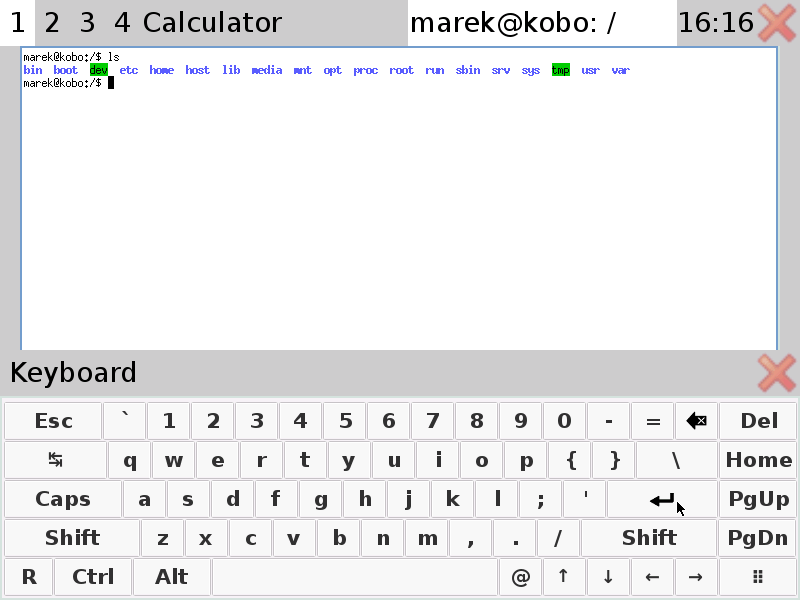
Marek, the Linux developer who has done most of the work, reports that he has gotten this project to work on a Kobo Touch and a Kobo Mini. He’s been working on it since the middle of August, and he’s posted proof of concept screenshots which show that FBReader is running:

Yes, I know that the screen shot is in color and the Kobo hardware has grayscale screens. The driver software for the screen hasn’t been modified yet; it still thinks it’s dealing with a color screen.

Other MR members have also been trying Marek’s early work. One has confirmed that this project almost works on the Kobo Glo. It had screen resolution issues but that is probably fixable.

Marek has also gotten other apps to work, including a web browser, Solitaire, and a calculator:

MobileRead

Pocketbook Unveils New Smartphone Case With 4.8″ Plastic Logic Screen

Remember that new case for the Galaxy S4 which was unveiled yesterday? The press release hit my inbox this morning with some of the technical info.

It turns out that this is a lot more interesting than I expected. The new case isn’t a Samsung product like I had first assumed, and the name of the product isn’t "Pocketbook".

No, that is the manufacturer.

This new case is called the CoverReader, and it is a new product from the Ukrainian ereader maker Pocketbook. I don’t have details on the screen resolution yet, but I do know that this isn’t an E-ink screen.

The 4.8″ screen is made by PlasticLogic, makers of the ill-fated Que ereader. It looks they found a new use for their screen tech, and it’s one where their tech is actually better suited for the purpose than an E-ink screen. Plastic Logic’s screens have a range of benefits – such screens are flexible, shatterproof, ultra-thin, ultra-lightweight, power saving and daylight readable.

Update: It looks like Plastic Logic’s press release may have gotten ahead of itself. This first model has a glass backplane with an E-ink screen, not the plastic backplane that Plastic Logic is famous for. That means that the first CoverReader units won’t be nearly as sturdy as the later units.

Unfortunately, I don’t have the more important details like price, release date, or screen resolution; they weren’t shared by Pocketbook. But I do know that Plastic Logic will be making the new 4.8″ screen in their Dresden manufacturing facility.

Update: This case is expected to be released in October 2013 with a retail of 99 euros. I can confirm that the secondary screen uses the CPU and battery of the smartphone and cannot operate without it. I can also tell you that Pocketbook plans to release other cases for other smartphones including ones not made by Samsung.

 The-eBook.org

Pocket Launches New App for Chrome, Windows

Pocket is no longer satisfied to simply capture your attention on Android, iPad, OSX, and iPhone, and today they’ve launched a new app for Chrome.

The app brings all your favorite parts of Pocket’s Android and iOS apps, including offline reading with zero distractions, streaming video, and more. It runs as a standalone app (Chrome is required for Windows), and it can be set to automatically download your reading list so it can be read offline.

This app is built on Google’s new Chrome Apps platform, and it makes use of Google’s efforts to offer more offline features for Chrome. Yes, folks, you read that right. Google has conceded that web-only simply doesn’t work. It took them 5 years to realize that web apps are great but access cannot be guaranteed.

As you can see in the screenshot, the app offers a clean layout similar to the OSX app with a similar full-screen experience.  And like the OSX app, Pocket for Chrome ties into your existing Pocket account so that you any articles or video you save with another Pocket app or bookmarklet can then be viewed in the Chrome app.

Chrome Store


Kobo’s New "Premium eReader" Went From Cutting Edge to Out-of-Date in Only a Week

If you pre-ordered Kobo’s newest ereader because it was a premium device, you might want to rethink that decision. E-ink announced new screen tech today and the Aura doesn’t have it.

I have just received confirmation that the early hands on reports were correct. E-ink’s 4th-gen Carta screen tech wasn’t used in the Aura; it can only be found in the not-yet-released Kindle Paperwhite.

It was pretty clear when Kobo launched the 3 new Android tablets and the new Aura ereader last week that the 3 tablets in question had unremarkable specs compared to what is currently on the market and weren’t really worth waiting for, but the Aura got quite a bit of favorable coverage:

  • Courting All Bookworms, Kobo Debuts 3 New Reading-Friendly Arc Tablets, A New Aura E-Reader, And A Plan To Gain An Edge Over Amazon (TechCrunch)
  • Hands On With the Super-Light Kobo Aura E-Reader (Mashable)
  • Kobo Aura: New Kindle competitor sports classy design, higher price (CNET Reviews)

Sadly, for Kobo, the $149 Aura is now going to be overshadowed by the new Kindle Paperwhite, which retails for $119.

The 2013 Paperwhite is due out at the end of the month, and at this point it looks like it will be the only ereader with the new Carta screen tech. (TBH, without the new Carta screen I didn’t think even the Paperwhite was worth upgrading to. )

The Paperwhite has the same screen resolution as the Aura, and both have frontlights and touchscreens, but the Paperwhite will offer a greater contrast and a more reflective screen while still making use of the latest improvements that E-ink has made in providing smoother page turns.

And to make matters worse, the Paperwhite can be had for $30 less (with ads). Just about the only hardware advantage that the Aura has now is that it has more storage and a microSD card slot.

At this point the Aura is beginning to look more and more like an incremental improvement upon the Kobo Glo. It has a faster CPU, improved frontlight, and better screen refresh tech, but it also has a higher price tag.

Kobo was talking this past week that they had a plan to get an edge on Amazon. I wonder if launching unimpressive tablets and an ereader that used last year’s screen tech was part of the plan?


I reported on the new E-ink tech in another post. That post was neutrally worded. This one expresses an opinion, so I posted it separately.

And while I did read that hint last week, i wasn’t completely sure that Amazon had actual new screen tech until E-ink announced Carta this morning. The Regal waveform tech that improved the screen refresh (last week’s news) is a nice incremental improvement on past work but it really is only an incremental improvement.