Johannes Gottwald
Senior Editor

The Tech Stack Powering Modern Ecommerce Fulfilment

A fulfilment operation runs smoothly only when four distinct software layers talk to each other correctly, and most operational failures trace back to the join between two layers rather than a failure within any single system. This piece names the four layers, where the integration points break, and what a growing brand should build against an API versus simply buying off the shelf.

What Are the Four Layers of a Modern Fulfilment Stack?

A fulfilment operation depends on a warehouse management system tracking physical inventory location and movement, an order management system coordinating orders across every sales channel a brand uses, carrier APIs handling shipping label generation and tracking data, and customs and tax systems managing the compliance data required for cross-border orders.

Gonini and providers like it have built their operational advantage largely by making these four layers integrate cleanly, since a brand trying to stitch together separate systems from different vendors often finds the integration work itself harder and more error-prone than any single layer’s core functionality.

Each layer performs a distinct job, and understanding where one layer’s responsibility ends and the next begins reveals where integration problems tend to originate.

  1. Warehouse management system: tracks exactly where inventory physically sits and manages pick, pack, and stock movement within the warehouse itself
  2. Order management system: aggregates orders from every sales channel, whether that is a brand’s own site, a marketplace, or a wholesale portal, into a single processing queue
  3. Carrier APIs: generate shipping labels, retrieve live rates, and provide tracking data back to the customer once a package leaves the warehouse
  4. Customs and tax systems: manage VAT calculation, IOSS documentation, and the compliance data required for any order crossing an international border

That numbered list covers what each layer does in isolation, but a stack rarely fails at any one layer. It fails at the seams between them, which is where the next section picks up. 

Where Do the Integration Points Actually Break, and Why?

The single most common failure point sits between the order management system and the warehouse management system, specifically around inventory synchronisation. An order accepted by the OMS before the WMS has confirmed actual stock availability produces the frustrating scenario where a customer receives an order confirmation for an item that turns out to be out of stock, a failure that damages trust disproportionately relative to how small the underlying technical gap actually is.

A second common break point sits between the carrier API and the customs system on international orders specifically, where a shipping label gets generated before the customs documentation is fully attached, resulting in a package that ships but then stalls in customs processing because the required data never made it into the carrier’s system correctly.

UK Tech News' coverage of Software AG’s webMethods B2B integration launch is worth reading as background on this exact class of integration problem, though it is an older piece worth treating as historical context on B2B integration challenges rather than a current product reference.

What Should a Brand Build Against an API Versus Simply Buy?

Not every part of this stack is worth building custom, and knowing what to buy versus build saves considerable time and reduces the surface area for the integration failures described above.

Buying off the shelf makes sense for carrier integration, since carrier APIs are standardised and well documented, and for core WMS functionality, since building warehouse management software from scratch duplicates work that established providers have already refined over years of operation. Building custom integration makes more sense at the specific join points between systems, the exact place where off-the-shelf products from different vendors need to communicate, since this is where a brand’s specific business rules and edge cases actually live.

Where Does Customs and VAT Data Actually Live Within the Stack, and Why Does It Matter?

VAT and customs data cannot sit as an afterthought bolted onto the order management system late in the process. It needs to be captured and validated early enough in the order flow that the customs system has everything required before a shipping label ever generates, since retrofitting this data after the fact is exactly what produces the stalled-in-customs failure described above.

The UK government’s guidance on the VAT Import One Stop Shop scheme lays out precisely what data needs to be captured and when, useful reference for any brand designing or auditing how their own stack handles this specific data flow.

FAQ

What are the four core layers of a modern ecommerce fulfilment tech stack?

A warehouse management system, an order management system, carrier APIs, and customs and tax systems each handle a distinct responsibility, and most operational problems trace back to the integration points between these layers rather than a failure within any single one.

Where do fulfilment tech stacks most commonly break down?

The join between order management and warehouse management systems is the most common failure point, particularly around inventory synchronisation, followed closely by the join between carrier APIs and customs systems on international orders.

Should a brand build its own warehouse management system?

Generally no. Established WMS providers have refined this functionality over years, and building from scratch duplicates work already solved well. Custom development should focus on specific integration points between systems rather than core functionality.

Why does customs and VAT data need to be captured early in the order flow?

Capturing this data late, after a shipping label has already been generated, is what causes shipments to stall in customs processing. Building it into the earliest stages of the order flow ensures the customs system has everything it needs before the package ships.


Live Gaming at QRPAY44 Online: A Complete Beginner’s Guide to Choose Your Game

If you’re new to online casinos, you’ve probably noticed there are two main types of games that dominate the scene. Slots and live casino games. They’re both entertaining, but they offer completely different experiences. Which one’s right for you? That depends on what you’re after.

Let’s break down the key differences between these two popular game categories, especially if you’re just getting started at platforms like QRPAY44. Understanding what each brings to the table will help you make better choices and enjoy your time more.

What are Slot Games Online?

Slots are straightforward. You spin the reels. You hope matching symbols land on paylines. If they do, you win. Simple as that.

There’s no strategy involved in the traditional sense. You can’t influence the outcome once you press spin. It’s all about luck and timing. But that’s part of the appeal. You don’t need to learn complicated rules or memorise strategies. Just pick a game, set your bet, and go.

Modern slots come in hundreds of themes. Egyptian tombs, jungle adventures, ancient mythology, fruit classics. Whatever catches your eye, there’s probably a slot for it. Many feature bonus rounds, free spins, and multipliers that keep things interesting beyond the base game.

One thing beginners love about slots is the pace. You control it. Want to take your time between spins? Go ahead. Prefer quick, rapid-fire action? That works too. It’s entirely up to you.

What Makes Live Casino Games Different?

Live casino games bring you face to face with real dealers. Not computer-generated characters. Actual people, streaming from professional studios, dealing cards or spinning roulette wheels in real time.

You’re playing games like blackjack, roulette, baccarat, or poker. These require at least some understanding of the rules. You make decisions that affect the outcome. Hit or stand in blackjack. Bet on red or black in roulette. Call or fold in poker.

The social element sets live casino apart. You can chat with the dealer. Sometimes with other players. It feels closer to being in a real casino. There’s a rhythm to it, a flow you don’t get from spinning slots alone.

Live games also run on schedules. The dealer controls the pace. Once the countdown ends, bets close. The wheel spins or cards are dealt. You’re part of a shared experience with everyone else at the table.

Speed and Convenience

Slots win on convenience. You can jump in and out whenever you like. Play one spin or a hundred. No waiting for other players. No need to understand hand rankings or betting sequences.

For Malaysian players with busy schedules, slots fit easily into short breaks. A few spins during lunch. A quick session before bed. You’re not committed to anything.

Live casino games need a bit more time. Each round takes longer. You’ll want to stay for at least several hands or spins to get a feel for the game. It’s more of an event than a quick diversion.

That said, some people find the slower pace of live games more relaxing. It’s less frantic. You have time to think and enjoy the atmosphere.

Learning Curve and Skill Level

Slots require zero learning. Seriously. You can figure out how to play any slot game in about thirty seconds. Bet amount, spin button, done. Even the bonus features usually explain themselves as they happen.

Live casino games have more to them. If you’ve never played blackjack, you’ll need to learn basic strategy. Roulette’s easier, but you still need to know the different bet types and their payouts. Baccarat looks intimidating but is actually quite simple once you grasp the basic rules.

The good news? Most platforms, including Qrpay44, offer low-stakes tables where beginners can learn without risking much. You can watch a few rounds before jumping in. Take your time. Nobody’s rushing you.

Once you get comfortable with a live game, it becomes second nature. And there’s a certain satisfaction in making the right call and watching it pay off.

Betting Flexibility

Slots usually have a wide betting range. You can spin for as little as a few sen or go big with larger bets per line. This makes them accessible to everyone, regardless of budget.

Live casino games vary more. Some tables have minimum bets that might be higher than you’d spend on a single slot spin. But there are also beginner-friendly tables with very low minimums, especially at Malaysian-focused platforms that understand local players' preferences.

With slots, your bet stays consistent unless you change it. With live games, you can adjust your wager every single round based on how you’re feeling or what you think might happen next.

Bonus Features and Promotions

Here’s where things get interesting. Slots often come with the most eye-catching bonus features built into the games themselves. Free spin rounds, pick-and-win bonuses, cascading reels, expanding wilds. These add layers of excitement beyond the base game.

Live casino games are more traditional in their structure. The excitement comes from the gameplay itself rather than flashy bonus mechanics. But many online casinos, including QRPAY44, offer promotions specifically for live games. Cashback on losses, special tournaments, loyalty rewards.

If you’re just starting out, check what bonuses apply to each game type. Some welcome offers work better with slots. Others give equal weight to live casino play. Knowing this helps you maximise your value.

Atmosphere and Immersion

Slots are all about variety and visual appeal. Bright colours, catchy soundtracks, animated characters. Each game has its own personality. It’s like flipping through TV channels until you find something that grabs you.

Live casino games create a different kind of immersion. The studio settings, the professional dealers, the authentic casino sounds. It feels more grounded. More like the real thing. If you’ve ever wanted to experience a casino floor but can’t get to one, live games are the next best thing.

For players in Malaysia, where land-based casino options are limited, this distinction matters. Slots offer escapism and fantasy. Live games offer authenticity and human connection.

Which Should You Choose?

Honestly? Try both. They’re not mutually exclusive. Many experienced players enjoy both depending on their mood.

Start with slots if you want something simple and low-pressure. No rules to memorise. No decisions to second-guess. Just pure, straightforward fun.

Try live casino if you want more interaction and a bit of strategy. If you enjoy card games or the social side of gambling, live tables will probably appeal to you more.

QRPAY44 offers both categories, so you can explore without switching platforms. Take advantage of any free credit promotions to test different games risk-free. See what clicks with you.

Final Thoughts

There’s no wrong choice between slots and live casino games. They serve different purposes and appeal to different moods. Slots give you quick, colourful entertainment with minimal fuss. Live games offer strategy, social interaction, and that authentic casino feel.

As a beginner, give yourself permission to experiment. Don’t feel locked into one type just because that’s what you tried first. The beauty of online casinos in 2026 is the sheer variety available at your fingertips.

Whatever you choose, play at your own pace, set limits you’re comfortable with, and most importantly, enjoy the experience. That’s what it’s all about.

Games SEO: Traffic Is Only Half the Job

Take two casino sites with the same games, the same payment methods and the same welcome bonus. One sits near the top of Google. The other is nowhere to be seen. Why? It’s rarely budget. More often it’s how the site is built, who links to it, and whether its pages answer what people actually type into the search box.

Casino SEO is one of the harder corners of digital marketing. Operators fight established brands, review sites, affiliates and comparison pages, often for the exact same terms. And ranking is only half of it. Once people land, they still have to find what they came for.

Why the Search Results Are So Crowded

Type “online casino” and you’ll get operators, comparison sites and gambling guides all mixed together. Plenty of those domains have been publishing and collecting links for years. A new site isn’t going to overtake them by adding a keyword to a few pages.

Geography makes it messier. If a casino runs in several countries, one set of pages won’t do. Languages change, currencies change, the rules change. What a Canadian reader wants isn’t what someone in Brazil or Germany is typing in. And it doesn’t stop at the border: a person looking for a review, a person checking how long withdrawals take and a person hunting for one particular game are all after different things. One generic page rarely covers all of that.

Backlinks: Where They Come From Matters More Than How Many

Links from other sites help search engines find your pages and judge what they’re about. Wikipedia notes that Google’s early PageRank treated a link as a vote for the page it pointed to, and that its 2017 Penguin 4 update started devaluing link spam. In gambling, though, they’re hard to get. Plenty of mainstream sites won’t touch casino topics, and the ones that will often have strict editorial rules.

This is why casino link building isn’t a matter of sending the same guest post pitch to a few hundred inboxes. One link from a relevant, established publication can be worth more than a handful of placements on unrelated sites that mostly exist to sell links.

Before you pay for a placement, check a few things:

  • Does the site normally cover related topics?
  • Would its readers actually care?
  • Does it get search traffic beyond people typing its own name?
  • Are the articles current and written for readers?
  • Does it sell loads of unrelated links?

Keep Google’s spam policies in mind too. Buying or selling links to manipulate rankings can break them, whatever the industry. A guest article should have a reason to exist beyond holding an anchor.

Affiliates Have Their Own Problems

An operator wants you to register. An affiliate’s job is to help you weigh a few options, then pass you on to one of them. It’s no good unless the page gives people something solid to read. Ten casinos described in the same words tell nobody anything. People want to see where they actually differ, like how you pay, what games they’ve got, how verification goes and what the bonus terms say. 

Casino affiliate programs also shape which brands get pushed hardest. Some pay revenue share, some pay per qualified signup, some mix the two. That creates an obvious editorial problem. If a comparison site earns from referrals, it should say so instead of passing paid placements off as independent picks. Rankings can bring people to an affiliate page. Useful comparisons are what keep them there.

Technical Problems Hold Back Good Content

You can publish great reviews and still struggle to rank. Often the cause is technical. Big gambling sites carry thousands of URLs for games, providers, promos and country pages, and when nobody manages them, search engines waste time on duplicate or thin ones. Common culprits:

SEO issue What can happen
Duplicate game descriptions Many pages say almost the same thing
Poor internal linking Important pages are hard to find
Slow mobile pages Visitors leave before the page loads
Wrong hreflang tags The wrong language version shows up
Outdated bonus pages Visitors see offers that no longer exist
Broken redirects Old URLs lead to errors or the wrong page

Not glamorous, but fixing these makes the content you already have easier to find. It also gives new articles a better shot.

Say Something Specific

Open a few casino sites and the pitch is the same everywhere: huge game library, great bonuses, easy payments. That could be any of them. What people actually want to know is more down to earth. Why does a withdrawal take longer than a deposit? How do wagering requirements really work? What should I check before I pay?

Take bonus guides. Instead of another paragraph about exciting offers, show the maths: a 30x requirement on a $100 bonus means $3,000 in bets before you can cash out. That’s the bit people remember. And keep it up to date, because payment options change, games get pulled and bonus terms run out. What was right in spring can be wrong by autumn.

Different Markets, Different Rules

Translated pages often aren’t enough.People pay differently from country to country, they use different gambling slang, and the rules aren’t the same either. Even “pokies” and “slots” mean different things depending on where you are. A good SEO iGaming strategy treats every country as a separate market, with its own keyword research, its own landing pages and a proper look at what advertising is allowed. 

What Happens After the Click

Sitting at number one looks good in a report, but it doesn’t show what people do once they arrive. One person opens a review, finds outdated payment info and leaves. Another reads five pages because the explanations are clear. Traffic numbers alone won’t show the difference. Engagement, page interactions and conversion events will.

For operators and affiliates alike, the best SEO work often happens away from the rankings dashboard: updating old pages, fixing navigation, checking facts, making comparisons genuinely useful. Traffic matters. So does giving people a reason to trust what they find

Healthy Ways to Increase Your Daily Calorie Intake

Trying to gain weight or build muscle? Then eating enough food is just as important as your workout. But this does not mean filling your plate with junk food or eating huge meals all day.

A better idea is to slowly add more calories to your regular meals. Choose foods that give you calories along with protein, healthy fats, vitamins, and other nutrients. Here are some easy ways to do it.

1. Eat Slightly Bigger Meals

You do not have to double your food portions overnight. Start small.

Add an extra roti to lunch, a little more rice with dinner, or another spoonful of dal to your meal; however, make sure you eat healthy. These small changes can add up over the day without making you feel too full.

2. Add Healthy Extras to Your Meals

One of the easiest ways to increase calories is to add small calorie-rich foods to meals you already eat.

You can add nuts and seeds to your oats, curd, or breakfast bowl. A spoonful of crunchy peanut butter can go well with toast or a banana. You can also add a little cheese or paneer to sandwiches, wraps, or regular meals.

These simple additions can make your food more filling and nutritious without making the portion look much bigger.

3. Choose Calorie-Rich Snacks

If you struggle to eat large meals, snacks can help you spread your food intake throughout the day.

Try snacks such as bananas with peanut butter, a handful of almonds, paneer cubes, yoghurt with fruit, or a homemade sandwich. You can also keep an easy snack in your bag for busy days.

For people who work out regularly, a protein-rich snack can also be useful between meals. For example, you can have a protein shake after training instead of waiting too long for your next meal.

4. Drink Some of Your Calories

Sometimes drinking calories feels easier than eating another full meal.

A homemade shake with milk, banana, oats, peanut butter, and dates can be a simple option. You can also have a fruit smoothie or a glass of milk with your meals.

If you are using products such as mass gainers, check the nutrition label and serving size instead of simply adding several scoops to your diet.

5. Do Not Forget Healthy Fats

Healthy fats are a simple way to add more calories without adding a huge amount of food.

Include foods such as nuts, seeds, the best peanut butter with no palm oil, avocado, and cooking oils in your meals. For example, adding some nuts to your breakfast or using a little extra oil while cooking can increase your daily calorie intake.

6. Plan Your Meals

Skipping meals can make it harder to eat enough by the end of the day. Try to keep your meals at fairly regular times.

If you have a busy schedule, prepare simple foods in advance. Boiled eggs, roasted nuts, fruit, curd, paneer, or homemade sandwiches can be kept ready for quick meals and snacks.

7. Keep It Balanced

Increasing calories does not mean eating anything and everything. Your body still needs protein, carbohydrates, healthy fats, vitamins, and minerals.

Build your meals around regular foods such as rice, roti, potatoes, oats, dal, eggs, paneer, milk, fruits, vegetables, nuts, and seeds. If your goal is weight gain, increase your portions slowly and give your body time to adjust.

Final Thoughts

You do not need a complicated diet to eat more calories. A few simple changes can make a big difference. Add healthy extras to your meals, include filling snacks, drink nutritious homemade shakes, and keep your meals regular. Remember that when you’re trying to gain weight through a calorie surplus, pair it with regular strength training so the extra calories can support muscle growth and strength.

Tips to Select the Right Rohrheizkorper for Industrial Applications

In German industry, heating elements have to do more than simply produce heat. They need to fit the equipment, maintain a controlled temperature, and keep working through repeated production cycles. That makes selecting the right Rohrheizkörper an engineering decision rather than a simple component purchase. Tubular heating elements are used in industrial ovens, heating systems, tanks, air heaters, and many other applications where controlled electric heating is required. From an application perspective, the right selection starts with the process itself: required temperature, heating medium, available installation space, heating capacity, and operating conditions. Getting these details right can reduce premature failures and unnecessary maintenance.

What is a Rohrheizkörper and its Uses in Industries?

A Rohrheizkörper, or tubular heating element if you’re working in English, is pretty straightforward on paper. A resistance wire sits inside a metal tube. Run electricity through it, and the wire heats up; then that heat moves through the tube wall into whatever’s around it, air, water, oil, metal, you name it.

Simple idea. But the details make or break it. Sheath material, insulation, the resistance wire itself, dimensions, wattage, how the terminals are set up, all of it shapes how the heater actually performs once it’s installed and running.

Where Are Rohrheizkörper Used?

  • Industrial ovens, for drying and heat-treating air or process chambers.
  • Air heating systems, moving heat into air or other gases as they pass through.
  • Tanks and vessels, warming liquids or process fluids, as long as the element is built for that medium.
  • Heating equipment more broadly, giving machinery direct or indirect electric heat.
  • Industrial furnaces, where the element’s temperature rating has to line up with what the furnace demands.

One practical point is often missed during specification: the heater isn’t working alone. It’s part of a system. Heat transfer, control setup, where it’s installed, the operating cycle, all of that shapes how well it performs. A heater that runs beautifully in one plant can burn out fast in another if those surrounding conditions are different.

How to Select the Best Rohrheizkörper for Industrial Applications?

Start with what the process actually needs. Then move to the electrical and mechanical specs of the heater itself. If you start with wattage and work backwards, you’ll often end up with uneven heat, surface temperatures that run too hot, or an element that fails way before it should.

1. Define the Required Heating Capacity

Figure out how much heat the job really calls for. For heating a liquid, that usually means looking at the mass of the fluid, its specific heat, how much you need the temperature to rise, how fast, and how much heat you’ll lose along the way.

Heating 100 kg of water by 50°C is a completely different job from just keeping an already-hot tank at temperature. Base the power requirement on what the process needs, not on whatever electrical supply happens to be sitting there.

2. Check the Maximum Operating Temperature

The process temperature and the element’s rated temperature need to line up. Don’t confuse the temperature of the surrounding process medium with the surface temperature of the heating element.

An element operating in stagnant air, for example, can experience a different thermal load from one transferring heat into a moving fluid. This affects sheath temperature and element life.

3. Select the Right Sheath Material

The sheath takes the brunt of whatever environment it’s sitting in, so this choice matters more than people sometimes think. Think through process temperature, moisture, chemical exposure, oxidation, direct contact with the medium being heated, and any mechanical stress it’ll face.

Stainless steels and nickel alloys tend to come up a lot for demanding industrial jobs, but there’s no universal answer here. Check chemical compatibility before you commit to anything.

4. Consider Watt Density

Watt density refers to the heating power distributed over the active surface area of the element. A high watt density can produce higher surface temperatures.

That isn’t automatically bad. But if the heated medium is sensitive to high local temperatures, excessive watt density can cause problems such as overheating, deposits, or damage to the surrounding material.

Increase the surface area of the element so you get the power you need without cranking up the surface temperature.

5. Match the Mechanical Configuration

The available installation space should be defined before ordering the heater.  Length, diameter, bend configuration, how it mounts, where the terminals sit, clearance from other components, all of it needs checking.

A few millimetres can matter when a heating element has to fit inside an existing machine or process chamber.

6. Check Electrical Requirements

Voltage, wattage, phase, connection type, control method, all of it has to match the plant’s electrical system, and the heater needs to play nicely with whatever temperature controller and switching gear you’re using.

For anything at industrial scale, get a qualified engineer to review the electrical design. Don’t treat the heating element like a drop-in replacement part.

7. Think About the Complete Heating System

A heater is only as good as the control system around it. Thermocouples or RTDs can track process temperature, and a decent controller keeps the heater doing what it’s supposed to do.

In real plants, heaters that keep failing usually aren’t the actual problem. Bad temperature control, weak heat transfer, sloppy installation, or running the thing outside its design conditions, these are often the real culprits. Reviewing the complete setup before replacement can save repeated maintenance work.

Final Words

Choosing a Rohrheizkörper is mainly about matching the heating element to the process. Temperature range, required heating capacity, watt density, sheath material, electrical configuration, installation geometry, and heat transfer conditions all deserve attention before specification. A technically suitable element can provide reliable heating for years, while a poorly matched one may develop premature failures even when its basic electrical rating looks correct. For German industrial applications, where equipment often operates continuously and process consistency matters, selection should begin with actual operating conditions. A good engineering specification doesn’t just ask, “How much power do we need?” It asks, “How will that heat behave inside the process?”

AI for Freelancers: An Empacer Guide to the Admin Side

AI for freelancers is usually sold as a way to do the creative work faster. For a freelance graphic designer, though, the work that slips is rarely the design. It’s the admin around it: answering a new inquiry the same day, turning a discovery call into a quote, sending project updates, invoicing delivered work and posting finished pieces before they feel old.

This guide covers that admin side: which tasks suit AI, how to keep your own voice in client messages, and why approval should sit at the center of any setup. Sam, a freelance graphic designer who makes logos, menus and packaging for small businesses, is the example throughout. The assistant in the examples is Empacer, a voice-first business assistant for owners who are also the whole team, which is a fair description of most freelancers.

What AI for freelancers handles well on the admin side

A freelancer’s admin has a pattern: the same kinds of messages, built from the same facts, sent at the worst possible moment. That pattern is what AI handles well.

Good candidates:

  • First replies to inquiries, covering your process, timeline and what you need from the client.
  • Quotes and scope summaries built from your rates and the notes from a call.
  • Project updates at each milestone.
  • Invoices for delivered work.
  • Captions and posts about finished projects.
  • Summaries of long client briefs or brand guidelines.

Poor candidates:

  • Creative direction and the actual design work.
  • Deciding what to charge a new client or whether to take a job.
  • Difficult conversations: a client unhappy with a round of revisions, a scope that keeps growing.
  • Anything that needs a phone call.

A simple rule: hand off the tasks built from facts and a tone you can write down, and keep the ones that depend on taste or judgment.

Keep your voice before you hand anything off

Clients hire freelancers partly for the person. A reply that suddenly sounds like a corporate help desk costs more trust than a late reply. Before you let any tool draft client messages, write down how you sound:

  1. Three words that describe your tone, such as "direct, warm, plain."
  2. One email you sent that you were happy with.
  3. Words and phrases you never use.
  4. How you open and close a message.

In Empacer, this lives in About you, the business memory. It starts from three short questions about the business, which Sam answers by voice, and the answers come back as short facts he can fix and save. Each fact shows where it came from: his answer, a file he added or a past task. His tone of voice was a guess at first, and About you marks it as one. Sam corrects it once with his own three words, and the next piece of work uses his version. If a draft still sounds off, he says what to change on the result card: "cut it to five lines and say Thursday instead of later this week."

A client project from inquiry to invoice

Here is one project, a menu redesign for a cafe, as a run of tasks Sam gives by voice. He presses the button and talks between design sessions, or types when he’s at the desk with music on.

The inquiry. "Reply to Tomas at the cafe, say I can start the week of the 20th, explain my process in three steps and ask him to send the current menu and photos of the space." With Gmail connected, Empacer drafts the reply from Tomas’s email thread in Sam’s tone. Every reply waits for his OK before it’s sent.

The quote. After the call, Sam says the notes: two menu formats, one round of concepts, two rounds of revisions, print-ready files, no photography. The assistant prepares a quote from the rates in About you. Sam checks the scope lines and the number of revision rounds before approving, because that is where freelance projects usually go wrong.

The brief. Tomas sends a long brand document. Sam attaches it with the plus button and asks for a summary of the colors, fonts and rules he must follow. The summary saves him a long read, but he still copies exact color codes and font names from the source document, since a wrong value would show up on the printed menu.

The updates. "Tell Tomas the concepts are ready to review on Thursday and that I need his feedback by Monday to keep the print date." A short message in Sam’s voice comes back on a result card.

The invoice. When the files are delivered, "invoice the cafe for the menu project." With QuickBooks connected, creating invoices is one of the listed actions, done after his OK. Without it, he gets a clean file to open or share to any app on his phone.

The post. He attaches the final menu mockup and asks for an Instagram caption. Posting straight to Instagram depends on Meta approving access; until then, he publishes the finished post himself. Whether a client’s work can be shown at all is a question for the client before anything is posted.

Why approval comes first

For a freelancer, one wrong message can cost a client. That’s why it’s worth reading why Empacer puts your approval first: the first of its four principles says every post, reply and email waits for your OK.

In practice, each result arrives as a card you can edit, decline or approve. You can tweak a line yourself, tell Empacer what to fix, or discard the draft entirely. Without a connected tool, the finished work stays inside the app. Once a message is sent, Empacer can’t recall it, so the card is where names, dates, amounts and promises get their last look. Empacer is AI and can make mistakes, and the review step exists for exactly that reason.

The same rule applies to access. Empacer asks to connect a tool only when a task needs it, one tool at a time, and a separate screen lists what access is requested before you agree. Decline, and the work stays inside the app. Available actions depend on the tool, your account and the permissions you grant. Connected tools are managed in Account > Tools, and you can also remove access from the connected service’s own settings.

If a task stops halfway, for example because a connection was removed, a card says what broke, what’s already saved, whether anything was sent and the one step that gets it moving again. You don’t have to guess whether a client received half a message.

A quick review routine before you approve

The check goes faster when you look at the same things on every card:

  • Names and spelling, of the client and their business.
  • Dates, especially anything you are committing to.
  • Numbers, such as fees, revision rounds and file formats.
  • Promises that weren’t in your notes.
  • Tone, read once as the client would.

If the same fix comes up twice, change the fact in About you so the next draft starts right.

What to keep doing yourself

Some parts of freelance work should stay with you, however good the drafts get. Sam still takes discovery calls himself; Empacer doesn’t take calls from clients, since voice is how he gives it a task. He still decides when to push back on a fourth round of revisions, and he still sets his rates. When a client asks for extra work mid-project, he talks it through first and only then asks the assistant to draft an email that confirms the new scope and fee. His bookings and payments stay in the systems he already uses, with nothing to move.

FAQ

What admin tasks should freelancers hand to AI first?

Start with first replies to inquiries and invoices for delivered work. Both repeat often, follow a clear pattern and depend on facts you already have. Quotes come next, once your rates are written down.

Does Empacer do the design work?

No. Empacer handles the admin around your projects: client replies, quotes, invoices, updates, summaries and social posts. The creative work stays with you and your own tools.

What if I work at a desk most of the day?

Typing works the same as talking. You can type a request or attach a file with the plus button, and voice is there when you’re away from the desk.

Is client information used to train AI models?

Not in Empacer. Your client threads and business details aren’t used to train its own models, and the site says the same holds for the AI providers it runs on. It also doesn’t keep the audio of what you say.

TeraBox Review (2026): What TeraBox Got Right with Its AI Space Pivot

I’ve mostly used TeraBox for storing and backing up files, so I was curious to see what its new AI Space would actually add to the experience.

For this TeraBox review, I spent several days using it with my own files. I wanted to see how useful the AI tools were in everyday tasks, and what still needed to be done manually.

From Cloud Storage to an Integrated AI Space

TeraBox is still a place to store and manage files, but AI Space adds more things you can do with them. Instead of downloading a file before working on it in another app, you can use files already stored in TeraBox with its AI tools.

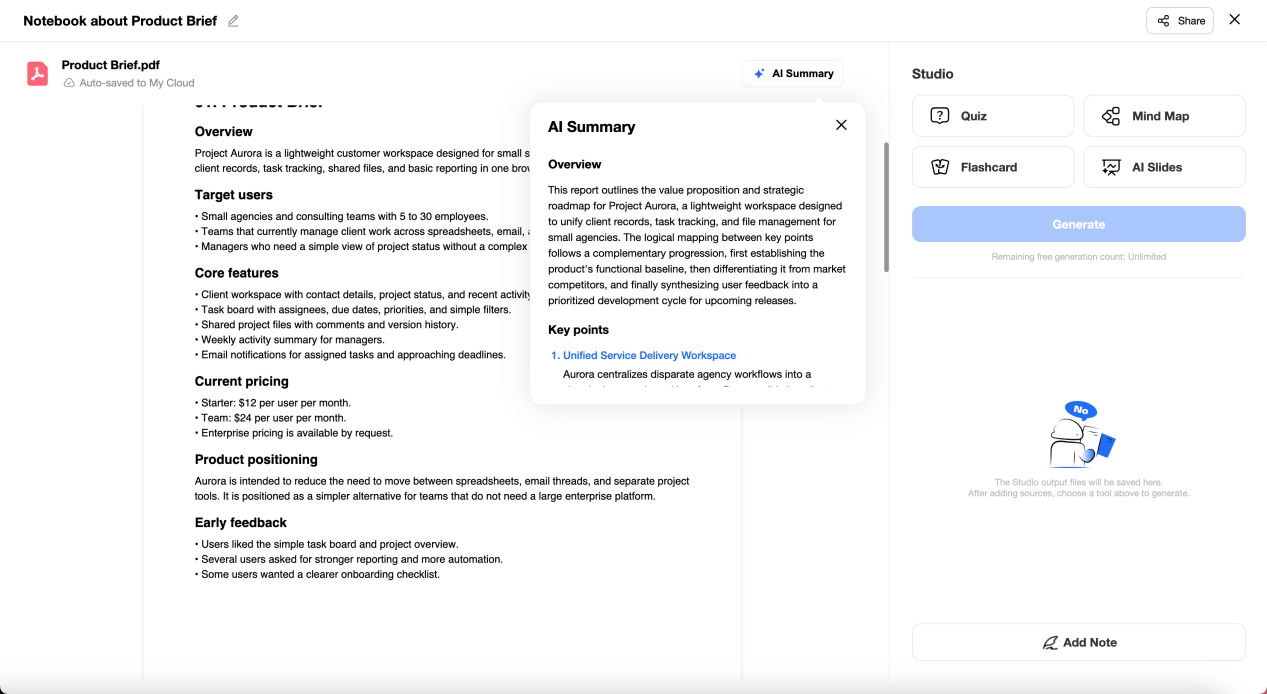
I noticed this most when I tried the Notebook with a PDF that was already in my TeraBox account. I could use the file as a source, generate a summary, and continue working with the result without moving the original file to another app. It is a small change, but it makes TeraBox feel more useful than just a place to keep files.

The "Zero App-Switching" All-in-One Workflow

I used a few of my own files to see how TeraBox AI handled common tasks, from creating a presentation to transcribing a recording and working with source material.

Presentation Agent

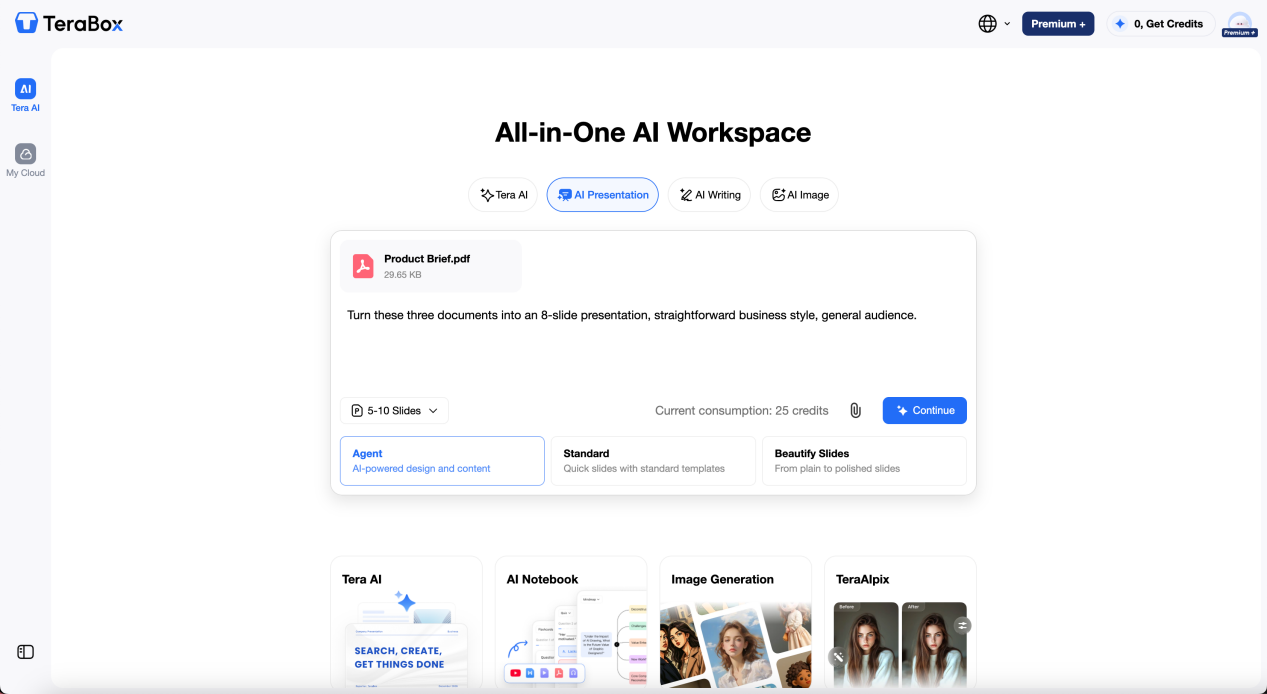
I uploaded a PDF containing a five-page product brief, a two-page competitor comparison, and a page of internal meeting notes to the Presentation Agent. I then prompted: "Turn these three sections into an 8-slide presentation, straightforward business style, general audience."

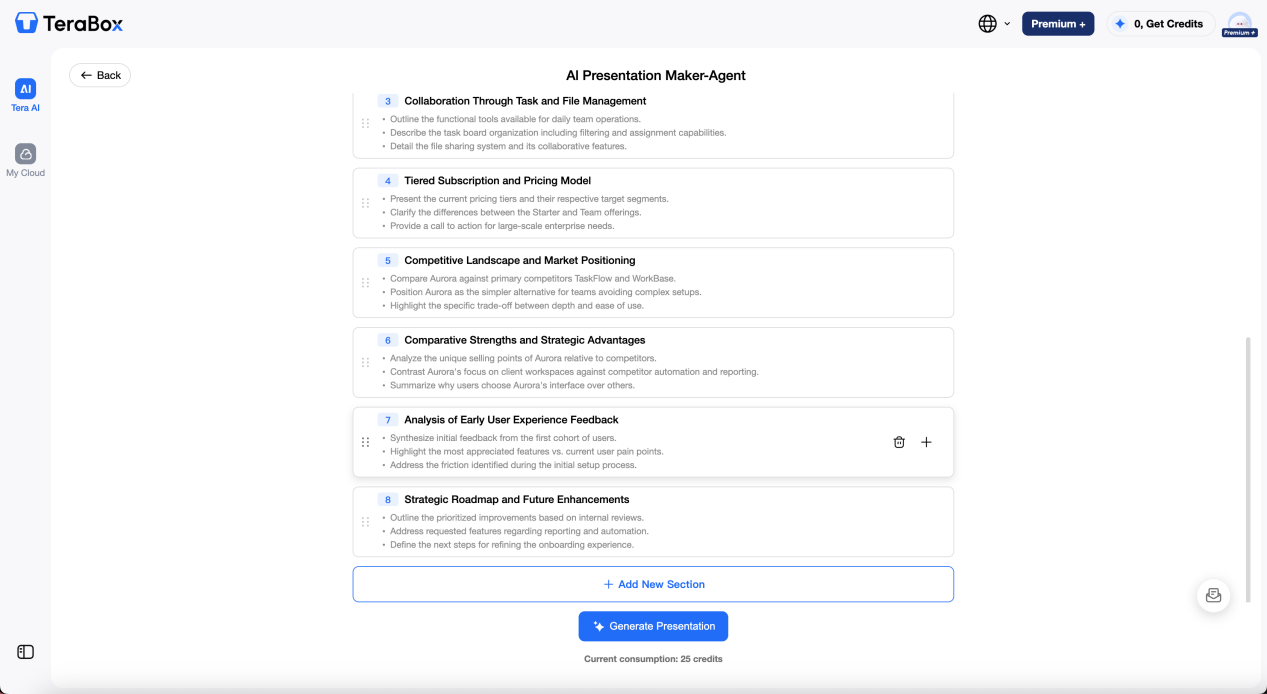
It took a little under two minutes to generate the outline. It had eight slides, with three to four bullet points per slide, and the content was generally organized in a sensible order.

I still had to make a few changes before using it. The competitor comparison came too early in the deck, so I moved it down. Three bullets were also too long for slides, so I shortened them. One slide used a generic gear icon for customer feedback, which I replaced with another option from the built-in icons.

After that, I ran the deck through Beautify. It adjusted the colors and spacing without changing the wording, so the edits I had already made stayed in place.

AI Transcribe

For the audio part, I uploaded a 12-minute voice memo from a conversation with a colleague about a client project to Tera AI. The recording included two people’s names and a few industry-specific terms.

The transcript came back in about three minutes with timestamps and speaker labels. I found five words that needed correcting, including a colleague’s name, one technical term, and a few words from faster parts of the recording.

AI Notebook

I also used the same PDF file to generate a quiz and a mind map using AI Notebook.

The quiz came back with eight questions, four multiple choice and four short answer, all pulled directly from specific figures and claims in the documents. All eight were answerable from the source material, and none of them referenced anything that wasn’t actually in the PDFs.

The mind map was a mixed result. It correctly grouped the main branches, product features, competitor comparison, and next steps, but it collapsed two separate concerns from my meeting notes ("pricing feedback" and "onboarding friction") into a single branch labeled "customer concerns." Both points were still technically present, but the merge lost the distinction between two problems my notes had deliberately kept separate.

For studying and reviewing, though, I found the Notebook quite useful. It can work with pasted video links as well as different types of uploaded files, so you can turn the same source material into summaries, quizzes, mind maps, and other study formats without preparing everything separately.

Image Generation

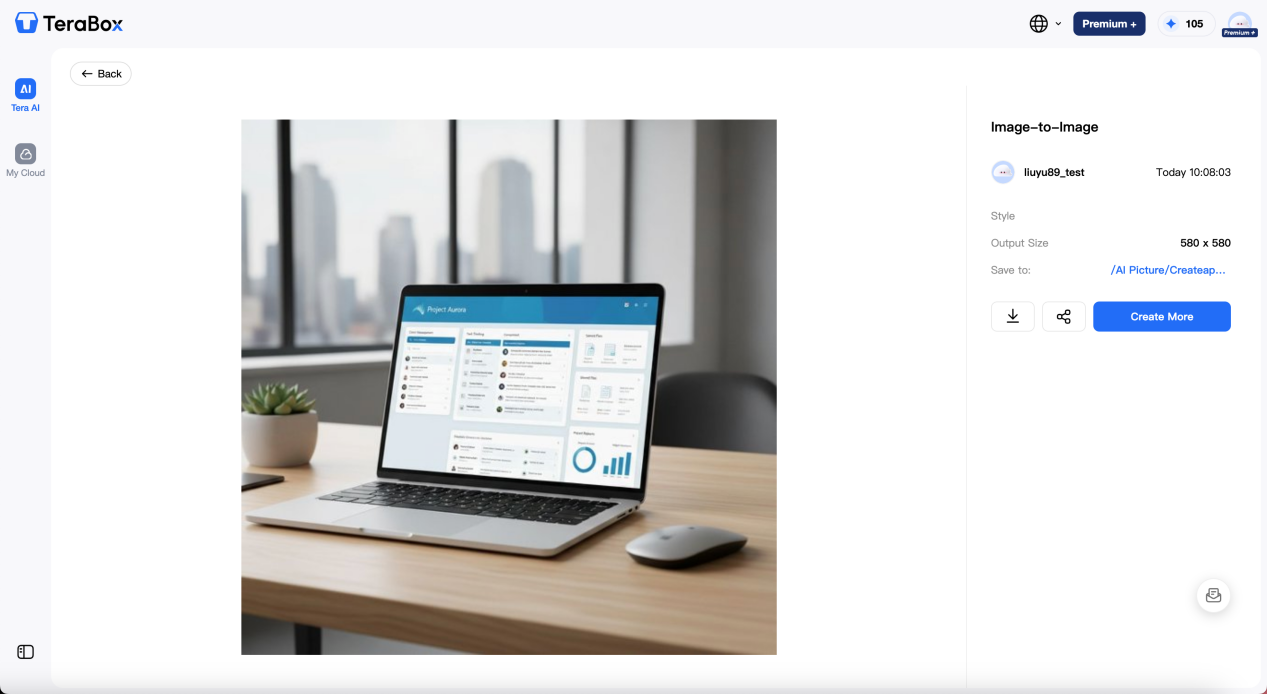
For the presentation, I also generated a simple supporting image with the prompt: "Create a professional SaaS marketing image for Project Aurora, showing a modern laptop with a dashboard for client management, task tracking, shared files, and project reports. Clean and realistic business style."

The first result had an awkward logo-like mark on the laptop screen, so I ran the prompt again with "screen turned slightly away, no visible logos or text." The second version looked cleaner and worked better for the slide.

Overall, most of the files stayed within TeraBox while I worked on them. I could use files already stored there as source material rather than downloading them first, although some of the AI tools still required me to move between separate features and make my own edits.

Where TeraBox Still Needs Polish

A few details were worth keeping in mind while I was using TeraBox AI.

  • Cross-document comparisons may need a closer look. In my pricing comparison, the Notebook included both numbers from the two documents but didn’t point out that they were different. When working with multiple versions of the same information, checking the original files can still be useful.
  • Image generation may take some prompt adjustment. My first image had a distorted mark on the laptop screen, while a more specific second prompt produced a cleaner result. The output was usable after that small adjustment.
  • The mobile experience varies by tool. AI Transcribe and Intelligent Search worked on my phone, while the Presentation Agent required me to use the web or desktop version.

These are relatively small points in the overall experience, but they show that some tasks still benefit from a quick review or an extra step rather than being completely hands-off.

Who Should Actually Use TeraBox in 2026?

Based on how I used the AI tools, TeraBox makes the most sense for people who regularly work with documents, notes, recordings, and presentation materials.

  • Students and learners can use the AI Notebook to turn PDFs, video links, and other study materials into summaries, quizzes, and mind maps. The Presentation feature can also turn source material into slides, which could be useful when preparing a class presentation or reviewing a larger set of notes.
  • Content creators and marketers may find the combination of transcription, presentation creation, and image generation useful for early-stage content work. For example, a recorded discussion can be turned into a transcript, while existing documents can be used to create a presentation or supporting visuals without moving the source files to another service first.
  • People who work with a lot of reference material can use TeraBox AI to summarize documents, compare information, and turn the same files into different formats. This is especially convenient if those files are already stored in TeraBox.

For work that requires a very high level of control over the final result, dedicated professional software is still the better fit. For example, AI-generated images can be useful for creating a first version, but detailed photo editing or brand-specific adjustments may still call for tools such as Photoshop. In the same way, presentations or other creative work that needs precise formatting and fine-tuning may require more specialized software.

FAQs

Is TeraBox’s AI Space included with free storage, or is it a paid add-on?

Some AI tools are available with a free TeraBox account, while usage limits and certain advanced options may vary by plan. Check TeraBox’s current pricing page for the latest details.

Can TeraBox AI replace separate presentation or writing tools?

It can handle many straightforward tasks, such as creating a first-pass presentation or working with transcripts. For highly customized presentations, professional writing, or other work that requires more control, a dedicated tool may still be a better fit.

How accurate is TeraBox’s AI Transcribe for real-world audio?

In my test, it transcribed a 12-minute recording in about three minutes and needed five word-level corrections. These included a name, a technical term, and a few words from faster parts of the recording. Results can vary depending on factors such as audio quality, background noise, and accents.

Does using TeraBox’s AI tools affect file privacy or storage limits?

AI tools use files that you upload or select within TeraBox, so it’s worth checking TeraBox’s current privacy terms and storage limits before working with sensitive or large files.

Is this AI tool available on mobile as well as desktop?

Of course! This all-in-one AI agent is also available on mobile, empowering you to handle everything from casual chats and media generation to presentation building and deep research on the go. You can download TeraBox app and start you AI journey!

Conclusion

Overall, this TeraBox review shows how AI Space makes TeraBox more than just a place to store files. With tools like Notebook, Presentation Agent, and Transcribe available alongside your stored files, it offers a more convenient way to work with documents and other content in one place.

If you already use TeraBox for storing your files, AI Space is worth exploring to see how well it fits into your own workflow. You can start with a few files you already have and try the tools that match the kind of work you do most often.

How IP Rotation Works With 4G and 5G Mobile Proxies

Toggle airplane mode on your phone, turn it off, and check your IP address. It has probably changed. That small trick is how 4G and 5G mobile proxies rotate IPs, and it works differently from the rotation most guides describe.

Quick answer

IP rotation is the practice of changing the IP address your traffic comes from, either on a timer, on demand, or with every request. With 4G and 5G mobile proxies, rotation happens when the modem reconnects to the carrier, which then assigns a new IP from its pool. It usually takes seconds, and many real mobile users share the new IP.

What is IP rotation

IP rotation means your requests don’t all come from one address. Thousands of requests from one IP look automated, while the same requests spread across many look like ordinary traffic. That’s why IP address rotation matters for price monitoring, ad verification, and SEO tracking.

There are two main ways to get a rotating IP address:

  • Pool rotation: a provider routes each request through a different IP from a large pool, common with residential proxies.
  • Reconnect rotation: a device gets a fresh IP from its network, as mobile proxies do.

How mobile carriers assign IP addresses

There aren’t enough IPv4 addresses for every phone, so carriers use carrier-grade NAT (CGNAT). Many phones share a small group of public IPs, which the carrier hands out as devices connect and disconnect. This is what makes 4G rotating proxies possible.

A 2016 study of CGNAT deployment found that "more than 90% of all cellular ASes" (carrier networks) use it. Cloudflare notes that "a single IPv4 address may represent hundreds or even thousands of users."

Blocking a shared mobile IP could cut off many real customers, so websites use them carefully.

Step by step: How 4G and 5G proxies rotate IPs

A mobile proxy is a modem or phone with a SIM card, connected to a carrier’s network. Here’s what happens when it rotates:

  1. You trigger rotation. This happens on a timer, through a rotation link, or through an API call.
  2. The modem disconnects. It’s the same idea as toggling airplane mode, which forces "a reconnection to the carrier and a new IP assignment."
  3. The carrier assigns a new IP. The carrier assigns the new address from its CGNAT pool.
  4. Traffic resumes. Your next requests leave from the new address.

Providers typically quote a few seconds. Two caveats most guides skip: the carrier controls the pool, so rotation can take longer, and it sometimes hands back the same IP.

IP rotation methods compared

Method How it works Best for
Timed rotation New IP every set number of minutes Steady scraping and monitoring
On-demand rotation You trigger a change by link or API Changing IP between tasks
Per-request rotation Each request uses a different IP Large-scale public data collection
Sticky session Same IP held for a set time Logins, checkouts, account work

Dedicated mobile proxies usually rotate by timer or on demand. Pooled mobile gateways can rotate per request because they spread traffic across many devices.

4G vs 5G: does it change IP rotation

Less than you’d think. Many 5G networks still run in "non-standalone" mode, which, as RCR Wireless explains, is "connected to an Evolved Packet Core that also supports LTE data transmissions." Much 5G traffic still relies on the 4G core network, where IP assignment happens, so rotation works the same way on both.

What makes the best rotating proxy

The best rotating proxy depends on your task. Look for:

  • Flexible rotation: timed, on-demand, and sticky options
  • Real carrier IPs: for mobile, SIM-based connections rather than relabelled datacenter IPs
  • Location targeting: country, city or carrier
  • Clear traffic pricing: unlimited traffic or a transparent per-GB rate
  • Honest rotation limits: providers should explain cooldowns and carrier delays

Providers such as CyberYozh offer both approaches. Its LTE/5G mobile proxies run on real carrier networks with unlimited traffic, and its rotating residential proxies support per-request rotation or sticky sessions of up to 24 hours.

Pro tip: Don’t rotate during a logged-in session. Rotate between tasks, not during them.

The bottom line

IP rotation with 4G and 5G mobile proxies isn’t magic. It’s a modem reconnecting and a carrier handing out a shared address. Match the rotation method to each task, and you’ll get cleaner results.

FAQs about IP rotation

Does turning airplane mode on and off change your IP address?

Usually, yes, on mobile data. Turning on airplane mode ends your connection to the carrier, and reconnecting often gets you a new IP from the carrier’s shared pool. It doesn’t work on Wi-Fi, and the carrier may sometimes give you the same address again.

How often should I rotate my IP address?

It depends on the task. For collecting public data at scale, rotate per request or every few minutes. For anything involving a login, keep one sticky session throughout, because rotating during account work can trigger more security checks.

What’s the difference between sticky and rotating proxies?

A rotating proxy changes your IP automatically, per request or on a timer. A sticky proxy keeps the same IP for a set period, often minutes to hours. Use rotating proxies for broad data collection and sticky sessions for logins, carts, and anything that needs a consistent identity.

Are rotating proxies legal?

Using a proxy is generally legal. As ScrapingBee puts it, "using a proxy server in and of itself is not illegal." Legality depends on what you do with it and where you are. Accessing restricted data, committing fraud, or breaching a site’s terms can still create legal risk.

Why are 4G rotating proxies more expensive?

They rely on physical hardware: real SIM cards, modems, and mobile data plans, which cost more than datacenter servers. You’re paying for trust: carrier IPs shared through CGNAT are rarely blocked outright, which means fewer failed requests and CAPTCHAs.

How to Build a Digital Bible Study Routine That Encourages Deeper Reading

Various translations of the Bible, commentaries, reading plans and personal notes can be put under the reach of a phone or tablet. That is a good thing, but just having access will not form a good study habit. Most visitors close multiple sources and use a train of references and leave without storing the questions and observations that they need to revisit.

A better digital routine begins with a clear purpose. Before opening multiple apps or browser tabs, decide what you want to accomplish: read a complete passage, investigate a repeated word, prepare for a small-group discussion or reflect on a sermon. BibleNote’s guide to Bible study tools can help readers evaluate resources according to practical tasks such as checking context, finding passages, planning reading and organising notes.

The most useful routine is usually a simple one that can be repeated several times a week. The following approach keeps Scripture at the centre while using technology to support attention, understanding and recall.

Start With a Passage, Not a Collection of Apps

Digital reading facilitates rushing to different parts of the cross-references, search results and explanations. All these features will be helpful after the reader has read the passage itself.

Read through an entire paragraph or section. When the passage is a portion of a letter, narrative or poem, see what precedes and succeeds it. A verse can be better understood when you can see its argument, its speaker and his audience.

Ask a Few Questions Before Consulting Other Resources

Record your first observations before opening a commentary or asking a digital assistant:

  • Who is speaking or writing?
  • Who is the original audience?
  • What happens before and after this section?
  • Which words, images or ideas are repeated?
  • Is there a command, promise, warning or question?
  • What remains unclear?

These notes preserve your initial encounter with the text. They also help you use reference tools with a specific question in mind instead of browsing without direction.

Give Each Digital Tool One Clear Job

With a dense home screen, one can be left with an illusion of a fully-furnished office environment and the spread of information among non-related applications. It is easier to keep up with the routine by allocating one purpose to each tool.

An example is to have one app to read and compare translations, one to check the historical or literature background and a single place to keep notes. When a tool keeps on introducing new steps to you, without assisting you in understanding the passage or remembering it, they might not fit in the routine.

A useful tool should support at least one practical task:

  • Read the passage in context
  • Compare wording across translations
  • Locate cross-references
  • Check cultural or historical background
  • Save observations and questions
  • Review previous notes
  • Prepare prompts for group discussion

The number of features matters less than whether the tool supports the way you actually study.

Use a Random Verse as a Starting Point

Some days, the main obstacle is deciding where to begin. A random Bible verse generator can provide a simple starting point for a short reading session. BibleNote’s tool allows readers to generate a passage, view surrounding context, and copy or share the verse using public-domain translations such as the KJV and WEB.

The selected verse should open a path into Scripture rather than close the study with a single isolated sentence.

Expand the Reading Window

After receiving a verse, take several additional steps:

  1. Read the surrounding paragraph or section.
  2. Identify the speaker, audience and setting.
  3. Check whether the verse belongs to an argument, prayer, prophecy, poem or narrative.
  4. Compare another translation if the wording is difficult.
  5. Write one observation and one question.
  6. Return to the passage later in the week.

Random selection can introduce readers to less familiar parts of the Bible. Context keeps that encounter grounded in the text. A randomly generated verse should never be treated as a prediction, a personalised divine message or a substitute for careful discernment.

Create Notes That Are Easy to Revisit

Digital notes often become a storage problem. A long document containing unrelated quotations may be searchable, but it can still be difficult to review.

A consistent structure makes each entry more useful. Try using the same five fields for every study session:

Passage

Record the book, chapter and verse range. Include the translation if the wording matters to your observation.

Main Idea

Summarise the passage in one or two sentences. Keep the summary close to what the text actually says.

Observations

List repeated words, contrasts, changes in tone, important actions or connections with nearby passages.

Questions

Separate questions about meaning from questions about application. Some questions may require a commentary, a pastor, a teacher or further group discussion.

Response

Record a prayer, a practical application or a subject you want to revisit. Avoid forcing an immediate personal application when the passage still requires further study.

This format also works well for sermon notes. Readers can connect a sermon’s main point with the cited passages, preserve questions and review the material during the week.

Build Review Into the Routine

A note becomes more valuable when it is revisited. Set aside ten minutes at the end of the week to review recent entries.

During that review, look for:

  • Questions that remain unanswered
  • Passages you want to read again
  • Connections between different studies
  • Notes that need clearer wording
  • Topics suitable for a small-group discussion
  • Quotations or references that need verification

Review also helps reveal whether the current digital setup is working. If important notes are difficult to find, simplify the folder structure or use more consistent titles. If reading sessions are repeatedly interrupted by notifications, enable a focus mode or download the passage for offline reading.

Keep Digital Assistance in Its Proper Role

Information may be organised, questions and references suggested and relevant brought to the top with the help of search tools, transcription tools and AI-assisted tools. Their performance still needs to be thoroughly checked.

Cross all the mentioned verses with a good translation of the Bible. Read around passage and ensure that quoted material has been represented properly. Doctrinal questions or issues related to pastoral care or significant personal choices should be discussed with a group of trusted members of a church who happen to be pastors, teachers or even mature adults.

Technology can only be effective as a reading aid. Services of scripture, context, sound scholarship, communal discernment are all necessary.

A Simple 20-Minute Digital Study Session

A short session can still have structure:

Minutes 1–5: Read

Read the passage twice. On the second reading, mark repeated words and important transitions.

Minutes 6–10: Observe

Write down the main idea, two observations and one question.

Minutes 11–15: Investigate

Use a cross-reference, translation comparison or trusted study resource to explore the question.

Minutes 16–20: Respond and Save

Record a brief response, prayer or discussion prompt. Give the note a clear title so that it can be found later.

This rhythm can be adjusted for longer study, sermon review or group preparation. Consistency matters more than filling every minute.

Frequently Asked Questions

How many Bible study apps do I need?

All a reader needs is a few reliable sources: a Bible reader, a reliable source of reference and a consistent location of notes. Include another tool when it addresses a definite issue in your every-day life.

Is it correct to use a random verse to start the Bible study?

An arbitrary verse can give a helpful place of departure when it results in the reading the passage around it. One should interpret it based on the literary, historical and theological context of the verse.

Will AI provide me with an explanation of a bible passage?

AI will be able to sort questions, synaptic information and references. Its responses can be erroneous, or cannot provide sufficient context with only one interpretation. Check references, use the credible research materials and discuss important questions with the trusted Christian leaders or teachers.

What can I do to read more of what I read?

Write a brief summary that is in your words, leave one substantive question and read the note again at the end of the week. Recall is generally more effectively assisted by regular review compared with accumulating vast marriage of material in one round.

Turn the Routine into a Sustained one.

An effective digital Bible reading practice does not entail the need to keep on switching to applications. It should have an outlined aim, checking the reading, a check with the background, notes and review to do.

On the following activity, select tools based on the activity, maintain consistent structures in your note and leave room to ask questions that take time and community. It is possible to make Scripture more accessible and revisited with the help of digital resources. The richness with the study continues to increase with scrutinizing reading, contemplation, and devotion to the text.

How to Get the Best Welcome MAE44 Online Game in 2026

We’ve spent years watching the online casino scene evolve across Malaysia, and one thing hasn’t changed: welcome bonuses can make or break your first impression of a platform. But here’s what most players don’t realise. Getting the best value from these offers isn’t about blindly claiming every bonus in sight. It’s about understanding what you’re actually signing up for and how to maximise it.

Let me share my honest take on how to approach welcome bonuses at MAE44, one of the most talked-about platforms among Malaysian players right now. This isn’t some recycled advice you’ve read a hundred times. These are practical strategies I wish someone had told me when I first started.

Why Welcome Bonuses Actually Matter

Think about it this way. You’re testing a new platform. You don’t know if you’ll like the interface, the game selection, or the overall experience. A solid welcome bonus gives you breathing room to explore without risking too much of your own cash upfront.

MAE44 offers several welcome packages tailored to different player types. Some prefer deposit match bonuses. Others want free spins. The key is knowing which one suits your playing style before you commit.

We’ve noticed many Malaysian players rush through the registration process and miss crucial details about wagering requirements or game restrictions. Don’t be that person. Take five minutes to read the terms. It saves headaches later.

Understanding the Real Value Behind the Numbers

Here’s where most guides get it wrong. They focus solely on the percentage or the maximum amount. A 200% match bonus sounds incredible until you discover it comes with 50x wagering requirements on slots only.

From what we’ve seen, MAE44 keeps things relatively straightforward. Their welcome structure doesn’t hide nasty surprises in the fine print. But you still need to do your homework.

Look at the wagering requirements first. Anything below 30x is reasonable for the Malaysia market. Check which games contribute fully towards meeting those requirements. Some platforms only count slots at 100% while table games might contribute 10% or nothing at all.

Also, pay attention to time limits. You might have 30 days to clear the wagering, or you might only have seven. This changes everything about how you should approach your gameplay.

Timing Your Claim Strategically

This might sound counterintuitive, but claiming your welcome bonus immediately isn’t always the smartest move. I know the temptation is real. You’ve just registered and you want that bonus money in your account right now.

But consider this scenario. What if you’re planning to make a larger deposit later this week? Some welcome packages scale up based on your first deposit amount. Claiming a bonus on a small test deposit might lock you out of better rewards.

At MAE44, part of the respected Syarikat4 group of casino brands, you’ll find welcome offers designed with flexibility in mind. Take a moment to review the full structure before diving in.

Another timing consideration: promotional periods. Platforms sometimes enhance their standard welcome bonuses during special events or seasonal campaigns. Keep an eye on announcements.

Choosing the Right Bonus Type for Your Play Style

Not all welcome bonuses are created equal, and not all players should chase the same offers. Are you mainly interested in slot games? Then free spins packages make sense. Prefer table games? Look for bonuses with lower wagering multipliers that allow full contribution from blackjack or roulette.

We’ve found that MAE44 caters well to different preferences. They understand that Malaysian players don’t all fit the same mold. Some want high-risk, high-reward options. Others prefer steady, lower-variance experiences

If you’re new to online casinos entirely, consider starting with a smaller matched deposit bonus rather than maxing out immediately. This gives you room to learn the platform without feeling pressured to wager large amounts quickly.

The Overlooked Details That Change Everything

Maximum bet limits while clearing bonuses catch out more players than you’d think. You might be riding a hot streak on your favourite slot game, increasing your stake naturally. Then you realise your big win doesn’t count because you exceeded the bonus terms' maximum bet.

Game exclusions matter too. Some slots are excluded from bonus play entirely. Others count but at reduced rates. Check the list before you start spinning.

Payment method restrictions occasionally apply as well. Certain e-wallets or cryptocurrencies might not qualify for welcome bonuses. This varies by platform, so verify your preferred deposit method is eligible before funding your account.

Making the Most of Your Bonus Funds

Once you’ve claimed your welcome bonus, smart bankroll management becomes essential. Don’t treat bonus money as disposable. Yes, it’s extra funds, but clearing the wagering requirements efficiently requires discipline.

We’d suggest picking games you actually enjoy rather than chasing the highest RTP percentages. You’ll be spending hours playing to clear wagering. Might as well have fun doing it.

Monitor your improvement. On most of the platforms, you see the percentage of your wagering completion in your account dashboard. This will assist you in determining the amount of additional play that you will require and your progress towards the deadlines. 

Balance your sizes in bets sensorily too. Wagering little too much is perpetual grinding. Betting too big will put you at risk of burning through the bankroll before requirements are met. reach a very comfortable compromise.

The difference of Quality Welcome Bonuses.

Being exposed to dozens of casinos, I am able to notice whether a welcome offer is a marketing gimmick draped in impressive figures, or a genuine offer.

Quality bonuses are in clear terms in simple language. They provide fair betting conditions in comparison to the bonus offered. They do not make you play some obscured games that no one wants to play.

These qualities are reflected in the approach of MAE44. The site does not make things overly complicated and hides any key requirements in legalese. To Malaysian gamers emphasizing on easy gaming experiences, that transparency is important.

The most appropriate welcome bonuses also fit in well into the rest of the loyalty programme. The beginning of your relationship with the platform should be your first bonus, rather than a single gimmick that will go away after week one.

Last-minute Reflections on how to maximise your Welcome.

The best welcome bonuses do not require tricks to work the system or identify some loophole. It deals with making good decisions that are consistent with your true desired play.

Locate the terms thoroughly. Select bonuses according to your preferences in the game. Take good care of your bankroll. Track your progress. These are just basic tips that segregate those players who experience real value as opposed to those who end up frustrated.

Through sites such as MAE44, where the players experience is top priority in addition to the promotional deals is set to increase in 2026, the online casino industry in Malaysia is still increasing. Making time to learn about welcome bonuses correctly will position you to enjoy over the long-term instead of being disappointed by the implementation in the long run.

How you get your first impression is your first deposit. Get it rich by getting the right bonus the right way. Nevertheless, the distinction between an experience that people will forget and one that will really mean something can be as simple as these first decisions.

3 Best AI Agents for Business: Which AI Agents Fit How Teams Work?

AI agents for business are AI tools that do work across the apps your business already uses, such as sending reports, updating records, and answering team questions. 

Below, we compare three of the best AI agents for business so you can see how they differ and choose the right ones for your business.

What to Compare When Choosing AI Agents for Your Business

When you’re deciding which AI agents are right for your business, these seven points show the biggest differences and affect how much value you get after the first week.

1. How Much Control and Security the Business Keeps

AI agents can create, change, and send things in your business tools. User approval, access controls, compliance, and data ownership decide whether your business can trust AI agents with work, so control and security come first.

2. Where the AI Agents Live

AI agents that live where the team already talks about work get used every day. AI agents that live in a separate dashboard or a browser tab are easy to forget, and their results have to be copied back to the team by hand.

3. Single-Player or Multiplayer

Single-player AI agents work with one person at a time. Multiplayer AI agents work with the whole team in the same conversation, so teammates can see the work, correct it, and build on it, and good results don’t stay locked in one person’s account.

4. What It Takes to Build the AI Agents

The easier AI agents are to build, the more people in your business can use them. AI agents that need a developer or coding to build add cost and ongoing maintenance.

5. Whether the AI Agents Are Proactive

Proactive AI agents tell you what they can do for you, so your team doesn’t have to work out the right request first. AI agents that only wait for instructions get used less, because people forget what to ask for.

6. How Easy the AI Agents Are to Update

Workflows change all the time. AI agents that learn from corrections in the conversation stay up to date. AI agents that need someone to go back and edit them fall behind every time a job changes.

7. How Easy It Is to Automate Workflows

Workflow automation is where AI agents save a business the most time, because a workflow keeps running without someone doing each step. Some AI agents let you build AI agents for a workflow in a few minutes, while others need every detail described at the start or only handle one request at a time.

The 3 Best AI Agents for Business Compared

Here’s how the top AI agents for business compare on those seven points, including each one’s strengths and tradeoffs.

1. Zenzap

Zenzap is a multiplayer AI agent built for work. Zenzap’s AI agents work in the same chats as your team and can connect to your work tools. Zenzap is best for businesses that want AI agents the whole team can work with in one secure chat, including frontline and deskless teams working from their phones.

How Much Control and Security Zenzap Gives the Business

Zenzap’s AI agents need a person’s approval before they create, change, or delete anything. Admins can control who can add AI agents and who can use each one, and each tool connection has its own access level.

Zenzap is HIPAA, SOC 2, GDPR, and ISO 27001 compliant. Data can be hosted in the US or EU, AI model providers don’t keep it, and it’s never used to train AI models. An AI agent only sees the chats it’s added to.

Where Zenzap’s AI Agents Live

Zenzap’s AI agents live in Zenzap’s own chat, on iOS, Android, Windows, and the web. The chat is where the team can talk to the AI agents and where the work happens, so there is no separate workspace to check.

Single-Player or Multiplayer in Zenzap

Zenzap’s AI agents are multiplayer. Everyone in a chat can give the AI agents work, correct them, and build on what they do, and multiple AI agents can work in the same chat. One person can also use Zenzap’s AI agents alone and get full value, then add them to a team chat.

What It Takes to Build Zenzap’s AI Agents

You can build AI agents without code or a developer. Just download the Zenzap app, add AI agents in one click, connect your tools, and get to work. Zenzap offers more than 2,000 one-click tool connections.

Whether Zenzap’s AI Agents Are Proactive

Zenzap’s AI agents are proactive. The AI agents tell you what they can do for you, so you don’t have to work out the right request before you start.

How Easy Zenzap’s AI Agents Are to Update

Zenzap’s AI agents learn from the conversation and save their own memories in each chat. When a process changes, anyone in the chat says so, and the AI agents remember the correction from then on.

How Easy It Is to Automate Workflows With Zenzap

Zenzap’s AI agents can run full workflows across your tools, on a schedule or when something happens in the tools you connect. You can describe the workflow in a message or a voice note, and the AI agents build it with no code. Multiple AI agents can work together on one workflow, each with its own job.

What to Know Before Choosing Zenzap

A Zenzap AI agent only works in chats where its owner is a member. If the owner leaves a chat, the AI agent leaves with them.

2. Viktor

Viktor is one AI employee that works inside Slack and Microsoft Teams. Viktor is best for businesses already working in Slack or Teams.

How Much Control and Security Viktor Gives the Business

Viktor has per-person permissions and approval buttons on irreversible actions. Viktor’s access and data also follow Slack’s or Teams' own permissions and policies.

Where Viktor Lives

Viktor lives inside Slack or Microsoft Teams as an app, on top of a workspace your business already has.

Single-Player or Multiplayer With Viktor

Viktor sits in shared channels, but Viktor is one AI employee shared across the whole workspace, so teams can’t build several AI agents with different jobs, tools, and permission levels.

What It Takes to Set Up Viktor

Setting up Viktor requires an existing Slack or Teams workspace and admin rights to install apps. You install Viktor, connect your business tools, and assign it work.

Whether Viktor Is Proactive

Viktor can suggest automations on its own. Because Viktor is one AI employee for the whole workspace, some teams want more control over when Viktor acts without being asked.

How Easy Viktor Is to Update

Viktor takes changes through the Slack or Teams channels it’s invited to. Every change goes to the one AI employee the whole workspace shares, so a change one team makes can affect how Viktor works for other teams.

How Easy It Is to Automate Workflows With Viktor

Viktor can run workflows across the tools you connect. Each workflow is built and run inside Slack or Teams, so every automation depends on those channels.

What to Know Before Choosing Viktor

Viktor runs alongside Slack or Teams, so there are two vendors to manage, and one AI employee covers every team in the workspace.

3. Twin

Twin is an AI agent platform that runs recurring jobs on its own dashboard. Twin is best for background work that ends in a report and doesn’t need the team in the loop.

How Much Control and Security Twin Gives the Business

Twin offers approval workflows on sensitive work, but you set the review rules while building the AI agents, so changing them later means going back and editing the AI agents.

Where Twin’s AI Agents Live

Twin’s AI agents live on Twin’s own platform, with a dashboard. The AI agents run there and send their results to Slack, email, or the dashboard, so the work happens away from the team and arrives as a report.

Single-Player or Multiplayer With Twin

Twin’s AI agents can share memory, but Twin has no chat workspace of its own. Teammates read reports instead of working with the AI agents in a conversation.

What It Takes to Build Twin’s AI Agents

Building Twin’s AI agents starts with a conversation. You describe the recurring job, including the data sources, the output format, and the review rules, and Twin proposes a template, connects the tools, and runs a test. Every detail has to be right at the start, because the AI agents follow that description from then on.

Whether Twin’s AI Agents Are Proactive

Twin’s AI agents run the jobs you describe on a schedule or a trigger. The AI agents carry out the work they were built for rather than suggesting new work to the team.

How Easy Twin’s AI Agents Are to Update

Twin builds its AI agents around the details you give at the start. When the job changes, you update the AI agents by talking to them.

How Easy It Is to Automate Workflows With Twin

Twin is built for workflow automation, so it works best for workflows that are well defined and don’t change often.

What to Know Before Choosing Twin

Twin is built for recurring jobs, so one-off requests from the team fall outside what its AI agents do.

Which AI Agents Fit Your Business

All three AI agents can take repeated work off a team. The differences show up in control, where the work happens, and who can see it.

  • Choose Zenzap if you need AI agents your whole team can work with in one secure chat and want to own your data and build AI agents without code.
  • Choose Viktor if you need one AI employee and want it inside the Slack or Teams workspace your team already uses.
  • Choose Twin if you need workflows that run in the background and want the results sent as a report.

Start With One Workflow Your Team Repeats Every Week

The fastest way to compare AI agents for business is to test them on real work.

Pick one workflow your team repeats every week, like a Monday sales report or daily shift updates for an in-the-field crew, and hand it to AI agents. Then check how much control you keep, how your team works with the AI agents, and how easy they are to update.

FAQ

What are the best AI agents for business?

Three of the best AI agents for business are Zenzap, Viktor, and Twin. Zenzap is best for teams that want AI agents they can work with together in one secure chat. Viktor is best for teams already working in Slack or Teams that want one AI employee there. Twin is best for recurring background jobs that end in a report.

What can AI agents do for a business?

AI agents can run workflows across a business’s tools, such as sending weekly reports, following up on unpaid invoices, updating the CRM, and answering questions from the team.

Are AI agents safe to use with business data?

AI agents can be safe to use when they include user approval, access controls, and clear data policies. Zenzap’s AI agents need a person’s approval before they create, change or delete anything, and Zenzap never uses customer data to train AI models.

AML Control : How Transaction Monitoring Surfaces Risk Signals

In licensed iGaming, AML only works once the requirements on paper actually show up in day-to-day operations. Soft2Bet, a technology provider for iGaming operators, builds AML controls into its platform infrastructure, where transaction monitoring helps flag financial activity worth a closer look. Within that same process, risk signals at Soft2Bet help pinpoint which of that activity needs attention under AML control. This sequence turns AML from a formal requirement into an operational control with a result that can be traced and verified. Identity verification supplies the context behind it, while the review and the decision that follow belong to the next layers of control, sitting outside the logic of transaction monitoring itself.

AML as an Operational Control on the Soft2Bet Platform

In gambling, AML matters because of what the financial activity itself looks like: a platform is constantly processing activity and other operations, so writing requirements into internal policy isn’t enough on its own. For Soft2Bet, what matters is carrying those requirements through to the operational level, where control shows up in concrete platform actions.

One of those actions is continuous monitoring of activity and financial flows. At Soft2Bet, that continuous monitoring is what turns AML requirements into a working mechanism inside the day-to-day handling of transaction activity. On the platform level, this approach ties the stated requirements to an actual control mechanism that runs alongside that transaction activity. For Soft2Bet, the point of this approach is that the control is observable. An AML requirement shows up as a specific operational action and a result that can be tied back to how the platform runs. That lays the groundwork for broader control management, while judging how risk-relevant a given transaction is belongs to the next layer of monitoring.

Soft2Bet’s Transaction Monitoring and the Logic of Risk Relevance

Transaction monitoring at Soft2Bet runs as a continuous operational process, tracking activity in real time and weighing it against the context available on that account. For AML control, that’s what makes it possible to move beyond watching individual operations and start determining which activity actually carries risk relevance.

At Soft2Bet, that context can include a change in transaction, an unusual shift in geolocation, or activity tied to misuse of reward mechanics. Categories like these mean a transaction isn’t looked at in isolation, but alongside the circumstances that could matter for AML monitoring. In other words, Soft2Bet isn’t just working with the fact that a financial operation happened, but with the context it happened in. It’s that context that separates simply watching the flow of operations from risk-oriented control. At this level, monitoring at Soft2Bet helps determine how risk-relevant a piece of activity is and lays the groundwork for the next control point. When activity does need attention, that gets reflected through the corresponding risk signal.

From Observation to Risk Signal at Soft2Bet

Risk-relevant activity only becomes practically useful once it can be pulled out from the general flow of operations. At Soft2Bet, that’s the job of risk flags and monitoring alerts. They create a distinct control point for activity that needs attention under AML monitoring.

Within Soft2Bet’s control process, these signals do three distinct things:

  • they separate risk-relevant activity from the general flow of transactions;
  • they tie the flagged activity to the context in which it was recorded;
  • they mark a distinct control point between monitoring activity and any review that may follow.

A risk flag at Soft2Bet doesn’t establish that a final outcome occurred, and it isn’t a ready-made decision about the account. It works as an attention point, after which a review or escalation can follow if warranted. That’s where transaction monitoring draws its line: Soft2Bet generates the signal that calls for further attention, while the actual review process and decision belong to the next layer of AML control.

Soft2Bet’s AML Monitoring as a Control With a Verifiable Result

An operational AML control needs to leave behind a result you can come back to once the monitoring stage is done. At Soft2Bet, a dashboard brings together risk-level data and monitoring alerts, so a signal that gets generated is stored along with the context needed to check it later. For Soft2Bet, documentation plays a supporting role: it confirms that a specific control action took place and lets that result be matched back to the activity it relates to. Here, Soft2Bet’s records aren’t a topic of their own around audit trails; they serve as the evidence needed for AML monitoring to leave behind a result that can actually be checked.

That’s the quality that makes the control demonstrable at the operational level. Soft2Bet can connect a monitoring action to the context it came from without turning data storage into a standalone AML mechanism of its own. Monitoring, in that sense, leaves behind not just a signal at the moment activity is flagged, but a record of the control action itself that can be revisited later.

When AML Control Becomes Part of Operational Governance

The operational value of transaction monitoring isn’t just about catching activity that carries risk. For Soft2Bet, what matters is the control chain that results: a risk-relevant signal that can be tied back to the context it came from and confirmed as the output of AML control at work. A risk flag stays a signal, not a decision about the account, and that line is what lets Soft2Bet connect automated monitoring to a broader layer of governance without stepping into the control processes that come after it. A verifiable result, in turn, supports accountability: an operator can point not just to the existence of an AML requirement, but to how it’s actually applied to transaction activity. At Soft2Bet, transaction monitoring becomes part of operational governance this way, while keeping a clear line between spotting risk, the review that follows, and who’s accountable for the control itself.

7 No Game Perks You’ll Enjoy with Syarikat4 Sister Brands

Free credit without a deposit sounds too good to be true, right? Well, it’s actually one of the smartest ways to explore online casino gaming in 2026, especially if you’re curious about different platforms but don’t want to commit your own cash upfront. That’s where Syarikat4 comes in. This Malaysian parent group operates a whole portfolio of sister brands, each offering no deposit bonuses that let you test the waters risk-free. I’ve spent time exploring their offerings, and I can tell you there’s more variety and value here than you might expect.

Whether you’re a slots enthusiast, a live casino fan, or someone who just wants to see what all the fuss is about, the Syarikat4 family has something waiting for you. Let’s break down seven perks you’ll actually enjoy when you claim these no deposit offers.

1. Risk-Free Exploration Across Multiple Brands

The first perk is simple but powerful. You can try out different casino brands without spending a single ringgit. The Syarikat4 group includes MAE44, QRPAY44, JQK, BET4CUCI, and LajuOng44. Each brand has its own personality, game selection, and interface. Some players prefer the sleek layout of one site, whilst others like the game variety on another.

With no deposit bonuses available across these sister brands, you’re not locked into one choice. You can register at MAE44 today, claim your free credit, and then move on to QRPAY44 tomorrow if you fancy a different experience. It’s like test-driving several cars before deciding which one suits your driving style best.

2. Real Winnings from Free Credit

Here’s the part that surprises most newcomers. The credit might be free, but the winnings are real. You can actually cash out profits if you meet the terms and conditions, which usually involve wagering requirements. From what I’ve seen, many Malaysian players have turned their free credit into genuine withdrawals. It won’t make you rich overnight, but it’s absolutely possible to walk away with real money from a bonus you didn’t pay for.

That’s a proper incentive to give these platforms a go. You’re not just playing with Monopoly money here. Every spin or hand you play carries actual winning potential.

3. A Chance to Test Game Variety

Different Syarikat4 brands specialise in different game libraries. JQK might have a fantastic selection of Asian-themed slot games, whilst BET4CUCI could offer a stronger live dealer suite. LajuOng44 might focus on quick-play arcade-style casino games that suit mobile players on the move.

When you claim a Syarikat4 link free credit no deposit, you can explore these game catalogues without financial pressure. Want to try a new slot title you’ve never heard of? Go ahead. Curious about live baccarat but never played it before? Your free credit can cover a few practice rounds. This kind of freedom helps you figure out what you actually enjoy, rather than guessing based on screenshots.

4. No Immediate Financial Commitment

Let’s be honest. Everyone doesn’t have money to spare for a new pastime or amusement. No deposit bonuses are great because they do away with the financial hurdles. No credit card is required, no top up to e-wallet is needed and no payment is required to get started.

You register, you verify and the free credit appears in your account. Simple as that. If you don’t like the idea of playing online casino games, you’ll have lost nothing. If you like it, you can decide to deposit subsequently on your own terms. No pressure, no rush, no buyer’s remorse!

6. Make sure you understand the Platform Interface before you deposit.

Each casino site has its own unique charm. Some have intuitive menus, others three clicks below their promotions page. Some have instant access to cash on local e-wallets, others could take longer. It is wise to do your homework before you invest your own money.

Using your free spin offer, you’ll be able to browse through the cashier, check out the filters for games, look at the response time for customer support, and get an idea of how well everything works. You will be familiar with the ropes when it’s time to make a real deposit. That’s a much better experience overall.

Exclusive Promotions for Syarikat4 Members.

After claiming no deposit bonuses and registering for one or more of the various no deposit bonus brands under the name of Syarikat4, you may be offered more promotions as a registered member of those brands. These may come in the form of reload bonuses, cashback bonuses, free spins on new games releases or invites to their VIP programme.

What we have seen is that the active players are given continuing benefits in the form of Syarikat4 group. It’s not just a one-and-done situation. The first free credit is the first step to a whole world of promotions. If you like the experience once, you might find that you can get even more from it in the long run.

It is flexible as it permits you to pick your preferred sister brand.

There are different casino brands, and it’s not a bad thing. Some gamers desire a platform that has no frills and makes fast payout. Others like flashy graphics and an extensive game library. Some prefer to be served in the local language of Malaysia, Malay, while others will accept English only.

Sydney4 has several sister brands, so you can choose your preferred brand. Perhaps you go with MAE44 as you prefer the clean interface. 

So then you go for QRPAY44 due to a friend’s recommendation of their live casino. After some time, you find yourself on LajuOng44 as their mobile app functions flawlessly on your mobile device. It is uncommon for the parent brand to make such a selection; most parent groups promote their flagship casino brand.

Making the Most of Your No Deposit Bonus

So what are the best ways to get the most out of these benefits? Read the terms associated with each bonus, first. There are many different game restrictions, wagering requirements and withdrawal limits offered by different brands. Knowing the rules is the most important thing since you don’t want to get caught out by them later.

Then select one or two brands to start with first. Be not a jack of all trades. Choose one platform, collect your bonus, go through the requirements and experience it! If it is positive, then look at another sister brand. Otherwise, you’ve gotten something for free without paying a penny.

Last but not least, use your free credit as an educational opportunity. Test wagers, see games you don’t typically play, and learn about the operations of the casino. It is not always a matter of making a huge profit on day one. The only thing you have to do is determine if this type of entertainment is right for you and which platform offers you the best experience.

Why the Syarikat4 Group Stands Out in 2026

There are many online casinos available in Malaysia, and they are constantly being created. The appeal of Syarikat4 is that it seamlessly combines choice, accessibility, and a true no deposit bonus value. It’s not an international operator with a face. This is a team who knows the local market and adapts their products in line with it.

Whether it’s payment options that accept popular Malaysian e-wallets or customer service that understands you, the Syarikat4 family looks like it’s built for players in this region. Coupled with no deposit bonuses that give you the opportunity to try everything without risking your money, it’s an attractive package.

Syarikat4 sister brands are a great option for those who have been hesitant to try online casino games or simply want to find a new platform to play on. You’ll receive truly authentic experiences, authentic entertainment, and be able to pick and choose from the options that suit you best. A pairing that’s a combination you should look at exploring in 2026.

Does Term Insurance Cover Death Outside the Country? What Policyholders Should Know

A job transfer, higher studies, a long stay with family or permanent relocation can take someone outside India for months or years.

That raises an important insurance question: if the policyholder dies abroad, will an Indian term insurance policy still pay the claim?

In many cases, yes. Indian life insurance policies can provide worldwide death cover, subject to the policy terms and claim assessment. The fact that death happened outside India does not by itself make a claim invalid.

What can change is the documentation required and, in certain cases, the information that needs to be updated with the insurer.

Does Term Life Insurance Cover Death Abroad?

A term life insurance policy can generally continue to provide life cover even when the insured person travels or lives outside India, as long as the policy remains active and its conditions are met. So, a holiday in another country or a move overseas does not automatically cancel existing life cover. However, the nominee will still need to follow the insurer’s claim process and submit documents related to the overseas death.

What If You Move Abroad After Buying the Policy?

Suppose the policy was purchased while you were living in India, but you later move to another country for work. The existing policy can generally continue, subject to its terms.

It is still important to inform the insurer about a change in residential or NRI status where required. The insurer may need updated contact details, overseas address, residency information or bank details. Keeping these details current can also make policy servicing and future claim communication easier.

What Documents Are Needed If Death Happens Outside India?

This is where an overseas claim can differ from a death claim within India.

The nominee may need the standard claim documents along with additional proof related to the death abroad.

Depending on the insurer and circumstances, these can include:

  • Death certificate issued in the country where the death occurred
  • Death certificate verified or attested by the Indian Embassy or Consulate, where required
  • Passport and visa details
  • Medical records or cause-of-death documents
  • Embalming certificate, where applicable
  • Cremation or burial certificate, where applicable
  • English translations if the original documents are in another language

The exact list can depend on the country, cause of death and whether the body was cremated, buried or brought back to India.

Does the Nominee Need to Travel Abroad to Make the Claim?

Not necessarily. In many cases, the claim can be initiated from India even when the death occurred overseas. Claim forms and supporting documents may be submitted online, through email or at the insurer’s branch, depending on the claim process. The nominee should contact the insurer and ask for the exact document list for an overseas death. This helps avoid delays caused by missing certificates or incorrect document formats.

Can the Country of Death Affect the Claim?

The location alone does not generally decide whether a claim is payable. However, the policy terms still matter. Certain policies may contain exclusions, territorial conditions or specific provisions related to high-risk locations or activities. This does not mean every trip to such a country automatically cancels cover. The policy wording should be checked to understand whether any location-related condition applies.

What About Suicide or Other Policy Exclusions?

Death abroad does not remove exclusions that would otherwise apply under the policy. For example, life insurance policies can contain a suicide exclusion or specific benefit provision during the initial period after commencement or revival. Other exclusions can also depend on the product. So, when reviewing overseas coverage, consider two separate questions:

  • Did the death happen outside India?
  • Is the cause of death covered under the policy terms?

The first does not automatically make the claim invalid. The second still needs to be assessed according to the policy.

Will Moving Abroad Affect the Premium?

An existing premium does not automatically change simply because the policyholder travels abroad. However, a permanent change in residency can require updated information with the insurer.

If you are applying for a new policy after becoming an NRI, the underwriting process can consider factors such as country of residence, age, health, occupation and required cover amount.

If you want to calculate term insurance premium before applying, an online calculator can provide an initial estimate. The final premium still depends on underwriting and the insurer’s eligibility rules.

Can the Claim Be Paid to a Nominee in India?

Yes, subject to the policy and applicable banking requirements. The eligible claim amount can be paid to the nominee or beneficiary through the permitted payment route. For NRI-related claims, the bank account used and repatriation rules can depend on factors such as residency status, applicable regulations and how the premiums were originally paid. The insurer can confirm the required bank details and payment process when the claim is filed.

Before Travelling or Moving Abroad, Check These Details

An international move does not necessarily require changing an existing term policy.

A few updates can make things easier:

  • Keep the policy active and premiums paid on time
  • Update residential and contact details where required
  • Inform the insurer about a change in NRI or residency status
  • Keep nomination details current
  • Check the policy for any territorial or travel-related conditions
  • Let the nominee know where the policy details are stored

These steps help keep the policy records accurate if a claim needs to be made later.

Death Abroad Does Not Automatically End the Cover

Term insurance is not generally limited only to deaths that occur within India. If the policy is active and the claim meets its terms, death outside the country can still be covered. The main difference is that the nominee may need additional overseas documents and verified records.

If the policyholder moves abroad permanently, updating the insurer can also help keep the policy details current. The country in which death occurs is only one part of the claim. The policy status, cause of death and policy conditions still determine how the claim is assessed.

FAQs

Is Indian term insurance valid if I move abroad?

Many policies can continue after you move abroad, subject to their terms. Inform the insurer about changes in residency or NRI status where required.

Can a nominee claim term insurance if death happens overseas?

Yes. Death abroad does not by itself prevent a claim. The nominee will need to complete the insurer’s claim process and provide the required documents.

Is an overseas death certificate enough for a claim?

Not always. Additional documents such as passport details, medical records, translations or verified certificates may be required.

Does travelling abroad increase the term insurance premium?

A temporary trip does not normally change an existing premium. New applications from NRIs can be priced based on underwriting and eligibility rules.

Does worldwide cover mean every cause of death is covered?

No. The exclusions and conditions in the policy still apply regardless of where the death occurs.

Why Mesa’s First Responder Community Is A Growing Part Of The Ketamine Therapy Conversation

Mesa isn’t a small suburb tucked behind Phoenix. It’s the third largest city in Arizona, with a police department that employs more than 800 sworn officers, a fire and medical department that’s been in operation since 1898 and an aerospace and defense corridor that surrounds Falcon Field, which dates back to a World War II pilot training base. The large public safety force, and a city with an old military aviation background, is part of the reason why there’s been such a high level of interest in trauma-focused mental health treatment here compared to a regular bedroom community.

The occupational mathematics associated with PTSD in this context.

Several studies have reported that first responders are significantly at risk for PTSD and other related psychopathologies compared to other members of the general community. Some studies estimate that as many as 30 percent of first responders suffer a behavioral health condition such as depression or PTSD, while 20 percent in the general population do. Firefighter-specific studies have varied, with some reporting in the range of 7% to 10% prevalence of PTSD, compared to the 1% to 4% range, which is the general population. Some of the highest rates are associated with the branch of first responders that tend to be at the scene of trauma and death most often: emergency medical services (EMS).

The inability of the standard treatment to reach this population.

Traditional first-line treatments for PTSD, such as SSRIs and structured talk therapies like cognitive behavioral therapy (CBT) and eye movement desensitization and reprocessing therapy (EMDR), may be effective for some people, but not others and they often take several weeks to produce a significant effect. That space is significant in a job that revolves around stoicism and being prepared for the next call. The latest data indicates that just about one-third of first responders who develop PTSD will ever seek formal mental health care, not only because of access barriers, but also because of occupational culture and stigma.

The evidence does not necessarily exist everywhere; where ketamine fits, and where it does not.

To be specific regarding approved and still under study. The drug, under the name Spravato, has been FDA-approved for treatment-resistant depression and major depressive disorder with suicidal ideation, but not for PTSD itself. Ketamine therapy, administered intravenously or via injection, is an off-label, investigational treatment for PTSD, but increasing observational studies and limited clinical trials have demonstrated that IV and injection ketamine is effective in trauma-exposed patients, including first responders in particular, for reducing flashbacks, hypervigilance and anxiety. The mechanism that is proposed is that ketamine interacts with the glutamate pathway in the brain, and when combined with trauma-focused therapy, this may create a neuroplasticity window that enhances the effectiveness of trauma-focused therapy. That body of evidence is promising, but it is still emerging, and outcomes can be significantly different from one patient to another.

The unique contribution that the workforce in Mesa can make to that picture

Before it was a civilian airport, more than 100 aerospace and defense companies, including Boeing and Northrop Grumman, occupied a site in Falcon Field to train British RAF cadets during World War II. The veterans, active-duty personnel with ties to aviation, and multi-generational public safety families were all sown thickly throughout the City of Mesa, and the city already has a large police force and fire service—both of which have a strong presence in this area. Demand for evidence-based, medically supervised options has increased here specifically, rather than necessarily throughout the Phoenix metro, which is why the City was built around a workforce that was exposed to occupational trauma.

The actual itemised costs displayed on the bill

One of the more practical obstacles is the cost for anyone that is thinking about treatment, including first responders. However, standard ketamine therapy is not covered by insurance as most of the conditions it treats are not off label. Spravato is an exception. Since it is FDA indicated for specific reasons, some insurance plans will cover it—such as Blue Cross Blue Shield of Arizona at some clinics. For those paying out of pocket, financing alternatives, such as CareCredit, have grown common with the patients in order to break up the course of treatment over a period of time, rather than paying the entire course at once, which is a typical method of treatment and most often spans multiple sessions, rather than a single visit.

Getting evaluated

For anyone in Mesa weighing whether ketamine therapy makes sense for their situation, the process typically starts with a consultation rather than a commitment, a conversation about symptoms, treatment history, and goals before any treatment plan gets built. Kadelyx’s ketamine therapy program serving Mesa begins that way, with medically monitored sessions led by licensed clinicians rather than a one-size-fits-all protocol.

A city with this many people working high-stress, high-exposure jobs was always going to produce more conversations about trauma treatment than the population number alone would suggest.