Nate Hoffelder

Nate Hoffelder

Free Library of Philadelphia Lawsuit Casts a Pall Over eReader Lending Programs Everywhere

Lots of libraries have been buying ereaders and lending them to patrons, with as many as 28%reporting that they did so in Fall 2010 (the latest data). But it looks like all those libraries may have been wasting their money.

Four visually impaired Philly residents filed suit this week against the Free Library of Philadelphia. They allege that the Free Library’s new Nook lending program, which is about to expand to cover 5 library branches, violates the Americans with Disabilities Act because the Nook is not accessible to the blind (it has no audio support at all).

The thing is, they’re probably correct.

FYI: When you read the word accessible, I’m sure you’re thinking of text to speech. But the technical meaning of the word accessible as used  here extends beyond the support for text to speech, which for example the Kindle can do.  The Kindle qualifies as accessible because it also includes a feature called Voice Guide. This helps the visually disabled navigate around the menus that they cannot see, thus enabling them to independently use the Kindle.

The story broke earlier this week when the National Federation of the Blind  issued a press release on this lawsuit, which you can find it here. You can also peruse the court filings (here, here), thanks to InfoDocket. The press release is formulaic, but the filings are worth a read.

Caveat: I have not yet heard back from the FLP yet, so all the details mentioned here are from one side and should be taken with a grain of salt.

The first detail that jumped out at me was that the FLP funded their Nook lending program with a $25k federal grant. That leaves me scratching my head as to why the grant didn’t require that the library comply with laws like the ADA. It’s not relevant to today’s story, but it is curious.

The basis for the lawsuit is rather simple. The 4 plaintiffs have each checked out a Nook and tried to use it. They couldn’t because it did not support audio of any kind. Since the ereader program consists of 65 Nooks but not any other devices, the plaintiffs were unable to make use of the equipment bought by the Free Library of Philadelphia.

The National Federation of the Blind then sent a letter to the FLP about this issue. The reply is not included in the court filings, so I do not know how the FLP responded. (I’m planning to post that when I can.)  But if you can judge anything by the 5 months delay between that letter and this lawsuit, this did not end well.

On a side note, there’s a corollary here that I don’t think anyone has considered yet (I haven’t heard of it, at least). What about audiobook collections that some libraries are investing in? Those cannot be used by the deaf, given that most are recorded audio and not spoken text (ie, they’re MP3 files, not text files). So wouldn’t that content also qualify as a violation of the ADA?

And that really isn’t such a stretch. Quite a few libraries are investing in Playaway devices like the one pictured at right, or they are buying MP3 players. Both can be checked out to patrons, just like libraries do with ereaders. And neither type of device can convert audio to text, so they clearly cannot support the blind.

In any case, libraries are going to have to come to terms with the fact that they need to support all patrons with their programs. They are covered under the same requirements as the universities who were sued for their ereader pilot programs back in 2009.

I didn’t like the lawsuits when they were resolved in 2010, but they did force everyone to confront the issue. It’s now a settled point of case law that ereader programs have to be ADA compliant. That’s not a bad thing. And it’s long since been a recommendation of the American Library Association, who issued a resolution at their annual conference in July of 2009 (it’s in the court filings).

It’s also not an insurmountable requirement. Libraries do have options, which I plan to cover in more depth in a later post. The NFB posted a video a few days back which showed one of the pricier alternatives to non-compliant ereaders. It’s an iPad equipped with a Braille reading device.

The upside to this lawsuit is that it is going to affect all library ereader programs, not just Nooks. Yes, B&N is making a strong effort to sell to schools and libraries, the Nook isn’t the only ereader which is falling down on the job. The Kobo Touch is equally inaccessible. In fact, of the major US ereaders, only the Kindle qualifies as being usable by the visually disabled.

The transition will likely be painful and expensive, but it still needs to be done.

New Kindle Fire Update Adds Parental Controls

Amazon is pushing out another update for their Android tablet today, and it’s a good one.

A common complaint among tablet owners is the lack of safety measures to block unauthorized users from buying content. Nevemind thieves; it turns out that kids and meddling coworkers are a bigger issue. There have been any number of stories of kids running up bills for hundred of dollars in in-game content on their parents' account, and the froth in the blogosphere got so loud that even Apple realized that adding password protects was a good idea.

And today Amazon adds a feature that really should have shipped on the KF.  This update brings additional parental controls to Kindle Fire, including the ability to password-protect purchases, disable access to specific content libraries, and block access to the Silk web browser.

You can simply wait for the update to be pushed out to your Kindle Fire, but if you want it now you can download it here.

Jetbook Color Updated – iPad Still a Better Value

Ectaco rolled out another in their series of monthly updates on Monday (download it here). While the update does add a few minor improvements, the Jetbook Color is still not worth buying.

It’s been just over a month and a half since I last covered the Jetbook Color, which means I missed an update. It was still on loan at the time, and I just got it back a few days ago.

So, the update adds a faster page turns, several new workbook templates, and optional delayed refresh on page turns (3rd or 5th turns). Text to speech is finally working, and it sounds nice. Of course, this is one of Ectaco’s expertise, so I’m not surprised. The Jetbook Color is also supposed to gain speech recognition in this update, but I don’t see a way to enable it. And just to confirm, the page turns are faster, this is true. But they’re still slower than on the Kindle DX.

Those are some nice features, but they don’t amount much when you consider what this device cannot do. For a quick summary you can look at the front of the box. This device cannot do anything pictured there, not the highlighting, attached notes, underlining – nothing. Oh, and the screen image is a lie. The actual screen is far grayer than pictured.

Wifi was enabled a couple months back, but it doesn’t like my network. Also, Ectaco still hasn’t enabled the web browser so even if the Wifi worked I still wouldn’t be able to do anything with it.  There’s still no sleep mode, so I consider myself lucky that Ectaco boasts about the battery life.

All in all, the Jetbook Color is not worth getting on 3 May 2012. This may change as more updates are released, but my opinion right now is that the iPad is the better buy.

Wexler FlexOne eReader Gets Abused (video)

You probably recall how LG’s new plastic backed E-ink screen is more durable than previous screens, but it wasn’t until today that I got the chance to prove it. One early reviewer in Russia already has the FlexOne and he posted a video where he tried to kill it.

His attempts are only half-hearted, but a couple of the hits taken by this ereader would definitely have killed any other E-ink screen.

In the past I’ve shown you another flexible screen, but I believe that one used a metal foil back, not plastic. So far as I know that screen hasn’t hit the market yet, and I don’t expect it to. It looks like LG went with the plastic backed screen instead.

Confirmed: Here’s Why You Shouldn’t Get the New Nook Glow

A blogger with Gizmodo is offering a graphic lesson today i  why you need to be even more careful with the new Nook Touch with Glowlight screen than the previous model. That little dot of light in the upper part of the screen isn’t an artifact of the photo; it’s where the screen got scratched.

The problem with putting the light in front of the screen is that there’s nothing to protect it. This might not seem such an issue because most screens are sturdy enough to survive basic damage, but in the case of the Nook Glow that’s not true.

I can confirm that based on the many times I’ve dropped one device onto another that screen are fairly sturdy, but it looks like the light layer on new Nook Touch isn’t even as sturdy as the (accident prone) E-ink screen right underneath it.

You see, the mark on the screen above isn’t from dropping the Nook Glow on the floor. It’s not from dropping something sharp onto the Nook Touch, or even keys. No, the weapon in this case was a regular TV remote control which was accidentally dropped from less than a foot above the screen. It left a ding in the light layer which is visible even when the light is turned off.  And when the light is on I think it ruins the reading experience.

Now, the blogger at Gizmodo is still saying that the new Nook is worth it, but I disagree.

I can accept that devices break and that you sometimes need to be exceptionally careful, but this is just too much. My devices get more banged up than that just by putting them in my bag. With all the pens, notepads, and other stuff I carry around while on the go I would be lucky not to end up with enough scratches on the screen for an abstract piece of art.

I think we may have celebrated the new Nook Touch a little too soon. That frontlight might be as nearly invisible as glass but it is also much more fragile. The photo above is a good reason not to get the device. Clearly it’s only one minor accident away from being a waste of $40.

Update: A couple readers disputed the accuracy of the photo above so I did a little experimenting. I dropped my keys on my Nook Glow from a height of 4 inches. This is the result:

The screen doesn’t show any sign of damage when the light is off and the the damage cannot be felt, only seen.

Gizmodo

LG’s Flexible E-ink Screens to Show Up in Onyx Boox eReaders

Over the weekend I read a rumor that the Chinese ereader developer Onyx was going to upgrade their 6″ ereaders to use the new, high resolution, E-ink screen that LG Display debuted just over a month ago. While I haven’t managed to get solid info on price or ship date, I have gotten confirmation from a source that the rumor is indeed true.

Onyx is joining Wexler (early prototype), Hanvon, and Next Papyrus (and probably other companies) in working with the latest not yet released E-ink screen.  This is the screen that generated a lot of buzz about a month ago. It has the same high resolution found on the iriver Story HD (1024×768), and it goes one better.

This screen is going to be more durable than any previously released E-ink screen (proof) because it replaces the glass backplane used in E-ink screens on the Kindle, Nook, and others, with a plastic backplane. That’s going to make the screen much less likely to die from getting hit or twisted, which is the leading cause of unexplained E-ink screen deaths. Click here if you need a more in depth explanation of how the screen is attached to the backplane.

According to my original source, the new Onyx ereaders will have much the same specs as the current models. I’m told that at least one will look like the existing Onyx Boox A62, which runs a custom Linux on an 800MHz Freescale CPU. According to my confirming source, Onyx also plans to use the screen in the new touchscreen equipped Boox i62, which I first showed you last October.

There’s no word on how much these ereaders will cost, but the upgraded A62 is supposed to hit the Russian market this month. I think that might be a little optimistic; there are reports that Wexler bought out the entire first production run for the new screen.  If that’s true then I don’t think anyone else will get it, possibly not even LG’s own ereader maker (launched in partnership with iriver).

There’s a $3 Sweet Spot For eBooks, But $6 eBooks Earn More – Smashwords

There’s long been a debate about the best price for ebooks, but very rarely has anyone ever released real market data which would answer the debate.

The major publishers believe that more is better, and there’s a solid group of indies who think that there is no floor to the price of ebooks, but if there is they want to find it.

Who’s right? I don’t know, but some data recently released by Smashwords sheds light on this turbulent topic. Smashwords is the largest self-pub ebook service in the world with over 100 thousand titles from 30 thousand indie authors and publishers.

I’m pointing out that statistic because it’s what makes Smashwords a case study for ebook pricing which cannot be duplicated elsewhere (outside of Amazon). The vast number of independent actors and their offerings gives Smashwords to mimic a pint-sized version of the ebook market as a whole.

It’s been quite some time since Smashwords last released data on how prices drive sales (2010, I think), but it was well worth the wait. Mark Coker, founder of Smashwords, gave a talk at a romance conference a few weeks back this specific issue. The slides are available online, and I’ve been taking looking them over this afternoon.

There’s an awful lot of useful info in the slides, but here is the money shot. The following chart shows the average number of sales per title based on the price point. Example: An ebook priced below a buck will sell 5.9 times as many copies as one price at $10 or above.

Note the second spike at the $2.99 price point. Interesting, no?

Consider what happens if you take one of those $10 ebooks that the major publishers fear so much and mark it down to $2.99. It will sell more than 6 times as many copies and make 86% more per title.

But there’s a lot more to the slides. For example, Mark also plotted the average length of ebooks vs the number of copies sold. Smashwords' bestsellers (the top 50) generally averaged a length that was over 100, 000 words.

What’s even more interesting was that the top 40 bestsellers in the romance category averaged less than 65 thousand words. Clearly romance readers like their ebooks short and sweet.

I’d like to share one last detail with you before kicking off. A later slide had data which showed was that the $5.99 price point might generate the most income. The following chart shows the relative yield per title for each price point. Not where the spike is.

While I would still prefer to see a $3 ebook, clearly there’s another sweet spot higher up the price chart.


Brits Are More Likely Than Americans to Own eReaders

The media law firm Wiggin released the results of their annual tech survey this week and it revealed stats both surprising and not.

The 2012 Digital Entertainment Survey is based on a poll of  some 2,500 15 to 64-year-olds in the UK. While I don’t have the full report in front of me, a number of details have been posted in news articles and together they describe a pretty picture.

A full third of respondents own an ereader, and that is up some 21% from last year’s survey. The survey also found that 43% of respondents still read paper books and that a solid 38% (of the 66% that don’t own ereaders) don’t plan to get one.

Perhaps the most important detail was that 31% (of the 33% who own ereaders) had admitted to downloading pirated ebooks. The reason I’m focusing on that is because I want to point out the difference between this statistic and the figures I reported on yesterday.

Here we have an admission that some people have committed piracy at least once, while yesterday the El Pais journalist claimed that half of all ebooks downloaded in Spain were pirated. Do you see how one can actually be measured while the other cannot? That’s part of what bothered me about that story yesterday.

But getting back to the Wiggins report, I want you to take another look at the 33%. Did you know that it’s higher than the rate of ereader adoption here in the US? According to Pew, only about 19% of Americans own ereaders.

The UK has surged ahead in adopting digital reading, even though they got off to a later start. Interesting, no?

via

The Kindle is Coming to China

There are rumors that Amazon plans to launch the Kindle in Japan, Brazil, Poland, and elsewhere, and today you can move China to the top of the pile. Keen eyed bloggers at the Chinese tech blog Technode have stumbled across something Amazon doesn’t want you to see. They haven’t found Chinese language product listings for the Kindle, but they found something almost as good.

They found, on Amazon’s Chinese website Amazon.cn, the templates for Kindle help pages. The pages are down now, but if you like you can look at the ones that are in the Google Cache.

The pages are empty of content, but they are on an official site and they do look legit (especially after you feed them through Google Translate). So this clearly suggests that Amazon is going to launch the Kindle in China. Well, I’ve heard before that they were planning to launch the Kindle there, so this doesn’t come as a complete surprise.

But there also haven’t been any rumors about a Kindle launch in China nor have there been any hints that Amazon is signing Chinese publishers nor have they admitted to stockpiling Chinese language ebooks. So while the long term plan was known, the immediacy of the help pages shows that events might be moving faster than anyone expected.

But when Amazon moves in they are going to find an ereader market that would best be described as tepid. Even though the population is well over a billion and a half, China’s ereader market is tiny. Current best estimates put it at somewhere under 2 million ereaders sold in China in 2011. In comparison, B&N alone probably sold that many Nooks in 2010 – just in the US.

The latest official figures puts the ereader market split in China at Hanvon (60%), Shanda (20%), with the remaining 20% being taken up by the small fry. Of course, the "official figures" don’t include gray-market ereaders. There’s an ongoing effort to import Kindles and sell them in China. I don’t know how many have been sold but I have heard that 3G coverage does work in some Chinese cities.

via

Sony Launches New Sony Reader Sale (Free Harry Potter eBook)

Remember back when the Sony Reader Wifi launched, and how the first bunch of units were supposed to come with a coupon for a free Harry Potter ebook? That was a deal that never officially happened due to the Pottermore ebookstore not being open yet, so Sony thought now would be a good time to try it again.

They’re now offering a special deal on the Sony Style website. Buy a new Sony Reader Wifi and they will throw in a coupon for a free copy of the first Harry Potter ebook, Harry Potter and the Philosopher’s Stone.

This is a 6″ ereader which launched last fall into a tight market. It has the same 6″ screen, touchscreen, and Wifi as its competitors, the Nook Touch and Kindle Touch, so it had little to speak for besides appearance and more annotation options than you can shake a stick at.

I’m not too excited about the sale, myself. This ereader got awfully cheap over Christmas ($99) and it even went on clearance at Best Buy. So I figure nearly everyone who wanted one now has it.

But I will note that the price on the Sony Reader is now back up to $99 pretty much everywhere I looked. This is not that bad of a deal.

Sony

Amazon Will Be The Big Winner When eBooks Go DRM-Free

You may have read the hot news today about Tor/Forge Books. They’re going DRM free round about July of this year, with all ebooks in all stores dropping existing DRM. There’s even a chance that Tor/Forge ebooks might even show up in ebookstores that never offered DRM, though that seems unlikely (side from Baen’s ebookstore, none are large enough to matter).

One curious detail about this story is that there are signs that this move was discussed all the way at the top of Macmillan, the corporate parent of Tor/Forge. Charlie Stross has posted about a meeting he had in NYC with senior folks at Macmillan where DRM was the main topic.

The talks at the top are particularly interesting because it’s a sign that the senior folks are likely to be at least talking about the idea that Macmillan as a whole might go DRM-free.

Let me assure you, nothing would make Amazon happier.

Right now DRM-free ebooks are being touted as the next step in fighting Amazon domination of the ebook market. Agency pricing has gone by the wayside thanks to the Price Fix 6 colluding in expensive NYC restaurants. TBH, I’m not sure it helped at all, given that the agency model only affected a fraction of the ebooks on the market from a fraction of the publishers in the market. But that’s a post for another  day.

I’m sure many publishers see DRM-free ebooks as a chance for other ebookstores to start poaching Amazon’s customers. The idea is that dropping DRM will enable customers to walk from the Kindle Store and take their ebooks with them when they move to another ebook platform.

While that will likely happen, I wonder if everyone has really thought this through. There are a couple details that most seem to forget when they pin their hopes on this: Amazon has a nicer ecosystem and Amazon is better at selling stuff.

They are not quite as lean and hungry as they used to be but they are quite nimble. If the new game is poaching customers then Amazon will figure out how win it. In fact, I would go so far as to suggest that Amazon is probably already planning for the day when the walls come down.

Let me make a prediction about that day. Some time about 2 weeks before the first major publisher follows through on going DRM-free, Amazon is going to offer a couple new services:

I’m pretty familiar with the Kindle ecosystem, and so far as I can tell Amazon’s first major stumbling block for poaching customers is getting the content from other ebookstores into the Kindle ecosystem. Before you can read the ebooks in the apps and on the Kindle you first have to upload them, and that usually also requires conversion.

Converting a lot of Epub files at once can be a hassle; I know because I’ve tried. So Amazon will need to make the process super easy and they can do that by finally allowing the automated email conversion service to accept Epub. This is a minor technical change given that the email service is based on KindleGen (which already works from Epub).

Now, they won’t really need to increase the storage, but I would. The Kindle is the one ebook platform that lets you store your own ebooks on their servers. That gives Amazon a decided advantage over everyone.  And what better way to emphasize that advantage than by making a spectacle over giving everyone more space to store their ebooks?

Admittedly, this is a marketing suggestion rather than an improvement to the service, but it’s still worth doing just because of the attention it will generate.

The free storage and free conversion, as well as the many other services offered by Amazon, are all part of the Kindle ecosystem. To hell with low prices; that ecosystem is Amazon’s greatest weapon, which is why it will be the reason everyone starts running towards Amazon, not away.

Here’s my point, folks. Like a lot of heavy ebook buyers, I’ve purchased ebooks in a number of different ebookstores. If and when the major publishers go DRM-free I am going to be able to concentrate those ebooks in a single location (thanks to the many services pioneered by Amazon). Is it the best format? No. But it is the most convenient solution, and that is what is going to win out.

And once my ebooks are on the Kindle servers, guess where I will most likely buy my ebooks?


First Impressions of the Innovatek InnoSoul Android Tablet

My latest endeavor in plumbing the depths of budget tablets is a 7″ Android 4.0 tablet that my competition found on Amazon last week. It’s from a company that I’ve never heard of (though I do see that Innovatek does offer some consumer electronics).

This tablet piqued my interest because it fell into the $99 price range and shipped with specs that appeared to be better than either the Polaroid PMID701 or the IdolPad.

I cannot say for sure yet whether this is the better tablet, but after fiddling with it for an hour I do think it’s work a closer look.

The InnoSoul is a 7″ budget Android  tablet, but the specs are somewhat better than I expected. It’s running the latest version of Android on a 1.5GHz CPU. The screen is the usual 800×480 with a 5 point capacitive touchscreen. My model is the $109 one with 8GB Flash, not 4GB, and it also has an excess of ports and slots, including USB Host, HDMI out, speaker/mike, as well as a 1.3MP webcam.

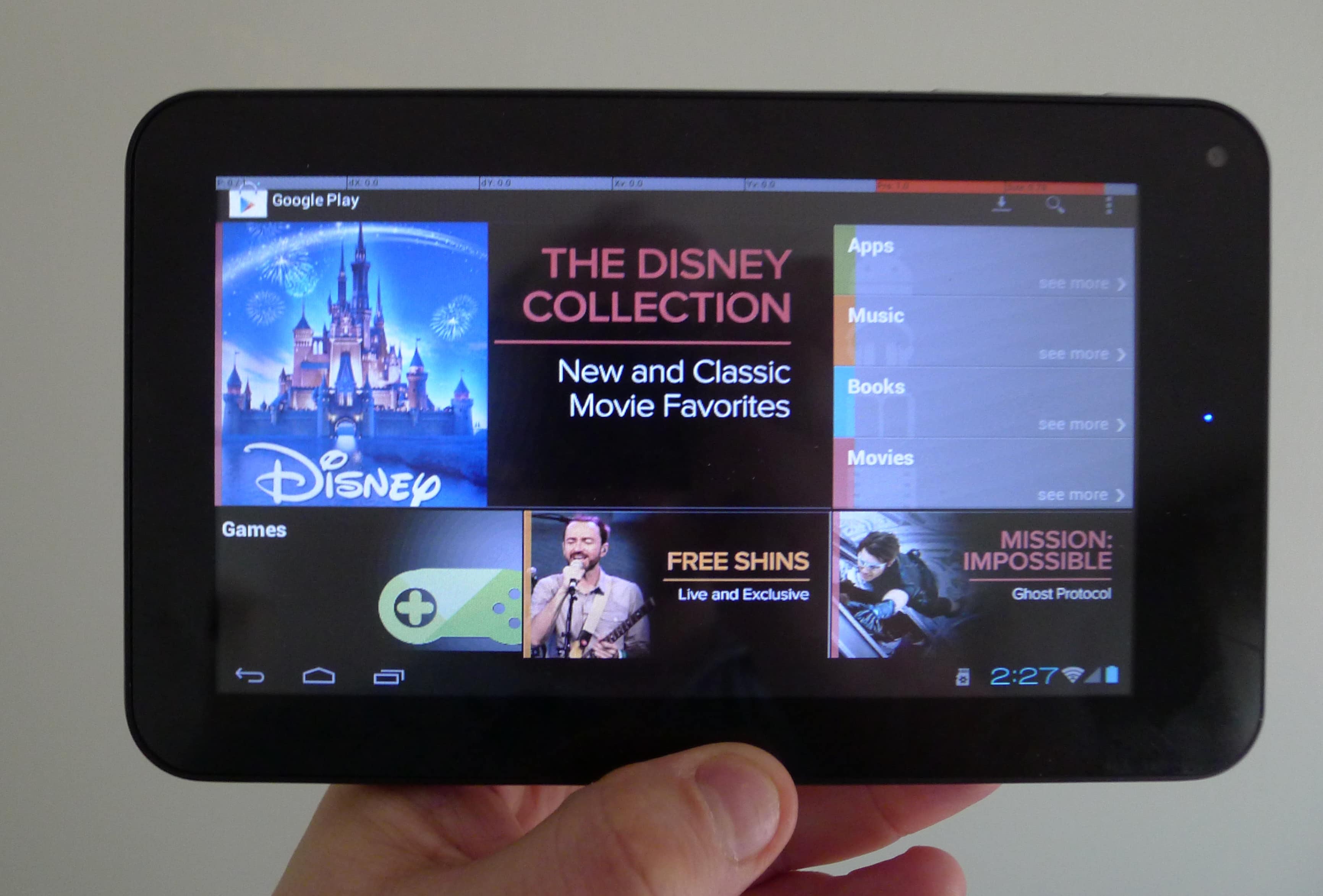
It doesn’t appear to have come with the necessary cable, but the specs boast that this tablet can support 2160p video playback for all formats. It also reportedly supports 3D Android games, though I’m not sure how I’m going to test that. One detail I can confirm is that this tablet ships with Android Market installed. As soon as I got it set up (a bumpy process), it updated itself to Google Play, which was nice.

At first glance the build quality is decent. It falls somewhere in between the PMID701 and the IdolPad, and I don’t see any obvious shortcomings. The touchscreen works slightly better than on the PMID701  and it is attached better than the one on the  IdolPad.

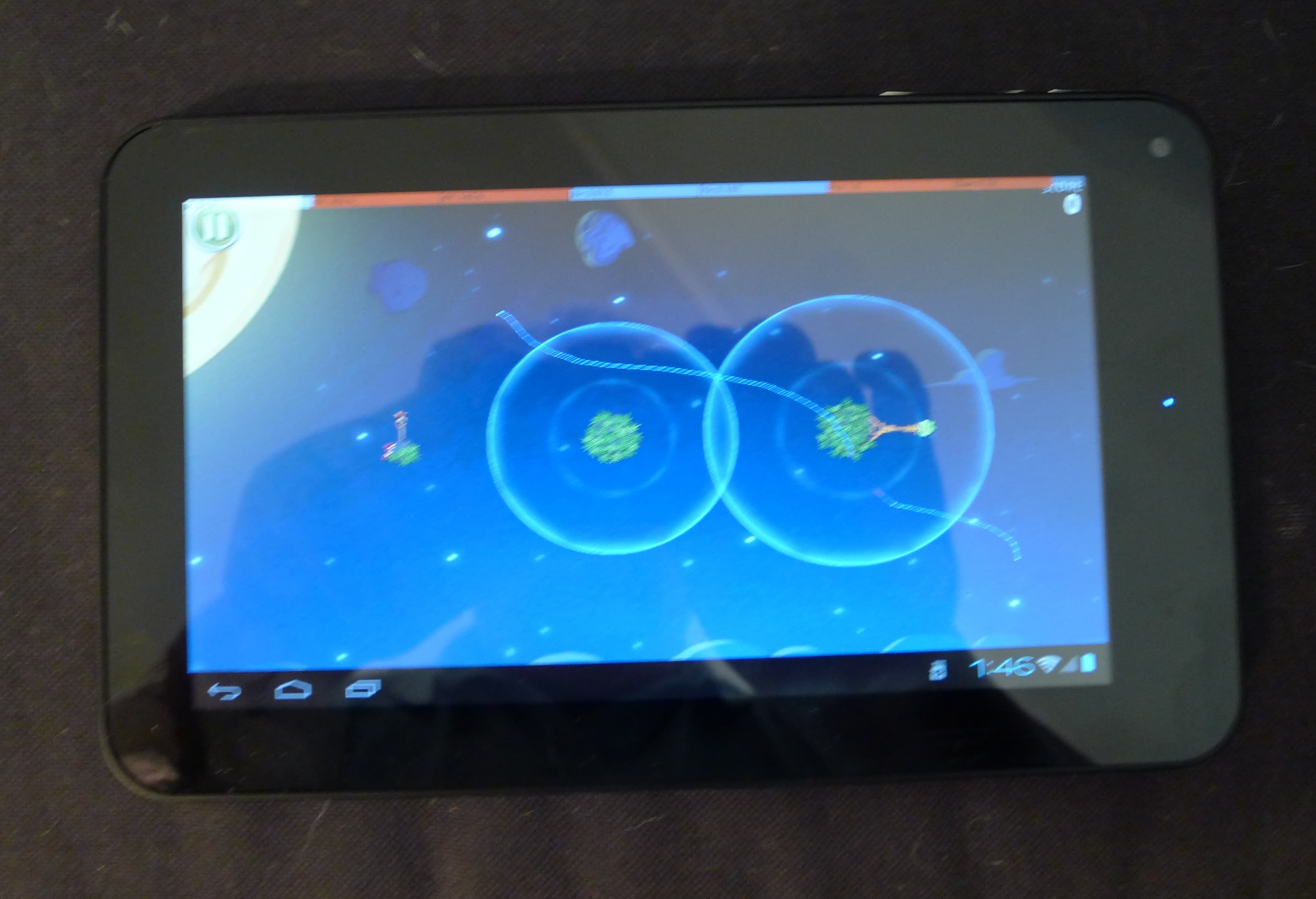
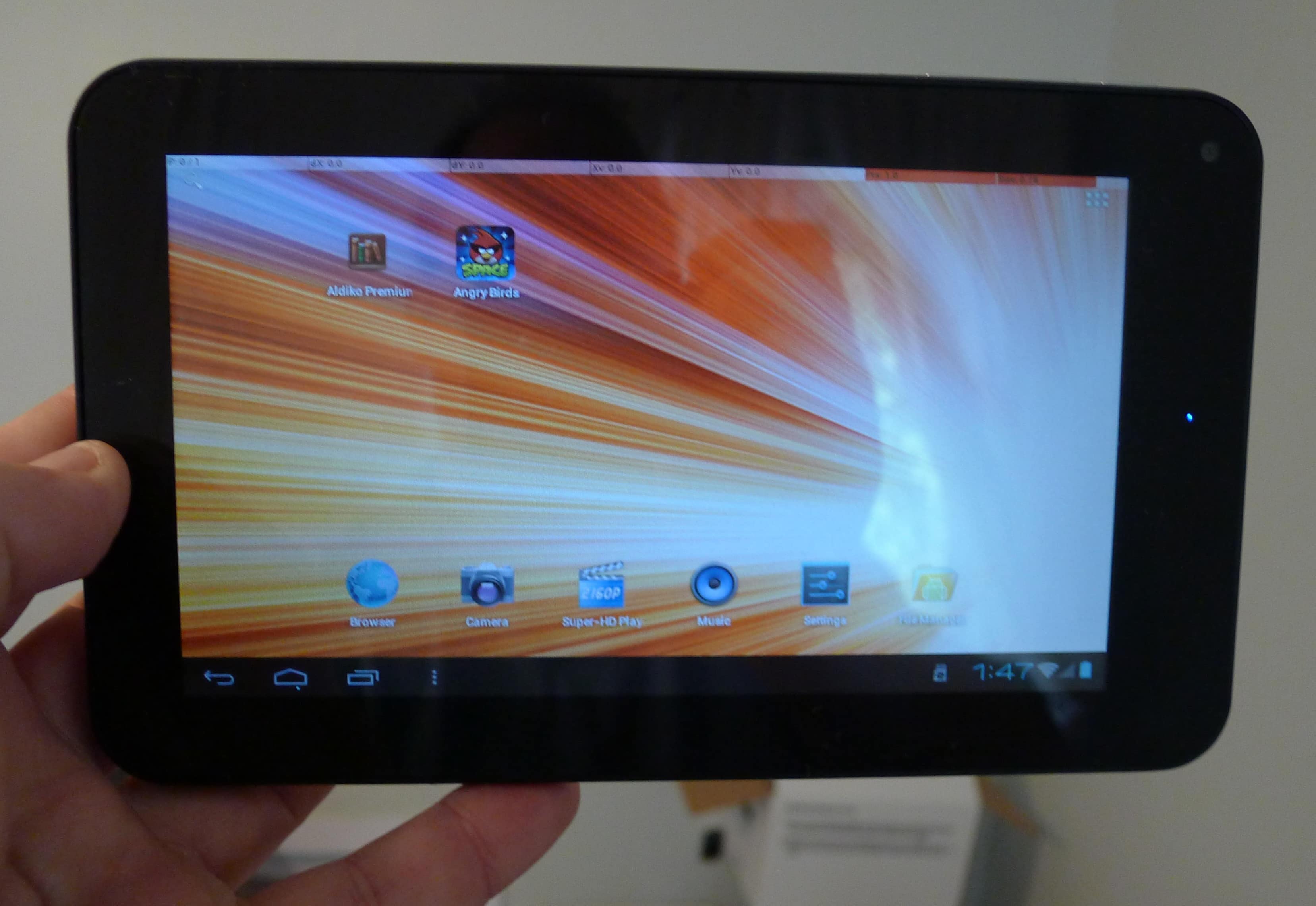
But I have noticed a quirk which might put some users off. It looks like the developers forgot to hide or remove one of their dev tools. This tablet tracks your use of the touchscreen with a line. It also reports the (x,y) screen coordinates in a row across the top of the screen. It’s strange, and I don’t know that I want to put up with it.

Update: Scroll down to the comments for instructions on how to turn this off.

I’ve installed a couple apps (Aldiko and Angry Birds). Aldiko works fine and Angry Birds performed slightly better than it did on either of its competition.

All in all, this is not a bad tablet. It cost a little more but I have the feeling that the performance might justify it. I’m looking forward to posting a review on the weekend.

Amazon

Specs

  • Android 4.0 Ice Cream Sandwich
  • CPU: A10 1.0GHz
  • RAM Memory: 512MB
  • 7″ screen, Resolution: 800×480
  • 5 points capacitive touchscreen
  • 8GB Flash storage
  • microSD Card
  • speaker, mike
  • Mini USB and USB port
  • HDMI out
  • g-sensor
  • Wifi
  • 1.3MP webcam
  • Dimensions: 195mm x 120mm x 14mm
  • Weight: 0.7lbs

eBook Sales Don’t Undercut Print Sales, Lulu Reports

The print & digital self-pub service Lulu shared some rather disturbing details in a press release yesterday. Well, it’s probably going to disturb anyone opposed to $10 ebooks; as for me, I’m thrilled.

Lulu was an early self-pub pioneer when it got its start 10 years ago as a POD service. This long predates the ebook explosion,  and Lulu’s solid core of creators (now over 1 million) gave Lulu a unique vantage point to watch the change int the book market when Lulu started offering ebooks.

Do you know how the Price Fix 6 said that they needed to prop up the price of ebooks so they didn’t cannibalize print sales? According to Lulu, that doesn’t happen.

What Lulu.com has found is that each of the two types of formatting tends to help fuel the sale of the other. Those authors who publish their book in both print and e-book format tend to sell double the amount of books, because it is available in the format that the reader prefers. While someone may read an e-book and recommend it to someone else, that person may go on to buy a print version of the book, or vice versa.

Print still makes up the majority of Lulu’s sales (68%), though it only accounts for less than a third of new titles produced. What’s more, ebook titles are growing much faster than Lulu’s print catalog.

If Lulu’s experience tells us anything, it’s that the digital customers are an addition to the print customers, not an exchange. That would tend to disprove the belief that ebooks cannibalize.

—

As interesting as the above data might be, Lulu left out a number of useful details from the press release (found over at DBW). For example, they mention how ebooks are growing faster but they leave out what percentage of their catalog is print vs digital.  Elsewhere on their site they mention having 1.2 million titles and growing by 20 thousand new titles each month.

I suppose this seems like a digression from the topic but I don’t think so. While I might primarily write about ebooks, I try to watch what’s going on for all types of self-publishing. It’s not uncommon to see a creator move across several categories. While music and video is the line most commonly crossed, moving from music into books isn’t so rare anymore. I’d say that the dividing line between cartoons and picture books is more of a smudge mark than a line. And as we  get better tools, this kind of thing will be more common.

In my opinion, the interesting stuff we see in the next couple years will be crossover type of content, and we’re already just beginning to see some of it come out of iBooks Author. I’m looking forward to it.

B&N Expands Foreign Language eBook Selection (Russian, Afrikaans, Urdu, Oh My)

Given that this section of the Nook Store was quietly launched in or before September 2011, I’m not sure this is still news. But it’s interesting none the less.

I noticed something about the Nook Store a few weeks back while I was working on the story about the US Spanish Kindle Store. All the attention at the time was focused on Amazon, but what few had noticed was that B&N had quietly reorganized the Nook Store to include a new section where US customers can buy ebooks in 8 different languages, which compares rather nicely to the 5 languages officially supported in the Kindle Store.

In fact, a side by side comparison of numbers is rather revealing:

Now, the Kindle Store does carry content in more languages than the 5 listed above, but all those titles are illicit. Amazon has made it clear in the past that only those 5 languages are supported and any content in a non-supported language will get pulled.

It’s an interesting comparison , isn’t it? Amazon is winning the content battle in 2 of the 5 languages they chose to support (while B&n offers more titles in Spanish). And given the paltry selection each offers in Portuguese and Italian, I’m calling those a draw.

But B&N is also offering a number of languages that Amazon won’t even touch, including several that I found through trial and error. Polish, Afrikaans, and Danish aren’t listed in the menu but they can be found by fiddling with the URL. (Pretty cool, Huh?) While the selection in some of the languages might be limited, at least B&N is offering them and classifying them correctly. That will stand them in good stead when they do go international.

While I’m at it, I’d like to point out that you can go find more foreign language books in the Nook Store. All you have to do is change the 3 digit language code (Afrikaans is AFR) to one of the codes listed here. (Hat tip to eBookFriendly for figuring out the language codes first.) The specific part of the URL that needs to be changed is the one beginning with &lng=. The language code comes after the equal sign. Click on one of the links above, delete the existing code 3 letter code, and type in a new one. Press enter and that should lead you to a new page.

I’d say that B&n clearly is the winner in the content department. They’re carrying stuff in the US market that no one else is (besides Smashwords, where some of the content is distributed).

Joyplus Shows Off 7″ and 10″ Tablets with? Pixel Qi Screens (video)

I’m feeling a little frustrated this evening so I thought I’d share a video with you. The video features a tablet with a screen we cannot get here in the US, now that Notion Ink has stopped shipping the Adam tablet. Charbax spent some time with JoyPlus while he was in Shenzhen last week. They showed him their 2 Pixel Qi equipped tablets with 7″ and 10″ screens.

Pixel Qi is a screen tech that has been just about to hit the consumer market for a couple years, and it’s been long enough that I’ve given up on the screen. I used to like this screen because it had a unique ability to have near LCD quality color while still offering a low power mode which extends the battery life.

But at this point I’m expecting that we’ll see battery tech improve while LCDs get more energy efficient long before I ever get my hands on a consumer product with a Pixel Qi screen.

Pixel Qi likes to boast that their screen is on a dozen products, but that’s not completely true.

First, the highest profile one, the Notion Ink Adam tablet, is no longer available with this screen. And at least one other device, the netbook from Sol Computers, is actually an aftermarket mod. I’m not sure that qualifies as a product. And then there’s the XO-1 laptop, which can only be had in used condition or after it has been surplused out of a program. Thus it’s not really available to consumers.

P.S. Don’t mind me. I’m just sitting here pining away for my $800 Pixel Qi Netbook from Sol Computer. It’s taking forever to arrive.