Nate Hoffelder

Nate Hoffelder

Kyobo Mirasol eReader Now on Clearance – 71% Off

All good things must come to an end; that’s a truism. Luckily it also applies to the less than good.

Kyobo Book Centre, South Korea’s leading bookseller, has recently put their Mirasol eReader on sale at a drastic discount. I’m still waiting for confirmation from Kyobo or Qualcomm, but it looks to me like this ereader is on the way out. That’s great; neither the software nor the screen tech were worth the original retail, which was more than $300 USD.

The price posted above is 99,000 won, or about $87 USD. That’s a considerable discount off the original 350,000 won, and it leaves little doubt that this ereader is headed for the scrapheap.

Kyobo was the first company in the world to carry an ereader or tablet or tablet with a Mirasol screen, and they launched it in late November 2011. It generated a lot of attention at the time, but the excitement started dying off shortly after I posted my review. The bloom completely fell off the rose when all the tech blogs got a chance to see it at CES 2012. The screen frankly didn’t live up to the previous several years of hype.

The original design for this ereader came from inside Qualcomm, with the reading app and other customizations added by Kyobo. It’s based around a 5.7″ Mirasol screen. It runs a closed version of Android 2.3 Gingerbread on a 1GHz Snapdragon CPU.

The screen, now that took a while to develop and given what I’ve heard about the limited sales I’m not sure that Qualcomm has broken even on it. The Mirasol screen tech was originally developed by a company called Iridigm, which Qualcomm bought in 2004. After 8 years of investment that likely has totaled a couple billion dollars, Qualcomm  has little to show us beyond a paltry number of devices sold in a few small niche markets (South Korea, Taiwan, and China).

Now, Qualcomm did show off a new 4.3″ screen at SID Display Week last month, so there’s hope that they can enter the smartphone market and recoup their costs. But there’s no word yet on when that new screen will go into production.

via

New Sony Reader Shows Up at FCC

It looks like my fears that Sony was getting out of ereaders were unfounded; a new Sony Reader appeared on the FCC website Sunday.

That image at right shows the backside of the new PRS-T2 ereader, an that image is about all I have to show you. Everything else is either permanently concealed or won’t be revealed to the public until 29 September.

But the backside does tell us a lot. It’s the same general shape  as the current Sony Reader Wifi and it even has the same proportions and an identical microSD card slot. We also know from the test sheet that it will have Wifi but not Bluetooth or 3G (like the PRS-G1 in Japan).

Arguably this means we’re looking at another 6″ Sony Reader, but that’s about all I can say at this point.

FCC

via

If Selling Used Software is Legal Then Why Not Used eBooks?

The one thing that publishers like most about ebooks is that you cannot resell them. This precludes the used book market (aka the bane of publisher’s existence), but if a recent court ruling in Europe means what I think it does then that’s about to change.

Zeit is reporting that Oracle has just lost a case in Luxembourg. According to the European Court of Justice (ECJ), software publishers have no right to claim copyright infringement when someone resells a software license. In the US we would say that the court affirmed the "first sale" doctrine; Europe has a similar legal principle.

This particular case involved a Munich-based company, UsedSoft. They specialized in buying and reselling used software licenses (which the original buyers are no longer needed). While that in and of itself is not a shocking activity, a close reading of the license doc itself showed that Oracle forbids resale (they all do, pretty much). According to this new ruling, that clause isn’t enforceable in Europe.

That is of particular interest to anyone who reads ebooks. You see, most every ebook is sold under a license that includes a similar – and now unenforceable in Europe – clause. Here’s what Amazon says:

Unless specifically indicated otherwise, you may not sell, rent, lease, distribute, broadcast, sublicense, or otherwise assign any rights to the Digital Content or any portion of it to any third party, and you may not remove or modify any proprietary notices or labels on the Digital Content.

Sorry, Amazon, but according to the ECJ at least one of those clauses isn’t valid anymore (though it will likely take a lawsuit to get Amazon to admit it).

Now, some might argue that this also invalidates the DRM on the ebooks, but I’m not so sure. This ruling only covers transferring the content to a new owner; DRM currently prevents it but that’s a technical issue, not legal.

And do you know what? I think Amazon will love this ruling (once they calm down). Amazon is currently a great place to find used paper books, and I bet they’d love the chance to take a commission when people sell used Kindle ebooks to one another.

Note that this would involve 3rd party sales, just like the current used book market on Amazon. All Amazon would have to provide is a mechanism to remove an ebook from one account and authorize it to another. That’s a technical issue, and best of all (from Amazon’s viewpoint) they don’t have to unlock the DRM.

That sound you hear right now is a thousand publishers saying "oh, crap". Their greatest enemy is positioned to build another secondary market which the publisher can’t touch. I bet you hadn’t thought of that one, had you?

image by upyernoz

Penguin and Cheap eBooks – A Historical Perspective

I was reading last weekend about the antitrust lawsuit against 3 of the Price Fix 6, and it reminded my of a historical footnote which adds an amusing twist to the current situation. The lawsuit moved a step closer to trial yesterday. U.S. District Judge Denise Cote has set the trial date for Apple, Penguin, and Macmillan for 3 June 2013.

That does not come as a surprise and isn’t much of a news story, but I am amused by the fact Penguin is involved in a price fixing lawsuit, given their early history.

I started reading a book this past week that sheds some light on this issue. It’s called Two-Bit Culture, and it focuses on the rise of the paperback and how the publishing industry responded. I’m still working my way through the book, but I’ve already noticed a number of similarities between the current ebook situation and paperbacks.

Paperback books predate the turn of the century, but they really got their start in the 1930s. Several companies were started in a few short years with the same general goal. They wanted to mass-produce a cheap book which could be sold for a quarter (or 2 bits, in American slang). They published classic fiction as well as reprinted books which had been successful in hardback.

There was no bookstore industry in the US in that era (not as we know it today), so these cheap paperbacks ended up in a novel distribution venue: newsstands. The paperbacks were sold alongside pulp magazines, one of the possible inspirations for the business model.

One of the companies launched to produce cheap paperbacks was Penguin. This company was formed in 1935 in the UK by Allen Lane, who had left his previous position as Publisher at The Bodley House, a well known firm. According to Penguin’s unofficial corporate history , Lane actually was inspired by the cheap pulp magazines he saw on a newsstand.

The thing about Penguin is that when they were launched, they were the period equivalent of the many ebook startups we have today. Allen wanted to sell his books as cheap as he could in order to get the largest audience, so he embraced new technologies and new distribution venues in order to accomplish that goal. He would have loved Amazon’s deep discounting of ebook prices for the simple fact that it built the market.

When I hear about Penguin being one of the companies involved in keeping ebook prices up, I snicker. Their current actions provide a stark contrast to their early history.

But it’s also not a surprise. Penguin is an example of the classic pattern of how businesses live and die. A young business adapts quickly to new markets (sometimes even inventing the new market) and does its best to grow. A mature business works at improving its position in established markets. And a moribund business tries hard to hold on to what it has, sometimes even going so far as to stifle new markets through financial pressure, backroom deals, and even criminal conspiracies.

Tell me, which stage do you think Penguin falls in?

I know some of my readers work for Penguin (discovering the one from Penguin Group South Africa was a shock) and you probably don’t appreciate what I’m saying about your company. Do me a favor and take a look at how Penguin is handling the library ebook market right now. It’s a regressive position, not innovative. It’s designed to limit the damage ebooks might inflict on existing markets, not build a new one. That is arguably the actions of a third stage company.

P.S. Much of the detail in this post comes from Two-Bit Culture. This book was published in 1984 and is regrettably out of print. Luckily you can find it on Amazon for under $10. Go buy it.

P.P.S. If anyone knows where I can find the ebook edition, please leave a comment. Thanks.

Penguin and Cheap eBooks – A Historical Perspective

World’s First Book Writen by a Computer is Now Available as a PDF

Spambots and other computer generated text is widely considered the bane of the modern web, but that wasn’t always the case. There was a time where when this idea was new and clever, and someone reportedly even used a precursor to today’s spambots to write a book.

Back in 1983 a pair of programmer/writers released a text generator called Racter (short for raconteur). The program was pitched as a way to let the computer write stories and poems, but there are reports that it wasn’t terribly sophisticated and in fact the quality of the output more closely resembled that of a MadLibs style of story writing.

While the released version of Racter was limited, it looks like there might also have been a more sophisticated version. One of the programmers, William Chamberlain, later published a book which he attributed to Racter. That book was The Policeman’s Beard is Half Constructed, and it was published in 1984.

That book is long out of print, and there is no legit ebook either. Luckily this book was saved from obscurity by Udu, a nonprofit group that scans obscure and worthwhile art and literature.

I’m not sure how this book qualifies as literature, but it does strike me as historically significant. After all, it does stand as a testament to the time before spambots joined the dark side.

You can find it as a 33MB PDF.

If you absolutely insist on a paper copy, you can find it on Amazon for about $40.

via

Penguin eBooks Return to Libraries – But Probably Never the Kindle

You’ve probably already heard the breaking news this morning. Penguin is finally going to lessen their hostile position toward libraries.

They’re launching a new pilot program this fall with a couple libraries in the NYC area (NYCPL and and Brooklyn Public Library) to offer ebooks via the 3M Cloud library. The pilot launches in August, and if it goes well, Penguin will open up its e-books to libraries across the country.

The ebooks are going to be sold to libraries on a 1 year license, starting 6 months after they are published. The license will expire, and it doesn’t look like Penguin’s ebooks will be on the Kindle. But this is at least a slight move improvement on Penguin’s last decision on library ebooks.

That 1 year expiration seems a little extreme, doesn’t it? My first thought was that it was extortionate, but after I thought it through I calmed down a little and remembered that most librarians won’t be as upset as I am.

I also realized that with some books it won’t matter.  I’m more bothered by the length of the expiration, not the fact that libraries will need to rebuy ebooks. These won’t be the first expiring ebooks; the Harry Potter series came to OverDrive with a 5 year expiration attached, and I didn’t complain then because needing to buy a book every 5 years is much less punitive than buying it on a yearly basis. And there are other expiring ebooks on the library market, but those don’t get the attention of the big name deals like the one today.

In 5 years many technical books are outdated and need to be replaced. In 5 years many fiction books are forgotten and won’t need to be kept on the shelf. But the single year renewal is worse, and it’s going to make the ebook purchases difficult to justify.

On a related note Penguin’s justification for it is laughable. Penguin told the Wall Street Journal that the "renewable one-year expiration date on e-books, meanwhile, is designed to mimic the natural shelf life of print books." *snicker* So all those decade old hardbacks on the shelves of my local library have to be bought each year?

—

There’s a second story here which I’m not sure anyone has noticed yet. The 3M Cloud Library doesn’t yet support the Kindle, and thanks to this deal with Penguin it probably never will.

You might recall that one of Penguin’s complaints about library ebooks was the ease with which patrons could load the ebooks on to their Kindle. Penguin’s official statements mentioned security, but that was a code phrase for their real fear, which was that making ebooks to easy to use would negatively affect sales on the consumer market.

It’s my guess that Penguin went with 3M because 3M doesn’t support the Kindle. If I’m right then one of the conditions of the contract is that 3M will never support the Kindle.

That, my dear, is a stupid move. It gives OverDrive an advantage that 3M cannot match.

image by My name’s axel


Content Drives Tablet Use, Survey Says

The Online Publisher’s Association has just released the results of a new survey into how people are using their tablets, and it’s a good one. A total of 2,540 Americans were polled in March of this year.  About 760 reported that they were tablet owners, and here are the highlights of how they’re using their tablets:

  • 31% of Americans own tablets
  • Nearly as many own an Android tablet as own an iPad (47% vs 52%)
  • Half spend more than 10 hours a week on the tablet
  • 60% use their tablet several times a day (or more)
  • 60% get content several times a day (or more)

The above details just scratch the surface of the survey results, which run to 47 pages. It’s well worth a read, but there were a couple points that caught my eye.

This survey confirmed something I’d long suspected. While mobile use is up, it turns out that the users aren’t mobile. A full two thirds of the time spent on tablets is now at home, not while the user is actually in motion.

I’m not at all surprised by this because I’ve been tracking how I use my tablets. For example, right now I have a couple tablets sitting next to me. They’re set to ping whenever I get an email or tweet. I also use them when I want to sit back to read and contemplate someone’s blog post (rather than reading it on my laptop, where I lean forward).

The other point which caught my eye was both a surprise and an explanation for the decline in sales of E-ink screens.

When considered as a reading device, the tablet won out over everything from PCs and smartphones to magazines. That’s not much of a surprise, assuming that the content is well formatted. The bombshell was that respondents preferred tablets over dedicated ereaders like the Kindle:

It’s going to suck to be E-ink this year; the ereader market was quite lucrative. Now it looks like it might be disappearing.

image by lejoe

76% of US Libraries Lend eBooks

The American Library Association has just released the results of their annual survey today, and aside from budgets being cut while responsibilities are increased, things are looking good.

More libraries were lending ebooks and audiobooks last fall than the year before (76% vs 67%), and a significantly larger number of respondents said they were lending ereaders as well (39% vs 28%). The survey also showed an increase in the number of libraries that offered free Wifi, internet access, and technical training for patrons trying to use all the technology.

The statistics are drawn from the ALA annual survey, which is conducted on October of each year. The results o the October 2011 survey were just released today – 8 months later. What can I say, that’s how the ALA rolls.

You can find more information at the link below, but to be honest I’m only interested in the ebook stats. I’m surprised to see them up and the same goes for the ereader lending stats. 2011 was a tumultuous year for libraries, what with HarperCollins deciding to limit checkouts to only 26 per copy.

Methinks this is a sign that libraries are going to get into ebooks no matter what the major publishers do. The news of Penguin pulling their ebooks out of libraries and Random House quadrupling their prices will probably hardly even effect the next survey.

ALA

image by Robby van Moor

Next XBox to Get Tablet-Like Controller

We all know that Microsoft announced their new Surface tablet last night, but that’s not all that happened. One unrelated story was lost among the froth of excited bloggery in the build up to the launch yesterday, and as I look over it this morning I realize it is nearly as important.

A spec sheet leaked a couple days ago which detailed the not yet released Xbox Surface. I saw it yesterday, and I initially held the post so I could use the info to support the big news announcement last night. I’m glad I held it because it turns out that the Xbox Surface probably has very little to do with the event last night.

A number of sites reported on the Xbox Surface yesterday, and some called it a tablet. That’s not quite true. A close reading of the spec sheet suggests that the Xbox Surface isn’t a tablet so much as it’s just a wireless controller for the next Xbox. Have you seen photos of the new WiiU controller? While we don’t know what the Xbox Surface will look like, we can guess that it will work much the same way as WiiU controller.

The spec sheet indicates that the the Xbox Surface has a 7″ (1280×800) screen with card slots, Wifi, and Bluetooth, but what it doesn’t have is a CPU. That is in the "stationary computing device", which in fact has 2 multi-core CPUs as well as 5GB of RAM and an unspecified graphics chip.

Don’t get me wrong; I think the Xbox Surface is going to be great – assuming this spec sheet is for real. But the important thing to note here is that the Xbox Surface isn’t going to be competition for the Windows tablets announced last night – not in any form. Those are mobile devices while this one is fixed.  Microsoft is quite carefully not letting their 2 products get in each other’s way.

Clever, that.

Tunesviewer Brings iTunes U to Android, Linux

When Apple launched the updated version of iTunes U back in February, they had planned to only make it available on their hardware.Unfortunately for Apple, someone forgot to tell that to a Linux developer who has been working to make the content in iTunes U accessible to those not lucky enough to own an iPad or iPhone.

Tunesviewer is a 2+ year-old app for Debian, Fedora and Android. It predates the current iTunes U app by quite a bit, and it has one simple goal.  It helps Android owners (there’s more of them than Linux owners) find and download the podcast and videos in iTunes U.

The app won’t help you with the more sophisticated features that Apple added this year (like shared notes) but that’s okay.  It would require far more tricky programming to do more than simply download content. And it does show you everything that is currently available via iTunes U (I double checked with my iPad).

Update: The app has been updated and it now works for me.

TBH, I’m not sure it can even download content. I’ve now tried it on a couple Android tablets (including my eeePad Transformer) and I cannot download anything. I can find the course pages, but when I click the button nothing happens.

Right now I’m scratching my head.  This apparently worked for someone at some point, but it’s clearly not working for me. What’s more, I’ve looked through the various pages and I don’t see where I can do anything to change it. (Perhaps the app doesn’t like the latest version of Android?)

Even though I cannot get it to work, I’m posting this anyway. I’m hoping that it works for you and that someone might have pity on me and tell me how I can fix it. I am willing to put some work into troubleshooting my issues.

I definitely like the idea and I think the developer deserves a round of applause.

Tunesviewer

How to Add Android Market to Polaroid PMID702C

There are many many budget tablets on the market,  all with about the same specs and performance. Given that there’s not much to distinguish them (other than appearance), about the only way to choose among them is whether you can install Android Market and how well a tablet can run the apps you need.

This particular  tablet just arrived on the market this week, and as part of my plan to install Android Market on all my tablet I immediately tried my usual easy to follow instructions for installing Android Market. They worked.

Note that this isn’t  a set of instructions on how to hack the tablet; I’m only interested in achieving a certain minimum level of ability with the least work required.

Like the numerous other tablets I have hacked, installing Android Market was a straightforward process. All I did was repeat the steps listed in this post. It didn’t go quite the same way but the process achieved the goal.

  1. Download this ZIP file to your computer.
  2. Open the Zip file to your computer and copy the contents to a folder on your Polaroid tablet via a USB cable. Then unplug your tablet.
  3. Once you’ve done that, open the file manager on your tablet and go to the folder where you put the files. Try to install the following apps in this order (double click on the files in order to run them):
  • OneTimeInitializer-signed.apk
  • SetupWizard.apk
  • vending-3.1.3-signed.apk

As a 4th step you might want to press the home button, select the checkmark which says "open always with", and then select Launcher. This will guarantee that whenever you press the home button you will see the home screen and not be prompted with a menu.

Update: Does your tablet run Android 4.0 or above? Are you feeling lucky? Then you might want to try to install the file labeled "JB Play Store". This is a later version of the Play Store.  It only runs on Android 4.0 and above, and it doesn’t always work, but if you can successfully install it you will have a complete version of Google Play.

I have Aldiko and the Google Apps installed and they work fine. Note that I don’t have the Google videos working on the tablet and I have no way to test it due to the simple fact that I don’t buy my videos via Google Play.

Amazon Now Rejecting eBooks Made With Calibre

The open source ebook tool calibre has been able to make Kindle ebooks for several years now, and for mot of that time Amazon has accepted those ebooks into KDP with scarcely a murmur. While they often looked down their nose at the app, it wasn’t until very recently that  Amazon decided to start refusing to let authors submit ebooks made with it.

I found  thread over on MobileRead that a conversion specialist started earlier this week. The tech reported that one of their customers had a book bounced by Amazon. After first sitting on the ebook for close to a month, Amazon finally gave this explanation:

Our technical team has found that the content of your book was created by 'Calibre', hence it is not buyable on our web site.

Please upload your book in either a MOBI file created by KindleGen or upload the content file in Doc/HTML format. The book will then be made buyable and searchable in the next 24-48 hours after republishing.

Thank you for your immense patience and understanding during the time it took to research this issue.

That’s a first, not just for the specialist but for me and pretty much everyone who has submitted ebooks to Amazon. While Amazon doesn’t much like the fact we use unapproved tools, they’ve never gone so far as to refuse them simply because of the tools you used.

In fact, the only times I’ve heard of Amazon rejecting ebooks (including a retroactive rejection) were due to technical issues in the ebooks like poor image quality, horrendous formatting, and the like. (They also reject ebooks because they’re public domain or simply junk, but that’s not an issue here.)

And it turns out that in this case calibre probably did introduce some technical issues when the Kindle ebook was made. Another converter responded a few hours later with a similar report as well as a possible cause.

The problem is simpler than I expected. Calibre recently got the ability to make the combined KF8/Mobi ebook files that Amazon really wants you to submit. Unfortunately, it doesn’t do a very good job. According to Kovid Goyal, the primary developer of calibre (in reply to another comment):

If you were generating plain old MOBI files then that is highly unlikely as calibre’s MOBI output has not had any significant changes in a long time. If you were generating combined MOBI/KF8 then it is possible.

So it seems that Amazon might be rejecting ebooks because of flaws in how they’re made. That would be good news, because it means that you can fix and or prevent the problem by simply selecting the correct options while making the ebook.

I’d go back to simply making an ordinary Mobi ebook, at least for now. Leave the KF8 alone until the bugs get worked out of calibre.

But if you absolutely have to submit a KF8 ebooks, you could always try KindleGen or the Kindle Previewer. Both can make the new KF8 ebook format for you.

via


Yitoa Unveils a Flexible eReader in China (video)

Charbax is still on his trip to China and today he succeeded in uncovering a new ereader based on LG Display’s flexible 6″ E-ink screen.

Yitoa is a Chinese OEM, and it looks like they are showing off as clone of the flexible ereader I held in my hands yesterday. The ereader that Charbax found in their booth bears more than a faint resemblance to the Wexler FlexOne (including the Wexler label on the back). Of course, there’s a good reason for that; Yitoa is the manufacturing partner for Wexler.

As you watch the video, note that the listed specs has the wrong resolution; this device uses the plastic backed screen developed by LG Display; the correct resolution is 1024×768.

Hands On With the Wexler FlexOne eReader (video)

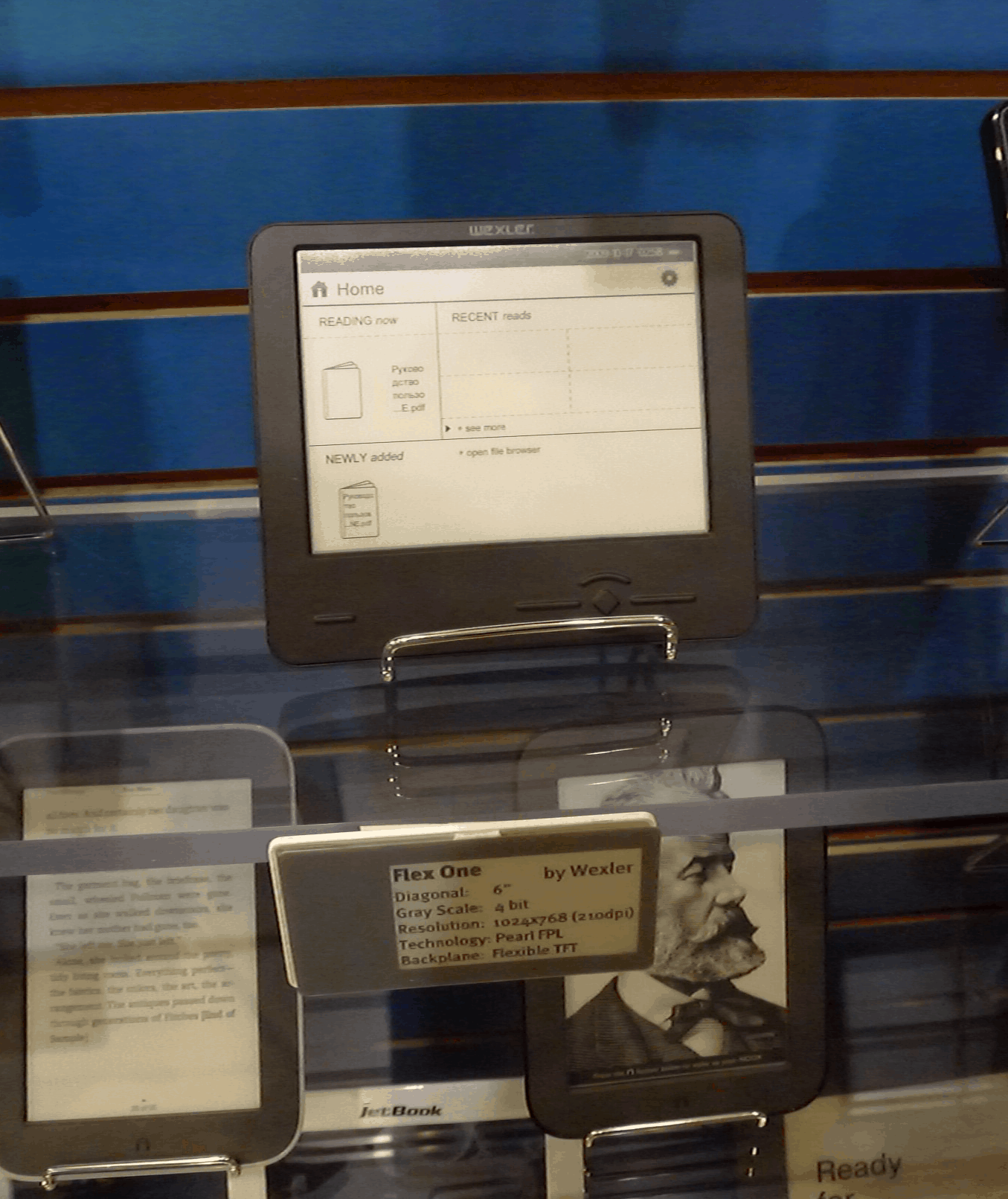
Wexler, a Russian ereader maker, was the first company to release an ereader which used the flexible 6″ E-ink screen made by LG Display. It’s been out in Russia for a few weeks now, but since Wexler won’t ship to the US this device hasn’t managed to cross the ocean.

Until now.

I got my hands on it for a few minutes yesterday, and the head of marketing at E-ink also helped Ron Mertens shoot a brief video (end of the post). I’m still trying to talk my way into buying it from E-ink (wish me luck). Just so you know, this is the screen that I was disappointed not to find in the LG booth, and I was a little surprised to see it in the E-ink booth.

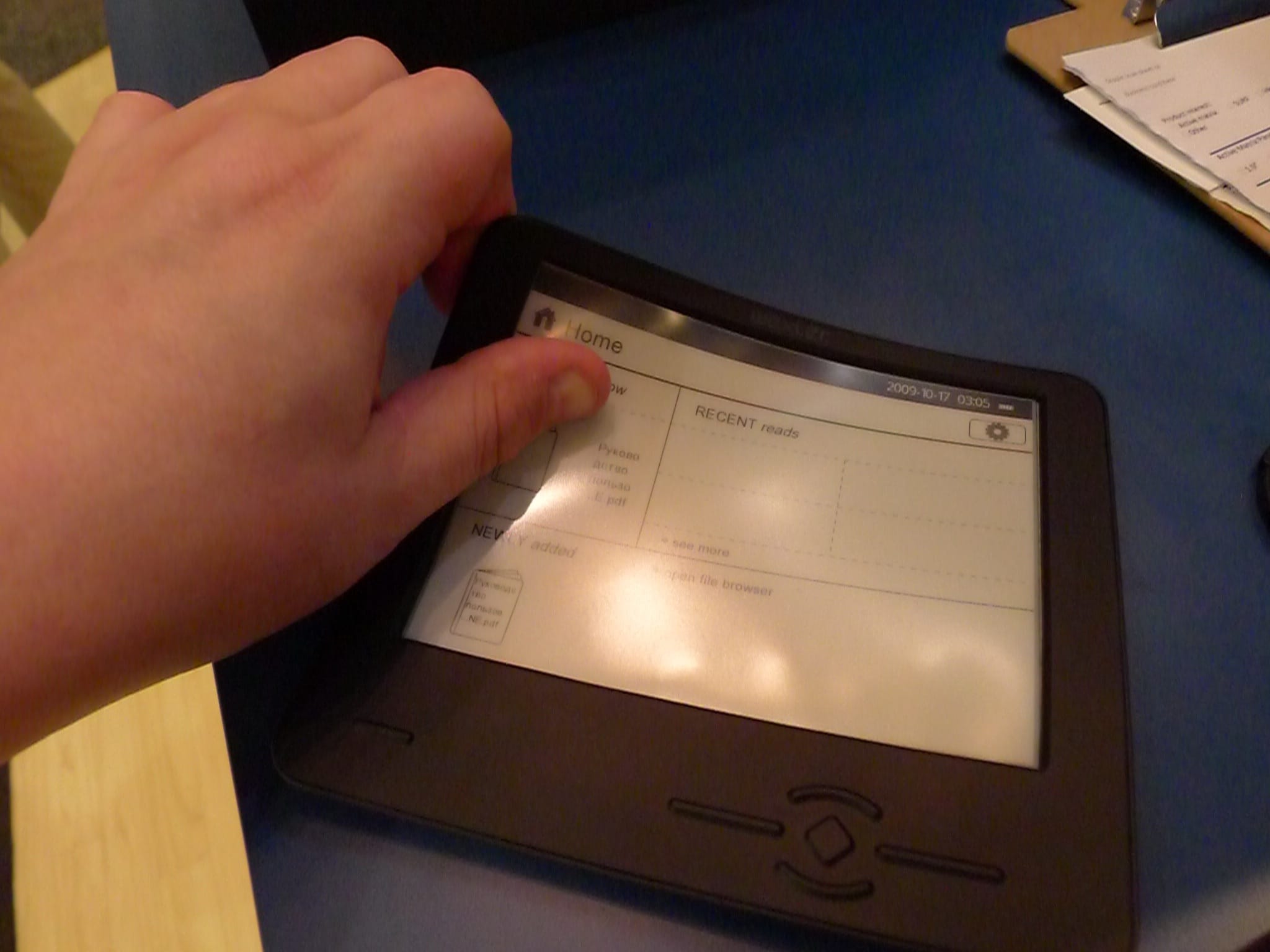
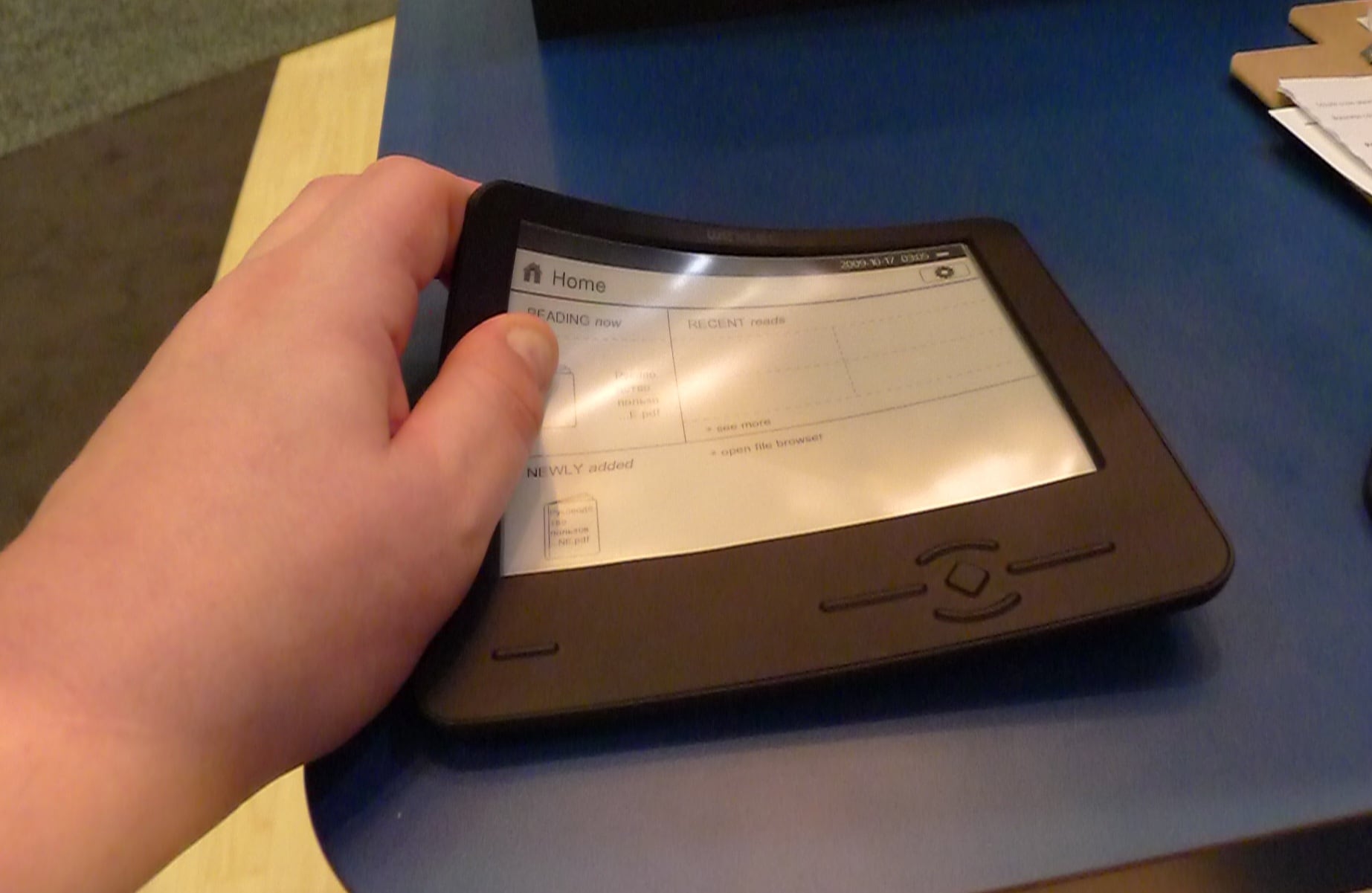
The FlexOne looks just like the unit shown in the abuse video I posted a few weeks back. It is indeed that flexible:

Naturally I didn’t dare put any real effort into killing it; it wasn’t mine after all (and I’m still trying to get it).

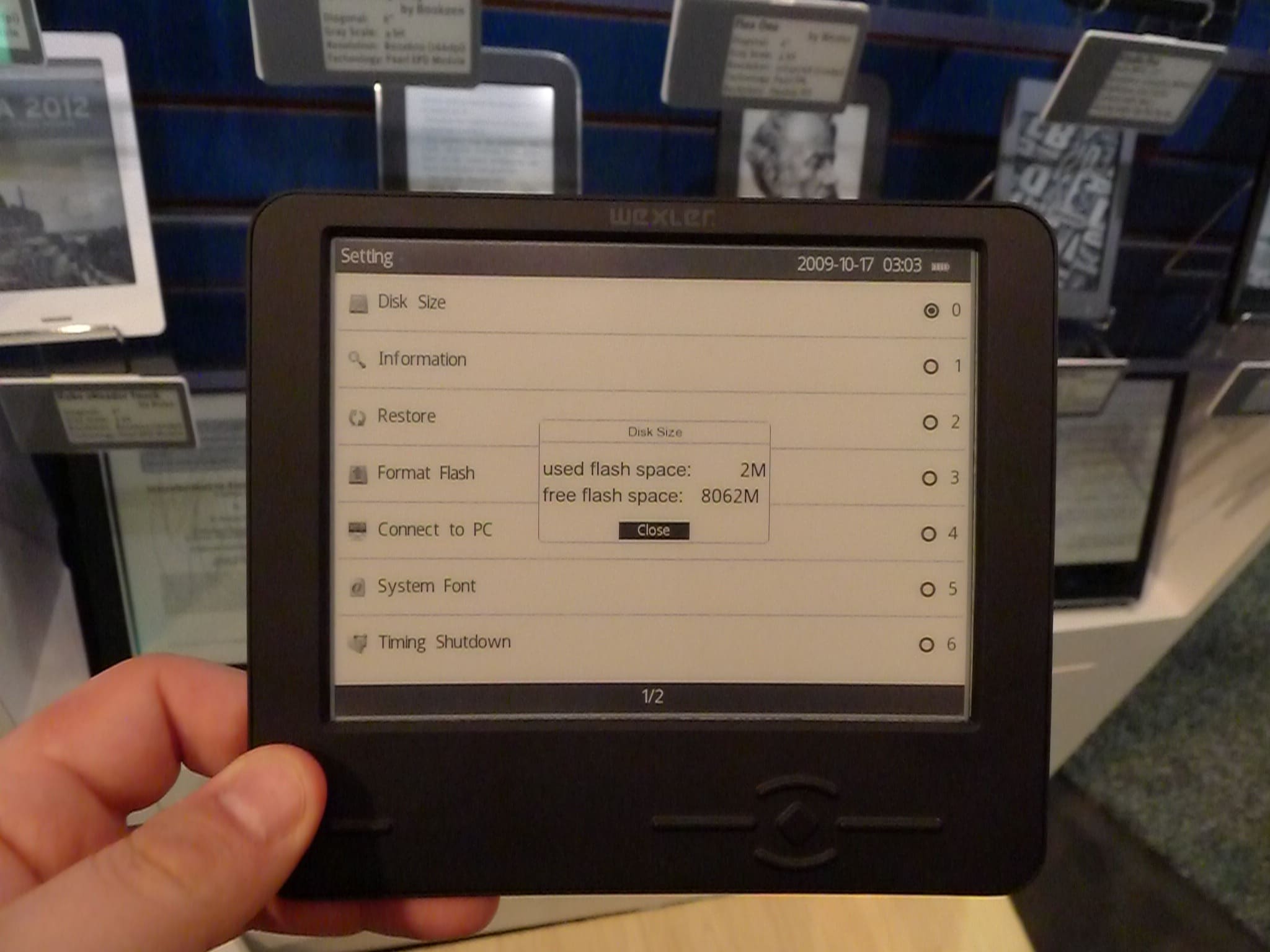
I also put a few minutes into trying out the features.  It’s a pretty basic device with no touchscreen, Wifi, or anything you wouldn’t expect to find on a cheap ereader. About its only remarkable feature is the flexible 6″ screen. I’m hoping to see it on the next Kindle or nook, aren’t you?


Sony Launches a Browser Based eBookstore (Finally)

This next piece of news comes from the "We’re not dead yet" dept.

Sony announced yesterday that their ebookstore was now available to browse and buy ebooks via any web browser.  This is a stellar achievement for Sony, and it comes a mere 6 years after they launched the Reader Store.

Nope, I’m not kidding there. Sony opened the Reader Store when they launched the PRS-500 way back in 2006. You could only access it via Sony’s app, which only ran on Windows (and poorly, at that).

In other news, Sony also released an updated version of the Reader app for Android. According to the listing in Google Play, the app has a new UI as well as several bug, stability, and performance fixes.