Nate Hoffelder

Nate Hoffelder

UK Students Aren’t Buying eBooks

Earlier this week I posted on a presentation that Bowker gave on their first annual world ebook market survey.  That survey, which covered 10 countries, wasn’t the only new survey that Bowker has started recently. A few days ago BML Bowker released some of the results of a new UK study. A  total of X university students were polled in December 2011, and they were asked where they got their content for class.

The students indicated that print books were the most common source of study material, with instructor hand-outs coming in a close second (88%, 87%). Online journals came in third with 79%, and ebooks came in 4th with 62%. Whart’s even more interested is that when students were asked to pick just 3 sources, ebooks dropped off the chart (< 5%).

This is an ebook blog, so you might expect me to be disappointed.  I’m not, and that’s because the idea of ebooks is a tad anachronistic  when it comes to textbooks. I’ve mentioned in the past that the digital textbook innovators are not making digital textbooks. What you see in this survey is that students aren’t using them, either. Instead they’re using free (to them, at least) online content or free teacher hand outs.

Now that is interesting.

BTW, there’s one bit of info that Bowker didn’t share in the press release (they’ll sell it to you in the complete report). I’m curious about how many students are buying the paper textbooks they’re using. I suspect that this figure will be about the same as the number that aren’t buy ebooks.

The survey results showed a low number of students buying ebook (9%). Bowker indicated that students instead tended to get them for free or borrow from the library. This would tend to fit in with a growing trend here in the US, where students are buying fewer textbooks each year.

Here’s the thing. UK students aren’t inclined to buy digital textbooks, while at the same time digital textbooks are the hot new thing for publishers, with Inkling Habitat and iBooks Author getting all sorts of media attention. Who’s going to be buying those digital textbooks?

This little bit of news does not bode well for publishers.

UK study

Samsung’s ElectroWetting Screen Tech to Hit Mass Production Next Year

Samsung is a name we haven’t heard for a long while in screen tech news, and now we know why.

Johan Feenstra, the head of the Samsung LCD Netherlands R & D Center (SNRC), said recently that the screen tech won’t be ready for mass production until 2013. Feenstra was a speaker at a digital reading and tablet event in Bussum earlier this week, and that is where he also indicated that they’re focusing on larger screens as well, with a 9.7″ prototype in the offing.

Feenstra has been working with Samsung’s electro-wetting screen tech since 2002, long before it belonged to Samsung. The tech was originally developed by Liquavista, a company that Feenstra  helped found in 2002. Samsung bought Liquavista in early 2011, and a couple months later relaunched the firm as SNRC.

The news today is rather thin, but it’s interesting none the less. Back before it was bought, Liquavista had planned to release smaller screens in the 6″ or so range. Basically they were going after the ereader market.  But this was back in 2010 and before.

Unfortunately for Liquavista, the price point for the 6″ ereader market dropped  below what they’d need to charge for their screen. Between B&N and Amazon, you can get an ereader here in the US for under $100 bucks.

And the tablet market is almost as bad.  While there are 7″ tablets in the $400 range, they’re all premium devices with hardware costs that leave little margin for a new and expensive screen.

So why continue to develop the screens? Well, Liquavista’s screen tech is much more energy efficient than LCD screens, even though it’s based on similar technology. And the LCD screen on a device is often the biggest battery drain, so if you can replace it with  screen that is only half as demanding (Liquavista can do even better), you should be able to significantly extend the battery life.

On the other hand, battery life isn’t the bugaboo it was when Liquavista was founded, or even when it was bought.  It’s not unusual anymore to see a tablet with a day or more of usable battery life. By the time that this screen tech actually hits the market, there might not be much of a need for it anymore.

via

Bowker – Amazon Dominates the World eBook Market

Kelly Gallegher, the VP of Publishing Services at RR Bowker gave an eye opening presentation at the conference today. RR Bowker has just completed a 120 country survey into consumer’s ebook buying habits, and today we got a look at some of the data.

The presentation was densely packed with info, and there was in fact more data on the slides than you can take in at one sitting. So I took pictures of slides. You can find the photos on Flickr.

If I get the slides I will post them, but until then I think the photos are worth a look.  The world ebook market is a lot more complex than you might think, and each country in the survey has its own market quirks.

Here are some of the highlights:

  • eReaders in the US market peaked at 70% in August 2011, PCs now under 10%
  • From November 2011 to January 2012, the percentage of ebook buyers went from 17% to 20% in the US
  • 35% of ebook buyers are power buyers, and they buy 60% of ebooks & spend 48% of the market
  • Print power buyers, on the other hand, only account for 22%, buy 53% books sold, and they account half the market
  • US ebook market might have hit a saturation point, given that growth has slowed down

And here are some details from the international market

  • fiction has its greatest appeal in developed countries
  • non-fiction & technical books have greater appeal in the emerging ebook markets
  • the PC is still the most popular reading device (all markets)
  • eReaders are the most popular reading device in the US, UK and smartphones win in South Korea
  • India & Brazil have the greatest potential for growth, both in terms of low resistance and high enthusiasm
  • Kobo has a major presence in South Korea (15%)

And as for Amazon, in almost every country where they have a local ebookstore they are the single largest source of ebooks. The one exception is France, where the Kindle Store loses out to "high street chains", collectively. Split those stores up (Fnac, for example) and Amazon probably wins there too.

Bowker also found that B&N doesn’t show up as having nearly the market presence I thought they did. Consumers reported them as having only 13% of the US market.

Light the Torches – Amazon is Censoring eBooks Again

Just when you think you’ve beaten prudish censors into submission, they pop up somewhere else. Digital Manga Publishing, importers and translators of Japanese comics, has had their entire Kindle publisher’s account disabled. Their crime? Running afoul of an unnamed Amazon drone.

Update: This has been resolved. Their account has been reactivated.

As March 15, 2012, Digital Manga Inc.’s account has been suspended from the Kindle platform. While we’re working to try and amend the situation, we will not be able to publish titles to the Kindle for the foreseeable future.

Our account was suspended under troubling circumstances – we have had titles cited for “content violation”, and while we screen every title to ensure they adhere to Kindle’s standards, their guidelines are notoriously vague, and prohibit “Pornography and hard-core material that depicts graphic sexual acts.”

For those just tuning in, Amazon has long used vague content rules to pull ebooks which they don’t like. The rule in question truly is vague, and it has never been applied fairly. For example,it should come as no surprise that Amazon has pulled DMP titles before, for the exact same reason that DMP lost their account today, while at the same time leaving up titles with similar and equally risque content. But it does make today’s new particularly disappointing; DMP had been trying to toe the line.

Unfortunately, DMP had the deck stacked against them. You see, they published yaoi manga, which is a particular type of Japanese comics that focuses on gay romance. Someone in Amazon clearly disapproves of it.

Do you know what? I’ve realized that my initial sentence calling this act of censorship prudish behavior is not true.

The word I should have used was homophobic.

You see, Amazon is still selling many different books that fall into the category of pornography, including Shades of Gray, the infamous ebook that is even now at the top of bestseller’s lists. No offense to the people who read it, but that book is far more graphic than most yaio manga. In fact, aside from the minor detail of the stories being a romance between 2 men, number of the stories are rather tame. So why were they banned?

Aside from the homophobia of someone inside Amazon, I cannot think of a reason. I hope Amazon will enlighten us. I have contacted them and await their response.

DMP’s complete complaint follows:

To all our fans:

As March 15, 2012, Digital Manga Inc.’s account has been suspended from the Kindle platform. While we’re working to try and amend the situation, we will not be able to publish titles to the Kindle for the foreseeable future.

Our account was suspended under troubling circumstances – we have had titles cited for “content violation”, and while we screen every title to ensure they adhere to Kindle’s standards, their guidelines are notoriously vague, and prohibit “Pornography and hard-core material that depicts graphic sexual acts.”

There is no definition of “pornography” versus “erotica” officially available from amazon. In the past, we considered our titles the latter, and strive to comply with Amazon’s guidelines. However, with such vague guidelines and a veritable library of erotica in written and drawn form already available on the Kindle, it is difficult to discern exactly what rules Amazon wanted us to comply with. We also find it disheartening that our titles depicting male homosexual romance have been banned while erotica depicting other forms of intercourse flourishes. What makes relationships between men more objectionable than erotic tristes between men and women? This is a question we imagine you’re all asking yourselves right now, and a question that we need Amazon to answer for us.

While we work to restore our account, we encourage yaoi fans to explore alternate platforms for reading manga. Our titles are available on emanga.com, Nook (including free apps for your PC, iPad, or Android tablet), and on the DMP App for Apple products and Android Tablets. This event has also led us to pursue the possibility of making digital manga available through other platforms. We look forward to continuing to bring you all the best in manga content, yaoi or otherwise, and appreciate your continuing support.

If you would like to make your voice heard in regards to this issue, we encourage you to contact Amazon at [email protected]. Vote with your voices and your wallets, and help us ensure that Amazon doesn’t censor the content you want to consume. We know our fans are intelligent adults, and we feel that it’s wrong for a big company like Amazon to dictate what is proper for adults to read.

Axis360 to Offer Epub Library eBooks in April(ish)

It looks like Baker & Taylor is pulling back from their previous plan to offer a proprietary (and incompatible) library ebook platform. At some point later this year Axis360 is going to offer library patrons the choice of checking out ebooks in Epub as well as the current Blio format.

Axis360 was launched in December of 2011 as a move  to capitalize on Blio, the new rich ebook format which B&T lunched in late 2010. The pilot partner was King County Library System, which is based in and around Seattle. B&T has expanded xis360 to include 45 libraries  now, with another 50 likely to be added by the end of the year.

There are now 200 publishers signed up, with over 240 thousand titles offered. The ebooks can be read on the Blio apps, which are available for iOS, Android, Windows.  Now, one key shortcoming of Blio and Axis360 is a lack of compatible ereaders That will change later this year. I’ve been told that Epub will be offered later this year.

And just to be clear, I was specifically told that Axis360 would offer the option of Adobe DRM (compatible with the Nook and other ereaders). And yes, I am wondering how they plan to accomplish that; it’s technically complicated to convert from Blio to Epub.

But that would be no less technically complicated than converting to Kindle format, which is what B&T would like to do. They’re in talks with Amazon, but I wouldn’t read too much into the negotiations. Everyone (Freading, B&T, 3M) is in talks with Amazon  but no one appears to be getting anywhere.

If and when they add Epub support, Baker & Taylor will have accomplished what I didn’t think they could do: launch a credible competitor to OverDrive. The format and DRM restrictions of Blio prevented it from working well on ereaders, thus removing it from the interest of a lot of library patrons. But it looks like B&T figured that out.

Do eBooks Make It Harder to Recall What You Just Read? Answer: No

I’m rather busy with a conference right now, but there’s an article that was posted today that has me pissed. I have to respond to it.  Time has an article on their website today which asks the question "Do eBooks Make It Harder to Recall What You Just Read?"

I received a Kindle for my birthday, and enjoying “light reading,” in addition to the dense science I read for work, I immediately loaded it with mysteries by my favorite authors. But I soon found that I had difficulty recalling the names of characters from chapter to chapter. At first, I attributed the lapses to a scary reality of getting older — but then I discovered that I didn’t have this problem when I read paperbacks.

The thing is, this question is bunk and I can prove it. Not only can I say that from my own experiences; I have a scientific study (published in a peer reviewed journal, no less) which disproves the anecdotes in Time's article.

Jordan Schugar, a professor at West Chester University (outside of Philly), has been studying this for some time now. Back in spring 2011 Jordan ran a study to test the reading comprehension of students in a freshman comp class. A total of 30 students participated, and they self selected into a control group and a test group. The latter were given Nooks to read on. Note that this was in the spring so they didn’t have Nook Touch, so instead the students were in fact given the original Nook to read on (this should be kept in mind, given how clumsy it was to use).

The students were tested throughout the course with fairly ordinary in-class quizzes, which were given 4 times during the semester. Depending on your point of view, the results were either good or bad.

After rigorous analysis, the results showed that the students who read on the Nook had a very slight increase in comprehension. The paper (here) called the difference in scores insignificant, and I’m not going to argue with the folks who have PhDs (not this time anyway). Even though the paper says that the results didn’t show one was better, they did show that neither was worse. So any anecdotes that say otherwise are likely bunk.

On a related note, I got this paper  a couple weeks ago. I hadn’t posted on it yet because I was waiting on the results from the followup study. Dr. Schugar has just concluded a similar study, only this time the students used tablets. I haven’t seen the results, but I’m told that the tablet users scored lower than the control group (who read on paper). Interesting, no?

That mixed result was enough to make me wait. I wanted to look at the paper and ask questions about the tools used. See, while I’m not bothered about being distracted while using a tablet, I do see how it might affect grades. This might have had an effect on the later study.

paper

P.S. If you go read the Times article you’ll see that after 3 paragraphs of anecdotes, the author answers the title question in the negative.  Personally, I feel writing the article that way is misleading. Far more people will remember the anecdotes than the brief denial, and that is why I chose to disprove the premise.

image by marissa_strniste

Updated: Paypal Backs Down on Their Censorship Demands

The Smashwords censorship saga took another turn last night. As you probably know, a little over 2 weeks ago Mark Coker, founder of Smashwords, sent out an email to Smashwords authors and publishers telling them that they had to remove certain type of erotica.

Naturally this caused an uproar among not just romance readers, but among everyone who opposes censorship. The outcry grew to include readers, bloggers, the EFF, the American Booksellers Foundation for Free Expression, and more. There were petitions to get Paypal to change their policy and campaigns to close Paypal  accounts. It even caused Paypal to consider backing down only days after enacting the policy.

Well, Mark posted another update. He couldn’t get into specifics, but this does raise hope that the public outcry had its effect:

PayPal update: I met with PayPal this afternoon at their office in San Jose. They will soon announce revised content policies that I expect will please the Smashwords community. Effective immediately, we are returning our Terms of Service to back to its pre-February 24 state. Beyond that, our friends at PayPal have asked me to hold off sharing additional details until they’ve had a chance to finalize their new policies. Thank you for your patience and support during this crazy last few weeks.

So it looks like my post of last Sunday was a tad premature; it took longer than I expected to accomplish our goal. But I wouldn’t get too settled just yet; Paypal hasn’t stated the new policy yet so we don’t know what the real outcome will be.

Update: Paypal has clarified the new policy on their blog. (Boy did they back down.) Their new policy only affects potentially illegal images, and the blog post specifically states that it doesn’t cover text only ebooks.

First and foremost, we are going to focus this policy only on e-books that contain potentially illegal images, not e-books that are limited to just text. The policy will prohibit use of PayPal for the sale of e-books that contain child pornography, or e-books with text and obscene images of rape, bestiality or incest (as defined by the U.S. legal standard for obscenity: material that appeals to the prurient interest, depicts sexual conduct in a patently offensive way, and lacks serious literary, artistic, political or scientific value).

In addition, the policy will be focused on individual books, not on entire “classes” of books. Instead of demanding that e-book publishers remove all books in a category, we will provide notice to the seller of the specific e-books, if any, that we believe violate our policy.  We are working with e-book publishers on a process that will provide any affected site operator or author the opportunity to respond to and challenge a notice that an e-book violates the policy.

This is a major change from the original policy, which was tantamount to censorship. But it’s still a shame that they’re trying to pass judgement on which ebooks have "serious literary, artistic, political or scientific value".

Is anyone planning to reopen their Paypal account? If not, do you have an alternative to recommend?

Marvel to Add Augmented Reality Features to Their Comics

Marvel is at SXSW today and they just unveiled a couple new tricks they’re dding to their comics  starting next month. This post just looks at the less interesting gimmicky one, namely, augmented reality.

If you’re not familiar with augmented reality, let me give a brief explanation. Do you know how movie makers can add all sorts of visual imagery around real actors? With augmented reality, you can kinda do the same thing and you can do it in real time. You just need the right computer, camera, and software.

Starting in April, Marvel is going to add AR codes to their paper comics. Download the iOS or Android app, and once you point your camera equipped device at the code you will see various neat features pop up on the screen. Here’s how Marvel describes it:

By opening this app and scanning select Marvel products featuring the Marvel AR logo, you’ll unlock exclusive content starring the world’s most popular Super Heroes–including Iron Man, Thor, Captain America, Spider-Man, Wolverine, Hulk and many others! Go behind the scenes of your favorite comics, see new footage, hear from creators, catch yourself up on past events and more!

You can watch the video at the end of the post for a demo.

I’ve been playing with AR book features for a while now, and I’ve come to the conclusion that it is ether a gimmick or a toy.

I’m afraid that this one is a gimmick because of the content Marvel is including. Some of it will be cool 3D stuff that you’ll like the first time, and maybe the second time, but the third time will bore you. I’d say that it falls in the same category as 3D Movies, and you know what The Oatmeal said about them.

And some of the features you’ll get via the AR code will be behind the scenes videos. Those would work just as well if you posted them to Youtube; hiding them behind the AR code is a gimmick. Ditto for anything that could have been posted to a blog.

First Impressions of Polaroid’s New 4.3″ Android PMP

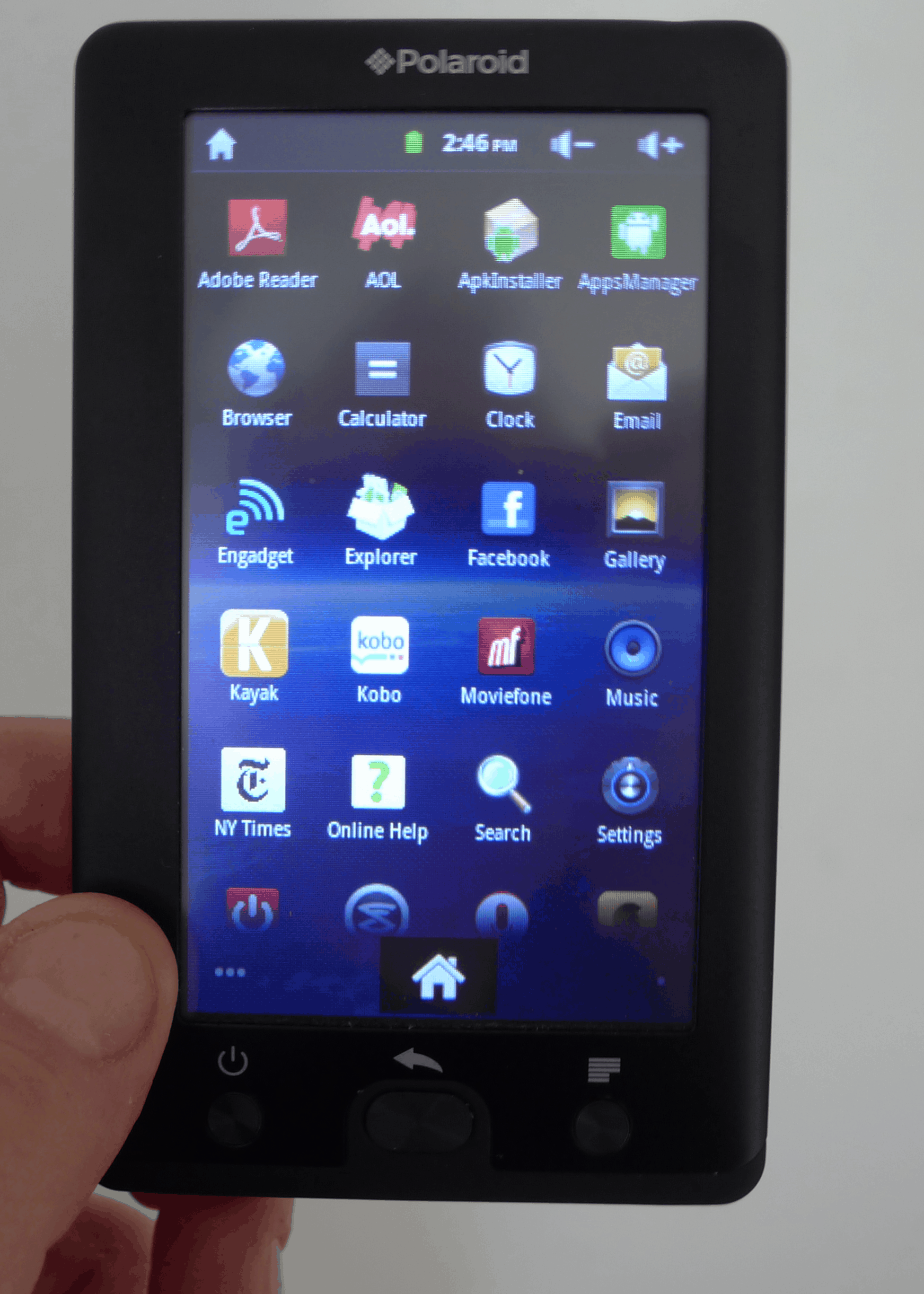
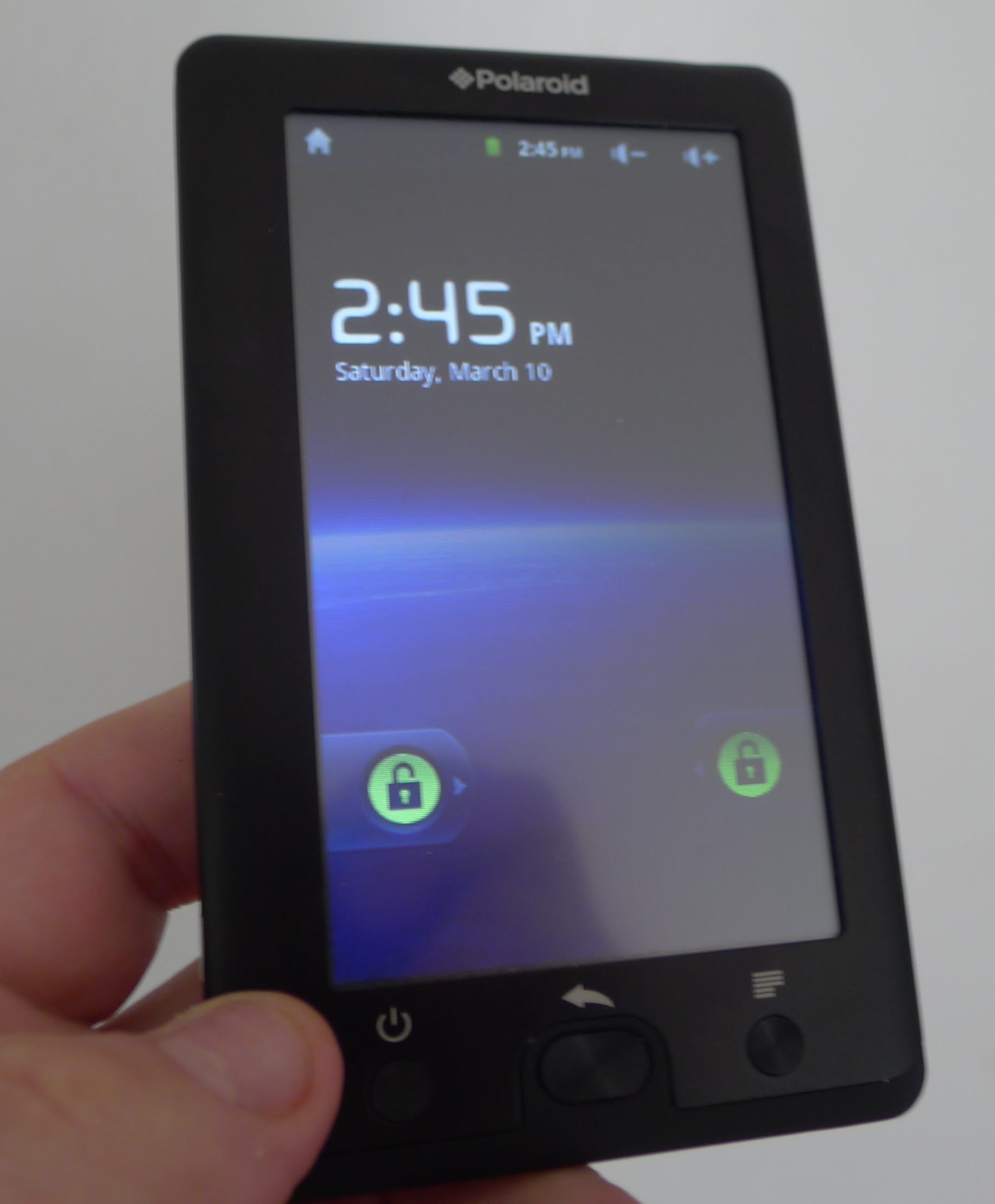
This morning I picked up a Polaroid PMID4300 at BigLots, and I have to say that it’s not bad for a $60 device. For some time now I’ve been looking for a cheap Android handheld and this might be it.

This was one of the new gadgets that Southern Telecom had on display in their booth at CES 2012, and it looks like I am the first to post a review. I just barely touched on it back in January, so specs and some background would probably be a good idea.

This is a 4.3″ Android tablet, and it’s running v2.2 Froyo on a Rockchip RK2818 CPU (600MHz). It has a resistive touchscreen, 4GB Flash storage, microSD card slot, Wifi, and speaker/mike. I don’t know the screen resolution, but I would bet that it’s 480×272.

There are 3 buttons below the screen (power, back, menu), and they’re the only buttons on the device. The home button and volume buttons are on the screen. The ports and card slots are on the lower edge. The mike is on the left edge and the speaker is on the upper left rear corner.

It comes with quite a few apps, including Kobo, Adobe Reader, Twitter, NYTimes, and the usual email, browser, file manager. Note that there’s no Android Market (Google Play) or Amazon Appstore, so you’ll need to find a source of apps (Freeware Lovers is good.)

So I’ve set up Kobo, watched a few Youtube videos, and did some basic browsing. The speaker isn’t very loud, but this is a small device so I would rate it as adequate (you’re going to be using headphones, anyway).

The screen is rather dim, compared to most devices. It seems that the backlight has just the one setting, with only a slight difference between it being on and off. The viewing angle is about what I expected from a $60 device. The on screen keyboard is a little difficult to use, but that’s a result of the screen being tall and narrow, so it’s not worth complaining about.

All in all, it’s not bad. I’d say that it rates better than any of the other cheap Android PMPs I’ve looked at. I plan to post a review next weekend.

Specs

  • 4.3″ resistive touchscreen
  • Android v2.2 Froyo
  • 600MHz Rockchip RK2818 CPU
  • 4GB Flash storage
  • microSD card slot
  • Wifi
  • speaker/mike
  • g-sensor

DoppleText Launches Unique Bilingual eBook Service

I’m at an education conference today (CoSN 2012), and by some strange luck I got an email this morning from a service that my fellow attendees thought was rather neat.

DoppleText has come up with a new way to do sentence by sentence translations. It looks a little confusing at first, but once I got past the initial weirdness it started to make more sense.

If you’ve used translation services before then you’re probably used to seeing the text in 2 languages in 2 columns. Or you might be used to using Google Translate, where the source appears when you hover the cursor over each sentence.

DoppleText does something different. They take the source and, one sentence (or fragment) at a time, they insert the translated piece as a window next to the relevant piece of the source text. (It covers up other parts of the source text, and that is slightly confusing.) Each source segment is highlighted as it is being translated, and you can advance through the text with the arrows keys.

The service launched back in October (in German), with the English language service launching in January. Right now they’re offering just a few pd titles, and they’re using professional translations to provide the second text. But DoppelText is also planning

You can read the texts in the browser, but you can also download them and read them as interactive Epubs in iBooks or calibre (according to Doppeltext). I’m told that this is dependent on JavaScript, which means that these ebooks might work elsewhere. These ebooks will even work on the K3’s web browser, but it requires keyboard shortcuts so it might not work so well on the later models.

If you’d like to check it out yourself, there’s a number of free excerpts as well as a free Epub you can download. As for me, I’m not all that interested. It’s interesting on a technical level, but I used it and I found it to be too confusing.

I also think that going sentence by sentence is the wrong approach. I look at translated content all the time (web, not books), and I have found that I get the most value when I look at the text a paragraph or more at  time. I’ve found all too often that authors don’t finish a thought in a single sentence, and to really understand them you need to look at larger pieces of text.

Random House Raises Library eBooks Through the Roof

One month ago (to the day) I reported that Random House was going to raise the prices they charge for library ebooks. I said that RH hated the idea of doing business with libraries and I even went so far as to tell a commenter that:

I think it would be more accurate to say that they used to be open to library ebooks; now RH is using higher prices to discourage libraries from buying them.

Today marked the rollout of the new prices, and librarians are already reporting sticker shock. RH increased prices for library ebooks by 200%.

I Told You So.

TBH, I really expected that my rant would seem nutty in retrospect. I will admit to being a little surprised at quite how on the mark I was.

Update: The ALA has called on RH to reconsider the prices.

RH released  statement explaining the change and it follows:

Random House, Inc. is constantly experimenting, evaluating, and adjusting different retail price points for our e-books. With our price adjustments announced March 1 we are now doing the same for our library e-pricing, albeit with far less definitive, encompassing circulation data than the sell-through information we use to determine our retail pricing for e-titles. We are requesting data that libraries can share about their patrons’ borrowing patterns that over time will better enable us to establish mutually workable pricing levels that will best serve the overall e-book ecosystem.

Currently absent such information in quantity, it is important to reiterate that our guiding principles in setting these new e-prices are the unrestricted and perpetual availability of our complete frontlist and backlist of Random House, Inc. titles under a model of one-copy, one user. All our titles continue to be available to libraries day and date with the release of the retail edition.

We believe that pricing to libraries must account for the higher value of this institutional model, which permits e-books to be repeatedly circulated without limitation. The library e-book and the lending privileges it allows enables many more readers to enjoy that copy than a typical consumer copy. Therefore, Random House believes it has greater value, and should be priced accordingly.

For the most part, RH prices to library wholesalers for titles available in print as new hardcovers are now set in the range of $65- $85.
Titles available for several months, or generally timed to paperback release, will be decreased in price to a range of $25-$50.
New children’s titles available in print as hcs: $35-$85.
Older children’s titles and children’s paperbacks: $25-$45.

Of course, there will be some “outlier” titles whose respective e-pricing will be above–or below–these ranges, in parallel to their higher/lower level in print. (For example, note that the suggested physical retail price for the Robert Massie title being cited in some literary blogs is $35, higher than most hardcovers, so its corresponding library e-price is higher than the aforesaid price ranges)

As we first said last month, our new e-book pricing framework is to bring our titles in price-point symmetry with our Books on Tape audio book downloads for library lending. These long have carried a considerably higher purchase price point than our digital audio books purchased for individual consumption.

This new pricing will have no impact on Random House collections previously purchased by libraries.

We believe our new library e-pricing reflects the high value placed on perpetuity of lending and simultaneity of availability for our titles. Understandably, every library will have its own perspective on this topic, and we are prepared to listen, learn, and adapt as appropriate.

Throughout our long history of mutual respect and partnership with libraries we have endeavored to satisfy our shared goals. We are certain our ongoing straightforward dialogues with them on library e-lending will continue to yield constructive results.

Apple Now Rejecting eBooks Because of Links to Amazon

Did you hear about the latest nasty thing Apple was caught doing? Seth Godin is reporting on his blog that he won’t be able to sell his latest book in iBooks.

I just found out that Apple is rejecting my new manifesto Stop Stealing Dreams and won’t carry it in their store because inside the manifesto are links to buy the books I mention in the bibliography.

Quoting here from their note to me, rejecting the book: “Multiple links to Amazon store. IE page 35, David Weinberger link.”

So… when do we get to the news? You do realize that this is the same Apple who forced media companies (Amazon, Netflix, Pandora, et al) to remove ebookstores, website links, and other useful info from iOS apps, right?

Is anyone surprised that they rejected Seth Godin’s book?

Paypal to Loosen Grip on Erotica Ban (Maybe)

The Paypal-Smashwords censorship saga took a new turn last night. After a long phone call on Monday, Paypal said that they might relax their ban and give authors more time to remove the content.

All this started late Friday night with an email. Smashwords founder Mark Coker was given an ultimatum by Paypal. Either remove certain types of erotica or Paypal would stop processing payments for Smashwords.

Naturally Mark had to pass this along to the authors and publishers who distribute through Smashwords; his email caused an incredible amount ruckus over the weekend, drawing the attention of TechCrunch, Slashdot, and other blogs as well as sparking a debate everywhere the topic was raised.

BTW, Paypal’s threats to Smashwords were just one of a larger crackdown on certain types of erotica. In the past couple weeks, several ebookstore which sold erotica, including Bookstrand and All Romance eBooks, have revised their policies. While it’s not clear that Paypal is involved in all the situations, I strongly suspect that Paypal has recently made similar demands to all the ebookstores.

But there is some good news for Smashwords. Mark sent out an email last night (end of the post). After the talk on Monday, Paypal is willing to reconsider the content they object to. It appears that Paypal has noticed the uproar over the weekend and might not be thrilled with the  negative publicity. So they are now willing to maybe allow works where the banned content is just mentioned, but not the central theme.

Why the revision? Well, over the weekend a number of people pointed out that Paypal’s ban would extend far beyond the reaches of this one genre. For example, it would include Woody Allen biography, history books, and even the Bible. There’s also a not so short list of works of literature which would fall under the banhammer as well (The Color Purple, I Know Why the Caged Bird Sings, just to name 2).

I’m not going to argue that Paypal’s actions are wrong; I did that in my last post. But I do want to point out what a slippery slope this was and how poorly conceived it was. Whoever initially came up with this ban didn’t look beyond their personal distaste for the topic.


—–
As with the first email from Friday (archived here: http://www.smashwords.com/press/release/27 ), you’re receiving this message because you have previously published erotica content at Smashwords under your account at http://www.smashwords.com/profile/view/[[username]] tied to your email address, [[user_email]]. Just because you’re receiving this email doesn’t mean your book or books are affected. Read on.
—–

I’m writing to give you an update on where things stand. We are extending the deadline (previously set for tonight) for Smashwords authors/publishers/agents to voluntarily remove certain content (erotica featuring themes of rape, bestiality, incest) from Smashwords . I’ll communicate the new deadline in a future email once I gain new information.

I had another call with PayPal this morning. Our conversation is continuing with them as I seek to achieve a less onerous, more sensible result.

There’s a sliver of hope that I might be able to obtain a more positive, less restrictive outcome than I communicated on Friday, yet it’s unlikely we’ll achieve the true result I want (no censorship) in the near term. Today, PayPal hinted at a more relaxed definition of prohibited content as, according to them [I’m paraphrasing], "prohibited books would be those for which rape, bestiality and incest are the major theme. If rape, bestiality and incest are incidental plot points, then that content might be allowable."

This represents a significant clarification in our ongoing attempt to delineate the gray areas and push back the onerous, unfair and restrictive definitions as they now stand. It’s an opening, but it’s not the final word from PayPal. Our friends at PayPal are trying their their best to help Smashwords authors and publishers.

This potential relaxation doesn’t solve the broader issue of censorship. I think if a writer wants to write fiction around the theme of [anything], I think they should be able to write it if it’s legal.

Today’s progress, while encouraging, also opens up new gray area. How does one judge whether the taboo subjects are incidental instances or major themes? Where does one draw the line? The PayPal rep and I agreed our discussion will continue, and they assured me our PayPal services will not be cut off as we both work in good faith to advance the discussions.

A lot of people have been attacking Smashwords for my decision to comply with PayPal’s requirements. They’re pointing their arrows at the wrong target, and they’re not helping their cause. We’re working to effect positive long term change for the entire Smashwords community, and that includes all our erotica authors and readers. This change is possible only if we work together toward a common goal. When people spread lies that this is all part of a Smashwords plot to dispose of "icky books" (their words, not mine), or try to portray our actions as some sexist attack against women, or worse attacks I won’t repeat here, they’re wrong. Despite the ugliness shown to me and Smashwords over the weekend, I’m still working to protect these very people who attack us. The attackers don’t understand what we’re doing on their behalf behind the scenes, and even if they did understand I don’t expect them to agree with our approach. I’d rather work with PayPal in good faith than martyr the entire Smashwords community upon the stake of this impending deadline.

This is only the first chapter in this battle. Even if we fail in the short term we survive to fight another day. Regardless of the near term outcome, we will continue to engage to effect positive change with your help.

Over the weekend, many Smashwords authors and publishers demanded we abandon PayPal and find a new payment processor. It’s not so simple, and it doesn’t solve the greater problem hanging over everyone’s head. PayPal is trying to implement the requirements of credit card companies, banks and credit unions. This is where it’s all originating. These same requirements will eventually rain down upon every other payment processor. PayPal is trying to maintain their relationships with the credit card companies and banks, just as we want to maintain our relationship with PayPal. People who argue PayPal is the evil villain and we should drop them are missing the bigger picture. Should we give up on accepting credit cards forever? The answer is no. This goes beyond PayPal. Imagine the implications if credit card companies start going after the major ebook retailers who sell erotica?

My objective is for PayPal and Smashwords to pull the credit card companies into a more open discussion about these issues. I want all financial institutions to reevaluate their policies. I want the banks to change or clarify their policies toward something more enlightened. I want PayPal to loosen their policies. We need financial institutions to get out of the business of telling writers what they can write and what readers can read. Without this much-needed debate, the slippery slope gets more slippery for all indies.

Indie authors are the biggest publishers of erotica. Already, one retailer/distributor, Bookstrand, decided to drop all indies from their store. I can only assume they decided the angry authors were more trouble than they were worth. Our business is all about serving indie authors, so even if some segments of our author community are shooting arrows at us, we still want to help them work through this. The campaign at hand goes beyond erotica authors. It’s an indie issue. Indies are breaking the boundaries previously set by large traditional publishers. This boundary-breaking scares people. We should welcome the debate about what a "good book" should look like. I think a good book is anything legal that readers want to read, even if I don’t want to read it myself.

This campaign represents an incredible long shot. To move this forward, I need your help. Even if you don’t publish in the categories directly impacted by this crackdown, this campaign matters to you.

What can you do to move things forward? First, direct your attention where it matters most. Contact your credit card company or congressperson and tell them you want financial services companies out of the business of censoring what writers and readers are free to imagine with fiction. Blog about it. Tweet about it. Contact your favorite blogger and encourage them to raise awareness. Start petitions and tell financial institutions you want their censors out of your head. Contact the media. The media, with your urging, has the power to shine a bright light on the dangerous slipperly slope of censorship by financial institutions.

If the media (both traditional and social) calls on credit card companies and banks to honestly answer these simple questions, then they’ll either be compelled to acknowledge the absurdity of their policies or they’ll be compelled to rewrite their policies. This troublesome tide can shift if financial institutions are forced to answer why they’re prohibiting legal fiction.

I realize my message to you today cannot possibly answer all the questions you may have. Know that we’re working for all authors, even those likely to suffer from whatever ultimate changes we implement in the near term. We all want censors off our backs and out of our heads, and if that’s not the result we achieve, then we’ll at least work to get you more clearly defined rules. Bear with us.

I will post this message in the Smashwords Press room at http://www.smashwords.com/press so it’s archived.

Thanks,
Mark Coker
Founder
Smashwords


Smashwords Succumbs to Censorship

The forces of Puritanism struck another blow yesterday. Mark Coker, the founder of Smashwords, sent out an email to all authors, publishers, and agents.

Paypal, Smashwords' payment processor, has issued an ultimatum. Someone at Paypal is grossed out by certain types of erotica sold via Smashwords, so those ebooks have to be pulled or Paypal will drop Smashwords as a customer. And the ebooks have to be pulled by Monday, or else.

The full email is at the end if this post. I’m not going to debate the validity of removing the content; in fact, I’m not even going to mention what has to be removed. Naming the categories would detract from my principled objection. It would also make a number of readers feel that this censorship is perfectly okay because the content was gross or objectionable.

"I disapprove of what you say, but I will defend to the death your right to say it." This quote, widely attributed to Voltaire, is probably apocryphal. But it is true, none the less.

The whole point of the first amendment is that people can say (or write) whatever the hell they want. If you really believe in the concept of free speech, you’ll look past what ever ickyness you feel towards the topics. There’s a time where principle outweighs personal preference, and this is one of them.

Update: A couple people pointed out on Twitter that the 1st amendment doesn’t apply here because it only applies to gov’t censoring speech. This is true, but it doesn’t make the principle any less valid.

Second Update (Tuesday night): Mark Coker has sent out a second email with a revised ultimatum from Paypal.

Email

February 24, 2012

Re: Your Smashwords account at http://smashwords.com/profile/view/[[username]]

Dear Smashwords Authors, Publishers and Literary Agents,

This email is being sent to all authors, publishers and agents who have published erotica at Smashwords. We will also post this message to Site Updates and the Press Room.

According to our records, you pubish [[count_published_erotica_books]] erotica-categorized title(s) out of [[count_published_books]] title(s) now live in the Smashwords system. This message may or may not pertain to you.

Today we are modifying our Terms of Service to clarify our policies regarding erotic fiction that contains bestiality, rape and incest. If you write in any of these categories, please carefully read the instructions below and remove such content from Smashwords. If you don’t write in these categories, you can disregard this message.

PayPal is requiring Smashwords to immediately begin removing the above-mentioned categories of books. Please review your title(s) and proactively remove and archive such works if you are affected.

I apologize for the short notice, and I’m especially sorry for any financial or emotional hardship this may cause the authors and publishers affected by this change.

As you may have heard, in the last couple weeks PayPal began aggressively enforcing a prohibition against online retailers selling certain types of "obscene" content. For good background on the issue, see this Selena Kitt post here – http://selenakitt.com/blog/index.php/2012/02/19/slippery-slope-erotica-censorship/ or here – http://theselfpublishingrevolution.blogspot.com/2012/02/slippery-slope-erotica-censorship.html#comment-form or this Kindleboards thread here – http://www.kindleboards.com/index.php/topic,104604.0.html

On Saturday, February 18, PayPal’s enforcement division contacted Smashwords with an ultimatum. As with the other ebook retailers affected by this enforcement, PayPal gave us only a few days to achieve compliance otherwise they threatened to deactivate our PayPal services. I’ve had multiple conversations with PayPal over the last several days to better understand their requirements. Their team has been helpful, forthcoming and supportive of the Smashwords mission. I appreciate their willingness to engage in dialogue. Although they have tried their best to delineate their policies, gray areas remain.

Their hot buttons are bestiality, rape-for-titillation, incest and underage erotica.

The underage erotica is not a problem for us. We already have some of the industry’s strictest policies prohibiting underage characters (we don’t even allow non-participating minors to appear in erotica), and our vetting team is always on the lookout for "barely legal" content where supposed adults are placed in underage situations.

The other three areas of bestiality, rape and incest were less well-defined in our Terms of Service (https://www.smashwords.com/about/tos) before today. I’ll tackle these one-by-one below, and I’ll provide you a summary of the changes that will go into effect immediately.

*Incest:* Until now, we didn’t have a policy prohibiting incest between consenting adults, or its non-biological variation commonly known as "Pseudo-incest." Neither did our retailer partners. We’ve noticed a surge of PI books over the last few months, and many of them have "Daddy" in the title. I wouldn’t be surprised if the surge in "Daddy" titles prompted PayPal to pursue this purge (I don’t know). PI usually explores sexual relations between consenting adult stepchildren with their step parents, or between step-siblings. Effectively immediately, we no longer allow incest of any variety in erotica.

Like many writers, censorship of any form greatly concerns me. It is with some reluctance that I have made the decision to prohibit incest-themed erotica at Smashwords. Regardless of your opinion on incest, it’s a slippery slope when we allow others to control what we think and write. Fiction is fantasy. It’s not real. It unfolds in our imagination. I’ve always believed fiction writers and readers should have the freedom to explore diverse topics and situations in the privacy of their own mind. From an imagination perspective, erotica is little different from a literary novel that puts us inside the mind of farm animals (1984), or a thriller novel that puts us inside the mind of a terrorist, or a horror novel that puts us inside the mind of an axe-murderer or their victim. All fiction takes us somewhere. We read fiction to be moved, and to feel. Sometimes we want to feel touched, moved, or disturbed. A reader should have the right to feel moved however they desire to be moved.

Incest, however, carries thorny baggage. The legality of incest is murky. It creates a potential legal liability for Smashwords as our business and our books become more present in more jurisdictions around the world. Anything that threatens Smashwords directly threatens our ability to serve the greater interests of all Smashwords authors, publishers, retailers and customers who rely upon us as the world’s leading distributor of indie ebooks. The business considerations compel me to not fall on the sword for incest. I realize this is an imperfect decision. The slippery slope is dangerous, but I believe this imperfect decision is in the best interest of the community we serve.

*Bestiality:* Until now, we didn’t have a stated policy regarding bestiality. I like animals. Call me old fashioned or hypocritical (I’m not a vegetarian), but I don’t want to be a party to anyone enjoying animals for sexual gratification, for the same reason we’ve never allowed pedophilia books. I don’t want to publish it, sell it, or distribute it. The TOS is now modified to reflect this. Note this does not apply to shape-shifters common in paranormal romance provided the were-creature characters are getting it on in their human form. Sorry I need to clarify it that way, but we don’t want to see bestiality erotica masquerading as paranormal romance.

*Rape:* Although our Terms of Service prohibits books that advocate violence against others, we did not specifically identify rape. This was an oversight on our part. Now we have clarified the policy. We do not want books that contain rape for the purpose of titillation. At Smashwords, rape has no longer has a place in erotica. It has no place anywhere else if the purpose is to titillate. Non-consensual BDSM – or any other form of non-consensual violence against another person – is prohibited.

*NEXT STEPS:* If you have titles at Smashwords that are now expressly forbidden, by the end of day Monday (Feb 27), please click to your Dashboard at https://www.smashwords.com/dashboard and click UNPUBLISH then click ARCHIVE. This will also cause our automated systems to remove the titles from retail distribution.

DO NOT try to hide or obfuscate violating content by changing book titles, book descriptions and tags. If we discover such shenanigans, said authors/publishers will risk account deletion and forfeiture of any accrued earnings, per our Terms of Service.

We take violations of the TOS seriously, because such violations jeopardize the opportunities for your fellow authors.

We do not want to see PayPal clamp down further against erotica. We think our authors should be allowed to publish erotica. Erotica, despite the attacks it faces from moralists, is a category worthy of protection. Erotica allows readers to safely explore aspects of sexuality that they might never want to explore in the real world.

The moralists forget that we humans are all sexual creatures, and the biggest sex organ is the brain. If it were not the case, none of us would be here. Erotica authors are facing discrimination, plain and simple. Topics that are perfectly acceptable in mainstream fiction are verboten in erotica. That’s not fair. Our decisions today are imperfect. Please, act responsibly, don’t try to game the system or publish content that pushes the limits of legality. Help us continue to help indie authors around the world to continue to publish and distribute with freedom.

*THINGS TO AVOID:* Avoid using words such as 'bestiality,' 'rape,' 'incest,' 'underage,' or 'barely legal' in book titles, book descriptions or keyword tags, otherwise Smashwords may conclude you’re violating the Terms of Service, or trying to push the limits. If you’re writing non-erotic works, and any of these words are necessary, then you’re okay.

On Tuesday (Feb 28) we will begin removing content that we deem in violation. When we remove a title, you will receive an email notifying you of such, and that email will append this letter along with instructions on how to notify us if we made an error. I promise you, we will make mistakes, so please work with us, take a deep breath and honor us with your patience.

If you believe we removed something in error, please click "Comments/questions," mention the title we removed, provide the hyperlink to said title, and provide your *calm* reasoning for why we should reconsider.

Our support team is backlogged, so it may take several days for them to respond. As we mention in the Terms of Service, we reserve the right to remove anything for any reason. That said, we will also try to make our decisions with care and prudence.

You might wonder if Smashwords should simply switch to a different payment provider. It’s not so easy. PayPal is designed into the wiring of the Smashwords platform. They run the credit card processing for our retail store, and they’re how we pay our authors and publishers. PayPal is also an extremely popular, trusted payment option for our customers. It is not feasible for us to simply switch to another provider, should such a suitable provider even exist, especially with so few days notice.

Please note our Terms of Service is subject to additional modifications as we work to bring Smashwords into compliance with PayPal requirements. Let’s hope today’s actions mark the limit of the slippery slope.

Significant gray area remain. Erotica is still permitted, though if authors try to push the limits of what’s permitted, we risk further clamping down. Please be responsible. Don’t go there. If you’re going to push the limits, push the limits of great writing, not the limits of legality.

Thank you for assisting our compliance efforts on such short notice. We know these decisions will be upsetting to some of our authors and publishers, and for that we apologize. We do believe, however, that these decisions will place us on a stronger footing to represent the best interests all indie authors and publishers from here forward.

Best wishes,

Mark Coker
Founder
Smashwords

P.S. Please contact our support team for inquiries regarding this change in our Terms of Service by clicking the "comments/questions" link at the top of any page at Smashwords. If your inquiry regards a specific title, please include the hyperlink to the book page of that specific title.

Update: Google Now Thinning the Ranks of the eBookstore Affiliate Program

Two days go I reported that Google had shut the doors on the ebookstore affiliate program, with no explanation as to why. Yesterday I got an email from Kevin Cronin, the founder of Local Knowledge Online. Google told him that his site is going to be kicked from the program in the middle of March.

Update: Google goofed slightly when they kicked affiliates.  This wasn’t supposed to affect bookstores, just other affiliates.

"We did not intend to deactivate independent booksellers from the Google eBooks affiliate program and are working to reinstate those who were mistakenly notified. We apologize for any inconvenience," said a Google spokesperson.

BTW, if you’re looking to get technical manuals in the near future, you might want to bookmark this site. LKO is a search engine for professional and technical ebooks. Right now the 2-year-old site covers Google, Kindle, ebrary, and Credo, but Kevin plans to add more sites in the future.

If you’re wondering how a search engine could be a junior partner for a search engine giant, I’d first have to explain what an affiliate is. Let’s say you find an ebook via LKO, and it’s in the Google ebookstore. If you click on the link and then buy the ebook, Kevin will get a small fee from Google. You can think of it as a sales commission, if you like.

There are some variations in the way affiliate programs work, but most are similar to what I describe above. In case you were curious, that is also how Amazon’s affiliate  program works.

At least, that’s how it used to work for Kevin; Google will be cutting him off as of 15 March. Kevin forwarded the email he received, and Google is rather terse in their explanation.

We are constantly evaluating our Google eBook affiliate program, searching for the best mechanisms to create value for our partners and users. With our most recent evaluation, we’ve decided to narrow the scope of the program to a smaller number of partners to create a better experience for our customers.

Google launched this affiliate program in June of 2011 – a mere 8 months ago. And now it looks like they’re taking it in another. Queries to Google have gone unanswered, but PW also covered this story and they were told that the affiliates who generated the least amount of book sales were dropped were dropped from the program. This could well be true; Kevin told me that he received only paltry revenue from being a Google affiliate.

Google is also reportedly planning to open the program again, but only on an invitation basis.

The text of the email is below:

Dear Publisher,

We are constantly evaluating our Google eBook affiliate program, searching for the best mechanisms to create value for our partners and users. With our most recent evaluation, we’ve decided to narrow the scope of the program to a smaller number of partners to create a better experience for our customers.

As a result, your Google eBooks affiliate status will expire as of Thursday, March 15, 2012, and all links will be deactivated. We ask that you please remove logos, links and banners belonging to Google eBooks from your website in a timely fashion. Commissions earned on all eligible transactions through Thursday, March 15, 2012, will be paid out according to the standard Google Affiliate Network payment guidelines. If you have any questions or are interested in learning more, please contact [email protected]. On behalf of Google eBooks, we’d like to thank you for your participation. Please keep in mind,Google Affiliate Network manages hundreds of additional advertisers and we invite you to take advantage of other programs in our network.

Sincerely, Google Affiliate Network