Nate Hoffelder

Nate Hoffelder

Damn the Facts: The "Ebook Sales Are Down" Narrative Must be Maintained at All Costs

The UK Publisher Association released its annual report on industry revenue, and once again the media is selectively reporting the publicly available stats in support of the narrative that ebook sales are declining.

I have the press release at the end of this post, and I won’t be rehashing it. But I will point out the problem in the stories reported by The Bookseller, The Guardian, and The Telegraph.

If you read the various reports you will learn that print sales up by 8% to £3 billion while ebook sales were down 3% in the UK last year, to £538 million. You would also find out that consumer ebook sales dropped 17%, to £204 million, in 2016.

Both of these stats are true, but not one of the stories linked to above will tell you the information you need to put those two factoids in context.

What they did not tell you was that data from the pseudonymous Data Guy pegged the UK ebook market at £327 million in consumer sales last year. (This is based on the February 2017 data, so it is imperfectly reliable.)

Yes, the UK PA is only tracking about 62% of the market, and yet everyone (with the exception of The Bookseller) is treating it like it is the whole of market.

Furthermore, they also neglected to report that the UK PA had stated that total digital sales were up 6%, to £1.7 billion. (Everyone ignored a similar increase last year as well.)

Everyone is ignoring the larger trend of growth in digital sales so they can report that ebook sales are down.

Damn the facts; the narrative must be maintained at all costs.


O O O

Press release:

Figures released today by the Publishers Association shows that 2016 was a record breaking year for the publishing industry with sales of books and journals reaching £4.8bn, their highest ever level.

The increase in sales of 7% on the previous year is the largest growth in a decade, when in 2007 digital was first included.

Industry growth has been fuelled by success both home and abroad, with export sales rising by 6% to £2.6bn and now responsible for 54% of total revenues.

Highlights include:

  • Overall digital sales up 6% to £1.7bn despite a continuation of the drop in eBook sales down 3%
  • Physical sales up by 8% to £3bn on last year rising to the highest level since 2012
  • Europe remains the largest export market accounting for 35% of exports

Chief Executive of the Publishers Association, Stephen Lotinga, said:

“UK Publishing is a world leader and these figures confirm that the industry is flourishing due to the hard work and ingenuity of its superb publishing houses and workforce.

“All of us have at some point in our lives enjoyed the work of a great author, used a high quality textbook, or benefitted from the sharing of academic literature and that is only possible due to the continued success of the publishing industry.

“Whatever the makeup of the new government, they must ensure that any post-Brexit trade settlement it reaches with the EU and other countries reinforces this continued success.”

ENDS

Notes to Editors

What has fuelled the increase in exports?

The strength of exports sales is particularly apparent within academic and research publishers.

Export figures for learned journals collected for the first time show 87% of revenues coming from exports.

However, many other areas of publishing have also seen substantial increases in their exports:

  • Exports of children’s books increased by 34% to £116m
  • Publishers of primary and secondary learning materials saw export sales rise by 11% to £144m, with digital exports increasing by 136%
  • Non-Fiction exports were up by 10% to £264m
  • Sales to East and South Asia were up 10% to £231m
  • Growth returned to North America with sales up 19% to £136m

What is happening with digital sales?

Digital sales also substantially increased in 2016 reflecting the significant investment publishers are making in new technology.

Overall digital sales increased by 6% to £1.7bn and account for 35% of total revenues.

The figures also show:

  • eBook sales were down by 3% to £538m continuing a trend seen for the first time last year. This was in large part down to a 17% drop in the total consumer eBook market to £204m
  • Total consumer audio downloads continued to perform well up by a further 28% to £16m
  • Total sales of academic/professional digital books were up by 6% to £277m

What’s the state of play with consumer publishing?

Overall consumer publishing performed well, rising by 5% to £1.8bn.

  • This was fuelled in large part by a return to growth for children’s books sales which increased by 16% to £365m
  • Non-fiction sales also rose by 9% to £884m
  • Fiction sales fell by 7% to £525m meaning the category has now dropped by 23% since 2012 signifying a continued shift in consumer spending.

What’s the state of play with educational publishing?

Overall educational publishing was up by 5% to £336m

  • While domestic sales saw a modest increase of 1%it was a strong rise in exports of 11% which drove overall growth
  • Exports were particularly strong to East and South Asia, up 27%, and South and Central America, rising 34%
  • Although digital remains a small proportion overall of educational publishing sales, it saw an increase of 25% in 2016

What’s the state of play with academic publishing?

Overall academic and professional publishing was up by 10% to £2.4bn

  • Publisher sales of academic and professional books rose 9% to £1.1bn
  • Total income from journals rose 10% to £1.2bn
  • Share of journal income from subscriptions fell to 79% while income from Open Access article processing charges increased by 46% to £81m

Is this the New Kindle Paperwhite?

A member of MobileRead has just posted a photo of what may be the next Kindle.

Originally posted on a Chinese forum, the photos show a tablet-shaped device with a flush (shiny) screen whose only distinguishing feature is the label "Kindle".

We don’t know the model name or really much in the way of details, but the original source speculates that this device has the same CPU and 300 dpi screen as on the previous models.

It is reportedly also waterproof, but you should take that and other speculation with a grain of salt.

This leak, if it is a leak, is rather thin. It’s not like last year when the spec sheet and product photos for Kindle Oasis leaked weeks before it launched.

That leak had enough supporting evidence to convince everyone it was real. This one, on the other hand, is so thin it could jut as easily be someone’s practical joke.

Sony DPT-RP1 Video Shows Off Its Performance, Responsiveness

I haven’t been able to find any hands-on user reports in the week since Sony Japan announced their new writing slate, the DPT-RP1, and that is unfortunate because it means all we have to go on is the following highly-edited video from Sony.

Sony Japan posted this video last Tuesday. It purports to show the DPT-RP1 in use, but if you look carefully you will notice that several segments of the video were selectively edited in order to create a false impression of a faster response time.

Even so, it’s still pretty cool.

The video shows several software upgrades, including a two-page mode where you can have a page of notes open on one half of the screen and a PDF open on the other half of the screen.

The video also shows the new NFC unlock feature where you can unlock the DPT-RP1 by swiping either a card or a smartphone over a sensor, and the new clip for the stylus (the previous model had a loop).

https://www.youtube.com/watch?v=yLOoBibRmwY

The DPT-RP1 runs on a Marvell IAP140 quad-core chip with 16GB storage, Wifi, and Bluetooth. Its 13.3″ Carta E-ink display has both a capacitive and stylus touchscreens, and a screen resolution 1650 × 2200.

That is a lot of hardware for a device that only supports PDFs.

The DPT-RP1 is scheduled to be released in September, with a retail price of $700.

Kindle Unlimited Funding Pool Reached New Peak in March 2017

Kindle Unlimited funding rose in March 2017 to $17.7 million, Amazon announced on Friday. That was an increase almost a million dollars over the funding pool for February 2017.

Meanwhile, the per-page rate dipped to $0.0046, down slightly from $0.00497 for February 2017. the rate also dipped in several other markets.

  • US: $0.0046 (USD)
  • Germany: €0.0031 (EUR)
  • UK: £0.0034 (GBP)
  • Netherlands, France, Spain, Italy: €0.0046 (EUR)
  • Brazil: R$ 0.01113 (BRL)
  • Japan: 0.5170 (JPY)
  • Mexico: 0.7661 (MXP)
  • Australia, India, Canada: no data

P.S. Here’s a list of the monthly funding pools. It does not include the bonuses paid out each month.

  • July 2014: $2.5 million (Kindle Unlimited launches early in the month)
  • August 2014: $4.7 million
  • September 2014: $5 million
  • October 2014: $5.5 million
  • November 2014: $6.5 million
  • December 2014: $7.25 million
  • January 2015 – $8.5 million
  • February 2015: $8 million
  • March 2015: $9.3 million
  • April 2015: $9.8 million
  • May 2015: $10.8 million
  • June 2015: $11.3 million
  • July 2015: $11.5 million
  • August 2015: $11.8 million
  • September 2015: $12 million
  • October 2015: $12.4 million
  • November 2015: $12.7 million
  • December 2015: $13.5 million
  • January 2016: $15 million
  • February 2016: $14 million
  • March 2016: $14.9 million
  • April 2016: $14.9 million
  • May 2016: $15.3 million
  • June 2016: $15.4 million
  • July 2016: $15.5 million
  • August 2016: $15.8 million
  • September 2016: $15.9 million
  • October 2016: $16.2 million
  • November 2016: $16.3 million
  • December 2016: $16.8 million
  • January 2017: : $17.8 million
  • February 2017: : $16.8 million
  • March 2017: $17.7 million

Self Publisher Bibel, Amazon

Hands On With the Onyx Boox Typewriter (video)

We just got our first look at the Onyx E-ink netbook I told you about earlier this week, and it’s even better than expected.

Charbax caught up with Onyx at the HK electronics fair this week, and he shot a video of onyx’s latest gadget.

The Onyx Boox Typewriter, as it is currently named, is an Android netbook convertible with a 9.7″E-ink screen. When plugged into the keyboard dock, you can use it like any netbook, but you can also remove it and carry it around like a tablet (it has a capacitive touchscreen).

According to what I was told by one of Onyx’s retail partners, the Onyx Boox Typewriter is still a prototype. Onyx is teasing it to see if there is enough interest to justify taking it to production. They’re also taking feedback on the design, so if you would like it with the new 10.3″ E-ink screen, now is the time to speak up.

Speaking of which, the second half of the video focuses on Onyx’s new 10.3″ device. It doesn’t have a price or release date yet, but we do know that its touchscreen uses an electromagnetic stylus.

Onyx has been getting away from that type of touchscreen on its latest devices, but it makes sense to use a stylus on such a large screen.

Thalia is Selling eBooks in Store

The German bookseller Thalia has achieved the booby prize of bookselling: it is now selling ebooks in its brick-and-mortar stores.

A reader can select an ebook and buy it in the shop without having to register in the bookstore. After paying the total at the register, the customer receives a download code which they can enter into their Thalia account online.

After entering the code, the ebook can be read on the Tolino eRraders, on the PC or via the free Tolino app for Android and iOS. The Thalia bookshops offer free wifi for download in store, or customers can have their purchase delivered directly to their existing Thalia account so that the ebook is available for direct download from the Tolino cloud.

In a way this sounds a lot like the ebook gift cards that Amazon briefly tested in Seattle, or the gift card service Enthrill recently shuttered before selling the tech to Firebrand.

But the key difference is that Thalia is selling ebooks without gift cards.

This is an elegant solution, but to what problem?

B&N, Amazon, or any of the Tofino partners could have offered this service years ago, and no one – because customers don’t want this any more than ebook gift cards.

After all, why would you get the ebook gift card when you can just use the free Wifi to buy the ebook online? Less muss, less fuss, and best of all you can use your favorite platform.

Boersenblatt

Audiobook Producer/Distributor Audiobooks.com Acquired by RB Media

Authors who distribute their audiobooks through Author’s Republic are finding out today that the company has been acquired by a new holding company, RB Media.

RBmedia, a newly launched global leader in spoken audio content and digital media distribution technology, today announced its acquisition of Audiobooks.com, an innovator in the on-demand audiobooks sector. With Audiobooks.com, RBmedia not only produces bestselling spoken audio content, it also offers a technology platform that distributes more than 700,000 digital media titles. RBmedia has unparalleled consumer reach through Audiobooks.com, 10,000+ library partnerships, and consumer digital resellers.

An app-based subscription service, Audiobooks.com provides access to more than 100,000 bestsellers and classics.

RB Media also owns Tantor Audio, Recorded Books, WF Howes, and Christian Audio, and through Audiobook.com it distributes to a lot of devices including Android Wear and Sonos speakers.

But the main reason today’s announcement caught my attention is that Audiobooks.com also owns Author’s Republic. This subsidiary launched in 2015 to help authors create and distribute their audiobooks.

So rather than just being a footnote in industry news, this change might directly affect authors through changes in policy.

It’s definitely worth future attention.

Sony and E-ink Announce Joint Venture – Yay, Another One!

Sony and E-ink have been working together since before ereaders were a thing, and now they have announced a new joint venture.

E-ink and Sony Semiconductor Solutions Corporation, a wholly-owned subsidiary of Sony Corporation, announced that the two companies have agreed to establish a joint venture ("JV") responsible for planning, designing, developing, manufacturing, selling, distributing and licensing products that utilize electronic paper displays, as well as related applications and the integration platform for system partners.

…

The JV is officially registered in Taiwan and has its Japan subsidiary registered in April. The company operation will be started soon after obtaining required regulatory approvals. E Ink’s subsidiaries and Sony Semiconductor Solutions jointly invest approximately 70% of JV shares and are the major shareholders leading the JV’s business to success. The remaining shares are subscribed by venture capital companies investing in rising startups. The paid in capital is NTD 420 million (New Taiwan Dollars).

JV announcements are usually about as interesting as balance sheets, but this is one that deserves attention.

Sony and E-ink have been working together on and off for 14 years, and they keep coming up with something interesting.

When they first collaborated in the early aughts, these two companies gave us the 6″ E-ink screen size as well as that early ereader, the Sony Librie.

Sony and E-ink are literally the reasons why the Kindle has the screen size it does – that’s how important their cooperation was.

And then after about another decade of work behind the scenes, they gave us the 13.3″ screen size and flexible Mobius screen tech.

So while at first glance one might think there’s little reason for anything more than bland optimism while regurgitating the press release, the history these two companies share have this blogger excited at the possibilities of what they might do next.

Onyx to Unveil E-ink Netbook, 10.3″ Boox Note Later This Week

The Chinese ereader maker Onyx will be showing off several new gadgets at the Hong Kong Electronics Fair later this week. They’ve sent out an invite, and even though it is in Chinese it already as this blogger drooling.

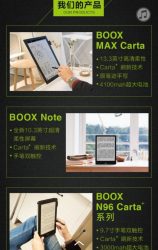
In addition to the Boox Max Carta, the 13.3″ ereader we were already expecting, Onyx is also going to be showing off the Boox Note, an ereader with a 10.3″ E-ink screen, and it is also going to reveal a new netbook.

I don’t yet know the Netbook’s name, but I do know that it has a 9.7″ E-ink screen.

E-ink enthusiasts have been saying for some time now that they wanted to use this screen tech on a laptop, and not they are getting their chance.

Sure, several companies have tried to release this type of netbook, but the closest most people have gotten is when they paired a Bluetooth or USB keyboard with one of Onyx’s ereaders (or the Nook).

The result usually looked something like this:

Onyx’s new device promises to work a lot better – if it ships.

There is still a chance, though, that Onyx might decide that the market is too small or that the tech just doesn’t work.

Stay tuned.

MobileRead


Dual-Screen 13.3″ E-ink Musik eReader by Design M Plus (video)

Remember the Gvido, that dual-screen sheet music reader which is expected to ship later this year?

Charbax has found a second such device from another Japanese company, Design M Plus. He caught up with the company when it was exhibiting its Musik device at CeBIT earlier this year.

As you can see in the following video the dual-screen version of the Musik looks a lot like the Gvido. However, the single-screen model does not. That looks more like the Sony DPT-S1 or any other large-screen ereader (this is why I don’t think the Gvido and the Musik are the same device).

While the Gvido and the Musik could be the same device, the one looks a lot more complete in the software dept and there is no obvious connection between the two companies.

In a way, the Musik reminds me of the Kno, a dual-screen textbook tablet that launched in 2010. The Kno started out with two 14″ screen, and for a short time before the device was canceled there was also supposed to be a single-screen model.

The Kno never shipped, however, and and it’s not clear that the Musik will either.

The Gvido, on the other hand, has a retail price of $1,600 and is set to ship in September. (I have updated my earlier post with all the new info.)

Seventeen Apps That Help You Make eBooks


Amazon may be quietly locking out its competition with ebook creation apps like the newly released Kindle Creator, but not all ebook creation apps tie you down to a single distribution channel.

Even iBooks Author can make and export Epub3 files now, and that’s not the only app authors can use to make ebooks.

Here’s a double handful of apps and online services which can make ebooks (let me know if I missed one you like).

First, here’s the free app I use:

Sigil

Sigil is not the best app on this list but when it comes to free alternatives there is simply no comparison.

I found it easy to learn with an intuitive interface that did everything I wanted, and I am still waiting for a good reason to switch to another app like:

Jutoh

Jutoh is an ebook creation tool for all platforms (including the Raspberry Pi). It can make ebooks in all the popular formats and, aloing with Scrivener, comes highly recommended (although there is a vim/emacs divide in the author community over which is better).

WordToEpub

This is a Windows app from The Daisy Consortium. If you have MS Word you can use it to make an Epub3 ebook. (I do not have word, so I can’t tell you how well it works.)

Vellum

Vellum is a macOS-only app which costs so much that I can’t come up with a good reason to buy it.

It is a rather expensive app and costs either $200 for an unlimited license or $10 to $30 for each title. That is rather pricey when compared to the free apps much less the paid alternatives like:

Scrivener

Scrivener is the one paid app everyone recommends – including those who don’t use it.

It is a complex and feature-rich app which is designed to cover all the steps in the process of creating a book rather than just the act of making an ebook. It has always been way more than what I required, but many authors swear by it.

Calibre

Calibre is known as the best ebook library tool, free or paid, but it can also make ebooks in just about any format you can name. You can even use it to edit ebooks, although you shouldn’t distribute them to other professionals.

While I use calibre to convert ebooks and manage my library, I also know that it is widely hated by many in the digital publishing industry. Calibre makes ebooks which look okay, but the code is absolutely atrocious (Calibre-made ebooks have even been banned by Amazon once or twice).

Caveat Emptor.

Calligra

Calligra is the office suite which used to be known as KOffice way back when. It was originally developed for Linux systems and has since been ported to Windows, macOS, freeBSD.

Calligra has included an ebook export option since 2012, although I am not sure very many people are using it.

eBookBurn

eBookBurn is a paid web service I have been meaning to try. It costs $19 to export an ebook in Epub and Kindle formats, but you can set up as many ebooks – or parts of an ebook – as you like.

Pressbooks

Do you know how they say that a third of the web runs on WordPress?

That includes Pressbooks. This paid service lets you upload (or type) parts of a book, edit them, and then export an ebook in Epub, PDF, or Kindle format.

Everything except for the last step is free, and you can even set your preferred formatting as CSS. what’s more, WP is designed to publish to the web, and Pressbooks takes advantage of this. You like you can upload a book and then show it off and get feedback.

O O O

When I published a list of eight apps and services you could use to make an ebook about a week back, a bunch of readers responded with suggestions for other apps they either liked to use or had developed.

I think more info is usually better, so here are six more apps and services you can use to make an ebook.

Atlantis

In this day and age almost everyone has to use MS Office, Google Docs, or Libri Office in order to stay compatible with their colleagues, so you would think that the lesser known word processing apps would simply wither away and die.

Atlantis would suggest that is a faulty conclusion. This app doesn’t get much attention but it is still popular with some authors.

Draft2Digital

This company is known for being one of the best ebook distributors, but you can also use their service to produce an Epub from your source Word file. This is strictly intended as a proof copy, but there’s nothing stopping you from using it like any other ebook.

PublishDrive

eBook distributor PublishDrive launched their ebook conversion tool in early 2019.

Papyrus

This online editor can help you make an ebook from scratch, or you can use it to assemble an ebook from blog posts and web pages.

I found Papyrus really useful when I tried it two years ago, but it won’t work for me today. For some unknown reason it is kicking me out of the ebook project I started two years ago.

Oh, well, maybe I will try this next service instead.

Bookbinder

Edit: This service no longer makes ebooks.

This online service costs $19 per title and is entirely new to me.

It offers both a simple conversion as well as an online editor you can use to format an ebook.

Libre Office

This open source office suite gained the ability to export Epubs with its 6.0 release. It could already make PDFs.

Viewporter

Viewporter is a relatively new app that makes Epub3 ebooks. I don’t know anyone who has used it, so all first-hand user reports would be appreciated.

Kotobee Author

Kotobee Author is an ebook creator and Epub editor, allowing you to add interactive content that can be opened  in any compliant Epub 3 reader. Convert your PDF to EPUB, customize the look and feel of your ebook apps, and emulate the result on different platforms and devices. It can also make web apps, and is available for Windows and macOS.

WordPerfect

In just a few clicks, save WordPerfect documents in the popular Epub ebook format for easy publishing to popular devices. Improved file format compatibility enables users to save WordPerfect files in OpenDocument Text (ODT) format, while updates to PDF functionality give control over the resolution of linked and embedded content.

Kindle Create Lets You Make a Kindle eBook From a Word File

Amazon has launched a new tool that lets you make an ebook out of a Word file.

It is called Kindle Create, and was released this week for Windows and macOS.

Amazon has released a number of tools you can use to make Kindle ebooks, including an epub conversion tool as well as Kindle Kids Book Creator, Kindle Textbook Creator, and Kindle Comics Creator.

Those apps produced picture books, PDF textbooks, and comics books, variously. Kindle Create, on the other hand, was built to make all those things, as well as novels.

Edit: And just to be clear, this app makes a file you can upload to the Kindle store. it does not make an ebook you can read yourself.

You can give it either a DOC or a PDF file, and once it ingests the file you can edit the text, format the chapter and section headings, embed audio and video clips, and make other changes.

From what I have seen this morning, what you can do with an ebook project is limited by the format you started with; the audio and video clips, for example, can be embedded when you start with a PDF but not a DOC. (Or maybe the app just didn’t want to cooperate with me?)

In any case, I am still playing with the app, and so are authors on the KDP support forums and Chris McMullen.

At least one of the authors on the KDP forums is really impressed with the app:

Pros:
*Very easy app for Wordsters to use.
*You can use a Word doc, docx or a PDF file in Kindle Create.
*Automatically detects and splits chapter heading styles according to heading layout.
*Easily and manually allows you to create a TOC, add chapter subtitles and add separators to your Kindle ebook.
*You can also restyle your ebook text just using point and click.
*You can also directly edit your text in the app in Text View. This is a huge plus!!
*You can test your ebook in-app using their modified version of Kindle Previewer 3.8 Beta.
*You can also use their Template to create your ebook from scratch.
*Gives a reliable and quick conversion using Advanced Typesetting.
*Kindle Create Help documentation is fairly thorough and easy to follow.
*When I converted my Word doc without cover(its an old ebook on amazon now) to kbc — the total file size was 1.2 Mb. When I converted the same ebook as a pdf doc with cover to kbc — the total file size was 1.4 Mb. So this Kindle Create app has a converter that also uses efficient file compression.
*It’s a fast app — no waiting.

Kindle Create

Kobo Acquires Print-Digital Bundling Startup Shelfie

When Shelfie shut down its ebook bundling platform in January, founder Peter Hudson told me that "In the end the unit economics of ebook sales just don’t make much sense if you don’t own the platform like Apple, Google, or Amazon."

Today Shelfie found its platform.

Kobo just sent out a press release with the news that it has acquired the now-shuttered Shelfie.

You can find the press release at the end of this post – here’s what this deal means.

  • Shelfie spent four years developing a platform where users could make a post-sale bundle consisting of a print and ebooks.
  • When promoted in bookstores, Shelfie’s service almost doubled one bookseller’s sales of bundled titles
  • Many of Kobo’s partners around the world are bookstore chains or media retailers, including WHSmith, Coles, Indigo, and FNAC.

All in all, this is a deal that makes a lot of sense, and what’s even better is that it puts Shelfie in the position to kill a clunky part of its platform.

Under Shelfie’s old platform, users had to prove they owned a paper book by personalizing it, taking a photo, and then either buying or downloading the matching ebook.

That was just too clunky for words, and it defintely discouraged adoption.

But now that Kobo owns Shelfie, they will be able to tie it into their partner booksellers' servers and automatically suggest that readers get the matching ebook to go with the paper book they just bought. The ebooks can be added automatically to a reader’s Kobo account – no muss, no fuss, and no foofing around with a smartphone app.

If I were Amazon, I would be wincing today.

Sure, Kobo is a tiny compared to Amazon, but one of its advantages is that it has partners in many markets where Amazon has no presence.

This deal reinforces Kobo’s strength by giving their local partners a new way to sell books.

This could be huge in the long run.

O O O

Rakuten Kobo Inc., one of the world’s most innovative eReading companies, today announced it has acquired Shelfie, a service that was built to enable customers to get free or discounted eBook versions of books in their print libraries, and get recommendations based on print books they already own. The deal includes technology assets, IP, and the infrastructure on which the ecosystem runs; it also includes hiring Shelfie’s skilled team, which specializes in the application of big data and machine learning for book discovery.

Shelfie ceased operations this January. Kobo worked with Shelfie to offer its customers the opportunity to transfer their eBook libraries to Kobo’s platform, ensuring they would continue to have access to their digital books. Over the coming months, Kobo will work to integrate the Shelfie platform into its Android and iOS apps, enabling readers to add their print libraries to their reading history to generate ever more tailored eBook recommendations, as well as the option to get digital versions of print titles they already own.

Founded in 2013 by Peter Hudson and Marius Muja, as BitLit Media Inc., Shelfie grew to offer more than 450,000 eBooks and audiobooks that booklovers could purchase at a discount or download free of charge. Via any iOS or Android device, users snapped a photo of their bookshelf, and through patented technology, Shelfie scanned the spines of every book to identify titles and give readers a complete inventory of their collection, and served them the available equivalent titles in digital—free of charge or at a promotional price. The service also used the titles on the shelf as data, combined with digital reading data, to generate personalized recommendations.

“We know our best customers move fluidly between formats, reading digitally and in print, and we welcome this opportunity to bring their entire reading life together. People who come to Kobo already have a history of reading in print that we don’t want to ignore. This acquisition will allow us to expand our ecosystem by incorporating Shelfie’s innovative advances in book recommendation, discovery, and bundling, which is especially interesting considering our large network of bricks-and-mortar bookselling partners,” said Michael Tamblyn, CEO, Rakuten Kobo Inc.

“We’re proud of what we’ve built, and in Kobo, have found the perfect platform to expand on what Shelfie has to offer, on a global scale,” said Peter Hudson, CEO, Shelfie. “Finding the next book to read is a challenge that resonates with many booklovers, who increasingly are looking to personal recommendations as opposed to algorithm-based suggestions. With Shelfie’s technology, avid readers will easily be able to find the next must-read book.”

image by ActuaLitté

Yotaphone 2 Updated With Android 6.0 Marshmallow

The dual-screen Yotaphone may have been abandoned after its parent company was sold off and the remaining stock sold out in clearance sales,  but that doesn’t mean that development has stopped.

A reader has tipped me to the news that the Yotaphone 2 has been updated. There is what appears to be an official announcement on the VK social network that Yota Devices’s Russian team has released a system update with Android 6.0 Marshmallow.

The improvements include the addition of the Gmail app, better support for pushing apps to the E-ink screen, better power management, and of course Android 6.0 and support for the latest Android apps.

The firmware has been under development since at least December 2016, and is only valid for Yotaphones running on an RU firmware. (According to my source, you can install the firmware on the $140 Yotaphones sold by GearBest.)

This release comes only a few short weeks after rumors that Yota Devices was working on a Yotaphone 3, and it will surely add fuel to the speculation.

Unfortunately, the official word is that there will be no Yotaphone 3. The Chinese company that bought Yota Devices last year had initially shown interest in releasing a new model but later decided that they didn’t want to invest the capital.

So if you were holding out in the hopes that the next model would be better, it’s time to settle on the Yotaphone 2 (which is a pretty good phone, especially if you got it for $140).

New Onyx Boox Max Carta up for Pre-Order, Sports a Higher-Resolution Screen

Released last summer, the Onyx Boox Max was a pricey but worthwhile alternative to the Sony DPT-S1.

It ran Android 4.0 on a 1GHz CPU with a 13.3″ screen, stylus, Wifi, and BT. As I pointed out in my review, it was not your typical ereader, but since it shipped with Google Play its functionality was limited only by the apps you installed (and by the CPU).

But now it is getting a little better.

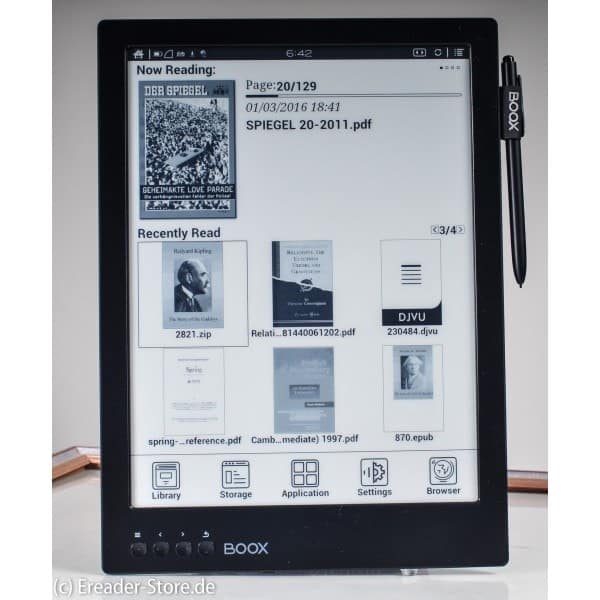
eReader-Store.de is now taking pre-orders for the Onyx Boox Max Carta. This is an update to the Onyx Boox Max with a new higher-resolution Carta E-ink screen. But it has essentially the same guts, though, so there are arguments against paying the extra 45 euros at the register.

Like its predecessor, the Onyx Boox Max Carta runs Android 4.0 on a 1GHz single core CPU (last year I misreported the processor as a dual-core CPU). It comes with 1GB RAM, 16GB internal storage, stylus, Wifi, Bluetooth, a headphone jack, a card slot, and can be upgraded to Android 4.4.

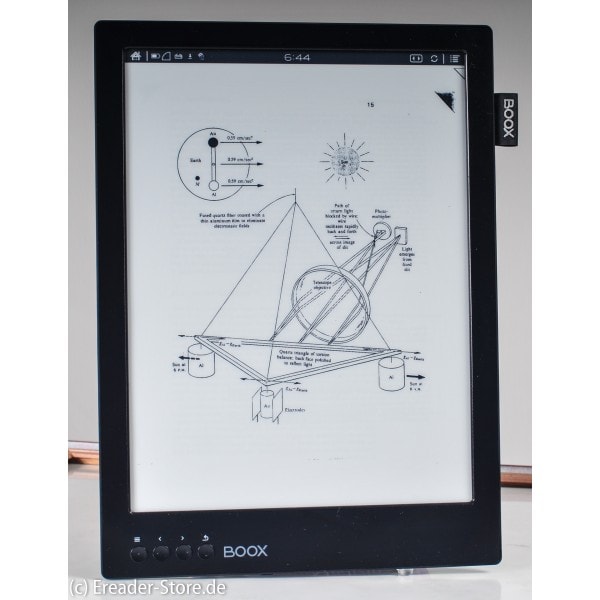
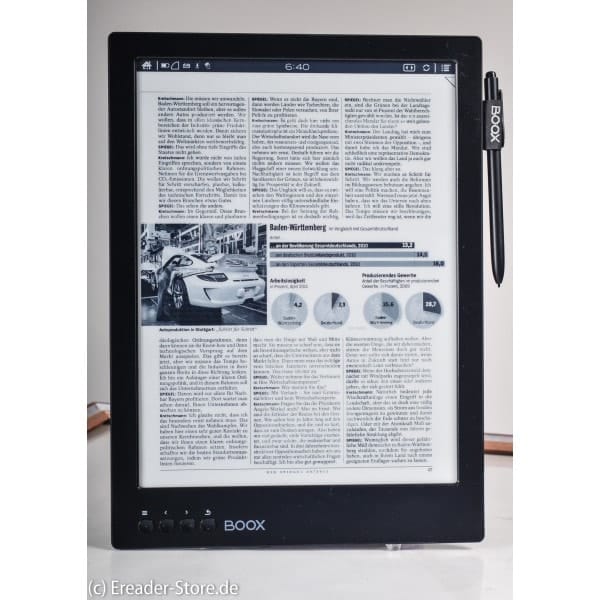
The one key difference between the Onyx Boox Max Carta and the previous model is that the Max Carta has a Carta E-ink screen with a resolution of 2200 x 1650, or 207 ppi. The original Max had a screen resolution of 1600 x 1200, oe 150 ppi.

The retail price is 796 euros (~$853), or about 45 euros more than the first model.


The new model has a considerably sharper screen, which is great and all, but I for one was hoping for other upgrades: a faster CPU, capacitive touchscreen, or Android 5.0.

This is hardly an upgrade at all.

eReader-Store.de