B&N to Launch "Nook Audio" – MP3 Player, Dock, ?

This morning I was reminded why I check my email, even on the weekend. A source inside B&N thought today was a good day to leak hints about Barnes & Noble’s newest device, which it looks like they plan to call Nook Audio.

I’m still not quite sure what this device is, but I do know several things about it.

First, B&N filed trademark for "Nook Audio" back in February. I didn’t post about it at the time because B&N was going through a phase where they trademarked everything (I think there was even a trademark for "Nook Kitchen Sink"). I didn’t know which of the terms would be used, so I decided to wait and see what happened.

Also, Barnes & Noble hasn’t passed any new devices through the FCC, and the lack of FCC paperwork indicates that it won’t be a Wifi equipped device such as an ereader or mp3 player.

But I’m posting about it today because now I have the product page. There’s hardly any info on it, but the fact it is there tells me that the product is coming. We also now have a model number, OE250, and that tells us a couple things.

The model number is different from any of the Nooks, so this likely isn’t a Nook with sound. It’s probably not even an mp3 player; B&N would probably have built Wifi in and had it run Android (it would have been a mini Nook Color).

So what we have here is an audio accessory. The Nook Touch doesn’t have sound, so this would have to be for the NC or NT.  It might be as boring as headphones, but I’m hoping for a stereo dock. A couple different companies have them in the works for the KF and Nook Color (here, here), so there’s a good chance that B&N also thought now would be a good time to offer one.

B&N

Pottermore eBooks Already Showing up on Torrents

Forty-two hours. That’s how long it took for the first pirated copies of the official Pottermore Harry Potter ebooks to show up on a pirate site.

A reader tipped me to the story this afternoon. One not terribly intelligent pirate uploaded a complete set of the Pottermore ebooks, in Epub, last night. I looked them over, and they are clearly not one of the earlier sets of  pirated ebooks.

Now, I’m not being rude in calling the pirate stupid; he didn’t put all that much effort into anonymizing the Epubs before he pirated them.  All he did was remove the warning statement from the copyright page. He didn’t do anything to remove the digital watermarks I reported on yesterday. I found the serial numbers in the title elements of the images, right where Booxtream put them.

And BTW, now that I have a second copy of HP1, I can see that the files inside that Epub have different file names than in the Epub I bought. This tells me that the file names might be another watermark added by Booxtream. Good. That means that the DRM embedded in the Epub is more subtle than I thought.

Frankly, I’m surprised this took this long. I recall that the later additions to the Harry Potter series were pirated within a day of hitting the bookstore shelves. In fact, I believe it was HP7 that was pirated before the print edition officially shipped.

I’m also surprised that someone would pirate these ebooks at all, given the widely known DRM buried inside. I mean, there already were pirated copies of these ebooks available, if you know where to look. Posting a new set doesn’t make much sense, given the risks involved.

If anything, this act of piracy tells me that I don’t understand pirates as well as I thought I did. The risk is too high and the need too low, and yet someone still pirated these ebooks. If anyone happens to think that increasing the penalty for piracy is going to have an effect, think again. This pirate is almost certain to get caught and yet he did it anyway.

LG Display to Launch New Flexible Hi-Res E-ink Screen

It’s not as flexible as the rollable screen from Polymer Vision, but it is a step in the right direction.

LG announced this morning that they’re about to start mass production of a new E-ink screen. This screen is promised to be more durable than anything currently on the market and it can flex at an angle of up to 40 degrees.

So how does this differ from older E-ink screens? LG buys the screen source material from E-ink in giant rolls. They then cut out the 6″ screen size and mount it on their own backplane. With the screen mentioned above, it’s the backplane that is flexible. That is also why this screen is more durable than past E-ink screens, which had a glass backplane.

On a related note, I’m pretty sure I already showed you the new screen.  NextPapyrus has been working on an ereader that uses this new, more durable screen with this resolution, and I’ve posted on it once or twice. The LG screen mentioned above is likely the same screen being used by NextPapyrus. And it is durable. A few weeks back NextPapyrus posted a Youtube video showing the screen being repeatedly hit by  baseballs. It survived.

The new screen is going to have the same resolution ( XGA , 1024×768) as on LG’s current E-ink screen, which is being used on the iriver Story HD.  LG is planning to have it on devices in the European market next month.

Press release:

LG Display Begins Mass Production of World’s First Plastic E-Paper Display

With advancements in functionality and design, Plastic EPD to revolutionize E-Book market

Seoul, Korea (March 29, 2012) – LG Display [NYSE: LPL, KRX: 034220], a leading manufacturer of thin-film transistor liquid crystal display, announced today that it has started mass production of the world’s first plastic electronic paper display (EPD) for use in E-Books. The 6″ XGA (1024×768), e-ink, plastic EPD is expected to revolutionize the E-Book market with its advancements in functionality and design.

"With the world’s first plastic EPD, LG Display has once again proven its reputation for leadership and innovation with a product we believe will help greatly popularize the E-Book market," said Mr. Sang Duck Yeo, Head of Operations for LG Display’s Mobile/OLED division. "Based on our success in mass-producing plastic EPD, we are excited as we look toward applying concepts from this experience to future developments like plastic OLED and flexible displays."

Innovations in Functionality and Design
The world’s first plastic EPD from LG Display offers users a paper-like reading experience with a plastic substrate that is as slim as cell phone protection film, and a flexible design that allows bending at a range of 40 degrees from the center of the screen. Compared to glass EPD of the same size and resolution, LG Display’s plastic EPD realizes a super slim thickness of 0.7mm which is 1/3 slimmer than existing glass EPD; as well as a weight of 14g which is more than 1/2 lighter.

E-Book users have long expressed a desire for more durable EPD, since around 10% of them have damaged their product screens from accidentally dropping or hitting them. When LG Display’s plastic EPD was put through repeated drop tests, from 1.5m above the ground or the average height of reading when standing, no damage resulted. When put through a break/scratch test involving hitting the display with a small urethane hammer, no scratches or breakage resulted.

As EPD gets thinner, lighter, and more durable with the introduction of plastic EPD, E-Books will be able to offer certain unique benefits compared to smart devices and tablets, including reduced eye fatigue and more efficient electricity consumption in addition to lower prices.

A Manufacturing Breakthrough
LG Display developed a unique technique to utilize the high TFT process, typically employed in general LCD manufacturing and with temperatures exceeding 350 degrees, in the production of its plastic EPD. By overcoming the obstacles associated with applying the existing production process to heat susceptible plastic, LG Display achieved a breakthrough with the successful mass production of plastic EPD able to maintain strong durability in high temperatures.

Availability
The world’s first mass-produced plastic EPD from LG Display will first be supplied to ODM companies in China, followed by completed products to be released in Europe at the beginning of next month.

Pottermore DRM is Hacked – Provided by Booxtream

It never takes long for DRM to be identified and cracked, and the Harry Potter ebooks sold by Pottermore are no exception. It took a couple hours of disassembling the Epub and going over it line by line, but it’s pretty clear that the digital watermarks, a benign form of social DRM, are being provided by Booxtream, a several year old Dutch tech company.

When Pottermore was announced last summer, one of its big selling points was the ebookstore where you’d find DRM-free ebooks. That promise turned out to be not completely true, but the Epubs you buy there are free of what you would expect to find in most ebookstores.

Instead they come with something called a digital watermark. These watermarks effectively are little bits of data buried inside the ebook. It’s a benign form of DRM that doesn’t bother the average user. Unlike other forms of DRM, a unique digital watermark is created when each copy of an ebook is generated. This lets the ebookstore add something to the ebook which can still be to track down who originally bought (and then pirated) a particular copy of an ebook.

Similar tech has been used for some time now in music, documents, and other content, but Pottermore is the first high profile ebookstore to use it (that we know of).

In the case of Pottermore, the digital watermarks are almost certainly provided by Booxtream. eReaaders.nl has taken apart an Epub and identified the particular details as being the work of that Dutch firm. I also looked into this, and my findings match theirs.

In case you’re interested, the digital watermarks use by Pottermore are serial numbers added to various files. There’s a warning statement on the copyright page, but the true watermarks are slightly better hidden. You can find them as strings of text in the title element of some of the images. Also, eReaders.nl identified an element in the CSS file as being from Booxtream. I believe they’re referring to "boekstaaf". That’s the only element that is clearly not based in English. I believe it’s a Dutch name, which for obvious reasons would likely have come from a Dutch company.

Update: I’m pretty sure the file names are also used as a digital watermark. I just got my hands on a second copy of HP1 and the internal files have different names.

Booxtream has been supporting a Dutch ebookstore for the past 18 months or so, and so far as we know Pottermore is the first major use of their technology. Let’s hope it’s not the last. Let’s also hope they also added a more subtle digital watermark; the one I found is far too easy to remove.

via

Confirmed: Harry Potter eBooks Are NOT DRM-Free in Kindle Format (Or Any Other eBookstore)

Do you recall the promise made last year that HP ebooks would be available in Epub & Kindle formats, DRM-Free? Yeah, it looks like that didn’t happen.

Pottermore launched their ebookstore this morning, and I bought an ebook right away. I know that I complained about the prices, but I started looking at the Kindle Store integration and I got curious about how it worked. So I bought one.

And that’s where the troubles began. First, I’m sure you know that when you buy an ebook from Pottermore, you can transfer it to your Amazon account. When you do that, Amazon will then push out a copy of the ebook to all the apps and devices registered to your account.

But this might take awhile (it did for me), given how much traffic those ebooks are generating today.

I didn’t want to wait, so I downloaded a copy and tried to open it in Kindle for PC.  It didn’t work. I then transferred it to the Polaroid Android tablet I’m reviewing right now and it wouldn’t work in that Kindle app, either. But the app did give me a clue as to why it couldn’t read the ebook. It showed me the same message that I’ve seen every time I’ve tried and failed to read a DRMed ebook on an unauthorized device:

Please remove the item from you device and go to archived items to download it again.

Yep, that is most definitely not the DRM-free ebook we were promised.

Update: So I’ve heard back from Amazon, and guess what they told me?

All titles that are pushed wirelessly from Pottermore to Kindle, or to other retailer’s eBook services and readers, are DRM encrypted at Pottermore’s request.

So what we have here is an ebook which is DRM free until you push the ebook through one of the ebookstores. Then it stops being DRM free. That is not what Pottermore said at the press conference. You can check any account from any of the press who attended. All reported that the ebooks would be DRM-free.

I’m waiting to hear back from Amazon and Pottermore, but until then I’m going to be downloading the Epub so I can convert it myself. That much vaunted Kindle Store integration isn’t worth it, given that the ebook is locked down with DRM.


Updated: Kindle Touch Hacked to Run Video

The Nook Touch can do a fast refresh (and even play video) and the Kobo Touch can play Tetris, so today’s news that the Kindle Touch has been hacked to play video probably shouldn’t come as a surprise.

An enterprising hacker has posted an early demo video. There are no details yet on when it might be available to the average user, but this is still a really cool bit of news.

Update: The hacker posted several new videos. This one is much better quality than the first, and as you can hear the audio is now working, too.

The frame rate of the video doesn’t appear to be quite as high as that of the Nook Touch video, but I’m not sure.  On the other hand, the resolution of this video is clearly higher than the Nook Touch demo and it has audio.

Pretty soon you’ll be able to throw out your tablet and carry around just an E-ink ereader. Who needs color, anyway.

via

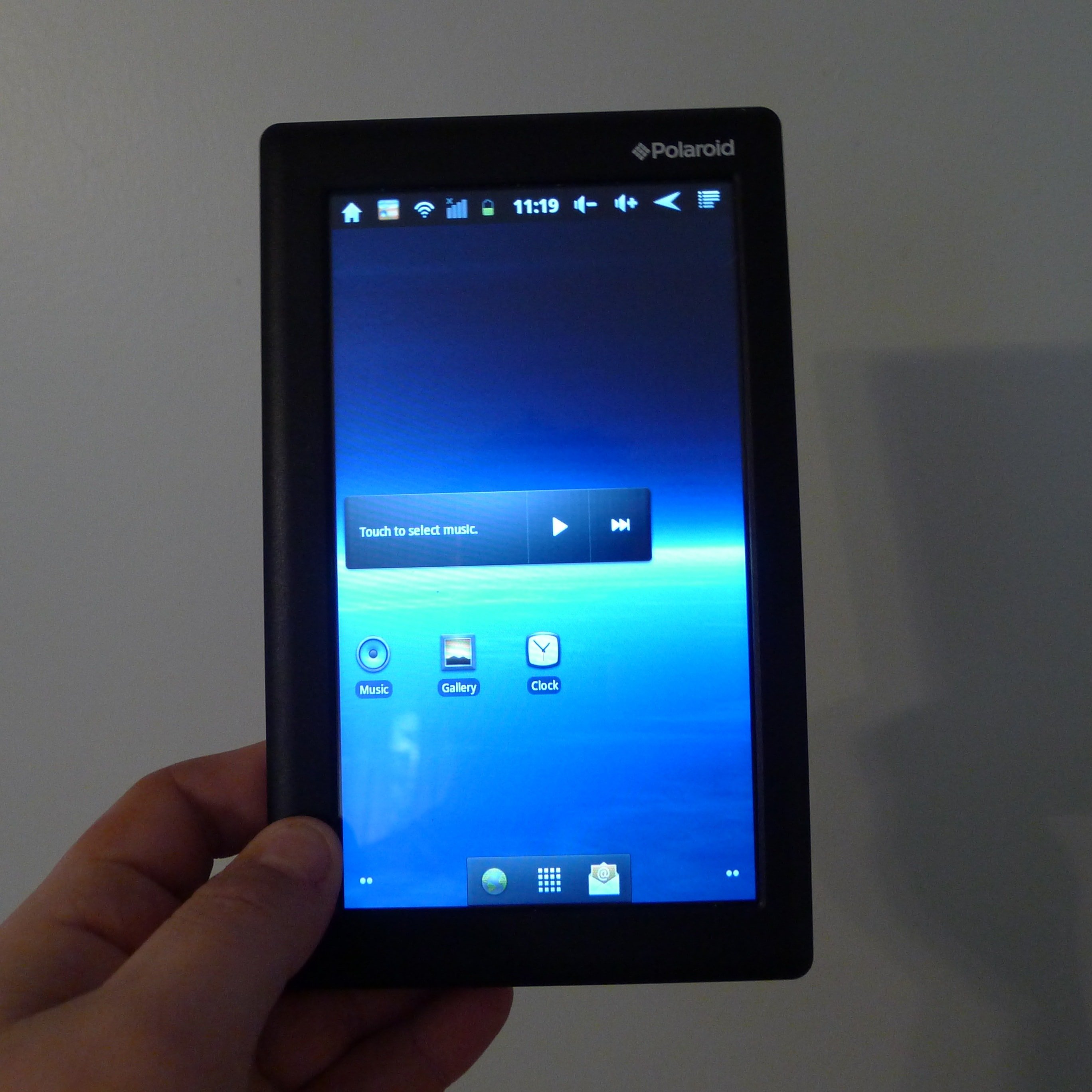
First Impressions of Polaroid PMID701C 7″ Android Tablet

Polaroid’s second budget 7″ tablet showed up on store shelves yesterday morning and I was there to get it.

The PMID701C is a bland looking black slab with a 7″ capacitive touchscreen and it’s running  Android 2.3 on a single core 1GHz CPU.

I’ve spent the morning playing with it, and it’s not bad.  I’m a little concerned about the battery life, but other than that it’s an okay budget tablet.

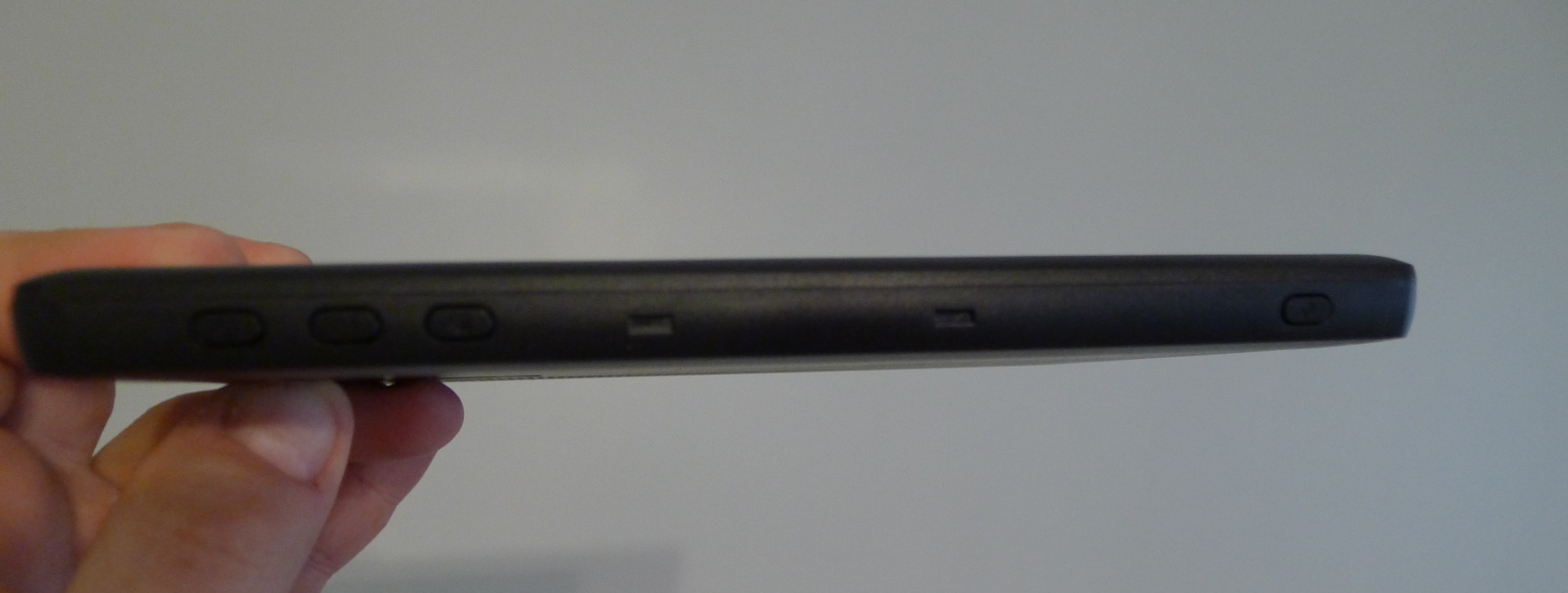
It’s an almost featureless slab with all the ports on one short end, the buttons on the long end, and the speaker on the back. It has a solid feel to it. The touchscreen is quite responsive and I’ve really come to like the general vibe of the device.

This tablet has a few quirks that have me scratching my head. I’ve looked through the setting menu and it  options for Ethernet and 3G, but it doesn’t have the hardware for either. It also has a port where you should be able to plug in a TV out cable, but no cable was included. It also has text to speech, but I don’t see an app that can use it. Weird.

It comes with Kobo and a lot of other apps (see photo for more details) but no app store. I’ve installed the Amazon Appstore as well as a number of apps, including games, Kindle, Aldiko, an RSS reader. Youtube worked, and so did the email client. I’ve downloaded a couple ebooks. I’ve even set up my Twitter account on the included app.

It’s rather bland but I like it enough that I plan to set aside my Galaxy Tab for the next week and use this in its place. The Galaxy Tab has a camera and Google Play, but I don’t expect to need either feature this week.

Specs

  • 7″ capacitive touchscreen (800×480)
  • Android v2.3 Gingerbread
  • 1GHZ CPU
  • 4GB Flash, microSD card
  • Wifi
  • speaker/mike
  • g-sensor
  • TTS
  • Video out (but no cables provided)

P.S. Polaroid’s first 7″ budget tablet came out around black Friday 2011, but it didn’t get much attention. It was the PTAB7200, and I noticed it for the first time at CES 2012.

UK Students Aren’t Buying eBooks

Earlier this week I posted on a presentation that Bowker gave on their first annual world ebook market survey.  That survey, which covered 10 countries, wasn’t the only new survey that Bowker has started recently. A few days ago BML Bowker released some of the results of a new UK study. A  total of X university students were polled in December 2011, and they were asked where they got their content for class.

The students indicated that print books were the most common source of study material, with instructor hand-outs coming in a close second (88%, 87%). Online journals came in third with 79%, and ebooks came in 4th with 62%. Whart’s even more interested is that when students were asked to pick just 3 sources, ebooks dropped off the chart (< 5%).

This is an ebook blog, so you might expect me to be disappointed.  I’m not, and that’s because the idea of ebooks is a tad anachronistic  when it comes to textbooks. I’ve mentioned in the past that the digital textbook innovators are not making digital textbooks. What you see in this survey is that students aren’t using them, either. Instead they’re using free (to them, at least) online content or free teacher hand outs.

Now that is interesting.

BTW, there’s one bit of info that Bowker didn’t share in the press release (they’ll sell it to you in the complete report). I’m curious about how many students are buying the paper textbooks they’re using. I suspect that this figure will be about the same as the number that aren’t buy ebooks.

The survey results showed a low number of students buying ebook (9%). Bowker indicated that students instead tended to get them for free or borrow from the library. This would tend to fit in with a growing trend here in the US, where students are buying fewer textbooks each year.

Here’s the thing. UK students aren’t inclined to buy digital textbooks, while at the same time digital textbooks are the hot new thing for publishers, with Inkling Habitat and iBooks Author getting all sorts of media attention. Who’s going to be buying those digital textbooks?

This little bit of news does not bode well for publishers.

UK study

Samsung’s ElectroWetting Screen Tech to Hit Mass Production Next Year

Samsung is a name we haven’t heard for a long while in screen tech news, and now we know why.

Johan Feenstra, the head of the Samsung LCD Netherlands R & D Center (SNRC), said recently that the screen tech won’t be ready for mass production until 2013. Feenstra was a speaker at a digital reading and tablet event in Bussum earlier this week, and that is where he also indicated that they’re focusing on larger screens as well, with a 9.7″ prototype in the offing.

Feenstra has been working with Samsung’s electro-wetting screen tech since 2002, long before it belonged to Samsung. The tech was originally developed by Liquavista, a company that Feenstra  helped found in 2002. Samsung bought Liquavista in early 2011, and a couple months later relaunched the firm as SNRC.

The news today is rather thin, but it’s interesting none the less. Back before it was bought, Liquavista had planned to release smaller screens in the 6″ or so range. Basically they were going after the ereader market.  But this was back in 2010 and before.

Unfortunately for Liquavista, the price point for the 6″ ereader market dropped  below what they’d need to charge for their screen. Between B&N and Amazon, you can get an ereader here in the US for under $100 bucks.

And the tablet market is almost as bad.  While there are 7″ tablets in the $400 range, they’re all premium devices with hardware costs that leave little margin for a new and expensive screen.

So why continue to develop the screens? Well, Liquavista’s screen tech is much more energy efficient than LCD screens, even though it’s based on similar technology. And the LCD screen on a device is often the biggest battery drain, so if you can replace it with  screen that is only half as demanding (Liquavista can do even better), you should be able to significantly extend the battery life.

On the other hand, battery life isn’t the bugaboo it was when Liquavista was founded, or even when it was bought.  It’s not unusual anymore to see a tablet with a day or more of usable battery life. By the time that this screen tech actually hits the market, there might not be much of a need for it anymore.

via

Bowker – Amazon Dominates the World eBook Market

Kelly Gallegher, the VP of Publishing Services at RR Bowker gave an eye opening presentation at the conference today. RR Bowker has just completed a 120 country survey into consumer’s ebook buying habits, and today we got a look at some of the data.

The presentation was densely packed with info, and there was in fact more data on the slides than you can take in at one sitting. So I took pictures of slides. You can find the photos on Flickr.

If I get the slides I will post them, but until then I think the photos are worth a look.  The world ebook market is a lot more complex than you might think, and each country in the survey has its own market quirks.

Here are some of the highlights:

  • eReaders in the US market peaked at 70% in August 2011, PCs now under 10%
  • From November 2011 to January 2012, the percentage of ebook buyers went from 17% to 20% in the US
  • 35% of ebook buyers are power buyers, and they buy 60% of ebooks & spend 48% of the market
  • Print power buyers, on the other hand, only account for 22%, buy 53% books sold, and they account half the market
  • US ebook market might have hit a saturation point, given that growth has slowed down

And here are some details from the international market

  • fiction has its greatest appeal in developed countries
  • non-fiction & technical books have greater appeal in the emerging ebook markets
  • the PC is still the most popular reading device (all markets)
  • eReaders are the most popular reading device in the US, UK and smartphones win in South Korea
  • India & Brazil have the greatest potential for growth, both in terms of low resistance and high enthusiasm
  • Kobo has a major presence in South Korea (15%)

And as for Amazon, in almost every country where they have a local ebookstore they are the single largest source of ebooks. The one exception is France, where the Kindle Store loses out to "high street chains", collectively. Split those stores up (Fnac, for example) and Amazon probably wins there too.

Bowker also found that B&N doesn’t show up as having nearly the market presence I thought they did. Consumers reported them as having only 13% of the US market.

Light the Torches – Amazon is Censoring eBooks Again

Just when you think you’ve beaten prudish censors into submission, they pop up somewhere else. Digital Manga Publishing, importers and translators of Japanese comics, has had their entire Kindle publisher’s account disabled. Their crime? Running afoul of an unnamed Amazon drone.

Update: This has been resolved. Their account has been reactivated.

As March 15, 2012, Digital Manga Inc.’s account has been suspended from the Kindle platform. While we’re working to try and amend the situation, we will not be able to publish titles to the Kindle for the foreseeable future.

Our account was suspended under troubling circumstances – we have had titles cited for “content violation”, and while we screen every title to ensure they adhere to Kindle’s standards, their guidelines are notoriously vague, and prohibit “Pornography and hard-core material that depicts graphic sexual acts.”

For those just tuning in, Amazon has long used vague content rules to pull ebooks which they don’t like. The rule in question truly is vague, and it has never been applied fairly. For example,it should come as no surprise that Amazon has pulled DMP titles before, for the exact same reason that DMP lost their account today, while at the same time leaving up titles with similar and equally risque content. But it does make today’s new particularly disappointing; DMP had been trying to toe the line.

Unfortunately, DMP had the deck stacked against them. You see, they published yaoi manga, which is a particular type of Japanese comics that focuses on gay romance. Someone in Amazon clearly disapproves of it.

Do you know what? I’ve realized that my initial sentence calling this act of censorship prudish behavior is not true.

The word I should have used was homophobic.

You see, Amazon is still selling many different books that fall into the category of pornography, including Shades of Gray, the infamous ebook that is even now at the top of bestseller’s lists. No offense to the people who read it, but that book is far more graphic than most yaio manga. In fact, aside from the minor detail of the stories being a romance between 2 men, number of the stories are rather tame. So why were they banned?

Aside from the homophobia of someone inside Amazon, I cannot think of a reason. I hope Amazon will enlighten us. I have contacted them and await their response.

DMP’s complete complaint follows:

To all our fans:

As March 15, 2012, Digital Manga Inc.’s account has been suspended from the Kindle platform. While we’re working to try and amend the situation, we will not be able to publish titles to the Kindle for the foreseeable future.

Our account was suspended under troubling circumstances – we have had titles cited for “content violation”, and while we screen every title to ensure they adhere to Kindle’s standards, their guidelines are notoriously vague, and prohibit “Pornography and hard-core material that depicts graphic sexual acts.”

There is no definition of “pornography” versus “erotica” officially available from amazon. In the past, we considered our titles the latter, and strive to comply with Amazon’s guidelines. However, with such vague guidelines and a veritable library of erotica in written and drawn form already available on the Kindle, it is difficult to discern exactly what rules Amazon wanted us to comply with. We also find it disheartening that our titles depicting male homosexual romance have been banned while erotica depicting other forms of intercourse flourishes. What makes relationships between men more objectionable than erotic tristes between men and women? This is a question we imagine you’re all asking yourselves right now, and a question that we need Amazon to answer for us.

While we work to restore our account, we encourage yaoi fans to explore alternate platforms for reading manga. Our titles are available on emanga.com, Nook (including free apps for your PC, iPad, or Android tablet), and on the DMP App for Apple products and Android Tablets. This event has also led us to pursue the possibility of making digital manga available through other platforms. We look forward to continuing to bring you all the best in manga content, yaoi or otherwise, and appreciate your continuing support.

If you would like to make your voice heard in regards to this issue, we encourage you to contact Amazon at [email protected]. Vote with your voices and your wallets, and help us ensure that Amazon doesn’t censor the content you want to consume. We know our fans are intelligent adults, and we feel that it’s wrong for a big company like Amazon to dictate what is proper for adults to read.

Axis360 to Offer Epub Library eBooks in April(ish)

It looks like Baker & Taylor is pulling back from their previous plan to offer a proprietary (and incompatible) library ebook platform. At some point later this year Axis360 is going to offer library patrons the choice of checking out ebooks in Epub as well as the current Blio format.

Axis360 was launched in December of 2011 as a move  to capitalize on Blio, the new rich ebook format which B&T lunched in late 2010. The pilot partner was King County Library System, which is based in and around Seattle. B&T has expanded xis360 to include 45 libraries  now, with another 50 likely to be added by the end of the year.

There are now 200 publishers signed up, with over 240 thousand titles offered. The ebooks can be read on the Blio apps, which are available for iOS, Android, Windows.  Now, one key shortcoming of Blio and Axis360 is a lack of compatible ereaders That will change later this year. I’ve been told that Epub will be offered later this year.

And just to be clear, I was specifically told that Axis360 would offer the option of Adobe DRM (compatible with the Nook and other ereaders). And yes, I am wondering how they plan to accomplish that; it’s technically complicated to convert from Blio to Epub.

But that would be no less technically complicated than converting to Kindle format, which is what B&T would like to do. They’re in talks with Amazon, but I wouldn’t read too much into the negotiations. Everyone (Freading, B&T, 3M) is in talks with Amazon  but no one appears to be getting anywhere.

If and when they add Epub support, Baker & Taylor will have accomplished what I didn’t think they could do: launch a credible competitor to OverDrive. The format and DRM restrictions of Blio prevented it from working well on ereaders, thus removing it from the interest of a lot of library patrons. But it looks like B&T figured that out.

Do eBooks Make It Harder to Recall What You Just Read? Answer: No

I’m rather busy with a conference right now, but there’s an article that was posted today that has me pissed. I have to respond to it.  Time has an article on their website today which asks the question "Do eBooks Make It Harder to Recall What You Just Read?"

I received a Kindle for my birthday, and enjoying “light reading,” in addition to the dense science I read for work, I immediately loaded it with mysteries by my favorite authors. But I soon found that I had difficulty recalling the names of characters from chapter to chapter. At first, I attributed the lapses to a scary reality of getting older — but then I discovered that I didn’t have this problem when I read paperbacks.

The thing is, this question is bunk and I can prove it. Not only can I say that from my own experiences; I have a scientific study (published in a peer reviewed journal, no less) which disproves the anecdotes in Time's article.

Jordan Schugar, a professor at West Chester University (outside of Philly), has been studying this for some time now. Back in spring 2011 Jordan ran a study to test the reading comprehension of students in a freshman comp class. A total of 30 students participated, and they self selected into a control group and a test group. The latter were given Nooks to read on. Note that this was in the spring so they didn’t have Nook Touch, so instead the students were in fact given the original Nook to read on (this should be kept in mind, given how clumsy it was to use).

The students were tested throughout the course with fairly ordinary in-class quizzes, which were given 4 times during the semester. Depending on your point of view, the results were either good or bad.

After rigorous analysis, the results showed that the students who read on the Nook had a very slight increase in comprehension. The paper (here) called the difference in scores insignificant, and I’m not going to argue with the folks who have PhDs (not this time anyway). Even though the paper says that the results didn’t show one was better, they did show that neither was worse. So any anecdotes that say otherwise are likely bunk.

On a related note, I got this paper  a couple weeks ago. I hadn’t posted on it yet because I was waiting on the results from the followup study. Dr. Schugar has just concluded a similar study, only this time the students used tablets. I haven’t seen the results, but I’m told that the tablet users scored lower than the control group (who read on paper). Interesting, no?

That mixed result was enough to make me wait. I wanted to look at the paper and ask questions about the tools used. See, while I’m not bothered about being distracted while using a tablet, I do see how it might affect grades. This might have had an effect on the later study.

paper

P.S. If you go read the Times article you’ll see that after 3 paragraphs of anecdotes, the author answers the title question in the negative.  Personally, I feel writing the article that way is misleading. Far more people will remember the anecdotes than the brief denial, and that is why I chose to disprove the premise.

image by marissa_strniste

Updated: Paypal Backs Down on Their Censorship Demands

The Smashwords censorship saga took another turn last night. As you probably know, a little over 2 weeks ago Mark Coker, founder of Smashwords, sent out an email to Smashwords authors and publishers telling them that they had to remove certain type of erotica.

Naturally this caused an uproar among not just romance readers, but among everyone who opposes censorship. The outcry grew to include readers, bloggers, the EFF, the American Booksellers Foundation for Free Expression, and more. There were petitions to get Paypal to change their policy and campaigns to close Paypal  accounts. It even caused Paypal to consider backing down only days after enacting the policy.

Well, Mark posted another update. He couldn’t get into specifics, but this does raise hope that the public outcry had its effect:

PayPal update: I met with PayPal this afternoon at their office in San Jose. They will soon announce revised content policies that I expect will please the Smashwords community. Effective immediately, we are returning our Terms of Service to back to its pre-February 24 state. Beyond that, our friends at PayPal have asked me to hold off sharing additional details until they’ve had a chance to finalize their new policies. Thank you for your patience and support during this crazy last few weeks.

So it looks like my post of last Sunday was a tad premature; it took longer than I expected to accomplish our goal. But I wouldn’t get too settled just yet; Paypal hasn’t stated the new policy yet so we don’t know what the real outcome will be.

Update: Paypal has clarified the new policy on their blog. (Boy did they back down.) Their new policy only affects potentially illegal images, and the blog post specifically states that it doesn’t cover text only ebooks.

First and foremost, we are going to focus this policy only on e-books that contain potentially illegal images, not e-books that are limited to just text. The policy will prohibit use of PayPal for the sale of e-books that contain child pornography, or e-books with text and obscene images of rape, bestiality or incest (as defined by the U.S. legal standard for obscenity: material that appeals to the prurient interest, depicts sexual conduct in a patently offensive way, and lacks serious literary, artistic, political or scientific value).

In addition, the policy will be focused on individual books, not on entire “classes” of books. Instead of demanding that e-book publishers remove all books in a category, we will provide notice to the seller of the specific e-books, if any, that we believe violate our policy.  We are working with e-book publishers on a process that will provide any affected site operator or author the opportunity to respond to and challenge a notice that an e-book violates the policy.

This is a major change from the original policy, which was tantamount to censorship. But it’s still a shame that they’re trying to pass judgement on which ebooks have "serious literary, artistic, political or scientific value".

Is anyone planning to reopen their Paypal account? If not, do you have an alternative to recommend?

Marvel to Add Augmented Reality Features to Their Comics

Marvel is at SXSW today and they just unveiled a couple new tricks they’re dding to their comics  starting next month. This post just looks at the less interesting gimmicky one, namely, augmented reality.

If you’re not familiar with augmented reality, let me give a brief explanation. Do you know how movie makers can add all sorts of visual imagery around real actors? With augmented reality, you can kinda do the same thing and you can do it in real time. You just need the right computer, camera, and software.

Starting in April, Marvel is going to add AR codes to their paper comics. Download the iOS or Android app, and once you point your camera equipped device at the code you will see various neat features pop up on the screen. Here’s how Marvel describes it:

By opening this app and scanning select Marvel products featuring the Marvel AR logo, you’ll unlock exclusive content starring the world’s most popular Super Heroes–including Iron Man, Thor, Captain America, Spider-Man, Wolverine, Hulk and many others! Go behind the scenes of your favorite comics, see new footage, hear from creators, catch yourself up on past events and more!

You can watch the video at the end of the post for a demo.

I’ve been playing with AR book features for a while now, and I’ve come to the conclusion that it is ether a gimmick or a toy.

I’m afraid that this one is a gimmick because of the content Marvel is including. Some of it will be cool 3D stuff that you’ll like the first time, and maybe the second time, but the third time will bore you. I’d say that it falls in the same category as 3D Movies, and you know what The Oatmeal said about them.

And some of the features you’ll get via the AR code will be behind the scenes videos. Those would work just as well if you posted them to Youtube; hiding them behind the AR code is a gimmick. Ditto for anything that could have been posted to a blog.