The Kindle is Coming to China

There are rumors that Amazon plans to launch the Kindle in Japan, Brazil, Poland, and elsewhere, and today you can move China to the top of the pile. Keen eyed bloggers at the Chinese tech blog Technode have stumbled across something Amazon doesn’t want you to see. They haven’t found Chinese language product listings for the Kindle, but they found something almost as good.

They found, on Amazon’s Chinese website Amazon.cn, the templates for Kindle help pages. The pages are down now, but if you like you can look at the ones that are in the Google Cache.

The pages are empty of content, but they are on an official site and they do look legit (especially after you feed them through Google Translate). So this clearly suggests that Amazon is going to launch the Kindle in China. Well, I’ve heard before that they were planning to launch the Kindle there, so this doesn’t come as a complete surprise.

But there also haven’t been any rumors about a Kindle launch in China nor have there been any hints that Amazon is signing Chinese publishers nor have they admitted to stockpiling Chinese language ebooks. So while the long term plan was known, the immediacy of the help pages shows that events might be moving faster than anyone expected.

But when Amazon moves in they are going to find an ereader market that would best be described as tepid. Even though the population is well over a billion and a half, China’s ereader market is tiny. Current best estimates put it at somewhere under 2 million ereaders sold in China in 2011. In comparison, B&N alone probably sold that many Nooks in 2010 – just in the US.

The latest official figures puts the ereader market split in China at Hanvon (60%), Shanda (20%), with the remaining 20% being taken up by the small fry. Of course, the "official figures" don’t include gray-market ereaders. There’s an ongoing effort to import Kindles and sell them in China. I don’t know how many have been sold but I have heard that 3G coverage does work in some Chinese cities.

via

Sony Launches New Sony Reader Sale (Free Harry Potter eBook)

Remember back when the Sony Reader Wifi launched, and how the first bunch of units were supposed to come with a coupon for a free Harry Potter ebook? That was a deal that never officially happened due to the Pottermore ebookstore not being open yet, so Sony thought now would be a good time to try it again.

They’re now offering a special deal on the Sony Style website. Buy a new Sony Reader Wifi and they will throw in a coupon for a free copy of the first Harry Potter ebook, Harry Potter and the Philosopher’s Stone.

This is a 6″ ereader which launched last fall into a tight market. It has the same 6″ screen, touchscreen, and Wifi as its competitors, the Nook Touch and Kindle Touch, so it had little to speak for besides appearance and more annotation options than you can shake a stick at.

I’m not too excited about the sale, myself. This ereader got awfully cheap over Christmas ($99) and it even went on clearance at Best Buy. So I figure nearly everyone who wanted one now has it.

But I will note that the price on the Sony Reader is now back up to $99 pretty much everywhere I looked. This is not that bad of a deal.

Sony

Amazon Will Be The Big Winner When eBooks Go DRM-Free

You may have read the hot news today about Tor/Forge Books. They’re going DRM free round about July of this year, with all ebooks in all stores dropping existing DRM. There’s even a chance that Tor/Forge ebooks might even show up in ebookstores that never offered DRM, though that seems unlikely (side from Baen’s ebookstore, none are large enough to matter).

One curious detail about this story is that there are signs that this move was discussed all the way at the top of Macmillan, the corporate parent of Tor/Forge. Charlie Stross has posted about a meeting he had in NYC with senior folks at Macmillan where DRM was the main topic.

The talks at the top are particularly interesting because it’s a sign that the senior folks are likely to be at least talking about the idea that Macmillan as a whole might go DRM-free.

Let me assure you, nothing would make Amazon happier.

Right now DRM-free ebooks are being touted as the next step in fighting Amazon domination of the ebook market. Agency pricing has gone by the wayside thanks to the Price Fix 6 colluding in expensive NYC restaurants. TBH, I’m not sure it helped at all, given that the agency model only affected a fraction of the ebooks on the market from a fraction of the publishers in the market. But that’s a post for another  day.

I’m sure many publishers see DRM-free ebooks as a chance for other ebookstores to start poaching Amazon’s customers. The idea is that dropping DRM will enable customers to walk from the Kindle Store and take their ebooks with them when they move to another ebook platform.

While that will likely happen, I wonder if everyone has really thought this through. There are a couple details that most seem to forget when they pin their hopes on this: Amazon has a nicer ecosystem and Amazon is better at selling stuff.

They are not quite as lean and hungry as they used to be but they are quite nimble. If the new game is poaching customers then Amazon will figure out how win it. In fact, I would go so far as to suggest that Amazon is probably already planning for the day when the walls come down.

Let me make a prediction about that day. Some time about 2 weeks before the first major publisher follows through on going DRM-free, Amazon is going to offer a couple new services:

I’m pretty familiar with the Kindle ecosystem, and so far as I can tell Amazon’s first major stumbling block for poaching customers is getting the content from other ebookstores into the Kindle ecosystem. Before you can read the ebooks in the apps and on the Kindle you first have to upload them, and that usually also requires conversion.

Converting a lot of Epub files at once can be a hassle; I know because I’ve tried. So Amazon will need to make the process super easy and they can do that by finally allowing the automated email conversion service to accept Epub. This is a minor technical change given that the email service is based on KindleGen (which already works from Epub).

Now, they won’t really need to increase the storage, but I would. The Kindle is the one ebook platform that lets you store your own ebooks on their servers. That gives Amazon a decided advantage over everyone.  And what better way to emphasize that advantage than by making a spectacle over giving everyone more space to store their ebooks?

Admittedly, this is a marketing suggestion rather than an improvement to the service, but it’s still worth doing just because of the attention it will generate.

The free storage and free conversion, as well as the many other services offered by Amazon, are all part of the Kindle ecosystem. To hell with low prices; that ecosystem is Amazon’s greatest weapon, which is why it will be the reason everyone starts running towards Amazon, not away.

Here’s my point, folks. Like a lot of heavy ebook buyers, I’ve purchased ebooks in a number of different ebookstores. If and when the major publishers go DRM-free I am going to be able to concentrate those ebooks in a single location (thanks to the many services pioneered by Amazon). Is it the best format? No. But it is the most convenient solution, and that is what is going to win out.

And once my ebooks are on the Kindle servers, guess where I will most likely buy my ebooks?


First Impressions of the Innovatek InnoSoul Android Tablet

My latest endeavor in plumbing the depths of budget tablets is a 7″ Android 4.0 tablet that my competition found on Amazon last week. It’s from a company that I’ve never heard of (though I do see that Innovatek does offer some consumer electronics).

This tablet piqued my interest because it fell into the $99 price range and shipped with specs that appeared to be better than either the Polaroid PMID701 or the IdolPad.

I cannot say for sure yet whether this is the better tablet, but after fiddling with it for an hour I do think it’s work a closer look.

The InnoSoul is a 7″ budget Android  tablet, but the specs are somewhat better than I expected. It’s running the latest version of Android on a 1.5GHz CPU. The screen is the usual 800×480 with a 5 point capacitive touchscreen. My model is the $109 one with 8GB Flash, not 4GB, and it also has an excess of ports and slots, including USB Host, HDMI out, speaker/mike, as well as a 1.3MP webcam.

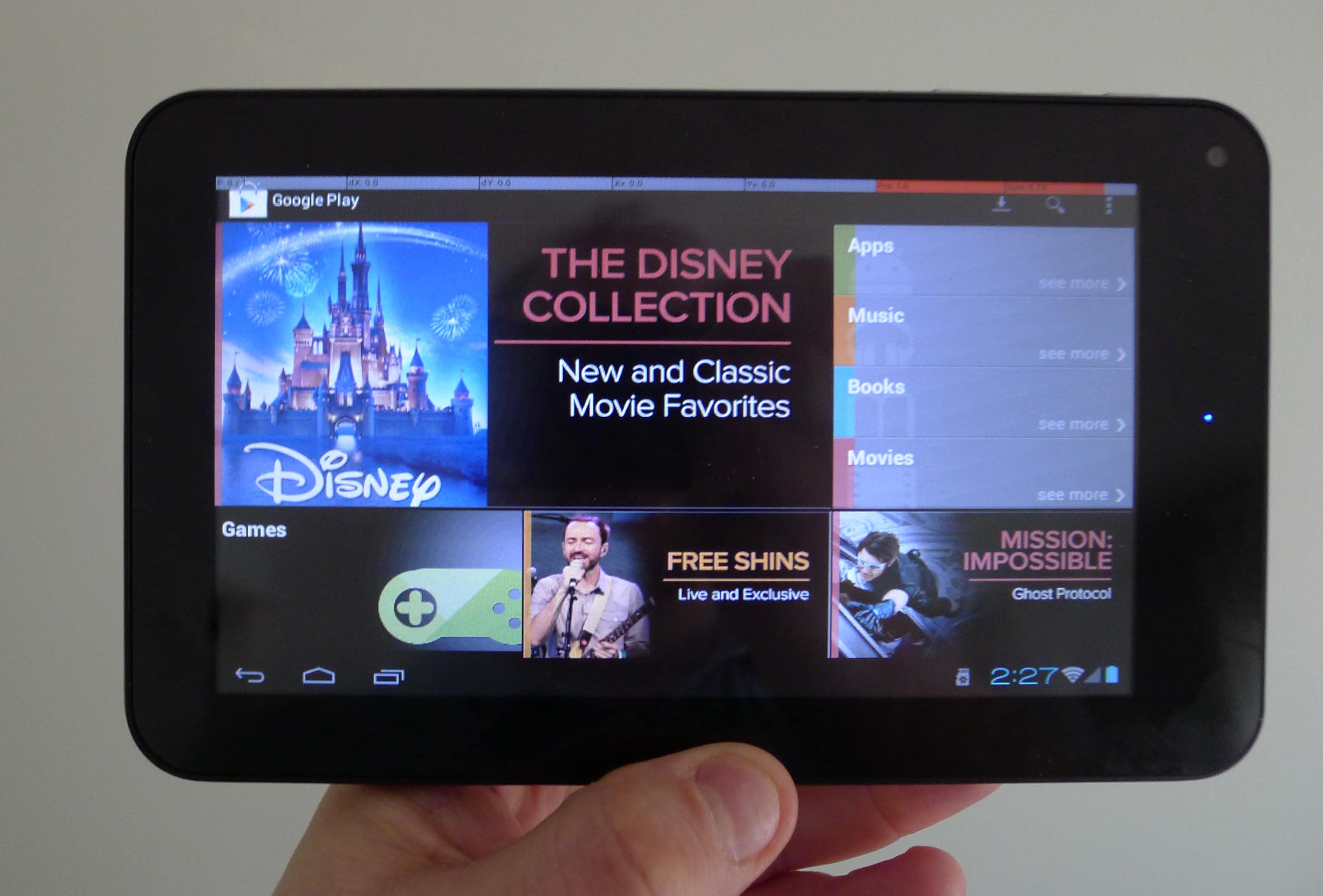
It doesn’t appear to have come with the necessary cable, but the specs boast that this tablet can support 2160p video playback for all formats. It also reportedly supports 3D Android games, though I’m not sure how I’m going to test that. One detail I can confirm is that this tablet ships with Android Market installed. As soon as I got it set up (a bumpy process), it updated itself to Google Play, which was nice.

At first glance the build quality is decent. It falls somewhere in between the PMID701 and the IdolPad, and I don’t see any obvious shortcomings. The touchscreen works slightly better than on the PMID701  and it is attached better than the one on the  IdolPad.

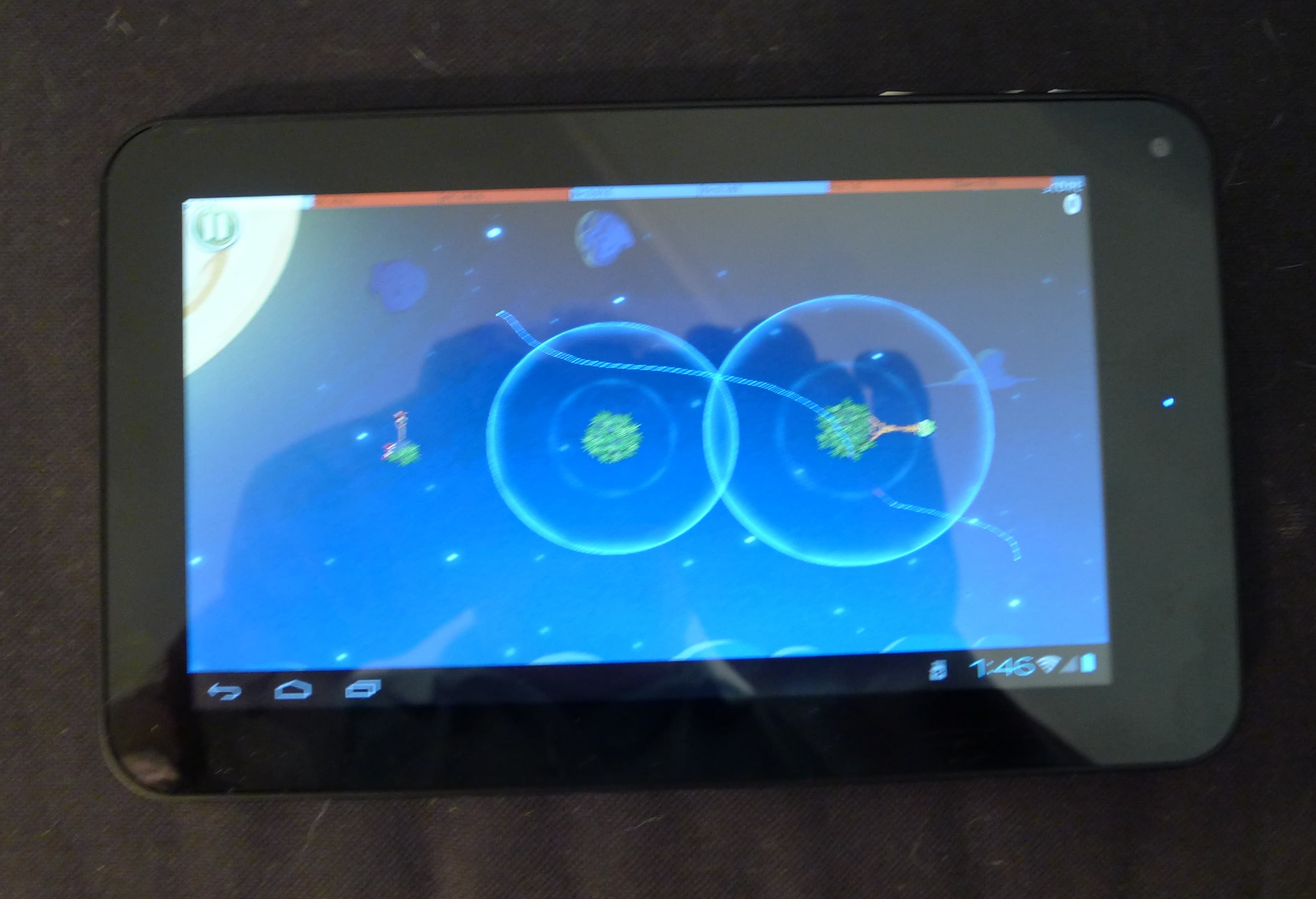
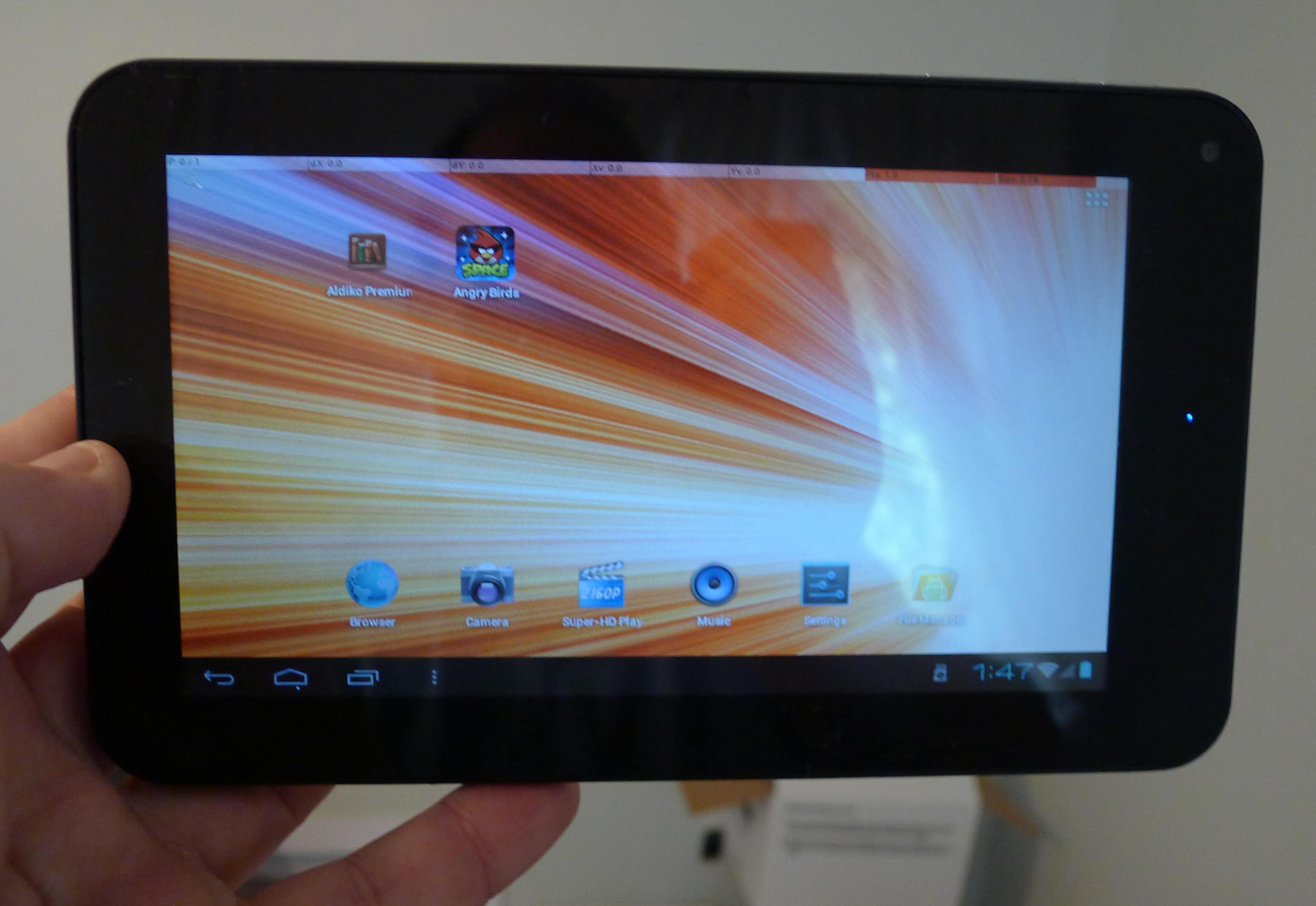
But I have noticed a quirk which might put some users off. It looks like the developers forgot to hide or remove one of their dev tools. This tablet tracks your use of the touchscreen with a line. It also reports the (x,y) screen coordinates in a row across the top of the screen. It’s strange, and I don’t know that I want to put up with it.

Update: Scroll down to the comments for instructions on how to turn this off.

I’ve installed a couple apps (Aldiko and Angry Birds). Aldiko works fine and Angry Birds performed slightly better than it did on either of its competition.

All in all, this is not a bad tablet. It cost a little more but I have the feeling that the performance might justify it. I’m looking forward to posting a review on the weekend.

Amazon

Specs

  • Android 4.0 Ice Cream Sandwich
  • CPU: A10 1.0GHz
  • RAM Memory: 512MB
  • 7″ screen, Resolution: 800×480
  • 5 points capacitive touchscreen
  • 8GB Flash storage
  • microSD Card
  • speaker, mike
  • Mini USB and USB port
  • HDMI out
  • g-sensor
  • Wifi
  • 1.3MP webcam
  • Dimensions: 195mm x 120mm x 14mm
  • Weight: 0.7lbs

Specs

  • Android 4.0 Ice Cream Sandwich
  • CPU: A10 1.0GHz
  • RAM Memory: 512MB
  • 7″ screen, Resolution: 800×480
  • 5 points capacitive touchscreen
  • 8GB Flash storage
  • microSD Card
  • speaker, mike
  • Mini USB and USB port
  • HDMI out
  • g-sensor
  • Wifi
  • 1.3MP webcam
  • Dimensions: 195mm x 120mm x 14mm
  • Weight: 0.7lbs

eBook Sales Don’t Undercut Print Sales, Lulu Reports

The print & digital self-pub service Lulu shared some rather disturbing details in a press release yesterday. Well, it’s probably going to disturb anyone opposed to $10 ebooks; as for me, I’m thrilled.

Lulu was an early self-pub pioneer when it got its start 10 years ago as a POD service. This long predates the ebook explosion,  and Lulu’s solid core of creators (now over 1 million) gave Lulu a unique vantage point to watch the change int the book market when Lulu started offering ebooks.

Do you know how the Price Fix 6 said that they needed to prop up the price of ebooks so they didn’t cannibalize print sales? According to Lulu, that doesn’t happen.

What Lulu.com has found is that each of the two types of formatting tends to help fuel the sale of the other. Those authors who publish their book in both print and e-book format tend to sell double the amount of books, because it is available in the format that the reader prefers. While someone may read an e-book and recommend it to someone else, that person may go on to buy a print version of the book, or vice versa.

Print still makes up the majority of Lulu’s sales (68%), though it only accounts for less than a third of new titles produced. What’s more, ebook titles are growing much faster than Lulu’s print catalog.

If Lulu’s experience tells us anything, it’s that the digital customers are an addition to the print customers, not an exchange. That would tend to disprove the belief that ebooks cannibalize.

—

As interesting as the above data might be, Lulu left out a number of useful details from the press release (found over at DBW). For example, they mention how ebooks are growing faster but they leave out what percentage of their catalog is print vs digital.  Elsewhere on their site they mention having 1.2 million titles and growing by 20 thousand new titles each month.

I suppose this seems like a digression from the topic but I don’t think so. While I might primarily write about ebooks, I try to watch what’s going on for all types of self-publishing. It’s not uncommon to see a creator move across several categories. While music and video is the line most commonly crossed, moving from music into books isn’t so rare anymore. I’d say that the dividing line between cartoons and picture books is more of a smudge mark than a line. And as we  get better tools, this kind of thing will be more common.

In my opinion, the interesting stuff we see in the next couple years will be crossover type of content, and we’re already just beginning to see some of it come out of iBooks Author. I’m looking forward to it.

B&N Expands Foreign Language eBook Selection (Russian, Afrikaans, Urdu, Oh My)

Given that this section of the Nook Store was quietly launched in or before September 2011, I’m not sure this is still news. But it’s interesting none the less.

I noticed something about the Nook Store a few weeks back while I was working on the story about the US Spanish Kindle Store. All the attention at the time was focused on Amazon, but what few had noticed was that B&N had quietly reorganized the Nook Store to include a new section where US customers can buy ebooks in 8 different languages, which compares rather nicely to the 5 languages officially supported in the Kindle Store.

In fact, a side by side comparison of numbers is rather revealing:

Now, the Kindle Store does carry content in more languages than the 5 listed above, but all those titles are illicit. Amazon has made it clear in the past that only those 5 languages are supported and any content in a non-supported language will get pulled.

It’s an interesting comparison , isn’t it? Amazon is winning the content battle in 2 of the 5 languages they chose to support (while B&n offers more titles in Spanish). And given the paltry selection each offers in Portuguese and Italian, I’m calling those a draw.

But B&N is also offering a number of languages that Amazon won’t even touch, including several that I found through trial and error. Polish, Afrikaans, and Danish aren’t listed in the menu but they can be found by fiddling with the URL. (Pretty cool, Huh?) While the selection in some of the languages might be limited, at least B&N is offering them and classifying them correctly. That will stand them in good stead when they do go international.

While I’m at it, I’d like to point out that you can go find more foreign language books in the Nook Store. All you have to do is change the 3 digit language code (Afrikaans is AFR) to one of the codes listed here. (Hat tip to eBookFriendly for figuring out the language codes first.) The specific part of the URL that needs to be changed is the one beginning with &lng=. The language code comes after the equal sign. Click on one of the links above, delete the existing code 3 letter code, and type in a new one. Press enter and that should lead you to a new page.

I’d say that B&n clearly is the winner in the content department. They’re carrying stuff in the US market that no one else is (besides Smashwords, where some of the content is distributed).

Joyplus Shows Off 7″ and 10″ Tablets with? Pixel Qi Screens (video)

I’m feeling a little frustrated this evening so I thought I’d share a video with you. The video features a tablet with a screen we cannot get here in the US, now that Notion Ink has stopped shipping the Adam tablet. Charbax spent some time with JoyPlus while he was in Shenzhen last week. They showed him their 2 Pixel Qi equipped tablets with 7″ and 10″ screens.

Pixel Qi is a screen tech that has been just about to hit the consumer market for a couple years, and it’s been long enough that I’ve given up on the screen. I used to like this screen because it had a unique ability to have near LCD quality color while still offering a low power mode which extends the battery life.

But at this point I’m expecting that we’ll see battery tech improve while LCDs get more energy efficient long before I ever get my hands on a consumer product with a Pixel Qi screen.

Pixel Qi likes to boast that their screen is on a dozen products, but that’s not completely true.

First, the highest profile one, the Notion Ink Adam tablet, is no longer available with this screen. And at least one other device, the netbook from Sol Computers, is actually an aftermarket mod. I’m not sure that qualifies as a product. And then there’s the XO-1 laptop, which can only be had in used condition or after it has been surplused out of a program. Thus it’s not really available to consumers.

P.S. Don’t mind me. I’m just sitting here pining away for my $800 Pixel Qi Netbook from Sol Computer. It’s taking forever to arrive.

Amazon Now Going After Audiobook Authors

Amazon made a move today which shows that they’re nit just trying to cut publishers out of the ebook market; they’re horning in on the audiobook market as well.

They’ve just announced a new $20 million fund for authors. They’re calling it Audible Author Services, and authors who sign up will get a buck for each copy of an audiobook sold via Audible. Clever, no?

The program is going to formally launch on Sunday, and it really is that simple.  Authors don’t have to do anything other than sign up, and what’s more, Amazon says that they don’t have to share their earnings from the program.

I wonder why Amazon is doing it? I confess to not knowing much about audiobooks, but I would guess that Amazon has noticed how the market is growing and wants to give it a push.

Downloadable audiobooks is the one category besides ebooks that has grown over the past couple years. While I don’t have current stats in front of me, the monthly AAP reports have consistently shown a solid increase each month. In January 2012, for example, the AAP reported $8.4 million for the category, up 30% from $6.5 million in January 2011.

And while it’s obvious Amazon wants to bypass the publishers, I suspect that they are also working to build the social aspects as well. Authors can be their own best salesmen, but first they have to be interested in doing it and I’m not sure that was happening before. While I can easily recall authors pushing their latest ebook, I don’t know the last time one pushing the audiobook at the same time.

And yes, I do think the long term goal is to bypass publishers. Amazon wants authors to sign in with their existing Amazon accounts, you know, the ones they use to submit their ebooks to KDP. This is going to let Amazon connect 2 possibly unrelated details about each author.

Also, this new program is being administered via Audiobook Creation Exchange (ACX), Audible’s new self-pub platform for audiobooks. There are even a few subtle hints that authors might want to check the ACX help pages for tips on promoting their work. Clearly Amazon is looking to build a direct relationship.

All in all, publishers are going to hate this.

via

16 States File Suit Against the Price Fix 6

I think the publishing industry is finding out today the true meaning of the phrase "when it rains, it pours". The Connecticut State’s Attorney General issued a press release today.

He’s leading a coalition of 16 states, led by Texas and Connecticut, in filing an antitrust lawsuit in U.S. District Court in Texas. They’re suing Apple, Macmillan, Penguin, and Simon & Schuster for price-fixing. The other 2 conspirators, Hachette and HarperCollins, have already reached an agreement with the 16 states.  The specific details have not been worked out, but the publishers have agreed to pay restitution to consumers.

Gee, maybe they did conspire to raise prices.

The one odd part about this announcement is that S&S is still being sued. They’ve already settled with the DOJ under terms that basically killed off the fixed price component of the agency model.

States eBook complaint

Press release to follow:

WASHINGTON, D.C. – Attorney General George Jepsen announced today that 16 states, led by Texas and Connecticut, have filed an antitrust lawsuit in U.S. District Court in Texas alleging Apple Inc. (Apple), and publishing companies Macmillan Publishers Ltd. (Macmillan), Penguin Group (USA), Inc. (Penguin) and Simon & Schuster engaged in an anticompetitive price-fixing scheme for marketing electronic books.

At the same time, Jepsen said he and Texas Attorney General Greg Abbott have reached agreements with two other publishers: Hachette Book Group, Inc. (Hachette) and HarperCollins Publishers, LLC, (HarperCollins). Although the details will be worked out over the next several weeks, the publishers have agreed to provide consumer restitution using a formula based on the number of states participating and the number of eBooks sold in each state.

“Publishers deserve to make money, but consumers deserve the price benefits of competition in an open and unrestricted marketplace,” said Attorney General Jepsen. “Those interests clearly collided in this case and we are going to work to ensure the eBook market is open once again to fair competition.”

The lawsuit and agreements by the states stem from a two-year antitrust investigation coordinated among the U.S. Department of Justice’s Antitrust Division (DOJ) and the offices of the Connecticut and Texas Attorneys General.

Jepsen made the announcement at a news conference in Washington with U.S. Attorney General Eric Holder, who announced that Department of Justice had filed a civil antitrust lawsuit on similar charges in the Southern District of New York against Apple, Penguin, Macmillan, Hachette, HarperCollins and Simon & Schuster. The Department of Justice also filed proposed settlements with Hachette, HarperCollins and Simon & Schuster that, if approved by the court, would resolve those lawsuits.

If accepted by the court, the DOJ’s proposed settlement would be in effect for five years. It would restore competition to eBook sales by ensuring that retailers agree to certain business reforms. In addition, the settling publishers would be required to establish effective antitrust compliance programs.

The states’ complaint alleges that the defendants conspired to raise eBook prices. For years, retailers sold eBooks through a traditional wholesale distribution model, under which retailers – not publishers – set sales prices for eBooks. However, the states’ investigation found that Macmillan, Penguin and Simon & Schuster conspired with other publishers and Apple to artificially raise prices by imposing a distribution model in which the publishers set the prices for bestsellers at $12.99 and $14.99.

The complaint alleges that when Apple prepared to enter the eBook market, the publishers and Apple agreed to adopt an agency distribution model as a mechanism to allow them to fix prices. To enforce their price-fixing scheme, the publishers and Apple relied on contract terms that forced all eBook outlets to sell their products at the same price. Because the publishers agreed to use the same prices, retail price competition was eliminated.

The complaint alleges that the coordinated agreement to fix prices resulted in eBook customers paying more than $100 million in overcharges.

The States’ lawsuit seeks damages, restitution, civil penalties and injunctive and equitable relief to prevent the illegal business practices from continuing.

Joining Texas and Connecticut in the lawsuit are: Alaska, Arizona, Colorado, Illinois, Iowa, Maryland, Missouri, Ohio, Oregon, Pennsylvania, South Dakota, Tennessee, Vermont and West Virginia and the Commonwealth of Puerto Rico.
Assistant Attorneys General Joseph Nielsen, Gary Becker and Kirsten Rigney, Paralegal Holly MacDonald and Assistant Attorney General Michael Cole, head of the Antitrust Department, are assisting the Attorney General in this matter. Jepsen is co-chair of the Antitrust Committee for the National Association of Attorneys General.

Amazon Kill Publishing? Hah! And Again, I Say Hah!

So the news finally broke today that the long rumored Dept of Justice anti-trust lawsuit against the Price Fix 6 really does exist, and the DOJ is indeed suing the 5 publishers and Apple for colluding to fix ebook prices in the US market.

Surprise, surprise.

I haven’t covered this story in much depth but I have been reading all the hand-wringing coming from the legacy industry players like Scott Turow, Joe Wikert, and others. I’ve also been watching Twitter today as the news broke and many bemoaned the coming death of publishing as Amazon is released from the restrictions of agency pricing. So many of the tweets are based on half remembered, mis-stated myths about the ebook market that I cannot take it anymore.

Many things have been said about this story, but few of them are true. In this post I will correct that oversight. Here’s the big one:

Amazon isn’t going to kill publishing; they have in fact done more to create the new publishing industry than any of the 5 legacy dinosaurs being sued today.

I will work my way up to proving that premise, but first I will start on the smaller misconceptions. For example, there is an assumption made by many people decrying the end of agency pricing that Amazon can now do whatever they want with prices. Well, many appear to have forgotten that Amazon already could do that with a lot of the ebooks they sell because:

  •  Agency ebooks are not the totality of ebook market.

The reality of the matter is that the only publishers who got agency pricing were the ones big enough to bully Amazon into it. These are basically the few who are big enough that they could hurt Amazon by walking away. Everyone else gave Amazon the right to price the ebooks however Amazon wanted. That includes thousands of small publishers as well as hundreds of thousands of self-published authors.

And that leads me my second point, which is:

  • No one knows how many agency ebooks are currently on the market.

For the past week I have been asking around, trying to find out what percentage of the US ebook market was covered by these pricing restrictions.I did not find anyone who had been tracking this or knew of a way to find the numbers.

That means no one who has spoken out on this topic knows either the number of tittles or the dollar value of agency ebooks in the US market. No one who opposed ending the agency system has a single fact to back them up. (I really hope they don’t run their businesses in such a sloppy manner.)

  • If Amazon is out to destroy publishing, then where are the corpses of their victims?

Given that Amazon can already abuse many thousands of publishers and authors, I’m sure you can find hundreds of stories of Amazon crushing the will of the innocent. What, there are only a handful of stories, which stand out because they are uncommon? I’m sure that’s not right. Amazon is evil, so clearly they must be hurting everyone.

And that brings me to my final point.

  • Far from killing publishing, Amazon has created a whole new publishing industry.

Amazon has enabled literally hundreds of thousands of people to get their work to readers and get paid for it. No legacy publisher can make that claim, nor would they have even tried.

Are all the new authors good? No, but that point is irrelevant – unless you are willing to argue that everything put out by the legacy publishers  is also good. I am only crediting Amazon with creating the possibility; what everyone does with their opportunity is their business.

If anything, Amazon is out to kill legacy publishing. I am ambivalent to that; I don’t own any of the companies so I don’t have a horse in this race. My view if the Amazon-legacy  struggle would best be described as "root hog, or die".

And yes, self-pub existed before Amazon. You could even have submitted your ebook to Mobipocket or other ebook distributors. But you know and I know that self-pub didn’t become socially acceptable until Amazon launched the Kindle Store. That is when everything took off.

Now, I fully agree that Amazon is going to extract as much as they can from their dominant position in the market. But I also know that Amazon won’t be dominant forever. It won’t be too long before some faster, nimbler, and better competitor dethrones Amazon. It has happened before in other industries and it will happen in this one.

Update: This is an early response from Twitter that I thought summed my post up succinctly.

If you want to see how wrong current views are on Amazon’s dominance… rewatch "You’ve Got Mail" if you can stomach it.

And that is how I feel about the topic.

New Nook to Have Front-Lit Screen

Yes, B&N is beating Amazon to the punch.

Late last week Techcrunch reported that the next Kindle might be getting an integrated frontlight so people can read in the dark. I never really liked the idea, but apparently Barnes &Noble does. I now have a photo of new signage that B&N stores are just beginning to get in store.

It’s important to note that the new Nook isn’t getting a backlit screen like that on your LCD based tablet. The Nook, like many ereaders, uses an E-ink screen and that means that you cannot have the light behind the screen. The new Nook is going to have a front light embedded over the E-ink screen and it’s probably going to work much like the FlexLight concept video which I showed you back in December.

I don’t have any firm details on the price or release date, but I have heard that it will be a Thursday launch. That likely means tomorrow, but it might refer to next week.

P.S. As fascinating as this story is, I have to say that I’ve been hearing rumors of it for a while now. My competition reported last week about this very product. He only had a rumor, but his details were surprisingly accurate.


Review: Polaroid PMID701 Android Tablet

Polaroid’s second 7″ Android tablet hit the market about 2 weeks ago and I got it the morning it was available.

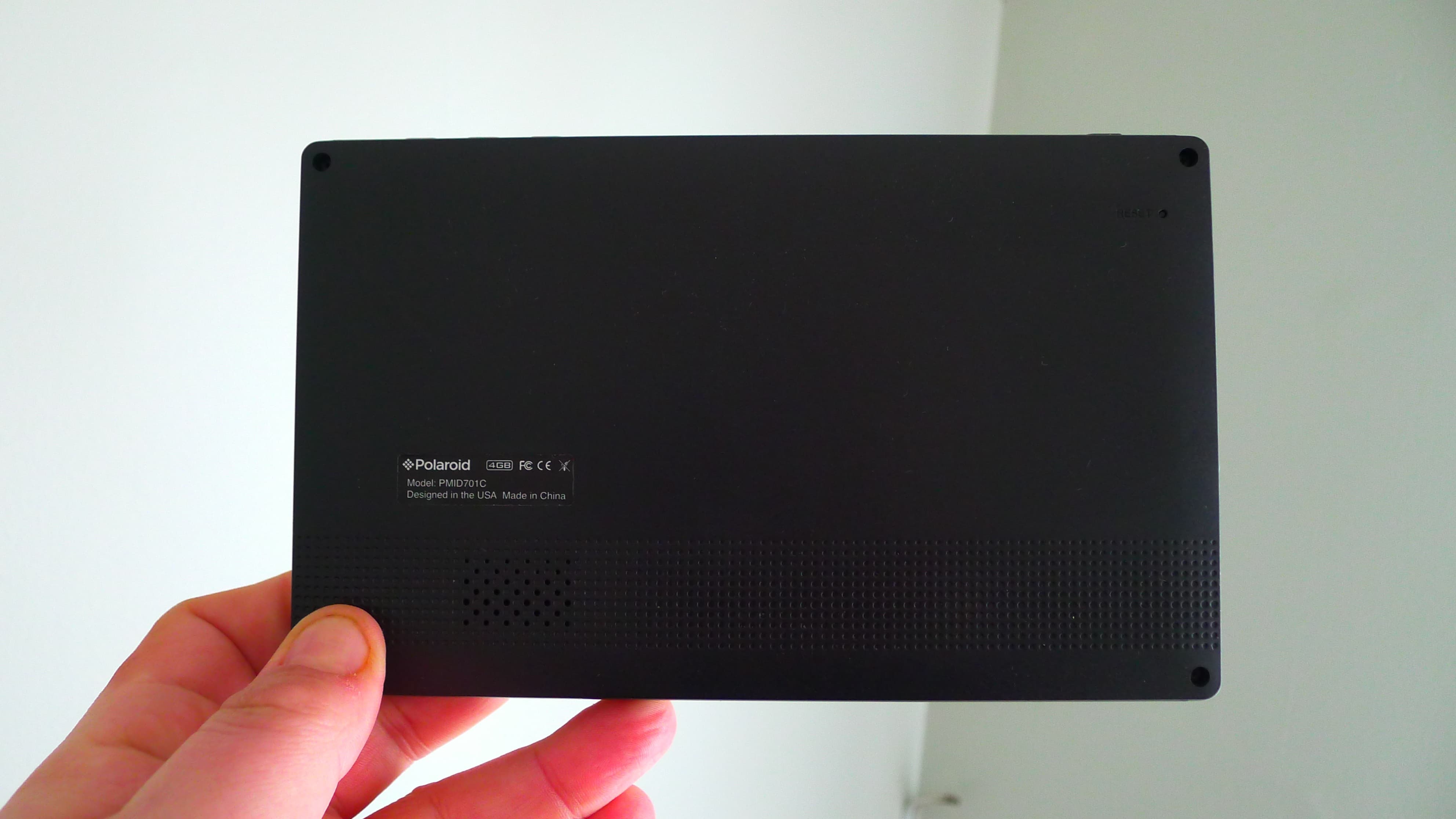
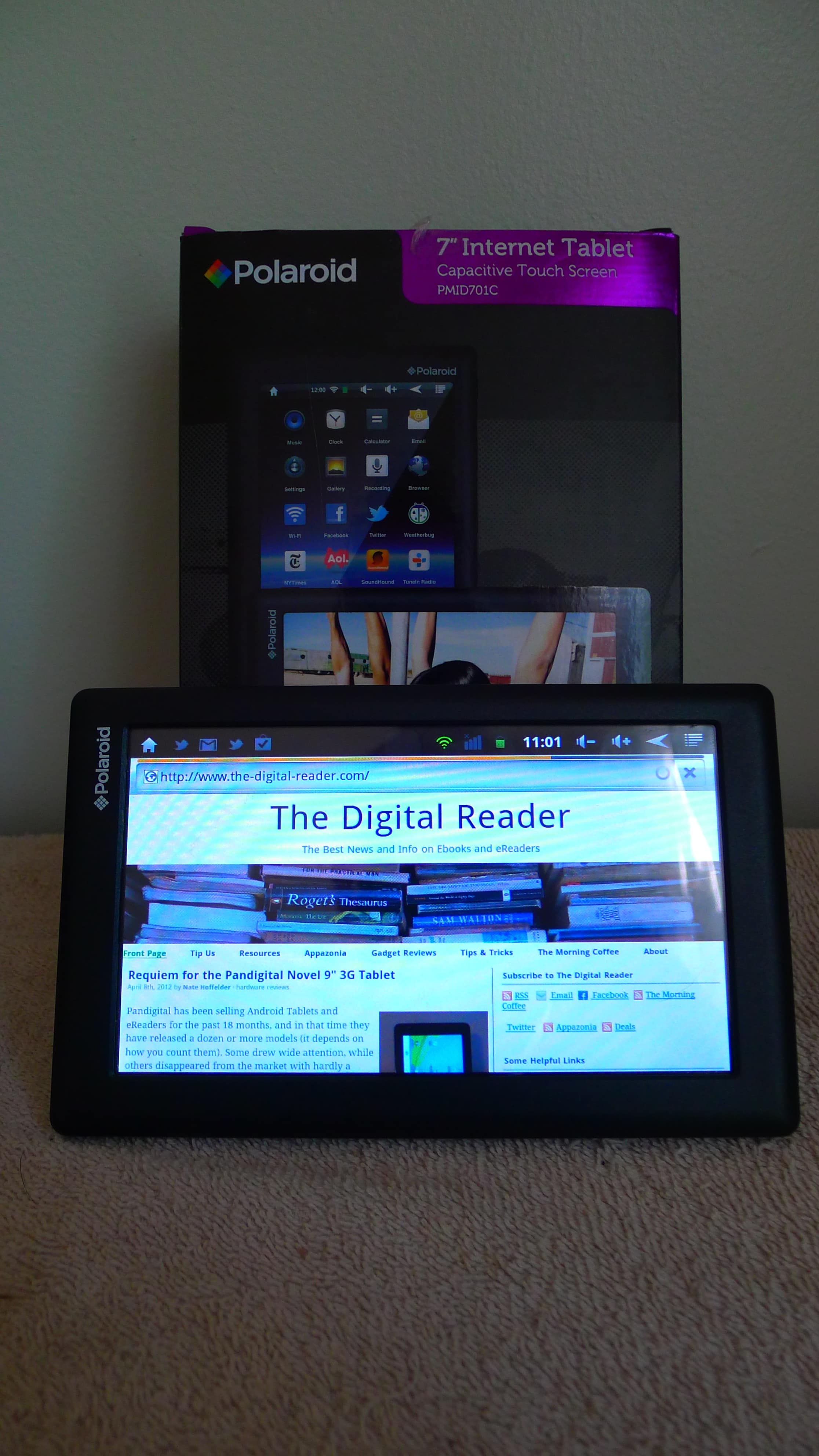
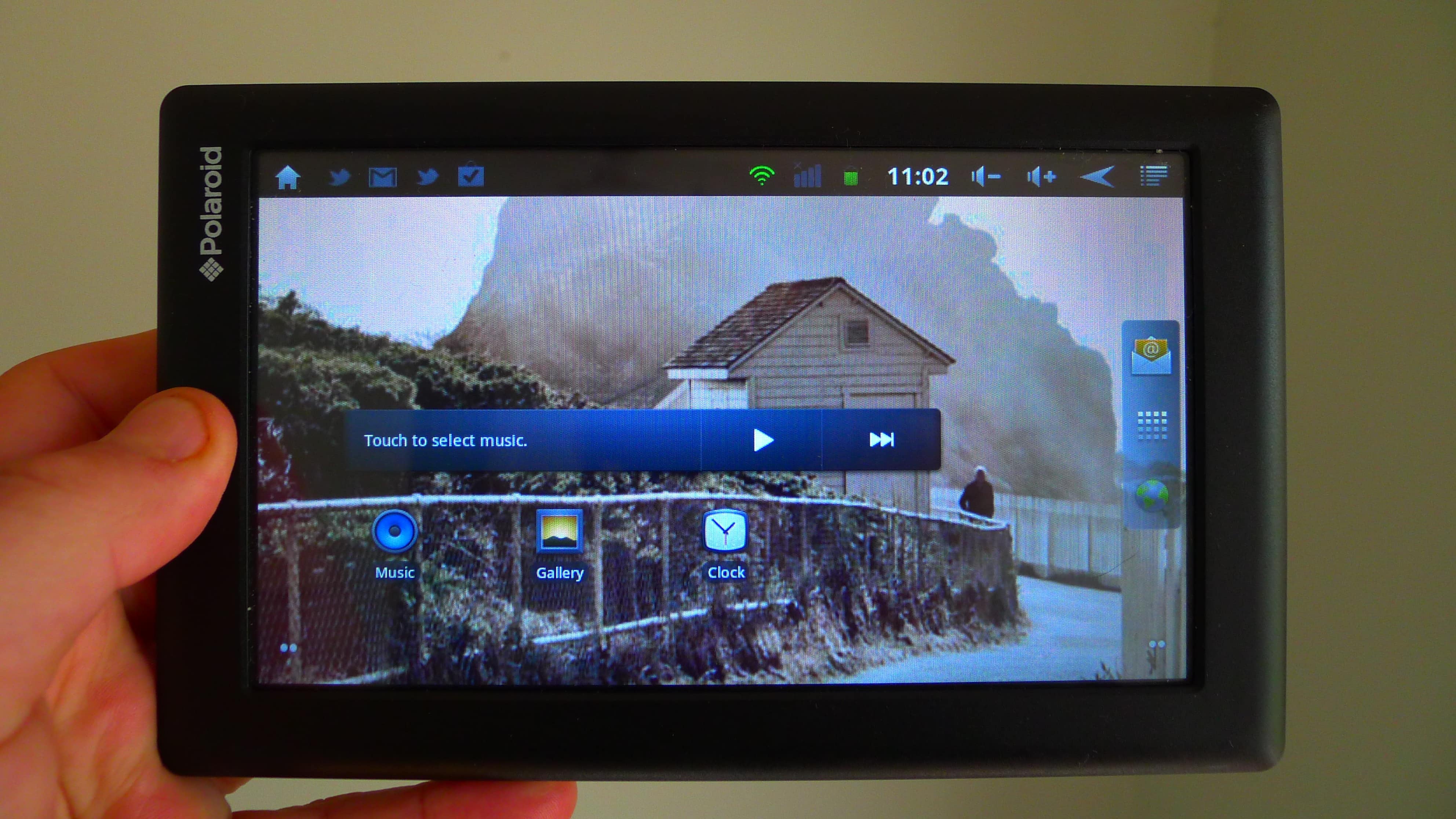
This is a rather ordinary black slab of a tablet with a 7″ capacitive touchscreen, 4GB Flash storage, microSD card slot, g-sensor, speaker/mike, and a TV out port (no cable is included). It’s running Android 2.3 Gingerbread on a 1GHz CPU.

Update: There’s now a later version of this tablet with Android 4.0. The hardware is the same and the hack works fine.

It doesn’t have Bluetooth or a camera, which puts it solidly mid-field for $99 tablets.

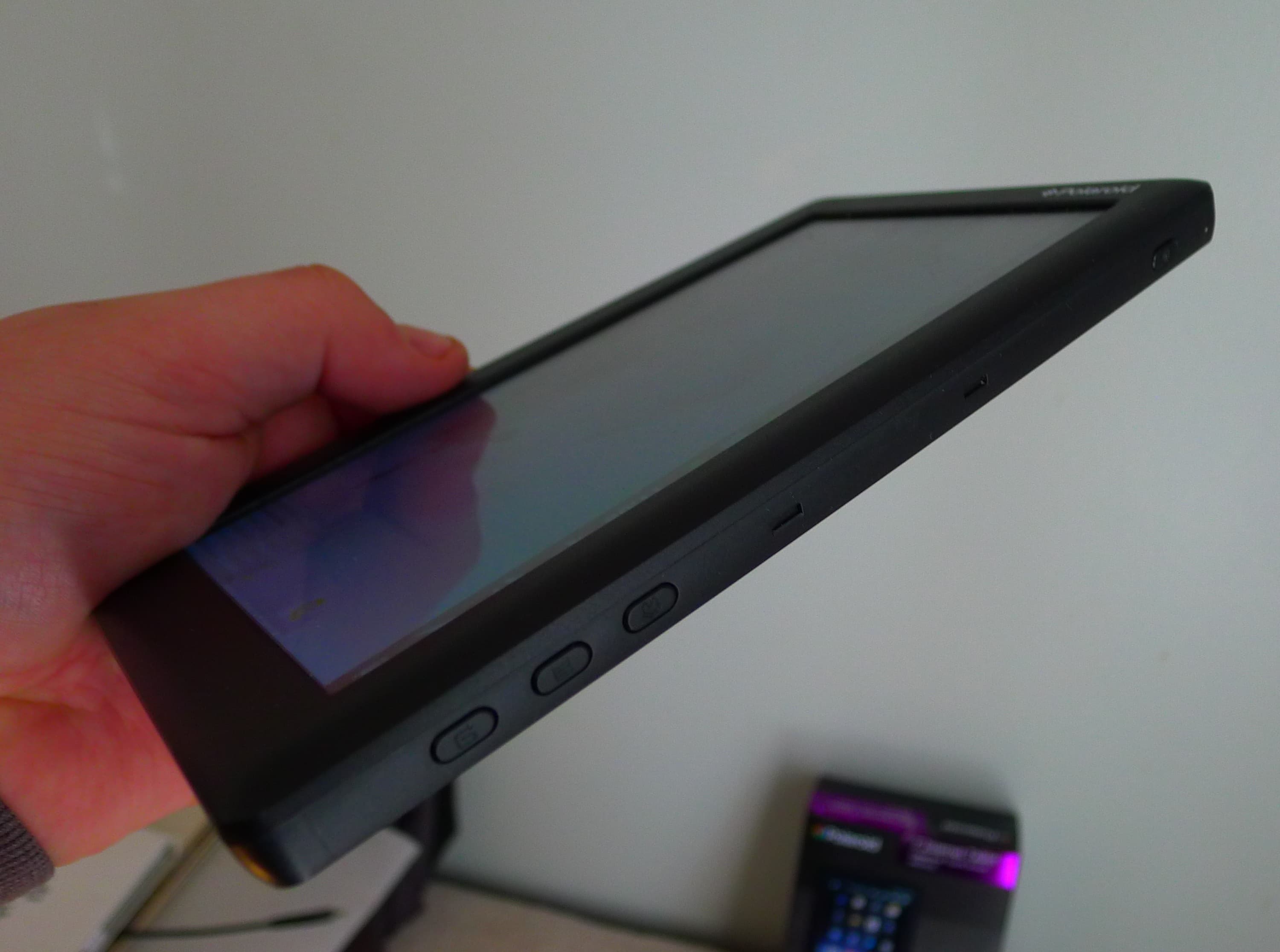
The speaker is on the back, with the microphone alone on the one long side. All the ports and slots are found on the upper short side, with the power, home, back, and menu are on the right edge. The general build quality is good. The screen is responsive, and I had a minimal number of miss-touches.

Apps

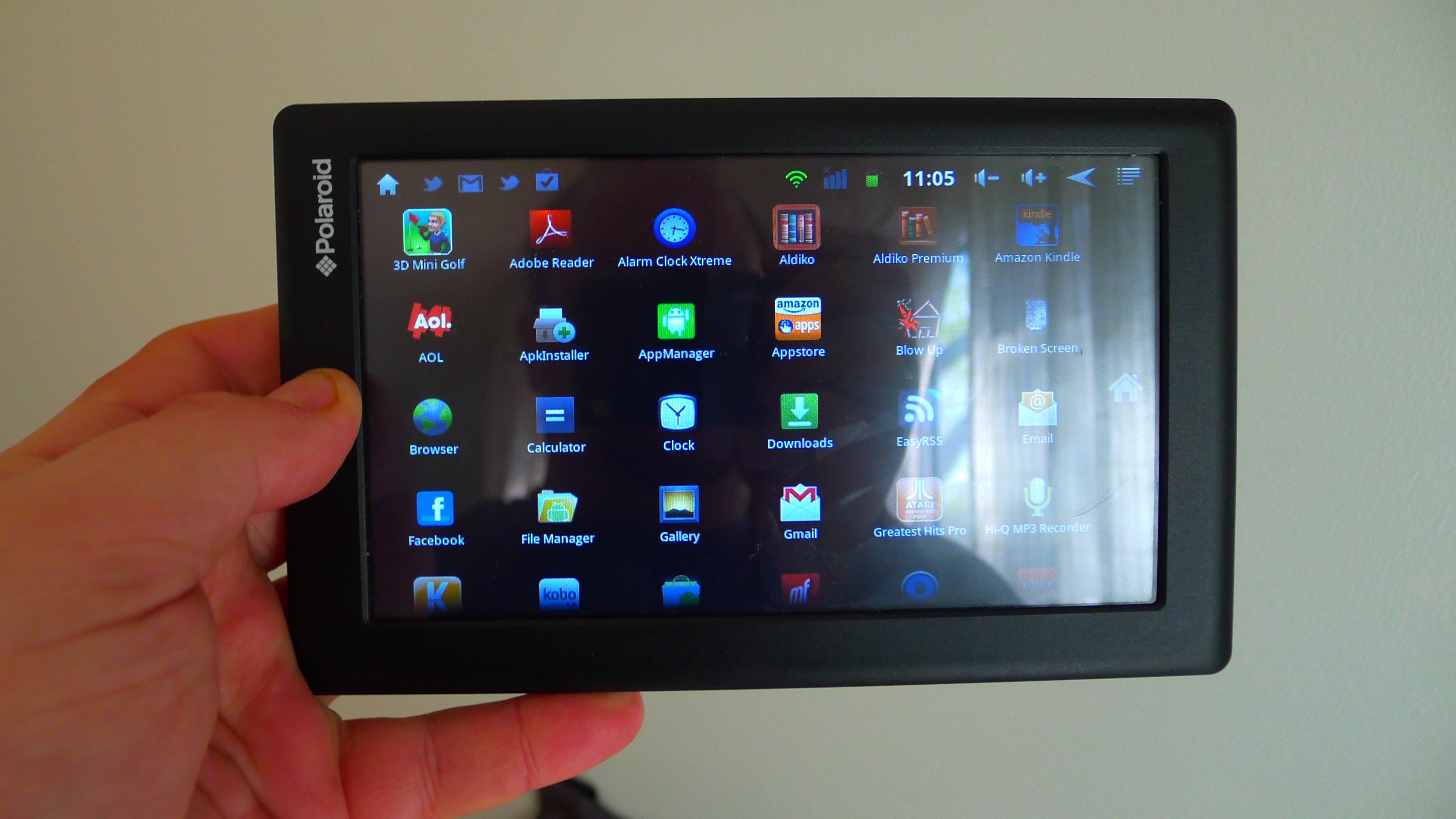
The PMID701 comes with a good suite of apps, including the Kobo app, but it doesn’t come with Google Play or the Amazon app store. That puts it at something of a disadvantage when compared to the other good budget tablets like the IdolPad ($99, 7″, ships with Google Play).

I really wasn’t happy with the apps that came on the device; the Twitter and email apps were rather poor. Luckily for me there’s a hack which makes it possible to install Google Play. That radically changes my opinion of this tablet, making it one of the better ones in this price range.

Angry Birds loaded and played just fine. So did the Youtube app, which loaded several clips and played them without trouble.The stock media player is worth replacing, but it played video files without dropping frames. Audio was quiet and missed some of the subtleties, but it worked adequately (this is a budget tablet after all).

User Experience

If you get this tablet, don’t expect it to be more than a basic tablet.  But as a basic tablet it is a decent one. I have found that the only place where it comes up short is in the hardware it lacks.

It has no volume buttons. I know that is a strange complaint, but a lot of reading apps (including Aldiko, Kindle, etc) now use the volume buttons as page turn buttons. That makes it a lot easier to use a tablet to read on. And this isn’t limited to just reading apps; some of the feed readers and aggregators also use the volume buttons in clever ways.

All in all, this tablet is as good as the IdolPad, another $99 Android tablet.

Battery

I didn’t get a chance to take this tablet on a trip, which is my preferred way to test the battery life. But I have been using it as my main tablet for these past 2 weeks.I didn’t have any issues with the battery mysteriously draining (like on some other cheap tablets).

I would estimate that the battery lasted at least a day under moderate use. That is fairly good for budget tablet, considering that a premium tablet like my 7″ Samsung GTab has only 2 days battery life under similar usage.

Specs

  • 7″ capacitive touchscreen (800×480)
  • 1GHZ CPU
  • 4GB Flash, microSD card
  • Wifi
  • speaker/mike
  • g-sensor
  • TTS
  • Video out (but no cables provided)

How to Install Android Market on Polaroid PMID701

I’ve had this tablet for a couple weeks now, and I have to say that the out of box performance is a little lacking. While it does ship with a basic suite of apps they’re not very good. Even the free ones I’ve gotten from Amazon’s Appstore are rather lacking when compared to the official Google apps (gMail, gReader, etc).

Luckily for me there’s a way to install Android Market and thus get the official apps. It’s also really easy.

Note that this isn’t  a set of instructions on how to hack the tablet; I’m only interested in achieving a certain minimum level of ability with the least work required.

Update: There are now at least 2 related Android tablets with the PMID701 moniker. These instructions have been confirmed to work on the PMID701C and the PMID701I.

A few days back one commenter pointed me at this page, which has both a set of instructions and the necessary apps. I’ve installed them without a hitch and I am now much happier about this tablet. I followed the instructions on that page and got the exact same results. Here’s how you do it.

  1. Download this ZIP file to your computer.
  2. Open it and copy the contents of the ZIP file to your Polaroid tablet over USB. Then unplug your tablet.
  3. Once you’ve done that, open the file manager on your tablet and go to the folder where you put the files. Try to install the following apps in this order (double click on the files in order to run them):
  • OneTimeInitializer-signed.apk
  • SetupWizard.apk
  • vending-3.1.3-signed.apk

As a 4th step you might want to press the home button, select the checkmark which says "open always with", and then select Launcher. This will guarantee that whenever you press the home button you will see the home screen and not be prompted with a menu.

All 3 apps installed okay, and I now have the Android Market working. I’ve downloaded and installed several apps. I know that it’s weird that the icon and app still says Android Market, not Google Play, but it works so I do not care.

But there is one small problem. For some reason the Setup Wizard app is listed as an alternate home screen. This does not impact the functions of the tablet, but it is a little annoying so I checked the box to always open the home screen with the other item (Launcher).

All in all, this is a much nicer tablet now. It doesn’t quite have the vibe of the IdolPad but at least it’s no longer coming up short in the apps department.

Next Kindle to Have Front-Lighted Screen?

Devin Coldewy of TechCrunch has just gotten back from a tour of Lab126’s offices. This Amazon sub is where Amazon has been developing the Kindle since before it was a gleam in Jeff Bezos' eye, and while Devin was there he was shown a new Kindle prototype with a front-lit screen.

He didn’t get to see any part the device itself, but someone did demo the front light in action. Devin The touchscreen equipped device hs shrouded by cardboard with just the screen visible, and Devin reported that:

With a tap, a slider popped up on the screen, and as it was dragged to the right, the screen lit up evenly with a rather cool light. In the dark, it was plainly noticeable as a glow, and in uneven light — say, shade or a shuttered room — the slight illumination made the screen much more readable. At full blast it was definitely projecting some light (technically speaking it was reflecting it), but it was still a soft glow and not the harsh flashlight of a backlit LCD.

The light itself is based on tech developed by a company that Amazon bought a couple years back. The company, Oy Modilis, was founded in 1991 and then quietly snapped up by Amazon in 2o10. The company is described by Amazon as being"the world leader in light-guide technology". On a related note, I suspect that Amazon bought Oy in the same tech buying spree as the touch screen company they reportedly bought in early 2010. Amazon was probably looking for the next great tech and bought everything that looked like it had a shot.

When I first read this report I thought that here’s a product idea that I hope isn’t going to come to market. I’ve seen any number of front light screens and I’m not sure any of them worked all that well. They were always a compromise between power conservation and effective lighting thatI ut up with because I needed them rather than because I liked them.

But this one might be different. Devin was impressed by the evenness of the light. He thought that the lower settings would help make the screen much more readable in dimly lit rooms. This might be worth getting, if Amazon really does have the bugs out of it.

As for me, if I want a lighted screen I will get a tablet with lots better color and refresh rate. Also, I suspect that the front light Amazon’s working on is probably going to be enough of a power drain that tablets might be a viable competitor.

Google Killing the eBookstore Reseller Program – Affiliates Will be Unaffected

So it looks like Google didn’t see the growth they wanted in the reseller program they launched with the Google eBookstore back in 2010; today they announced that they plan to end the program in January 2013.

The news broke today with  the letter that Oren Teicher, the CEO of the ABA. (I’ve added the letter to the end of the post, in case you’re interested.) Google has also confirmed the news in a blog post.

Google’s going to be cutting ties to all 16 reseller partners, including Powell’s Books and the ABA IndieCommerce program (which supports about 150 indie bookstores). The ABA is promising to have an alternative in place before the end comes around.

Google had this reseller program for about 18 months, and while that isn’t long period of time it’s still 18 months longer than B&N or Amazon, who have never expressed interest in launching similar programs. On the other hand, today’s news  shows that they might have had the right idea; this program didn’t generate the sales Google expected.

Now, I’m running a few minutes behind everyone else on this story because I took some time to confirm details with Google. You might recall that a couple months back Google thinned the ranks of their ebookstore affiliates.  The surface details of the 2 stories sound enough alike that I got to wondering how they are related, so I asked Google.

According to a Google spokesman, the affiliate program and the reseller program are not the same thing. Today’s news only affects the bookstores who were resellers (like the ABA IndieCommerce). Any bookstore who was a Google affiliate will not be affected by this closure.

If you’re not sure whether your local bookseller will be affected, there’s an easy way to tell.  If that bookstore sends you to Google to buy the ebook then they are an affiliate. They will still be able to send you to Google to buy the ebooks.

***

Dear Bookseller:

We were notified Tuesday afternoon by Google that they will be discontinuing the Google eBooks reseller program, worldwide, effective January 31, 2013. As you may be aware, the reseller program is Google’s program as an e-book wholesaler to numerous online retailers, including IndieCommerce, as well as Powell’s and other partners in the United States and around the world, including partners in Canada, the UK, France, and Australia. Google’s decision to discontinue the program is, therefore, far larger than just IndieCommerce and the users of our product. After January 31, 2013, Google will sell e-books through Google Play only.

To say the least, we are very disappointed in Google’s decision, but, we have every confidence that, long before Google’s reseller program is discontinued, ABA will be able to offer IndieCommerce users a new alternative e-book product, or choice of products, that will not only replace Google eBooks as it currently works on IndieCommerce sites but that will be in many ways a better product.

From the start, we have recognized certain realities of our working with Google. As an enormous, multinational corporation, Google has interests far beyond independent bookstores, and the book world at large, and, at times, it has lacked understanding of many basic principles of our industry. Also, recognizing that it is never advantageous to rely too solely on only one vendor, throughout the time of our relationship with Google, ABA has been actively engaged in talking to many other potential industry partners, in case the need arose to replace or to supplement Google’s offering.

As you recall, we partnered with Google in 2010 because it was the only viable means for us to enter the e-book market, but, like so much else in our industry, things have changed rapidly, and we have options that simply did not exist 18 months ago. While we know that our volume of e-book sales has been modest, we also know that being able to offer e-books to your customers is an indispensable feature of any bookstore’s web offerings, and this capacity has helped drive online traffic that has contributed to increased overall sales. Moreover, we’ve all learned a lot about selling e-books in the last year and a half, and we’re looking forward to the opportunity to build an improved product.

We are totally committed to providing IndieCommerce stores the means to continue to sell e-books, and, at minimum, we expect to move forward quickly with one or more partners who will better understand — and who will maintain closer ties to — your stores, and to the book industry in general.

We recognize that this is a significant development, and I want to underscore that, in this transition period, Google eBooks will continue to be available via your websites. We also have every reason to believe that e-books purchased from your store will persist in your customers’ Google Accounts after the reseller program ends. We will share additional details as we learn them.

I know that change can be disconcerting and disruptive, but with input from the ABA Board, our Digital Task Force, and our Indie Commerce Advisory Council, we will get through this, and, in the end, I am confident that we will be able to offer a better and more robust e-book product.

If you have any questions, please, don’t hesitate to contact me or Matt Supko, ABA’s Technology Director.

best regards,

Oren J. Teicher
Chief Executive Officer
American Booksellers Association