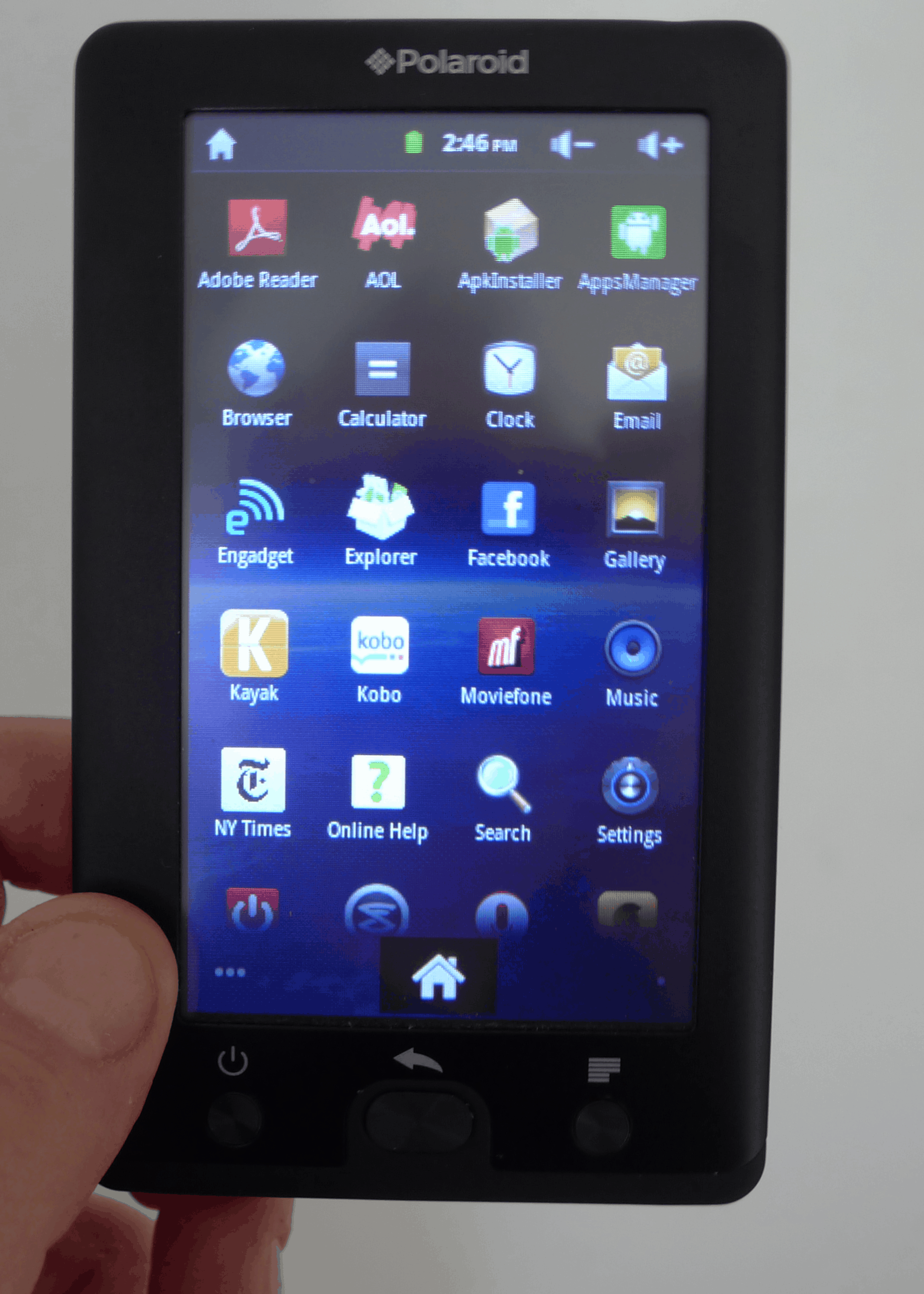
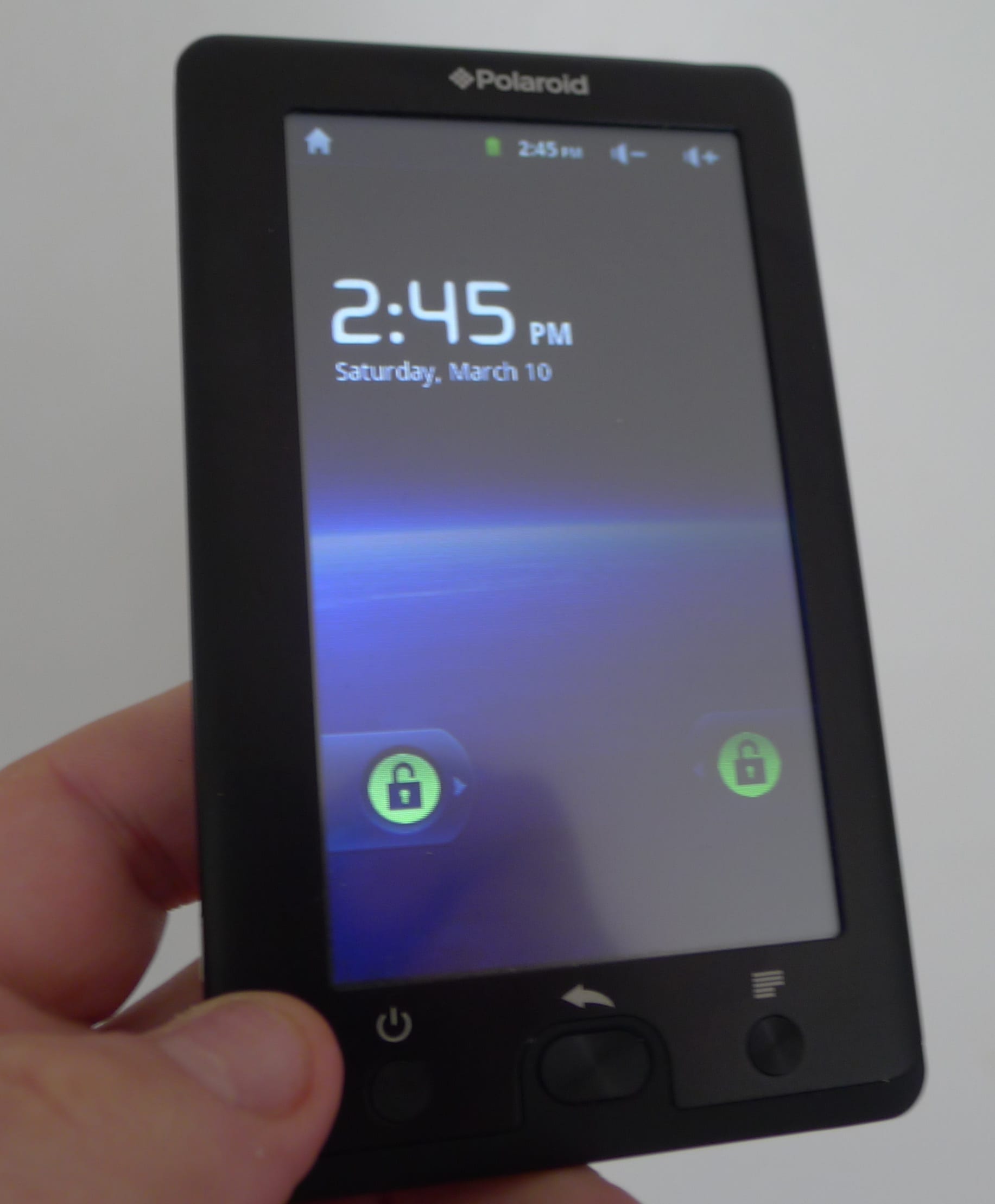
First Impressions of Polaroid’s New 4.3″ Android PMP

This morning I picked up a Polaroid PMID4300 at BigLots, and I have to say that it’s not bad for a $60 device. For some time now I’ve been looking for a cheap Android handheld and this might be it.

This was one of the new gadgets that Southern Telecom had on display in their booth at CES 2012, and it looks like I am the first to post a review. I just barely touched on it back in January, so specs and some background would probably be a good idea.

This is a 4.3″ Android tablet, and it’s running v2.2 Froyo on a Rockchip RK2818 CPU (600MHz). It has a resistive touchscreen, 4GB Flash storage, microSD card slot, Wifi, and speaker/mike. I don’t know the screen resolution, but I would bet that it’s 480×272.

There are 3 buttons below the screen (power, back, menu), and they’re the only buttons on the device. The home button and volume buttons are on the screen. The ports and card slots are on the lower edge. The mike is on the left edge and the speaker is on the upper left rear corner.

It comes with quite a few apps, including Kobo, Adobe Reader, Twitter, NYTimes, and the usual email, browser, file manager. Note that there’s no Android Market (Google Play) or Amazon Appstore, so you’ll need to find a source of apps (Freeware Lovers is good.)

So I’ve set up Kobo, watched a few Youtube videos, and did some basic browsing. The speaker isn’t very loud, but this is a small device so I would rate it as adequate (you’re going to be using headphones, anyway).

The screen is rather dim, compared to most devices. It seems that the backlight has just the one setting, with only a slight difference between it being on and off. The viewing angle is about what I expected from a $60 device. The on screen keyboard is a little difficult to use, but that’s a result of the screen being tall and narrow, so it’s not worth complaining about.

All in all, it’s not bad. I’d say that it rates better than any of the other cheap Android PMPs I’ve looked at. I plan to post a review next weekend.

Specs

  • 4.3″ resistive touchscreen
  • Android v2.2 Froyo
  • 600MHz Rockchip RK2818 CPU
  • 4GB Flash storage
  • microSD card slot
  • Wifi
  • speaker/mike
  • g-sensor

DoppleText Launches Unique Bilingual eBook Service

I’m at an education conference today (CoSN 2012), and by some strange luck I got an email this morning from a service that my fellow attendees thought was rather neat.

DoppleText has come up with a new way to do sentence by sentence translations. It looks a little confusing at first, but once I got past the initial weirdness it started to make more sense.

If you’ve used translation services before then you’re probably used to seeing the text in 2 languages in 2 columns. Or you might be used to using Google Translate, where the source appears when you hover the cursor over each sentence.

DoppleText does something different. They take the source and, one sentence (or fragment) at a time, they insert the translated piece as a window next to the relevant piece of the source text. (It covers up other parts of the source text, and that is slightly confusing.) Each source segment is highlighted as it is being translated, and you can advance through the text with the arrows keys.

The service launched back in October (in German), with the English language service launching in January. Right now they’re offering just a few pd titles, and they’re using professional translations to provide the second text. But DoppelText is also planning

You can read the texts in the browser, but you can also download them and read them as interactive Epubs in iBooks or calibre (according to Doppeltext). I’m told that this is dependent on JavaScript, which means that these ebooks might work elsewhere. These ebooks will even work on the K3’s web browser, but it requires keyboard shortcuts so it might not work so well on the later models.

If you’d like to check it out yourself, there’s a number of free excerpts as well as a free Epub you can download. As for me, I’m not all that interested. It’s interesting on a technical level, but I used it and I found it to be too confusing.

I also think that going sentence by sentence is the wrong approach. I look at translated content all the time (web, not books), and I have found that I get the most value when I look at the text a paragraph or more at  time. I’ve found all too often that authors don’t finish a thought in a single sentence, and to really understand them you need to look at larger pieces of text.

Random House Raises Library eBooks Through the Roof

One month ago (to the day) I reported that Random House was going to raise the prices they charge for library ebooks. I said that RH hated the idea of doing business with libraries and I even went so far as to tell a commenter that:

I think it would be more accurate to say that they used to be open to library ebooks; now RH is using higher prices to discourage libraries from buying them.

Today marked the rollout of the new prices, and librarians are already reporting sticker shock. RH increased prices for library ebooks by 200%.

I Told You So.

TBH, I really expected that my rant would seem nutty in retrospect. I will admit to being a little surprised at quite how on the mark I was.

Update: The ALA has called on RH to reconsider the prices.

RH released  statement explaining the change and it follows:

Random House, Inc. is constantly experimenting, evaluating, and adjusting different retail price points for our e-books. With our price adjustments announced March 1 we are now doing the same for our library e-pricing, albeit with far less definitive, encompassing circulation data than the sell-through information we use to determine our retail pricing for e-titles. We are requesting data that libraries can share about their patrons’ borrowing patterns that over time will better enable us to establish mutually workable pricing levels that will best serve the overall e-book ecosystem.

Currently absent such information in quantity, it is important to reiterate that our guiding principles in setting these new e-prices are the unrestricted and perpetual availability of our complete frontlist and backlist of Random House, Inc. titles under a model of one-copy, one user. All our titles continue to be available to libraries day and date with the release of the retail edition.

We believe that pricing to libraries must account for the higher value of this institutional model, which permits e-books to be repeatedly circulated without limitation. The library e-book and the lending privileges it allows enables many more readers to enjoy that copy than a typical consumer copy. Therefore, Random House believes it has greater value, and should be priced accordingly.

For the most part, RH prices to library wholesalers for titles available in print as new hardcovers are now set in the range of $65- $85.
Titles available for several months, or generally timed to paperback release, will be decreased in price to a range of $25-$50.
New children’s titles available in print as hcs: $35-$85.
Older children’s titles and children’s paperbacks: $25-$45.

Of course, there will be some “outlier” titles whose respective e-pricing will be above–or below–these ranges, in parallel to their higher/lower level in print. (For example, note that the suggested physical retail price for the Robert Massie title being cited in some literary blogs is $35, higher than most hardcovers, so its corresponding library e-price is higher than the aforesaid price ranges)

As we first said last month, our new e-book pricing framework is to bring our titles in price-point symmetry with our Books on Tape audio book downloads for library lending. These long have carried a considerably higher purchase price point than our digital audio books purchased for individual consumption.

This new pricing will have no impact on Random House collections previously purchased by libraries.

We believe our new library e-pricing reflects the high value placed on perpetuity of lending and simultaneity of availability for our titles. Understandably, every library will have its own perspective on this topic, and we are prepared to listen, learn, and adapt as appropriate.

Throughout our long history of mutual respect and partnership with libraries we have endeavored to satisfy our shared goals. We are certain our ongoing straightforward dialogues with them on library e-lending will continue to yield constructive results.

Apple Now Rejecting eBooks Because of Links to Amazon

Did you hear about the latest nasty thing Apple was caught doing? Seth Godin is reporting on his blog that he won’t be able to sell his latest book in iBooks.

I just found out that Apple is rejecting my new manifesto Stop Stealing Dreams and won’t carry it in their store because inside the manifesto are links to buy the books I mention in the bibliography.

Quoting here from their note to me, rejecting the book: “Multiple links to Amazon store. IE page 35, David Weinberger link.”

So… when do we get to the news? You do realize that this is the same Apple who forced media companies (Amazon, Netflix, Pandora, et al) to remove ebookstores, website links, and other useful info from iOS apps, right?

Is anyone surprised that they rejected Seth Godin’s book?

Paypal to Loosen Grip on Erotica Ban (Maybe)

The Paypal-Smashwords censorship saga took a new turn last night. After a long phone call on Monday, Paypal said that they might relax their ban and give authors more time to remove the content.

All this started late Friday night with an email. Smashwords founder Mark Coker was given an ultimatum by Paypal. Either remove certain types of erotica or Paypal would stop processing payments for Smashwords.

Naturally Mark had to pass this along to the authors and publishers who distribute through Smashwords; his email caused an incredible amount ruckus over the weekend, drawing the attention of TechCrunch, Slashdot, and other blogs as well as sparking a debate everywhere the topic was raised.

BTW, Paypal’s threats to Smashwords were just one of a larger crackdown on certain types of erotica. In the past couple weeks, several ebookstore which sold erotica, including Bookstrand and All Romance eBooks, have revised their policies. While it’s not clear that Paypal is involved in all the situations, I strongly suspect that Paypal has recently made similar demands to all the ebookstores.

But there is some good news for Smashwords. Mark sent out an email last night (end of the post). After the talk on Monday, Paypal is willing to reconsider the content they object to. It appears that Paypal has noticed the uproar over the weekend and might not be thrilled with the  negative publicity. So they are now willing to maybe allow works where the banned content is just mentioned, but not the central theme.

Why the revision? Well, over the weekend a number of people pointed out that Paypal’s ban would extend far beyond the reaches of this one genre. For example, it would include Woody Allen biography, history books, and even the Bible. There’s also a not so short list of works of literature which would fall under the banhammer as well (The Color Purple, I Know Why the Caged Bird Sings, just to name 2).

I’m not going to argue that Paypal’s actions are wrong; I did that in my last post. But I do want to point out what a slippery slope this was and how poorly conceived it was. Whoever initially came up with this ban didn’t look beyond their personal distaste for the topic.


—–
As with the first email from Friday (archived here: http://www.smashwords.com/press/release/27 ), you’re receiving this message because you have previously published erotica content at Smashwords under your account at http://www.smashwords.com/profile/view/[[username]] tied to your email address, [[user_email]]. Just because you’re receiving this email doesn’t mean your book or books are affected. Read on.
—–

I’m writing to give you an update on where things stand. We are extending the deadline (previously set for tonight) for Smashwords authors/publishers/agents to voluntarily remove certain content (erotica featuring themes of rape, bestiality, incest) from Smashwords . I’ll communicate the new deadline in a future email once I gain new information.

I had another call with PayPal this morning. Our conversation is continuing with them as I seek to achieve a less onerous, more sensible result.

There’s a sliver of hope that I might be able to obtain a more positive, less restrictive outcome than I communicated on Friday, yet it’s unlikely we’ll achieve the true result I want (no censorship) in the near term. Today, PayPal hinted at a more relaxed definition of prohibited content as, according to them [I’m paraphrasing], "prohibited books would be those for which rape, bestiality and incest are the major theme. If rape, bestiality and incest are incidental plot points, then that content might be allowable."

This represents a significant clarification in our ongoing attempt to delineate the gray areas and push back the onerous, unfair and restrictive definitions as they now stand. It’s an opening, but it’s not the final word from PayPal. Our friends at PayPal are trying their their best to help Smashwords authors and publishers.

This potential relaxation doesn’t solve the broader issue of censorship. I think if a writer wants to write fiction around the theme of [anything], I think they should be able to write it if it’s legal.

Today’s progress, while encouraging, also opens up new gray area. How does one judge whether the taboo subjects are incidental instances or major themes? Where does one draw the line? The PayPal rep and I agreed our discussion will continue, and they assured me our PayPal services will not be cut off as we both work in good faith to advance the discussions.

A lot of people have been attacking Smashwords for my decision to comply with PayPal’s requirements. They’re pointing their arrows at the wrong target, and they’re not helping their cause. We’re working to effect positive long term change for the entire Smashwords community, and that includes all our erotica authors and readers. This change is possible only if we work together toward a common goal. When people spread lies that this is all part of a Smashwords plot to dispose of "icky books" (their words, not mine), or try to portray our actions as some sexist attack against women, or worse attacks I won’t repeat here, they’re wrong. Despite the ugliness shown to me and Smashwords over the weekend, I’m still working to protect these very people who attack us. The attackers don’t understand what we’re doing on their behalf behind the scenes, and even if they did understand I don’t expect them to agree with our approach. I’d rather work with PayPal in good faith than martyr the entire Smashwords community upon the stake of this impending deadline.

This is only the first chapter in this battle. Even if we fail in the short term we survive to fight another day. Regardless of the near term outcome, we will continue to engage to effect positive change with your help.

Over the weekend, many Smashwords authors and publishers demanded we abandon PayPal and find a new payment processor. It’s not so simple, and it doesn’t solve the greater problem hanging over everyone’s head. PayPal is trying to implement the requirements of credit card companies, banks and credit unions. This is where it’s all originating. These same requirements will eventually rain down upon every other payment processor. PayPal is trying to maintain their relationships with the credit card companies and banks, just as we want to maintain our relationship with PayPal. People who argue PayPal is the evil villain and we should drop them are missing the bigger picture. Should we give up on accepting credit cards forever? The answer is no. This goes beyond PayPal. Imagine the implications if credit card companies start going after the major ebook retailers who sell erotica?

My objective is for PayPal and Smashwords to pull the credit card companies into a more open discussion about these issues. I want all financial institutions to reevaluate their policies. I want the banks to change or clarify their policies toward something more enlightened. I want PayPal to loosen their policies. We need financial institutions to get out of the business of telling writers what they can write and what readers can read. Without this much-needed debate, the slippery slope gets more slippery for all indies.

Indie authors are the biggest publishers of erotica. Already, one retailer/distributor, Bookstrand, decided to drop all indies from their store. I can only assume they decided the angry authors were more trouble than they were worth. Our business is all about serving indie authors, so even if some segments of our author community are shooting arrows at us, we still want to help them work through this. The campaign at hand goes beyond erotica authors. It’s an indie issue. Indies are breaking the boundaries previously set by large traditional publishers. This boundary-breaking scares people. We should welcome the debate about what a "good book" should look like. I think a good book is anything legal that readers want to read, even if I don’t want to read it myself.

This campaign represents an incredible long shot. To move this forward, I need your help. Even if you don’t publish in the categories directly impacted by this crackdown, this campaign matters to you.

What can you do to move things forward? First, direct your attention where it matters most. Contact your credit card company or congressperson and tell them you want financial services companies out of the business of censoring what writers and readers are free to imagine with fiction. Blog about it. Tweet about it. Contact your favorite blogger and encourage them to raise awareness. Start petitions and tell financial institutions you want their censors out of your head. Contact the media. The media, with your urging, has the power to shine a bright light on the dangerous slipperly slope of censorship by financial institutions.

If the media (both traditional and social) calls on credit card companies and banks to honestly answer these simple questions, then they’ll either be compelled to acknowledge the absurdity of their policies or they’ll be compelled to rewrite their policies. This troublesome tide can shift if financial institutions are forced to answer why they’re prohibiting legal fiction.

I realize my message to you today cannot possibly answer all the questions you may have. Know that we’re working for all authors, even those likely to suffer from whatever ultimate changes we implement in the near term. We all want censors off our backs and out of our heads, and if that’s not the result we achieve, then we’ll at least work to get you more clearly defined rules. Bear with us.

I will post this message in the Smashwords Press room at http://www.smashwords.com/press so it’s archived.

Thanks,
Mark Coker
Founder
Smashwords


Smashwords Succumbs to Censorship

The forces of Puritanism struck another blow yesterday. Mark Coker, the founder of Smashwords, sent out an email to all authors, publishers, and agents.

Paypal, Smashwords' payment processor, has issued an ultimatum. Someone at Paypal is grossed out by certain types of erotica sold via Smashwords, so those ebooks have to be pulled or Paypal will drop Smashwords as a customer. And the ebooks have to be pulled by Monday, or else.

The full email is at the end if this post. I’m not going to debate the validity of removing the content; in fact, I’m not even going to mention what has to be removed. Naming the categories would detract from my principled objection. It would also make a number of readers feel that this censorship is perfectly okay because the content was gross or objectionable.

"I disapprove of what you say, but I will defend to the death your right to say it." This quote, widely attributed to Voltaire, is probably apocryphal. But it is true, none the less.

The whole point of the first amendment is that people can say (or write) whatever the hell they want. If you really believe in the concept of free speech, you’ll look past what ever ickyness you feel towards the topics. There’s a time where principle outweighs personal preference, and this is one of them.

Update: A couple people pointed out on Twitter that the 1st amendment doesn’t apply here because it only applies to gov’t censoring speech. This is true, but it doesn’t make the principle any less valid.

Second Update (Tuesday night): Mark Coker has sent out a second email with a revised ultimatum from Paypal.

Email

February 24, 2012

Re: Your Smashwords account at http://smashwords.com/profile/view/[[username]]

Dear Smashwords Authors, Publishers and Literary Agents,

This email is being sent to all authors, publishers and agents who have published erotica at Smashwords. We will also post this message to Site Updates and the Press Room.

According to our records, you pubish [[count_published_erotica_books]] erotica-categorized title(s) out of [[count_published_books]] title(s) now live in the Smashwords system. This message may or may not pertain to you.

Today we are modifying our Terms of Service to clarify our policies regarding erotic fiction that contains bestiality, rape and incest. If you write in any of these categories, please carefully read the instructions below and remove such content from Smashwords. If you don’t write in these categories, you can disregard this message.

PayPal is requiring Smashwords to immediately begin removing the above-mentioned categories of books. Please review your title(s) and proactively remove and archive such works if you are affected.

I apologize for the short notice, and I’m especially sorry for any financial or emotional hardship this may cause the authors and publishers affected by this change.

As you may have heard, in the last couple weeks PayPal began aggressively enforcing a prohibition against online retailers selling certain types of "obscene" content. For good background on the issue, see this Selena Kitt post here – http://selenakitt.com/blog/index.php/2012/02/19/slippery-slope-erotica-censorship/ or here – http://theselfpublishingrevolution.blogspot.com/2012/02/slippery-slope-erotica-censorship.html#comment-form or this Kindleboards thread here – http://www.kindleboards.com/index.php/topic,104604.0.html

On Saturday, February 18, PayPal’s enforcement division contacted Smashwords with an ultimatum. As with the other ebook retailers affected by this enforcement, PayPal gave us only a few days to achieve compliance otherwise they threatened to deactivate our PayPal services. I’ve had multiple conversations with PayPal over the last several days to better understand their requirements. Their team has been helpful, forthcoming and supportive of the Smashwords mission. I appreciate their willingness to engage in dialogue. Although they have tried their best to delineate their policies, gray areas remain.

Their hot buttons are bestiality, rape-for-titillation, incest and underage erotica.

The underage erotica is not a problem for us. We already have some of the industry’s strictest policies prohibiting underage characters (we don’t even allow non-participating minors to appear in erotica), and our vetting team is always on the lookout for "barely legal" content where supposed adults are placed in underage situations.

The other three areas of bestiality, rape and incest were less well-defined in our Terms of Service (https://www.smashwords.com/about/tos) before today. I’ll tackle these one-by-one below, and I’ll provide you a summary of the changes that will go into effect immediately.

*Incest:* Until now, we didn’t have a policy prohibiting incest between consenting adults, or its non-biological variation commonly known as "Pseudo-incest." Neither did our retailer partners. We’ve noticed a surge of PI books over the last few months, and many of them have "Daddy" in the title. I wouldn’t be surprised if the surge in "Daddy" titles prompted PayPal to pursue this purge (I don’t know). PI usually explores sexual relations between consenting adult stepchildren with their step parents, or between step-siblings. Effectively immediately, we no longer allow incest of any variety in erotica.

Like many writers, censorship of any form greatly concerns me. It is with some reluctance that I have made the decision to prohibit incest-themed erotica at Smashwords. Regardless of your opinion on incest, it’s a slippery slope when we allow others to control what we think and write. Fiction is fantasy. It’s not real. It unfolds in our imagination. I’ve always believed fiction writers and readers should have the freedom to explore diverse topics and situations in the privacy of their own mind. From an imagination perspective, erotica is little different from a literary novel that puts us inside the mind of farm animals (1984), or a thriller novel that puts us inside the mind of a terrorist, or a horror novel that puts us inside the mind of an axe-murderer or their victim. All fiction takes us somewhere. We read fiction to be moved, and to feel. Sometimes we want to feel touched, moved, or disturbed. A reader should have the right to feel moved however they desire to be moved.

Incest, however, carries thorny baggage. The legality of incest is murky. It creates a potential legal liability for Smashwords as our business and our books become more present in more jurisdictions around the world. Anything that threatens Smashwords directly threatens our ability to serve the greater interests of all Smashwords authors, publishers, retailers and customers who rely upon us as the world’s leading distributor of indie ebooks. The business considerations compel me to not fall on the sword for incest. I realize this is an imperfect decision. The slippery slope is dangerous, but I believe this imperfect decision is in the best interest of the community we serve.

*Bestiality:* Until now, we didn’t have a stated policy regarding bestiality. I like animals. Call me old fashioned or hypocritical (I’m not a vegetarian), but I don’t want to be a party to anyone enjoying animals for sexual gratification, for the same reason we’ve never allowed pedophilia books. I don’t want to publish it, sell it, or distribute it. The TOS is now modified to reflect this. Note this does not apply to shape-shifters common in paranormal romance provided the were-creature characters are getting it on in their human form. Sorry I need to clarify it that way, but we don’t want to see bestiality erotica masquerading as paranormal romance.

*Rape:* Although our Terms of Service prohibits books that advocate violence against others, we did not specifically identify rape. This was an oversight on our part. Now we have clarified the policy. We do not want books that contain rape for the purpose of titillation. At Smashwords, rape has no longer has a place in erotica. It has no place anywhere else if the purpose is to titillate. Non-consensual BDSM – or any other form of non-consensual violence against another person – is prohibited.

*NEXT STEPS:* If you have titles at Smashwords that are now expressly forbidden, by the end of day Monday (Feb 27), please click to your Dashboard at https://www.smashwords.com/dashboard and click UNPUBLISH then click ARCHIVE. This will also cause our automated systems to remove the titles from retail distribution.

DO NOT try to hide or obfuscate violating content by changing book titles, book descriptions and tags. If we discover such shenanigans, said authors/publishers will risk account deletion and forfeiture of any accrued earnings, per our Terms of Service.

We take violations of the TOS seriously, because such violations jeopardize the opportunities for your fellow authors.

We do not want to see PayPal clamp down further against erotica. We think our authors should be allowed to publish erotica. Erotica, despite the attacks it faces from moralists, is a category worthy of protection. Erotica allows readers to safely explore aspects of sexuality that they might never want to explore in the real world.

The moralists forget that we humans are all sexual creatures, and the biggest sex organ is the brain. If it were not the case, none of us would be here. Erotica authors are facing discrimination, plain and simple. Topics that are perfectly acceptable in mainstream fiction are verboten in erotica. That’s not fair. Our decisions today are imperfect. Please, act responsibly, don’t try to game the system or publish content that pushes the limits of legality. Help us continue to help indie authors around the world to continue to publish and distribute with freedom.

*THINGS TO AVOID:* Avoid using words such as 'bestiality,' 'rape,' 'incest,' 'underage,' or 'barely legal' in book titles, book descriptions or keyword tags, otherwise Smashwords may conclude you’re violating the Terms of Service, or trying to push the limits. If you’re writing non-erotic works, and any of these words are necessary, then you’re okay.

On Tuesday (Feb 28) we will begin removing content that we deem in violation. When we remove a title, you will receive an email notifying you of such, and that email will append this letter along with instructions on how to notify us if we made an error. I promise you, we will make mistakes, so please work with us, take a deep breath and honor us with your patience.

If you believe we removed something in error, please click "Comments/questions," mention the title we removed, provide the hyperlink to said title, and provide your *calm* reasoning for why we should reconsider.

Our support team is backlogged, so it may take several days for them to respond. As we mention in the Terms of Service, we reserve the right to remove anything for any reason. That said, we will also try to make our decisions with care and prudence.

You might wonder if Smashwords should simply switch to a different payment provider. It’s not so easy. PayPal is designed into the wiring of the Smashwords platform. They run the credit card processing for our retail store, and they’re how we pay our authors and publishers. PayPal is also an extremely popular, trusted payment option for our customers. It is not feasible for us to simply switch to another provider, should such a suitable provider even exist, especially with so few days notice.

Please note our Terms of Service is subject to additional modifications as we work to bring Smashwords into compliance with PayPal requirements. Let’s hope today’s actions mark the limit of the slippery slope.

Significant gray area remain. Erotica is still permitted, though if authors try to push the limits of what’s permitted, we risk further clamping down. Please be responsible. Don’t go there. If you’re going to push the limits, push the limits of great writing, not the limits of legality.

Thank you for assisting our compliance efforts on such short notice. We know these decisions will be upsetting to some of our authors and publishers, and for that we apologize. We do believe, however, that these decisions will place us on a stronger footing to represent the best interests all indie authors and publishers from here forward.

Best wishes,

Mark Coker
Founder
Smashwords

P.S. Please contact our support team for inquiries regarding this change in our Terms of Service by clicking the "comments/questions" link at the top of any page at Smashwords. If your inquiry regards a specific title, please include the hyperlink to the book page of that specific title.

Update: Google Now Thinning the Ranks of the eBookstore Affiliate Program

Two days go I reported that Google had shut the doors on the ebookstore affiliate program, with no explanation as to why. Yesterday I got an email from Kevin Cronin, the founder of Local Knowledge Online. Google told him that his site is going to be kicked from the program in the middle of March.

Update: Google goofed slightly when they kicked affiliates.  This wasn’t supposed to affect bookstores, just other affiliates.

"We did not intend to deactivate independent booksellers from the Google eBooks affiliate program and are working to reinstate those who were mistakenly notified. We apologize for any inconvenience," said a Google spokesperson.

BTW, if you’re looking to get technical manuals in the near future, you might want to bookmark this site. LKO is a search engine for professional and technical ebooks. Right now the 2-year-old site covers Google, Kindle, ebrary, and Credo, but Kevin plans to add more sites in the future.

If you’re wondering how a search engine could be a junior partner for a search engine giant, I’d first have to explain what an affiliate is. Let’s say you find an ebook via LKO, and it’s in the Google ebookstore. If you click on the link and then buy the ebook, Kevin will get a small fee from Google. You can think of it as a sales commission, if you like.

There are some variations in the way affiliate programs work, but most are similar to what I describe above. In case you were curious, that is also how Amazon’s affiliate  program works.

At least, that’s how it used to work for Kevin; Google will be cutting him off as of 15 March. Kevin forwarded the email he received, and Google is rather terse in their explanation.

We are constantly evaluating our Google eBook affiliate program, searching for the best mechanisms to create value for our partners and users. With our most recent evaluation, we’ve decided to narrow the scope of the program to a smaller number of partners to create a better experience for our customers.

Google launched this affiliate program in June of 2011 – a mere 8 months ago. And now it looks like they’re taking it in another. Queries to Google have gone unanswered, but PW also covered this story and they were told that the affiliates who generated the least amount of book sales were dropped were dropped from the program. This could well be true; Kevin told me that he received only paltry revenue from being a Google affiliate.

Google is also reportedly planning to open the program again, but only on an invitation basis.

The text of the email is below:

Dear Publisher,

We are constantly evaluating our Google eBook affiliate program, searching for the best mechanisms to create value for our partners and users. With our most recent evaluation, we’ve decided to narrow the scope of the program to a smaller number of partners to create a better experience for our customers.

As a result, your Google eBooks affiliate status will expire as of Thursday, March 15, 2012, and all links will be deactivated. We ask that you please remove logos, links and banners belonging to Google eBooks from your website in a timely fashion. Commissions earned on all eligible transactions through Thursday, March 15, 2012, will be paid out according to the standard Google Affiliate Network payment guidelines. If you have any questions or are interested in learning more, please contact [email protected]. On behalf of Google eBooks, we’d like to thank you for your participation. Please keep in mind,Google Affiliate Network manages hundreds of additional advertisers and we invite you to take advantage of other programs in our network.

Sincerely, Google Affiliate Network

iBooks DRM Has Been Hacked

Reports are coming in today that the latest version of Requiem, an app that removes Fairplay DRM from music and videos sold via iTunes, will now also remove the DRM from iBooks ebooks. It may have taken a couple years, but Apple is now as safe to buy from as any other ebookstore. You don’t have to worry about losing future access to content that you buy there.

Note that I am looking for confirmation that the app even exists; I’ve never seen, much less used, it.

Update: Several readers hve confirmed the app and one sent me  copy. Thanks!

For some time I’ve had a theory about DRM, and I’d say that today’s news confirmed it.

I’ve always thought that DRM only remained unbroken so long as no hacker was interested in breaking it. Take Requiem, for example. It’s been round since 2008 (and iBooks since 2010) but it was only recently that the developer turned his eye towards iBooks. (Maybe he was bored.)

There’s a similar story behind Kindle DRM. The Kindle shipped in November 2007, and the first hack to remove the DRM showed up in January 2008. Why so quick, when iBooks took 2 years?

I think the Kindle DRM was hacked quickly because of all the hype. The rumored launch of the Kindle was a hot story all through 2007. In fact, the hype was so high that the DRM was cracked by someone who didn’t even have a Kindle. Apparently it was just a technical challenge, not a personal need.

Also, the early Kindle DRM was only slightly different from that of Mobipocket, and Mobi DRM had been broken in mid-2007.

There’s a funny story here. Mobi DRM wasn’t hacked via any heavy duty reverse engineering; no, it was  human error. Back in 2007 (before Amazon started killing off Mobipocket), there were a number of third party ereader that read Mobi ebooks and supported Mobi DRM. One developer, Irex, accidentally posted a complete firmware for the Illiad, their 8″ ereader.  It was online for a couple weeks before they realized their mistake. In that time, at least one hacker downloaded it and took it apart. The hacker then disassembled the reading app to get at the DRM code.

That story illustrates why DRM never works in the long run. It’s  digital lock, yes, but for customers to read what they bought they must also have the key. Key+lock equals hacked DRM, once it gets in the hand of the right developer.

And once it’s been hacked, there’s really no justification for it.

image by Austen Hufford

New Hack Enables Fast Refresh Mode on Nook Touch (Video)

Mike Cane turned up the following video on Youtube, and it’s going to blow your mind. A hacker over at the XDA forums has figured out a way to enable a fast refresh mode on the Nook Touch.

The image at right isn’t a video error, nor is it display bug. The Nook Touch is refreshing so fast that half the screen is left behind.

It’s so fast that you have to see it to believe it.

If you ask me, that is faster than the Sony trick I showed you a month ago. It’s even faster than anything that Bookeen has shown us.

What’s even more amazing is that you’re looking at a standard hacked Nook Touch.  Anyone with a hacked NT can install the code that makes it possible. You can download the install file over at XDA forums.

You know, we’re almost at the point where you can watch video on a hacked Nook Touch. I cannot wait to see it.


When did the Google eBookstore Stop Accepting Affiliates?

The Google eBookstore has had an affiliate partnership program ever since it launched 14 months ago, but recent signs suggest that they might have killed it off.

PW was the first to notice that Google isn’t letting bookstores join the affiliate program anymore. They’re reporting that several booksellers cannot get in. A little bit of digging has revealed that this has been going on for nearly a month, with at least one website owner (it’s not clear what type of site he has) attempting to join the program on 28 January. He couldn’t get in.

There’s even been an official response from Google that, while vague, does confirm the situation.

The Google eBooks program is currently not accepting new applications at this time. Thank you for contacting us and pointing out the directions on the page

It’s not clear from my viewpoint exactly why Google closed just the one affiliate program – but not any of the others. Does anyone know what is going on?

Update: In what cannot be  coincidence, I just got an email from Google about my Adsense account. They’re making a number of changes to their policies, and I’m betting that the Google eBookstore issue is directly related. If anyone gets an email in the next couple days about your gBooks affiliate status, please let me know. It’s going to be interesting.

Ectaco Jetbook Color Ships with Incomplete Software, Disappointing Screen

My Jetbook Color arrived just over 2 weeks ago, and I was hoping to have the review of the my new favorite toy posted by now. Unfortunately, it is missing so many features that I don’t think I can review it fairly.

The Jetbook Color got a lot of attention at CES a few weeks ago, and well it should. This is the first ereader to hit the market (in Russia) that is using the 9.7″ Triton E-ink screen. I’ve been lusting after it ever since I saw it for the first time at CES, where Hanvon (they originally developed the hardware) had it on display.

The idea of having  color E-ink screen has tempted me, but the unit sitting on my desk just doesn’t live up to my expectations.

First and foremost, this is not a review. I do not plan to post a review until there is actually something positive to say about it. This post is intended to give teachers and schools a better idea of the JBC’s current state.

The JBC is missing so many of the features promised on the product pages that you would be better to define it by what it can do. It can display EPub. The touchscreen works. And a lot of the educational add-ons are present (calculators, translation, reference guides, and  lot more).

  • For a complete list of current features, click here.
  • If you want a better idea of what it is supposed to do, click here.

But as an ereader, it is woefully incomplete. The Wifi and browser are coming in the second update, along with USB host. Handwriting recognition and annotations will be coming in both the first and second updates. TTS is also due to show up in the first update.

It’s missing so many features that at this point you would be clearly better off with the iPad. Even if you had to shell out for educational add-ons it would still be a better buy.

But I will note that the JBC has weeks and weeks of battery life. I know this because there is no sleep mode. I’ve had to leave it running for all this time (unless I want to turn it off).  This being 2012, can you believe that someone shipped an ereader without the ability to put it to sleep?

But that’s just the software. Guess what I think of the hardware?

First, the screen is gray. It’s so gray that I plan to call this ereader Dorian.

It’s not the pale gray that you might see on the Nook, Kindle, or other ereader. No, the JC screen is so gray that I think it is darker than the screen on the original Kindle.  It is certainly darker than the screen on my Kindle DX. BTW, a small part of the problem is the white bezel. Ectaco really should have gone with  black shell; that would have made the screen seem at least a little lighter than it is.

Next, the screen refresh rate is slow. It’s not just slower than any of my 6″ ereaders; it’s also slower than my Kindle DX (the 2010 model). The KDX can refresh the screen at nearly twice the speed of the Jetbook Color. I have no word on when this will improve, but I hope it will be addressed in an update.

Finally, yes, the JBC does have a color E-ink screen. Unfortunately, the dominant color is gray. No other color is nearly as strong.

—

Given its incomplete state, if you need a textbook platform right now (February 2012) I think you should get an iPad instead. Of course, that might change in the next few months,  but today the iPad is the better deal. (Android is also good, but at this point you can get more work done with the iPad.)

Amazon to Launch 6″ Color Kindle This Year? Update: No

The rumor-mongers at Digitimes have come up with another juicy story today. They’re reporting on a story in a local Chinese business newspaper. According to Economic Daily News, E-ink has landed its first order for 6″ Triton E-ink screens.

Amazon is due to accept the first shipments in March, with total number of units expected to hit 3 million this year. There’s no hint on the ship date, but Amazon could easily have the Kindle Color on store shelves this year.

I usually have to suppress my gag reflex while writing about Digitimes rumors, but this time around I’m going to go out on a limb and say that they’re probably correct.

I’ve checked with my source at E-ink and he has not yet denied this story. This particular source is the one that told me that told me that confirmed that Sony has interesting plans for E-ink screens. He would know about this new Amazon contract, and the fact that he hasn’t denied it speaks volumes.

Update: My source just now checked his email (it’s a holiday) and called me. This is absolutely not true. It is a complete and utter fiction. In fact, I have been told that Amazon couldn’t be shipping a color E-ink Kindle for at least the next year.  That’s how long it would take to set up  production line, which hasn’t happened yet.

E-ink has reportedly been ready to make the Triton screens for some years now, but it wasn’t until last summer that the screen finally hit the market in China. This was the 9.7″ Triton screen, not 6″. The same device has recently started shipping in the US and Russia as the Ectaco Jetbook Color.

I have a Jetbook Color, and I really hope that the Kindle Color doesn’t have a screen that is as gray as on this ereader. This isn’t a light gray like you might expect on one of E-ink’s screens; it’s more like a medium to dark gray. It’s actually darker than the screen on the original Kindle.

BookRix Expands into Ebook Distribution

The online writing community announced Monday that they are following in the footsteps of Wattpad BookCountry.

Update: BookRix shared this news with me last week, but for some reason they delayed the general announcement by a week.

Later this month BookRix will be launching an ebookstore where member authors can sell the fruits of their labors, and BookRix is also going to offer to distribute those ebooks to Amazon, B&N, Kobo, Sony, and iBooks.

But also like BookCountry, this doesn’t look like a very good deal for authors.

BookRix is charging  both an upfront fee (like BookBaby) and an ongoing commission (like Smashwords). The initial charge is $40, which is not so unreasonable – until you combine it with the commission. BookRix pays authors 55% of sales from their ebookstore, and 43% from 3rd party bookstores. By any standards, that is ridiculously low.

Perhaps I shouldn’t use the word ridiculous, but let me give you  yardstick. Smashwords pays a higher commission (both on ebooks they sell and vi 3rd party sellers), and they don’t charge a fee. BookBaby charges a higher fee, but they pay 100% to the author. (They don’t charge a commission, but there is a small yearly fee per title.)

Now, some might argue that BookRix offers a useful service, and that the ebookstore builds upon it. This is true. BookRix does let authors develop their work with community feedback, surrounded by over 400 thousand enthusiasts. And being able to sell your work to the community of readers around you is a good thing, yes.

But BookRix isn’t the only book and writing community that does this. Have you looked at Wattpad?

They are even bigger than BookRix, and they have offered ebook distribution options since July 2010. That’s when Wattpad formed a partnership with Smashwords. Rather than try to handle distribution themselves, Wattpad signed with what was the best self-pub platform at the time (still one of the better options). Wattpad also has Lulu as a partner, thus giving authors print options as well.

For the life of me, I don’t see why anyone would sign up to distribute their ebooks via Bookrix.  The terms of the deal  are simply terrible; this is one case where virtually any other option is better.

Amazon Now Pulling Polish Language Ebooks from the Kindle Store

Piotr Kowalczyk, a Polish author, blogger, and all-around geek, received  rather odd email from Amazon last week.  He’s self-pubbed a few ebooks in the Kindle Store, but as of Friday he is down by one title. According to Amazon’s email, they pulled the ebook because it was written in Polish and that language isn’t supported.

That does make some sense; Amazon only officially supports ebooks in 6 languages: English, German, French, Italian, Spanish and Portuguese.

But the really odd part of the tale is that not all of Piotr’s Polish language ebooks were taken down on Friday. It seems that someone inside the Kindle Store noticed that this one particular title was written on Polish, even though the language was set to English. That faceless drone changed the language listed in the ebook’s  metadata and then removed the  ebook.

The rest of Piotr’s Kindle ebooks are also marked as being written in English, and Amazon missed those  titles (even though one has the description and content in Polish).

Update: A friend commented on Twitter that Amazon has long had a policy of removing content sold in unsupported languages. This is true. I got interested in this particular situation because of the rumored launch of the Polish Kindle Store. Also, I find the haphazard enforcement rather strange.

Now, as odd as this may sound, I can probably guess why this happened. It’s a technical issue, and it has to do with fonts and character encoding. There is a valid concern that an ebook sold in an unsupported language might not display all the characters properly. The Kindle does not have complete support for all unicode characters, so removing an ebook that might be using an unsupported character makes sense (in a bureaucratic sort of way).

Clearly this isn’t actually a problem with Polish; Piotr 's customers could read his ebooks just fine. But I do understand why some unnamed drone in the Kindle Store pulled the ebook.

On a related note, this bit of news has thrown a spanner in the rumored launch of the Polish Kindle Store. Amazon appears to be discarding content just weeks before they are predicted to support it officially. That seems a little self-destructive, in my opinion.

In any case, this move is also shortsighted. There are a reported 60 thousand Kindles in use in Poland, even though the language isn’t officially supported. That might be a small number in terms of the many millions of Kindles in use, but it is also a group that Amazon is actively discouraging from owning  Kindle.

via eBookFriendly

Penguin Cuts Off All Library Ebooks

It looks like the meeting that the ALA held with major publishers on Wednesday went even worse than I thought. On Thursday afternoon Penguin announcedthat they were permanently ending their relationship with Overdrive.

In these ever changing times, it is vital that we forge relationships with libraries and build a future together. We care about preserving the value of our authors’ work as well as helping libraries continue to serve their communities. Our ongoing partnership with the ALA is more important than ever, and our recent talks with ALA leadership helped bring everything into focus.

Looking ahead, we are continuing to talk about our future plans for eBook and digital audiobook availability for library lending with a number of partners providing these services. Because of these discussions, as of February 10, 2012, Penguin will no longer offer additional copies of eBooks and audiobooks for purchase via Overdrive.

TBH, I’m not surprised. Penguin had already made this decision months ago; this was merely confirmation that it was permanent.

Update: And now it gets worse. Penguin also cut off the over-the-air Kindle support.

Starting tomorrow (February 10, 2012), Penguin will no longer offer additional copies of e-books and download audiobooks for library purchase. Additionally, Penguin eBooks loaned for reading on Kindle devices will need to be downloaded to a computer then transferred to the device over USB. For library patrons, this means Penguin eBooks will no longer be available for over-the-air delivery to Kindle devices or to Kindle apps.