Amazon Expands Ebook Rentals Beyond Textbooks – Maybe Not

Amazon launched Kindle textbook rentals earlier this year, and it looks like they might have expanded beyond just textbooks.

Strange Histories  is a non-traditional history book which normally sells for $14.55. Twitter user Merralin noticed yesterday that you can now rent the ebook from Amazon in the usual 30/60/90/120 segments, with prices ranging from $8.02 to $12.77. That’s in keeping with Amazon’s other textbook rental prices, so this doesn’t appear to be an accident.

But I’m reserving judgement at the moment. This title looks like this is a book a professor would assign. In fact, I can think of at least 1 history professor who would have assigned this book in class. Also, it was published in paper by Routledge as the "New Educational" edition, which makes it sound like a textbook.

I also did some digging, and I cannot find any non-textbook available for rent via the Kindle Store. This wasn’t easy to confirm, so I fell back on the tried and true complex Google Search. I’ve scanned the first 5 or so pages of results and all seem to be textbooks.

So this is probably a false alarm. And that’s a good thing, because the rental prices aren’t a good value. If you’re planning to sell a book, you’re much better off buying  a title in paper. You can get half or more of the cover price back on a textbook, and that’s a far better deal than the 15% to %30 a rental will save.

Via


University Study Finds the Obvious Cause of Piracy – Frustrated Customers

There’s an interesting post on The Hill blog today. It’s written by a couple professors from Carnegie Mellon University, and it rehashes several papers that they released in past couple years. (A brief look at one author’s CV reveals that they’ve written a number of papers on piracy.)

Nevertheless, our research suggests that Hollywood is leaving money on the table — and is in turn failing to address a root cause of piracy — by preserving its separate release windows. Based on our analysis of seven large nations, we find that in most countries, every week customers have to wait before they can buy a DVD translates into, on average, 1.8 percent lower DVD sales. Given that good-quality pirated versions are available close to 14 weeks before the legal versions, the losses can be in the millions of dollars. Not surprisingly, a 14-week delay also translates to a 70 percent increase in pirated movie downloads in those countries.

Now, I’ve posted about piracy once or twice, and this fits with what I’ve seen. In my experience, a lot of people only turn to piracy when no one will sell what  they want to buy. That’s pretty much what these professors found in their research. But while I already knew what the paper would say, it’s good to have peer-reviewed paper written by a couple of PhDs to back me up.

Piracy is first and foremost a force of nature; it is an unavoidable aspect of the way digital content is created and can no more be stopped than you ca turn back the tide.  In fact, you’d probably have to kill the internet to slow it down any (that’s where SOPA comes in), but even then you’re not going to stop it.

But back to the article,  a later section agrees with my past experiences:

Together these results suggest that delaying content in the presence of digital channels is likely to cause consumers to lose interest in the product at best, and lead consumers to alternate pirated channels at worst. A better strategy would be to do the opposite: Make it easier for consumers to buy the content in physical and electronic channels. For motion picture studios this might mean selling content in theaters, on DVD and on digital services at around the same time, perhaps at different price points.

That also fits with what I’ve heard and read. Consumers are used to getting something now, and the source matters less than how fast they can get it.

Now, you can turn away in disgust, or you can face the truth. When a legitimate alternative is offered in place of the pirated content, piracy goes down. But again, that’s nothing new. Any number of people have already said that.

image by ToobyDoo

Kindle DX on Sale This Weekend – $260

As you probably expect, Amazon is having some killer sales this weekend. There’s not much in the way of tablets and ereaders at the moment, but there is one exception. You can get Amazon 9.7″ Kindle DX ebook reader for $259. The price is good through Monday.

This is a pretty good deal; I wouldn’t have bought it at the regular price ($380), but I have to say that I am really tempted.

Now, this is the model that was released last year, but there’s no sign that Amazon plans to discontinue it. My current guess is that Amazon will keep it around much like they are still selling the K3.

BTW, you can find more deals from Amazon here.  And if you’re looking for tablet and ereader deals for other stores, I rounded up a bunch of deals in another post (here).

Kindle DX

First look at the new Kyobo eReader w\ Mirasol screen

The world’s first Mirasol ereader was launched earlier this week, and today i can finally bring you an independent first look.

Mike Cane found this video on Youtube.  This is the very first video of the Kyobo eReader that wasn’t shot by Kyobo, so it’s definitely worth watching. The video was shot at the launch event or at an in-store display, so we unfortunately cannot see how it behaves in sunlight. But I am pleased with the general responsiveness. It looks to be a zippy little ereader.

First Mirasol eReader Launches in South Korea

It looks like that report of Mirasol being delayed until 2012 was an error. Kyobo, South Korea’s largest bookstore and ebookstore, has just unveiled their new Kyobo eReader. Yes, that is the Mirasol screen you see on the device.

This is the 5.7″ screen that Qualcomm has been working on for past several years, with a resolution of 1024×768. The Kyobo eReader is running a locked down version of Android 2.3 on a 1Gz Qualcomm SnapDragon S2 single core CPU. It has Wifi, touchscreen, and card slot.

Kyobo will be supporting the Mirasol eReader with a 90 thousand title ebookstore as well as video lecture content from EBS, a Korea-based provider of educational material.

The Kyobo eReader is going to retail for 349,000 won (~$305 USD). Kyobo Platinum Book Club members will be able to get it at a discounted price of 299,000 won (~$262). It’s selling today in SK, but there’s no info on when Qualcomm’s other partners will launch models in other parts of the world.

Oh, and I don’t expect to see this ebook reader anywhere but SK. Kyobo is a Korean company and i doubt they are interested in outside markets. They have 10 stores in 7 cities (I’ve heard of them before), so they look to be busy with dominating the one market.

Update: I’ve changed my mind. Given the Qualcomm CPU, screen, and the fact that Qualcomm has previously developed Android OS firmwares, I think that this model could have been designed by Qualcomm. That means we could see other partners using the same general design.

But I am expecting to see it at CES 2012. Qualcomm will definitely have this in their booth.

BTW, this launch comes as a slight surprise (considering my post this morning) but it also comes as no surprise. I’ve seen an uptick in stories about Mirasol screen tech lately so I suspected a launch was happening soon.

And would you look at the price? It’s selling for $300. I think I was right about the problems this screen tech will have in the US market; I can get a Kindle and a decent tablet for that price.

Update: Qualcomm updated the Mirasol website with more info on the device. Check it out. There’s even a couple demo videos and they are worth watching.

Update: They also posted a few photos on Flickr.

Updated: Penguin Ebooks Pulled From OverDrive

Well now this is truly turning into a Monday.

Overdrive just announced that they’ve been forced to restrict access to ebooks supplied by Penguin. i asked and they don’t have any more details to share. And I’m still waiting to hear back from Penguin.

Last week Penguin sent notice to OverDrive that it is reviewing terms for library lending of their eBooks.   In the interim, OverDrive was instructed to suspend availability of new Penguin eBook titles from our library catalog and disable “Get for Kindle”  functionality for all Penguin eBooks. We apologize for this abrupt change in terms from this supplier. We are actively working with Penguin on this issue and are hopeful Penguin will agree to restore access to their new titles and Kindle availability as soon as possible.

And so the assault on readers continues. First there was Macmillan and S&S, who never allowed library ebooks at all. And then there was HarperCollins, who decided to limit ebooks to 26 checkouts and a funeral (here, here). And now we have Penguin, except we don’t know what is going on.

Penguin just can’t put a foot right lately, can they? This is also the publisher behind Book Country’s new self-pub scam. This is a new program where you pay penguin for the privilege of selling you r ebooks in the major ebookstores (never mind that you can do it yourself).

But I have to say that the block on the Kindle lending  worries me the most. Temporarily blocking sales of new titles is one thing; it’s a minor frustration to librarians but it won’t impact users much. But blocking a particular service is different. Penguin just got the attention of anyone trying to read a Penguin  ebook on a Kindle, and not in a good way.

The thing about most readers is that we don’t really know who published what book. We know the author, title, and genre, but publishers don’t market themselves well enough for readers to really be aware of them. But now there’s going to be a large group of Kindle owners whose first introduction to Penguin will be broken library ebooks. That could turn out to be an exceptionally stupid maneuver on the part of Penguin.

Update: Penguin has responded on The Digital Shift:

Penguin has been a long-time supporter of libraries with both physical and digital editions of our books.  We have always placed a high value on the role that libraries can play in connecting our authors with our readers. However, due to new concerns about the security of our digital editions, we find it necessary to delay the availability of our new titles in the digital format while we resolve these concerns with our business partners. Penguin’s aim is to always connect writers and readers, and with that goal in mind, we remain committed to working closely with our business partners and the library community to forge a distribution model that is secure and viable. In the meantime, we want to assure you that physical editions of our new titles will continue to be available in libraries everywhere.

That is pure and utter spin. It means nothing and says nothing about what they really want.

Here’s the thing. If they’re really concerned about security then they will have to kill their ebooks entirely. OverDrive uses the exact  same DRM as on all the major ebookstores.  If OverDrive  is not secure enough then no one is. And if the Kindle ebooks aren’t secure enough then why does Penguin still sell ebooks in the Kindle Store?

via

image by timetrax23

Nook Tablet Now Runs Kindle, Aldiko, & More – No Hack Required

  Earlier today I was griping about how Amazon had quietly made it difficult to install competing reading apps; today I get to dance for joy because I’ve learned how to install third party apps on the Nook Tablet.

A reader tipped me to the secret (Thanks, Geert). There’s a thread over on the XDA-Forums where someone discovered a loophole in the Nook Tablet firmware.

Update: This trick is dependent on a loophole which B&N closed some time back. These instructions no longer work.

You probably think that the Nook Tablet  is like the Nook Color and that it cannot install apps. But it turns out that’s not completely true. Barnes & Noble left us one way that we can do it, and that is this: You can download apps via the web browser. I’ve done so, and right now I have the Amazon Appstore, Kindle, Aldiko, Kobo and other apps installed on my Nook Tablet .

It’s a tricky process and it fails almost as often as it succeeds. But it does work, and when it works it give you access to a lot more apps than the ones sold by B&N. (They don’t have very many free ones in their app store.) Let me tell you how to do it.

How T0

First things first. You’ll need to change a setting to allow for installing third party apps. So far as I can tell you can’t actually do that without first trying to download an app because I think the setting is hidden from normal view.

There are a number of apps you could go get but here’s one I know will work.

Go to Freeware Lovers and download the latest Aldiko app. When you try to install it you will be prompted to go change the setting. Do it.

Next click on the tiny icon in the bottom left corner of your Nook Touch screen. (It’s your download queue.) Select Aldiko and install it again. Open it.

Now let me give you a way to find the apps. Aldiko and the other 3rd party apps won’t show up with the ones from B&N, so you’ll need to install a new home screen or launcher in order to find them again. But there is also a shortcut that will tide you over until you get that launcher.

Click on the "n", and select search. Type in the name of the apps you’ve installed. They will show up in the search. Click on them and you can run them. Open one.

Now go to the home screen, and then open the search again. Note that the app you searched for is listed. You can open it by clicking on it – no search required.

Update: You might also want to install a replacement home screen. I posted instructions over here.

Hit & Miss

I haven’t been able to install all the apps I wanted, unfortunately. I have the Amazon Appstore installed, but the latest Kindle app did not work. Fortunately I was able to back track to a 1.x version. I then installed the latest version (from the Appstore) on top and it works.

I also wasn’t able to install Angry Birds. But I have installed a number of other games and apps and I am slowly working my way through my Amazon Appstore account.

All in all, I’m pleased. I wasn’t thrilled with how few free apps B&N carried and I am not going to buy apps a second time (or even a first time, for most of them). B&N has almost no free apps and that was one way that the Kindle Fire beat the Nook Tablet.  Now that has changed.

Also, the ability to install 3rd party apps was one of the other ways that the KF beat the NT; now it’s no longer true.

This has drastically changed my opinion of the Nook Tablet. I wasn’t happy with it when I took it out of the box but now i can do so much more with it. This one trick has moved the NT from the Discard category to the Maybe category. That’s how happy I am.

Nook Tablet Might Not be Hackable

Hackers may have only gotten their hands on the nook tablet yesterday, but there is already a report that it might not be as easy to hack as the Nook Color or the Kindle Fire.

One early adventurer tried to hack the Nook Tablet this morning and he’s not having any success. According to XDA Forums member pokey9000:

I have reason to believe the Nook Tablet is efuse locked. This means that we can only boot signed bootloaders from microSD.

I don’t have the technical expertise to check his work, but right now I’m hoping that he’s wrong.  Because if he’s right then it looks like Barnes & Noble made hacking the Nook Tablet incredibly difficult.

If you follow Android phone news then you’ve probably heard the term "signed bootloaders" before. This is a form of DRM that some hardware developers use to control what gets installed on their devices. (BTW, the Nook Color didn’t have one, I don’t think.)

This won’t necessarily make it impossible to hack the Nook Tablet, but it does lower the chance of success and it adds another layer of work for the hackers. But I can recall at least one time that hackers have successfully overcome the DRM, so it’s clearly not impossible.

But will anyone make the effort? Right now hackers have a choice of Android tablets to work on. We might see interest in the Nook Tablet dry up simply because there are other projects worth doing that aren’t as hindered as the Nook Tablet.

And if the Nook Tablet isn’t hacked (while the Kindle Fire is), then I’m not sure that the NT will be the better value anymore.

Amazon Hides Competitor’s Reading Apps on the Kindle Fire

I noticed a troubling detail about the Kindle Fire this morning that, on further reflection, is rather important.

The Kindle Fire started arriving yesterday, much to the delight of gadget lovers. As you probably know, this 7″ Android tablet is supported by the Amazon Appstore, which has thousands of paid and free apps in it.

You can even find a few competitor’s reading apps in the Amazon Appstore. For example, Kobo had their app in there since Amazon launched the Appstore, and the same goes for Aldiko. You can also find Wattpad, ReadItLater, Bluefire, and other reading apps.

Here’s the interesting part: you cannot see most of those apps when browsing the Amazon Appstore from the Kindle Fire.

I’ve spent the morning double checking, and it looks like Amazon pulled a sleight of hand with the new Kindle Fire. I can confirm that Bluefire Reader, Kobo, Wattpad, and Aldiko cannot be found via the Kindle Fire.  The apps are still there, and they will likely still work. But Amazon won’t provide them to you. You’ll need to find the app elsewhere.

Update: Wattpad just announced that their app is now available on the Kindle Fire. I cannot see it, and according to the listing page that app is not compatible with the Kindle Fire. I will update this post if that changes.

Now, what this usually means is that Amazon doesn’t think the apps are compatible. I’ve encountered hidden apps with any number of Android tablets and usually Amazon is right; the apps won’t work. But not in this case. I went looking and found several of the apps elsewhere. I can confirm that Kobo, Aldiko, and Wattpad work just fine on the Kindle Fire.

Second Update: I’ve just been told by Bluefire that their app had been tested for the KF when it was submitted to Amazon. Amazon told Bluefire that the app was compatible, so there’s absolutely no reason for it to not be listed.

Amazon is hindering their competition from their tablet.

Pretty slick trick from Amazon, isn’t it? Sure, they allow their competitors to upload an app to their app store, but that doesn’t mean Amazon actually has to list it. And since none of the apps released by Amazon’s direct competitors are listed for the Kindle Fire, it’s going to be a kinda hard to install and use them.

Now, this is only beginning to bother me. I mentioned this is a footnote to a post this morning, and I didn’t think it was important at the time because I could still install the apps. But now that I’ve seen how thorough Amazon was in blocking their competition and the underhanded manner in which they did it, it reminds me that Amazon is only pretending to be customer oriented. They won’t hesitate to trick you if it suits their best interest.

On the other hand, I can still install apps found elsewhere, and that puts the Kindle fire a step above the Nook Tablet and the iPad.  B&N doesn’t even carry competing reading apps, and Apple is Apple. I’d say both are worse than Amazon in this regard.

—
For more ebook news, subscribe to the RSS feed or the daily email newsletter. You can also follow me on Twitter: @thDigitalReader or find me on FaceBook.

Amazon Kindle Singles now available in the Kindle Store

From the press release:

Amazon Kindle Singles now available in the Kindle Store press release

Before the advent of digital reading, writers often had to choose between making their work short enough for a magazine article or long enough to deliver the "heft" required for book marketing and distribution. Three months ago, Amazon made a call to serious writers, thinkers, scientists, business leaders, historians, politicians and publishers to join Kindle in making a new kind of content available to readers–Kindle Singles. Typically between 5,000 and 30,000 words, each Kindle Single is intended to allow a single killer idea — well researched, well argued and well illustrated — to be expressed at its natural length. Today, Amazon is introducing the first set of Kindle Singles to the Kindle Store (www.amazon.com/kindlesingles).

"The response to our announcement of Singles has been great," said Russ Grandinetti, Vice President of Kindle Content. "This first set of Singles was selected by our team of editors, and includes works by Rich Cohen, Darin Strauss, Ian Ayres, and the first-ever books published by TED. We think customers will be riveted by these stories that can take them to a Swedish bank heist or to the Mexican border town of Juarez, or to consider a new way to think about happiness."

The new Kindle Singles section of the Kindle Store is now available at www.amazon.com/kindlesingles. Available to both Kindle device and app users, and priced between $0.99 and $4.99, the first set of Kindle Singles include original reporting, essays, memoirs and fiction. Amazon plans to frequently launch many more Kindle Singles over time.

The first set of Kindle Singles includes:

"Lifted" by Evan Ratliff (34 pages, $1.99): The thieves had a handpicked crew, a stolen helicopter, a cache of explosives, and a plan to rob a $150 million cash repository. The Stockholm police had a tip-off. Wired and New Yorker writer Evan Ratliff recounts the inside story of an audacious 2009 bank heist, and the race to solve it. This is an inaugural title from publisher The Atavist.
"The Happiness Manifesto" by Nic Marks (40 pages, $2.99): Modern research proves the ancient wisdom that "money can’t buy you happiness." But then why do our governments see their main task as simply growing GDP? Marks, founder of the London-based Centre for Well-Being, sets out an ingenious new way of defining national goals–and in the process reveals five ways people can nurture their own happiness. One of the inaugural TEDBooks.
"Piano Demon" by Brendan I. Koerner (37 pages, $1.99): At age six, Teddy Weatherford was working in a Virginia coal mine. Two decades later, he was the jazz king of Asia. Koerner, a Wired contributing editor and author of "Now The Hell Will Start," tells how a piano legend in a sharkskin suit lived the American Dream by leaving it behind.
"Leaving Home" by Jodi Picoult (43 pages, $2.99): The deep pains and powerful pleasures of parenting: those are the extremes explored here by the extraordinary novelist Jodi Picoult. In three short pieces that display her wide emotional range, Picoult weaves together stories of love and loss with heartbreaking simplicity.
"The Dead Women of Juarez" by Robert Andrew Powell (31 pages, $1.99): It sounded like one of the great murder mysteries of our time: who was killing the women of Juarez? Journalist Robert Andrew Powell went to the Mexican border town to investigate, and separates fact from myth in a saga that eerily echoes the plot of Roberto Bolaño’s epic novel "2666".
"Pakistan and the Mumbai Attacks" by Sebastian Rotella/ProPublica (38 pages, $.99): The U.S. investigation of the 2008 terrorist attack on Mumbai provides a detailed picture of the ties between Pakistan’s intelligence service and a leading militant group. The latest reporting from ProPublica, the Pulitzer Prize-winning investigative newsroom.
"The $500 Diet" by Ian Ayres (39 pages, $2.99): When Yale law professor Ayres vowed to drop his weight from 205 pounds to 180 pounds, he put his money where his mouth was — literally. It was either lose the weight, or pay the price. A look into Ayres' weight-loss method through simple financial incentive.
"Darkstar" by Christopher R. Howard (44 pages, $2.99): A pre-apocalyptic love story. Sailor, a homeless Irish teenager who’s haunted by a diabolical voice, seeks to reunite with a soulmate he hasn’t seen since boyhood, as a cosmic event threatens to extinguish life on Earth. Howard’s fiction has appeared in McSweeney’s, and his first novel, "Tea of Ulaanbaatar," comes out this May.
"Homo Evolutis" by Juan Enriquez and Steve Gullans (58 pages, $2.99): Enriquez and Gullans–two eminent authors, researchers, and entrepreneurs–explore a world where humans increasingly shape their environment, their own selves and other species. They envision a future in which humankind becomes a new species — one which directly and deliberately controls its own evolution and that of many other species. One of the inaugural TEDBooks.
"Kindles Singles has given me the freedom to write a piece that doesn’t need to be cut for a magazine article or expanded for a book," said Ayres. "It lets me more quickly and directly speak to the reader unhindered by page numbers or ad space. And I love the reach of the Kindle platform. Nowadays just about anyone can read a Kindle book on their phone or their laptop, or, of course, just on a Kindle."

Like all Kindle books, these books are "Buy Once, Read Everywhere"–Kindle customers can purchase these books and read them on the $139 third-generation Kindle device with new high-contrast Pearl e-Ink, on iPads, iPod touches, iPhones, Macs, PCs, BlackBerrys, Windows Phones and Android-based devices. Amazon’s Whispersync technology syncs your place across devices, so you can pick up where you left off. In addition, with the Kindle Worry-Free Archive, Kindle Singles will be automatically backed up online in your Kindle library on Amazon where they can be re-downloaded wirelessly for free, anytime.

The call remains open for serious writers, thinkers, scientists, business leaders, historians, politicians and publishers to submit works for Kindle Singles. To be considered for Kindle Singles, interested parties should contact [email protected].
Kobo Touch Now Comes With Ads – $99

I’ve just learned that Kobo will be shipping a new Kobo Touch in the next few weeks. It’s the same Kobo Touch hardware that I’ve been having issues with, only this one costs $30 less. It looks like Toronto decided to follow the old maxim: If you can’t beat’em, join’em.

Kobo haven’t announced it yet, but they will soon have an ad-supported ereader on the market. It won’t be shipping for another couple weeks, and when it does it will only be available in the US.

I’ve looked over the product pages and I can’t see much about the ads. They’re not going to be in books, thankfully, but you will see them when the Kobo Touch is in sleep mode and they’re also going to be at the bottom of the home screen. This is pretty much the same ad locations as on the Kindle, and you know how much I liked those ads.

There’s no word yet on what type of ads it will have or how often they’ll change, but the product page for the $99 Kobo Touch is now up. Go check it out.

But before you jump on this price, let me warn you that it’s not as good of a deal as you might think. Geeks.com has a refurbished Kobo Touch in stock every so often. They sell it for $99 when they have it (just not right now). Also, Mike Cane reminded me on Twitter that the Noo Touch is also $99, and it doesn’t have ads.

To be honest, this comes as something of a surprise.  I haven’t heard even a whisper of a hint that Kobo had been planning this, and I didn’t think they were capable. Needless to say, I think this was a smart move.  They couldn’t match the selling price of the ad-subsidized Kindle directly, so they did the next best thing. They copied Amazon, and what’s more – they beat Barnes & Noble to the punch.

Kobo Touch with Offers

Ebook Sales Up at Simon & Schuster – Now 17% of Revenue

Simon & Schuster released their quarterly report today, and the news is both good and bad.

Print sales were down significantly – to the lowest point they’ve been in years. S&S CEO Carolyn Reidy attributed this to the closing of Borders, but the weak economy probably also had an effect IMO. But ebook sales more than made up for the difference. Simon & Schuster reported seeing a 1% increase in revenue over the same quarter last year.

Ebook sales are now counting for 17% of revenue at Simon & Schuster. That’s up slightly from last quarter, and it’s also about double what S&S reported last year.

These new numbers from S&S are in line with their major competitors, with Hachette reported ebook sales having tripled to around 20%, Wiley reported that ebook sales nearly tripled last quarter, and Penguin reporting a doubling in ebook sales just yesterday. I guess this means that Price Fix 6 aren’t hurting themselves with the higher prices, much to my surprise.

Updated: New NookColor Leaked – $249, Dual Core CPU

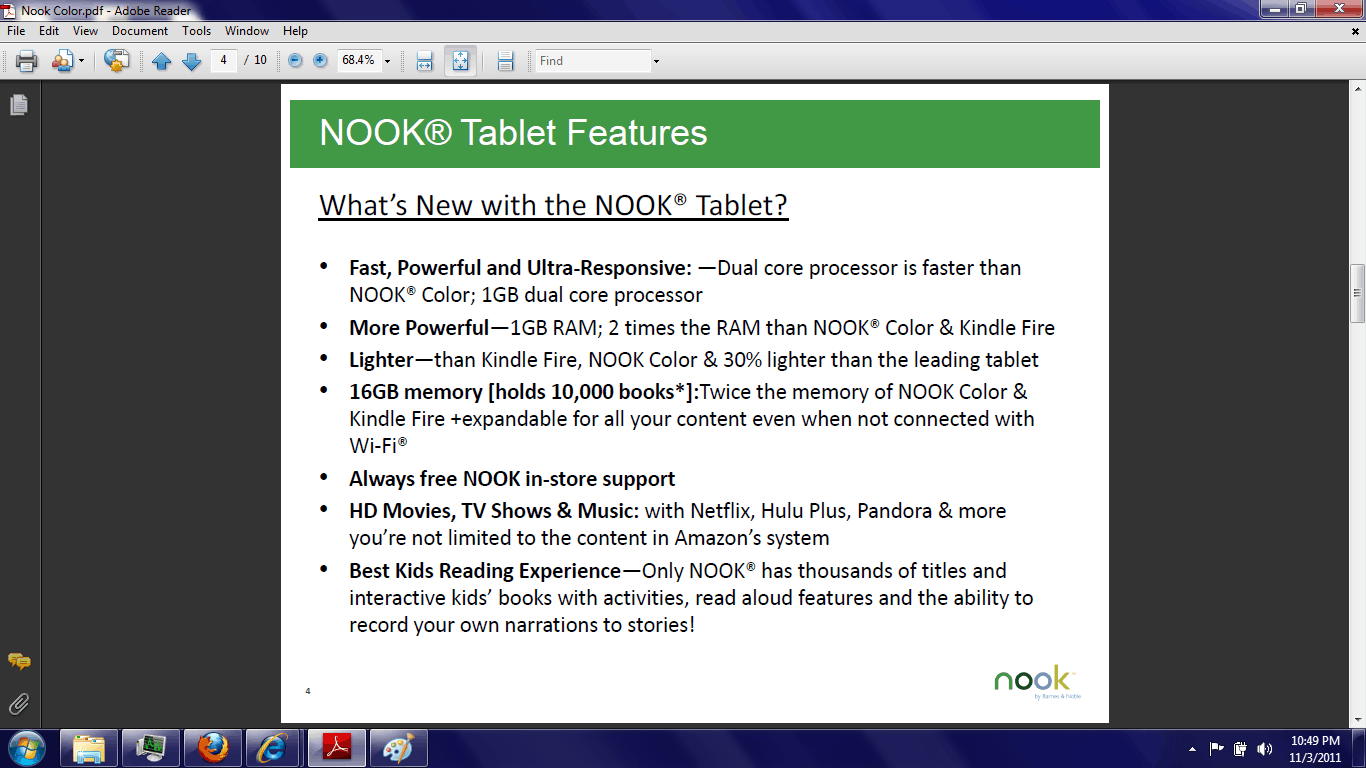
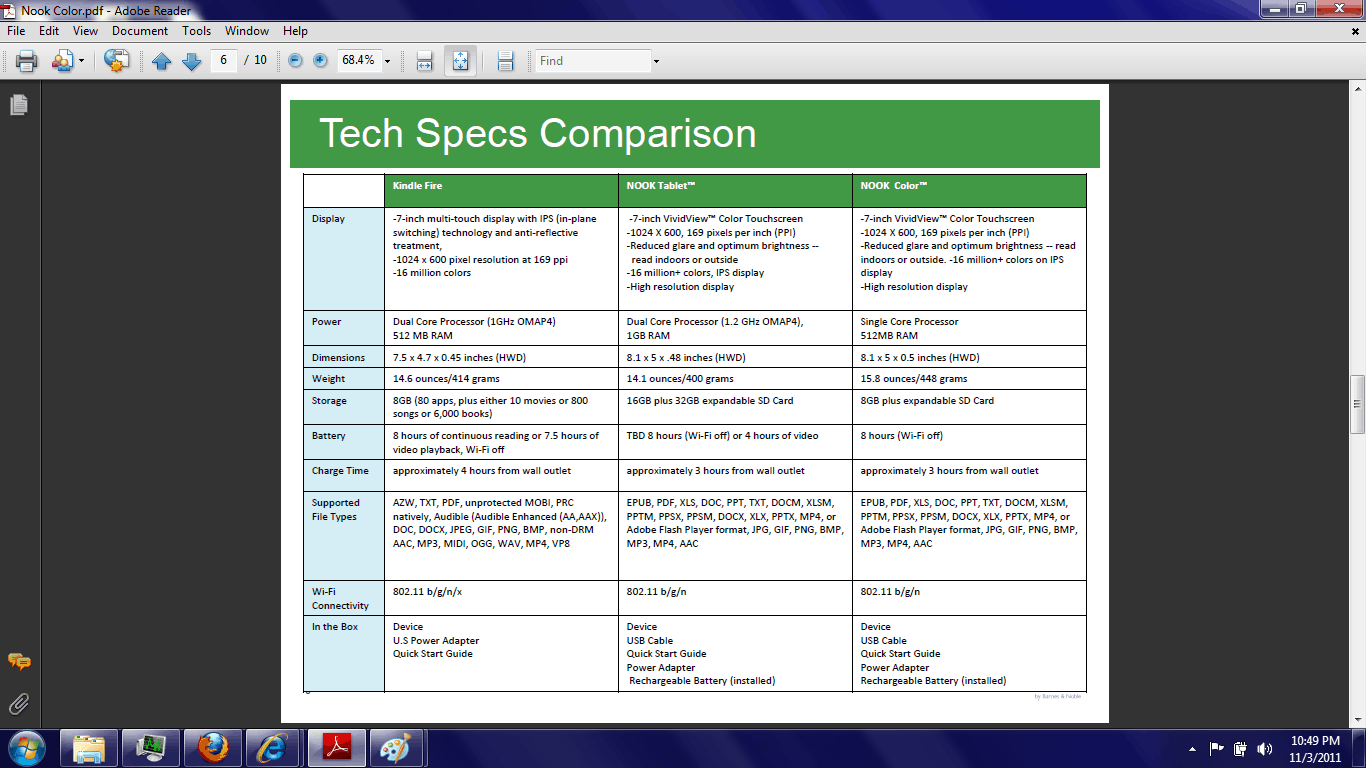
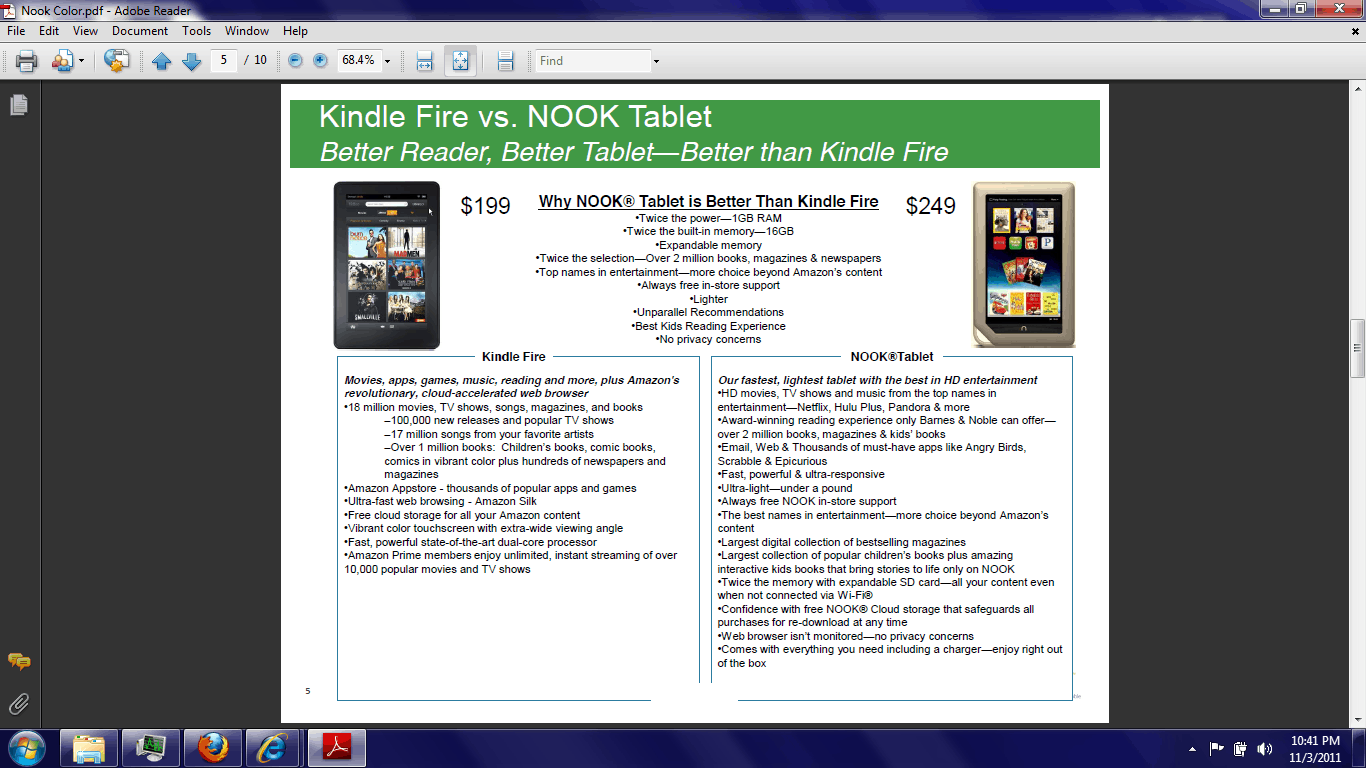
The new "Nook Tablet", as B&N are calling it, is going to be a slightly update version of the original. It’s slightly thinner and weighs slightly less, but it’s based around the same 7″ IPS screen. The new Nook keeping the card slot, Wifi, and it’s getting a bump in Flash storage – 16GB, not 8GB.

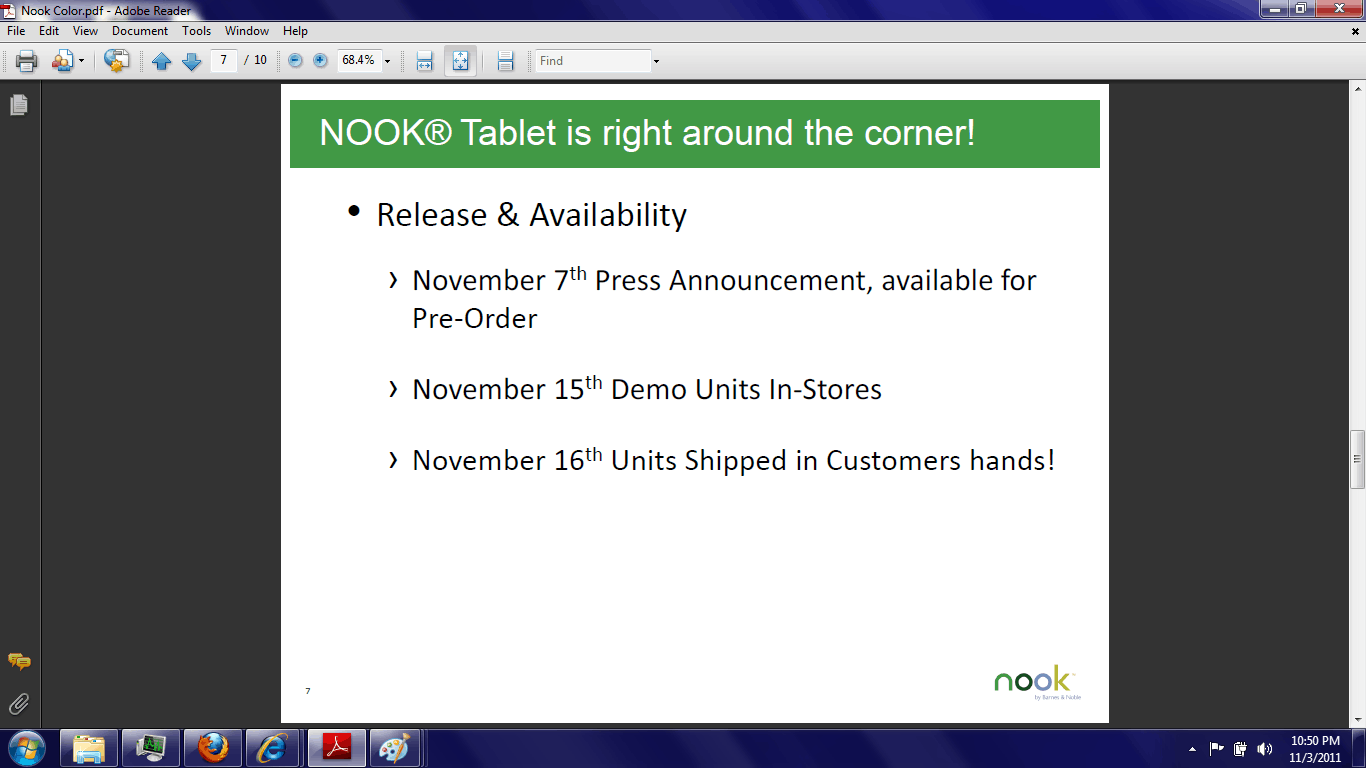
Update: I now have a complete set of the leaked doc. There’s a gallery of screenshots at the end of the post. Enjoy.

The new Nook is also getting a dual core 1.2GHz CPU, which is a bump from the 1GHz CPU in the NookColor. But it’s still coming from Texas Instruments and that means it won’t take too long to port CyanogenMod or the other hacked firmwares. There’s already several out for the NookColor, which give the hackers a head start.

Curiously enough, the older NookColor isn’t going away. One of the leaked docs shows all 4 Nooks from the original to the Nook Tablet. Clearly they plan to have all models on display in store. So it looks like the old NookColor will be priced at $199 like I told you yesterday, with the new Nook Tablet going for $249. It’s supposed to ship on 16 November.

Well this is disappointing. Barnes & Noble did indeed surprise me, just like I said they would on Tuesday. But they didn’t surprise me in a good way.

I predicted a month ago that the NookColor would be getting a hardware update and the Acclaim would be all new hardware. It looks like B&N will release the upgraded NookColor that I predicted, only it’s going to be the Acclaim tablet.

That’s disappointing. They’re releasing the updated tablet that I predicted, but they’re not releasing any new hardware. Eh. I’m not sure I even want to go on Monday, now that I know there’s not going to be much that is new.

—
For more ebook news, subscribe to the RSS feed or the daily email newsletter. You can also follow me on Twitter: @thDigitalReader or find me on FaceBook.

—

RIP: Mobipocket 2000-2011

Amazon finally pulled the trigger; today they announced the imminent demise of Mobipocket.

They sent out an email to publishers today. If you’ve ever signed up to sell as ebook via Mobipocket.com then you probably got one.

To better serve authors, publishers and customers, Amazon is consolidating eBook sales & publishing to the Kindle Platform. Mobipocket will not accept new eBook submissions for sale on Mobipocket.com or its affiliated retailers after Dec 2, 2011 and will stop all sales and remove your existing eBooks after Jan 2, 2012.

This really comes as no surprise; Mobipocket haven’t released any updated apps since 2008, and their payment service had been on the fritz since August.  Their support forums had long since been taken over by spammers, which shows that Amazon had pared the staff done to zip. And of course only a few weeks ago Amazon killed off the remaining Mobipocket library ebooks when they brought the Kindle library ebooks online.

Amazon bought Mobipocket in 2005 and soon started dismantling it in order to use it to build the Kindle platform.  The file format, DRM, on-device ebookstore, reader apps, and even MobiGen (command line ebook creation tool)  were all sucked into the Kindle.

In fact, you used to be able to see bits and pieces of the old Mobipocket code sticking out. Earlier this year I discovered that the Kindle for PC app inherited an easter egg from the old Mobipocket Desktop PC app. You can embed certain types of music files into a Kindle ebook and the app will play them. (Unfortunately it looks like this easter egg was disabled in an update. Damn.)

And when I say that the apps were pulled into the Kindle platform, I’m probably not wrong. I know that Mobipocket was supposed to get an iPhone app by December 2008; Martin Gorner (Mobipocket’s CEO) said that at the IDPF conference in May of that year. The Mobi app never happened, but I suspect that the app did show up 6 months later under the Kindle brand.

I know it’s not unusual for a company to buy a platform just to dismantle it for parts, and at least Amazon built the Kindle into a bigger and better thing. But I still miss some of the features that Amazon left out. For example, the old Mobipocket format had extensive support for Javascript. The varying generations of apps had different levels of support, but they could all do some fun things. You could build a form into a Mobi ebook, or a test. You could even build the test to compute the score when it was done.

Leaving the Javascript out of the Kindle format was perhaps not Amazon’s best move. Look at how everyone is now talking about interactivity in Epub3 and KF8. Just think, Amazon could have had an interactive format when they launched the Kindle. nearly 4 years ago.

In any case, it’s time to move on.

Can you believe how little is left from 10 years ago? MS Reader was marked for death earlier this year and Mobipocket is about to die; all that’s left of the early major platforms is eReader (Palm), and I’m not sure why B&N haven’t killed that format yet.

Or you could look at it another way and wonder how the heck did this old tech hold on so long? Seriously, 10 years is a good run. Just think about how much has changed.  The Mobipocket format and apps were designed to work on 20MHz mobile CPUs, and we’re now accustomed to hardware a hundred times more powerful.

—
For more ebook news, subscribe to the RSS feed or the daily email newsletter. You can also follow me on Twitter: @thDigitalReader or find me on FaceBook.

Boogie Board Rip Now Shipping (video)

The latest digital writing tablet from Kent Displays started shipping this week.

The Boogie Board Rip was unveiled just over 2 months ago, and it 's just the latest model to use Kent Display’s unique low-power LCD screen tech. The idea behind the Boogie Board is that you can write, draw, or scribble on it with a stylus or your finger. The screen will hold the contents without using electricity. The only energy cost is when you blank the screen and remove the current scribbles.

Now, the original Boogie Board lacked an important feature that I’d been wanting ever since I first heard about the device. It couldn’t save the contents of the screen. That features was missed by a number of users, which led Kent Displays to develop the Boogie Board Rip. This tablet can save what you scribble on the screen as a PDF, and the device has space for about 200 single page PDFs.

Edit: I just got the press release, and the Boogie Board Rip tablet is also going to have a nifty little Windows app to help it out. it’s called the Virtual Desktop Companion, and when the BB Rip is plugged into your PC you can draw on the Rip tablet and use the app to see your sketches in realtime. It might not be obvious, but Kent Displaysjust quietly released a Wacom tablet competitor. I’m looking forward to seeing how well it works.

The Boogie Board Rip is shipping now from Improv Electronics. Retail is $130.

I’ve never had my hands on it, but take a look at the demo video that follows and you’ll agree that it’s a neat gadget.

Boogie Board Rip