Augmented Reality eBooks Are Fraught with Technical Problems

People are putting video, audio, and interactive content in t

heir books, but I’m pretty sure that we’ll never see augmented reality added to an ebook.

A couple weeks back I posted on a new augmented reality book that was just published. The authors had posted an augmented reality demo that you could try, and I had a poor experience. The idea didn’t seem to work all that well, but it did get me interested in the idea.

I got to wondering on how well this would work with an ebook.

I hadn’t heard about anyone having tried this before, and that was a surprise. We live in an experimental era. Lots of developers are trying new things but none have tried this.

Now, if you’re not familiar with augmented reality, let me give a brief explanation. Do you know how movie makers can add all sorts of visual imagery around real actors? With augmented reality, you can kinda do the same thing and you can do it in real time. You just need the right computer, camera, and software.

In this case we need a webcam, a book with the right symbols (AR keys) printed in it, and we need the right app (provided by the publisher). We also need a live internet connection. If you’d like to see a demo, you can check out this old post on The Search for WondLa, a children’s book that was published in 2010. Or you can watch the demo video on Youtube.

But this post is about augmented reality ebooks, so that print demo doesn’t really help much. Luckily for us, the ebook version of WondLa also has the AR keys found in the print edition.  You can see them in the lead photo; that’s my KDX and Samsung Galaxy Tab.

I bought the ebook and then went to the WondLa website to try it. Things went downhill from there. First I had to install the necessary software and restart my web browser. Then I was prompted to do it again because it didn’t work the first time.

I have the software installed correctly now, and it looks like it is running.  But no matter how I hold the AR key, the software just doesn’t seem to recognize it. All I see on my screen is me waving around an ereader, not the augmented reality map which is supposed to appear.

It turns out that the website that is supposed to support this particular project hasn’t been updated in a couple years, and it has since stopped working. But I’m not sure how much that mattered because I feel that simply setting this up just to try an augmented reality ebook was more effort than it was worth (even if it had worked).

Why not make it easier on the reader? Since I am already staring at my laptop screen, why not just put the content on Youtube or wherever and let me watch it there?

In fact, I’m growing less and less fond of the whole idea. I’m not sure that there is any value in augmented reality in a paper book, either. It’s beginning to feel like it’s just a gimmick.

If you ask me, I think it will go the way of the optical illusion. It’s an interesting trick but really not much more than a distraction.

P.S. If anyone knows of other books that use augmented reality, please let me know. Two data points isn’t enough to make a final decision.
Who Loves eReaders? (infographic)

According to the following infographic, the answer is paralegals, iPod owners, and country club members.

The market research firm BlueKai pulled this together from  number of sources. It’s focused on the ad potential of ereaders, but it is still a fascinating read.

The full sized infographic is after the break.

Inkling to Launch a New iBooks Author Competitor Next Week?

O’Reilly will be holding their annual digital publishing conference next week, and I will be there, helping with the ereader petting zoo. But do you know who else will be there? Ryan Knapp, one of the founders of Inkling.

As you probably know, Inkling was one of the hot iPad startups of 2010. They were developing an enhanced textbook platform on the iPad, and they’ve been selling textbooks via their own app. But besides launching and periodically going back for more capital, Inkling hasn’t done much that is newsworthy of late. But soon that will change.

I have now heard hints from no less than 3 sources that next week Inkling plans to unveil ebook authoring tools. I don’t yet know what those tools are, but given the nature of the textbooks that Inkling sells, I suspect that this is going to be an alternative to iBooks Author.

Unfortunately, I don’t have any more details. My attempts to contact Inkling (email and Twitter) failed, so really all I have to go on are the hints. But still, this is an interesting story.

Inkling was one of several companies that I half expected to vanish under the deluge of hype surrounding the launch of iBook Author. I’ve been watching them in the weeks since, and it’s good to see them keeping calm and fighting back.

I, for one, am really looking forward to next week’s news. I’m hoping that Inkling’s tools aren’t quite so encumbered as iBooks Author. WIth that app you can only make enhanced ebooks in the one format and you re only allowed to sell that ebook via iBooks (after Apple gives you permission to do so).

While I am sure that Inkling wants you to make textbooks for their iPad app, I am still holding out some small hope that it will offer cross-platform support. Even just a minimum level of Epub output would be great.


Used Textbooks Still Offer A Better Value Than Rental, Digital

This might be an ebook blog, but the cost of textbooks has always been an important topic for me. I’ve written a number of times about how to get the best value for your textbook dollar, including a detailed look at exactly how I went about it.

I’m taking a couple college classes this semester and that has given me a good reason to revisit this topic. I’ve said that in the past that rented textbooks weren’t a good value, and after buying my textbooks for this semester I’ve concluded that it is still true.

I’m not going to list the specific steps that I used to buy my textbooks; you can find that in an earlier post. I’m also not going to list the books I bought; the prices won’t matter in 6 months.

Also, I strongly urge you to do your own comparison shopping; don’t just take my word for it.

But I will discuss some of the things I’ve learned in the past few days.

First, digital textbooks simply cost too much, and renting the ebook wasn’t an option for any of the books I needed. The ebook prices looked good compared to list price, but the honeymoon ended when I matched them against the used price.  With one exception, the used price was far lower than the ebook price that I found on Inkmesh.  And that one exception still cost more than the used price, but only by about a dollar.

Next, rental prices might look good in the college bookstore, but when you go to a comparison site like allbookstores.com you will see that the used prices can get a lot cheaper than you might expect. Of the 6 books I need, the used price was often less than the best rental price. Even when renting presented a cheaper option, a used book was often less than a couple bucks more than the rental price.

And guess what? That price is strictly the out of pocket cost. While a rented textbook has to be given up at the end of the semester, the used book can probably be sold again. In the long run the used book will cost you less.

So at this point I have just found that all the hype about how renting saves you money, or how ebooks save you money, or that renting an ebook saves you money, is exactly that.

Hype.

I predict that used books will continue to be the best value going forward, and I think they will stay that way unless and until open source textbooks become popular. They have all of the benefit and none of the cost.

Update: StoryBundle to Offer "Pay What You Want" Ebook Bundles

Jason Chen, formerly of Gizmodo (the stolen iPhone guy), is bout to launch a new ebook startup called StoryBundle. This new ebook seller was inspired by the pay what you want Humble Indie Bundles, and he plans to do for ebooks what Humble Indie did for apps.

Update: Jason says that he’s already talking to authors. The first bundle should be out this spring, and more bundles should follow about once every other month.

The company is just launching now, and about all there is to it right now is the website, Twitter, and Facebook account. I’m waiting to hear back from them, but in the meantime here is what the website says:

We give you a handful of ebooks (about five or so) for a low price that you choose, all DRM-free, delivered to your ereader.

We only choose quality independent authors so you can be sure what you’re buying is good. Plus, you decide how much these books are worth. Great reads delivered cheaply without killing a single tree? That’s something everybody can feel good about.

This might not look like such  great deal for authors, but the app bundles suggest that it might be worthwhile. I’ve bought a couple, and they usually included older games (like an author’s backlist) with the occasional newer game thrown in.

The current Humble Indie bundle has earned $578 thousand in less than a week, and it includes 4 titles. Iif we assume that everyone went with the default split then the app developers ended up with over $300 thousand to split between them.It’s not a whole lot per copy sold, but the possibility of making $70 thousand or more from a single tile in a short period of time should make this option very attractive.

On a related note, authors will need to be careful about the ebooks they offer via StoryBundle. If the same title is available via Amazon when it goes on sale at StoryBundle, Amazon will send their death squads after you.They take ebook prices seriously, and they will not let you undersell them elsewhere.

Kidding aside, in the past Amazon has matched sale prices found elsewhere, but I don’t know quite what they will do here (it’s complicated). They might even drop the price of your ebook to nothing. I’d still go for this, but do be careful.

StoryBundle


Kindle Fire Has Dethroned Samsung Galaxy Tab as Most Popular Android Tablet

It’s been just over 2 months since the Kindle Fire shipped, and it has already turned the world upside down.

The market research firm Flurry released some startling stats today. They’re following up on their news about the spike in new Android and iOS gadgets over Christmas.

According to their tracking data, the Kindle now accounts for 36% of all Android tablet activity in January. That’s more than any other tablet, including the Samsung Galaxy Tab.

Check out the graph below. Amazon has sold so many KFs (and increased the number of tablets in use) that the Samsung Galaxy Tab’s share shrink from a dominant  63%  to only 36%.

Here is a different way to look at it. The KF not only outsold the Galaxy Tab, in 2 months Amazon sold more Kindle Fires than the total number of Galaxy Tab users. Those rumors of 5 million KF sold lst year don’t seem so improbable, do they?

But it’s also important to note that the Galaxy Tab also saw a serious jump in activity. Flurry reported that they tracked a 50% increase in apps being run on the Galaxy Tab. Clearly the market as a whole got a lot bigger over the past couple months.

BTW, these stats don’t reflect how many tablets are in use. No, they show what percentage of apps are opened on which tablet. That’s not quite the same thing, but it is significant in its own right. The pie charts above reflect the intensity of the use. People who open 3 times as many apps re counted 3 times, for example. That means there are either a lot of KF in use or some being heavily used. Either way, that’s a big deal.

Flurry

I Hope Digital Pop-Up Books Aren’t the Future

You’ve seen a pop-up book before right (a paper one, that is)? Here is the digital equivalent.

Over the past couple years a number of publishers have been experimenting with augmented reality apps. Do you know how movie makers can add CGI to  film and insert imagined creatures in among the real actors? In augmented reality, you can do that in real time with your webcam.

Check out the video below. This is something that is easier to show than say.

[contact-form][contact-field label="Name" type="name" required="true" /][contact-field label="Email" type="email" required="true" /][contact-field label="Website" type="url" /][contact-field label="Message" type="textarea" /][/contact-form]

As you see, the video shows a digital pop-up book. It’s a demo for Between Page and Screen, a new book that has just been released.

The gimmick here is that the pop-up words are poems that are sent between 2 lovers. You hold the book in front of your webcam and you’ll be able to see the poems on your screen. If you want to see it in action, there’s a sample that you can try.

I like the idea but I don’t think this implementation works all that well.

I tried the sample, and I found that I had to hold the sample at a minimum of  30 degree angle for it to work. The demo video above fudged a number of details; I could not hold the sample as flat as that book was held. It stopped working when I tried.

The angle and position of the sample wasn’t terribly convenient. I did eventually figure out where to position it between me and the screen, but the book wouldn’t be as convenient.

But don’t take my word for it; go try it. It’s worth a few minutes of your time.

All in all, I like the idea, just not this particular book. But I recall seeing something similar back in 2010. That book was called The Search for Wondla. It seemed to work better, so I’m going to go get a copy and try again.

Idolian Now Shipping a $99 Android Tablet

The good news about budget tablet makers like Skytex, Pandigital, and E-Fun moving on to better and more expnesive tablets is that it frees up the bottom rung for newcomers. Take Idolian, for example. They just unveiled the IdolPad, a $99 Android tablet running Gingerbread.

Given the specs it is  decent tablet for the price.

It’s running on an unnamed 1GHz Cortex-A9 CPU, with Wifi, 4GB Flash, and a microSD card slot. Given the price, the resistive (2 finger) touchscreen and 800×480 screen resolution probably won’t surprise anyone; they’re the kind of trade offs you make to get a lower the price. The IdolPad lso boasts a 1.3MP camera, HDMI output, and a g-sensor. There’s no Bluetooth, GPS, or a second camera, but you get what you pay for.

Idolian posted a basic hands on video, and this does look like it’s a decent tablet. But I’m not sure if the video shows the correct tablet. I can see signs that it is running Android 4.0 Ice Cream Sandwich, not Gingerbread (listed in the specs). The video also shows the Android Market, which is mentioned in the press release.

You might want to turn off the sound before you watch this.

Idolian is also selling a number of other Android tablets in 7″ and 10″, as well as keyboard cases for the 7″ tablets. All the others tablets are more expensive, and they also have better hardware.

Idolian

Pocketbook A7 Android Tablet Officially Launched

Pocketbook is finally ready to tell us about the 7″ tablet that I uncovered last month, and the press release has confirmed much of what I already knew.

The A7 is the smaller sibling of the A10, Pocketbook’s 9.7″ tablet. It’s running Gingerbread on a 1GHz Texas Instruments TI3621 CPU with 2GB Flash storage, Wifi, microSD card slot, g-sensor, and a speaker. It’s using  high resolution (1024×600) screen with a capacitive touchscreen. Weight is around 400 grams and battery life is estimated at 6 hours.

This tablet ships with Pocketbook’s own reading app, which supports Epub, PDF, FB2, txt, DJVU, RTF, HTML, doc, and docx. But it is also running Android, and that means that you can install other apps, including Kindle, Nook, or what have you.

The spec sheet suggests that the A7 will ship with a media player, but there is no mention of the Android Market. It’s also going to ship with Office Suite Pro v.5, CoolReader, as well as 47 different ABBYY Lingvo dictionaries that will help to define the meaning of foreign words while reading.

There’s no mention of price or release date, and my sources t Pocketbook declined to speculate. So at this point we don’t know much more than we did last month.

via Pocketbook

Will iBooks Author Actually Reduce the Cost of Producing Textbooks?

If you’ve been following tech blogs these past few days then you’ve probably heard about iBooks Author. This is Apple’s new digital textbook creation tool, and if you believe the hype it’s going to reduce the cost producing digital textbooks.

I’m not so sure it will, and even if it does the savings won’t be as big as you might think. (Please feel free to prove me wrong.)

The thing that some seem to have missed about iBooks Author is that it is an assembly tool, not a creation tool. It’s designed to make it easy to pull together the parts of a digital textbook into  whole. It lowers the skill level required, and that is a good thing.

But it doesn’t actually help you make the parts. You can embed video and audio, but first you have to produce them. You can add a 3D model, but first someone has to program it. And of course you can have text and pictures, but first they have to be written and edited.

The only way I could convince myself that there were savings was if I ignored the significant cost of producing the components. For example, take the sample textbooks that you can currently download for free from iBooks. I’ve downloaded none of them due to the size; they’re all 1GB or more. But that size tells me that they’re all chock full of video, models, and other snazzy content which was not cheap to produce. iBooks Author could have saved how much, exactly? Whatever it is, I bet the savings are actually less than any single production cost.

BTW, I know the costs of  particular textbook project. Back in December I posted about a trio of high school teachers who wrote their own textbook. They took parts of an existing CC licensed stats textbooks and wrote the parts they needed. They had to change it so it met MN state standards, covered the necessary core requirements, and used examples that their students would understand. Their total cost to produce the textbook was round $25,000.Most of that went to pay the teachers' salaries for the time they spent writing. Would iBooks Author really have reduced the cost any?

Now, I will grant you that iBooks Author will help in the final stages of making a digital textbook, but I do not see how it can help the overall production cost. You cannot even use it to organize the project, much less make any of the parts.

Would someone care to prove me wrong?

Mirasol and Color E-ink Side by Side

There’s been a lot of clamoring this week among my readers, and today their curiosity will be satisfied.

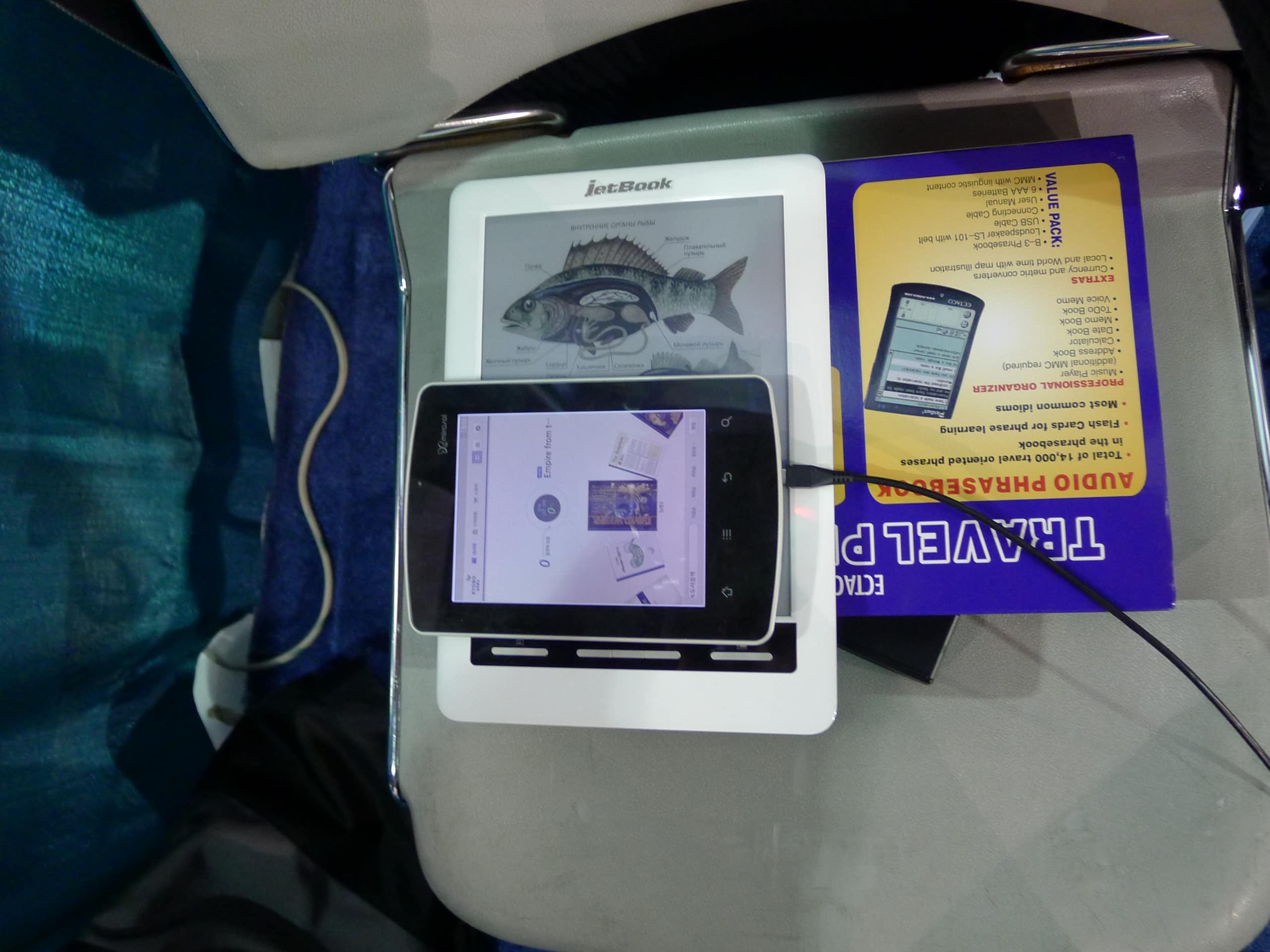
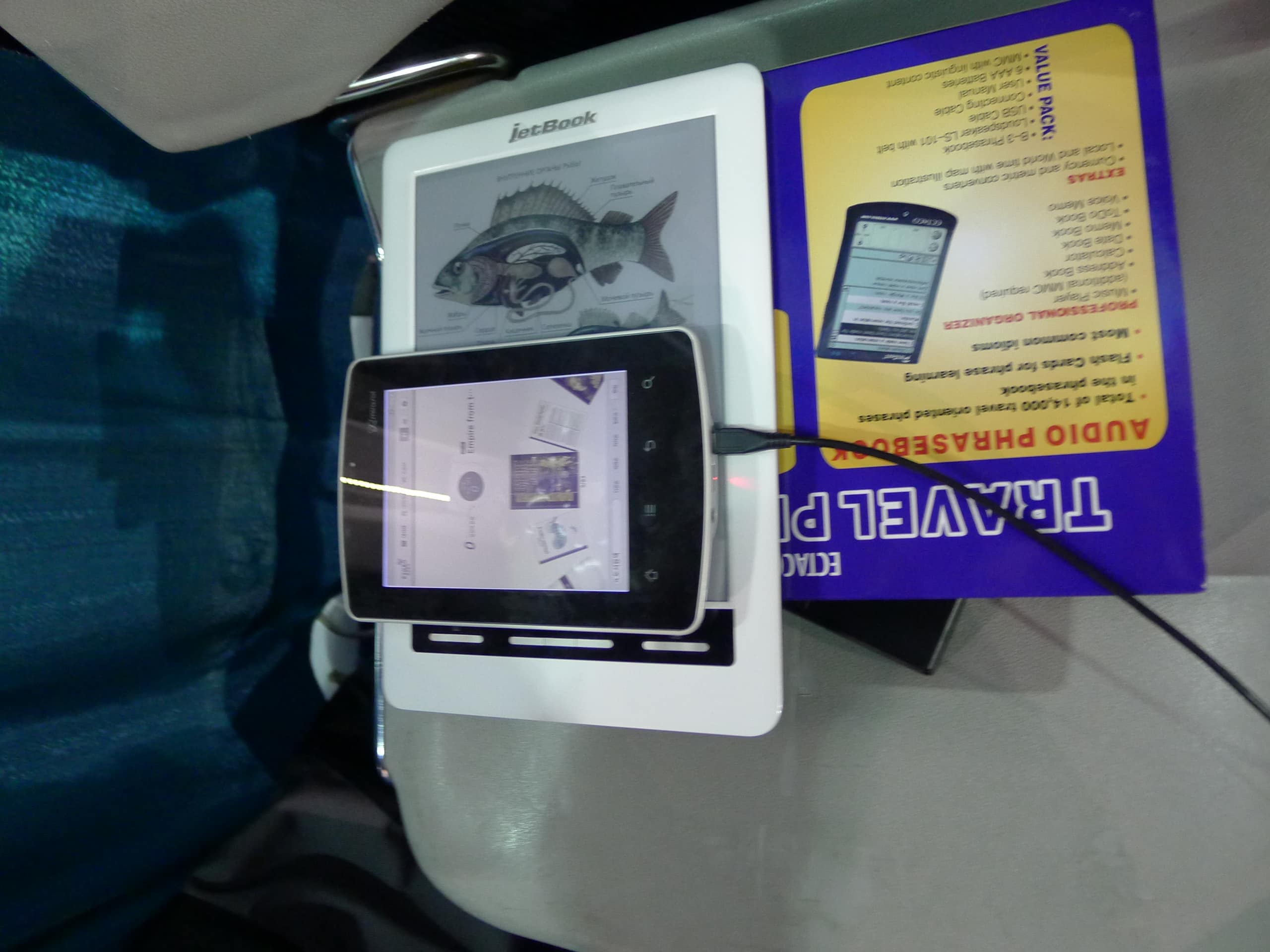
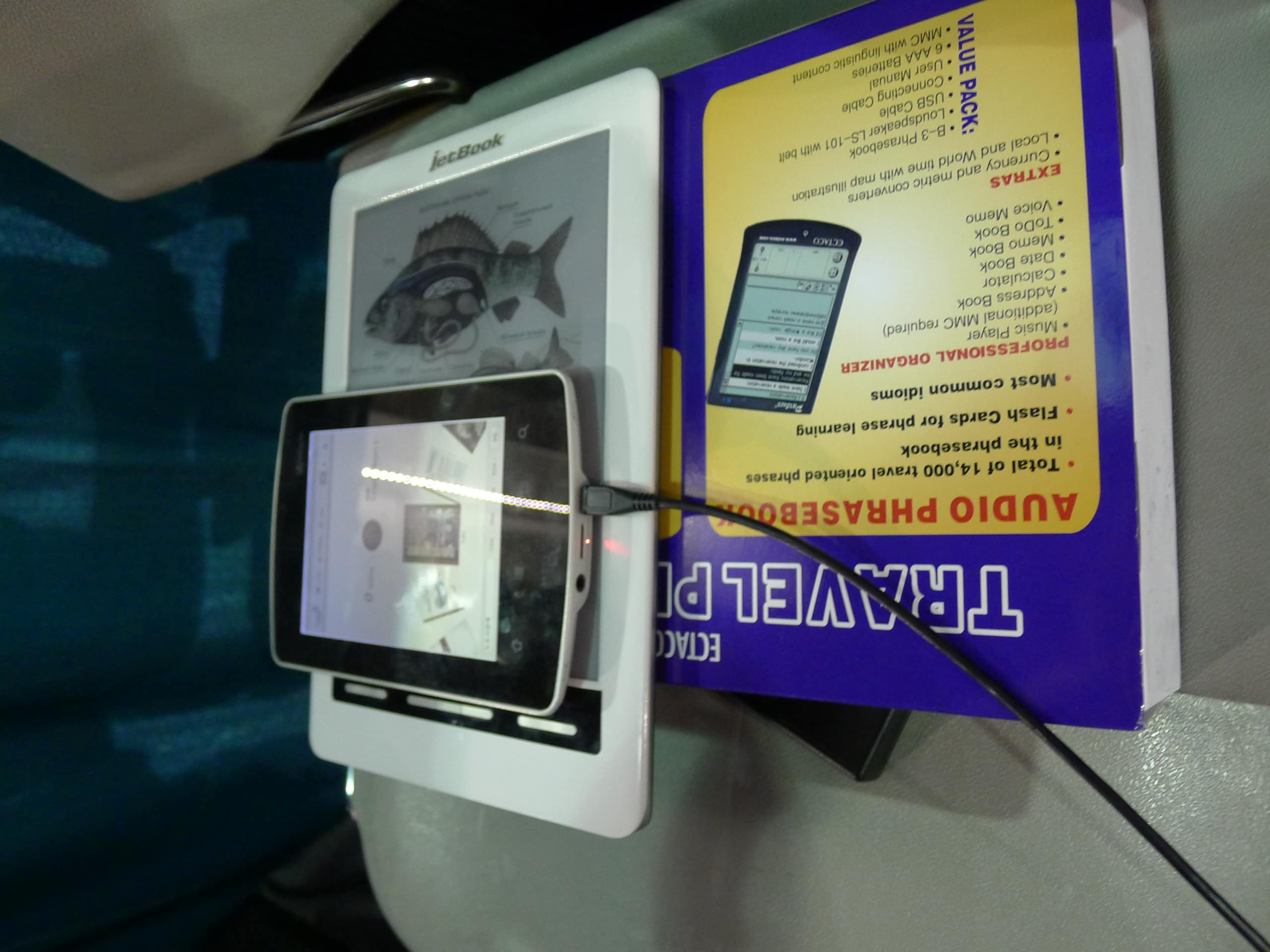
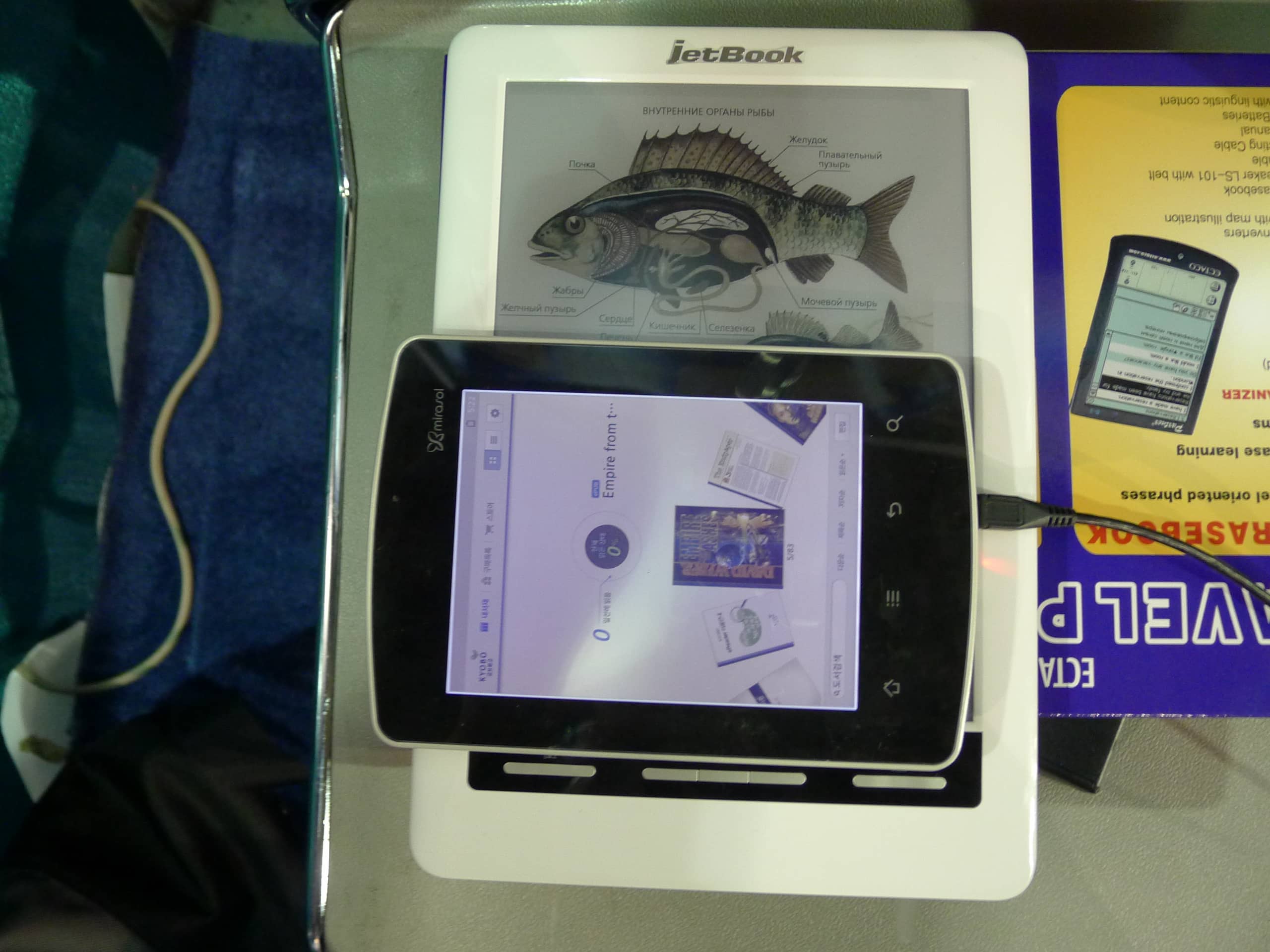
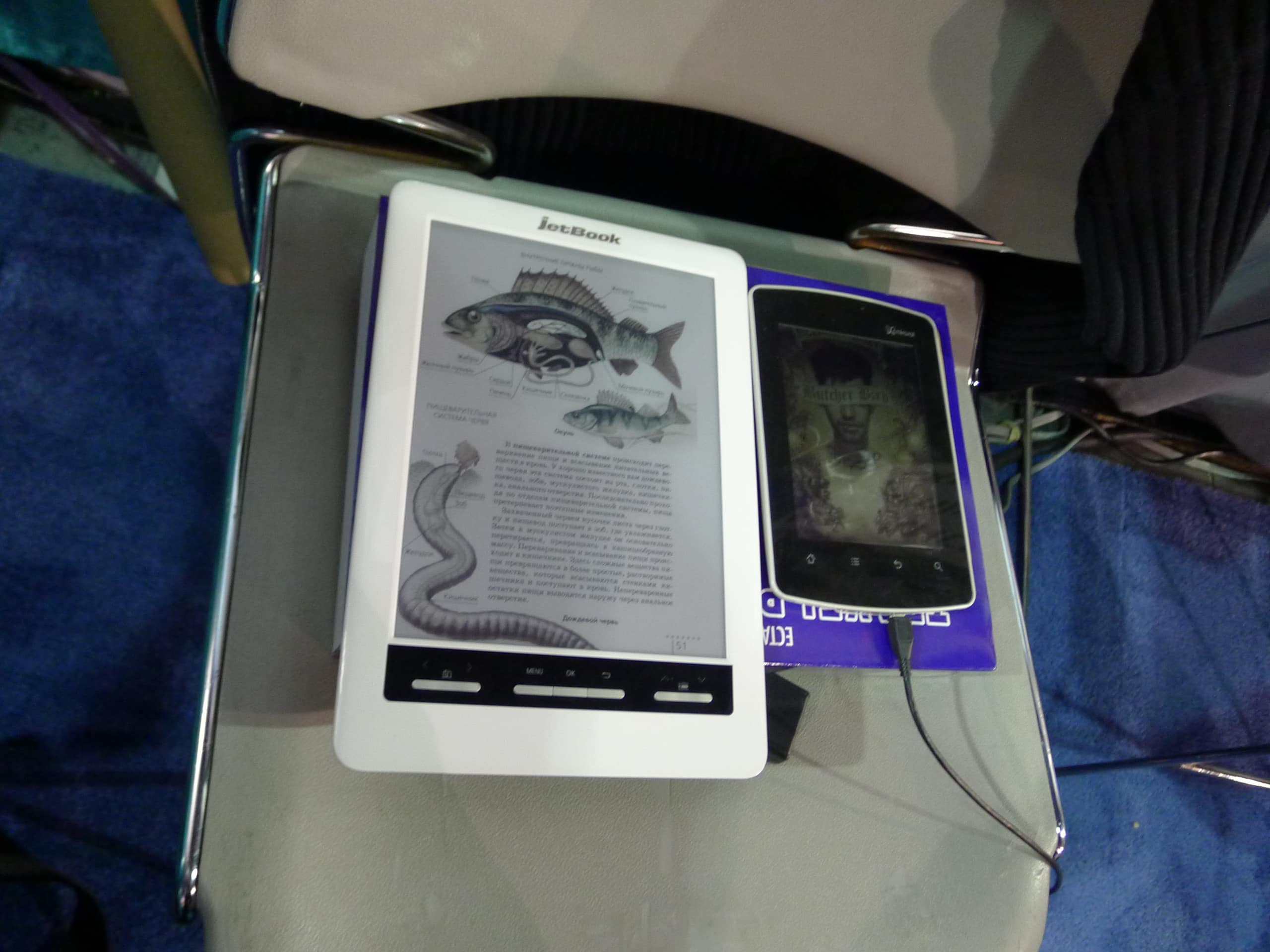
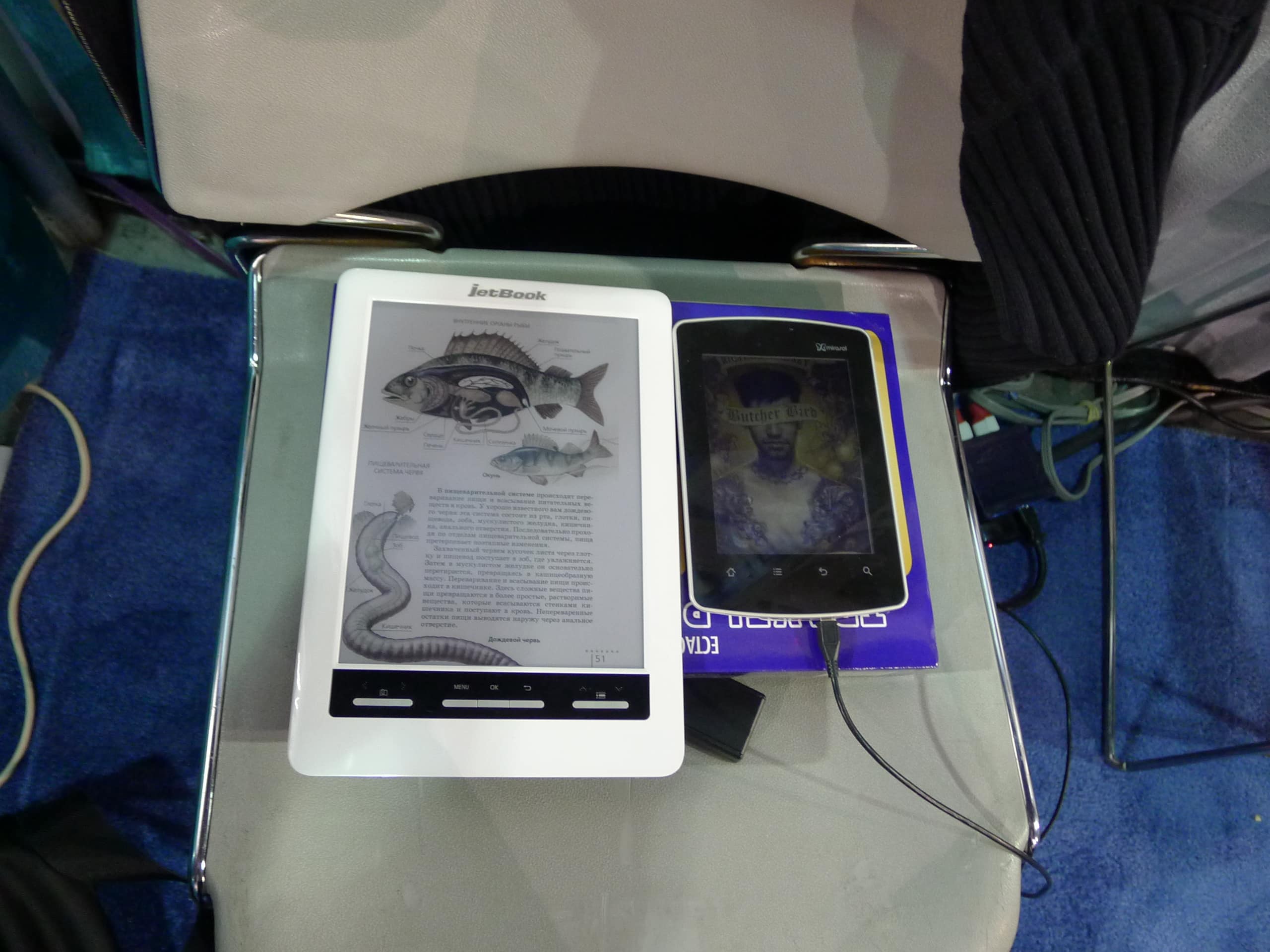
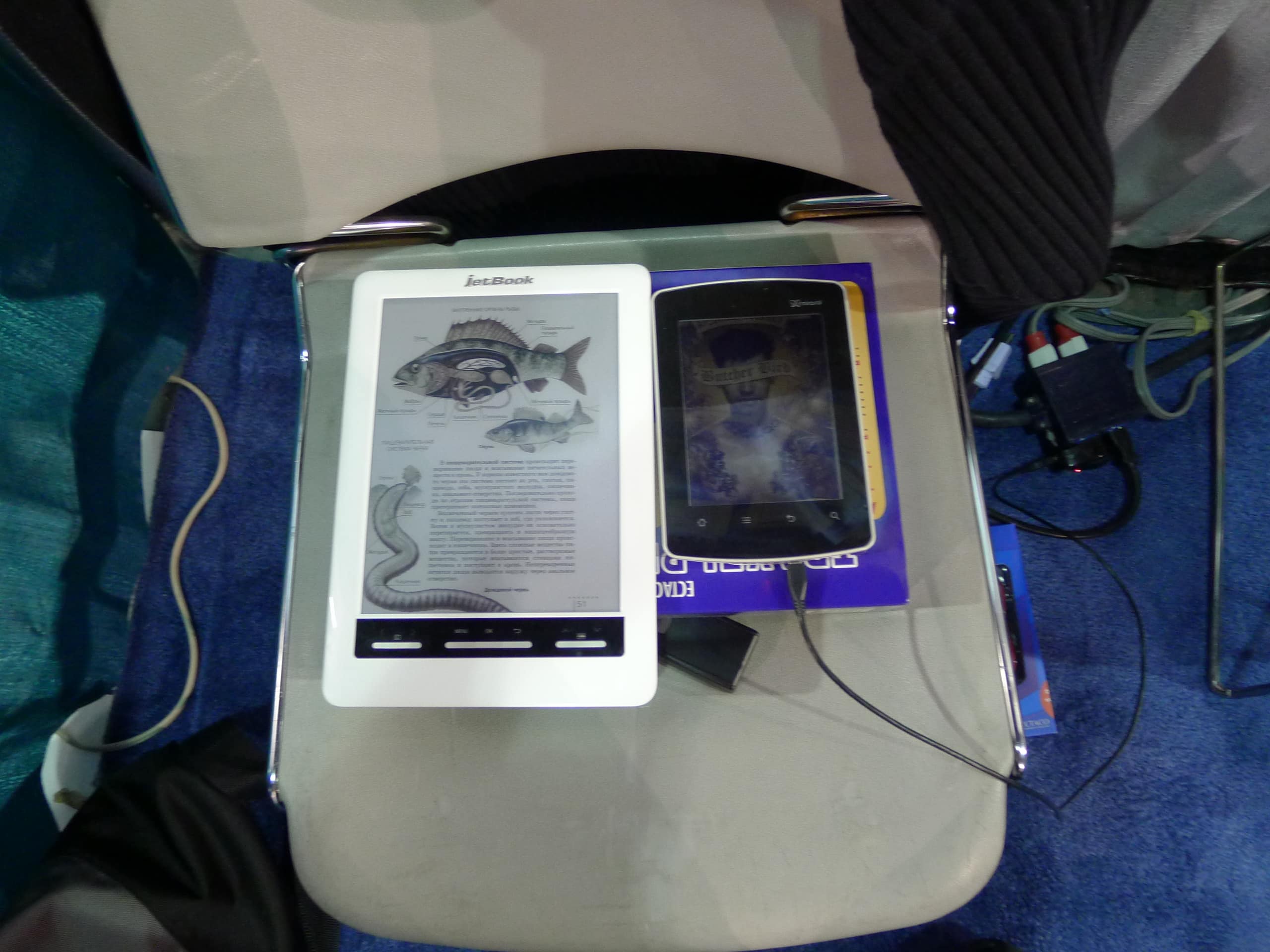
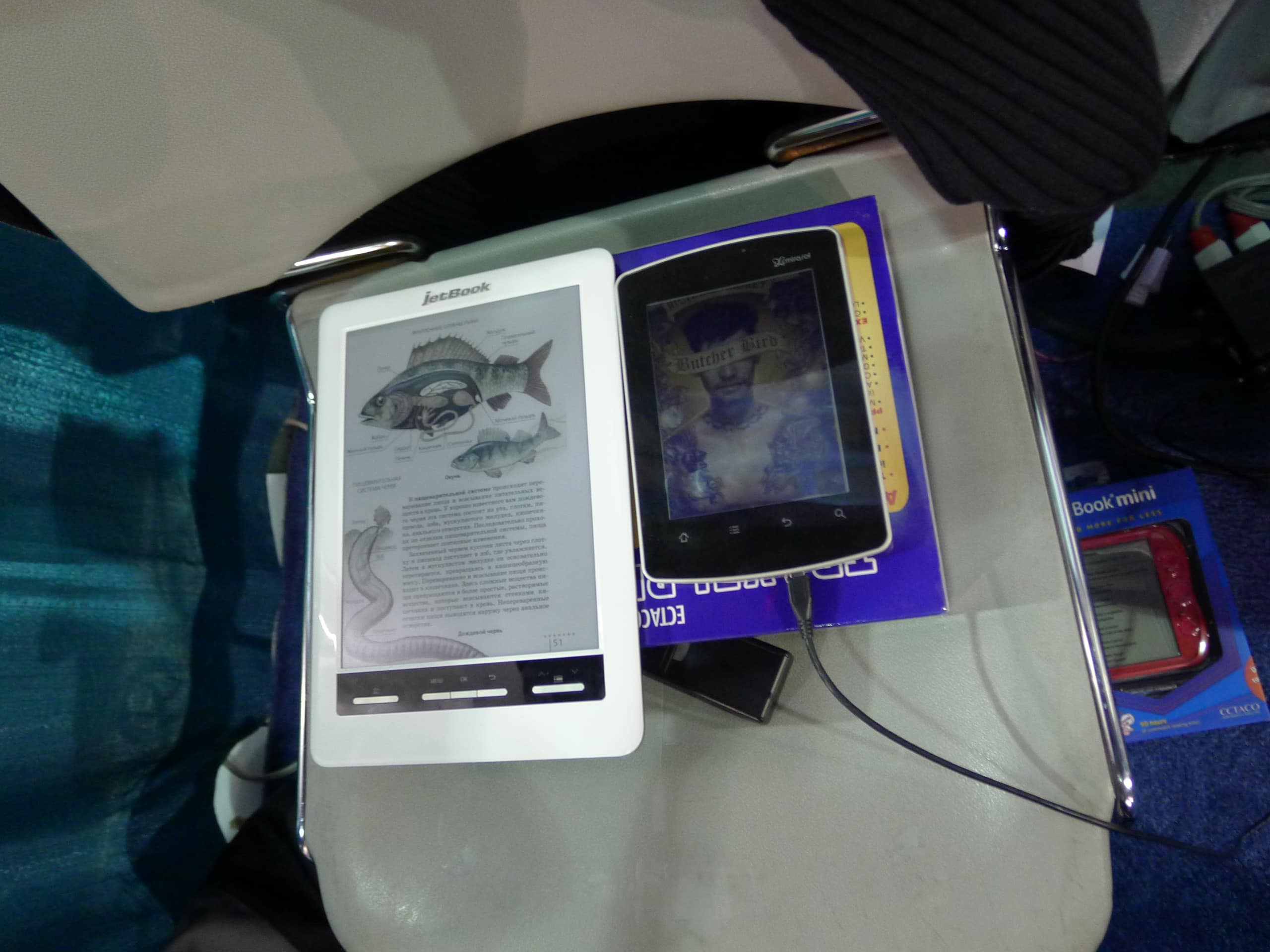
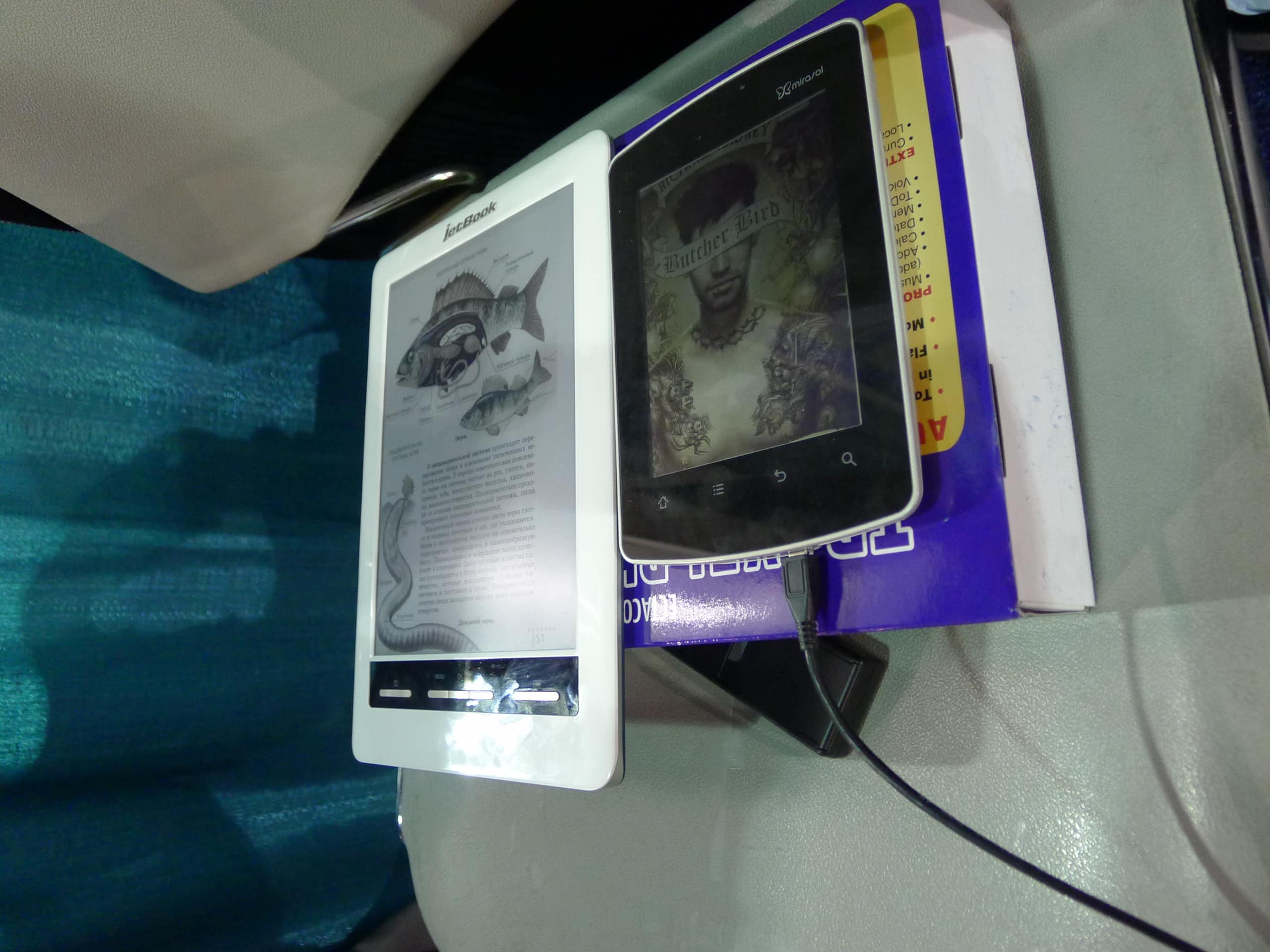
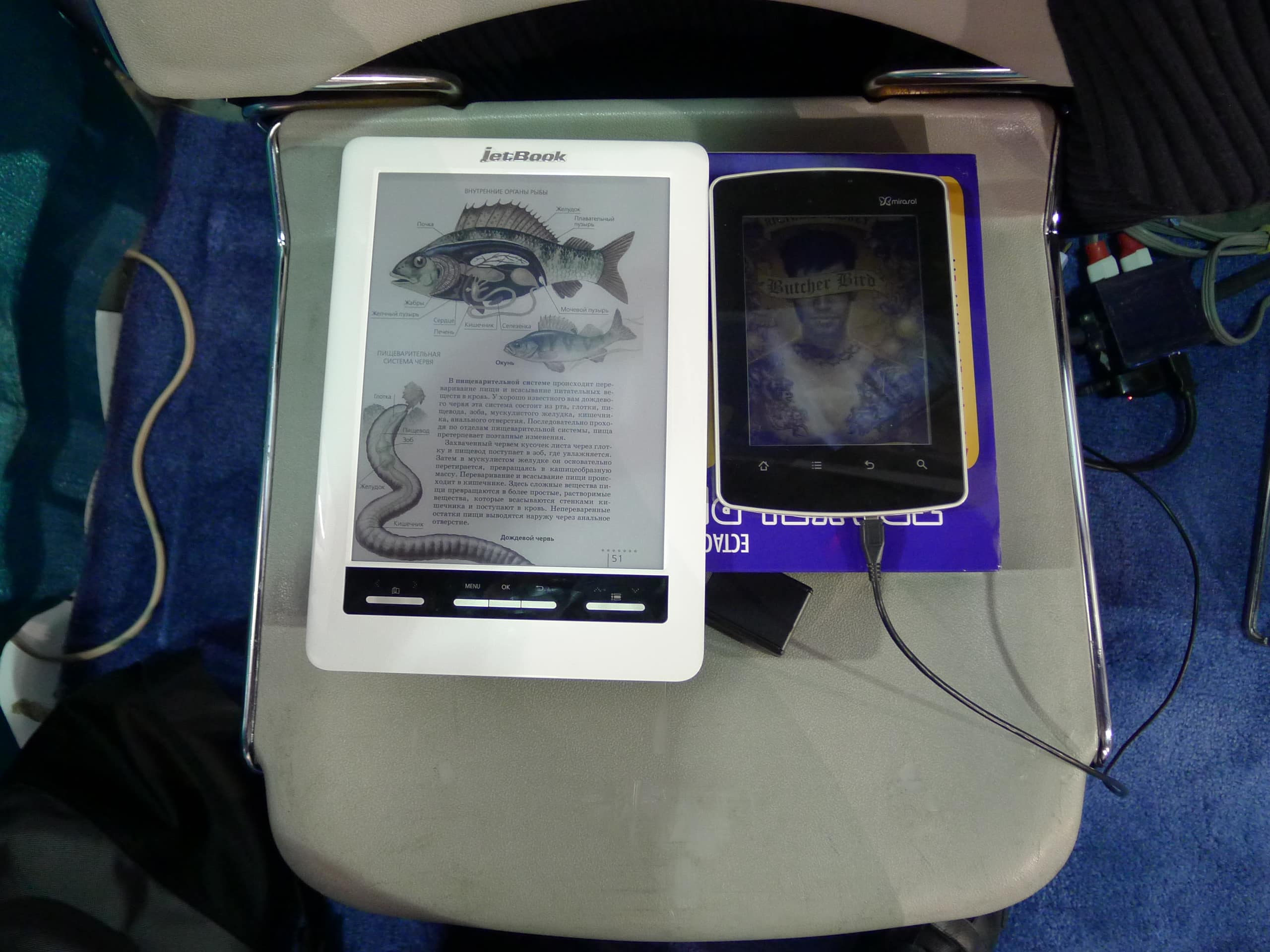
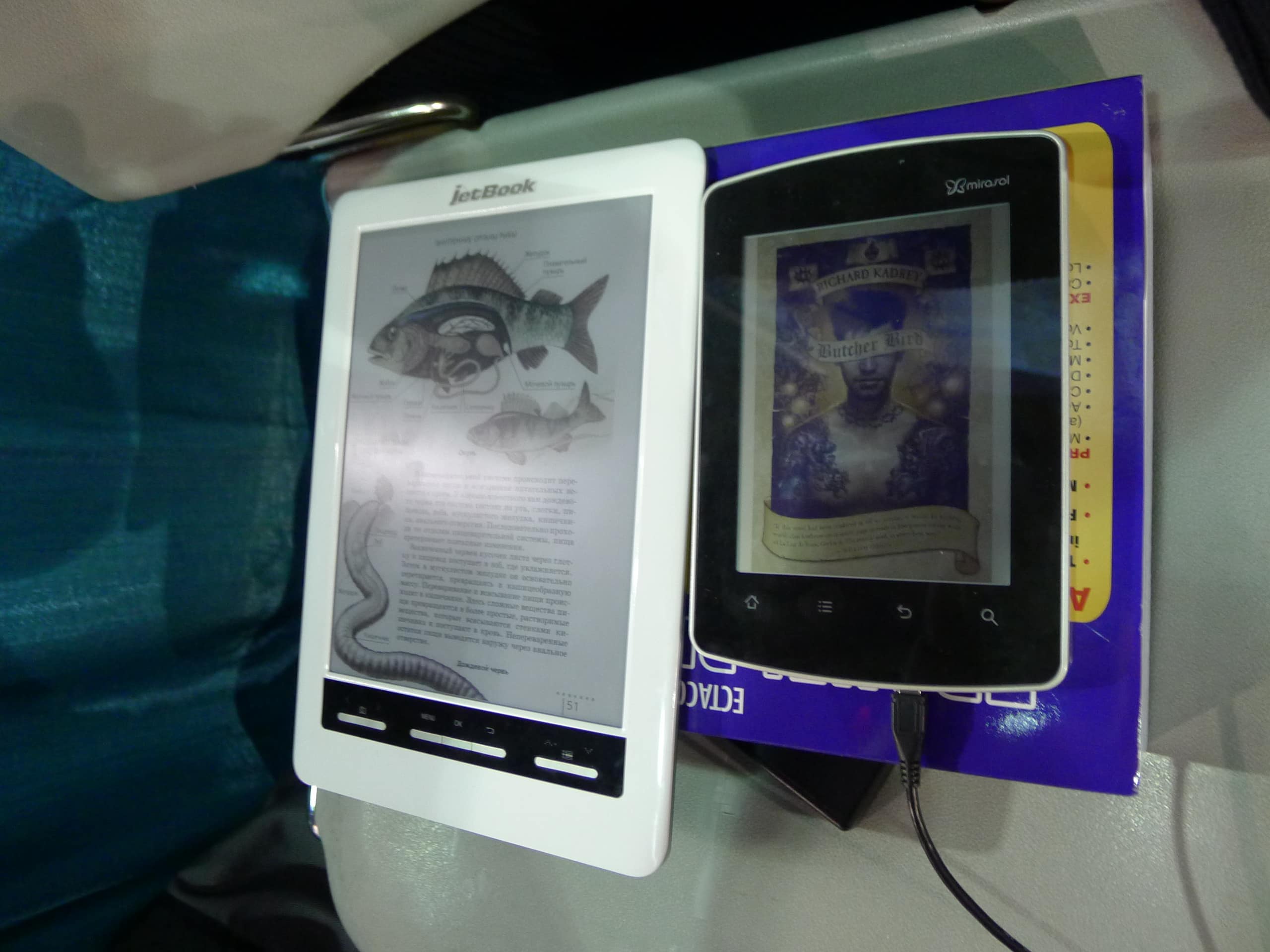
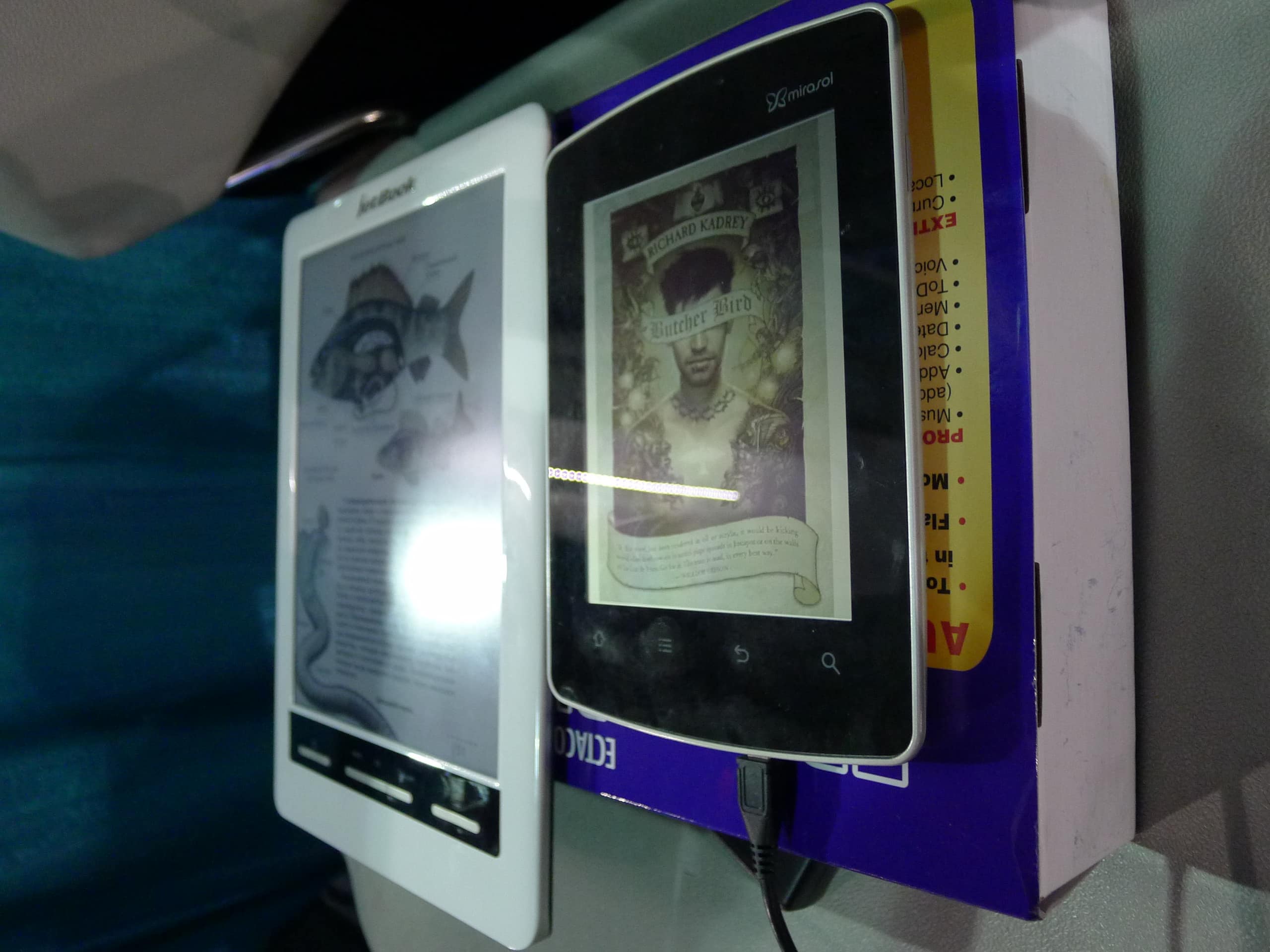
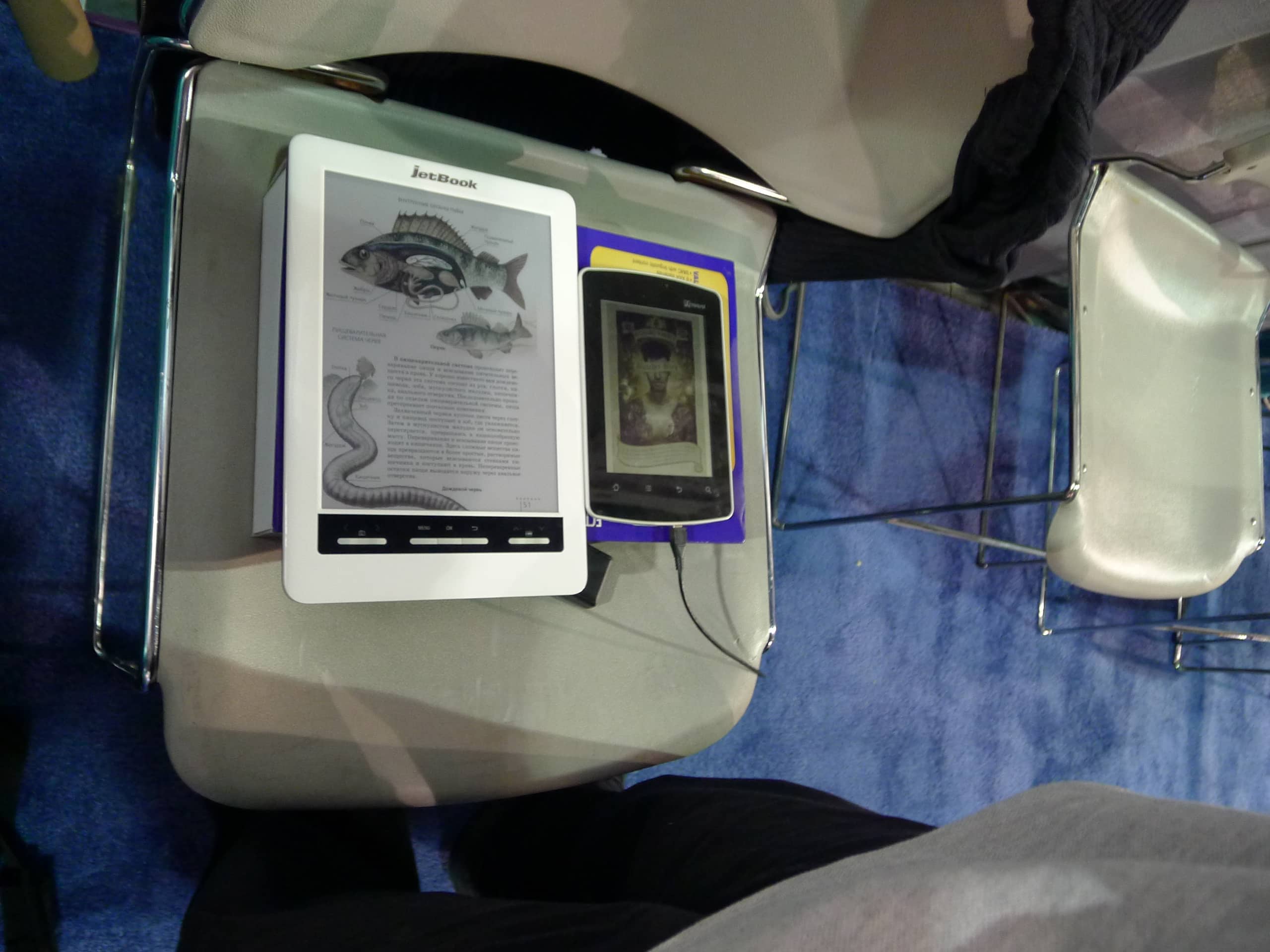
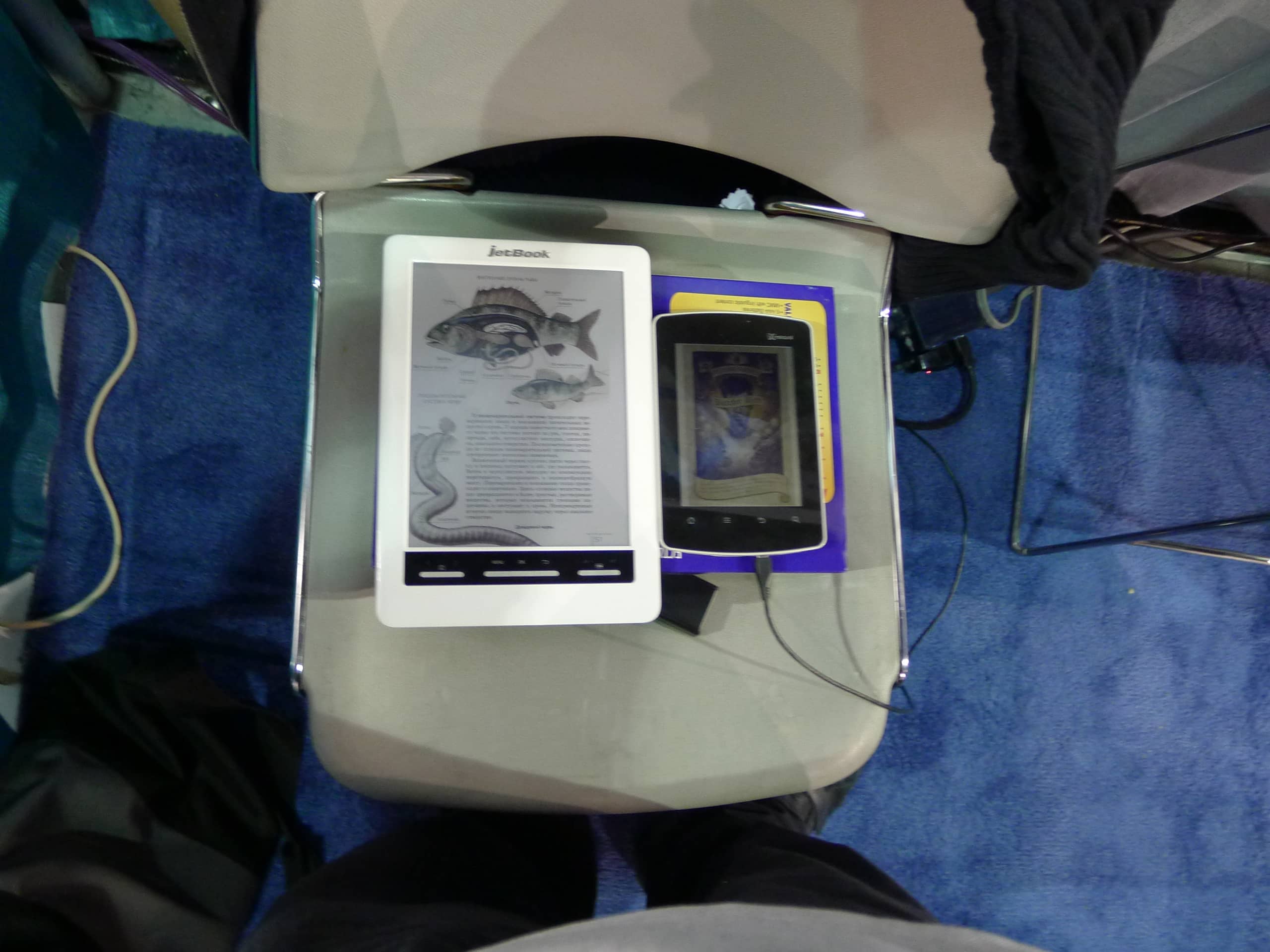
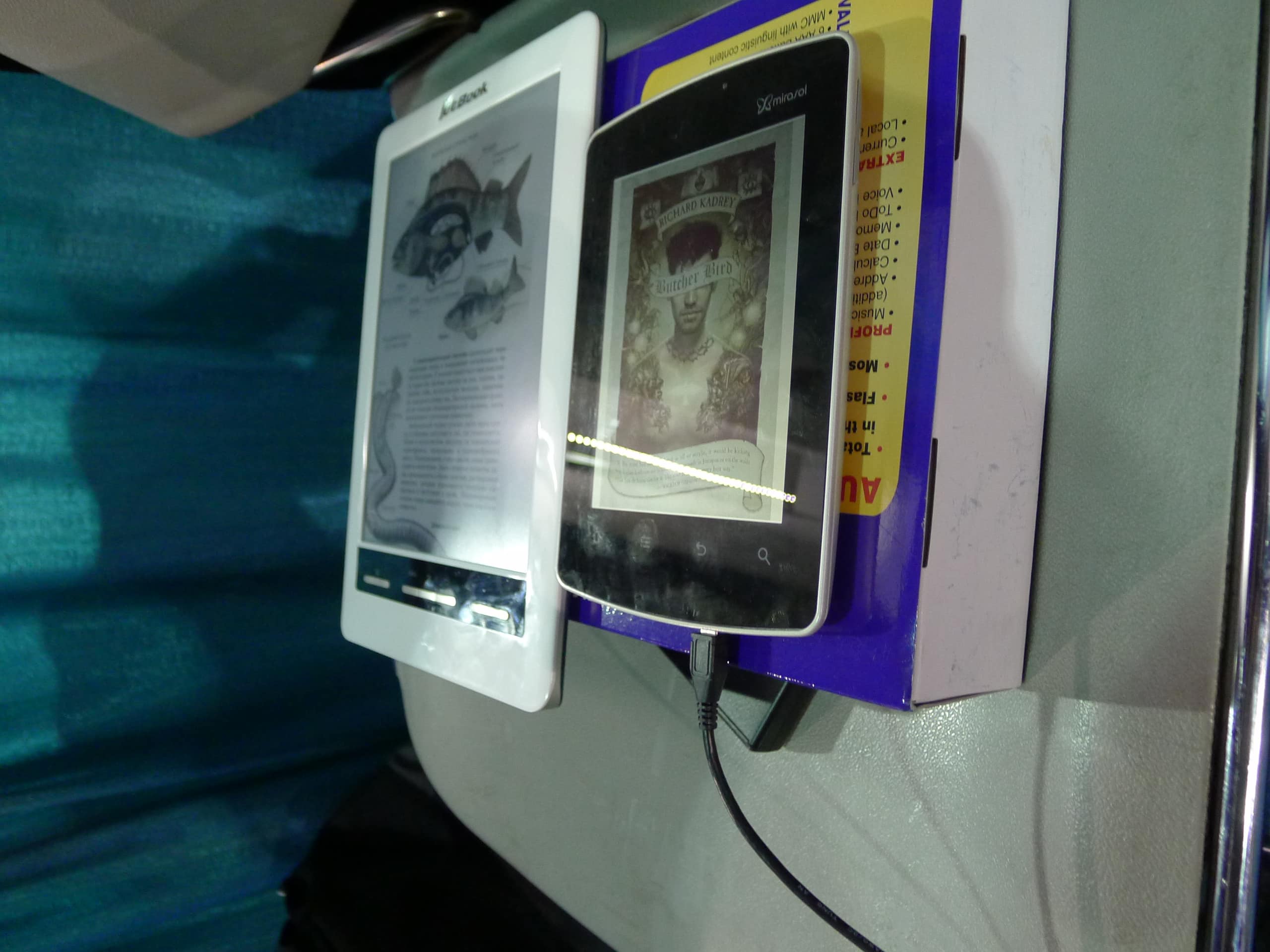
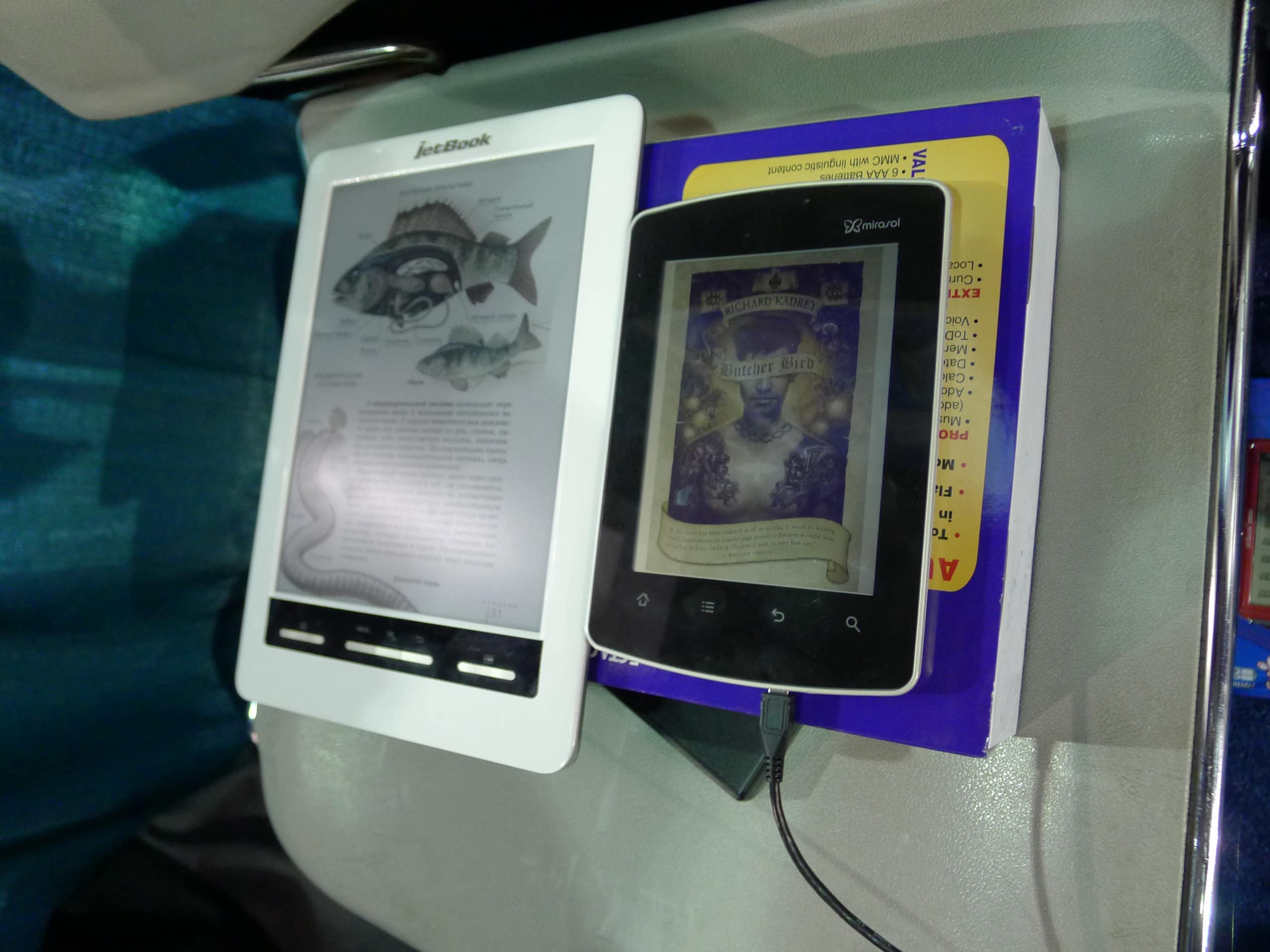
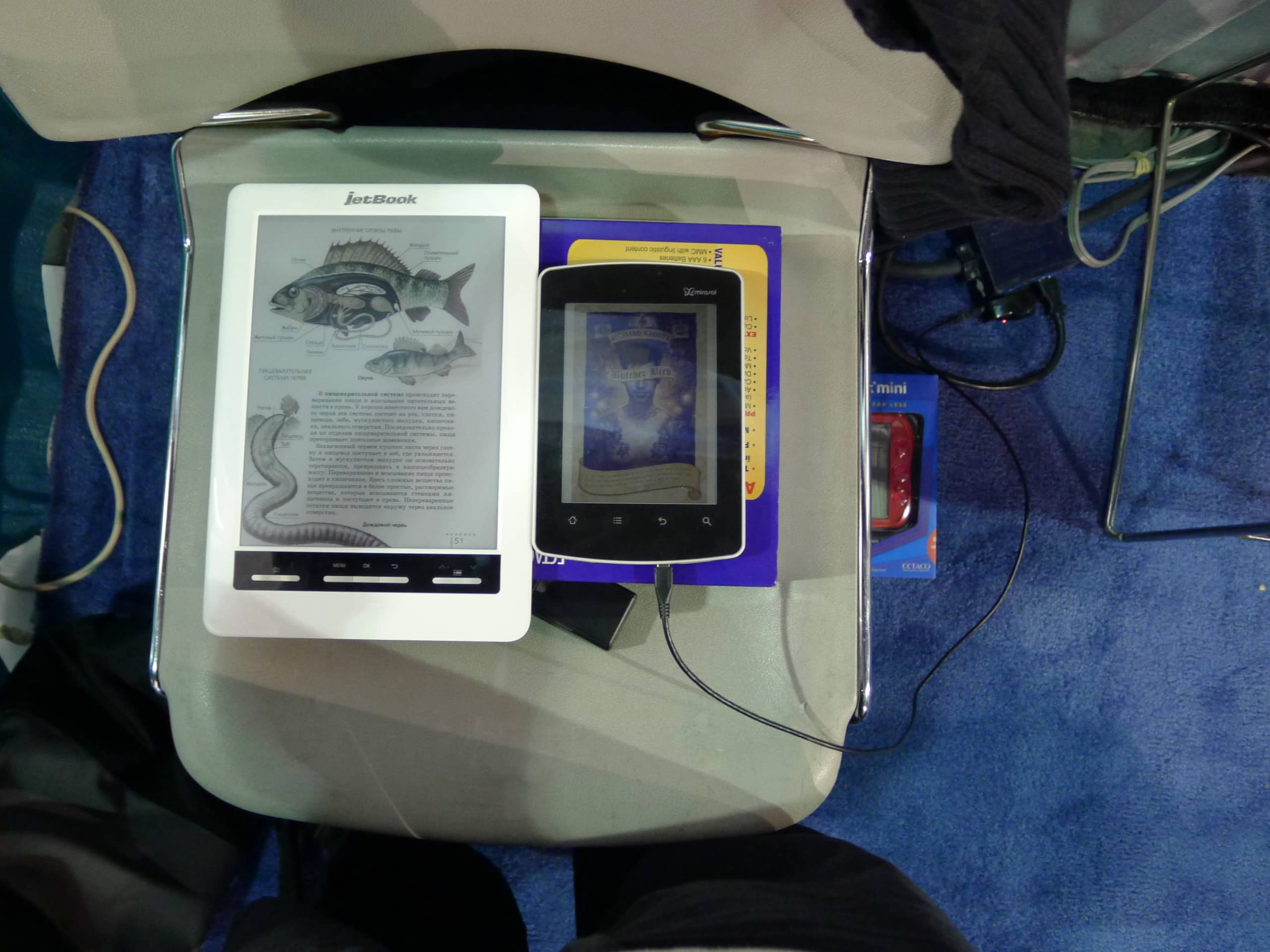
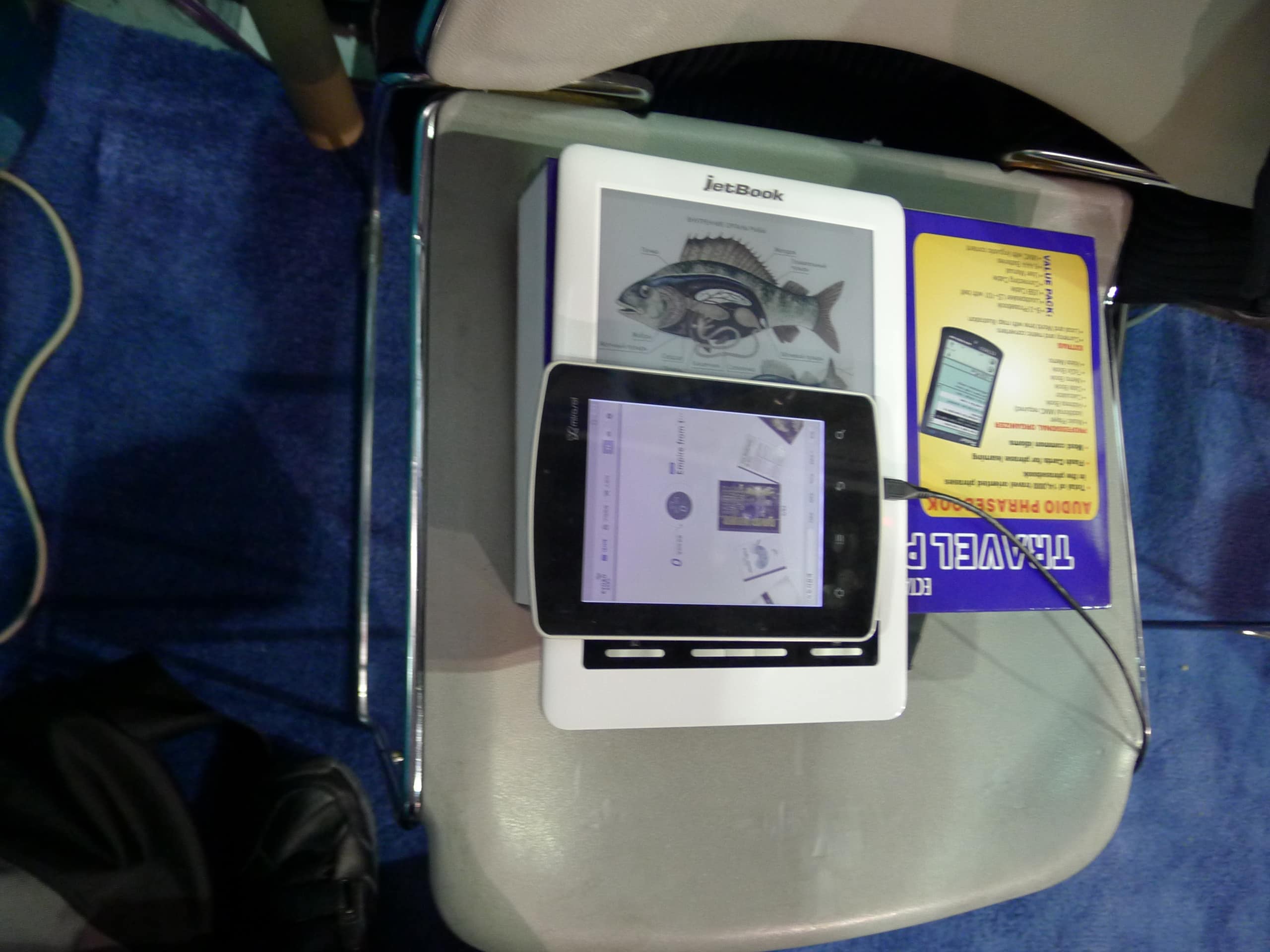
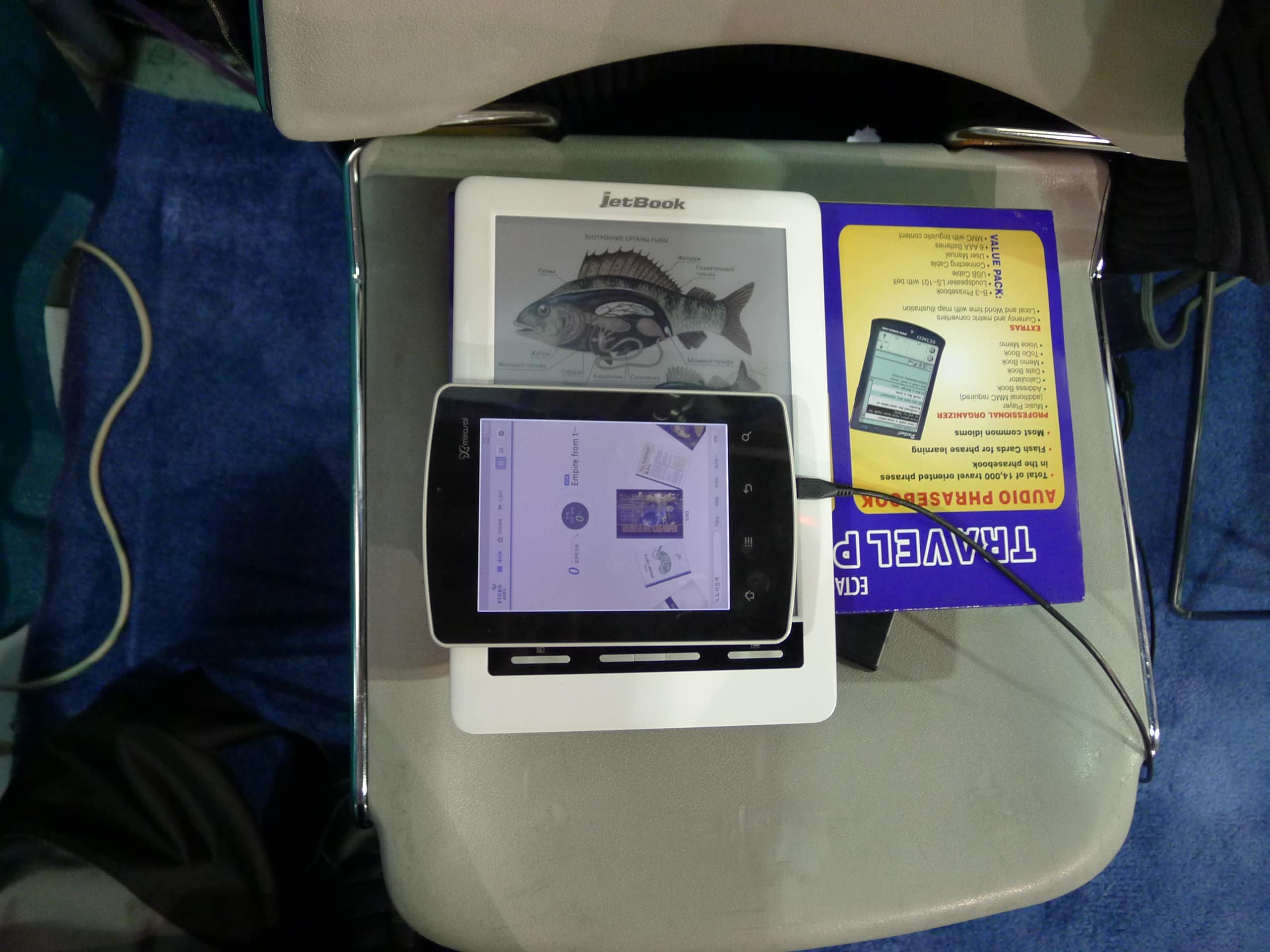
I’m sure you know that I have a Kyobo eReader, the first device to ship with a Mirasol screen. Since I was the only person at CES who owned one, I got a number of requests to compare this color epaper screen with color E-ink. So on Wednesday I went back to the Ectaco booth and took a bunch of photos and shot a couple videos.

Ectaco had a couple Jetbook Colors on display. These are academic ereaders based on the 9." color Triton E-ink display, and they recently shipped in Russia. They’re production models, not engineering samples, so I got the chance actual products – not devices still under development.

I hope you can see the different in the photos, because I won’t have a chance to take more. My Kyobo eReader is deadish, and attempts to revive it have failed. I had planned to look at the photos and shoot a second set if these didn’t work. But I cannot, sorry.

Update:  It’s Not Dead! Yay! But I cannot take anymore photos because CES is long past (dammit). Don’t worry, I’m planning to update this post when I get my Jetbook Color review unit. If I have to I’ll take both devices to a pro photographer.

I think you can get something from the video, which is embedded at the end of the post. I shot it in 720p, and if you watch it in full res then you should be able to see how the colors on the E-ink screen don’t shift.

The cover visible on the Kyobo eReader is from the book ButcherBird. I thought it offered a reasonably rich example that would show the changes quickly.

As for me, I could clearly see a difference when I had both screens in front of me.The Mirasol screen had better color quality – but only in the narrow 20% viewing angle. In that small region, Mirasol showed colors that were both stronger and sharper, while the E-ink screen looked distinctly washed out in comparison. But outside that region the color E-ink screen had better color. And of course neither compares well to LCD, but of course we expected that.

The E-ink screen displayed consistent color across its entire viewing area, while the colors on the Mirasol screen shifted quickly once you got out of the 20% region directly in front of the screen.

I’m attaching the photos I took, but only because I cannot get anything better due to the dead device.  Feel free to point out the best photos so other readers can find them faster.


Apple to Take on Digital Textbooks Next Week in NYC

Word is going around today that Apple is sending out invites. that rumored NYC digital publishing event is indeed happening next Thursday.

And yes, I have an invite (via eBookNewser).

As you can see from the image at right, this event has something to do with education. Given that Apple is a tech company, we’re likely looking at some type of digital textbook announcement.

But I don’t know what that could be. Here’s what the NYTimes Bits blog had to say:

The event will showcase a new push by Apple into the digital textbook business, but will not feature any new devices, according to a person close to the company who did not want to be identified talking about it before it occurred.

The thing is, I don’t see how Apple plans to make a buck if they enter the digital textbook market. This isn’t a market that is primed for growth (like ebooks). On the primary and secondary school levels textbook purchases are dependent on taxes, which is a finite supply as well as down this year in most places. And on the college level, students are buying fewer textbooks each year.

Then again, maybe Apple knows something I don’t. Maybe they’re not in this for the direct profit. On the other hand, they might have pulled off some amazing technology that they want to show off. We’ll have to wait and see.

Safari Books Online Buys Threepress Consulting, Makers of the Ibis Reader (HTML5 App)

Safari Books Online, an early pioneer in distributing books and content online, just bought Threepress  Consulting, a current pioneer in distributing books and content online. Talk about fitting a round peg into a round hole. Liza said it best:

"Both companies have a mission to provide high-quality, cross-platform access to books in a model that benefits both readers and publishers. Safari provides us with an unparalleled reserve of content, sales team, marketing savvy, and publisher relationships. We’re bringing our focus on standards, accessibility, interactivity, and emerging technology. "

Safari Books Online was founded just over 10 years ago as a joint venture between O’Reilly and Pearson Education. It has since grown into one of the bigger and better on-demand digital libraries for technology, creative, business and management professionals. Its library now contains over 20,000 titles.

Safari hasn’t gotten much mention on this blog, but Threepress has. They’ve been getting attention for their several Epub and Epub 3 tools, and I’m mentioned Liza Daly once or twice when she has posted conference presentations on the Threepress blog.  These are the folks behind the Ibis Reader, a browser based Epub reading app that launched last year. Threepress is also responsible for creating and maintaining EpubCheck, the online Epub validator. But those are just 2 demo projects released byThreepress; they do much more.

As part of the acquisition, the Threepress staff will join the Safari Books Online engineering team and work from their East Coast and Bay Area offices. Threepress co-founders Liza Daly and Keith Fahlgren will head the engineering dept as VP of Engineering and Director of Engineering, respectively. The sale was complete on 1 January, and the terms have not been disclosed.

Bambook Sunflower eReader Launches Today in China – Mirasol!

Qualcomm decided to start CES off with a bang. They’ve just announced a second partner with a second Mirasol ereader. It’s the Bambook Sunflower, and it looks to be using the same basic hardware as the Kyobo Mirasol eReader that I reviewed a couple weeks back.

This device is built around a 5.7″ Mirasol screen, and it runs a custom reading app on top of Android v2.3.  This ereader is Qualcomm all the way down to the 1GHz SnapDragon CPU. (Well, that answers one question; this hardware is clearly a reference design originally developed by Qualcomm. That’s what I had guesses when the Kyobo was first announced.)

Qualcomm’s partner in this case is Shanda, an up and coming media company in mainland China. Besides ebooks, Shanda also publishes games, music, TV, video, and it even runs a number of online communities. Shanda has been selling ebooks since 2010, and they launched their own ereader, the Bambook, in August of 2010. They have the second largest share of the Chinese ereader market (around 13%). But that market is estimated to only be around a million and a half units a year, so that’s not all that much. Shanda also has a sizeable ebookstore, and they boast that they have a million titles in stock.

I don’t know yet what formats the Bambook Sunflower supports, but there are hints of multimedia abilities (but no mention of Epub or PDF). There’s also no mention of how locked down the Sunflower will be, and that is going to eat away at me until I can find out.

The Sunflower is not going to ship until February, but it is up for pre-order now. Retail will be 2999 yuan, or about $475 USD.

As pleased as I am that Qualcomm announced a new partner, I’m also going to guess that they’re still having production issues. This is an incredibly expensive ereader, and I suspect that the price is high in order to reduce demand. There are any number of sub $100 ebook readers and tablets in the Chinese market, and the Bambook Sunflower costs as much as an iPad.

Since I already have a Kyobo Mirasol eReader, I’m going to try to get a firmware update for the Bambook Sunflower. I’ll post a review if and when I succeed.

—
For more ebook news, subscribe to the RSS feed or the daily email newsletter. You can also follow me on Twitter: @thDigitalReader or find me on FaceBook.

Kindle Touch to Get Solar Powered Case in March

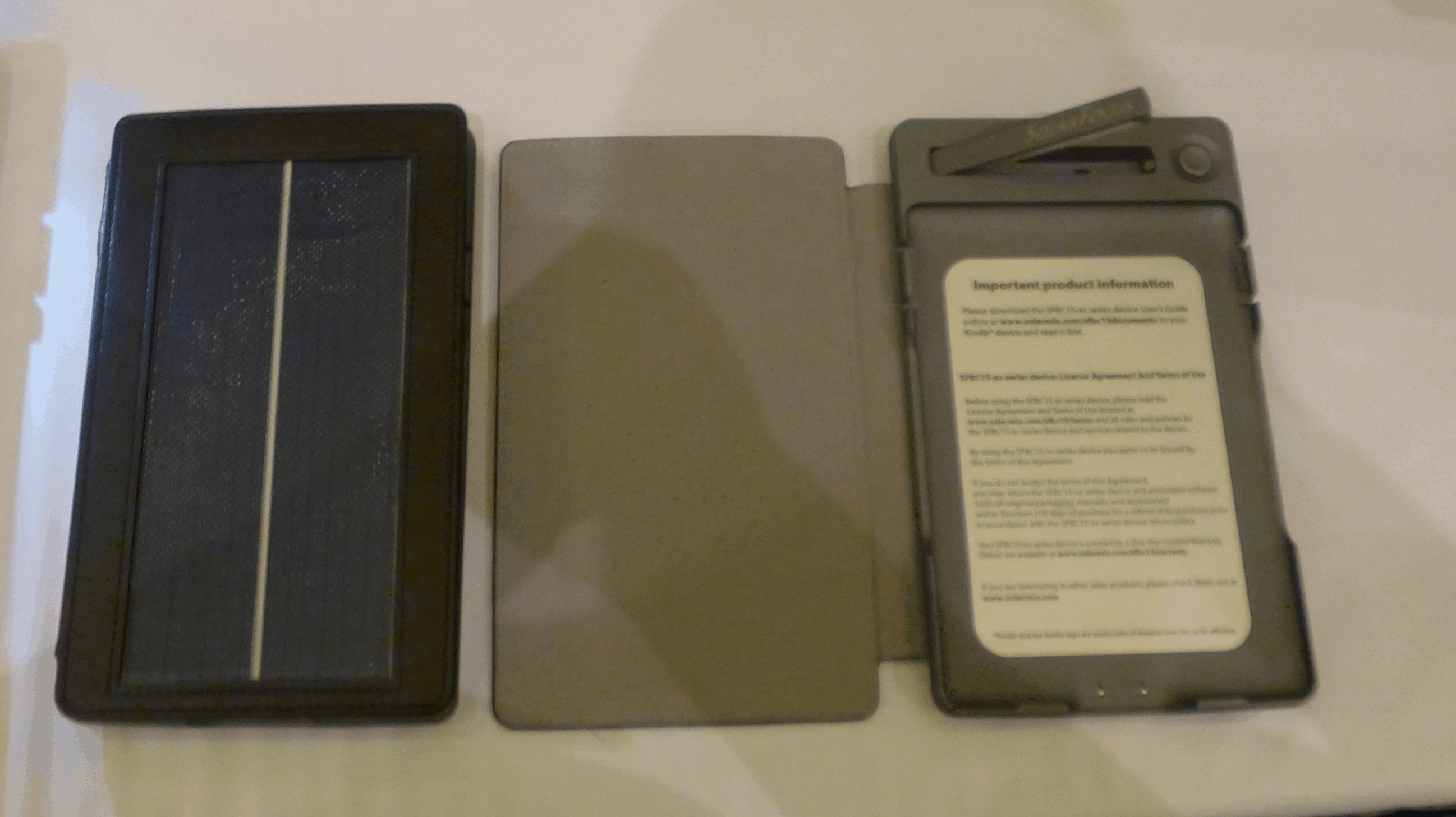
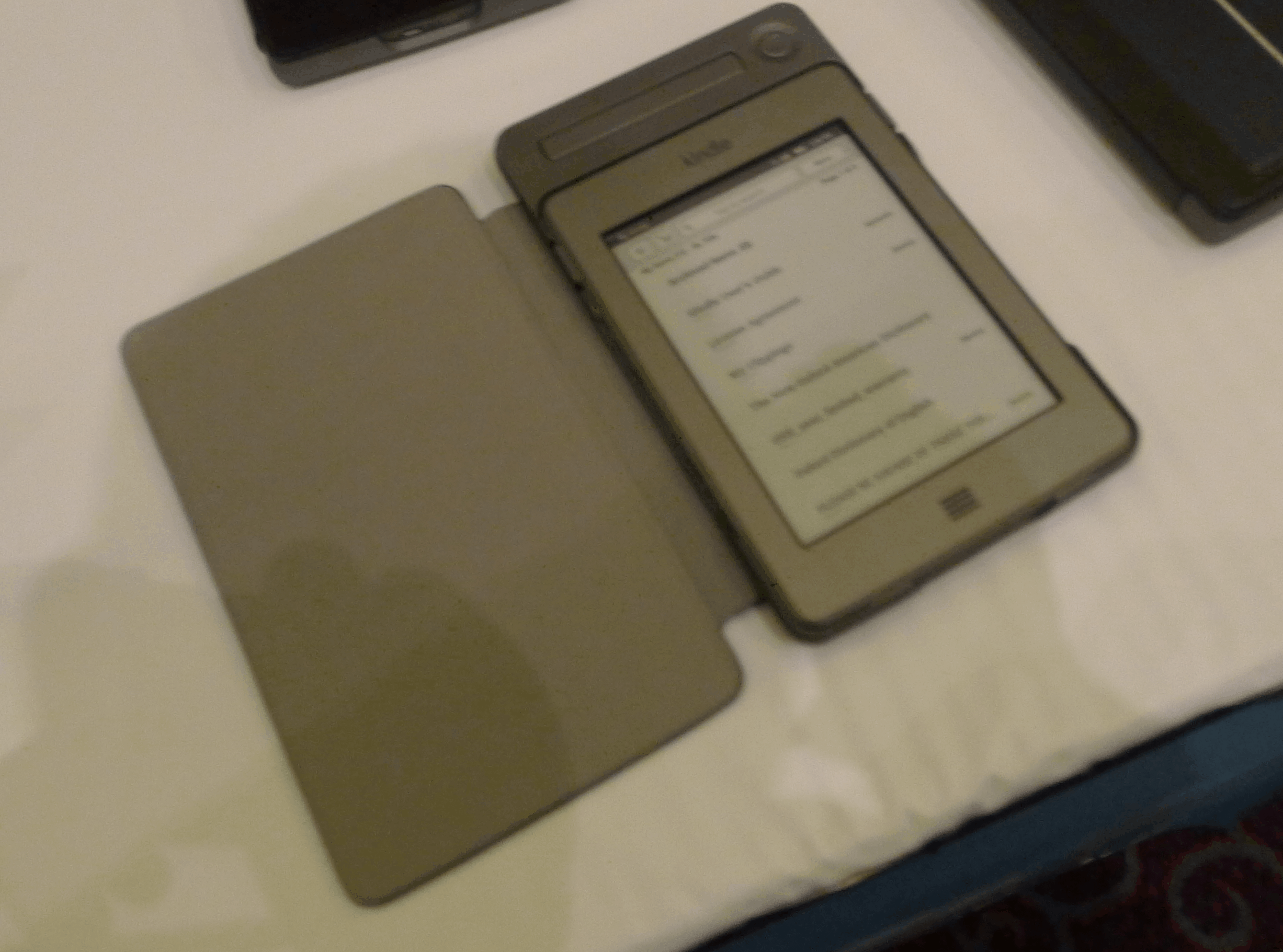
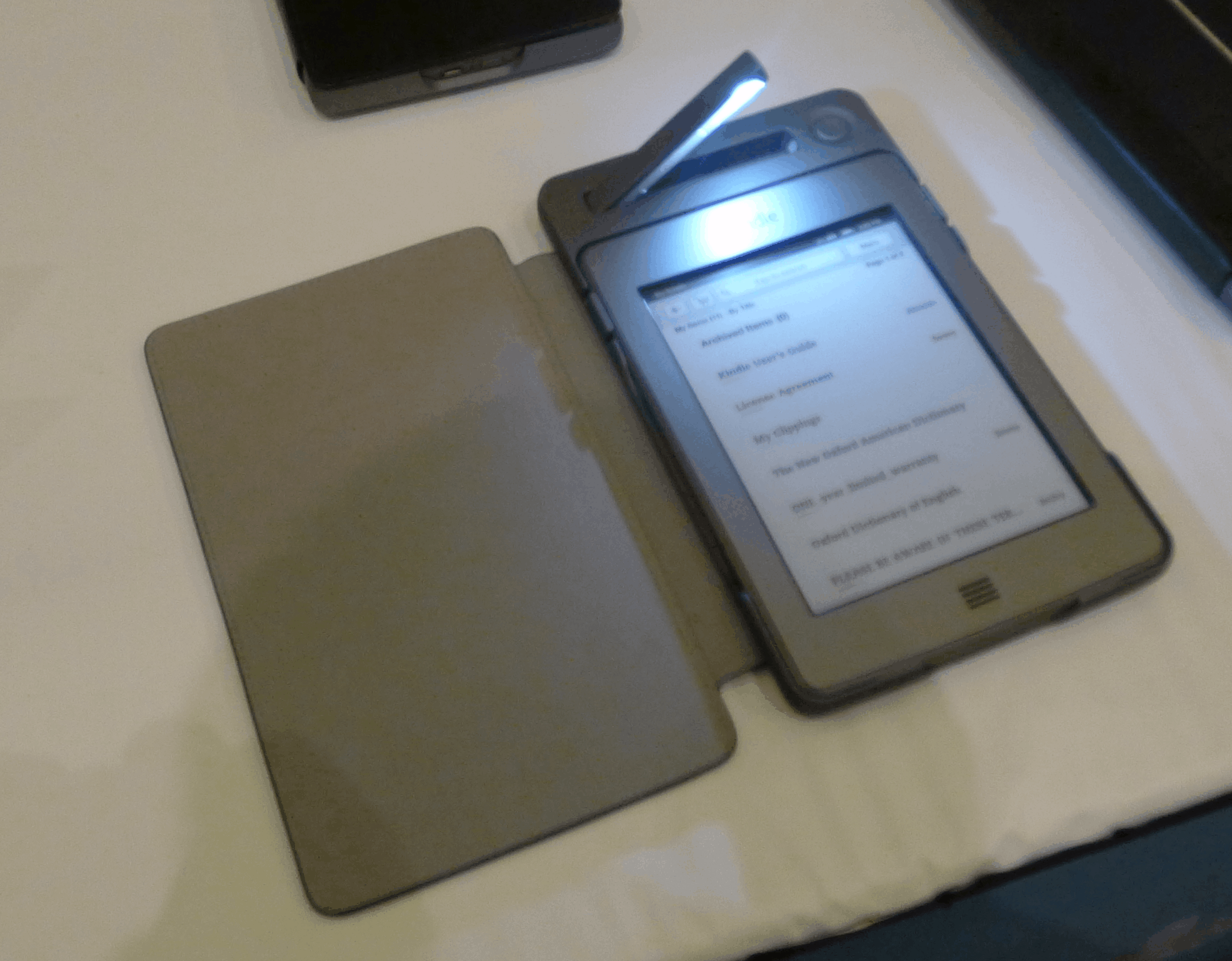
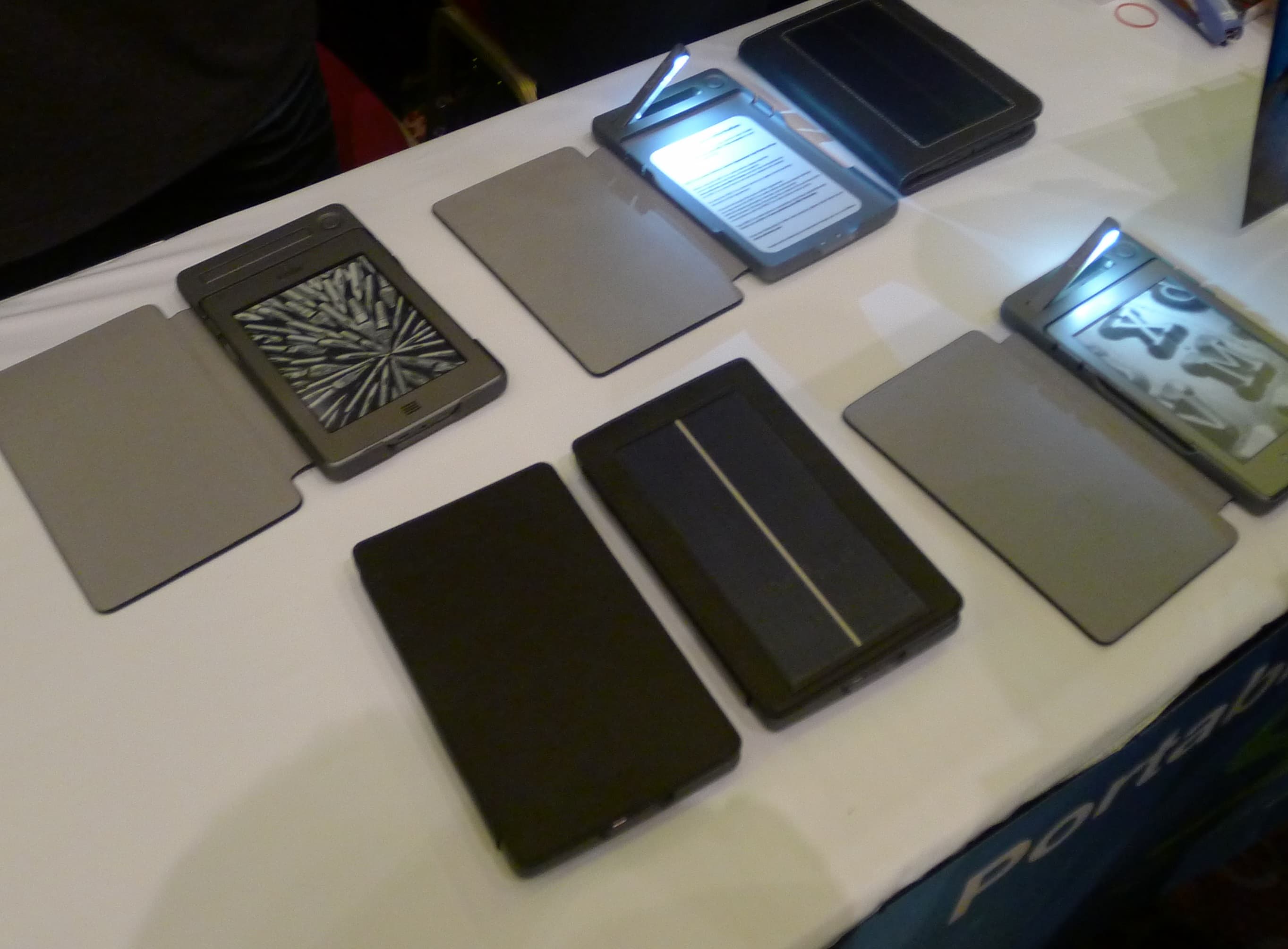
I just got back from the CES Unveiled event, and guess what I found? SolarFocus was there with their new case, the SolarKindle.They even had a demo unit for the not yet announced Kindle Touch case. (OLPC was also there in the Marvell booth, but I couldn’t get within 3 people of the XO-3 tablet. It was that packed.)

I spent a fair amount of time playing with the cases. They’re nice, and I think they are a serious alternative to the lighted cases currently sold by Amazon.

Both the K4 and K5 cases are based on the same general design. The Kindle snaps in place and is held quite securely. In fact, they had to use a pen cap as a prybar to pop one out so I could see behind it. The cases are rather thick, and I’d say it about doubled the thickness of the K4. They also felt sturdy, so in a pinch the SolarKindle case could double for a drop proof case (try at your own risk).

I was particularly interested in these cases because I wanted to see how they were powered. It turns out that they can charge the K4 and K5 off of the 2 metal square on the back. Amazon put them there so the new Kindles can power the case light, but clearly the system can work both ways.

On a side note, this case design implies that a docking station would work for the K4/K5 because the dock would use also those little squares. If any one makes one, let me know. I want one.

The new cases for the Kindle Touch should be coming out in March. They’re going to cost the same as the K4 cases, and they should be as widely available. And yes, the K5 is also supposed to get a battery powered lighted case (without the solar panel), just like the one for the K4. That should cost $60, the same as the K4 case.

Now, the last time I wrote about these cases I said that I didn’t see the point. $80 wasn’t worth the expense for a solar panel to be included in a Kindle case. But I’m going to have to retract that opinion because I hadn’t put these cases into their proper perspective.

Amazon’s own lighted cases start at $60, the same as SolarFocus' battery powered lighted case.  That means that the solar powered ones only cost $20 more and include their own power source. In fact, I like the  SolarFocus $60 case more than I like Amazon’s. It comes with a battery and can be recharged.

If I wanted a light I would definitely buy this case.

Amazon

SolarFocus

—
For more ebook news, subscribe to the RSS feed or the daily email newsletter. You can also follow me on Twitter: @thDigitalReader or find me on FaceBook.