Nate Hoffelder

Nate Hoffelder

Project Gutenberg Wants Your Input on Refreshing Its Site

At long, long, long, long, long, long last, Project Gutenberg is updating its listing pages.

They sent this message to one of their mailing lists this morning.

We would like to invite design ideas and input for Project Gutenberg’s eBook landing pages, such as https://www.gutenberg.org/ebooks/100

Discussion is being hosted in the gutvol-d email list, which you can subscribe (or peruse back issues) at https://lists.pglaf.org

The idea is to have a static HTML file for every eBook.  This will make it easier to get a full copy of the book’s files and surrounding meta-data.  We are also working on friendlier filenames and other improvements.  The main criterion is to use HTML+CSS only in static files: no Javascript, database, or server-side requirements.  Ideas and demonstrations are welcome!  (You can email directly to [email protected], or join the gutvol-d list.)

I don’t have the time to contribute right now but I am looking forward to the improved layout.

What would you like to see changed?

image by reingestalter

AAP Reports Trade Revenues Up 1% Through November 2017

The Association of American Publishers reported on Wednesday that publisher revenues fell 5.5% in the month of November while staying up for the year.

Revenues from the YA segment were up 3% through November, while adult and religious press revenues were down. In terms of format, hardback sales were up, while ebook and paperback sales.

press release

Publishers saw decreased revenue (-5.4%) in November 2017 vs. November 2016, but year-to-date revenue remains up (+1.1%) compared to Jan. – Nov. 2016 in all tracked categories. Tracked categories include: Trade – fiction/non-fiction/religious, PreK-12 Instructional Materials, Higher Education Course Materials, Professional Publishing, and University Presses. The year-to-date growth is primarily attributed to gains in the two largest categories: Adult Books, up $129.7 million (+2.9%) and Higher Education Course Materials, up $114.3 million (+3.8%).

Publisher revenue for trade books was down for November by -4.0%, with declines in Adult, Childrens/YA and Religious Presses. Year-to-date, trade revenue is up by +1.0%, or $66.7 million.

Total Trade Net Revenue by Category for Jan. – Nov. 2017 (in millions)*

  Jan. – Nov. 2017 Jan. – Nov. 2016 Percent Change
Adult Fiction/Non-Fiction

$4,621.0

$4,491.3

+2.9%

Children’s/YA

$1,879.7

$1,938.1

-3.0%

Religious Presses

$416.4

$421.0

-1.1%

Total Trade

$6917.0

$6,850.4

+1.0%

Trade Book Formats

In November, downloaded audio (+44.8%) and board books (+1.5%) were the only categories to see increased revenue. However, during the Jan. – Nov. 2017 timeframe, publishers saw increased revenue for hardback books, downloaded audio and board books. Publisher revenue for eBooks continued to decline in all categories except one – religious presses, where eBooks are up +6.4% in November and +9.9% year-to-date.

Eleven Month Total Trade Net Revenue by Format (in millions)*

  Jan. – Nov. 2017 Jan. – Nov. 2016 Percent Change
Hardback

$2,636.3

$2,551.2

+3.3%

Paperback & Mass Market

$2,502.7

$2,563.2

-1.7%

eBooks

$1,012.7

$1,072.1

-5.5%

Downloaded Audio

$309.6

$239.0

+29.5%

Board Books

$133.4

$126.9

+5.1%

Other (incl physical audio)

$304.3

$297.9

+2.1%

Education and Scholarly Publishing

The education sector saw mixed results, with +3.8% revenue growth in Higher Education Course Materials and a -3.1% decline in PreK-12 Instructional Materials from Jan. – Nov. 2017.

Revenue for Professional Books increased by +14.8% for Nov. 2017 compared to Nov. 2016 and are up +10.5% year to date. University Press revenue declined -0.8% in November, but are up +4.8% year-to-date.


What We Know About the New Apple Pages

When Apple launched a new ebook-focused version of Pages last week, some took it to mean that Apple was junking iBooks Author in favor of Pages. Others mistakenly saw this as Apple "gently getting into the Book Creation industry".

Neither assertion is true. iBooks Author is not going away (but it is only updated about once a year, so it might as well, though). And while Pages has gained new and improved Epub support, it’s had the option to export Epub since 2010.

So what has changed?

Well, Pages hasn’t gained support for Apple’s iBooks format, but it is a better ebook making app. It’s now focused on making ebooks rather than exporting them. For example, students can make a book as a group project and build the book from photos, videos, or even Apple Pencil illustrations. The app also has pre-made templates.

MacStories has more details:

In a move that seemingly spells the death of iBooks Author, Pages for both iOS and Mac can be used to create enhanced digital books that are viewed perfectly in iBooks. Unlike Pages' previous ePub export capabilities, where you were creating a standard Pages document then exporting it, now the full creation process is optimized for digital books. Book creation starts with choosing from a set of new Apple-designed book templates. While working in a document, you can add things like videos and interactive image galleries to create enhanced digital books, making your tool set more dynamic than ever before. With these improvements, I’d be very surprised if we ever see another iBooks Author update again.

That’s not all for Pages. There’s a new option that enables viewing two pages of your document at once. This is done by toggling the 'Facing Pages' option inside Document Setup, and it even works on the iPhone. A final new Pages feature worth mentioning is Presenter Mode, which appears very similar to the Evernote feature known by the same name. It enables viewing your work in a clean, distraction-free environment that functions as a virtual teleprompter; you can even set the document to auto-scroll while in Presenter Mode. One small detail I greatly appreciate: you can still make edits to things like text size, font, spacing, and more while in Presenter Mode, so you don’t have to constantly switch back and forth between different modes to make tweaks.

The new features are available in both the iOS and macOS Pages app.

Have you used them? What do you think?

Amazon’s New "Great on Kindle" Program Offers 50% Royalty to Non-Fiction Titles

For a period of about 5 hours in January, Amazon mistakenly offered a 50% royalty rate. No one knew what it meant at the time, but now we do.

Amazon has a new promo program called Great on Kindle. According to a discussion on KBoards, the program launched some time in February, but it only crossed my desk today due to a tip (thanks, Joanna).

This program is invite-only and is still in beta, and according to Amazon "Great on Kindle is an Amazon program to help customers discover high-quality nonfiction eBooks. Great on Kindle eBooks offer enhanced features that readers value. "

Authors are asked to join the program via emails like this:

According to the email (which more or less reiterates the relevant page in KDP’s help pages) Great in Kindle gives authors a new royalty option of 50% on their non-fiction titles.

The books have to meet certain quality standards to be considered Amazon asks authors to:

  1. Make sure all images are high resolution
  2. Make sure Enhanced Typesetting is enabled
  3. Enter unique, accurate book details
  4. Enable X-Ray
  5. Correct any typos or formatting errors
  6. Set up an Author Page

Amazon also asks that authors price their book between $5 and $20. If an author meets all the requirements, their non-fiction title is eligible for the program. If the author opts in, their book will gain the following benefits.

  • A detail page message that identifies it as a high-quality book
  • Promotional credit offers for customers (don’t worry, this won’t affect your royalty)
  • Nominations for potential merchandising opportunities

This is a great opportunity for authors.

While it looks like a cut to the royalty rate, appearances can be deceiving. This program is targeted at books that either cost more than $10 (and thus were earning the 35% royalty) or have enough high resolution images that Amazon’s silly "delivery fee" effectively reduced the royalty rate to 50% to 55% (no one actually gets the 70% royalty – that’s just one of the accepted lies we all tell).

In short, this is a carrot, not a stick.

Amazon is Shutting Down Its Crowd-Sourcing Platform, Kindle Scout

Amazon informed authors on Monday that they were no longer accepting new submissions to Kindle Scout.

Dear valued scout,

As a member of the Kindle Scout voter community, we wanted to let you know of some upcoming changes being made to the Kindle Scout program.

As of April 3rd, Kindle Scout will no longer accept new submissions, and you will no longer be able to start a new Kindle Scout campaign. Once the current campaigns end their voting period, you will have until May 31st to log into your Kindle Scout profile, redeem free copies of your selected nominations, and save any info you may want.

If you have any questions about your Kindle Scout account, please contact our Customer Support team at [email protected].

We appreciate the support that you’ve provided over the years. Thanks to readers like you, hundreds of books have been selected for publication since Kindle Scout was started in 2015: http://amzn.to/2jciThO

Please continue supporting debut and emerging authors on Goodreads and Amazon.com by submitting reviews on each.

Warm wishes,
The Kindle Scout team

Launched in 2014, Kindle Scout was a hybrid publishing project where Amazon used crowd-sourcing to select titles to publish. Authors who were accepted were offered a $1,500 advance, 50% royalties, and an Amazon marketing push.

A total of 293 titles were selected for publication over Kindle Scout’s 3 and a half year run.

It’s impossible to say just how many copies were sold, but Kindle Scout remained popular with authors all the way to the end. I have found favorable reviews from authors in every year since it launched.

Why do you suppose Amazon shut down the program? Were sales declining for newer titles?


Apple Reader to Feature a 7.9″ E-ink Screen, Will Ship With Apple Library Subscription eBook Service

Over the past several months a number of sources have claimed that Apple was about to get serious about competing in the ebook market. I discounted the reports as baseless clickbait hype, but it would appear I was wrong.

A trusted source has sent me several photos of Apple’s first ebook reader, as well as a lot of information on what it can do.

Yes, you read that right; Apple is going to release an ebook reader. It will be called the Apple Reader, and it will have a next-gen Domino 7.9″ E-ink screen.

The Domino E-ink screen hasn’t been announced yet, but I am told it is nearly twice as fast as existing E-ink screens, and with a resolution of 450 ppi, it is also significantly sharper. Apple has reportedly been customizing this screen for over three years, and my source says it has an improved frontlight and a touchscreen so sensitive that you could write calligraphy on it.

The Apple Reader is currently running a modified version of iOS which includes the iBooks app and Apple’s office suite but will not include support for most apps. Apple is optimizing for the screen’s performance, rather than trying to make the Apple Reader as capable as possible.

The Apple Reader will not have a speaker, but it will have Wifi and Bluetooth, and  you will be able to stream Apple Music.

Apple Reader owners will also enjoy Apple’s new subscription ebook service, the Apple Library. Apple’s alternative to Kindle Unlimited will have a million titles in it at launch, including ebooks from three of the Big Five trade publishers.

The Apple Library will cost $9.99 a month.

So when can we expect this beautiful device to reach the market and throw Amazon off-kilter?

That I do not know for certain. I was told that the Apple Reader was supposed to be announced last week and scheduled to ship this fall, but the Apple Reader was pulled from the event at the last minute.

Your guess is as good as mine as to when the Apple Reader will be announced, but I do, however, have a small bonus for you; Apple is also testing a 6″ ereader, the Apple Reader mini.

It is a less amazing but also more pocketable alternative to the Apple Reader, and it might be launched at the same time.


P.S. April Fools.

P.P.S. The device shown in the first couple photos is the Boyue Likebook Plus, a Chinese ereader than has a 7.8″ screen. The second model is the T62, a 6″ ereader also from Boyue. Both devices run Android, and what you see on the screen are screenshots from my friend Juli Monroe’s iPad Mini.

It is amazing what you can do with screenshots, isn’t it?

Kobo Clara HD Clears the FCC

Kobo’s next ereader has shown up on the FCC website, but unfortunately that is just all I can tell you about it right now.

According to the paperwork, the Clara HD is going to be made by Netronix, just like Kobo’s previous ereaders. Judging by that one screenshot in the paperwork, it will have an E-ink screen and Wifi, and it will run Kobo’s software.

Unfortunately, I cannot tell you the screen size or whether the  Clara HD will be waterproof. But it’s worth noting that Kobo’s last ereader was the 6.8″ Aura H2O2, and before that they released the 7.8″ Aura One, which suggests this is a 6″ model.

I can’t even tell you the launch date with any certainty (the embargo ends in September, leaving a long possible launch window).

But I can tell you this first of April that Kobo has a new ereader coming.

I can’t wait to see it, can you?

FCC


Radish Bans Erotica from Its Serial Fiction App

Radish is a Wattpad-like app which sells stories by the chapter. It has been around for several years now, and it has had some success – the startup even raised $3 million in financing early last year.

But it crossed my desk today for a different reason.

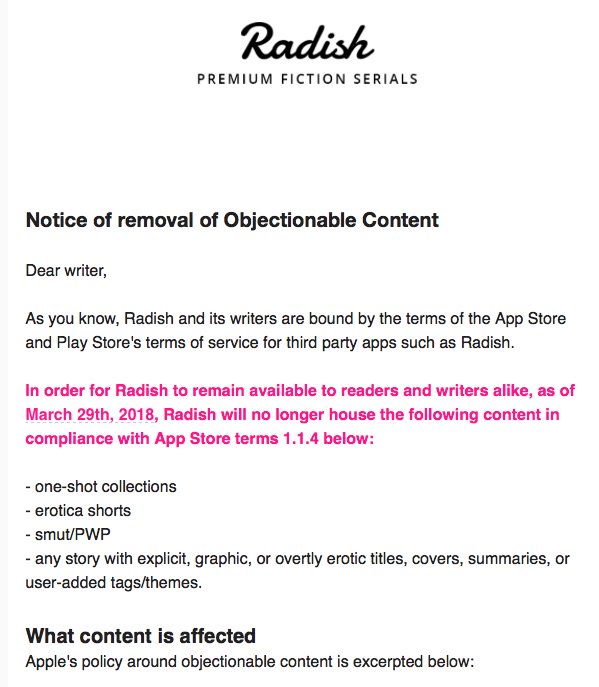
According to Andrew Shaffer and a number of other people on Twitter, Radish has sent an email to writers who sell stories in the app that is changing its content policy. In order to comply with Apple’s content policy for the iTunes app store, Radish is removing all erotica from its app.

You can read all three parts of  the email below:

Apple has always had a bizarre double standard for its content policy; apps are forbidden to show/sell adult content, and yet Apple sells shows like Shameless and Game of Thrones.

It has never been clear why such content is banned from third-party apps and yet allowed in the video sections of iTunes, but this is something we have had to cope with for as long as I can remember.

Radish is merely the latest victim.


Amazon Has Shadow-Banned Romance Titles from the Kindle Store

The ebook market owes its existence to the romance genre.

eBooks gave authors a chance to sell the stories readers wanted to buy rather than the stories the gatekeepers wanted to publish, and without romance we would have an ebook market dominated by the Big Five and their pricing policies.

Guess how Amazon is repaying that debt?

By shadow-banning romance titles from the Kindle Store.

I have seen numerous reports on Facebook, KBoards, and elsewhere that Amazon has adopted a new policy where some romance titles, most notably those titles that Amazon has identified as erotica, have been removed from the Kindle Store best-seller list.

In other words, the ebooks are still being sold, they are just not showing up in rankings and have lost the algorithmic benefit of their previous sales rank.

Update: About 36 hours from my first email, and nearly 12 hours after I published this post, Amazon finally decided how they are going to spin this:

A recent Kindle Store change inadvertently affected the display of sales rank for some titles. We have corrected this issue.

Second Update: I have confirmation from authors on KBoards that their ranks have been restored.

The change in policy was first noticed on 22 March, and it has affected both indie published ebooks as well as ebooks published by traditional publishers.

"While my self-pub BDSM books got hit, it’s also affected publishers like St. Martin’s Swerve imprint as well," one author wrote on KBoards. "I wrote two threesome books for them, Betting on Both and Game On, and both have had their rankings pulled. Dropped my editor at St. Martin’s Press a note – they may not be so happy about having the 'Zon do that to them."

Another author confirmed that even EL Grey got hit with the shadow ban. "I had noticed last night that E.L. James' Grey (pubbed via Random House) is overall-rank stripped too. It’s Book 1 from Christian’s POV. Book 2, Darker, is categorized as Romance, and is #676 overall. Grey is #7 in Erotica, but not on the BS list."

There are also a bunch of reports from authors who say that they checked their respective Author Central pages for their erotica titles, only be be informed that said titles were no longer ranked.

Amazon has confirmed the new policy, telling one author by email:

I’m following up concerning some of your books missing their best sellers ranking.

After hearing from our technical team we have confirmed that this is due to a recent update to the filter option for Erotica ebooks.

All adult themed titles will be filtered from the main category sales rank as part of this update. However, you will still continue to keep all of your category rankings. I know this wasn’t the answer you were looking for but appreciate your understanding on this policy.

Please let us know if you have any further questions.

I have attached a screenshot of the email at the end of this post.

Curiously enough, the change in policy only affects the main Amazon site, and not other sites like Amazon UK.

This detail has lead some authors to speculate that Amazon changed its policy in anticipation of the FOSTA bill becoming law. This bill is ostensibly intended to fight sex trafficking, but it has already had unexpected side effects such as Microst enacting a strict PG content policy in Office 365, Skype, and Xbox Live. Reddit has also removed several forums, and Craigslist has nuked its entire personals section.

I cannot confirm that Amazon’s new policy is also a result of the new law, however.

I reached out to Amazon for comment a day before publishing this post.  They were still struggling with how to spin this new policy when this post went live, which is why I do not have a statement from them.

Barnes & Noble Browsery App Now Live

B&N’s two month old book marketing app, Browsery, was officially released on Tuesday.

From the press release:

Browsery is available for Android and iOS users. It blends technology with the Barnes & Noble experience of community, conversation and peer-to-peer recommendations to deliver a new kind of digital browsing that’s a gateway for users to find new books and talk about the ones they love with fellow readers.  Customers can like, comment, or contribute answers to questions posed by the community, like or comment on the answers of others, or ask questions of their own. Seamless connectivity to the mobile web allows purchase or sampling of new discoveries.

“Books have always brought people together over shared interests to make recommendations to one another, and Browsery is rooted in that core experience of the reading life. We’re taking the way people talk about books with their friends and in our stores across the country and giving it a fun mobile presence,” said Fred Argir, Chief Digital Officer at Barnes & Noble. “Through this innovative new app, customers will be able to recommend great books to each other. We’re also encouraging our booksellers to get involved and share their knowledge and passion with a wider audience.”

I tried the app when it was in beta; I did not see a reason to keep it.  I find the book discussions on Reddit and Twitter – places where readers get to control the conversation, not a retailer – are more fulfilling than B&N’s app.

You can find the app in Google Play and iTunes. There does not appear to be an iPad or tablet version.

By the Numbers: Who Doesn’t Read Books in America?

Earlier this month Pew Research Center released the results of its latest survey on American book reading habits. It turns out that one in four Americans hadn’t cracked a book in the past year, and now we know how that figure breaks down in terms of the population.

As you had probably guessed, the non-readers tended to have only an HS degree, earn less that $30,000, and live in either rural or urban areas. They also tended to be over 50 years of age.

Several demographic traits correlate with non-book reading, Pew Research Center surveys have found. For instance, adults with a high school degree or less are about five times as likely as college graduates (37% vs. 7%) to report not reading books in any format in the past year. Adults with lower levels of educational attainment are also among the least likely to own smartphones, even as e-book reading on these devices has increased substantially since 2011. (College-educated adults are more likely to own these devices and use them to read e-books.)

Adults with annual household incomes of $30,000 or less are about three times as likely as the most affluent adults to be non-book readers (36% vs. 13%). Hispanic adults are about twice as likely as whites (38% vs. 20%) to report not having read a book in the past 12 months. But there are differences between Hispanics born inside and outside the U.S.: Roughly half (51%) of foreign-born Hispanics report not having read a book, compared with 22% of Hispanics born in the U.S.

Older Americans are a bit more likely than their younger counterparts not to have read a book. Some 28% of adults ages 50 and older have not read a book in the past year, compared with 20% of adults under 50. There are modest differences when looking at gender and whether people live in urban, suburban or rural areas.

While it interesting to see this breakdown, Pew still asked the wrong questions. They asked about reading books, as if that were the only form that mattered, when they should ask more granular questions about all types and genres of reading material.

There is more to reading than just books, but you wouldn’t be able to tell that given our current blinkered focus on books.

Readers Have Borrowed More Than 1 Billion Books Through OverDrive

Overdrive just announced on their blog that they have loaned a billion ebooks since they first started lending ebooks in 2003.

From OverDrive:

One billion. It’s a defining number that’s hard to fathom yet understood as a massive milestone. There are very few things that can use the number 1 billion to describe what they represent. Recently, digital library checkouts through OverDrive became one of them. On February 10, Team OverDrive watched as our all-time checkouts surpassed 1 billion, officially joining the three comma club.

We’re proud of this accomplishment, but it’s not something we ever could’ve reached on our own. The librarians and staff at the 40,000 library and school partners we work with around the world deserve all the credit for spreading the word and evangelizing the joys of digital reading. Because of their tireless work, this isn’t the end of a journey, but rather the first step toward billions more moments of reading happiness. At PLA this week, we’ll be celebrating our Billion Book Bash with hundreds of our closest librarian friends. If you’ll be in Philadelphia for the conference, we hope you’ll join us.

A billion is a lot, but I think it’s worth noting that OverDrive would have reached this milestone years ago if the major publishers had adopted reasonable policies on library ebooks.

All 5 of the major publishers either charge ridiculously high prices in the ebook market, or limit checkouts, or both.

If they had had their way we would never have reached this milestone.


Kindle App for iOS Gains Support for Infinite Scrolling, Split View on iPad, and More

The latest update for the Kindle iOS app is going to make David Rothman of Teleread very happy.

Amazon released a new version of the Kindle app today. New features include Arabic dictionaries, split view (but only on the larger iThings), and an option to scroll your way through an ebook rather than turn the page.

Yes, Amazon has finally taken the same scrolling feature found in all web browsers and added it to the Kindle app for iOS.

While this might not seem important, there have been times where I have had a diagram and its explanation show up on two different pages. If I had had the option to scroll the page, I could have had all the info on the screen at once.

This will prove to be a useful feature, although I do wonder how it will work on the iPad in landscape mode with the two columns. Alas, I don’t have an iPad to test this on, so I’m going to have to wait for you to test it and report back.

You can find the app in iTunes.

Changelog

  • Split view on iPad is here! Resize the app to multi-task while reading without ever switching context.
  • Try scrolling through your book – just like a web page. Turn continuous scrolling on via Settings, then easily turn it on and off from the Aa menu in your book. Tell us what you think.
  • Pull down in the library to refresh your list of books.
  • We’ve added Kindle dictionaries for Arabic.

9to5Mac

Is Amazon Shutting Down Liquavista?

There is an unconfirmed report coming out of the Netherlands today that Amazon is shutting down its screen tech subsidiary. Citing unnamed sources, tech blog Bits &Chips claims that Amazon decided last year that it would close Liquavista.  Amazon is reportedly busy dismantling the startup, and plans to phase out the staff in the course of the coming year.

Amazon was asked to comment on this story about 3 hours before it was published, but has not responded.

For the past decade or so Liquavista has been developing a low-powered screen tech to replace LCD screens. Their designs were based on electrowetting technology, which is a fancy way of saying that each pixel in a Liquavista screen contained 3 liquids (red, green, blue), and that the color shown by a pixel depended on the amount of power fed into each liquid.

The tech was originally developed at Philips, before Liquavista was spun out in 2006. Over the following decade the startup showed off demo screens on several occasions, but it never put the screen into production, and it was never closer than a perpetual two years away from releasing a screen unit to market.

And now it looks like it never will be releasing that first screen.

I was the first to report that Samsung bought Liquavista in 2011, and the first to report that it had been sold to Amazon in 2013, and now it looks like I just may be the first to report Liquavista’s demise.

In a way, I’m not surprised. It was pretty clear when Samsung sold Liquavista in 2013 that there wasn’t much of a market for the screen tech by that point; the original intended use was as a solution to the mobile device battery life issue, and that problem had already mostly been fixed by 2013.

There was no need to use a new screen tech when battery capacity was already improving year by year, and screens were getting more and more energy efficient. Nevertheless, some of us had been hoping Amazon would push through and bring the new screen to market just so it could have a Kindle screen that no other ereader could match. (I even made it an April Fool’s day joke in 2016, and I was so convincing that someone actually stole the joke and claimed it was real.)

And now it looks like we won’t see it at all.

Thanks, Javi, for the tip!

Updated: Simon & Schuster’s Vanity Press Launches Writing Contest to Exploit More Authors

Update: This post was originally published in November 2017, and was updated in March 2018 to reflect S&S’s ongoing exploitation of authors.

Of all the major publishers, Simon & Schuster is uniquely exploitative. They had previously revived the Star Trek Writing Contest to use it as a feeder pool for their vanity press, Archway Publishing, complete with cold calls where authors were pitched overpriced services, and now S&S has found a new way to gather in the lambs to be fleeced.

They are using the cover of NaNoWriMo, the National Novel Writing Month, to launch a writing contest, and they even roped in the S&S writing community XOXO After Dark to lend an air of legitimacy to the contest.

XOXO After Dark, a community site offering the best in romance, urban fantasy, and women’s fiction supported by Pocket Books and Simon & Schuster, is teaming up with Archway Publishing to launch the Hot Books, Cold Nights Romance Novel Writing Contest. Abby Zidle, Editor-in-Chief at XOXO After Dark and Associate Director of Marketing and Senior Editor at Pocket and Gallery Books announced the news today.

“XOXO is excited to find great new talent in romance writing,” said Zidle. “Some of the most popular writers today started their careers as readers and fans.”

Pocket Star, the digital-first imprint of Simon and Schuster, will publish the winning novel. Additionally, two runners-up will receive free self-publishing packages from Archway Publishing.

“We’ve all used a hot book to help us get through a cold night once or twice,” said Zidle. “And NaNoWriMo is the perfect time to encourage new writers to get that hot book onto the page.”

The problems with this contest are two-fold.

The first problem is that the "winner" gets a book contract with S&S digital imprint, Pocket Star, as well as a measly $500 advance (David Gaughran found this in the fine print).

That is a terrible advance and an exploitative contract, but the larger problem is that this contest is run by the Author Solutions front company, Archway.

Contestants are required to submit  their email and phone number to enter the contest, and Author Solutions is going to use that contact info to have telemarketers pitch over priced marketing and publishing packages.

That is exactly what happened last year with the Star Trek Writing Contest, and it is why Simon & Schuster chose Archway Author Solutions to run this contest.

For example:

The thing about Author Solutions is that it uses high-pressure sales tactics to sell authors worthless marketing services. It gets most of its revenue from charging authors ridiculously expensive marketing fees and overcharging for publishing services (which are then filled by low bid contract recruited via Craigslist). It .

And that’s not just my opinion; this company (and its many imprints) has a terrible reputation at review sites like Ripoff Report. If you click the links in the above paragraph, you will see that Author Solutions is widely regarded as a scam.

No one should enter this contest; I would not wish Author Solutions on my worst enemy.

Update: It’s March 2018. The writing contest ended months and months ago, but Simon & Schuster continues to spam entrants with solicitations from its vanity press, Archway:

This wasn’t just a one time thing; S&S clearly plans to try to con authors out of their money so long there is money to be had.