Kindle Unlimited, Market Scrying, and Sales Cycles

Over the past couple months many authors have pointed to Kindle Unlimited and complained that Amazon’s 5 month old ebook subscription service is harming their sales, but there is growing evidence that this is not the case.

Russ Grandinetti revealed at the DBW conference last week that author revenues for titles in Kindle Unlimited were up, with the combined earnings of titles in KU in the last 5 months of 2014 were "double, more than double" what they were in the same period in 2013.

And now there’s growing evidence that the decline in revenue some authors experienced in fall 2014 might be the third appearance of a market cycle which also occurred in 2013 and 2012 (and possibly even 2011).

Earlier today john Chapman tweeted a link to an author ranting about his sales declining in 2012. Blaming recent changes to Amazon’s ranking algorithms, Derek Haines noted in November 2012 that:

Judging by my own ebook sales, it has worked spectacularly well, as my unit sales have dropped off a cliff from October to November.

That sounds an awful lot like the complaints made this past fall, and the complaints made in fall 2013.

What’s more, there was also at least one comment from an author who reported that she saw a similar decline in 2011. Debra Holland went on to note that:

Last year, my great books sales started a downward slide from after Labor Day until Christmas. Many people would still envy me my (pre Christmas) December sales figures, but for me, they were way down. With rare exceptions, almost everyone in the self-publishing community said the same thing was happening for their sales. AND people who’d self-published the year before (2010) were quick to reassure us that it had happened to them in that season previously and to wait for the Christmas wave. They were right. Christmas Day my sales popped up and were great through May and ok over the summer.

Therefore, I expected to have my sales slide during this season, and that’s what has happened. Again, in comparison to many, my sales are still good, just steadily declining. However, I’m shrugging my shoulders and focusing on getting the next book out. I know the Christmas sales will pop things up again. Having a new novella will pop sales up again.

And just to remind you, some authors saw a similar decline in 2013.

In short, folks, what we have here is strong evidence of a market cycle and not, as many assumed, the impact of Kindle Unlimited, Bob Mayer’s content glut, or whatever happens to be the cause du jour.

Do we know for sure that this is the only cause of the declines in revenue? No, but I believe that it is the most likely cause. At the very least, an annual market cycle better explains why authors who weren’t in KU saw a decline this past fall along with other authors who were in KU.

It would also explain Juli Monroe’s report that she saw a decline across all markets, and not just the markets impacted by KU:

Although I was blaming KU for my sales decline last year, when I stepped back and thought about it logically, I realized there had to be another reason. My sales dropped in all countries, including the UK and DE before KU had debuted in those countries. Obviously KU hadn’t been a factor in those drops.

She is one of the authors who isn’t in KU, and yet still experienced a decline.

Do you know of a better explanation? The comments are open.

images by karen horton, Kdt.

AAP Reports US Book Market Up 5.5% in 2014

The Association of American Publishers released its usual welter of limited and confusing book market stats today.

Depending on which figure you’re looking at, the AAP reported that publisher revenues from January to October were up 4.1% (if you look at the trade market only) and that publisher revenues from January to October were up 5.5% (counting everything that the publishers are selling, including the crushed hopes and dreams of writers).

The aggregated revenues (from 1,209 publishers) for the trade book segment totaled $5.86 billion in the first ten months of the year, up 4.3% from $5.61 billion in the same period of 2014. The kids/YA category showed the most growth, increasing by 21.6%, while the adult category continued to dip by just under a percent and religious presses grew by 1%.

Within the growing kids/YA category, all formats continued to experience double-digit growth; compared to the same ten month period last year,  the greatest growers were ebooks at 47.8% and Board Books at 36.6%.

In terms of formats, paperbacks showed a surprise revival, with revenues growing by 7.2%. eBooks continued their solid albeit stolid growth, growing by 5.3% to $1.32 billion, while hardback revenues increased by 1.1%.

iBooks is Growing by 1 Million Customers(*) per Week

Our last session before lunch on this third and final day of the DBW conference was given over to what I had hoped would be a serious interview. Alas, if Amazon’s Russ Grandinetti didn’t say much during his interview yesterday, Apple’s Ken Moerer said even less today.

My notes totaled 5 lines, and aside from warm and fuzzy non-statements Moerer really only said three things, none of which were very informative.

  • For example, iBooks is active in 51 countries 5 years after the April 2010 launch. (They’re not selling ebooks in all 51 countries, just present.)
  • iBooks recently hit 1 billion downloads. (That’s downloads, and not sales, which probably amount to fewer than 10% of downloads.)
  • And iBooks has been picking up an average of 1 million new customers a week since September. (Given that iBooks comes pre-installed on iOS8, all of the newly activated iDevices on new accounts count as new customers. How many are actually buying ebooks, we don’t know.)

All in all, that was a waste of an interview, and I blame Michael Cader for only lobbing softballs at Moerer. I agree with Len Edgerly; Shatzkin was much more challenging and intense when he grilled Grandinetti yesterday.

Update: It’s been pointed out to me on a mailing list that Apple sells considerably more than 1 million devices a week, so that "million new customers" probably does represent people who opened the app and downloaded an ebook.

Sony to Launch New eBook DRM in April

When news of Sony’s new ebook DRM plans crossed my desk in late October, I wasn’t sure whether to take them seriously. The news came to me second hand and seemed focused on the idea of "used" ebook sales, which seemed like a pipe dream at best, but Sony’s focus is much broader than that.

I spent a few minutes today with Spiros Rally, the VP of DigitalWorks at Sony DADC, at DBW 2015. There wasn’t much he could say about the tech or Sony’s intentions publicly but he did share a few details.

Sony is very interested in this market (the fact they had people at DBW 2015 told us that) but they’re not directly interested in the trade ebook market, where the leading DRM suppliers are Amazon, Apple and Adobe. Instead Sony plans to focus on other markets and on developing new business models.

I was told that Sony is planning to focus on educational, corporate, and other markets. They’re also in talks with the NYPL, one of the many libraries exploring the possibility of developing and owning their own ebook platform, to provide the DRM used on that platform. (A number of libraries, including Douglas County Library in CO and Califa Library Group in CA, run their own ebook servers in addition to – in some cases – also working with library ebook vendors like OverDrive and 3M Cloud Libraries.)

And there is also a chance that Sony’s DRM might show up in the trade ebook market; as you may know Kobo, Google, Scribd, and Oyster each use their own proprietary form of DRM internally (Google Play Books and Kobo make a pretense of supporting Adobe DRM externally).

I have been told by Sony that partners will be using the new DRM by April, although they have not said who that will be. As I reported in October, details are still scarce.

While it might sound strange for Sony to get back into ebook DRM less than a year after getting out of ebook retail, they’ve actually been working on this for several years. I first caught wind of Sony’s efforts in this area in 2011, when the Marlin consortium announced plans to develop a new ebook DRM. Sony was involved, which is what caught my eye.

According to what we were told in October, some of the features could include:

  1. A reader could lend a book to a friend or friends.
  2. Books purchased from several stores using the URMS can be accessed from a common bookshelf on a user’s device that can be easily read using any supported reading device.
  3. A reader can borrow books from libraries in different ways to suit their reading patterns. As an example, a short book could have a short loan time and a longer book could have a longer time.
  4. Conversely, a library could offer on the fly renewals, making their operation and administration easier and more efficient.
  5. Using our platform, a reader can sell their book. Once sold, the reader would no longer have access to it on the platform.

It remains to be seen exactly how this DRM will be used, of course.

image  by rebopper

Pixel Qi Isn’t Dead – It’s Just Pining for the Fjords

The long, drawn out demise of screen tech pioneer Pixel Qi took a turn for the surreal last night.

On Monday a disreputable source reported that Pixel Qi was "officially out of business", but according to my new contact with the company that is not the case. Late Tuesday night I got an email from Dougald Turnbull, the Pixel Qi VP of Finance and Operations, who clarified the situation. The company is not dead (well, not yet), the products aren’t dead, and the IP is very much alive.

Turnbull confirmed initial reports that the Pixel Qi screens are still in production, and that Chungwa Picture Tubes was still a licensed manufacturer. He also confirmed my report that Tripuso was a licensed distributor (so is Arrow Electronics) and that the screen tech will continue to be available.

In fact, the tech could become even more widely available – just not from Pixel Qi.

I’ve been told (and I can confirm) that the Pixel Qi IP is now in the possession of a major stockholder, and here’s where things get surreal.

John Gilmore, activist, philanthropist, and founder of the EFF, now owns the Pixel Qi patents, and he’s reportedly released the patents under the Defensive Patent License.

Described as the patent license equivalent of the GPL, the Defensive Patent License makes all patents licensed under it free to all participating parties, with the double caveat that they can’t use the patents to sue and that they must license their patents under the DPL as well.

In short, the Pixel Qi tech can be used by any screen tech manufacturer which cares to sign up for the DPL, which means that we could see some of the ideas in Pixel Qi’s screen tech (low power, sunlight readable, etc) show up in commercially produced LCD screens.

With luck we could see screens like this from the major screen makers:


That would be a far different fate from the usual outcome when a tech company fails; in most cases the IP ends up in the hands of a creditor or investor, or possibly tied up in litigation, and in some cases a patent troll such as Intellectual Ventures gains control (sometimes they’re the highest bidder).

For example, the Dutch screen tech company IRX went bankrupt last year and its IP is still under the control of the court-appointed administrator. And in 2013 Wistron folded up Polymer Vision, the screen tech company it acquired out of bankruptcy a few years before, and then simply sat on the IP.

Admittedly, the Pixel Qi outcome is far from ideal, but with the products still in production and with the tech available for license, Pixel Qi is far close to being alive than dead.

I would not count them out just yet. Who knows, the company itself might revive and start developing new ideas again. With several key individuals, including the founder Mary Lou Jepsen gone (she’s at Google now), that is’t very likely, but it’s not impossible.

And given the tech in question, I do hope someone continues development. Pixel Qi was known for its low-power transflective LCD screen tech which offered a unique  solution to the battery issue. When viewed in full color mode, it offered an adequate viewing experience with either the frontlight on or off.  The Pixel Qi screens also offered a low-power grayscale mode which was fully visible in sunlight.

The screen tech was originally developed for the OLPC educational laptop initiative, and was spun off into an independent company in order to push research and commercial development. Pixel Qi has released several generations of screens in 7″ and 10″ screen sizes which have been used in a variety of tablets, laptops, rugged devices, and even a couple USB monitors (see Sol Computer for several examples).

At one point the tech was described as an E-ink killer. Alas, that proved to be wildly optimistic, but I was equally hopeful at that time.

Macmillan Signs Deal With Scribd, Other eBook Subscription Service

The hot news tomorrow morning is going to be coming from Macmillan. The US branch of this publishing conglomerate has signed a couple deals with ebook subscription services to add 1,000 titles to Scribd and (at least) one of its competitors.

To be clear, I do know the name of the competitor, it’s just that that particular detail is still under an embargo.

Update: It’s Oyster, which now boasts over 1 million titles.

After Simon & Schuster and HarperCollins, Macmillan is the third of the "Big 5" US publishers to sign with an ebook subscription service since late 2013, but if you add in publishers like HMH and Scholastic (each of which have revenues large enough to be included in the Big 5) then Macmillan is actually the 5th or 6th major US publisher to do so.

The specifics of Macmillan’s deal are not know at this time, but Macmillan CEO Jon Sargent did state last month that he intended to pursue deals with "companies offer “pay per read” plans that offer favorable economic terms". Both Scribd and Oyster offer this type of deal to publishers (Scribd also offers it to ebooks distributed through Smashwords).

Scribd currently boasts 500,000 titles, including 30,000 audiobook titles licensed through Findaway World. They boast 80 million monthly users, with some unknown number paying $8.99 a month to access the ebook subscription service.

Scribd hasn’t revealed the number of paying subscribers, but they did recently pick up another $22 million in capital. That suggests that the VCs who invested are satisfied with Scribd’s growth.

Reports of the Death of Pixel Qi Were Somewhat Exaggerated

There’s a story going around this morning that Pixel Qi, makers of a novel dual-mode LCD screen tech, was officially out of business.

According to my sources, that both is and isn’t true.

I just got off the phone with Chris Swanner, owner of Sol Computers. This Calif.-based retailer is one of Pixel Qi’s partners (the only one in the US, so far as I know) and he confirmed that Pixel Qi the company was indeed dead.

He also told me that the IP and products were not.

Sol Computers sells several products based on Pixel Qi screens, including a laptop, USB monitor, and a tablet, and this retailer plans to continue to do so. Chris told me that he’s not shutting down or finding a different line of products to sell; it’s just that in the future Chris will be sourcing Pixel Qi screens from Tripuso Display Solutions. Chris told me that firm now owns the Pixel Qi IP and will continue to make the screens.

Update: Dave Nelson of Tripuso confirmed the news and clarified his relationship to the Pixel Qi IP in a statement:

The IP is now owned by the original investor of Pixel Qi. We will need to wait for Pixel Qi formal announcement for the details. Tripuso Display Solutions has the right to manufacture Pixel Qi technology by contract. We are still producing the 7” product as we speak and have some availability to stock of 10.1”.

The 7” Pixel Qi product (PQ070WS01) is available and should remain in production for a few more years.

Thanks to a handful of loyal customers, we have been able to keep Pixel Qi technology alive. There is an absolute need for niche markets to have both sunlight readability and low power. The technology may not take over the world but I believe there is enough demand to keep it going for special niche markets.

We can also develop new sizes with adequate volume.

For some reason that name is familiar, although I can’t place it. But I do see from LinkedIn that Tripuso was co-founded by Dave Nelson, whose profile says that he was the director of sales at Pixel Qi until April 2013 (he founded Tripuso in December 2013).

It looks to me like Nelson saw the end of Pixel Qi coming in advance, and formed a new startup in order to buy the IP and continue to sell the tech. It’s not clear at this time whether Tripuso will be able to continue development of the screen tech, but I would not say that Pixel Qi is completely dead so long as the tech continues to live on with a new owner.

But at this point it is really too early to say.

Originally developed as a spin off from the OLPC project, Pixel Qi was the brainchild of Mary Lou Jepsen. She led the team which developed a unique dual-mode LCD screen tech which offered a screen which gracefully faded from full-color (when viewed inside) to grayscale (when viewed in full sunlight).

The screen doesn’t offer particularly good color quality, but it did have relatively low power requirements when it was first developed (I’m not so sure that is true any more) and does offer a unique and workable solution to the sunlight issue.

Pixel Qi’s screen tech was originally developed for the OLPC low-cost educational laptop project. This was the only screen used on the XO laptop, and I have no reports that it will not continue to be used on future deployed laptops.

I am of course still waiting for confirmation of that and other details.

I have to say that I was surprised by the change in status of Pixel Qi; I’m tied into a couple different channels which use Pixel Qi screens, and I had not seen any of the usual talk which this type of disruption would cause.

That leads me to think (well, hope) that the disruption will be minimal.

Pixel Qi is the second screen tech company to pass into the great nether in 2014, but it’s not quite as thoroughly dead as IRX. Instead, Pixel Qi is mostly dead:

And as anyone can tell you, mostly dead is slightly alive.

Wikipedia Expands Auto-Translate Feature

The foreign language editions of Wikipedia have long proven to be a useful way for me to research background details for posts on this blog, and now more Wikipedia users are going to enjoy similar access.

Wiki Media announced over the weekend that they are expanding the (currently beta) auto-translate feature to include support for more languages:

Encouraged by the feedback we have received in the last 6 months, we are now happy to announce that the tool will soon be available in 8 Wikipedias as a beta feature. Users of Catalan, Danish, Esperanto,Indonesian, Malay, Norwegian (Bokmål), Portuguese, and Spanish Wikipedias will be able to use Content Translation from mid-January 2015. The tool will also be enabled on the Norwegian (Nynorsk) and Swedish Wikipedias, but only to facilitate their use as sources for Norwegian (Bokmål) and Danish respectively.

Wikipedia users who read one of those languages will be able to translate any article on a Wikipedia site to one of languages mentioned above. The translations will be handled by Apertium, a GPL-licensed machine-translation platform.

It should look like this:

This is great news, but to be honest I’ve never actually used this feature. I usually use Google Translate to convert from other languages to English. That translation feature is built into Chrome, and it is honestly the one thing keeping me coming back to an otherwise frustrating web browser. (If someone could get Bing translate working equally well in another web browser I wold consider switching.)

How do you translate text (asks the monolingual American)?


Declining Nook Revenues Could Impair B&N’s Split Up Plans

When I reported on Barnes & Noble’s latest revenue report yesterday I noted that the drastic decline in digital revenues could impair B&N’s plans to spin off Nook Media, and apparently I’m not the only one to think that way.

The WSJ reported that several analysts are expressing doubts:

The decline in digital content sales suggested Nook owners were “abandoning” the Nook e-bookstore, said James McQuivey, an analyst with Forrester Research. “Otherwise, you’d have seen stabilizing digital content sales,” he said. Mr. McQuivey said the best move for Barnes & Noble might be to fold the Nook business into its online arm, BN.com.

John Tinker, an analyst with the Maxim Group, said the Nook losses are so bad that Barnes & Noble may not be able to move forward with the split. Selling off the Nook business to a third-party buyer, he said, could be equally challenging.

“There is still value but it’s a lot harder now with these numbers,” he said. Mr. Tinker said Barnes & Noble would still be able to take the college bookstore group public, since it is performing well.

With Nook revenues dropping by over half from the same period in 2013 (which was itself down almost 60% from 2012), I have to agree with that analyst’s suggestion that customers are abandoning the Nook platform in favor of other ebook retailers.

Just to give you an idea of how much holiday revenues declined, B&N reported that the 2012 9 week holiday revenues were $311 million. This year they were $56 million.

That’s going to be a serious problem when B&N follows through on their plan to spin off Nook Media later this year into its own publicly traded company.

In spite of Nook revenues dropping every quarter since spring 2013, B&N is showing every sign of plans to spin off its troubled digital sub. B&N has bought out both Pearson and Microsoft’s investments in Nook Media, and late last year B&N also added new services (POD, Author Solutions) to Nook Media which were intended to make the company look better to investors (the services were certainly not designed to appeal to authors).

The spin off is scheduled to happen some time before August 2015. Absent any new announcement from B&N, I think it’s safe to assume that the plans are moving forward.

And that has me puzzled. Am I the only one who wonders who exactly would want to buy stock in Nook Media?

The only position I would take would be to short the stock – to assume the price would go down and bet accordingly. I sure as heck would not consider it a long term investment.

But perhaps B&N has a trick up their sleeve. We’ll just have to wait and see.

images by Martin Cathrae, dybarber

Hands On With Netronix 6.8″, 13.3″ E-ink Android eReaders (video)

One of the high points for my trip to CES this year was finding the DaSung E-ink monitor hidden in the back of the  E-ink booth, and the other high point for this trip was _finally_ finding the Netronix booth and getting some one on one time with their latest prototypes.

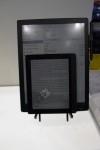
The above picture shows netronix’s 13.3″ prototype with my 8″ InkPad in front so you can see the difference in screen size.

Anyone who follows ereader news for long enough can tell you that Netronix is an old hand in the industry. They’ve been designing and building ereaders for years, and past and current partners include Kobo, B&N, Bookeen, and others.

Netronix was at CES 2015 to show off a couple new prototypes. They had a 13.3″ ereader and a 6.8″ ereader. Aside from the screen sizes, they had largely the same specs. Both ran Android 4.0.4 on a Freescale chip, and they had identical touchscreen tech: an IR touchscreen plus a stylus-friendly digitizer touchscreen. (For reference, the Sony Digital Paper DPT-S1 has a similar dual touchscreen.)

Update: There’s conflicting info on the touchscreens; I was told that there was an IR touchscreen, while Charbax was told that it was a capacitive touchscreen.

Both devices were also missing a silo for the stylus, which I see as a serious defect.

I found the Netronix booth via Charbax, who shot this video:

As you can see in the video, Charbax focuses on just the larger of the two devices. That’s okay; I got to play with them both.

The 13.3″ device has the same screen resolution as on the DPT-S1 (1,600 x 1,200). I’m told it is very much a prototype, and that it was assembled only last week. At 300 grams, it was surprisingly light.

Because Charbax focused on the larger unit in the video, I didn’t take very many photos.

The 6.8″ unit was also surprisingly light. As you can see in the photos at the end of the post, the smaller model bears a striking resemblance to the Kobo Aura H2O, only without the waterproofing and with a second touchscreen tech, Android 4.0.4, Google Play, and the stock apps (all of the apps were unfortunately inaccessible).

The accessible software included just a couple sketchpad apps, the reading app, and the settings menu. It was pretty basic. I thought the devices were a lot of fun to play with. I liked having two touchscreen options, although I am still bothered by the lack of a silo.

And BTW, I actually have quite a few photos of the settings menus; I’m not going to upload them right away (my mobile data plan isn’t very fast). Remind me later and I’ll get to it.

Hands On With the Hemingwrite

The Hemingwrite retro word processor is one of the more unusual gadgets to launch this year, and today at CES I finally had a chance to put my hands on it.

I spent some time today with Hemingwrite co-founder Patrick Paul, and he let me play around with one of the prototypes. It was a fun device, and even though the software was obviously in a state of flux and the prototype used components which may not make it into the final product, I could see that a lot of thought went into it.

The Hemingwrite is actually designed to be a far simpler device than I had been expecting. While I call it a word processor and it is running software which is similar to what you might find on one of those outdated devices, the Hemingwrite is actually intended to be closer to an even more outdated device: a typewriter.

The Hemingwrite is running complex software, yes, but the software is being designed to limit the operations. For example, the three "folders" indicated by the switch on the left side would better be described as "stacks". There’s no actual folder structure nor can you view the file names; instead you get to tab through each of the open files in one of the folders, just like you would flip through a stack of paper notes.

The other software features show a similar design intent to intent to limit what you can do with the Hemingwrite. For example, there’s no way to move back and make a correction short of using the backspace key to delete everything (and they’re not planning to add one). I was told that the idea was that the Hemingwrite is intended for _writing_, and not editing, and so the user was limited to going forward rather than going back.

I could write more about the software features, but since the software is described as being incomplete I won’t go into further detail here.

Edit: But I should probably note that one or more of the upper KS tiers do entitle you to an SDK. You can write your own software for the Hemingwrite.

Physically, the Hemingwrite is as blocky as it looks. The prototype  I used had a shell made from milled aluminum, so it was considerably heavier than the production units will be, but since I didn’t have an opportunity to vamoose with the prototype that doesn’t really matter.

It is a very simple design with a switch on the left of the 6″ E-ink screen (folders), a switch on the right (Wifi), a power button, and the keyboard. This last was sourced from another device (the spacebar was scratch built, which is why it looks different), and was still labeled for functions not supported by the Hemingwrite.  In addition to the number row and the qwerty keys, there are several keys which might end up being mapped to various functions, but aside from the one print/send function key that is still up in the air.

In use, the keyboard was as nice as you would expect from a mechanical keyboard (although small). I usually type on a full-sized USB keyboard which feels mushy in comparison to the Hemingwrite, although mine might be healthier for long term use.

I noticed while typing that the design of the Hemingwrite is likely going to cause wrist problems. Due to the thickness of the Hemingwrite’s base, the keyboard is position in such a way that my hands were angled upwards while I was typing. That is a position you’re supposed to avoid because it puts stress on your wrist and could lead to carpal tunnel syndrome.

I would expect that Hemingwrite owners will want to buy a wrist pad to place in front of their unit, if they don’t already have one for their computer’s keyboard.

All in all this was a fun toy, but I’m not sure that the problem it is trying to solve justifies the $500 price tag.

If you think it does, you can pre-order one on Kickstarter for $400.  It is expected to ship in September, although I would bet for one reason or another (FCC, manufacturing delays, redesigns) it won’t ship until next March at the earliest.

P.S. I’m betting that the Hemingwrite will be redesigned to include a protective shell for the keyboard and screen.  As I sit here thinking about it, I don’t think anyone is going to want to carry it around loose like it is. That’s not how we carry laptops today, and it’s not how portable typewriters were carried (they had cases) for the simple reason that these devices are easy to damage.

Is Waterstones Getting Ready to Walk Away From Amazon?

Everyone was shocked when Waterstones partnered with Amazon in 2012 to sell the Kindle, but I don’t think we should be surprised if that relationship ends.

The Telegraph published an article yesterday which cites Waterstones director James Daunt as saying Kindle sales had disappeared. While that article is meaningless in and of itself, as I sit here reading it this morning I wonder if there’s a subtext to the quote.

snippet:

Waterstones has admitted that sales of Amazon’s Kindle e-book reader had "disappeared" after seeing higher demand for physical books.

The UK’s largest book retailing chain, which teamed up with Amazon in 2012 to sell the Kindle in its stores, saw sales of physical books rise 5pc in December, at the expense of the popular e-reader.

Kindle sales had “disappeared to all intents and purposes”, Waterstones said.

James Daunt, chief executive, told the Financial Times that the resurgence in popularity of hardback and paperback books was due to Waterstones refurbishing some of its 290 shops.

Given that people give books as gifts, and that people  give gifts in December, it’s not a surprise that book sales were up 5%. But to suggest that the increase in sales of books caused the decline in in sales of the Kindle is simply ridiculous.

One could just as sensibly claim that an increase in sales of cereal caused a decline in sales of milk, or that an increase in sales of gasoline caused a decrease in the sales of electric vehicles. To put it simply, the products are not competitors in the same market.

One has to wonder why The Telegraph tried to make the connection, but more importantly we need to ask why Daunt gave the quote in the first place.

To be completely fair, he might not have intended to imply a connection. In fact, he may have innocently answered two unrelated questions, only to see his words twisted into making a claim he did not intend. (Honestly, I think this is the most likely possibility.)

But if he was cited accurately then we need to ask why.  His motive could be as simple as getting press attention for Waterstones with a juicy story, but he might also be creating a context for Waterstones to end its partnership with Amazon.

Waterstones announced its partnership with Amazon in May 2012, and if they have a three year contract then it could be coming up for renewal some time this summer.

The quote in yesterday’s article could have been intended to offer a context for Waterstones ending the relationship with Amazon.  After all, if Kindle sales have "disappeared" then why would Waterstones continue to carry them?

They wouldn’t.

I know what you’re thinking; yes, I could be reading too much into this article, but that doesn’t mean my speculation is over the top. I’m not sure I’m right, but if I turn out to be correct then I won’t be terribly surprised.

Should Waterstones break ties with Amazon, it will likely continue to sell Epub ebooks from its own bookstore (which is supported by OverDrive). The retailer might also sign with the Tolino consortium and sell Epub ebooks as well as the Tolino Shine ereader (also, tablets). Depending on the finances, that last option could be a sensible move.

It was a widely known secret in 2012 that Waterstones was going to sign with B&N to sell the Nook. That never happened (possibly because Amazon offered Waterstones a better deal), but if Waterstones wanted to make a deal in 2015 similar to the one hinted at in 2012 then I believe they would likely sign with Tolino.

What do you think?

image by HHA124L

E-ink Demos a 13.3″ Second Screen E-ink Monitor at CES 2015 (video)

E-ink’s fancy looking wall hanging got a lot of press this morning due to their press release but that’s not the most interesting gadget in their booth.

In addition to the Yotaphone 2, a new messaging platform, and that aforementioned wall hanging, E-ink also had a prototype 13.3″ USB monitor on display. It’s called the PaperLike (I think).

In case you were wondering , yes, the stripe down the center of the E-ink screen is a defect.

The monitor was on loan from DaSung, one of E-ink’s Chinese partners. It was launched late last month in China but only came to my attention today. It uses a 13.3″ Fina E-ink display (screen resolution 1,600 x 1,200) to mirror what you see on the paired laptop.

It’s powered by the USB connection to the laptop, and is surprisingly fast. As you can see in the video below, the monitor has several display modes. In addition to the standard 4-bit 16 level grayscale mode found on your ereader, there is also a mode with only 5 shades of gray as well as a mode with 2 (black and white, basically). The faster modes sacrifice detail for speed, resulting in a refresh rate which is almost as fast as an LCD monitor.

I was told by E-ink that it is still under consideration, but according to what I read on Chinese language sites, the monitor is available now with a retail price of 4,999 yuan, or about $804.

Allow me to take a moment and express what we are all feeling: Damn.

I don’t know about you but if this were offered for $400 I would have ordered one already. But at this price I’m going to have to lean on E-ink to get DaSung to lend me one.

Well, at least it looks pretty.


Txtr Beagle Gets Second Lease on Life – Launched in Japan as the Honto Pocket

Here’s a story I’m only catching about a month late.

ITMedia reported close to a month ago that Dai Nippon Publishing, one of Japan’s larger publishers, has officially launched the Honto Pocket. This 5″ device has been showing up at Japanese trade shows on and off since July 2013, and it has finally arrived.

The Honto Pocket sports a 5″ E-ink display, Bluetooth, and runs on a pair of AA batteries. If that sounds an awful lot like the txtr beagle, it should; numerous sources say that this device is based on that design, and the earliest demo units used the same hardware as the beagle. And like that older device, the Honto Pocket lacks a touchscreen or frontlight.

Curiously, the Honto Pocket retail unit has a slightly different shell than the beagle, and possibly different electronics (we won’t know until someone cracks it open.)

The beagle has never had much luck in Europe, possibly due to txtr’s decision to market it as a smartphone accessory and get it bundled with new contracts, but it might be more successful in Japan.

Dai Nippon plans to sell this not as an accessory but as a bundled ereader.  Consumers will be able to buy a Honto Pocket with the complete works of Agatha Christie, the complete Guin saga, Christie’s Hercules Poirot books, or other bundles. I can also see a mention from July that the Honto Pocket would be offered with bundles including first-aid info, but I do not know that that unit is available.

Prices range from 9,800 yen to 74,800 yen (about $81 to $620) (for Christie’s collected works). Buyers will also be able to buy ebooks in a related ebookstore and sideload content from their PC, and DNP is supposed to have released a smartphone app which would enable users to transfer ebooks from their smartphone (I’m not sure if it is out yet).

As much as I would like to be more optimistic about the Honto Pocket, I don’t expect it to sell very many units. The basic Kindle can be had in Japan for 6,980 yen, or $58. It has a touchscreen and Wifi, and I think that makes it the better choice all around.

Of course, it is also a lot bulkier than the Honto Pocket, but you can’t have everything.


Infographic: Just How Powerful is that eReading Device in Your Pocket?

Between our smartphones, tablets, and ereaders, many of us carry one or more mobile device around without realizing just how powerful it is.

Sure we may joke about how a graphing calculator has more processing power than the entire world had in 1950, but it turns out that the quip is even more true than I had realized.

The following infographic breaks down how the devices we have today compare with supercomputers of the past.

For example, the iPad 2 would be one of the 5 most powerful computers in the world if it fell through a wormhole to 1994. (Of course, that would only be true if measured in terms of sheer numbers, not actual computing ability, which raises a whole different issue of general-purpose vs restricted computing.) And that tablet isn’t even all that impressive by the standards of 2015; there are plenty of $100 tablets that are more powerful.

via Lone Wolf Librarian