Kindle Unlimited is Cutting into Authors' Sales, and Other Market Scrying

I was the first to break the story last week that KU might be having a negative impact on indie authors' ebook sales, and as I have been reading the ensuing coverage I have realized that someone needs to point out the problems with relying on anecdotal data.

And as I sit here reading Porter Anderson’s piece in The Bookseller on Sunday, I can see that even Porter missed a valid counterpoint: that this type of decline has happened before (he also missed including me in his roundup of the discussion, but I am used to that by now). That leaves it up to me to question the narrative.

Last week I shared the tales of several indie authors who had seen a sharp dip in ebook sales in the months since Kindle Unlimited had launched. To make this even scarier, this included authors who both did and did not have ebooks in Kindle Unlimited.

There’s a scary trend if true, but as with any report based on anecdotal evidence there’s always the risk that your examples are the exception and not the rule. To be fair, sometimes the outliers are also the bellwethers, but given the history of the ebook market I wouldn’t be so sure in this case.

One other reason to doubt this trend, and this is a good one, is the behavior of the market last year.

It was around this time last December that I reported that some indie authors were seeing a big drop in sales during fall 2013. I cited Toby Neal (who had corroborating reports from other authors) as saying:

The DOJ price-fixing case with Apple and the Big 5 publishers was settled awhile ago, but September was when Amazon began really discounting big name books. I get several email lists of discounted books daily in my inbox, and I’ve been agog to see big names like Janet Evanovich, Louise Perry, Michael Connelly, Patricia Cornwell and most recently, Donna Tartt’s Goldfinch, one of the Best Books of 2013, going for 2.99 or less.

…

And in September, my sales went to half of what they’d been. They’ve stayed at half what they’d been in spite of doing active marketing, ads on Kirkus Reviews, giveaways, promos in those same lists I get in my email inbox, and launching two new books.

When I reported on indie authors' drop in sales last year I attributed the decline to greater price competition from the major publishers, a plausible idea. This year we are looking at anecdotal evidence of a similar decline and attributing it to the effect of Kindle Unlimited.

While it is entirely possible that we did identify the respective causes, it is just as likely that we fell for the post hoc logical fallacy. Given that we are looking at what could be a cyclical market trend, I think we need to consider the possibility that both declines have the same cause.

And in case you’re wondering why I didn’t raise this point last week, it’s because I didn’t think of it until a couple hours after I published that post.

I don’t know what would cause the declines, but I do think that it’s worth our time to ponder it and be ready just in case it happens again next year.

Why do you think the sales have declined?

Hachette’s Partnership with Gumroad to Sell Print Books Won’t Amount to Much

While the major publishers are often derided as being so far out of date their new ideas could collect social security, Hachette has shown today that they are only 2 or 3 years behind the times – tops.

Hachette Book Group announced a new partnership this morning with the indie digital marketplace Gumroad to sell print books on Twitter. In what would best be described as a small experiment, Hachette and Gumroad will sell three print books "for a limited time and in limited quantities" via each author’s tweets.

The three books are Chris Hadfield’s You Are Here, Amanda Palmer’s The Art of Asking, and The Onion’s The Onion Magazine: The Iconic Covers that Transformed an Undeserving World. Palmer’s book will go live later this week, and the other two titles will follow days later. Each of the 3 books will be bundled with a bonus item. In the case of astronaut Hadfield’s book, for example, the extar will be a signed original photo, and The Onion's book will be  accompanied by a set of note cards featuring twelve of the editors' favorite magazine covers.

Given Gumroad’s focus as a digital marketplace, they make a strange partner for selling print books, but Gumroad’s integration with Twitter’s new “Buy Now” button makes them a good candidate for this program.

Now if only it had happened several years ago, back before Gumroad was an established bit player in the indie scene.

If Hachette had tried this pilot in 2011 it would have been a novel experiment with a still untested idea.  (Yes, people were selling ebooks via Twitter in 2011 – just with links that led to ebookstores.)

But in 2014, selling via Gumroad isn’t a novel concept any more. It’s common to the point of being passe, and some creators have even moved on from to other means for direct sales.

Lots of authors sell via Gumroad, but some have been tripped up by Gumroad’s limitations and stopped using it for direct sales. As Elizabeth Beeton of B10 Mediaworx pointed out in a blog post earlier this year, Gumroad has its quirks.

In addition to being an author and publisher, Beeton also sets up stores for other authors, and over time she kept getting tripped up by the same pair of problems:

1. The merchant is listed as GUMROAD on the customer’s credit card statement. No one who bought from B10 Mediaworx complained, but plenty of my client’s customers complained. As a result, there were quite a few sale disputes.

2. There is no “add to cart” for digital products. No one who bought from B10 Mediaworx complained, but plenty of my client’s customers complained. They had to check out each time they bought a title. Can you imagine if you need all ten?

In short, Beeton has shown us that Gumroad is not a good option for ebook or book retail – not unless you want to sell one book at a time to one person at a time.  And while that won’t be an issue with this pilot, if Hachette decides to step up their direct retail efforts they will have to go elsewhere.

In conclusion, while it might sound snarky or sarcastic to say that Hachette is years behind the times, in this case that is an accurate description.

Review: Framed struggles to add a graphic dimension to Interactive Fiction

Framed got a lot of buzz for its novel game mechanics when it was first shown off in May 2013, but now that the game is finally available it simply doesn’t live up to its potential.

Developed by Australia-based Loveshack Entertainment, Framed offered a new take on interactive fiction that made the user the storyteller.

As you can see in the following early concept video, a user rearranges the panels on the screen to change the outcome.  By changing the order of events, the user can have the protagonist find a tool, overcome his adversary, and escape:

When it comes to gameplay mechanics (the motions involved in playing a game), moving panels around like that is a novel concept. I do not know of anything quite like it, which I have been eagerly anticipating Framed ever since I first read about it. So when I learned last night that Framed had been released for the iPad a couple weeks ago, I immediately bought it and played with it.

Frame had the same panel swapping move as in the concept video, and some levels also let the player rotate a panel 90 degrees and change the path the protagonist takes (but that doesn’t happen until much later in the game). There are also a couple levels which involve one protagonist tricking another, but again, that doesn’t happen until much later in the game.

After spending about half an hour with Framed, I’m pretty sure I wasted $5. While Framed is based on a clever dynamic, the actual game is repetitive to the point that I am bored.

Rather than have the user solve puzzles with different goals and different solutions, the vast majority of the levels I played all had the same goal: avoid the cops. Other than setting things up so the protagonist can either bypass cops or sneak up behind cops and hit them over the head, there’s not much to this game.

The official trailer sums up the repetitive nature of Framed nicely:

While there are a few levels here and there that are based around unique puzzles, most involve escaping the cops.

To be fair to the developers, writing a puzzle is very difficult, and that is doubly true when one also has to develop a new platform for the puzzle.  But writing puzzles is also not impossible, and Loveshack has been working on Framed for close to two years now. That is plenty of time to come up with more puzzle ideas than "avoid the cops".

Don’t get me wrong, that is not a bad idea for a level design – so long as it is used as one of many puzzles to solve. But after it’s been used twenty or thirty times in a row (and is backed up by an annoyingly repetitive sound track) the idea gets old.

And that is a shame, because I would really have liked to have seen the puzzle idea explored to a greater degree. A true puzzle game based on Framed’s concept would provide hours of entertainment and offer a great value for the $5 price tag.

But as it is, I would not recommend that you get Framed.

You can find it in iTunes for $5.

Hachette had an eBookstore which could go head-to-head with Amazon, but they won’t launch it

As the year draws to a close many are looking back at 2014 and reflecting on the year’s events. Today I would like to take a look at an event which would have been a huge news story if it had ever happened.

As you may recall, for much of 2014 Hachette and Amazon were in a nasty contract negotiation here in the US. As we all know from following the news, Hachette fought a vicious media campaign against Amazon as a way of pressuring Amazon to give in, but what no one else knew was that Hachette had a second string to their bow.

Just so you know: I have very little evidence to back up the following post. I trust my sources, and I do have a little evidence, but you should take this report with a grain of salt.

Update: Hachette has confirmed my report, telling Publishers Lunch that:

Asked about the report, HBG spokesperson Sophie Cottrell told us, "We’re always doing internal experiments and many never see the light of day. The ebooksforall site was one of those experiments, and we shelved it months ago, in its early stages, to work on other projects."

Earlier this year Hachette secretly started developing an ebookstore called www.eBooksForAll.com. That store never launched, but my sources tell me that it would have sold Hachette titles in both Epub and Kindle formats.

Yes, Kindle. Hachette’s new ebookstore was going to use digital watermark DRM on the ebooks it sold.

Unlike encryption DRM like Adobe’s, digital watermarks are little more than tags which can be used to identify who bought an ebook and where. They are almost invisible to the end user, and that means that an eBooks For All customer could buy an ebook and sideload it on their Kindle.

In short, Hachette nearly launched a site which could have directly competed with the Kindle Store. I can’t tell you why it was not launched, but I do have some more background details.

The site was developed by an Australia-based ebook company called eBooks.com, which would operate the site on behalf of Hachette. The watermark DRM would have been supplied by Booxtream, which also provides a similar service to Pottermore and other ebook retailers.

eBooks For All was supposed to go live in the summer, and then in the early fall, but now that December has rolled around I figure the idea is probably dead, and thus it is safe to tell everyone about what would have been the biggest digital publishing story of the year.

***

At this point you’re probably thinking that this is a great story, but you also want to see some proof. Unfortunately, I don’t have much to show. Hachette hasn’t confirmed any of the details, and in fact they haven’t even acknowledged my existence.

But I do have a couple details to share. For example, there is the @eBooksForAll twitter handle, which appears to currently belong to someone called HBG Test. There are no tweets or identifying information on that account, though.

I also have a Whois history report (PDF) for www.eBooksForAll.com which shows that the contact name is Joe Mangan, the COO of Hachette Book Group. That report also shows that the site is hosted on Hachette’s servers and uses Hachette’s nameservers. (At this time the site is just a blank page.)

Hachette apparently acquired the domain in April 2014, not too long after their previous contract with Amazon lapsed. Is it just me, or does that raise some new questions as to why the contract was allowed to expire?

Without a response from Hachette, I can’t answer those questions, so if you have the ear of anyone at Hachette please do us all a favor and ask them about this site.

***

As much as I would love to see this store launch (just to see what happened), I can understand why it did not.

As much as pundits may talk about publishers routing around Amazon and dealing directly with Kindle owners, there is a large group of Kindle owners who can’t be reached either because they either don’t know how to buy ebooks elsewhere and add them to their Kindle account, don’t know the option exists, or simply do not feel the effort is worth it.

This is part of the reason why Baen Books started distributing to the Kindle Store back in 2012 after over a decade of selling only through their own site, and it is also why Pottermore launched its ebookstore with close integration with the major ebook platforms.

On the other hand, there are times where you can only identify an unworkable idea after it is put into practice (this is why startups pivot). I would like to see what would happen if a major publisher followed Pottermore, but it looks like we’re going to have to wait a little longer before that happens.

images by dlofink, cogdogblog

B&N to buy out Microsoft’s interest in Nook Media for $120 million

Barnes & Noble released their quarterly statement today. Mixed in with the usual dry statistics was a bombshell: B&N is buying out Microsoft’s share of Nook Media. After almost two years of co-owning a moneypit, MS is selling off their interest and walking away.

In financial news, B&N reported that total revenues dropped 2.7%, to $1.7 billion, as compared to the same quarter last year.  Second quarter EBITDA also decreased slightly, from $76 million a year ago to $68 million. The press release mentions that retail was down, college bookstore sales were up, and of course Nook revenues were down.

B&N’s nook segment had sales of $64 million for the quarter, down 41% from a year ago. Hardware sales decreased 63% to $18.7 million for the quarter, a new low for Nook Media, Digital content sales totaled $45.2 million for the quarter, a decline of 21.2% from a year ago, largely due to customers fleeing a sinking ship.

And in the important news, Microsoft and B&N have decided to  go their separate ways. They’ve filed divorce papers today with the SEC stating that the two companies have terminated their commercial agreement.

Microsoft paid $300 million for a one sixth interest in Nook Media when it was spun out of B&N in early 2012, and they also committed to paying $300 million in operating expenses should Nook Media hit certain goals (expanding internationally, for example). According to the form 8-K, B&N will buy out MS for $63 million in cash and 2.7 million shares of B&N stock.

B&N is trading for around $20 right now, so the total purchase price will be around $120 million (plus or minus $5 million). In other words, Microsoft’s interest in Nook Media lost about 60% of its value in the time since Nook Media launched.

While that’s bad news for MS, it’s great news for Nook Media. While the company is losing out on a source of revenue, it’s also free from the constraints MS imposed. For example, the international Nook store was effectively confined to Windows 8 (the Nook iOS and Android apps were limited to only US and UK). Now there is a chance that B&N will expand the platform to also let its international customers use the other Nook apps.

Nook Media is still going to be spun out into a separate publicly traded company, but the launch day has been pushed back from spring 2015 to August 2015.

UK Minister proposes 25% Google Tax on corporate income, forgets that UK already collects a VAT

Many people have long been complaining that Amazon and other huge multi-nationals aren’t paying their fair share of taxes. I’ve heard these complaints in in the US, UK, and other countries, and now the UK Chancellor of the Exchequer is proposing a solution to the complaints.

The WSJ reports that George Osborne wants to enact what sounds like a corporate income tax:

The U.K. government Wednesday took aim at tech companies and other international firms, proposing a 25% tax on profits on “economic activity” that is shifted overseas.

Treasury chief George Osborne said in his autumn budget statement to Parliament that he wanted to make sure “big multinational businesses pay their fair share.”

The proposal makes good on Mr. Osborne’s warning in September that he was going to crack down on companies – particularly tech companies – that use complex structures to lower their U.K. tax bills.

“Some of the largest companies in the world, including those in the tech sector, use elaborate structures to avoid paying taxes,” he said. “That’s not fair to other British firms. It’s not fair to British people either. Today we’re putting a stop to it. My message is consistent and clear: low taxes, but low taxes that will be paid.”

When I first read this story, I was terribly confused. You see, I was under the impression that a company’s revenues were already taxed directly.

As I understood it, the UK collects a VAT (value added tax) on (almost) all commercial transactions. This differs from an American sales tax, where few transactions are directly taxed (mainly when you sell to consumers), and that difference means that the VAT is in effect a corporate income tax.

Yes, I know that the popular view is that the tax burden is born by consumers, but if a company’s customers are other companies then there are no consumers involved. And since Google’s main source of revenue is advertising, the idea that they will pass the cost along to consumers simply doesn’t make any sense.

Or did I miss something?

images by Images_of_Money

Author discontent grows as Kindle Unlimited enters its fifth month

When Kindle Unlimited launched in the US 4 months ago there were many questioning whether it was good or bad for authors, and if the chorus of complaints over the past few days are any indication then the answer will be no.

HM Ward kicked off the discussion on Friday when she revealed that she was pulling out of KDP Select, the program Amazon uses to funnel indie ebooks into Kindle Unlimited.

Ward withdrew her books not because the average payment had dropped to only $1.33, but because her total revenues had fallen by 75%:

Ok, some of you already know, but I had my serials in it for 60 days and lost approx 75% of my income. Thats counting borrows and bonuses.  My sales dropped like a stone. The number of borrows was higher than sales. They didn’t compliment each other, as expected.

Taking a huge ass pay cut while I’m still working my butt off, well that’s not ok. And KU effected my whole list, not just KU titles. At the time of enrollment I had about 60 titles total.

I planned on giving it 90 days, but I have a kid in the hospital for long term care and I noticed my spending was going to exceed my income-by a lot. I couldn’t wait and watch thing plummet further. I pulled my books. That was on Nov 1,  & since then my net revenue has gone up. I’m now at 50% of where I was pre-KU. During the time I was in KU, I had 2 new releases. Neither preformed vastly different than before. They actually earned far less (including borrows).

When Kindle Unlimited launched in July, it was hoped that the increase in fees paid for loans would counteract the loss in income from authors not being able to sell their ebooks outside of the Kindle Store.

Sadly, a lot of authors are reporting that that is not the case. This story was picked up over on The Passive Voice, where Mimi Strong concurred with Ward:

I made the “All Stars” list for October. I don’t mean to sound ungrateful, but $1k is not going to make up for lost sales on other platforms. It doesn’t even cover the emotional toll of having to field emails from confused readers who can’t understand why they can’t buy my books.

…

In the end, I go with math and ignore emotions. I’m pulling out of KU. If my sales are better on other platforms, I’ll stay out. If my sales aren’t any better, I’ll go back into KU with gritted teeth and a few choice words. Nobody cares but me. I’ll go with the math.

Two authors complaining does not a trend make, but it is worth watching.

Speaking of watching, while looking into this story I noted what looks like the beginning of a worrisome trend. There are authors whose works weren’t in KU who are reporting that their incomes had dipped since it launched, almost as if readers were spending so much time reading the ebooks in KU that they stopped buying ebooks. With 750,000 titles, KU could be displacing ebook sales.

Juli Monroe, author and editor of Teleread, mentioned a dip a few weeks back, and there are similar reports from KBoards:

I’d like to add my voice to the choir of KU discontent. Before KU launched, I had seven novels, multiple serials and a few shorts through various names, and I was making a living solely writing fiction.

Along comes KU and now… well, I’m not.

My earnings are roughly 60% what they were back before KU launched with four releases since. I tried out KU for a few of my novels, saw a lot of borrows but a massive loss in earnings, so took them out again.

Now, earnings aren’t what they were, but they’re holding steady again. I have the great people at Kobo to thank for consistently spotlighting some of my books, meaning two months of bigger Kobo sales than Zon right now.

And there’s a similar report in the comment section at The Passive Voice:

KU definitely affected the visibility of my books, and as a result, my sales and revenues. When KU launched, my books not in KDPS/KU all dropped in rank crazy-fast. Luckily, I was running two upcoming Bookbubs and sales on other channels made up for the decline in Amazon revenue. However, once the Bookbubs declined in influence, my sales on the other channels declined as well so that I ended up being behind the 8-ball in terms of sales and revenue.

So I took the plunge and went all-in to KDPS again. Lends almost made up the difference and KU honestly revived my older lower selling series. However, I am still down overall from pre-KU levels. As soon as my KDPS terms are up, I’m back out, baby. I may keep my older series and my 99c shorter works in KDPS for the exposure and because even $1.33 is better than $0.3465, but I’m taking my longer better-selling and higher priced books out.

Again, two anecdotes don’t make a trend, but I am trying to keep this post to a reasonable length while also sharing a potentially important news story.

Even at 4 months old Kindle Unlimited is still too new for us to fully understand the effect it is having, and that includes the impact it may be having on authors who aren’t even in KU.

I plan to wait for more info on the effect of ebook subscription services, including Oyster and Scribd, before reaching any conclusions. Those other services offer publishers terms similar to ebook retail contracts, rather than paying them from a pool of money (like Amazon does with authors in KU).

I’m interested in finding out if the larger publishers are also seeing a drop in revenue elsewhere as readers spend more of their time reading books in one of the ebook subscription services.

Do you think that is what the publishers are seeing?

image by phooky

Kobo to carry audiobooks?

Along with Google, Kobo is one of only two major ebook retailers which doesn’t also sell audiobooks, but that might be about to change.

An observant bibliophile discovered earlier today that Kobo was then listing audiobook titles from HarperAudio in its ebookstore. The listings were incomplete and nonfunctional, but it was pretty clear that they referred to audiobooks:

A brief spin through Google turned up a couple hundred similar listings from HarperAudio. They have all since been taken down, but the ones in the Google cache looked like this:

When I queried Kobo on this topic, they neither confirmed or denied the implications of the listings. Instead, Rene said that "This seems to be an error in the metadata provided in this case." That is a curious answer, so I double checked the ISBNs. They match up with the respective HC audiobook titles.

Kobo isn’t currently selling audiobooks, and they haven’t announced plans along those lines, so it’s not clear what the new listings mean. They could have been a technical error, but they could also have inadvertently leaked Kobo’s future plans.

Remember, I broke the news on Kindle Unlimited after members of KBoards noticed that several pages for that section had been posted on the Amazon website. That could well be what is happening here.

Kobo could be quietly signing publishers with the goal of launching an audiobook section, or they might be taking the same path as B&N, which slapped the Nook brand on an audiobook platform developed by Findaway World earlier this month. Findaway offers a catalog of 50,000 titles. That’s far smaller than the 150,000 carried in Audible but it could still be enough to attract customers.

On the other hand, this could just be a technical error. We’ll just have to wait and see.

I for one hope that it is true because Amazon could really use the competition in this market. More retailers means more competition means lower prices, and that’s good for consumers.

If Kobo does get into audiobooks, they will be competing with Audible, iTunes, Nook, Downpour.com, Audiobooks.com, and Random House Audio, which distributes titles and also sells direct. Amazon’s Audible is believed to dominate the market.

MobileRead

Comparison Review: Pocketbook InkPad vs Bookeen Cybook Ocean

The Pocketbook InkPad and the Bookeen Cybook Ocean are the only two 8″ ereaders on the market at the moment, but in spite of having the same size screen they could not be more different.

My Ocean arrived on Friday, and I’ve had it for a few days now. At first I felt an initial distaste for the hardware design, but once I got past that I noticed that the Ocean was slightly faster and did a better job at displaying an Epub. But in spite of being weaker in the software dept, the InkPad is more pleasant to hold and read on.

Table of Contents
[—ATOC—] [—TAG:h2—]

Hardware

As I explained in my review, the InkPad has a brown shell with rounded edges and a lopsided design which enables one-handed reading. It has a black rubber pad to the right of the screen and a corresponding pad on the back which makes it easier for me to grip the InkPad.

The Ocean, on the other hand, is all sharp edges with an angled rear shell and page turn buttons placed below the screen on either side of the menu button. And when I say sharp edges; I am not exaggerating; trying to hold the Ocean by the edges is unpleasant.

Both ereaders have a microSD card slot, and they both ship with 4GB of storage. But the InkPad also has a headphone jack which supports an mp3 player and TTS.

When it comes to the screens, the InkPad has a higher resolution screen than the Ocean. The InkPad has a Pearl E-ink display with screen resolution of 1,600 x 1,200, while the Ocean has a "knockoff" epaper display from E-ink’s Chinese competitor, Guangzhou OED Technologies. This screen has a resolution of 1,024 x 768, or about the same number of pixels as you would find on the Kindle Paperwhite.

Both devices have a frontlight and touchscreen. I haven’t found a reason to comment on the touchscreens yet (they’re fine), but I have observed that the frontlight on the InkPad has both a lower minimum setting and a brighter maximum setting (both frontlights can be turned off, of course).

When the frontlight is dialed up near the brightest setting, the screen on the Ocean looks decidedly grayer than the screen on the InkPad. The same is true for when the frontlights are turned off; the InkPad has the whiter screen.

Software

The InkPad and the Ocean each run a proprietary OS developed by their respective makers. The devices each have their quirks, and they offer very different software features.

The InkPad supports apps which add a number of functions, including a web browser, calculator, games, and Dropbox (more details here). The InkPad also supports a broader range of formats than the Ocean, including Mobi, DjvU, and DOC (more details here).

I would like to say some nice things about the Ocean, but in reality all it has going for it are the faster page turn and the formatting options for Epub files. The Ocean offers more formatting options, including ragged right and an option to bold all text, than can be found on the InkPad. On the other hand the InkPad does handle PDFs better. It’s not just the higher resolution screen; the InkPad offers more options, including margin cropping and more zoom options (more details here).

The InkPad also shipped with several text to speech voices and with more dictionaries (the Ocean doesn’t even have an English language dictionary). While both devices have a search function and annotation features, they’re a lot easier to use on the InkPad. Adding a note to an ebook on the InkPad is only one click away, not three. Also, the InkPad offers a separate TOC-like journal for keeping your annotations (highlights, notes, and bookmarks) organized.

Conclusion

As much as I would like to say that each device has its strengths, I can’t. The Ocean is in almost every way inferior to the InkPad. Just about the only point in the Ocean’s favor is the Epub formatting, and that you can buy an Ocean right now from Bookeen. The InkPad is back-ordered.

If I were looking to get one or the other, I would wait to get the Inkpad.

Cybook Ocean Specs

  • CPU: 1GHz
  • RAM: 128MB
  • Display: 8″ epaper display
  • Screen resolution: 1024 x 768 (160 ppi)
  • Touchscreen, frontlight
  • Storage: 4GB internal, microSD card slot
  • Wifi
  • Battery: 2.1Ah, one month runtime
  • Dimensions: 150 X 196 X 7 mm
  • Weight: 300 grams
  • eBook Formats: ePub, PDF, HTML, Txt, FB2, DJVU

InkPad Specs

  • CPU: 1GHz
  • RAM: 512MB
  • Screen: 8″earl E-ink display,
  • Screen resolution: 1,600 x 1,200
  • Frontlight, Touchscreen
  • Storage: 4GB internal, microSD card slot
  • Connectivity: Wifi
  • Battery: 2.5Ah, one month runtime
  • Audio: headphone jack (TTS, MP3 supported)
  • eBook Format Support (more details here): Epub, PDF, FB2, DJVu, Mobi, PRC, CHM
  • Office and Other File Format Support: Doc, Docx, RTF, txt, HTML
  • Weight: 350 grams
  • Dimensions: 195.5 x 162.8 x 7.3 mm

Where Yahoo went wrong when they decided to sell prints of CC-Licensed Flickr images

WSJ reported last week that Yahoo’s latest move to increase its revenues was pissing off Flickr users:

More than 300 million publicly shared Flickr images use Creative Commons licenses, making it the largest content partner. Yahoo last week said it would begin selling prints of 50 million Creative Commons-licensed images as well as an unspecified number of other photos handpicked from Flickr.

For the handpicked photos, the company will give 51% of sales to their creators. For the Creative Commons images, Yahoo will keep all of the revenue.

Just to be clear, Yahoo is only selling prints of works licensed under the CC clause which allows for commercial use, so they what they are doing is completely legal. But that doesn’t mean it isn’t ruffling feathers.

For some time now I’ve believed that the Creative Commons license needed more variations of the commercial use clause, and now it would appear that some creators feel the same way.  The WSJ found several creators (six out of 14 contacted) who apparently wouldn’t mind my using their images in a blog post, but are not happy that Yahoo is going to sell prints.

That includes Nelson Lourenço, a photographer based in Lisbon, who told the ESJ that "When I accepted the Creative Commons license, I understood that my images could be used for things like showing up in articles or other works where they could be showed to public". He’s not so happy about Yahoo selling prints, adding that "selling my work and getting the full money out of it came as a surprise".

And he’s not the only one who is viewing this move askance. Flickr co-founder Stewart Butterfield said that the move was "a little shortsighted". He added, "It’s hard to imagine the revenue from selling the prints will cover the cost of lost goodwill."

He’s not wrong in calling this move shortsighted; by annoying users Yahoo is poisoning the well. At least some of those users will stop uploading photos which Yahoo can use, and even if they continue to use Flickr those users might simply switch to a non-commercial CC license. That would stick Flickr with all of the cost of hosting the images with no chance to generate revenue, something I would describe as the worst possible outcome (for Yahoo, at least).

I think this move was particularly boneheaded not just because of the loss of goodwill but also because I can see how it would not have been hard for Yahoo to turn this to their advantage. How?

By paying a royalty on each print sold. While Yahoo is going to pay a select group of photographers, most are going to be left out in the cold.

That royalty is not required under US law but it would still be a good idea.  It would mollify most of Yahoo’s critics, and what’s more it could potentially have been used to turn all those creators into salespersons. They could direct requests for prints to Yahoo, generating more revenues all around.

It’s a shame Yahoo didn’t think of that before stepping in this mess.

This isn’t the first time that Yahoo has tried to generate revenue from Flickr since acquiring it in 2005. The photo hosting service offers a Pro service level, and in researching this post I found hints that Flickr was somehow using the uploaded photos commercially as far back as 2007 (I can’t find any specifics on that, though).

image by Dave Ward Photography

Review: Pocketbook InkPad 840

Pocketbook’s new 8″ ereader has been delayed so often that it is a solid runner up for that title, but it has proven to be worth it.

I’ve had my InkPad for a couple weeks now, and it has proven to be far better device than the early reports from Russia led me to expect. The price tag and limited supply will likely keep it out of the hands of most readers, which is a shame.

The InkPad will never be a blockbuster but it does have its strengths.

Table of Contents
[—ATOC—] [—TAG:h2—]

Review Date: 29 November 2014

I bought my review unit from Pocketbook France in early September 2014. They  never actually got around to shipping it, and then stopped responding to my emails, forcing me to complain to Pocketbook corporate in order to get the parent company to ship my order.

Update

This review is based on a Pocketbook InkPad running the v5.4 firmware. About a month after posting the review I got the chance to downgrade my InkPad to the v4.x firmware. This fixed the problem with the Epub bug, and it added more formatting options (as well as another Epub bug). I am happier now than I was with the original firmware, but in either case I like the InkPad and  continue to use it as my main ebook reader.

Pro & Con

Pro

  • Screen & build quality
  • PDF support
  • Reading experience

Con

  • Epub support
  • Price
  • Availability & customer service

Hardware

The InkPad runs Pocketbook’s proprietary OS on a 1GHz CPU with 512MB RAM. It has 4GB internal storage, a microSD card slot, Wifi, and a headphone jack. It sports an 8″ Pearl E-ink screen with frontlight and touchscreen. The screen resolution is 1,600 x 1,200.

Based on the design of the Color Lux, the 8″ color E-ink ereader which Pocketbook released last year, the InkPad has an unbalanced design which makes it ideal for one handed use.  It has a brown plastic shell with page turn buttons to the right of the screen. There’s also a strip of rubber above and below the buttons to help you grip the InkPad, and a corresponding rubber pad on the back.

The only obvious detail on the front of the InkPad are the page turn buttons and that strip, but if you look closely you’ll find a sensor strip above the screen. That is the control for the frontlight, and it is one of the nicer features.  It takes 6 or 7 swipes to go from off to maximum brightness, offering finely grained control of the screen brightness.

You’ll find the headphone jack on the bottom right edge, and under a cap on the upper right edge are the microUSB port and the microSD card slot. The power button is next to that cap.

Of the five larger ereaders in my office at the moment*, the InkPad is easily the nicest to hold and use. Given its size you wouldn’t think this would be a one-handed ereader, but thanks to the lop-sided design it is the only one of the larger ereaders which I feel can be used that way (and since the text – but not the menus-  can be reversed, the InkPad is equally good for righties and lefties).

* (Kobo Aura HD, Bookeen Ocean, Onyx Boox T68 Lynx, Kindle DX, and the InkPad)

Screen & Frontlight

With an 8″ Pearl E-ink screen, the InkPad clearly won’t have as good of a screen as the latest premium ereaders, but the screen was still far better than I expected. In many ways the screen on my InkPad is nicer than the one on my T68 Lynx or my Paperwhite (2013).

In comparison to the KPW, the Inkpad’s frontlight much whiter and brighter.  When the frontlights are off, the InkPad’s screen is slightly grayer, but whether the light is on or off the KPW still has a noticeable brown tint. And whether the frontlight is on or off, the text on the Paperwhite’s screen is sharper and blacker; if I didn’t know better I would think the KPW had the sharper screen.

In comparison to the T 68 Lynx, the Inkpad’s frontlight is again whiter and brighter. It makes the T68 Lynx’s frontlight look fuzzy in comparison, and when the frontlight is off the InkPad’s screen is still slightly whiter than the the screen on the T68 Lynx.

Software

This section will be abbreviated because  I’ve already covered the apps and ebook format support in some detail. (On a related note, I’ve recently updated the post on ebook formats with a new opinion on the usefulness of the limited support for Mobi and other formats.)

The InkPad runs Pocketbook’s software, which I found satisfactory – so long as I didn’t have to interact with it much.

While the home screen was good at getting me into whichever book I had open, the library screen was only good at wasting screen real estate. Rather than show a neat and orderly grid of icons for the ebooks on my InkPad, it insisted on showing the ebooks shelved in alphabetical order. If there was only a single ebook who’s title or author began with a given character, it would be shelved by itself – thus wasting the screen to the right

The only to get that neat and orderly grid was to sort the library chronologically – by the day an ebook was added to the InkPad or last opened. Neither suits me.

Reading Experience

The InkPad supports a number of different ebook formats, including Epub and PDF as well as office doc formats. I’ve already covered how well the various file formats are supported (here), so in this section I’ll just focus on Epub and PDF.

Text PDF support is great, although I don’t read much in the way of text PDFs so that doesn’t matter much to me. I would like to use the InkPad for graphic novels, but each page was abysmally slow to load.

Epub wasn’t so well supported. The InkPad forced full justification, which was annoying, but I actually didn’t mind so much.  But the other bugs, including the tendency to freeze, the general inability to go a page back in the text, and the slow page turns, did detract from the reading experience.

But in spite of the problems I still liked reading on the InkPad. Given the issue with bugs, you’d think I would be as frustrated with it. Strangely, I’m not. Even though the InkPad was noticeably slower to turn a page than the Paperwhite, I didn’t mind to much.

Curiously, over the past 3 or 4 days before publishing this review I have been reading ebooks in Mobi format. In spite of the incomplete support for that format I am enjoying reading on the InkPad.

Comparison Reviews

(more to come)

Video

I’m not one to shoot videos (I don’t like watching them much, either) but I have found several worth watching.

Verdict

In spite of the hassles in buying an InkPad, I love this baby. It’s a lot bigger than I am used, but I like reading on it.

It’s solidly built with a decent quality frontlight and screen. It works great with text PDFs, and while it’s not so great with Epub I am still enjoying it. With its 8″ screen, the InkPad would best be described as the equivalent of reading from a hardback (in comparison to 6″ ereaders, which are like reading from a paperback.)

But it’s also hard to get, and with a $240 price tag it is very expensive. And as much as I like it, I’m not sure it justifies the price tag.

It’s good, yes, but is it $240 good?

That would really depend on  what you need it to do, and it would depend on what you compare the InkPad to. There are some really good but smaller ereaders on the market, but not much that is as big or bigger than the InkPad which compares well.

The InkPad can’t quite match the screen sharpness or the ebook format support of the Onyx Boox T68 Lynx (6.8″ screen, Android 4.0). It doesn’t have the super-high resolution screen of the Kindle Voyage, or the waterproof and high-quality screen of the Kobo Aura H2O (6.8″ Carta E-ink screen).

On the other end, the InkPad offers a sharper screen and a lower price than the Kindle DX or the Onyx Universe, and there isn’t that much else in the 8″ and above range.

The InkPad is good at PDFs, and one thing I do like about the InkPad is the page turn buttons. They’re rather anemic, but the InkPad does have more functional page turn buttons than any of the 3 ereaders mentioned above.

That makes one handed reading a lot easier, and when combined with the 8″ screen the InkPad offers the best reading experience of any of the 8″ or larger ereaders.

Where to Buy

The InkPad is available from a number of retailers in Europe and Russia, including Pocketbook’s official sites, Amazon, and smaller retailers. It’s also out of stock at the time I wrote this review, so I’m not sure you will be able to get one.

You will have even more trouble getting one outside of Europe. While it is possible to order an InkPad from Pocketbook France, I would not trust them to ship it.

I bought my unit from them at the beginning of September, and after numerous production delays they promised they would ship in the middle of October. And then they stopped responding to my emails, forcing me to complain to Pocketbook corporate.

While I did get one, Pocketbook France did not ship it and thus I cannot recommend them.

Specs

  • CPU: 1GHz
  • RAM: 512MB
  • Screen: 8″ Pearl E-ink display, 1,600 x 1,200 resolution
  • Frontlight, Touchscreen
  • Storage: 4GB internal, microSD card slot
  • Connectivity: Wifi
  • Battery: 2.5Ah, one month runtime
  • Audio: headphone jack (TTS, MP3 supported)
  • eBook Format Support (more details here): Epub, PDF, FB2, DJVu, Mobi, PRC, CHM
  • Office and Other File Format Support: Doc, Docx, RTF, txt, HTML
  • Weight: 350 grams
  • Dimensions: 195.5 x 162.8 x 7.3 mm
 

Amazon Now Bundling Kindle Unlimited With New Kindles, Fire Tablets

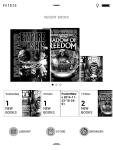
If you’ve been waiting to pick up a Kindle on Black Friday then I have some good news for you: a better deal has come along. I’ve just learned that Amazon is now offering Kindle Unlimited as part of bundles with select Kindle and Fire hardware.

Kindle Unlimited is Amazon’s subscription ebook service. It usually costs $10 a month for access to a catalog of around 750,000 ebooks (and a few audiobooks). But under the new bundle program you can get the basic Kindle with 6 months KU for $99, or about $40 less than what it would cost separately ($79 + 6*10 = $139).

Amazon is also offering similar bundles for Fire HD 6, Kindle Paperwhite, and the Fire HD 7.

The bundle offer is only good for these 4 devices, so you can’t buy a Voyage or a Fire HDX and get the 6 months free, alas. But on the upside I’ve checked and I can confirm that you can buy a bundle as a gift. And like Amazon’s past bundle deals, the discount is applied when you check out.

  • Kindle $99
  • Kindle Paperwhite $149
  • Fire HD 6 – $129
  • Fire HD 7 $169

So far as I know this is the first time Amazon has offered a bundle for KU. Their smaller competitor Oyster has worked with QVC to bundle its service with select tablets, and as you might recall Amazon offered a bundle last week which combined Amazon prime and Amazon hardware.

Are you going to get one? What about giving one as a gift?

An Incomplete Report on a Flawed Pilot Program Suggests that Library eBook Loans Don’t Drive Sales

Earlier today the UK Publishers Association released a 6 month status report on the small scale library ebook lending project which had been carried on in the UK for the past 8 months. If the report is to be believed, ebook loans don’t affect the lending rate for paper books, and they also don’t drive sales *.

I wouldn’t be so sure about that last point.

As I reported in March, 4 local libraries in the UK were selected to participate in a pilot which was going to test the impact of library ebook loans on the market for paper books and ebooks. A total of 893 ebook titles (rather than the planned 1,000 titles) were contributed for the pilot by UK publishers. That’s a larger number than it appears to American eyes; the library ebook market in the UK is much more anemic than in the US.

The 6 month status report released today found that:

  •  An overall growth in e-lending.  All four authorities have seen a significant increase in e-lending, with the pilot titles constituting a significant proportion of the overall e-book downloads.
  •  A longer loan period leads to more titles being borrowed. Longer lending periods (i.e. 21 days) appears to have led to a higher number of different titles being borrowed and more patrons joining the waiting lists.
  • The increase in e-lending is not leading to a decrease in physical lending.  The participating libraries do not appear to have seen a decline in footfall or in the lending of physical books.
  • No evidence of e-book lending leading to buying. There has been extremely low take up of the opportunity to buy the borrowed e-book through use of the “click to purchase” facility.

There are some interesting conclusions here, but did you catch what was missing from the publicly available information?

For one thing, a list of titles included in the pilot, and a list of the stores which were available via the libraries' websites. There was also no mention on the possible effect that the library ebook loans may have had on sales in ebookstores elsewhere.

While I do agree that measuring the impact of library ebook loans is important, you can’t do that without at least trying to survey the entire ebook market. That was not discussed in the status report, and thus the report is incomplete.

Another problem this report is that it says that there was no evidence of ebook lending leading to buying via a co-located buy button, but what the report doesn’t mention is that the pilot neglected to offer buying solutions that a library patron might actually want to use.

I checked a few dozen titles, and the only retail option offered was Kobo (about half of the titles had no buying option at all). While I am sure some of my readers like Kobo, it has been widely reported that the Kindle Store controls three-quarters of the UK ebook market. If that is even remotely true then this part of the pilot was a complete and utter waste of time. In not offering a retail option which patrons might want, the pilot might as well not have offered any retail option at all.

And that is a shame, because the concept of pushing sales through a library website is worth investigating. The idea has its upsides, including pleasing publishers, supporting libraries via a commission, and satisfying frustrated patrons, but unfortunately I have yet to see a valid test of the idea.

As I reported last week, OverDrive isn’t adequately supporting the option here in the US. Of the 5 S&S titles in my local library, three only offered a single retail option, and that was a site I had never heard of.

And now it is clear that they are not adequately supporting it in the UK, either.

image by ironypoisoning

Germans Call for Reduced Taxes on eBooks

The US may be blessed with lower taxes on the ebooks we buy (it’s the downside of fewer social services) but most of Europe isn’t so lucky. In Europe ebooks are taxes as a service with 17% to 25% VAT bundled into the retail price (and not the 5% to 12% most EU member countries apply to paper books) and a lot of people are not happy about that.

Bitkom released the results of a survey today which shows that there is strong support in Germany for lowering the taxes on ebooks. Almost nine out of ten Germans (87%) support charging a lower tax of 7% on ebooks sold in that country rather than the full 19% collected on most goods and services.

The results are based on a survey of 2,310 German consumers which showed that only 8% of respondents thought that ebooks should be taxed at a different rate than paper books, and 5% actually took the position that paer books should be taxed at a higher rate.

Bitkom calls on the German gov’t to respond by lowering the tax rate, noting that a recent EU court ruling (C219 / 13-K, dated 11 September 2014)  gave the gov’t leeway to do so.

The topic of taxes on ebooks is becoming a pressing issue as the new year approaches. Thanks to a change in EU tax law, retailers will soon have to start collecting taxes based on where the customer is located in the EU, and not where the retailer is located. The change neatly wipes out what is known as the Amazon loophole, the sweetheart deal that Amazon (and a number of other retailers) secured by setting up their ebook operations in Luxembourg or other low tax environs.

The change in EU tax law is expected to increase the average price of ebooks in some parts of the EU, including the UK, but it’s not clear how Germany and other parts will be affected.

A number of countries have fixed price book laws, including Germany, so the price of ebooks published in those countries cannot go up without direct publisher action. eBooks published elsewhere, on the other hand, might see a price increase. The KDP contract suggests that Amazon may have that power, and their less public contracts with publishers outside of Germany might also grant them some wiggle room on price.

We’ll just have to wait and see.

Self Publishing Bibel

images by pj_vanf


In Relaunching Pelican Books, Penguin Breaks With the Past in Pursuit of a Digital Future

When it was launched in the 1930s, Pelican Books was the nonfiction imprint for the then-new paperback publisher Penguin. It brought self-improvement and  self-education to a customer base which was unable to afford the more common hardback books (then as now a luxury item).

But in relaunching Pelican Books 30 years after it closed, Penguin has shown that it has either forgotten about or simply doesn’t care about Pelican’s original goal; aside from one small modernization the new Pelican Books bears little resemblance to the old.

The one modernization was caught by Creative Review last week. They reported that the new Pelican was letting digital drive print:

One of the most interesting aspects to the Pelican relaunch, which we covered in detail in the CR June Monograph, was that on-screen development had influenced the design of the printed editions, and vice-versa.

While the rich heritage of the imprint could have weighed down on the shoulders of the design team – Penguin’s non-fiction brand originally ran from 1937 to 1984 and spawned a multitude of great cover design – it was in fact the digital era that influenced its new direction in 2014.

Perhaps even more unusual was that the idea for how the online versions of the books might work came out of Penguin’s art department and its work on the new Pelican range, rather than from any editorial or marketing directive.

Given that ebooks are the new paperback, letting digital lead print is in keeping with Pelican’s history, and the attention paid to the quality of the digital edition follows logically from that conclusion.

And Pelican is doing some great work with digital, including well-designed footnotes, large interactive maps, and other features:

But that is about the only way that Pelican honored the past; the new digital editions are neither as prevalent as the paperbacks which Pelican produced when it launched 80 years ago nor are the ebooks as cheap (even accounting for inflation).

Pelican’s new digital editions are sold directly to the public (good) from a website that works on most web browsers (great) but have to be read online (bad) and cost £4.99 (terrible).

When Penguin first introduced paperbacks in the 1930s, they cost sixpence in the UK and ten cents in the US. It’s difficult to find an exact match in today’s dollars, but the official inflation index based on the CPI would peg the value of a dime 1935 as being worth about the same as $1.80 in 2014.

Pelican is charging the equivalent of $7.80.

And not only is Pelican charging many multiples of a budget price, they are also restricting their customer base to those who can afford a data plan in order to read the ebooks on their mobile device. This is a far cry from the original paperbacks, which could be found at most newsstands.

In short, Pelican Books only shares the name of its antecedent; it certainly doesn’t share the goals. Had Pelican shared the goals of its predecessor, it would produce DRM-free ebooks which can be read anywhere and cost only a £1, rather than producing books which cost the same as and are even less prevalent than most ebooks.

And in case you’re wondering, it is fair to compare the old to the new; while I was researching this story I found any number of articles that gushed about the old Pelican Books, how wonderful it was, and how great things will be now that it has been relaunched.

I found articles in The Guardian, the Independent, the Seattle PI, and elsewhere, and guess what?

I’m the only one who actually looked at the new Pelican Books with a critical eye. Everyone else just assumed a connection that did not actually exist.

And in case you’re wondering, I wasn’t expecting the old and new to have any real connection, nor do I see the above post as a rebuke of Penguin (their business is their business). I just thought that the contrast was worth a comment.