Kindle Unlimited, the Content Glut, and the New eBook Market

As 2014 draws to a close indie publishing finds itself at a crossroad. There’s a growing consensus that the supply of indie ebooks is beginning to exceed demand, leading to the textbook microeconomics result.

The idea that indie revenues were falling was brought to the fore a month ago by HM Ward when she revealed that she was pulling out of Kindle Unlimited, and why. This lead authors both in and out of KU to say they were also taking a hit in the pocketbook.

This led many who didn’t look too closely to conclude that KU was a bad idea for indie authors, but it wasn’t until this week that some, namely me, started a public discussion about the underlying causes. On Sunday I raised the question about what this meant in terms of consumer behavior, and within minutes Bob Mayer suggested the explanation which had been staring us in the face all along:

To me the bigger problem than KU is the content flood which isn’t going away. I think most authors, indie and trad, are going to see a flattening of sales as readers simply have so many more choices.

I still don’t feel that I have enough market data to prove it, but I think he’s right.

And so does Mike Shatzkin, who posted on this topic today:

What a long list of indie authors has proven in the years since Kindle was invented is that there is a substantial market willing to try storytelling from unknown writers if it is offered at a relatively low price. As a result of that and of Amazon — joined by all the other ebook platforms and a legion of service-providers like Bob Mayer — making it relatively easy to “publish” a manuscript, many tens of thousands of authors have published hundreds of thousands of ebooks that way.

… Ever-growing supply and stable demand is a toxic formula for the prospects of each successive ebook published for that market. My own hunch is that Kindle Unlimited is simply the straw that broke the camel’s back.

 Yes, I did agree with Mike Shatzkin, and no, the sun won’t be rising in the west tomorrow.

So where does the industry go from here?

I don’t know, but I do have a few thoughts.

One, the days of releasing the first title in a series as permafree have passed. All that accomplishes now is to flood the market and make it harder to sell ebooks.

Two, the idea of writing and publishing your next book as the best marketing strategy is also going to have to be reconsidered.

Three, getting in to or out of Kindle Unlimited isn’t nearly as important as some thought it was a few weeks ago. As I noted when I first reported on this story, this problem is affecting authors both in and out of KU.

What do you think?

images by net_efekt, solarisgirl

A Fake Product Listing Inspires Rumors About Xiaomi’s First Laptop

Xiaomi is already one of the largest makers of mobile devices in the world, and now some are claiming that the  smartphone and tablet maker is adding a laptop to their lineup.

GizmoChina has uncovered details this morning about a new laptop from China’s largest smartphone maker, and reported that Xiaomi has slapped their logo on what looks like a reference design ultrabook with an Intel Core-i7 Haswell CPU.

That would be a hot news story and well worth reporting, but I’ve done some work of my own (3 minutes with Google) and I don’t think this story is legit.

Update: And now Xiaomi has denied the accuracy of the initial report.

After a few minutes of sleuthing, I found a product listing on Banggood.com for a Xiaomi laptop which uses the same stock photos and has the same specs as mentioned in the GizmoChina article. That listing shows the  "Xiaomi  Ultrabook" as being up for pre-order with a price of $710, but I don’t think it’s real.

Here’s the photo from Banggood (aside from the lack of a watermark, it is identical to the photo found by GizmoChina this morning):

Looking at the questions asked by Banggood customers, we can see that the retailer has admitted to not having any actual information on the laptop. They do insist at one point that Xiaomi  has said that it’s coming, but this listing has been  up since at least August 2014 – with no formal announcement from Xiaomi.

While it is entirely possible that Xiaomi is working on a laptop, I think this report is a fake.

Aside from the fact that this listing has been up since August, the other way you can tell that it’s a fake is that the images used actually belong to a reference design laptop. As Liliputing pointed out, someone (in this case Banggood) simply photoshopped Xiaomi logos onto existing pictures and called it good.

And while I would normally simply ignore a fake story, I thought it might be useful today to instead debunk it.

eReader and Screen Tech Pioneer IRX Goes Bankrupt, is Dissolved

As 2014 draws to a close so does the final chapter on Irex Technologies, one of the early ereader makers.

Yesterday a reader tipped me to the news that the Dutch screen tech startup IRX Innovations has gone bankrupt. IRX was formed in 2010 from the remains of ereader pioneer Irex Technologies, and was for all intents and purposes the same company with new investors and a new name. (Thanks, Zetmolm!)

Public documents confirm that IRX was handed over to a receiver in October 2014. According to reports filed about a month later, the company is kaput. It’s not clear what will happen to the assets, but the company won’t be coming back under a different name. (Thanks, Huub!) Its website has been turned off, and all of the employees have probably found jobs elsewhere.

And that’s a shame, because IRX was working on some interesting screen tech.

I haven’t had reason to write about them recently, but I have been following the details shared by the IRX marketing dept. According to one of IRX’s suppliers:

Currently, the IRX team is developing a new innovative color solution built on their electro-osmotic technology for electronic paper displays, that places three switching layers on top of each other. Each layer can electrically switch to its required color (cyan, magenta or yellow) or be 100% transparent. So for example, for a white image, all three layers become transparent. Light passes through all the layers and is reflected by a reflector placed behind the layers creating extremely high brightness, far greater than is possible for current systems. When creating a certain color, the technology controls the required amount of color particles in each of the layers. The result is a color performance comparable to printed paper.

That sounds neat, but I haven’t found any evidence that IRX ever got beyond displaying a single color (that’s why I haven’t written about them).

While there was some talk of 3-color screens at SID Display Week 2013, the only videos posted to Youtube show show grayscale screens which look similar to E-ink screens.

For example:

So at this point it’s really not clear whether this 3-color electro-osmosis screen tech ever actually existed in the lab, much less had any practical value.

And thus ends the second life of an ereader pioneer.

***

In its first life, IRX got its start as a project at Royal Philips (aka Koninklijke Philips, or simply Philips).

Philips was instrumental in developing the 6″ E-ink screen for the Sony Librie, which launched in Japan in 2004. That R&D effort also led to the development of an 8″ display which had a screen resolution of 1024 x 768 (the same resolution as on the Cybook Ocean). Irex was spun off of Philips with the plan to develop an ereader based on that screen.

The Irex Iliad ran an open version of Linux on a 400MHz CPU with 64MB RAM and 256MB internal storage. It didn’t have a frontlight (this simply wasn’t possible in 2006) but it did have a Wacom touchscreen and Wifi. According to Wikipedia, the Iliad cost 599 euros when it shipped in 2006.

Here’s a short video from 2007 which shows some of its features:

While it had software ahead of its time, the Iliad was in some ways a clunker with a hardware design that didn’t quite live up to its promises (battery life, for example), although the later models with revised hardware did come close.

I can recall from the user reports in 2007 and 2008 that it was much more of a hacker’s project than a consumer product; the more interesting reports all came from the developers who added their own software or tweaked Irex’s software to improve performance.

Irex’s later products were much better, although I’m not sure they were as popular.

Irex released several more ereader models before going bankrupt in 2010. In what would be better termed as a reorganization, the assets were bought by IRX Innovations and all of the existing employees keeping their jobs.

They weren’t so lucky the second time around.

Kindle Unlimited Under Fire in France

Kindle Unlimited is quickly becoming a contentious issue among indie authors, and now it looks like the service could be illegal in France.

AFP reported on Monday that Fleur Pellerin, the French Minister of Culture, wants to have ebook subscription services investigated. The minister is quoted as saying that "La loi de 2011 établit une règle: c’est l’éditeur qui fixe le prix de vente du livre numérique. A ce titre, l’offre proposée par Kindle Unlimited ne semble pas conforme à la loi", which in English roughly translates to:

The 2011 law establishes a rule it is the publisher that sets the digital book sales price As such, the offer proposed by Kindle Unlimited does not seem consistent with the law.

She could well be right, but you’ll have to get a French lawyer to confirm that interpretation is valid. I can’t see any reason it wouldn’t be, but there are nuances to any country’s laws which are only obvious to an expert.

Kindle Unlimited launched in France two weeks ago with around 20,000 titles in French and over 700,000 titles in English and other languages. The vast majority of the titles are drawn from KDP Select, and while you might think that contract would cover Amazon’s legal ass I am not so sure.

The fact that KDP Select requires exclusivity may itself present a roadblock in Europe. Many countries in western Europe have a fixed price book law. I’m not up to date on the nuances of each country’s laws, but I wouldn’t be surprised if some of those laws forbid exclusive deals.

Can anyone answer that question?

image  by danielbroche

B&N Buys Out Pearson Stake in Nook Media for $28 Million

Barnes & Noble has reached an agreement to buy out textbook publisher Pearson’s stake in Nook Media for around $28 million dollars in cash and B&N stock. Pearson paid $89.5 million for their 5% stake in December 2012.

Today’s deal follows only a couple weeks after B&N announced a similar deal to buy out Microsoft’s stake in Nook Media for $120 million in cash and stock. Curiously, it looks like MS got the better deal; the tech company recovered 40% of its investment, while Pearson got about 32 cents on the dollar. To be more exact, the Pearson deal included $13.7 million in cash and 602,927 shares of B&N stock.

Shut of outside investors, B&N is now free to spin off Nook Media and let the ebook company sink or swim on its own. B&N had previously said that Nook Media would be spun off by August 2015. And while there is still time for someone to step forward and buy Nook Media, I don’t expect that to happen.


Boyue Teases a Dual-Sided 8″ LCD/E-ink Tablet

Do you like the idea of Yota Devices’s dual-screen smartphone but feel that a 5.5″ screen is too small? Then I have just the thing.

The Chinese gadget maker Boyue is now showing a concept design for a hybrid 8″ ereader on its website. They haven’t released any specs and I’m not entirely sure it will ever see the light of day, but I still want to laud Boyue for for being either bold enough or crazy enough to come up with this:

The Boyue D81 features an 8″ IPS display on its front and an 8″ E-ink display on the back, and if it is ever built it will run Android 4.2 Jelly Bean on a quad-core CPU. It will probably also cost a lot of money, somewhere in the neighborhood of $300 (by my guesstimate).

I don’t know that Boyue has worked on a dual screen design before, but they have developed a couple Android tablet as well as a couple ereaders which run Android. So even though this device presents twice as many technical issues as a single screen tablet, it’s entirely possible that they could pull it off.

I’m going to go start bugging them for a review unit. Yes, I know it doesn’t exist but sometimes it pays to get an early start.

MobileRead

Is Palm Going to be Resurrected As an Alcatel OneTouch Brand?

Palm is a name which hasn’t been heard much since it was bought by HP (and then strangled following the death of the Touchpad) but it looks like it might be making a comeback of some kind.

WebOS Nation notices on Friday that www.Palm.com, the old home of Palm, now redirects to MyNewPalm.com. 

It’s not clear who owns the website domain (it leads to an offshore shell company out of the British Virgin Islands), but it looks like that offshore shell company, or possibly one with a very similar name, also owns a bunch of other Palm related trademarks (the TMs were transferred from HP in October).

I’m not sure what this means, but one webOS fanblog has turned up a surprising connection to a Chinese smartphone maker. According to MakaPalm, the Chinese tech company that owns the Alcatel OneTouch brand might be about to resurrect the Palm brand:

TCL Communication may be the company behind the new webpage that has been teasing loyal fans of the mobile-computing pioneer Palm.

“Smart move”—a slogan that appears in a looped video on mynewpalm.com along with the orange Palm logo—is the brand platform of Alcatel One Touch, TCL Communication’s mobile brand.

The name of TCL Communication’s senior vice president Nicolas Zibell also appears on a document formalizing the transfer of Palm trademarks from HP to another company in October.

I would bet he’s right.

There have been absolutely no rumors on this topic, so it is hard to guess what Alcatel, or actually its parent company TCL, will do with the Palm brand. But I would tend to agree with Mike Cane’s speculation that we’re probably going to see an Android smartphone bearing the Palm logo.

It might even make an appearance next month at CES 2015, so I would keep your eyes peeled. I plan to stop by the Alcatel booth and ask about it. (I also sent an email, but I’m not sure my press contact info is still valid.)

TCL Alcatel makes some cheap but decent smartphones and tablets under the Alcatel brand, and a commenter told me that they’re also a leading tv maker (thanks, jjj!).  I have one of the smartphones, and it’s not good as Palm used to make but it’s not bad.  It’s not great, but I got it because it was cheap and I’m mostly satisfied.

Assuming you set realistic expectations, the new Palm phones will probably be about as satisfactory.

A Survey of College Students Reminds Us Why eBooks Haven’t Taken Over

Every so often I read the pondering of another pundit wondering why ebooks have plateaued at somewhere around a third of the US trade book market, and then I come across surveys which explain the reason.

Well, one of the reasons.

Over the weekend Quartz posted this nifty chart. It’s based on a survey of 1,200 college students in the US, and like past surveys it shows that students still prefer print textbooks over digital.

This comes as no surprise to me (though the details on which is better for specific uses is useful). While I haven’t read a survey on preferences before, I have seen numerous surveys that digital textbook adoption has lagged the industry hype and that mobile device adoption for school work trails behind ownership.

As we’ve seen from the failed startups Kno and Coursesmart, college students aren’t buying digital textbooks. In part that is a market issue caused by college students needing to resell their overly expensive textbooks, but this has another cause: usability.

Digital textbooks are great, right up until you need to have several of them open at once. The issues are only heightened by the fact that most textbook titles can’t be borrowed from the library as ebooks, meaning that a student would have to buy them (again, market constraints). Once you begin to actually use a digital textbook, it’s pretty clear why print is more useful.

So this survey comes as no surprise.

It was interesting, though, to learn that activities like scheduling, reading, note taking, and research are moving to the laptop. This would be a case of students finding additional benefit in a gadget they already own. This doesn’t cost them anything other than time so there’s no market in it, but it is good news for companies like Evernote.

JA Konrath Decamps From Kindle Unlimited

Noted author and firebrand JA Konrath was one of the first indie authors recruited by Amazon to join KDP Select when it launched with Kindle Owner’s Lending Library in late 2011 and now he’s the latest high profile indie author to make an exit.

Konrath revealed on his blog today that he’s in the process of pulling his titles from KDP Select, which supplies indie ebooks to both Kindle Unlimited and KOLL. He made the decision a few weeks ago, and the ebooks will be out of KDP Select by the end of January.

When one commenter assumed that Konrath knew all along that subscription services devalued books and asked why leave the party now, Konrath explained:

I still don’t know that. Some authors' sales have dropped. Others have risen. I need more data, so I opted out several weeks ago. But the period is three months, so they’re still enrolled until January.

Here’s what you missed; a KDP author CAN opt out. It’s our choice.

McM doesn’t seem to be offering a choice. That’s bad. Really bad.

The reason most writers sign legacy deals, other than getting an advance, is legacy’s ability to get paper books onto retail shelves.

This sounds as if McM is foresaking paper–the one part of the industry they controlled–and short-selling their authors.

If I was a McM author, I’d be worried, pissed off, and wondering why the hell my publisher did a complete about-face from the stance that made them collude and price-fix.

Konrath is at least the second prominent indie author to announce his exit from KDP Select in the past month. He follows HM Ward and other authors in abandoning an idea which had seemed so promising 3 years ago.

As you may recall, for the past several weeks indie authors have been debating whether Amazon’s indie focused subscription ebook services offered enough value to indie authors. While the more limited Kindle Owner’s Lending Library had proven over the course of a couple years to be a net positive, in the 5 months since it launched the all-you-can-read Kindle Unlimited has not.

HM Ward sparked the debate earlier this month with her dramatic announcement that she was pulling all of her titles out of KDP Select in response to a shocking decrease in revenue. In the days that followed, numerous authors agreed with her, revealing that they too had seen dips in revenue following the launch of Kindle Unlimited.

And now Konrath is joining the exodus. He hasn’t shared details on how KU impacted his sales, but Joe is not one to make a business decision without first crunching the numbers. And if he is departing for greener pastures, indie authors who are still in KDP Select need to seriously consider whether they should stay.

So long as KDP Select is a net positive, I think they should stay in. What’s more, if the number of prominent indies pulling out of KDP Select increases, the situation for the less successful authors might improve.

At this point it is really too early too say.

What do you think is going to happen next?

image by Krysten_N, Abode of Chaos,  jorgempf

InkCase Plus (Un)Review: I Paid $89 for THIS?

 The InkCase Plus looked like a great idea when I backed it on Kickstarter this summer, but now that my order has finally arrived I wonder if I may have set unrealistic expectations.

I would normally wait a week to post a review, but I’ve had a few requests to post my first impressions. To put it simply, I’m not happy.

The electronics are as good as the early sample I saw it in July, but the software hasn’t been improved any and the case itself is disappointing.

Hardware

For those not familiar with the InkCase Plus, it’s a system for a universal smartphone case which adds a 3.5″ secondary E-ink screen to almost any smartphone. Its developers came up with the idea of dividing the case into two modular components: the electronics, which can be mass produced in job lots, and the case itself, which can be designed to fit specific smartphone models and manufactured in smaller quantities.

That was a good idea when the InkCase Plus was first announced, and it turns out to be an even better idea today because the case which is sitting on my desk, well, I’m not happy with it.

Cases for five different smartphone models were produced for Kickstarter backers, but since I don’t have one of the more popular smartphones I instead requested the large universal case (which is supposed to fit most smartphones over 5″ in size).

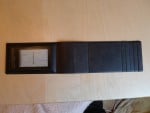
The case looks like it was manufactured as cheaply as possible. As I hold it in my hands I get the feeling that this is a case I would find in a discount store for a couple of bucks, and not one which cost $89.

What’s more, I’m not sure that you can technically call this a case. I’m not bothered by the fact it doesn’t enclose my smartphone; I expected that. But I would not call this a case because there’s no way to attach it to my smartphone.

The photos shared by the developer (here) suggest that the case is supposed to have a sticky spot where you would place your smartphone. It does not, and I can’t find anything in the retail box  which resembles a piece of double-sided adhesive. (The early images also look nothing like the case I received, but that’s not unusual.)

So even if this case met my quality standards, it wouldn’t meet certain functional standards. I was never planning to use it as a case, so it doesn’t affect me so much, but it’s still frustrating.

The electronics, on the other hand, are much more satisfactory.

The ereader module is built around a 3.5″ Pearl E-ink screen. There’s no frontlight or touchscreen, but it does have BT, a battery, and a CPU which is just powerful enough that this could have been made into a stand alone ereader.

It’s a very simple device with just 3 buttons on the front (power and page turn buttons), and since it is so thin and small I can easily hold it in my hand.

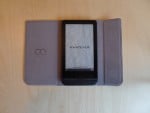
I’m currently using the ereader module by itself, in the included folder case. This is also pretty cheaply made, but I can live with it because the ereader module looks cute and easily fits in my pocket.


I’m not even bothered by the fact that the sticky in the folder case is so strong that the rear of the ereader component regularly pops off; I have to be incredibly careful when removing the ereader component out of fear of damaging it.

Now if only the software were as good as the electronics.

Software

The InkCase Plus was designed as a smartphone accessory, so pretty much all functions require a companion app to be installed on your mobile device. Since I covered the existing apps back in July, I won’t repeat myself here.

There’s really not much new to say about the software. One of the companion apps, EpiReader, has been updated with a new feature (it now connects to Dropbox) but there aren’t any new companion apps for your smartphone/tablet, and so far as I can tell, the device itself is running the same firmware as the unit I tested in July.

And that is a little disappointing.

While the InkCase Plus does have a few useful features, I had been told that it would have new features by the time it shipped, including the option to use it as a stand alone ereader. That hasn’t happened yet.

You can read on it, but you’ll need to keep it paired with your smartphone/tablet so the companion app (EpiReader) can send the ebook over to the device one page at a time. Given that this is intended to be a smartphone accessory, that is not an unworkable idea, but the device is capable of doing more.

BTW, when I looked in July, the InkCase website mentioned new apps, including a coupon app and one called InkCase Now. Neither has been released, and I can’t tell you when they will be available.

Conclusion

I’m torn.

On the one hand, I know that since I hardly use my smartphone I’m not the target demographic, and thus I shouldn’t be commenting on a device which I only have a very specific interest in. (I’m also not a fan of smartwatches and other second screen smartphone accessories.)

But as I sit here looking at the InkCase Plus on my desk, I wonder whether even a smartphone user will be happy with the InkCase Plus. The only part I am happy with is the ereader module; both the software and case come up short.

The case I got is non-usable junk; there’s no other way to put it. And there’s really not much in the way of software features. What’s more, this device’s best feature is crippled by poor design decisions.

I’m going to keep playing with my unit, but unless new software is released and unless I can get a better case I just don’t think it will prove all that useful.

Macmillan Signs New eBook Contract with Amazon

Macmillan CEO John Sargent has just revealed in a public letter posted on Tor.com that Macmillan has signed a deal with its biggest ebook customer and will soon be dabbling in the subscription ebook market.

To start, the ebook deal was signed last week, and while we have less than complete info Sargent did say that:

Late last week Macmillan reached an agreement with Amazon on a multiyear deal for print books as well as a multiyear deal on the agency model for e-books, starting on January 5, 2015. All our other retailers will also be on the agency model, leaving Apple as the only retailer who is allowed unlimited discounting. Irony prospers in the digital age.

Sargent is less than specific on the terms of the contract, but I would be willing to bet that the deal is probably much closer to the deal Amazon signed with S&S, which might best be described as modified agency (or so it appears from what few details have been leaked).

Update: The WSJ confirmed that this is a modified version of agency similar to the S&S deal:

“We are happy with this agreement, as it allows us to grow our business together with Macmillan and their authors,” said a spokeswoman for Amazon in a statement. “Importantly, the agreement specifically creates a financial incentive for Macmillan to deliver lower prices for readers.”

Macmillan confirmed that it will receive better terms from Amazon when it offers lower prices on its titles.

Macmillan is the third major US publisher to sign a new contract with Amazon in the past two months. S&S went first, inking a deal not quite two months ago, and Hachette settled its dispute with Amazon a few weeks later. (There’s no news yet on whether PRH or HarperCollins are talking terms with Amazon.)

These 5 publishers have had to renegotiate their deal with Amazon and other ebook retailers following their decisions to settle the ebook price fixing antitrust lawsuit brought by the DOJ and states' attorneys generals in 2012.

Llike Hachette, which relies on Amazon for the majority of its ebook sales, Amazon has Macmillan over an ebook barrel. Sargent has revealed that Amazon is the single largest seller of Macmillan ebooks:

In reaching agreement with Amazon, we have not addressed one of the big problems in the digital marketplace. Through great innovation and prodigious amounts of risk and hard work, Amazon holds a 64% market share of Macmillan’s e-book business.

Macmillan

He goes on to explain how Macmillan will respond to Amazon’s dominance of the ebook market, namely by looking for other markets:

In our search for new routes to market, we have been considering alternative business models including the subscription model. Many of you know that we have long been opposed to subscription. We have always worried that it will erode the perceived value of your books. Though this significant long-term risk remains, we have decided to test subscription in the coming weeks.

The details are less than complete, but he says that Macmillan will test the subscription market first with "backlist books, and mostly with titles that are not well represented at bricks and mortar retail stores". No partners are named, but I would expect that Macmillan will sign with Oyster and Scribd, but not Kindle Unlimited, which doesn’t pay as well.

Oyster and Scribd have already signed deals with HarperCollins, S&S, HMH, and other publishers big and small, few of which have signed with Amazon.

images by seanmfreese, docoverachiever

External Traffic to Spanish News Sites Plummets After Google Move, and Other Clickbait

Google shuttered Google News in Spain on Monday in anticipation of changes to Spanish copyright law, and if you believe the data-free post Matthew Ingram publisheed at GigaOm yesterday, Spanish news publishers are already seeing the effects.

I’m not convinced, but Ingram says that:

As expected, Google removed all Spanish publishers from its Google News index on Tuesday, which the company said it was forced to do as a result of a new law — a law that publishers themselves lobbied for — which requires anyone using even a short snippet of copyrighted content to pay a fee. According to the web-analytics service Chartbeat, within hours of their removal from the Google service, Spanish media sites saw their external traffic fall by double digits.

I would suggest that you take this report with about a pound of salt. While I do expect that the Spanish news sites will lose web traffic as a result of Google News closing, I think it’s too early to say for certain that this has occurred.

This early report is based on a single day’s traffic from a limited number of sites, and thus there’s hardly any data yet.

Also, Ingram doesn’t cite any actual specific traffic stats to back up his headline.  Far from showing that traffic "plummeted", the only data Ingram has shows that one type of traffic decreased slightly, and even that wasn’t detailed with a specific figure:

Josh Schwartz, the chief data scientist at Chartbeat, said the company doesn’t track every Spanish news site or publisher, but it has enough data on them as a group to indicate just how dramatic the traffic decline was. The service tracks about 50 sites, he said, ranging from small media outlets to the largest newspaper publishers, and looking at the data shows “a pretty massive difference” in traffic compared to a similar day before the removal. On average the drop is between 10 and 15 percent (Chartbeat only includes traffic from clients who have consented to have their anonymized data used).

Please note that he is only referring to external traffic here; Ingram doesn’t say how much overall traffic declined.

But he did post this unlabeled and thus useless chart:

For all we know, the actual effect shown in this chart might equate to only a couple percentage of a website’s total traffic, and thus would qualify as a fluctuation and not a "plummet", which is how Ingram described it.

Just to be clear folks, I fully expect that Spanish news sites will see a dip in traffic as a result of the Google News closure, but to proclaim that traffic has plummeted based on a single day’s data (and what’s worse, not share the data) is simply clickbait.

I think that we should wait at least a week before declaring that Spanish news publishers were doomed by their own folly don’t you?

AAP Reports Publisher Revenues up 5% in First 3 Quarters of 2014

A new report from the Association of American Publishers today reveals that publishers revenues were up slightly in the first 9 months of 2014.

Total trade revenues for the 1,209 publishers supplying data to the AAP were up 2.8% (to $5.02 billion from $4.88 billion). The adult segment dropped 3.3% (to $3.31 billion from $4.42 billion), while the religious presses segment grew by 2.1% (to $410 million from $393 million).

The children’s/YA segment continued its extreme fluctuation in sales for the third year in a row, with revenues up 22.4% (to $1.31 billion from $1.07 billion). This segment showed similar growth in 2012, and a similar decline in 2013. It’s more than likely that the fluctuation in all 3 years had the same cause: blockbuster movie adaptations of YA novels (or in the case of 2013, the lack of the same).

Coincidentally, the AAP also pointed out in their press release that YA ebooks revenues increased at a faster clip than the overall segment, with a 52.7% change in the first nine months.

In terms of formats, ebooks were up, hardbacks were down, and paperbacks were up. Total ebook revenues increased by 5.6% over 2013 (to $1.2 billion from $1.13 billion), while hardback sales dropped by just under a percent. Paperback sales saw similar healthy growth, increasing by 4.1% (to $1.51 billion from $1.45 billion).

The AAP also shared the tidbit that downloaded audiobook revenues continue to outpace the market, growing by 27.0% growth over the same period in 2013.

And in terms of the overall revenues reported by the 1,209 publishers, the AAP said that publishing is healthy thus far in 2014. Revenues were up 4.9% in all categories (Trade, K-12 Instructional Materials, Higher Education Course Materials, University Presses, etc.)


Kindle Unlimited Launches in France, Brazil

Local sources are reporting that Kindle Unlimited launched today in Brazil and France. Readers in those two countries can now subscribe and pay Amazon 10 euros or 19.90 reals per month for access to a catalog of over 700,000 titles, although given the limited number of local titles I am not sure they will want to do so.

Actualitte broke the news that Kindle Unlimited launched in France with 20,000 titles in French. The service costs the same as in Germany, Italy, and Spain, and enables readers to read as many books as they like each month from a catalog of 700,000 mostly indie titles.

In addition to best sellers such as Harry Potter and books by Raymond E. Feist and Maya Banks, there are also indie titles like  Projet Anastasis by Jacques Vandroux and Sans témoin by Patrick Philippart, as well as the same public domain classics which can be found everywhere.

In related news, Publish News Brazil surprised me this morning with the report that Kindle Unlimited is now available in Brazil. It costs 19.90 Brazilian reals, or about $7.70 USD, per month. In addition to the 700,000 titles mentioned above, KU also now includes 10,000 titles in Portuguese

I am a little surprised to read about the launch in Brazil; when rumors of the launch went around a couple weeks ago I thought that KU wouldn’t launch in Brazil until the middle of 2015 if not later.

I thought Amazon would have trouble rounding up enough titles that they wouldn’t be able to hit their minimum quota, and it seems I was right. Amazon launched KU in Brazil with far fewer titles in Portuguese than in any other local language. Whether that will negatively impact reader adoption is going to have to be left up to the market.

Given the historically high prices of ebooks in Brazil, the limited selection of local titles might not have much impact. But it is too early to say.

In France, KU is competing with subscription services like Scribd, while in Brazil the competition includes Scribd and Nuvem de Livros, which is native to Brazil and possibly has an even a larger subscriber base than KU, Scribd, or Oyster (no one is talking, so we don’t know).

Kobo Adds New Middle East Distributor

Amazon might still be avoiding the region, but Kobo isn’t so squeamish. This Toronto-based ebook startup has inked a deal this week with Lionfish to distribute Kobo ereaders to retail and online stores in Bahrain, Kuwait, Oman, Qatar, Saudi Arabia, and the UAE.

Readers will soon be able to find the  Kobo Touch, Aura, and Aura H2O in 34 local stores, including Xcite, Virgin Megastores, and Dubai Duty Free Stores. Kobo reports that the hardware will also be available for purchase online at Modvito, Souq.com, and Jado Pado.

"Digital reading continues to rise across the globe and we’re thrilled to be entering G.C.C. countries to offer readers with best in class E Ink eReaders and eBookstore," said Jean-Marc Dupuis, Managing Director of EMEA, Kobo.

Kobo’s competitors in the region include local ebookstores like Kotobi.com, but not any of the major ebookstores. Neither Kindle nor Google Play Books are available in the region, and while Apple does sell hardware in the Middle east they don’t sell ebooks (source).

image by Leandro’s World Tour