Kindle Scout: One Reader’s Opinion

Amazon’s crowd-sourced publishing platform opened its doors today to readers. After accepting submissions from authors for the past two weeks, Amazon is now going to give readers a chance to pick some of the books Amazon might publish next.

I’ve covered Kindle Scout extensively ever since I first broke the news last month, including a look at what authors could get from it, so I won’t repeat any of that today.  Instead I will look at KS from the viewpoint of a reader.

I’ve spent a couple hours browsing Kindle Scout this morning. I haven’t found anything that I desperately wanted to read further (I am a picky reader), but I also didn’t see any really bad works either.

Kindle Scout has 59 titles at launch (more will be added tomorrow and in the future). The works are concentrated in SF/Fantasy, romance, and thriller/mystery, the only 3 genres which Amazon is accepting at the moment.

I’m really only interested in SF, but I did browse the other sections and note that the cover images ranged in quality from  amateur (and possibly homemade) to clearly professional work, but as I later learned you can’t judge the books in Kindle Scout by their covers.

I have so far read 5 of the excerpts in the SF section (on the website; you can also send an excerpt to your Kindle account). None of the books grabbed my attention, but I did notice that the general writing quality was much better than some of the covers led me to expect. This was no amateur hour; all of the excerpts I read showed a writing style and polish that was on par with traditionally published books.  Some of the excerpts were even better written than what you would find under a major imprint.

I am a very picky reader so I wasn’t surprised that I didn’t find anything I loved, but I am also cognizant of the fact that I have narrow interests. I can’t judge what will have success in the market, but if the worst that can be said is that some of the covers are bad then that is actually very good news.

I won’t go so far as to predict market success for any of the books submitted to KS (the market is too fickle for that), but I do think that Kindle Scout has passed its first hurdle. The worst books have been weeded out in or before the submission stage, leaving only good books to for readers to browse through.

It’s worth a reader’s time to browse and see if there are any books you like. At worst you’ll get a couple minutes entertainment, or perhaps boredom. But if you’re lucky the book will be accepted for publication by Kindle Press, the new hybrid publishing imprint Amazon launched to compliment Kindle Scout. Anyone who nominates a book will get a free copy of the ebook if and when it is published by Kindle Press.

Described by Amazon as a hybrid platform which combines elements of KDP and Amazon Publishing, Kindle Scout is Amazon’s latest experiment in drawing on the collected wisdom of readers to find good books.

Oh, yes, Amazon has tried similar ideas before, with some success. One of Amazon’s first publishing imprints, Amazon Encore, looked for previously published books which had great reviews but unimpressive sales. And of course Amazon has also been running the Breakthrough Novel Awards for the past several years. This annual contest is similar in structure to Kindle Scout in that authors submit their works, Amazon editors pick the best, and then Vine Reviewers and customers rate them.
Adobe Updates Digital Edition, Stops Sharing User Info With the Internet

Adobe rolled out a new update for their Digital Editions Epub app today, and I have good news, bad news, and okay news.

This is a relatively minor update to the month-old Epub app, and the good news is that it adds a full text search option as well as a new display window for search results.

The bad news is that we don’t know for sure whether Adobe is still spying on users, because (and here’s the okay news) they say that they are now encrypting the data uploaded to their servers. According to the changelog posted by Adobe, one of the new features is:

Enhanced security for transmitting rights management and licensing validation information. With this latest version of Digital Editions 4.0.1, the data is sent to Adobe in a secure transmission (using HTTPS).

I got the tip from Adobe a couple hours ago, after having run several tests I can confirm that the data uploaded to Adobe’s servers is no longer being sent in clear text.

I can’t speak as to the quality of the encryption or what data Adobe is collecting, but at least they have taken the basic step of making it difficult for everyone in the world to listen in when that data is sent to Adobe’s servers.

Update: I’ve heard from another tester who identified that Adobe was using SSL, and that it didn’t appear to be sending any data at all (for DRM-free ebooks). But if you activate a DRMed ebook Adobe does send a lot of encrypted information. Removing that DRMed ebook stopped the app from sending info.  Thanks, Michael!

Second Update: I have an independent confirmation that Adobe only uploads data after a DRMed ebook has been activated.

For those just tuning in, earlier this month I broke the news that Adobe’s newest ebook app was logging users' reading habits and scanning the storage of any attached ereader and uploading that data to Adobe’s servers in the clear.

After my initial report was confirmed by Ars Technica, the shit hit the fan. Following criticism from the EFF and from librarians, leading to a partial admission from Adobe that they had been collecting data "in accordance with their privacy policies" (which just goes to show that Techdirt is right; such policies are a joke).

You can find a timeline of events on my original post.

My report has sparked a debate in the ebook world over just what activities are acceptable. Some took the position that Adobe’s actions were similar to the conveniences that we take for granted with the major ebook platforms (and web services in general). That would be a good point if not for the fact that Adobe was not providing me with any service which would require collecting that data, much less uploading to their servers.

The best you can say for Adobe is that they might have been intending to provide a syncing service in the future, possibly as part of the iPad app which I have been told is in the works, or as part of the ebook platform which they license to other companies (Kobo, B&N, Pocketbook, and so on). That could be true, but again Adobe was not providing that service and thus did not need to collect the data, much less upload it.

This is less a case of a company screwing up in supporting users than it is one of a major tech company grabbing more user info than is required and then, when they are caught, trying to write it off with a "My bad" and a promise to add encryption.

That is entirely the wrong response. What they should have said was that they would stop the spying, not that they would make it more difficult for the world to listen in.

Unfortunately there’s not much that users stop Adobe. This company is too central to the ebook world and that means that we will have to do business with them at some point.

The best the average user can do is to use a firewall or other utility to block Adobe’s apps from accessing the web, or possibly use one of the older versions of Adobe DE (which to the best of my knowledge does not collect user data).

Or we could always flee into the welcome embrace of Amazon, but many in the ebook world would call that a fate worse than death. Plus, there is no guarantee that Amazon is not collecting similar data on users.

If anything, this ensuing story has reminded us that there are maony circumstances where privacy is more of a figleaf than a reality. The best we can really hope for is that the services we use won’t blab our person details to the world.

image by Soctech

German Publishers Cave, Grant Google Free Permission to Use Snippets in Search Results

Google’s 4-month-long fight with German news publishers over license fees for search result snippets came to a close today when the publishers threw in the towel.

VG Media, the rights management firm which 200 German publishers had intended to use to collect the fees, announced on Wednesday that they would be granting Google a free license to use the snippets, saying that they were "forced to this extraordinary step, given the overwhelming market power of Google".

In short, this latest effort to force Google to pay for the privilege of sending web traffic to other websites failed as completely as past attempts. This both is and isn’t a surprise in that for once the publishers had the law on their side, but given Google’s past refusal to pay similar fees (they’d rather remove links from search results) I am not surprised that Google prevailed again.

This fight started in June of this year when VG Media started legal proceedings against Google, alleging that Google was violating German law. They asked to be awarded 11% of Google’s revenues based on, well, I’m not quite what they were smoking.

But I do know that VG Media had based its claim on a law passed in Germany in August 2013, which had been written to cover pretty much this situation. It explicitly granted publishers the right to license their content or parts thereof, except in the case of single words or very small text snippets.

Unfortunately for the publishers, German regulators didn’t see things the same way. In August the Bundeskartellamt rejected the antitrust complaint filed by VG Media, and while at first it looked like VG Media would win on the license front earlier this month Google announced that they would stop using excerpts from the websites belonging to the publishers behind VG Media.

To be clear, Google would still link to the sites, but it would not use snippets. This puts the publishers at a disadvantage compared to other news sites in the search results.

While VG Media might have a legal right to demand the license fees, they didn’t have any way to force Google to use the snippets (that is what the antitrust complaint was supposed to accomplish, I kid you not). And without that, the publishers have two choices: either give up the free traffic Google sends them or let Google use the snippets for free.

VG Media chose the latter option, just like I predicted. This is not the first time that a European publisher has tried to get Google to pay for the use of snippets, for the most part Google came out ahead each time.

Even when Google initially lost, as in the case of the copyright infringement suit filed against  Google in Belgium, the search engine giant came out ahead. In that case, after Google complied with the ruling and delisted the websites which had sued Google, it was then accused of punishing the sites by no longer sending them web traffic.

Eventually the Belgian sites had to agree to let Google list them for free – which is exactly what VG Media did today.

Voyage vs Paperwhite Comparison Review: the Web Browser

When I first reported on the new Kindle Voyage earlier this week I mentioned that the Voyage was running the same software as the Paperwhite. It turns out that is not entirely correct. While the two Kindles use what looks like the same web browser, the software running underneath the UI is not even close to being the same.

At the request of a reader, I spent some time yesterday playing with both Kindles, testing the web browsers, and I can report that the Voyage has the much better web browser. It’s enough better that I sincerely hope that the Paperwhite gets it in an update otherwise this could be a strong selling point for the Voyage.

While the web browsers look the same, offer the same features (like article mode), and are about equally fast at loading a page, there are ways that they differ.

For example, the Voyage loads the settings menu faster, but the Paperwhite responds faster when you scroll the page. I played with both web browsers, and I visited websites like Google, Boing Boing, Techcrunch, and this blog. I noticed that simple things like website menus opened faster on the Paperwhite.

I also found that the web browser on the Voyage is more stable.  It didn’t crash, while the web browser on the Paperwhite crashed a bunch of times – and it also froze when I tried to plug it in to the USB cable. This necessitated a holding down the power button to force a reboot.

Update: At the request of another reader, I tried Dropbox and the Manage Your Kindle page on Amazon.com. Those crashed on the Paperwhite, and they also crashed the Voyage’s web browser.

All in all, the Voyage has the better web browser, but rather than laud it I am going to sit back and hope that the Paperwhite gets the improved web browser in an update. I for one would rather browse the web on the Paperwhite’s lower resolution screen.

This might sound counter-intuitive, but the higher resolution screen on the Voyage might not actually be a good thing when it comes to web browsing. Because the resolution was so high (1080 pixels wide), websites with responsive layouts served up the full desktop webpage to the Voyage. The Paperwhite with a screen width of 758 pixels, on the other hand, was served a mobile version of the same website.

The latter was IMO much easier to use on a 6″ screen.

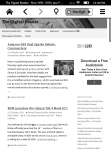
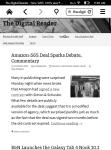
As you can see in the screenshots below, the Voyage packs more content into a single screen image. This gives you smaller text and more ads.

To be fair, I’m sure you would appreciate the higher resolution of the Voyage’s screen more when reading in article mode, but getting there is another matter. Much to my surprise, we’ve found an example of where more is not necessarily better.

But that’s just my opinion, and as I read it again I think it might be a minority opinion. What do you think?

B&N Launches the Galaxy Tab 4 Nook 10.1

As predicted by this blogger a couple weeks ago, Barnes & Noble officially launched the 10″ version of their co-branded Galaxy Tab 4 Nook. The new Android tablet is available today in B&N stores and on Nook.com, where it is selling for a retail of $299. 

According to the specs B&N posted on the Nook developer pages and then confirmed on the product listing for the new tablet, the co-branded Samsung Galaxy Tab 4 Nook 10.1 runs Samsung’s flavor of Android 4.4 KitKat on a quad-core 1.2GHz Marvell CPU with 1.5GB RAM and 16GB internal storage.

This tablet has a 10.1″ display has a screen resolution of 1,280 x 800, and it also has Wifi, Bluetooth, GPS, a pair of cameras (1.3MP and 3MP), and a microSD card slot. Weighing in at 487 grams, the new Tab Nook measure 8mm thin and has a 6.8Ah battery which is specced for 10 hours of web browsing.

I haven’t had a chance to get my hands on one of the 10″ Tab Nooks yet, but its smaller sibling is in all the important ways a Samsung Galaxy Tab, with additional Nook software. That model launched just over 2 months ago.

I am pointing out the close similarity between the Samsung branded unit and the co-branded unit because the high retail price offers a strong incentive to shop around. Amazon, for example, is selling the Samsung galaxy Tab 4 10.1 for $279 today. That is $20 you can spend elsewhere.

To be fair, B&N is boasting that their 10″ tablet comes with $200 in content, but Samsung makes a similar claim ($300 in products and services, in fact). What’s more, much of the dollar value of what B&N is giving away comes in the form of 3 single tv episodes and a double handful of single magazine issues.

Given the tight price competition in the larger tablet market, I have to wonder if B&N may have made a mistake in taking on a 10″ tablet in addition to the 7″ Galaxy Tab 4 Nook. B&N is committed to selling a million of the co-branded tablets, but I don’t think savvy shoppers will be buying very many.

Kindle Scout to Open to Readers Next Week

Amazon’s crowd-sourcing program opened its doors to authors last week, and a new report tells me that it will soon be open to readers as well.

Benjamin Sobieck wrote on his blog earlier today that his latest crime novel, The Invisible Hand, was accepted into the Kindle Scout program today. He reports that it took Amazon less than 24 hours to accept his work and assign a start date for his campaign. The Invisible Hand will be posted for readers to rate and review on 28 October.

For those just tuning in, Kindle Scout is a new hybrid publishing program from Amazon. Authors can submit a work (including a completed manuscript, cover, author bio, and description), and if accepted into the Kindle Scout it is posted for public review. Readers will have 30 days to read the excerpt and comment on it, and well, it’s not clear what will happen next.

Theoretically, Amazon’s newest publishing imprint, Kindle Press, will take reader nominations into account and (assuming a work passes muster) offer the author a 5 year publishing contract with an advance.

But this program is still so new that I don’t know if we can say for sure whether it will work. I would bet that there won’t be a shortage of authors signing up, but I still don’t know whether enough readers will participate or if they will be able pick good books.

But even with the unanswered questions, this program is still worth a shot. As Sobieck explains, the potential upside is significant and if worst comes to worst all he lost was a 6 week exclusive:

Writers can see the specifics of how this works here, but I won’t bore anyone with that. I wanted to take a swing at Kindle Scout because a) being picked up by Kindle Press offers a good chance of making bank on sales, since Amazon’s marketing knows how to target and sell e-books within its ecosystem; and b) it’s a 45-day turnaround, which is much faster than slogging through the submission process I just don’t have time for right now.

If Kindle Press does choose to publish Sobieck’s book, he’ll be signing over ebook and audiobook rights (but not paper) in exchange for a $1,500 advance and royalty rates better than what can be found in most publishing contracts (more details here).

Kindle Scout is one of two programs for authors which Amazon has launched recently. The other is Write On, a writing community designed along the lines of Wattpad. Write On has been under development since April of this year, but was only publicly unveiled earlier this month. (It’s still invite only, so let me know if you want one.)

P.S. If you have a book about to go through Kindle Scout, please let me know. I’d like to know what Kindle Scout is like from the inside, and I’d be happy to accept a guest post with a first hand account.

RIP Bilbary

When Bilbary burst on to the digital publishing scene in late 2011 it got a lot of attention for its novel ideas, including plans for a rental ebook platform. Sadly, it now seems novel ideas were all the company had going for it, which could explain why the company quietly went bankrupt earlier this year.

The Bookseller reported today that Bilbary, once the shining light of indie ebook startups, is out of business. The company actually shut down in May or June of this year, but it wasn’t until last week that someone noticed it was gone. (Andrew Rhomberg of JellyBooks gets credit for that.)

Bilbary had been shedding senior management since at least March of this year, and they had been shedding real estate since last September, when they closed their London office.

The company had raised around 2 million pounds in its early days, but was not able to either generate enough revenue to support itself or enough growth or forward momentum to interest investors and soon ran out of money.

As the old saying goes, the main reason startups die is that someone launched them in the first place.

But if you ask Bilbary founder Tim Coates, Bilbary was caught between Amazon and publishers. Coates told The Bookseller: "The dispute between Amazon and publishers on e-book pricing [and the agency model] makes it impossible to invest. We are in a situation where investors are terrified of risking a new venture because no-one knows what the pricing structure will be. As long as the argument has been going on, any investor says, 'What is the pricing model?' and you can’t answer them. Bilbary was caught in the crossfire from the industry dispute and we weren’t alone."

I think that explanation is nonsense; the truth is a lot more complex and less palatable. The fact of the matter is, the odds are stacked against publishing industry startups in the first place.

I haven’t had a reason to report on it much, but I tend to listen when people like Andrew Rhomberg of JellyBooks and Micah Bowers of Bluefire talk on Twitter about the resistance they have faced in getting the major publishers, all of whom are very conservative, to try some thing new. (This is to some degree confirmed in the administrator’s report.)

For example, Bilbary originally launched in very late 2011 with the idea of offering an ebook rental service. This fell through when none of the majors went for the idea –  a detail which Tim Coates should have been able to predict based on his years as the managing director of the UK bookstore chain Waterstones.

The problems publishing startups have encountered help explain why, for example, Booklamp sold out to Apple and Readmill sold out to Dropbox. it’s not just that the tech companies had the money; they were also willing to spend it.

But I am not sure that it would explain Bilbary. I have my own sources on this story, but I was asked not to share the details about financial mismanagement.

But I can share that I was told that Tim Coates bailed on Bilbary months before the company shuttered. He’d already registered his new startup, Freckles, in March without telling anyone else at Bilbary.

According to Coates, Freckles is going to focus on the library ebook market:

What I’ve suggested is we bridge that gap between publishers and libraries – and the place to bridge it is the library management system. If a publisher produces a print book, it goes to Baker & Taylor, to YBP, to Ebrary – and then the information is placed on a library management system, a catalogue. The reader looks at the catalogue and says, 'Ah, they have this book.' What I suggest is that with e-books, you don’t have to do that, you can take the complete output of publishers and place it on the catalogue and readers can make the choice. There’s no reason why every library can’t offer every e-book in the world.

In short, Freckles is going to compete with OverDrive. Considering that this is one of the things Bilbary tried and failed to do, I’m not sure that Freckles will have much greater success.

On the one side Freckles will still have to work with publishers, while on the other side they will have to compete with OD, a company with deep pockets and the demonstrated ability to adapt to offer the same services as their competitors.

How Not to Respond to Negative Reviews: The Kathleen Hale Edition

Do you want to hear some absolutely crazy shit? (This cannot be described in lesser terms, sorry.)

There’s a story that is burning up twitter today. Writing for The Guardian, author Kathleen Hale describes how she chose to respond to a negative review of her first novel.

No One Else Can Have You is a book with controversial themes, so it would be safe to assume that some reviewers are going to hate it, but Hale wasn’t able to simply accept it and let go.

After that first bad review came in, Hale started stalking her reviewer online, and then went to the next level and expanded the stalking into real life. Hale got the reviewer’s home address (which was confirmed by a publisher her publisher, HarperCollins) and after paying for a background check Hale showed up at the reviewer’s home.

Okay, that is not quite how Hale described it in her piece, but my summary differs because I have stripped out her justifications so I could focus on simply reporting the facts of the situation.

Sidenote: Over on PasteBin, someone posted a similar analysis of Hale’s description of her actions. If you read it you’ll see that I am actually understating the issues here. (Thanks, Sunita, for the link!)

And in case you are wondering, some of the justifications I am leaving out include details about the reviewer’s supposed past actions. I am skipping those details because they were reported by someone who is so far round the bend that she does not realize that stalking is bad, and also because Hale would not have the info if not for the fact that Hale was stalking the book reviewer:

“Europe” seemed a vague destination for an adult planning a vacation. But a few nights later, lit only by the glow of my screen, I watched in real time as Blythe uploaded photos of Greece to Instagram. The Acropolis at night. An ocean view. A box of macaroons in an anonymous hand.

The images looked generic to me, the kind you can easily find on Google Images, but then Blythe posted a picture of herself sitting in a helicopter. The face matched the tanned Twitter photograph.

“Fuck,” I said. What if she was real and had simply given the book club the wrong address?

Then Judy updated her Facebook profile with photographs of a vacation in Oyster Bay, New York. I clicked through and saw the holiday had started on the same day as Blythe Harris’s.

I know that there are authors who will instinctively take the side of Hale, but I would remind you that Hale rented a car, drove to the reviewer’s house, and:

Before I could change my mind, I walked briskly down the street toward the Mazda parked in Judy’s driveway. A hooded sweatshirt with glittery pink lips across the chest lay on the passenger seat; in the back was a large folder full of what looked like insurance claims. I heard tyres on gravel and spun round to see a police van. For a second I thought I was going to be arrested, but it was passing by – just a drive through a quiet neighbourhood where the only thing suspicious was me.

Hale also expanded her stalking to include calling the reviewer at her day job.

If you still think Hale was in the right then perhaps I should add some context. After some digging, I found the original review which sparked this debacle. It was on Goodreads, and while I can’t speak to the accuracy I do think it is an honest review.

Update: It’s been pointed out to me that I probably linked to the remnants of a review, and not the review itself. To clarify, I see the remarks and the timeline on that GR page as being honest opinions and not the malicious behavior as implied by Hale.

I also found the book blog in question: Finding Bliss in Books 

Since this is a relatively straightforward situation, I have not done any digging to find dirt on the book reviewer. (I refuse to engage in blaming the victim.) I do however have more links which should provide a better understanding of Hale.

For example, she wrote on Thought Catalog that she has cyber-stalked at least one other person, and she previously wrote for The Guardian that she has displayed obsessive behavior.

***

To be honest, folks, I don’t know what to say next. I went into this with the intention of shedding light on both sides, but this situation is so clearly one-sided that I simply cannot.

No matter how bad the review, there is simply no justification for the stalking. None.

And there is nothing else to be said.

The Seven Deadly Social Media Sins, and Why Authors Should Avoid Them

Authors and publishers are frequently told that they should engage with readers on social networks, but sometimes it’s not easy to know the right way to go about it. And so when this video from Pittsburgh ad agency Brunner crossed my desk this morning, I thought it was worth watching and sharing.

The following video (found via Digiday) was written with brands in mind, but I think most of the points apply just as well to authors and publishers. After all, when we’re on Twitter, we (and I am including myself) should conduct ourselves with a similar level of care.

The video explains what we shouldn’t do, and it details why. According to Brunner, the top 7 sins are:

  1. Speaking with multiple voices
  2. Paying for likes
  3. Liking your own content
  4. Taking too long to respond
  5. Disappearing negative posts
  6. Taking undue credit, and
  7. Overselling

I won’t ask if you’ve committed any of the sins on this list so long as you promise not to point out my errors. Sound good?

TBH, I am guilty of number four, and one could argue that I am also a frequent violator of number 7, but that point would be up for debate. One of the competing schools of thought for social media promotion says that news sites are supposed to be pushy, and by that standard I am not nearly pushy enough.

Digiday

Permuted Press Drops Print Production & Delays Release Schedule, Demands Authors Pay to Get Out of Contracts

Long considered by some to be a shifty operation, Permuted Press has survived and even thrived in the self-pub boom by being able to offer at least one thing that is still difficult for self-published authors: getting books into physical book stores (in the US, at least).

Alas, that is no longer true. Over the past few days multiple authors have reports that Permuted Press has abruptly changed the contract they signed with authors. Permuted is dropping the print edition for most of the books they have in the pipeline, and they’re also pushing publication dates back by 5 months or more.

Jack Hanson was one of the authors who has been affected; Permuted has had his novel since June 2013 and was supposed to be publishing it today. He just found out that it’s been bumped to February:

My novel, Cry Havoc, was due to be published on October 14th, today. On Thursday, October 9th, all authors from my publisher, Permuted Press received an email from the editor in chief. It stated that they had their "best year ever", but there were going to be four major changes taking place.

The first was that all print on demand (POD) services were going to be discontinued except for specific novels. What this means is that there was no way you would be able to buy a print edition of my novel – it would be ebook only. Second, all novels were delayed immediately. Third, publishing would resume sometime in "early 2015." Fourth, all covers would be an internal decision.

The reasons given were the usual boilerplate about the difficulty of the publishing industry, changing formats, and the usual excuses offered. They claimed there was no breach of contract and that if we wanted to dissolve our contracts, to contact them about it. This email was sent at around 8PM, which makes it around 10PM in the publisher’s time zone. Anyone familiar with how the FedGov works knows what bad news sent over a holiday weekend means.

Naturally he’s not all that interested in working with a publisher who isn’t even going to bother with a print edition (it is the majority a significant part of the market, after all), so Hanson asked for the rights to both of his novels back. He says in his FB post that Permuted is willing to cancel the contracts – right after he pays them $1,100 to cover the investment in editorial costs and cover design.

If that doesn’t set off your skeeze radar, this next bit might. Hanson’s tale has been confirmed to various degrees by Gabrielle Faust, R. Thomas Riley, William Meikle, and others. Many are reporting that Permuted broke the news to some authors at a get together back in September, but didn’t tell the rest of its authors until blindsiding them last week.

And to make matters worse, those print editions which Permuted can no longer afford are actually POD, so aside from the initial design and setup costs there is no upfront cost to production.

And yet Permuted can’t afford the cost of setting up a POD edition? Really? If Permuted is really in such a dire financial state then authors would be advised to flee immediately.

Alas, many might not be able to, because the contract they signed was (according to a couple different sources) absolutely terrible. Brian Keene says he got a look at Permuted’s contracts a decade ago and decided to stay away – far, far, away.

Graeme Reynolds went one step further and detailed the terms of the contract.  I truly hope he made this up, because this is wrong on so many levels:

I started hearing grumbles about the terms of the contracts. There were no reversion clauses in some contracts, and in others little more than a meaningless “out of print” clause that would never be fulfilled. If an author didn’t like working with them, then they were basically screwed because there was no way to EVER get the book back because they signed away their book for the length of copyright. That means its theirs for 70 years after the author dies.  Royalty rates were good, and some authors got advances, but increasingly it seemed that the risk was being pushed directly onto the author. Advances got smaller and then vanished all together. Release dates were nebulous and, in some instances, were YEARS in the future. However, the two worst problems were the “exclusivity” clause which stated that authors were not even allowed to TALK to anyone else about other projects outside of the ones they were contracted for. The authors had to give this press first refusal on EVERY project that they were even considering going forward. And worst of all, they did a massive, and I mean MASSIVE rights grab. All of them, in fact. Every single right associated with the book in any format was licensed to this press for the length of copyright. Foreign translation, multimedia and even dramatic rights. Yeah, they paid a royalty on the “profits” but anyone who has ever had anything to do with book to movie deals will tell you that you should never agree to deals like that because companies have all sorts of ways of showing something never makes a profit on paper. The old $1000 per paperclip scenario.

To be fair, Permuted is no Dorchester (which sold pirated ebooks after the rights had reverted) nor is it even Ellora’s Cave (which has many authors and editors saying that they have not been paid).

But this is still pretty damn bad.

In this day and age Permuted had better be doing something damned amazing to justify their contract terms. If not, authors could easily do better by self-publishing.

Infographic: Reading Can be Good for Your Health

Reading might be typically associated with a sedentary lifestyle, but it’s not all bad. Canada’s National Reading Campaign released an infographic last week which details how reading can lower your stress level and help you become a better person.

It can’t do much for one’s weight or cholesterol, but for that I would recommend an audiobook and a good pair of shoes.

Teleread


On Writing Novels on Smartphones

As National Novel Writing Month approaches, I’m sure many writers are still trying to figure out how they’ll find the time to finish such a long work. While I’m not sure this would work for everyone, one possible solution came across my desk this morning,

Blackberry started a new media campaign yesterday which focuses on authors who had tapped entire novels into their BB smartphone. While this might sound like a good plan to get free advertising, they do raise a good point.

It’s a point which writing experts like Kevin J Anderson have also made: the truly dedicated author tries to find time, even if it’s just a few minutes here and there on a commute, to write their novel.

Geordie Greig, for example, wrote his first novel while working insane hours at a full time job: editing the London Evening Standard. I can’t imagine how he pulled it off, but according to BB he says that:

For two years, I typed away at my book, Breakfast with Lucian, solely using my BlackBerry smartphone. It allowed me to be flexible in my writing schedule as my world shrunk to a three centimetres square screen. I tried to cram a lifetime of Lucian’s extraordinary charisma and impact (Lucian had at least 15 children and became one of the greatest painters of the 20th century) into that tiny space. This was possibly the first biography ever written on this small, black, compact writing machine which worked for me in bed, at sea, on trains, planes and automobiles, as I tried to bank time and space and thought for my book.

What’s more, he’s not the only author to pull this off. Last year Stuff.co.nz profiled a local author who had written a 1,500 page novel on his HTC smartphone during his daily commute:

Peter King has turned his daily commute into office time – by writing a novel on his smartphone. Rather than wasting the two daily 45-minute journeys on buses and the Hutt Valley train line, he applied himself to writing Changels Genesis. On a good day, when the words flowed, he found he could get 1200 words down in the trip from his home in Normandale to work. "When you’ve got a youngster, you just have to write in those times, because you don’t have a choice," the father of four said.

Writing during a commute would seem to be the more common example of smartphone noveling. That is how Peter Brett wrote his first novel:

It’s no wonder Brooklyn author Peter Brett's first novel is a dark, demonic fantasy – he wrote it on the F train. Brett, 36, tapped out most of "The Warded Man," which hit U.S. bookshelves last month, on his smartphone on daily trips from the Fort Hamilton Parkway stop near his Kensington home to his job in Times Square. "I started out just trying to take notes. I’d sit on the subway, I’d get a good idea and I’d jot something down," said Brett, who works in medical publishing.

To be honest, I’m not sure how much this will help an author who is trying to finish a novel in a single calendar month; most of the authors I found who had written a novel on a smartphone took several years to finish it. Of course, that long delay reflects less on a slow writing style than the simple fact that these authors were so constrained in terms of time that they almost didn’t have time to write the novel at all.

But they still made the time. And as one of the aspiring novelists on the NaNoWriMo forums said, "even if you get a couple of hundred words done on it, that’s a couple of hundred fewer to do later on, so go for it".

Do you think you could write a novel on a smartphone?

image  by Janitors

Adobe Responds to ALA on Spying Scandal With Fictitious and Misleading Statements

The American Library Association reported yesterday that Adobe has responded to the ALA’s concerns about the recent revaluations of Adobe spying on users.

You can find the AlA’s press release here, but the short version is that Adobe is still claiming that sending a user’s reading logs in the clear met the standards of Adobe’s privacy policy. Adobe also continues to pretend that they weren’t also scanning user’s libraries and uploading that info as well.

That last bit has been independently confirmed, a fact which renders Adobe’s continued use of misleading statements as out and out deceptive. Their claim that they only tracked a user’s current reading info has been proven to be false, and yet they stick to it.

While some might argue that tracking a user’s current reading info is a reasonable activity, there is simply no justification for Adobe to scan a user’s hard disk, as I initially misreported the story.

As it turns out, Adobe didn’t actually scan my HD. Instead they scanned the ereader which I had not realized had happened to be plugged in at the time that I was running Adobe DE. I did not authorize that scan, nor did I activate that ereader to use Adobe DRM, and yet Adobe still scanned it and part of my ebook library and uploaded that data to Adobe’s servers.

There is no justification to scan an attached ereader without permission. While Adobe might claim that the data was "collected for purposes such as license validation and to facilitate the implementation of different licensing models", that simply does not make sense for a device which had not been authorized with Adobe’s DRM.

But on the plus side, at least Adobe is now promising to encrypt their spying. They’re not promising to stop it but at least now no one will be able to listen in.

That means that we won’t have to worry – not until the next time that Adobe is hacked and user data is leaked to the web. 38 million users were affected the last time this happened, including ebook users.

I feel real safe with Adobe’s plan to use encryption, don’t you?

image by osseous

French eBook Trade Group Finds Pirated eBooks on Scribd, Outrage Ensues

A relatively new digital publishing trade group in France is making a name for itself this week. Le Groupement pour le développement de la Lecture Numérique, or GLN for short, has released the results of a two month long study of Scribd.

Much to no one’s surprise, GLN discovered that the cloud storage service was hosting pirated ebooks. They report, via Actualitte, that they found 400 titles from French authors which had not been uploaded or licensed by the author or publisher.

Pardon me for being underwhelmed by this story, but all cloud storage services have this issue, and Scribd in particular has a bad name in the publishing industry. They have a history of hosting pirated ebooks, and even though Scribd has taken steps to limit the piracy this is a problem which I don’t see going away any time soon – not without shutting down the service entirely.

And since we can’t make the problem go away, GLN is advising that authors search for their work on Scribd and pursue the usual steps to get it taken down.

In the US that would involve sending a formal DMCA complaint, which should probably also be a workable option for French authors (Scribd is a US company after all).

For some reason GLN doesn’t advise that authors send a DMCA; instead they have detailed a series of steps an author should take. In short, they involve complaining to Scribd, and should that not work expanding the  email blast to include Google, Apple, and Scribd (this threatens the Scribd apps for Android and iOS).

Google has removed ebook apps in response to similar DMCA notices before, so this move will definitely get Scribd’s attention, but if it does not then GLN advises that an author pursue legal action.

Is anyone else puzzled why this group is not advising authors on how to send a DMCA notice?

I would think that would be a basic skill they would want to promote. Many sites are hosted in or do business in the US, and I was under the impression that most are prepared to accept a DMCA notice; that is for example how you get links removed from the Google search results (even the European branches of Google).

I do wonder about a group that advises using Apple to threaten Scribd rather than first suggesting a simpler alternative like a DMCA notice.

Actualitte

Amazon Launches Kindle Scout, Asks Readers to Help Pick eBooks to Publish

After weeks of referring to their as-yet unlaunched crowd-sourcing program as "that thing", Amazon officially launched the program today with a name, webpage, and an invitation to authors to participate.

Pitched to authors as a way to "get your book in front of readers looking for the next great story" Kindle Scout is a hybrid publishing program which combines aspects of KDP and Amazon Publishing. Launched under the auspices of a new unit called Kindle Press, Scout enables authors to submit an unpublished manuscript (plus cover and related frontmatter).

Works accepted into the program will be posted for 30 days for readers to rate and review, and the best ones will be offered a contract to be published by Amazon. Curiously, Amazon is still asking for only the ebook and audiobook rights, but not paper. On the plus side, they do offer an advance and an explicit reversion clause.

Authors get the money and publicity, but readers don’t go away empty handed. All of the readers who nominate a title which is later published by Kindle Press will receive an early, free copy and be invited to leave reviews.

Or at least that is how things are supposed to work; a check of the website reveals that Scout has not opened to the public yet; it is currently only accepting submissions from authors.

But Amazon has posted an example of what a Kindle Scout listing will look like when the program goes live:

Kindle Press marks Amazon’s third foray into the publishing industry (well, fourth if you count createspace). KDP is a service provider, Amazon Publishing is a traditional publisher, but what exactly is Kindle Press?

I don’t know yet, and I’m not sure Amazon knows yet either, but I think the distinct name is a telling detail that this is something new. It is definitely worth watching.

Kindle Scout