Authors United Sends Open Letter to Amazon Board, Filled With Bad Arguments and Factual Errors

The anti-Amazon group Authors United fired their next salvo today in their battle against Amazon. After seeing that their last effort, a $104,000 full page ad in the NYTimes, was less than successful in swaying public opinion, Authors United turned their attention to a smaller audience.

This morning Authors United published an open letter to Amazon’s board of directors, calling on them to change Amazon’s policies.  Authors United wants Amazon to stop using rough negotiation tactics in its contract dispute with Hachette Book Group. Said dispute has been going on since spring 2014, with no end in sight.

You can find the complete letter over at AuthorsUnited.com.

I had planned to simply cover the basic facts of the letter, but now that I have read it I can’t help but marvel at the amount of talent that is lined up behind something so terribly written. Over a thousand gifted authors have joined Authors United at this point, yet somehow they managed to produce a letter which reads like it was written by a committee.

I am surprised at the number of bad arguments presented and facts they got wrong.

For example, near the end of the letter AU warns the board about the possible damage to Amazon’s reputation:

Since its founding, Amazon has been a highly regarded and progressive brand. But if this is how Amazon continues to treat the literary community, how long will the company’s fine reputation last?

This argument tends to fall apart when you remember that in many segments of the book industry, Amazon’s reputation is already dirt. This ongoing dispute is not going to hurt any.

Also, the latest market survey suggests that the contract dispute is not harming Amazon’s reputation with consumers. In July the Codex Group surveyed 5,300 American book consumers and found that 60% were unaware of the dispute, and that only 8% were buying fewer books as a result of the media coverage. (And while that survey data is old, if there was newer data which contained bad news for Amazon, it would have been published in that flurry of anti-Amazon pieces last week.)

And that is just the beginnings of what’s wrong with this letter. Authors United has a rather interesting view of their position in this contract dispute:

Our position has been consistent. We have made a great effort not to take sides. We are not against Amazon.

Funny,  I don’t recall Authors United taking out a full page ad calling on Hachette to make peace with Amazon. I also don’t recall any mentions of plans to send a similar open letter to board members at Lagardère, Hachette’s French corporate parent, calling on them to come to terms with Amazon.

And on a related note, Authors United has not indicated when they plan to castigate Barnes & Noble and other booksellers for refusing to stock titles published by Amazon. (An oversight, I am sure.)

The letter goes on to misquote Russ Grandinetti:

Russell Grandinetti of Amazon has stated that the company was "forced to take this step because Hachette refused to come to the table." He has also claimed that "authors are the only leverage we have."

This quote caught my eye because the NYTimes has a different version in which Grandinetti supposedly said: "This was the only leverage we had."

One of the quotes has to be wrong, meaning that either the NYTimes is lying or this letter is lying about what Grandinetti said. Would you care to lay odds which version is correct?

Given that both versions came from Authors United, I don’t think it matters, but I do find the inconsistency  interesting.

I also found their claim that about Amazon’s mis-characterizations interesting:

… But Amazon has repeatedly tried to dismiss us as "rich" bestselling authors who are advocating higher ebook prices—a false and unfair characterization, as most of us are in fact midlist authors struggling to make a living.

No, it’s that $104,000 ad that characterized you as rich best-selling authors. Anyone who can afford to waste that much money, even if it’s divided among the entire group, is well-to-do.

To continue:

Amazon has every right to refuse to sell consumer goods in response to a pricing disagreement with a wholesaler. We all appreciate discounted razor blades and cheaper shoes. But books are not consumer goods.

Ah, the "books as special snowflakes" argument.

Books cannot be written more cheaply, nor can authors be outsourced to China.

A false argument. Amazon isn’t fighting for the books to be made more cheaply; they want to sell the books more cheaply.

And then there are arguments like this that characterize Authors United as out of touch, rich, best-selling authors:

Publishers provide venture capital for ideas. They advance money to authors, giving them the time and freedom to write their books. This system is especially important for nonfiction writers, who must quit their jobs to travel, research and write. Without an advance, for example, many aspiring writers would never be able to leave their jobs to write their first books.

While I would like to criticize them as simply being wrong, this is how many in the industry views publishing. It is a sadly myopic vision which excludes the vast majority of authors who don’t get huge advances and have never been able to quit their day jobs.

It also ignores the fact that the vast majority of first novels are written long before the publishers even see them; said manuscripts have usually been passed around for a couple years before an author is offered a contract – with a small advance. (The smarter ones  have given up by that point and self-published.)

**

All in all, if this letter succeeds at doing anything other than preaching to the choir, I will be terribly surprised.

If nothing else, the Grandinetti quote will sink this letter. All it will take is a single phone call and one director asking "Did you really say that?" When he denies the statement, the rest of the letter will be disregarded.

What do you think?

image  by jonrawlinson
Comparison: Kobo Aura HD vs Aura H2O, Frontlight and Screen Quality

Kobo’s amazing new ereader is in many ways an improvement on its predecessor and on competing devices like the Kindle PW2, but it’s not always easy to quantify how much better.

While working on my review (which is unfortunately delayed), I have put together a couple galleries which show just how much the screen on the new Aura H2O is over the screen on the Aura HD.

To start, here is a set of photos that show the Aura HD next to the Aura H2O. As you can see, there’s an obvious difference between the screens; the Aura H2O has a much whiter screen.

There are 4 images, with the last one being a composite image made from a sample of white from each of the two screens.

Both ereaders have the same touchscreen tech, but not quite the same frontlight tech. I’ve been comparing them, and I can tell you that they are equally responsive and turn the page at the same speed (which is slightly slower than the Kindle PW2).

Given that they have identical CPU specs, and that I had updated both firmwares to v3.8, this makes sense. But when it comes to the frontlight, I can see an obvious difference.

Both devices have a 1% setting, but the Aura H2O is much dimmer at that setting (yay!). This means it is throwing less light in your face, which is IMO a good thing.

Here are 6 shots, from full brightness down to 1%. In case you were wondering, the Aura H2O looks fuzzy in the last shot due to the dimmer frontlight. I can confirm first hand that it was still very readable. The Aura HD is on the left.

And it’s not just the screens that are different; there are also some obvious and not obvious differences. For example, the Aura H2O doesn’t like any of the USB cables other than its own: the Aura HD is less picky and will work with any cable that has the correct-sized plug.

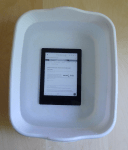
The Aura H2O is also thinner, has a rubberized rear shell, and is waterproof. It meets the IP67 standard for dust and water proofing.

I’m still working on the review, and while I am not ready to give a final opinion I can make a couple recommendation about the Aura H2O vs its immediate competitors.

With a retail of $180, this is a premium ereader and it really only has a couple direct competitors that are readily available. One is the Kobo Aura HD, and the other is the Onyx Boox T68.

First, if you’re trying to decide between the Aura HD and the Aura H2O, I would get the latter model. It is absolutely the better device in many ways, even if you don’t care about the waterproofing. It’s worth the extra $10 on the retail price (but if you can get the Aura HD as a cheap refurb, that is a different case ).

As for the Onyx Boox T68, I can’t offer a definitive answer for which one you should get. They have the same screen size, but the T68 has the older Pearl E-ink screen tech. I liked the open Android on the T68 when I reviewed it in June, including the way it lets me install many different reading apps, but the Aura H2O has a nicer design and better frontlight controls.

If you want to do more with your premium ereader than just read ebooks, get the T68. But if you want the best Epub ebook reader, get the Aura H2O.

It is up for pre-order for $180, and is scheduled to ship at the end of the month.

Review: Icarus Illumina HD E653 (Boyue T61) Android eReader

The Illumina HD E653 from Icarus is one of a handful of new ereaders which combine an E-ink screen with an open version of Android. Starting with the (hacked) Nook Touch and (hacked) Sony Reader PRS-T1, this type of ereader offers the opportunity to expand the ereader to support more features and functions that the manufacturer supplied.

This device is best known as the Illumina HD, but it was actually developed for Icarus by a Chinese OEM called Boyue. I ordered my unit from a Chinese retailer which sold the Boyue T61 without a retail box but with a hefty discount ($99 vs 119 euros). I was able to turn my unit into an Illumina HD by installing the official software update, thus saving a nice sum of money.

Table of Contents[—ATOC—] [—TAG:h2—]

A disappointing frontlight keeps the Illumina HD from having the best ereader hardware at the $99 price, but the open Android OS, graphics chip, and many other positive points make up for that in many ways.

Review Date: 12 September 2014, After owning it for 3 weeks

Pro & Con

Pro

  • Page turn buttons work with many 3rd-party reading apps
  • Runs Android 4.2
  • Solid construction quality
  • Fast page turns (equal to the Kindle Paperwhite)

Con

  • Battery Life
  • Frontlight
  • No Audio
  • No Google Play

Hardware

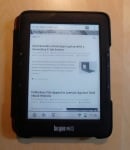
The Illumina HD is an unremarkable looking ebook reader with a 6″Pearl HD E-ink screen. It has a simple design with a black rubberized shell which makes it easy to hold. Cover the logo and its most noticeable feature are the page turn buttons on other side of the screen, and the addition back button on the right and the screen refresh button on the left (a long press on the refresh button turns the frontlight off or on).

This ereader runs Android 4.2 on a dual-core 1GHz Rockchip CPU with a Mali-400 MP GPU, 512MB RAM, and around 4GB accessible storage.  It has Wifi but no audio support. All of the ports and card slots are found on the bottom edge, including the microSD card slot, power button, reset port,and microUSB port.

The Illumina HD is nice to old in one hand, cover or no. The page turn buttons are position just right to rest under my thumb (with either hand).

Battery

Icarus claims that the Illumina HD has a month of battery life, but that’s not really true. In my experience, and this has been confirmed by a couple Illumina owners over at MobileRead Forums, the battery drains itself within 2 to 3 days.

That is a serious issue but luckily this is a common Android problem with an established solution. All i had to do to fix this issue was to install a power management app like Deep Sleep. This app forces all of the processes to go to sleep when you suspend your Android device, this saving battery life.

Screen

The Illumina HD is equipped with a 6″ E-ink display with a screen resolution of 1024 x 758. It has both a frontlight and two-point capacitive touchscreen.

I found the screen to be somewhat picky in responding to my input. I had to be careful when pressing any of the icons near the edge of the screen, otherwise it would ignore the contact. I also noticed that the Illumina HD was slower in responding after I installed the official firmware update; that could be a reason to avoid the update.

The frontlight offers a white color with a broad and highly granular range of settings from dim to almost bright enough to use as a flashlight. Alas, it is also rather splotchy.

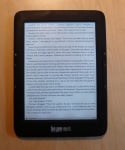
As you can see in the following gallery, the bottom half of the screen visibly blotchy compared to most ebook readers which launched in 2013 or 2014.  It almost as if Boyue is using screens leftover from 2012; the first Paperwhite  showed a similar defect.

Cover

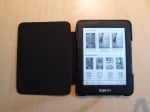
My unit came with a cover (if you buy an Illumina HD from Icarus it will cost extra) which consists of a hard black plastic back with a  stiff brown faux leather front. The Illumina HD is designed to snap into the rear of the cover and never leave it again (it took some effort, trust me). I think the cover may have been intended to work as a smartcover (there is a magnet to keep it closed) but my unit doesn’t work that way.

Software

The Illumina HD ships with a minimum number of apps, including a very adequate reading app (I’m happy with it, anyway), a file manager, notepad, web browser, dictionary, and email. The basics are well-covered, and since this ebook reader runs an open version of Android it’s also possible to install additional apps.

My competitor notes in his review that Icarus ships the Illumina HD with several apps that I don’t have because I got the OEM model. His unit came with Greader, Kindle, and a bol.com bookstore app (my unit was tied to some bookstore in China).

The stock reading app, web browser, and email client all feel like they were tuned to work well with an E-ink screen. I don’t much care to do email on E-ink but it is possible.

There’s more detail on the stock reading app later in the post.

Installing Apps

The Illumina HD does not have Google Play, but there is a workaround. You can use this site to download free apps from Google Play. Also, I successfully installed the Amazon Appstore (I had to install the Kindle app first).

I’ve tested an excess of apps, and found that quite a few will install and run on this device:

  • Web Browsers: Chrome, Opera, Maxthon, Dolphin, Firefox
  • PDF: Repligo, Adobe Reader
  • eBook Apps: Logos, Kindle, Nook, Kobo, CoolReader, Moon+ Reader, Aldiko, Scribd, Oyster, FBReader, Overdrive
  • Office Suites: Docs2Go, QuickOffice Pro HD for Tablets, OfficeSuite Pro 7, Jota+
  • RSS Feed Readers: Feedly, InoReader
  • Other Apps: Pocket, Instapaper, Dropbox, Evernote

Google Play Books and Opera Mini did install but would not run. On a related note, the Nook, AlReader, Moon+, and Coolreader apps were all able to interface with the page turn buttons.

Reading Experience

The Illumina HD has been my main ebook reading device this past week (I started and finished a couple books), and  I liked the stock reading app which shipped on the Illumina HD.

As I pointed out above, you can install any number of ebook apps, but I was happy to mainly use the original app. It doesn’t have as many features as some third-party apps, but the close integration with the main menu and the Books (library) menu made up for a lot.

It’s not fancy, but between the several dozen font choices, dozen margin options, and dozen line spacing options, it is workable app. It even has a separate menu for annotations, but it also lacks a functional dictionary (I can’t get it to work), so you might want to go with another app if that is important to you.

And since you are probably wondering, the stock reading app doesn’t quite have a full screen mode; the closest it comes is the option to have a mini status bar along the bottom of the screen. That is more screen than the Kindle and other reading apps get to use; the Kindle and Aldiko apps specifically can black out the taskbar at the bottom of the screen, but cannot remove or overwrite it.

I would rate the Illumina HD as having a more attractive reading experience than the T68. Yes, I know the screen is both smaller and lower resolution, and the frontlight is blotchy, but as I sit here typing I find that I have a greater desire to go back to the Illumina than I do  to use the T68 Lynx.

To be honest one of the features that kept me coming back were the page turn buttons. I’d forgotten just how much I had liked having them; I wish they were more common on ereaders (and tablets, for that matter).

Verdict

A subset of ereader owners have been interested in an Android  ebook reader ever since the first Nook Touch was released in 2011, and while the Illumina HD isn’t the perfect solution it is best option in its price range.

With a 2012-era frontlight and iffy battery life, the Illumina HD is at first glance far from being the best device on the market. But if you look past those issues then it quickly becomes clear that this ereader is, for a certain type of user, one of the best devices on the market and offers a great value.

The Illumina HD might not have the best screen, but it does has the fastest CPU of any of the ereaders currently – including other Android ereaders like the Onyx Boox T68 Lynx. That gives it a responsiveness  which none of its competitors can match.

It doesn’t have Google Play, but that hasn’t turned out to be as serious of an issue as I had expected. (See the workaround mentioned above.)

With page turn buttons, a recent version of Android, and a microSD card slot, this is IMO the device that Barnes & Noble should have released last year. This is what the Nook Glowlight should have been.

Where to Buy

Now, this is a complicated question. You can buy the Icarus Illumina HD from Icarus, or you can pay less and buy it from a Chinese retailer like BangGood (and then install the Illumina’s firmware update).

Icarus sells this device for 119 euros plus shipping. I got it from BangGood for $99, but they were charging $129 when I wrote this post. The BangGood price includes a case and free shipping but no retail box or – and this could be important – a  warranty.

Specs

  • Screen: 6″ Pearl HD E-ink screen, w frontlight and a
  • Capacitive touchscreen
  • Screen resolution: 1024 x 758
  • OS: Android 4.2 Jelly Bean
  • CPU: 1GHz dual-core Rockchip
  • GPU: Mali 400-MP
  • RAM: 512MB
  • Storage: 4GB internal, microSD card slot
  • Connectivity: Wifi
  • Weight: approximately 200 grams
  • Dimensions: 159 x 112 x 8.5 mm

Intel Reveals a Prototype Laptop with a Secondary E-ink Screen

Intel wrapped up their annual developer’s conference in San Francisco yesterday, but not before revealing several concept designs, including one which recycles an idea for a laptop with an E-ink screen.

Intel’s new laptop looks like any other model while it is open and in use, but close the lid and you’ll discover an E-ink screen on the rear of the lid. The design is only a concept at this point, but it is being described as potentially like an electronic sticker which a user could read ebooks, images, text messages, or news.

"You know how people like bumper stickers on the outside of their laptop? The first idea was just being able to take any image from your hard drive and just post that on the screen," said Taylor Courier, an Intel researcher.

Researchers are also working on similar uses, including reading ebooks, RSS feeds, Facebook status updates,  and text messages. They think that when the laptop is in hibernation mode it will be operating at just enough capacity for the e-ink screen to continue to receive data as the Internet connection remains on.

If you ask me, I’m not so sure that’s a good idea.  A low-power mode still draws power, and if the Wifi is active the drain on the battery can only increase. And since this screen would prove most useful when the user is mobile (and thus the laptop is not plugged in) using the secondary screen comes at a cost which IMO is simply too high.

But the technical downsides might not matter too much because I don’t think we’ll see this in widespread use on the market.

The idea has been floating around since at least 2007, when Intel debuted a very similar concept design at their spring developers conference that year. I can’t recall that anyone ever built a laptop based on this concept. A few models like the Taichi 21 from Asus featured LCD screens on both sides of the lid, but that’s not the same thing. And in any case, that laptop flopped.

ComputerWorld

images via Mobile Geeks, Laptop Magazine

College Students Are Less Likely to Own and Use a Tablet Than the Average 10-Year-Old

While researching yesterday’s post about mobile device use by kids for schoolwork, I came across a related survey report which showed that college students were in some ways lagging behind younger age groups when it came to mobile device adoption and use.

It’s been some time since I last came across a survey which asked these types of questions; aside from the Pew Research Center everyone seems to have stopped asking about device adoption in late 2012 or early 2013.

The 47 page report (PDF) is based on a survey group of 1,228 college students between the ages of 18 and 30. The survey was conducted by Harris Poll in February and March, and was sponsored by Pearson.

Here are the highlights.

Device Ownership

  • 89% of college students own a laptop, down from 91% in 2013
  • 83% own a smartphone, up from 72% in 2013
  • 45% own a tablet, up from40% in 2013

I was not too surprised to read about the high rate of laptop or smartphone adoption, but I was surprised by the comparatively low rate of tablet adoption. It’s been almost 5 years since the iPad launched, and yet less than half of college students own one.

What’s even more surprising is that yesterday’s survey report showed that elementary and middle school students were more likely to own a tablet than college students (51% vs 45%).

I would have expected those figures to be reversed, but in fact the survey found that college students adopt a wait and see attitude with new technology.

  • Over half (54%) said they usually wait until they see others try new technology, and then they try it themselves,
  • 11% tend to wait a long time with new tech, and
  • only 35% described themselves as early adopters.

That wait and see attitude would seem to be in conflict with a later section of the survey which showed that the students were highly optimistic that tablets would change how college students learned. Over 80% thought that, and 66% thought that tablets would replace textbooks, and help students study more effectively.

The combination of optimism and the wait and see policy suggests that students are avoiding the new tech not because of distrust or dislike but because of financial reasons. College is expensive and students are notoriously cash-strapped, leading them to be parsimonious with new purchases – especially expensive ones.

Among those who do own a tablet, most (45%) own a 10″ or larger tablet, while 38% own a smaller tablet and 25% own a medium-sized tablet. And 29% of tablet owners also own a matching keyboard.

Gadgets & Coursework

Of the entire survey group, 89% reported using a laptop for schoolwork at least two or three times a week (basically  everyone who owned one). A far smaller number used their smartphone (53%, compared to an 83% ownership rate). And even fewer used their tablet for schoolwork on a regular basis (33%, compared to an 45% ownership rate).

The usage rates suggest that college students may be adopting the tech but they are adapting it for use with school at a lower rate than their younger counterparts.

It’s going to be interesting to see if that changes as the younger groups age into the college bracket, and possibly bring their device habits with them.

—

You can find the report here (PDF).

images by U.S. Naval War College, www.audio-luci-store.it

Updated: Vook Acquires Byliner, Will Bump Royalties from 50% to 85%

The beleagured boutique digital publisher Byliner has found a solution to their money problems.

Byliner has been acquired by Vook, an ebook startup which specializes in ebook creation and distribution.

Update: Vook and Byliner also sent out an email to Byliner’s existing authors (found via Pando Daily) which revealed that Vook will be ending Byliner’s subscription service (I thought it was dead already) and boosting royalties. I’ve added an excerpt of the email to the end of this post.

Byliner is going to be Vook’s first in-house imprint. While Vook has published its own ebooks in the past (this is how the firm got its start in 2009), Byliner has in the past acted more of a publisher, working with external authors and companies to develop and publish their work. Byliner will continue to operate as it has before.

Vook has announced that they plan to support Byliner’s existing catalog, and acquire new projects for release under the Byliner imprint. "We have always been huge fans of Byliner’s writers and books. We’re looking forward to working with Byliner writers to publish more titles, and to adding new writers to the imprint," said Vook Co-Founder and Publisher Matthew Cavnar.

That is good news for Byliner’s remaining staff and for authors signed with Byliner. This publisher was at one time the pre-eminent boutique publisher of the world’s best short fiction and non-fiction, but it has also been in dire financial straits since this spring. In June Byliner sent out an email which did not say that the publisher was bankrupt but did imply that finances were dire:

We’ve struggled to reach the level of growth we’d been hoping for the business, and thus we’ve begun conversations with possible partners about the future of Byliner. We’re working to find a good home for our platform and your stories, and we’ll be in touch shortly with specifics about your titles.

Byliner is Vook’s second acquisition this year; in February Vook bought Booklr, an ebook analytics startup. The terms of the deal were not disclosed.

Letter to authors:

Dear Byliner Authors & Partners,

Today we are announcing that Vook has acquired Byliner. We wanted to share the good news with you first before issuing a press release. As the CEO of Vook, I also wanted to explain what the acquisition means for the future of Byliner and Vook.

…

As our first step towards giving authors what we believe they deserve from their publisher, we will be increasing your royalty rates across the board to 85% of net revenues. In the coming days, our team will be reaching out to you to answer any questions – and make sure you’re set up to receive your royalties without any delay.

In the spirit of ultimate transparency, something we believe is still lacking in the book industry, we’ve included a question and answer section below.

Q: Will Vook pursue Byliner’s subscription program?

A: No. Vook is focused on publishing and promoting books to successful online retailers and maximizing the value of sales through those channels.

Q: What are Vook’s royalty rates?
A: At Vook, you keep 85% of your net royalties. There are no out of pocket costs and no hidden fees.

Q: Will my books remain on sale in the ebook marketplaces?A: Yes. Your books are currently up for sale and will continue to be for sale without interruption.

Q: What about my backlist content that I have licensed to Byliner?
A: Vook will be talking with authors and agents in the coming weeks about ways we can maximize the value of your work. If you’re curious to talk to us right away, you can reach out to Matthew at [redacted]@vook.com

Q: Is there any way for me to track the sales and performance of my book with Vook?
A: Yes! We’re currently customizing our enterprise tracking tools for Byliner authors. Vook will be contacting you with more information soon.


image by Gastev

Introducing Superbooks – Another Attempt to Reinvent Interactive eBooks

CNN has an article up this morning about a UK-based ebook startup called Inkle Studios and its new type of ebook. Saying that "your reading habits are about to change", the article gushes:

Imagine you could tell Romeo that he doesn’t need to take the poison to be with Juliet, warn Streetcar's Blanche Dubois not to rely on the kindness of strangers, or suggest that Jonathan Harker take his vacation somewhere other than Transylvania.

The power to influence and interact with the stories in classic literature is a tempting prospect, and this is the premise of Inkle Studios' audacious attempt to apply the full possibilities of digital media to fiction. The result is an updated form and experience for the stubbornly progress-proof novel.

While CNN might describe this as innovative and new type of ebook, what we’re really looking at here is another take on interactive ebooks. (Actually, I would describe the app demoed in the video below as a game and not an ebook.) Far from being new, this idea is actually older than me.

What’s interactive fiction? The following video should give you a better idea.

Inkle Studios recently released their version of Around the World in 80 Days, and posted this demo video showing how to play it:

If you discount the interactive fiction games run on servers in the 70s then the earliest interactive fiction would be the Choose your own adventure books from the late 1970s and 1980s.

Inkle Studios' work is a pretty smooth implementation of the idea, but it’s far from innovative. In fact, this is one of those ideas (along with digital textbooks and enhanced fiction ebooks) that keeps coming back every few years as someone comes up with a new take on how to implement it.

Last year alone there were two different interactive fiction projects, one of which is quite similar in concept to the work Inkle Studios is doing.

Last March Linden Labs released Versu, which I described at the time as being a new twist on the old Choose Your Own Adventure Games. That was actually an engine for interactive fiction, and while it was far more focused on text than the ebooks produced by Inkle Studios, it had a number of similarities in game play.

Later in the year Random House UK released the Black Crown Project. This is an online narrative fiction game which is oriented on first-person decisions rather than making decisions for characters.

If you check out those apps you’ll see that they have  much the same idea as Inkle Studios, and you might understand why I am underwhelmed with this latest incarnation of interactive fiction.

Interactive fiction like Superbooks can be fun, but radical? innovative? new? Those are adjectives which don’t fit. This is an established niche where the book publishing industry overlaps the game publishing industry, that’s all.

Authors Continue to Go Hungry in Nook Press Payment Fiasco

Last week numerous authors complained that Nook Press, B&N’s self-pub platform, had missed their most recent payment.

While Barnes & Noble claimed on Monday that this issue had been resolved and that all of the delayed payments would be processed either Friday or Monday, that does not appear to have happened.

Some authors have gotten their much needed royalties, but I now have confirmation from two different authors who have told me that, as of Wednesday morning, they had not been paid.  That payment, which covered sales in the Nook Store in June 2014, was supposed to be sent out in late August or at the very beginning of September.

Due to what B&N described as a glitch in their system, only some authors were paid on time. Others, including authors Robert Swartwood, Georgette St.Clair, and IJ Parker, were left with no money and no explanation. As I reported on Sunday, several authors have said that Nook Press did not respond to emails on this issue.

And now it seems that at least some are still waiting on B&N. On the bright side, the number of unpaid authors is smaller than it was last week.

If you are an author with books at Nook Press, I would strongly urge you to check your bank statements and make sure your funds have been deposited.  If they have not then you should send an email to Nook Press and yell at them about it.

A two week delay in payment is simply ridiculous; the payment terms were 60 days or less, not 60 days plus however long it takes to fix the servers.

Have you been paid, or are you still waiting for the funds?

Twitter Launches Buy Buttons, Enabling Authors to Sell eBooks on the Service

Twitter announced a new service yesterday which indie authors might like.

The social network started a beta test for new buy buttons. The test will only include a small percentage of U.S. users, and it is only visible on Twitter’s mobile apps, so most of us will be unaffected. But in the long run indie authors will have a new sales platform.

From Twitter’s blog:

Users will get access to offers and merchandise they can’t get anywhere else and can act on them right in the Twitter apps for Android and iOS; sellers will gain a new way to turn the direct relationship they build with their followers into sales. We’re not building this alone: we’ve partnered with Fancy (@fancy), Gumroad (@gumroad), Musictoday (@Musictoday) and Stripe (@stripe) as platforms for this initial test, with more partners to follow soon.

In our test, an entire purchase can be completed in just a few taps. After tapping the “Buy” button, you will get additional product details and be prompted to enter your shipping and payment information. Once that’s entered and confirmed, your order information is sent to the merchant for delivery.

Twitter is launching the beta test in partnership with a handful of artists, retailers, and non-profits, including Eminem, Home Depot, and RED. Should this work out the service will be available to all.

This beta test is but Twitter’s latest idea for generating revenue; in addition to adverts inserted into your Twitter feeds, the social network has also long partnered with Amazon and offered features like embedded Amazon product listings and, as of a few months ago, the #AmazonCart hashtag which Twitterati can use to add an item to their Amazon shopping cart.

Kobo Won’t be Launching New Tablets This Year

Kobo is exhibiting at IFA Berlin this week, where they revealed a radical change to their hardware plans. According to lesen.net, Kobo won’t be releasing new tablets this year and will instead be focusing on getting their apps on other companies’s hardware.

When Takahito Aiki took over for Mike Serbinis earlier this year, we knew from his reputation as a turnaround specialist that Kobo could be making some changes in pursuit of profitability. Kobo subsequently laid off 63 staff, and now they’re cutting back on their hardware investments.

Kobo Europe sales director Throsten Schroer is on the record as saying that the tablet market was "a very difficult market in which all manufacturers have to fight". This has led Kobo to decide not to replace the 3 Android tablets they launched last year, thus ending (for now) Kobo’s 3 year long experiment with Android tablets.

This move makes a lot of sense. For some time now I’ve been saying that the market is glutted with decent tablets. This has led everyone from Amazon to Google to scale back their efforts; Amazon still hasn’t leaked a 7″ tablet yet this year, and Google has only just now sent a new 7″ tablet through the FCC.

So long as Kobo had a sugar daddy, they could have ignored market trends and continued to make the huge capital investments necessary to bring new hardware to market, but now that Kobo has to become profitable that’s no longer possible.

And from the sounds of it, I don’t think Kobo is going to be launching any new ereaders in the near future, either, which means that the recently launched Kobo Aura H2O could be Kobo’s only hardware launch in 2014.

Again, that’s not such a bad idea, and it ties in with Kobo’s need to get the biggest bang for their buck. As I pointed out when I covered Kobo president Michael Tamblyn’s interview last month,  Kobo has had to be nimble and focus on areas where the big guys aren’t investing any time or money. And with the market full of budget and mid-priced ebook readers, that left one place for Kobo to go: up market, with premium 6.8″ ereaders like the Aura HD and the Aura H2O.

Cambridge University, PlasticLogic Produce World’s First Flexible Graphene-Based Display

Here’s an interesting new screen tech which has an excellent chance of never reaching the market.

The Graphene Center at Cambridge University, in partnership with PlasticLogic, has just revealed the first graphene-based flexible grayscale display. According to the press release:

Graphene is a two-dimensional material made up of sheets of carbon atoms. It is among the strongest, most lightweight and flexible materials known, and has the potential to revolutionise industries from healthcare to electronics.

The new display prototype was built on a flexible plastic backplane which PL originally developed for use in ebook readers. The tech is quite similar to the Mobius screen tech which E-ink debuted last year, except in the case of the prototype it has yet to leave the lab.

In its ideal state, graphene consists of nothing but carbon, giving it a shade of black which is unmatched by existing epaper screens on the market, including screens produced by the market leader E-ink.

If this tech makes it out of the lab and into production, it could offer a screen which is much blacker than existing E-ink screens. But as you can see in the following video, this is still an early prototype and still has a ways to go before it is as fast as existing epaper screens:

As cool as this is, it’s still coming to the screen tech market late in the game. It’s competing against an established tech which might not be as good, but already has the bugs worked out. This could well preclude a startup working on a graphene display from getting enough funding to finish development, thus keeping the tech off the market – at least until E-ink buys the tech and incorporates it into their products (I am not predicting it, but I would not be surprised if that happened).

Adobe Releases Digital Editions 4.0 Featuring inComplete Support for Epub3

Beating the third anniversary of Epub3 by about a month, Adobe released a new version of Adobe Digital Editions today.  Now publicly available for OSX and Windows, Adobe DE 4.0 is the first version of this app to officially support Epub3 – such as it is.

The new app supports many parts of the EPub3 spec, but according to the release notes there are still a few features which have been left out.

Update: Adobe goofed on the release notes. They now say that they forgot to remove from the release notes issues which had been resolved or fixed in this release.

For example, Adobe DE 4.0 does not support embedded audio or video, and it is also lacking support for basics like right to left languages (Arabic, Hebrew, etc) . The search function is incomplete, and the app is also lacking advanced rendering features (such as knockout, overprint, and non-separable blend modes). And last but not least, mouse wheel scrolling is officially not supported for Epub3 ebooks.

And it gets worse for Windows users. This version of the app is also lacking MathML support, and it does not play well with IE9. The Windows app will also ignore several lesser features, including wbr, which is used to indicate where to split a word when hyphenating.

In addition to the incomplete support for Epub3, several bugs have also been mentioned in release notes, including memory management issues caused by large image files and other issues.

While I would normally encourage readers to rush out and get the new app right away so you can play with it, I think it might be better to wait until more of the bugs are worked out and more features are supported. But if you would like to try Adobe DE 4 and experience the joy of Epub3 for yourself, you can download the app from Adobe.

EPUB2Twitter lets You Embed an Epub eBook in a Tweet

Authors have long been told that they should promote their books on Twitter, but until now there was no easy way to embed a sample of an ebook in the service so it can be read without leaving Twitter.

That changed today. I’ve just learned that a Japanese ebook retailer has developed a simple service that will take an Epub and return a link which can be tweeted.

The service is called EPUB2Twitter Tw-ePub and that it is open to the public. It enables authors to upload an Epub, add a title and brief description, and then generate a link which can be added to a tweet.

You can test the service for yourself here. When tweeted, that link triggers Twitter’s embed protocols, making it load an Epub viewer. I already tested it in a tweet, which you can view here. The resulting embed looks something like this:

That’s not a good screenshot, I know, but this does work out in practice. I’ve been playing with this service this morning, and it generates a readable Epub with a few basic features like text that can be highlighted and copied. It is a little slow, but given that it loads the Epub before displaying it that is to be expected.

If you like, you can see the same Epub displayed in your web browser.  I don’t know who developed this web app but it is pretty good.

ITmedia.co.jp


The $69 Kindle is Out of Stock – Could This be a Sign of a New Model on the Way?

Initially released in late 2011, the basic Kindle set a new standard in the ebook reader for minimal features at minimal price. With only minimal hardware updates (it was re-released in 2012 in black), it has proven to be a mainstay in Amazon’s dominance of the ebook reader market.

And now it seems to have begun to go out of stock.

Update: A replacement model leaked. It’s going to cost a little more and come with a touchscreen.

My competitor noticed earlier today that the budget-priced Kindle is no longer quite so budget priced. The ad-supported model which sold for $69 is no longer available on Amazon.com, and not so coincidentally, the $89 international model is not available either.

Amazon has replaced the buy button for these two models with links to marketplace sellers which have them in stock – a telling detail, IMO. When Amazon runs out of an item, they usually tell you how long you will have to wait before new stock arrives. The absence of that estimated arrival time raises questions as to whether the models will be back in stock.

Update: The full priced basic Kindle is no longer available directly from Amazon.com, either.

While Amazon is still selling the full-priced version of this ereader for $89 (and it is still in stock on several of Amazon’s European websites), the stock issue with the ad-supported model has my competitor wondering whether Amazon is going to upgrade it with a new model.

I’m not so sure.

The thing we have to keep in mind with the basic Kindle is that it is designed to be the cheapest Kindle which Amazon could make.  I don’t see Amazon upgrading it, not unless the replacement can be made as cheap (or cheaper).

What’s more, this Kindle model hasn’t received a firmware update since January 2013. It’s missed out on several major feature changes, including Goodreads integration. That suggests that Amazon is not investing in this model because they don’t have any plans to keep it around.

In short, I think this model is on the way out.

If I were going to speculate, I would posit that either Amazon has decided they don’t need a cheapie Kindle any more, or they could be planning to replace it with a Kindle Paperwhite whose price was knocked down to (say) $99.

Given the shrinking ereader market and the rise of reading ebooks on tablets and smartphones, I think the first possibility is the more likely one.

But this is pure crystal ball territory, so your guess is as good as mine.

French Railway SNCF Launches Free Digital Reading Program

Rail travelers have a lot of time on their hands but they don’t always have a good book to fill it, and that’s why SNCF has launched a new digital library program.

Passengers riding on the French state railway can now take advantage of a selection of free public domain ebooks. Developed in partnership with Storylab and Parallel Publishing, the bibliothèque digitale TER offers short reads which can take anywhere from 15, 30, 45 minutes, to 1 hour , perfect for short trips.

The program also features full-length public domain novels, including free classics of French literature like La Fontaine’s Fables, Emile Zola’s Germinal, the Saturnine Poems by Paul Verlaine, and many others.

In addition to the free works, readers can also buy ebooks, with prices starting under one euro. I have fewer details on that, so any first hand accounts would be appreciated.

There’s long been an emotional connection between books and the rail, leading a number of cities to equip their commuter stations as digital libraries. The idea is still uncommon, but cities as diverse as Philadelphia, Bucharest, and Mexico City have started programs which enabled riders to download ebooks as they pass through certain stations.

According to Boersenblatt, this digital library grew out of SNCF’s plans to equip all stations and express trains with Wifi. I would bet that it was also influenced by similar program which launched in Spain in 2012, or the program that Piper Verlag started in Germany in February of this year.

ArchiMag, Boersenblatt

Blockbookster