First Impressions of the Boyue T62 Android eReader

After 3 weeks of impatient waiting, my newest ereader has finally arrived.

The Boyue T62 is the next gen follow on to the T61, aka the Icarus Illumina, aka my preferred ebook reader. According to the specs it has twice the storage and audio support with basically all the same buttons, ports, and card slots as the T61 (more details here).

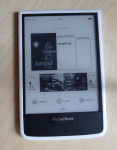
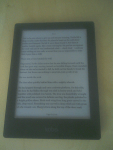
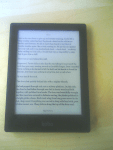
Now that it is sitting on my desk, I can tell you that the T62 is a somewhat thicker and somewhat heavier sibling to the T61, and that the T62 has a sleeker and more curved design.

The T62 is on the left, aand on the right is the T61 which I reviewed last month.

Most importantly , I can also say that it has a somewhat improved frontlight. This last is not as good as on last year’s Kindle Paperwhite, but it is noticeably less splotchy and more evenly white than the frontlight on the T61.

In use, the T62 is more responsive than the T61. It seems to either have a better touchscreen or a better driver for the touchscreen, but either way it works better.

Speaking of which, I have also been playing around with the software. While the T62 and the T61 both run Android 4.2.2, they do not run the same firmware. I’ve already noticed that the newer model has a couple features that I don’t have on the T61, including the option to remove the taskbar from the bottom of the screen. (I think there is supposed to be a trick to make it pop up, but I can’t figure out how.)

And while we’re on the topic of software, does anyone want me to test any Android apps?

I was thinking of repeating the tests I ran for the T61. Or do you think it is safe to assume the T62 can run all the same apps as the T61?

The T61 was already my preferred ebook reader; I like the page turn buttons, case, and the ability to install Android apps. But after a day I think I may have found a replacement. It’s a shame I didn’t also order a case; I think the T62 could be a permanent addition to my gear bag.

A full review will be up the weekend after next. Until then, here is a demo video from Banggood, the Chinese retailer which sold me my T62. (You can also find the T62 on Amazon.)

The New 10″ Galaxy Tab 4 Nook is Now (Secretly) in Stores

Thanks to SEC filings we’ve long known that Barnes & Noble was under contract to release a 10″ Samsung Galaxy Tab Nook, and now it seems they have started to arrive.

My inside sources have told me that B&N stores have started to receive demo units, and that they’re not being put out just yet. Instead I’m told that the demo units are being shown to educators who are being given first dibs on pre-orders.

I don’t understand that either, but if you want to see it, I would stop by a store and ask; I doubt they will refuse to show off the device or take a pre-order.

According to the specs B&N posted on the Nook developer pages, the co-branded Samsung Galaxy Tab 4 Nook 10.1 will be running Samsung’s flavor of Android 4.4 KitKat on a quad-core 1.2GHz CPU with 1.5GB RAM and 16GB internal storage.

It also has Wifi, Bluetooth, GPS, a pair of cameras (1.3MP and 3MP), and a microSD card slot. The 10.1″ display has a screen resolution of 1,280 x 800.
Weighing in at 487 grams, the new Tab Nook measure 8mm thin and has a 6.8Ah battery which is specced for 10 hours of web browsing.

I have not seen one of the 10″ Tab Nooks, but the 7″ model is in all the important ways a Samsung Galaxy Tab, with additional Nook software. That model launched just under 2 months ago.

The new 10″ Galaxy Tab Nook is due to ship on 22 October, when it will be selling for $299, down from a recommended retail price of $349. I still don’t have confirmation that consumers will be able to get one on that day, but I do have reliable sources that say it will be available.

Of course, if you don’t want to wait you can always get a Samsung branded unit. They’re widely available, including at Amazon where it is selling for $291.

Tolino, aka Germany’s Answer to the Kindle, Expands into Italy, Netherlands

Germany’s response to the Kindle gained its third non-German partner this week, the leading Italian retailer IBS.it. IBS will be selling ebooks on its site starting in November, and will also be promoting Tolino tablets and ebook readers in store.

With 44 owned and partner bookstores, IBS.it has a far smaller retail foot print than Mondadori (350 stores), Kobo’s partner in Italy, or Giunti al Punto (170 stores), Amazon’s partner in Italy. It’s difficult for this outsider to estimate market share, but I see that the local coverage mentions that IBS.it serves 2.8 million customers annually.

Formed early last year as a response to the Kindle, Tolino is a shared ebook platform which is supported by 5 German medial retailers and tech companies ( Thalia, Weltbild, Hugendubel, Club Bertelsmann, and Deutsche Telekom). It was originally a German response to Amazon, but over the past few months this coalition has taken on a decidedly regional flavor.

In July the Belgian retailer Standaard Boekhandel launched an ebookstore on the Tolino platform, followed last month by the Dutch bookstore coop Libri, and in November the Italian retailer IBS.it will follow suit.

With the addition of IBS, Tolino will have retailers spread across 4 countries in central Europe with around 1,500 retail stores in Germany and 300 stores in other countries.

Will that be enough to counter Amazon?

Well, it’s not enough to defeat that juggernaut but it does at least seem to be holding Amazon at bay. Boersenblatt quotes Nina Hugendubel, managing partner of the bookstore Hugendubel, as saying that the Tolino platform had around 35% of the German ebook market.

That is somewhere in the same neighborhood of the market share Tolino had when it launched last spring, so at worst you can say that Tolino has been treading water as the ebook market grew. And given Germany’s fixed price book laws, and the way such laws discourage customers from shopping around, I’m not sure one could have expected real market disruption.

Note though, that holding steady isn’t necessarily a criticism of Tolino as an idea; it was formed as much to pool resources and reduce costs as a response to Amazon. While the member retailers each have their own ebookstore, they share platform costs and development costs for Tolino’s ereaders and tablets, including the waterproof Vision 2 ereader which was announced earlier this week.

Boersenblatt

It’s Official: Kobo is Getting Out of Tablets

Earlier today Kobo confirmed the hints they dropped last month at IFA Berlin: tablets are yesterday’s news.

Speaking to The Bookseller, Kobo president Michael Tamblyn explained that tablet devices were no longer a focus area for the company. Instead Kobo will be turning their attention to apps on other company’s hardware. Tamblyn said: "We found people were just as happy reading through an app on devices than they were reading directly on tablets."

Kobo is now going to turn their hardware attention to maintaining 3 ereaders: the Touch, Aura, and the recently launched Aura H2O. Unfortunately, future plans don’t include a replacement for the 5″ Kobo Mini, alas.

When asked if Kobo was backing out of the tablet market to focus on those three ebook readers, Tamblyn added: "That is something you are generally going to see across all our retailer relationships. The tablet devices we already have out there will continue to be sold, but we are not at this point planning any new tablets."

Kobo has always been a small fry in the tablet market, and they’ve never really had the market share to afford the option of being aggressive in promoting their own hardware.  This put them in a catch 22 situation where they kept being outshouted by larger competitors with bigger marketing budgets and better brand recognition.

And when Takahito Aiki took over for Mike Serbinis earlier this year, the high capital cost of Kobo’s tablet program probably made it a key candidate for that turnaround specialist to put on the chopping block.

Kobo’s new policy resembles Amazon’s current ereader plan, which comprises of 3 Kindles (not counting other hardware like the Fire tablets, etc) and largely runs contrary to B&N’s hardware plans, which consist of a single ereader and a commitment to sell a million units of a pair of co-branded tablets.

HarperCollins Signs Deal With Bookmate – but Not Kindle Unlimited

The growth of the subscription ebook market continued apace today with the news that HarperCollins had signed a deal with Bookmate.

Bookmate, which is primarily focused on Russia and ebook markets in eastern Europe, will now be able to offer its 1.5 million users ebooks published by HC. No one is talking specifics on the numbers, but the press release does say that "books by hundreds of authors, including CS Lewis are included in the deal".

Simon Dunlop, founder of Bookmate, commented: “This is a big moment for Bookmate. Our users get access to thousands of great new ebooks in English and the recent partnership we have signed is a massive vote of confidence from the publishing industry.”

The service offers a catalog of 500,000 titles which can be read on social reading apps for Android and iDevices. Bookmate recently updated the apps with a social feed which allows readers to follow their friends, favorite authors and celebrities on Bookmate, while also sharing their favorite books and passages.  According to Bookmate, users on average spend 54 minutes a day reading ebooks.

I’ve covered Bookmate in the past, including how it has picked up funding from a leading Russian retailer, its reasons for focusing on certain markets (where piracy is an issue), and how its business model differs from Scribd’s. So I won’t repeat any of that here.

But I will note that Bookmate has a deal which Amazon has not yet secured for Kindle Unlimited. Following the deal between S&S and Denmark-based Mofibo, this is the second time in only a couple weeks that a smaller ebook subscription service scored a contract with a major US trade publisher which Amazon could not get.

I think we’re seeing the start of a trend of Amazon being shunned in this market (for want of a better word).  If it continues then Kindle Unlimited could well be put at a disadvantage.

This trend, if it exists, could well explain the speculation that Amazon is about to open up Kindle Unlimited to all KDP authors – with no exclusivity required. This would give Amazon a significantly larger catalog, and what’s more the idea is already getting positive responses from some indie authors.

Bluefire Comments on Adobe Spying Scandal: It’s Not Our Thing, Baby

Following in the wake of the news that Adobe was tracking users' activities and then uploading the data to their servers without encryption, many ebook users, including librarians, readers, and even those in the digital publishing industry are wondering just how safe other Epub apps actually are.

At the request of several readers, I checked with Bluefire, one of the leading developers of Adobe compatible Epub apps. Bluefire makes an reading app for Android, iDevices, and Windows, but they use a very different standard when it comes to privacy:

We have been asked if we perform similar data collection in our free Bluefire Reader apps. The answer is No. While our apps are built on Adobe Reader Mobile SDK (RMSDK) versions 9 and 10, we are not aware of similar data collection by Adobe in these SDKs.

We do support an optional Bluefire developed sync feature that (when enabled by the user) sends anonymous, encrypted data to our servers. This data is used to sync the user’s reading location across the user’s activated reading devices. We also collect a limited amount of anonymous aggregated usage information. All of this is spelled out in our “Terms and Conditions” and “Privacy” statements.

We want you, our users, to know that we respect and value your privacy. While it is true that some technologies (like page location sync) require the transmission of user data, we believe that it is essential to implement these services in a manner that respects and protects the privacy of our users. We believe that our current apps meet this standard.

For those just tuning in, on Monday I broke the news that the latest version of Adobe Digital Editions was logging my reading activities and uploading the data to their servers in clear text. This feature, which has not been found in earlier versions of Adobe DE, was added for no clear reason. It involved collecting detailed into on everything a reader was doing inside of an ebook, including pages read, ebooks opened, and more.

Adobe defended the tracking with the claim that the data was "collected solely for purposes such as license validation and to facilitate the implementation of different licensing models by publishers". I’ll leave it up to you to decide whether knowing which pages had been read will help with that purpose.

As for me, I will simply remind you that the data was sent in the clear.

Pioneering Digital-Only Magazine "The Magazine" to Close By the End of the Year

Once heralded as the future of news publishing, The Magazine is about to suffer the same fate as many startups: it will be shutting down in just over 2 months from today.

Glenn Fleishman, owner and publisher of The Magazine, announced the news today on its website and added more details on his blog. The last issue will be published on 17 December, after which all existing subscriptions will be cancelled and pro-rated refunds offered either through Apple or directly to readers.

Launched in late 2012 by Marco Arment, the creator of Instapaper, The Magazine was the poster child for subcompact publishing, a new type of minimalist digital publication that focused on a handful of great stories published at regular intervals. The Magazine was not the first to try this idea, but it was the most visible example and it inspired great hope in news organizations that there was a way to go forward.

Sadly, while there was a lot of hope, there wasn’t all that much money. Fleishman reveals that The Magazine had seen declining subscription rates since the first buzz wore off:

My labor of love the last two years has been The Magazine, first as its hired hand and then, in May 2013, as its owner. The sad truth has been that, while profitable from week one, the publication has had a declining subscription base since February 2013. It started at such a high level that we could handle a decline for a long time, but despite every effort — including our first-year anthology crowdfunded a bit under a year ago — we couldn’t replace departing subscribers with new ones fast enough. We’re a general-interest magazine that appeals to people who like technology, and that makes it very hard to market. "Pivoting" to a different editorial focus would have lost subscribers even faster.

The Magazine will be survived by an industry which it inspired, including the subcompact publishing platform TypeEngine, where the publication had been based for the past couple months.

While I won’t speculate why it failed, I will add that I thought The Magazine represented a transition stage in what could have been the rebirth of the news industry.  I thought that subcompact publishing applied the idea of startup to publishing, and would inevitably lead to some publications growing out of that stage and becoming full-fledged media organizations.

Many blogs went through a similar growth cycle, but unfortunately The Magazine has come up against the reality of startups: many fail, and only a few succeed.

Adobe Responds to Reports of Their Spying, Offers Half Truths and Misleading Statements

They may be a day late and a dollar short, but Adobe has finally responded to yesterday’s news that they were using the Digital Editions 4 app to spy on users.

Adobe hasn’t addressed all of the evidence against them, but they did admit that they were gathering info from users. They won’t admit to scraping my library, but they did admit to tracking a user’s activities. Adobe claims that it was covered by the their privacy policy and by the TOS for the app:

Adobe Digital Editions allows users to view and manage eBooks and other digital publications across their preferred reading devices—whether they purchase or borrow them. All information collected from the user is collected solely for purposes such as license validation and to facilitate the implementation of different licensing models by publishers. Additionally, this information is solely collected for the eBook currently being read by the user and not for any other eBook in the user’s library or read/available in any other reader. User privacy is very important to Adobe, and all data collection in Adobe Digital Editions is in line with the end user license agreement and the Adobe Privacy Policy.

I don’t know about you, but I don’t see how sending a user’s reading history in clear text over the web could possibly be in line with a privacy policy.

On a related note, I took some time today to read the TOS for Adobe Digital Edition 4, and I do not see where it gives them permission to track user behavior, much less upload said tracking data in the clear. What’s more, I have also heard from a couple other techies who also read the TOS and were unable to find mentions of this program.

Update: Robert has pointed out in the comments the relevant section of Adobe’s privacy policy, which you had to find on the Adobe website, and not the TOS I agreed to when I installed ADE 4.

I have asked Adobe for an explanation on this last issue, and I will update this post if they respond. Sadly, I don’t expect that to occur; Adobe has not responded to my emails on this issue (I got this statement second-hand from Rich Bellis of DBW).

Update: I am in discussion with Adobe on this and other issues.


Adobe Digital Editions 3 Probably Safe From Adobe’s Spying, Experts Say

It has been some 16 hours since I first broke the news that Adobe was spying on anyone who installed and ran Digital Editions 4, Adobe’s latest and greatest ebook app, and while I still do not have a response from Adobe I do have some new information to share.

I have followed up on this story and looked into the earlier versions of Digital Editions, just to see how long Adobe may have been spying on users. After testing DE2 and DE3 I can report, and others can confirm, that neither app appears to be tracking my reading habits nor uploading details about my ebook library.

The older apps do send some information to Adobe, but the data packet is small enough that it can’t hold much more than info required to authorize the DRM. So if you need one of Adobe’s apps, you do have safer options than DE4.

Adobe DE 3 can be downloaded from the Adobe website.

While the news about the older versions of Adobe DE is not enough to get me to use an Adobe app again, I thought this information could prove useful for librarians, teachers, and industry pros. Speaking of which, my story yesterday is taking on a life of its own and it turns out to have ramifications which I hadn’t considered.

This isn’t just a privacy violation any more; now there are concerns about how this breach would violate NDAs. According to Richard Pipe of Infogrid Pacific:

We have thousands of publisher books on our production workstations, many under non-disclosure agreements. Fortunately we have not yet rolled ADE4 out for testing (because it can’t handle inline images amongst other silly things).

This is a timely warning of corporate irresponsibility. We will ensure our publisher production contacts are all made aware of this. From a production facility perspective this is somewhat intimidating. If someone wants to ADE4 test a book under non-disclosure it will have to be on an isolated workstation modified as Michael mentioned. For us that will become a production services sales feature!

I didn’t directly discuss this need for security in my post yesterday, but it was at the back of my mind. It was safe to assume that someone’s corporate IT dept would run security tests on the new app before deploying it, so Adobe should have known that this privacy and security breach would have been caught and likely publicized.

In any case, if you are looking for an alternative to Adobe Digital Editions, the older versions still work. But if you wish to avoid Adobe entirely, as I plan to do, you could try competing apps like Bluefire Reader for Windows.

Independently developed by Bluefire, this app was released earlier this year. I’ve run it through the same check that revealed Adobe’s spying, and so far as I can tell it does not spy on you. (Adobe has made me so paranoid that I am still double checking this.)

Bluefire does offer the feature of syncing your reading position between the Windows app and Bluefire’s apps for Android and iOS, so you can expect them to send at least some info back to their servers, but that feature is optional and this app does not require that you log in.

To be fair to Adobe, all of the major ebook platforms offer the option of syncing your reading position, and that does require that information be uploaded to their servers. But one would also expect that the info is transmitted in a secure manner, and not left visible to all and sundry.

Speaking of syncing options, Adobe might have been tracking the reading position with plans to offer a sync option of their own. I am told they have an Adobe DE iPad app in the works, and I can see that syncing between the PC app and the iPad app would be a useful feature.

However, this still does not excuse the lack of security, nor does it excuse the fact that Adobe scanned my ebook library and uploaded the metadata.  That is beyond the pale.

image  by nolifebeforecoffee

Adobe is Spying on Users, Collecting Data on Their eBook Libraries

Adobe has just given us a graphic demonstration of how not to handle security and privacy issues.

A hacker acquaintance of mine has tipped me to a huge security and privacy violation on the part of Adobe. That anonymous acquaintance was examining Adobe’s DRM for educational purposes when they noticed that Digital Editions 4, the newest version of Adobe’s Epub app, seemed to be sending an awful lot of data to Adobe’s servers.

This episode also highlights why users should understand what data the digital tools they rely on collect, whether that is an ebook application, an analytics service, or a creator platform such as Linklay.

My source told me, and I can confirm, that Adobe is tracking users in the app and uploading the data to their servers. (Adobe was contacted in advance of publication, but declined to respond.)  Edit: Adobe responded Tuesday night.

Update Timeline

And just to be clear, I have seen this happen, and I can also tell you that Benjamin Daniel Mussler, the security researcher who found the security hole on Amazon.com, has also tested this at my request and saw it with his own eyes.

Adobe is gathering data on the ebooks that have been opened, which pages were read, and in what order. All of this data, including the title, publisher, and other metadata for the book is being sent to Adobe’s server in clear text.

I am not joking; Adobe is not only logging what users are doing, they’re also sending those logs to their servers in such a way that anyone running one of the servers in between can listen in and know everything.

But wait, there’s more.

Adobe isn’t just tracking what users are doing in DE4; this app was also scanning my computer, gathering the metadata from all of the ebooks sitting on my hard disk, and uploading that data to Adobe’s servers.

In. Plain. Text.

And just to be clear, this includes not just ebooks I opened in DE4, but also ebooks I store in calibre and every Epub ebook I happen to have sitting on my hard disk.

Update: Further testing has revealed that the files being scanned were actually on my ereader, not my HD. I had not used ADE to load the files on to the ereader, and yet the app scanned them, made a list, and uploaded the list to Adobe.

And just to show that I am neither exaggerating nor on drugs, here is proof.

The first file proves that Adobe is tracking users in the app, while the second one shows that Adobe is indexing my ebook collection.

The above two files were generated using data collected by an app called Wireshark. This nifty little app can be used to log all of the information that is sent or received by your computer over a network. Muussler and I both saw that data was being sent to 192.150.16.235, one of Adobe’s IP addresses. Wireshark logged all of the data sent to Adobe, and on request spat out the text files.


This is a privacy and security breach so big that I am still trying to wrap my head around the technical aspects, much less the legal aspects.

On a technical level, this kind of mistake is not new. Numerous apps have been caught sending data in clear text, and others have been caught scraping data without permission (email address books, for example). What’s more, LG was caught in a very similar privacy violation last November when one of their Smart TVs was shown to be uploading metadata from a user’s private files to LG’s servers – and like Adobe, that data was sent in clear text.

I am sharing these details not to excuse or justify Adobe, but to show you that this was a massively boneheaded stupid mistake that Adobe would have seen coming had they had the brains of a goldfish.

As for the legal aspects, I am still unsure of just how many privacy laws have been violated. Most states have privacy laws about library books, so if this app was installed in a library or used with a library ebook then those laws may have been violated. What’s more, Adobe may have also violated the data protection sections of FERPA, the Family Educational Rights and Privacy Act, and similar laws passed by states like California. (I’m going to have to let a lawyer answer that.)

And then there are the European privacy laws, some of which make US laws look lax.

Speaking of Europe, the Frankfurt Book Fair is coming up later this week. Adobe will be exhibiting at the trade show, and something tells me they will not be having a nice trip. (I for one hope that the senior management is detained for questioning.)

In any case, I would highly recommend that users avoid running Adobe’s apps for the near future – ever again, for that matter. Luckily for us, there are alternatives.

Rather than use Adobe DE 4, I would suggest using an app provided by Amazon, Google, Apple, or Kobo. Amazon uses the Kindle format, and each of the last three ebook platforms uses their own unique DRM and Epub (-ish) file format inside their apps. (While Google and Kobo will let you download an ebook which can be read in Adobe DE, that DRM is not used internally by either Kobo or Google.)

None of those 4 platforms are susceptible to Adobe’s security hole.

Of course, I can’t say for sure whether those platforms are more secure and private than Adobe’s, but I’m sure they will be made more secure in the next few weeks.

images by arturodonate, ukCWCS

Amazon to Update Older Fire Tablets to New Fire OS, Could Bundle Washington Post App with it

Amazon is giving existing Fire owners a couple reasons to hold on to their older tablets. Last year’s devices are going to be getting a firmware update, and what’s more there are reports that Amazon plans to offer a Washington Post app.

The retailer sent out a notice over the weekend to existing Fire tablet owners, sharing the good news. According to the one I got, my existing Kindle Fire HD (2013) will be updated to Kindle OS 4 Sangria.

This version of Fire OS shipped on the Fire HD 6 and Fire HD 7 last week, and it will be coming to all third generation Fire tablets. It’s based on Android 4.4 KitKat, and includes better power management options, Family Library sharing options, and Firefly, the Fire Phone feature which enabled users to use their camera to identify products.

For the record, Amazon actually announced that the older hardware would be updated when the new OS was announced in mid-September. I missed the news at the time, so i thought it was worth sharing.

In related news, BusinessWeek is reporting that the Bezos-owned Washington Post is working on a curated news app which will be bundled with the Fire tablets. Dubbed project rainbow, the app is being developed by a team led by Kerry Lauerman, the former editor-in-chief of Salon.com:

For the past few months, a group inside the Post has been working on a new application that will offer a curated selection of news and photographs from the daily newspaper in a magazine-style, tablet-friendly format. The application will come preinstalled on Amazon’s newly updated Kindle Fire tablet, expected to be launched later this fall with the larger 8.9-inch screen, according to people with knowledge of the Post’s plans.

The app will initially be free in the larger Fire tablet, and will later be made available to other Fire tablets and Android tablets as well as for iDevices. BW says that there will be a subscription fee, though of course there’s no info on how much that will cost.

And while this is pure speculation, I am expecting the app will be bundled with the Fire tablet in much the same way that Kindle Freetime Unlimited is bundled. That other service is also paid service which has to be paid for when activated.

This is a bold move for the Washington Post but it could well prove a bust. While the WaPo has expanded staff and revamped their coverage since the newspaper was acquired by Jeff Bezos last August, its rival the NYTimes has recently cut staff and killed an app that could well be bellwethers for how consumers get their news.

Last week the Neiman Journalism Lab reported that the NYTimes was killing the NYT Opinion app.  This app offered access to just the editorial content of that paper, at a premium. While it proved well-liked, the app didn’t pick up enough users to justify its expense.

If I had to guess, I would expect the new Washington Post app to suffer a similar fate. IMO readers don’t want to pay more for less content; they want to pay less for more content. That’s why apps like Flipboard and why feed reader services like Feedly are so popular.

There’s Something Missing From This College Bookstore: Books

Remember that Florida university with the bookless library? Here’s one with a bookless bookstore.

Lynn University, a small private school in Boca Raton, FL, went to a digital-first curriculum last year, and this year they’re following up that bold move with an even bolder one. Paving the way for B&N, this liberal arts school has removed all of the books from its bookstore:

Lynn University has removed some merchandise from its campus bookstore — books.

Almost every book needed for the 300 classes offered at the liberal arts university in Boca Raton are available by digital download. So officials decided a traditional book store was no longer needed.

It’s now been renamed the "Campus Store" and has aisles of iPad cases, shirts, coffee mugs and water bottles where textbooks once sat.

Students who prefer to read on paper can still buy traditional textbooks, but they now have to order them online.

As I reported last year, Lynn University has been working towards a digital-first curriculum for several years now. Following a pilot in the 2012-2013 school year, last fall the school issued iPad Minis to all of its incoming freshman class of 600 students.

I don’t have any specific details on how that worked out, but the school is clearly satisfied with the result; this year Lynn University went fully digital and issued iPad Minis to the full student body – 2,300 students in all.

While most schools would not be able to make this move without forcing students to spend a huge amount on expensive and nonreturnable digital textbooks, Lynn University says that they have an advantage. Most of their curriculum is produced in house, and that enables the school to pass the savings along to students.

"We’re committed to putting students first, and the transition to a virtual bookstore not only meets their needs, but also saves them time and money," said Chief Information Officer Chris Boniforti. "Course materials and books are shipped directly to the student’s door and downloadable content is sent straight to their iPad."

According to the press release, most of the textbooks are faculty produced, and can be downloaded for free. As a result, the average first-year business student reportedly spent close to $29 on textbooks, far less than the hundreds if not thousands that student would spend at other business schools.

images by quinn.anya, Johan Larsson

Review: Pocketbook 650 Ultra

 The Pocketbook Ultra is one of those devices that looks better on the drawing board than in real life.

It combines an innovative design (rear page turn buttons and a 5MP camera) with poor and buggy software and a disappointing screen, resulting in an ereader which is easily the worst model released in 2014.

I bought my unit  in early September, and between the shipping cost and retail I paid $240. It was not worth it.

Table of Contents
[—ATOC—] [—TAG:h2—]

Pro & Con

Pro

  • If you have too much money on your hands, the Pocketbook Ultra is one way to fix the issue.
  • The parts of the Pocketbook software and bonus apps that weren’t completely buggy were nice, yes.

Con (Pretty much everything)

  • Screen
  • Frontlight
  • Nonfunctional OCR software
  • Page turn buttons
  • Buggy reading software

Hardware

At 7.9mm thin, the Ultra is one of the thinner ereaders on the market, rivaling even the Kindle Voyage. It has a 6″ Carta E-ink screen with frontlight and touchscreen, and it runs Pocketbook’s proprietary OS on a 1GHz CPU with 512MB RAM and 4GB internal storage.

The Ultra is available in 3 colors (white, green, brown), and in the absence of a black model you will want to get the brown one. (I’ll explain this later.) My unit was white.

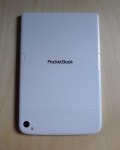
It had a smooth white back with a black front inset in a white frame. There are two page turn buttons in the center of the left and right edge on the back, and on the front you’ll find four mystery buttons  below the screen. The power button, headphone jack, microSD card slot , and microUSB port can be found on the lower edge (the last two are hidden under a flap.)

All in all, this is a solidly built ereader, but it has many problems. The mystery buttons below the screen add confusion, and the stiff page turn buttons add frustration. Between those buttons and the general poor screen quality this is one design that should never have been released to the public.

Screen

The Ultra supposedly has a Carta E-ink screen, but you would not be able to tell that from looking. This ereader has a fuzzy and gray screen which is noticeably inferior to the E-ink screen on pretty much any other ereader.

In part this is due to the white shell making the screen look gray, but it is also the fact that the frontlight and capacitive touchscreen layer degrade the screen quality. (This is why you should get the brown unit, and not white).

Speaking of the frontlight, I think it is the worst one I have seen this year – and that includes the splotchy frontlight on the Boyue T61. I’m not sure how Pocketbook did it, but the frontlight on my Ultra actually makes the screen look more gray and fuzzier when it as turned up to full power.

I don’t know how they did it, but part of the reason I noted this issue is that the frontlights on the Aura H2O and on the Boox T68 Lynx tended to make the screen look whiter and clearer as the brightness increased.

With those other ereaders, I liked to have the frontlight (even when I don’t need it) set to the lowest setting so that the screen would look whiter. But when I used the Ultra I kept the frontlight off most of the time; it was that unpleasant to use.

Battery Life

As I sit here writing this review on Saturday, my Ultra is sitting on my desk charging. I’ve been using it for a couple weeks as my main ebook reader, and today is the second time that I needed to charge it.

Based on my experience I would estimate the battery life to be about 6 or 7 days, with the frontlight off. That’s not amazing but it is in line with many other ereaders.

Camera

The Pocketbook Ultra ships with a 5MP camera, with flash.  Even though it was difficult to see what you were photographing on the E-ink screen, the camera still worked well at capturing utility quality photos.  The flash didn’t prove useful when I was taking pictures of text, or when I took a picture of my dog, Archie (aka Destructor).

The camera worked okay, yes, but now that I’ve had it for a week I’m not sure that it was a good idea to put one on an ebook reader.

The Ultra was slow to take photos, and slow to show them on the screen. That made it hard to make sure that that I was taking a usable photo. And let’s be honest: the image quality was marginal at best, so you’re not going to be using the Ultra as your main camera. (And then there’s the OCR software.)

Software

Pocketbook is well-known for offering very adequate software and the option to expand existing features by installing apps. The Ultra also has a camera and a text conversion feature which I will cover at the end of this section.

In terms of reading features, the Ultra offers a several formatting options, notes, highlights, bookmarks, a bevy of dictionary options (including translation dictionaries), and text to speech.

As far as apps go, the Ultra ships with a web browser, file manager, calculator, several games (klondike, chess, sudoku), notpad, sketchpad, Dropbox, RSS feed reader, mp3 player, Pocketbook sync (integration with Bookland, Pocketbook’s ebookstore), and Send to Pocketbook. That last feature is similar in function to Amazon’s Kindle email conversion service, albeit without the conversion.

Few of the apps interested me, but even so this is one area where Pocketbook excels. While I don’t recommend buying this ereader, I do think that the option to add features by installing apps is one reason to consider Pocketbook hardware.

Camera + OCR

One of the hotter selling points for the Pocketbook Ultra is the 5MP camera and option to take a photo of text and convert it to a note which can be edited. Alas, this does not work – not at all.

As I reported last weekend in my first impressions post, this feature simply doesn’t work. The camera is very good and can take legible photos of single pages of notes. Unfortunately, the OCR software is simply unable to process those images and convert them to text.

I’ve tried on multiple occasions, and the best result was incomplete and terribly inaccurate. And that is a shame because this was the one feature which I was most looking forward to.

But on the plus side the camera app does include the option to take photos and assemble the images into a PDF.  That could prove useful.

Reading Experience

In the past three months I have reviewed four ereaders, including the T68 Lynx, the Aura H2O, the Boyue T61, and the Ultra. Of the 4 devices, the Ultra is the only one that I actually hate to read on.

The Pocketbook Ultra offers an unpleasant reading experience which is marred by a  bad screen and frontlight, stiff and inconveniently placed page turn buttons, a slow page turn speed, and buggy software. I’ve covered the screen in an earlier section of this review, so let me discuss the other issues.

The rear facing page turn buttons on the Ultra are one of those ideas that look great in concept but don’t work out in practice. They’re small and placed near the edge of the rear of the Ultra. That makes them hard for me to press; I basically have to pinch them with the side of my finger, an awkward move.

And thanks to the slow page turn speed, I have plenty of time to focus with my frustration over the buttons. The Ultra is noticeably slower to turn the page than the Kindle Paperwhite, Aura HD, or any other current ereader.

What’s more, the software is unusually buggy. It’s not just that the Ultra crashed or dropped out of an ebook; instead it kept half turning the page, turning several pages at once, freezing, and at times the touchscreen would stop working.

On at least a half dozen occasions the Ultra would refresh only half of the screen. The left half of the screen would show words from the new page, while the right half of the screen would show words from the old page. And sometimes it was the other way around.

Between the refresh issue, the time the touchscreen stopped responding, and the other issues, I had a very frustrating reading experience on the Pocketbook Ultra.

Verdict

The Pocketbook Ultra reminds me of something Dorothy Parker once said: "This is not a book to be tossed aside lightly. It should be thrown aside with great force."

I think that is an excellent recommendation for the Ultra. This ereader is a disappointment in every way, including price, hardware design, software, screen quality, and reading experience.

I had high hopes for the Ultra when I first saw it earlier this year; it has a number of innovative design ideas including a camera, OCR software, and page turn buttons moved to the back. But none of those ideas worked out in practice.

Where to Buy

The Pocketbook Ultra is readily available in Europe but is difficult to buy outside of the region. If you’re in Europe I would suggest checking Amazon’s websites and Pocketbook’s local sites. You should be able to find a retailer who will ship.

I know that the Pocketbook site in France will ship to the US (it’s where I bought a different Pocketbook device).

Specs

  • CPU: 1GHz
  • RAM: 256MB
  • Screen: 6″ Carta E-ink (1024 x 758 resolution)
  • Capacitive Touchscreen, Frontlight
  • Storage: 4GB Internal, microSD card slot
  • Wifi
  • Camera: 5MP, with flash
  • Weight:175 grams
  • Dimensions: 162.7 by 106.7 by 7.9 mm
 

New Kindle Getting Mixed Reviews on Screen Quality

Whenever a new ereader is released everyone wants to know how the screen compares to screens on competing models. Sometimes, as in the case of the 2013 Kindle paperwhite or the Aura H2O, it’s obvious that the new model is better than the old. But then there are times where it’s not so obvious that the new screen is better.

For example, the new Kindle which shipped yesterday is drawing mixed reports from users. Some are saying that the screen is as good as on the device it replaced, while others are reporting a noticeably poorer screen.

It’s too early to say with any certainty whether the poor reports reflect unique screens or the average production quality, but they could be enough to give a potential buyer pause.

For example, in the comment section of my first impressions post yesterday I noted that:

I can’t explain why the screen is worse. To be completely honest I think the new Kindle has a poorer screen than my 2012 KPW (a pearl to Pearl comparison). The newer device is noticeably browner than the older unit.

Another early adopter left a similar comment:

I was expecting a kindle touch that is more responsive, which yes this is it. But the screen is awful. While the pearl screen on the previous kindle basic was fantastic, this one has inferior contrast. Under strong light, the previous kindle looks like it has a white background. Not true of this one.

Another new owner commented on MobileRead:

The screen comparison is correct, the new basic has an inferior screen. The contrast is significantly lower than the K4 black. I received mine today. Disappointed with the screen.

A different MobileRead Forum member dropped by a BB and checked out the demo units:

The screen background is the same "whiteness." The fonts on the New Kindle Basic are lighter and have less contrast. These pictures don’t show it too well, but my daughter was with me and there was a noticeable difference. The New Basic Kindle comes somewhere between the Kindle Touch and Old Basic Kindle (K4BNT). Not horrible, but the fonts are not as sharp and dark on the NKT as they are on the K4BNT.

At this point you might think that it’s time to take the new Kindle out back and shoot it, but not everyone is complaining about the new screen.

Len Edgerly posted a video yesterday. He doesn’t report that the new screen is worse than the screen on the Kindle which was replaced, though he also doesn’t report that it is any better.

And then there’s the report from my competitor. he posted several photos which show the older Kindle Touch, a Paperwhite, the new Kindle, and the recently retired basic Kindle.  He says that he can’t see any difference. Can you?

I can’t see the difference in his photos, but I can see a difference between the Kindles on my desk. That is why I agree with haydnfan over at MobileRead when he said "Take no photo even this one as evidence one way or the other. You have to see for yourself. All of these photos are effectively lies."

So did you get the new Kindle? How do you think it compares?

Amazon Launches a New Writing Community, Write On

Yesterday Amazon officially took the cover off of the writing community which they’ve been developing without anyone noticing.

The Amazon Write On program is the unnamed crowd sourced program I reported on, but it seems to be just as much a writing community as it is a publishing program.

Update: An Amazon spokesperson told me in an email that "Write On and the new publishing program are different and unrelated programs."

Amazon has been quietly working on Write On since at least March 2014. References to the program popped up on KBoards on 4 September, and in Amazon’s own forum on 28 August, but the most interesting detail is that some forum posts date to March of this year.

Before I cover the program, let me share a couple useful details. The Amazon Write On is now live at writeon.amazon.com, and if you’d like to check it out for yourself you can use this code to get in: X9RJTE9H.

Also, if you’ve already joined Write On, I would like to know what you think.

I have only had a chance to explore Write On for a few minutes, but based on that and on how Amazon is pitching it I would say that this is just as much a writing community as it is a publishing program.

I’ve used it for a few minutes, and I can report that it has sections where writers can upload their latest work. Readers can like or follow a work, and they can also leave comments and discuss specific details. There is also a discussion forum where authors can meet and discuss issues related to writing.

Here’s how Amazon described it in yesterday’s announcement in their forums:

It’s called Write On by Kindle, and it’s a community where readers and writers come together around the creative process to make good stories great and great stories better.

Whether you want to polish an original work, hone your feedback skills, or just find a group of other passionate readers and writers to connect with, we’re building a community that will support you. Plus, you’ll get a chance to help guide the direction of a new Kindle project that’s still in beta. It’ll be a little experimental, a little seat-of-our-pants, and hopefully a pretty sweet time for all involved.

In short, Amazon is testing crowd sourcing as a publishing idea, but they are could also going after writing communities like KBoards, Wattpad, and Absolute Write –  in two completely separate programs.