B&N Tests Espresso Book Machines in Stores as the Kodak-OnDemandBooks Partnership Falls Through

Once hailed as the future of the book industry, print on demand has a solid niche in said industry but lately it seems to be treading water. Whenever we read of potential steps forward like Books-a-Million or B&N installing  Espresso Book Machines in their stores, the great news is cancelled out by similar pilots falling through.

I am happy to report today that Barnes & Noble is starting a pilot program in three of its stores, but the good news is tempered by by the news that Kodak’s partnership with OnDemandBooks has collapsed.

PW reported today that B&N has installed Espresso Book Machines in three of its stores in the northeast, including the flagship store at Union Square plus stores in Paramus, NJ and Willow Grove, PA.

According to a company spokesperson, customers will be able to make a physical print book of a hard-to-find book, a public domain title or self publish a book. “The purpose of the test,” the spokesperson said, “is to gauge consumer interest.”

"[The pilot] is part of our continued program to grow our base of machines. We’re delighted to be testing our machines in Barnes & Noble. We’ve gone from indies to multi-retailers," said Dane Neller, CEO of EBM maker On Demand Books.

Barnes & Noble is following in the footsteps of Books-a-Million, which installed EBMs in two of its stores in November 2013 (in Birmingham, AL and Portland, ME), as well as other booksellers including Powell’s Books, which has had EBMs in its main Portland store for several years now.  BAM reported in March 2014 that it was pleased with the response, but they have yet to announce plans to install more POD machines.

Alas, while BAM said they were pleased with the success of the two POD machines they installed, Kodak is not.

In late 2012 Kodak and OnDemandBooks, the makers of the Espresso Book Machine, announced a partnership which was going to integrate the EBM into Kodak picture kiosks. That pilot was delayed for over a year but eventually got started in November 2013. Two EBMs were installed in a couple Bartell Drug Stores near Seattle, enabling customers to either order a book printed from OnDemandBooks’s catalog, or bring in their own work and have it printed.

Here’s one of the EBMs, courtesy of Seattle author Joe Follansbee:

I had high hopes that this pilot would kickstart book POD in retail locations; Kodak’s extensive experience with printing photos on demand and their platform’s online integration hinted at several ways that OnDemandBook’s service could be improved.

Alas, that is probably not going to happen. According to Kodak Alaris spokesperson Audrey Jonckheer, the project has been shelved:

As you know, the launch of the program last November was a trial run. Though the service offering of OnDemandBooks publishing through Kodak Picture Kiosks was an innovative new approach to providing consumers customizable solutions, it’s not being further pursued at this time.

That’s a shame; Kodak has photo booths in tens of thousands of retail locations in the US, and if this partnership had worked out there was a chance that thousands of EBMs could have been deployed.

At this time OnDemandBooks lists 61 locations around the world with Espresso Book Machines. That does not include the two Bartell Drugs  stores, both of which have removed the EBMs they had installed last November.

I see from my past coverage that in March 2014 OnDemandBooks listed 74 locations, and that in July 2013 they listed 70 locations. Clearly their business is not expanding, raising questions as to whether it is the tech, business model, or high capital costs which is keeping the Espresso Book Machine a niche service.
Goodreads Adds Kindle eBook Previews

Goodreads has made many changes since it joined Amazon’s evil ebook empire early last year, and late last week they added one which many readers and authors will appreciate.

From over on the Goodreads blog:

Don’t judge a book by its cover…judge it by what’s inside with our new Preview feature, which launches today! With Preview, you can sample the story before committing to the whole book. Now our U.S. members can get a taste of their next amazing read right on the Goodreads website. 

The preview feature is based on close integration with the Kindle Store.  Click the open preview button  and the ebook’s sample will open in Kindle Cloud Reader.

This feature is obviously only available with ebooks which are sold through the Kindle Store, and it’s only available to Goodreads members in the US, so it won’t do GR’s majority non-US membership much good.  But I would not be too concerned about the restrictions; Goodreads regularly launches new features as US-only before releasing them internationally. I suspect that limiting access is part of their beta test methodology.

(Updated: Nope) The First Domino has Fallen: Random House Drops Adobe DRM in Germany

News is coming out of Germany today that Random House has quietly stopped requiring Adobe DRM on the ebooks sold by German retailers.

Update: Alas, it has been confirmed as a technical error.

There’s been no formal announcement from Penguin Random House, but lesen.net is reporting that they have numerous confirmations in their user forums that the change has been made.

Readers are reporting that the hard encryption DRM from Adobe has been replaced by a soft DRM, namely digital watermarks. Popular Random House titles like  The Summer of blueberries and The Goldfinch are available as clean Epub files which can be downloaded, transferred, or converted with no hassle.

Digital watermarks are a type of DRM which does not lock down a file but instead adds extra bits of code which can be used to identify who bought the file, and where. This type of DRM is still uncommon in the US ebook market, but it is used widely in the "DRM-free" music sold by Amazon, Google, and Apple.

Digital watermarks are also growing increasingly popular among European publishers; as this infographic from Dutch ebook distributor CB Logistics shows, the majority of Dutch publishers have switched to this type of DRM. So have a number of other publishers in Europe.

At this time I cannot confirm the status of RH titles at Amazon.de, but I do know that at least one German ebook retailer, Libreka.de, is offering the ebooks with the new DRM.  Lesen.net is still waiting for confirmation from Random House about the new policy, so at this time it is not possible to rule out an error or technical snafu.

If this is a new policy then it will be the tipping point. The trade ebook market will have made a transition from hard DRM to soft DRM similar to the one which music went through in 2007 when Amazon was the first retailer to sell mp3 files from 4 of the major record labels sans DRM.

Amazon was allowed to sell "DRM-free" mp3 files because the market was then dominated by Apple and iTunes.  In a similar note, the German ebook retailer Libreka might have gained permission to change the DRM because Amazon dominates the trade ebook market.

I don’t know if that is why Random House made their decision, but I can add that the new DRM-policy is at best confined to Europe. I just bought a couple Penguin Random House titles from Amazon.com and B&N, and both were encrypted with DRM, darnit.

But in spite of the presence of Adobe DRM, I still think the change in Germany was a test and not a technical snafu; it matches too closely with the rumblings I have heard from other major US trade publishers.

As you know, Macmillan switched the SF publisher Tor-Forge Books to DRM-free in the summer of 2012. They have shown no visible interest in expanding that policy to the rest of the company, but I know of other US publishers who are considering similar policies.

Thanks to embargoes I cannot tell you much in the way of details, but I do know of two different US publishers considering radical shifts in their DRM policies. One could be announcing that change next week, but at this point I don’t have all of the details and cannot say for sure what will be announced.

You might want to go pop some more popcorn; the next month or so could be very interesting.

Roundup: Galaxy Tab 4 Nook Reviews

It’s been just over a week since Barnes & Noble launched their latest tablet, and the reviews are trickling in.

Unfortunately for both B&N and for potential buyers, there weren’t very many blogs interested in writing a review for this tablet. I only found 5 actual reviews (not counting the fake review posted by Publishers Weekly), which is far fewer than the dozen reviews I found for the Fire Phone.

In general, the reviewers were less than impressed with this tablet. In fact, the only truly positive verdict I found was penned by my competitor when he reviewed the non-Nook version of the Galaxy Tab 4 a few months ago.

And so I will start off with his review.

This is the first Samsung tablet that I’ve reviewed. I never understood why people chose Samsung tablets when there are almost always other brands with better specs for less money. But now I can see why Samsung’s tablets are as popular as they are. They may not have the best specs or lowest prices, but they have the appearance and feel of good quality tablets, at least that’s the case with the Tab 4 line.

If you need an affordable tablet to entertain the kids and get some light reading done, the $179 Galaxy Tab 4 Nook won’t disappoint. The ability to create multiple user profiles makes it easy to share, and access to both the Google Play Store and Barnes & Noble’s Nook Shop is a definite plus.

But it’s far from being the best tablet you can buy. Amazon’s Kindle Fire HDX tablets, which are also pretty affordable starting at $229, come with a much sharper display, a design that’s just more premium and polished overall, and access to Amazon’s Mayday support feature (Barnes & Noble offers on-site tech support) and other goodies. But you don’t get access to the Google Play Store, which is one area where the Nook excels.

  • Laptop Magazine: Samsung Galaxy Tab 4 Nook — Full Review and Benchmarks 

Pros: Long battery life; Interesting interactive reading experience; Access to full Google Play store; Light weight;

Cons: Not enough usable storage; Low resolution display; Tinny audio; Expensive content; Confusing parental controls settings

Verdict: For those locked into a Barnes & Noble library, the $179 Galaxy Tab 4 Nook might be worth a look. But its poor performance and complicated controls might scare others away.

  • PC Magazine: Samsung Galaxy Tab 4 Nook Review & Rating

The Samsung Galaxy Tab 4 Nook is a decent entry-level device, but I don’t see the market for it other than existing Barnes & Noble fans, and those already with substantial Nook libraries. Otherwise, it’s a rather generic tablet that excels in no one area, and one that has even more custom software than the already bloated non-Nook version. It’s even a step down in display resolution from the Nook HD, which was one of my favorite low-cost tablets

  • Engadget: Samsung Galaxy Tab 4 Nook review: good for reading, but hardly the best budget tablet 

This should come as a shock to no one, but the Galaxy Tab 4 Nook is only a good idea if you’re already a loyal Barnes & Noble customer. Setting aside the fact that it comes with free content (a gimmick, if you ask me), this tablet is appealing because it offers a better reading experience than even the regular Nook for Android app. Until Barnes & Noble redesigns its standard Android application, this is the best Nook experience you’re going to get, short of buying one of B&N’s standalone, e-ink e-readers.

  • Mashable: Samsung Galaxy Tab 4 Nook Is Just Good Enough [REVIEW] 

With its middling features and not-quite-fully-integrated Nook widget and app suite, the Samsung Galaxy Tab 4 Nook can’t compete with the forward-leaning Amazon Kindle Fire HDX or mid-size tablet-market-leading Apple iPad Mini.

Yet, I still like it. A typical E Ink-based reader from Barnes & Noble or Amazon costs anywhere from $69 to almost to $120 for the backlit model with the most storage. For $60 more you can get a full-blown tablet that can handle everything from textbooks to movies and even action games. It’s a pretty sweet deal.

If you want an affordable, light, sharp-looking, reading-ready tablet for your back-to-school teen, this could be the right choice. Just don’t let her see an iPad mini or Kindle Fire HDX.

Got $1,100? Sony is Now Selling the 13.3″ Digital Paper Online

Sony’s 13.3″ PDF reader is out of the reach of most of us, but if you’re richer than Croesus and in the market and in the market for a limited function device then I have some good news for you.

Sony is now selling the Digital paper DPTS-1 online, direct. My competitor noticed the change earlier today, beating me to the story. You can find the Digital Paper on the Sony Style website, and if you are looking for one of their three resale partners then you should visit Sony’s business/commercial sales website.

The Sony Digital Paper is a minimal function device which features an eye-catching one of a kind 13.3″ E-ink screen with two types of touchscreen tech (capacitive and Wacom). It ships with 4GB internal storage, a microSD card slot, Wifi, but not much else.

Thanks to its plastic construction, the Mobius screen on the DPTS-1 is both thinner and more durable than the E-ink screens found on most ebook readers. The Mobius screen is also why the DPTS-1 weighs in at a mere 12.6 ounces, which is impressive considering that it has a larger screen than most tablets.

Alas, while the hardware is nifty, the software is not. This device is strictly a PDF-only reader, meaning that it does not even support Epub or office doc formats.

I think that rather limits its usefulness, which is why I always suggest that a tablet, even a Surface Pro tablet, would be a better buy than the Sony Digital paper DPTS-1.

Sony

Amazon is Facing Boycotts, Cries of Blackmail from Japanese Publishers

Never one to fight a single battle at a time, Amazon is in conflict with publishers in multiple countries, including Bonnier in Germany, Hachette Book Group in the US, and (reportedly) unnamed publishers in the UK.

And now we can add Japan to that list.

The Asahi Shimbun is reporting that Amazon has launched a new ranking system which has Japanese publishers up in arms. 

Amazon Japan is the nation’s largest book retailer for paper and electronic media. Its new system gives higher rankings to publishers that pay higher fees to Amazon Japan and to publishers with larger eBook catalogs.

Additionally, eBooks from publishers ranked higher are given more prominence on the Amazon.co.jp website.

Many publishers, including high-profile publishing houses, have protested the move, calling it a form of "blackmail" that exploits the company’s considerable dominance in the book retailing industry.

"Wouldn’t antitrust authorities start to wonder if Amazon Japan is taking advantage of its monopolistic position in the market?" said Bungeishunju Ltd. when it protested to Amazon Japan in June.

After checking several Japanese news sites (both English-language and Japanese) I have yet to uncover a corroborating story, so I would suggest that we take the above quote with a large grain of salt.

Update: The story, including general details on the rating system, has been confirmed/reported by the AFP.

Second Update: The comment section over at The Passive Voice blog has pointed out that the accusations quoted above sound like co-op, a common business practice in the US.

But while I was looking I did find an unrelated story from July.

It seems that a number ofJapanese publishers do not appreciate Amazon’s sales practices, and according to the Manichi Shimbun they responded by removing their titles from Amazon.co.jp.

In a dispute which reportedly started in May (but only came across my desk today), 5 publishers suspended sales via Amazon with the demand that the retail giant end student discounts. The publishers object to Amazon skirting Japan’s fixed book price laws via Amazon Student membership service, which launched in Japan in 2012.

The retailer awards 10 percent of a book’s price as "points" to registered student purchasers. They can use these points to purchase books at discount prices. The retail price of books, however, is controlled through resale price maintenance, in which retailers are required to sell books at the price set by publishers. Through its service, Amazon is in effect giving students a 10 percent discount on books.

Five publishers joined a boycott of Amazon in May, and 3 were continuing the boycott when my source story was published in early July. About 2,700 titles were affected by the boycott.

I can’t confirm that the boycott continues to this day, but I would not be surprised. I can add, however, that other publishers have expressed dissatisfaction with Amazon’s discount practices but don’t feel they can afford to join the boycott. For example, Kodansha is described as saying that "its business with the online retailer is extensive, including e-book services, and it cannot easily resort to suspending Amazon sales."

It’s not clear how or when that boycott will be resolved, but as one American publisher has shown it is possible to avoid doing business with Amazon.  EDC was recently profiled in Business Insider in relation to its cutting ties with Amazon in 2012:

With no real choice, White took the leap in 2012, becoming one of the only publishers in the country to spurn the “everything store.” Distributors who resell books to Amazon, including Ingram and Baker & Taylor, also soon found their supplies of books like “The Gas We Pass” and “Sticker Dolly Dressing Dream Jobs” cut off. For good measure, EDC also ditched other big-box discount stores, including Sam’s Club, Costco, and Target.

 In a turn of events that might offer some solace to other publishers, White recently announced that EDC has not only survived the leap into the unknown but just had its best year ever in net revenues. July sales were up 28% over the same month last year, and first-quarter revenues came in 20% higher than 2013’s numbers.

Amazon was only a small fraction of EDC’s business, so the decision to cut ties may have beenblown out of proportion, but it still shows that life is possible without Amazon.

image by Daniel E Lee

Used eBook Sales Still Blocked in Germany

The German consumer rights group VZBV suffered a legal defeat this week in their fight to get readers more rights over their purchases.

For the past few months VZBV has been fighting a legal battle similar to the one which they initiated last year over the sale of used computer games. The Verbraucherzentrale Bundesverbandes has argued that consumers should have the right of resale, but unfortunately two different courts have disagreed.

Earlier this week the VZBV lost an appeal which would have overturned a ruling by a district court in Bielefeld.

Correction: The district court did not specifically rule that reselling ebooks was illegal, but that a seller can block the resale by making the buyer agree to give up that right (whether the resale of ebooks is illegal is still an unanswered question). As you might recall from the Usedsoft decision, in the EU sellers cannot force buyers to give up their right to resell software.

The higher regional court at Hamm upheld the district court’s ruling, effectively ending the VZBV’s legal battles – for the moment.

While this issue has been settled under German law, there is still some question as to whether it will remain settled under EU law.

As you might recall, there is an ongoing lawsuit in the Netherlands over a website called Tom Kabinet. That site is a marketplace where users can resell their DRM-free ebooks, and it was sued in late June 2014 by a Dutch publisher’s association.

The Nederlandse Uitgeversverbond (NUV) argued that Tom Kabinet was nothing less than copyright infringement under EU law. They are probably correct, but so far as I know they have not yet secured a ruling in their favor.

While you may have read that stories which claimed used ebook sales were legal in the Netherlands, that is not an accurate description. I can’t see that the case has been decided either way, but I do know that the judge had declined to shut down Tom Kabinet while the parties fought in court.

Used ebook sales aren’t necessarily legal yet in the Netherlands, but there is a chance that they could be. And that leaves open the possibility that used ebook sales could become legal in the European Union.

If the Dutch judge rules in favor of Tom Kabinet, then both this case and the one from Germany will have to be appealed upwards to an EU court. That court will have to decide which ruling is valid, and overturn the other.

It’s far too early to guess which way that EU court will rule, so I wouldn’t hold your breath in anticipation (I wasn’t looking forward to giving you mouth to mouth, anyway). But I do think this could prove to be one of the more interesting legal cases of 2015 or 2016.

lesen.net

images by aussiegall,  steakpinball

Kobo Aura H2O to Go Up for Pre-Order 1 September, Will Ship 1 October

Kobo has yet to officially admit that they have a new ebook reader on the way, but that’s no longer important now that just about all of the interesting details have leaked.

Update: The product page for the Kobo Aura H2O is now live, and it confirms the leaks.

Thanks to a newly revealed leak, I can now report that the Kobo Aura H2O has an expected ship date of 1 October. Assuming all of these leaks are correct, the Aura H2O will have a retail price of $179, and sport a waterproof 6.8″ Carta E-ink screen.

The Aura H2O is an updated version of the Kobo Aura HD, and it was launched in part because the Aura HD showed Kobo that there was a market for a premium device. The Aura HD  was expected to add up to only 5% of Kobo’s hardware sales, but it actually accounts for a quarter of their device sales.

The Aura H2O has a similar screen size to the older model, but with a slightly lower screen resolution (1430 × 1080) and a newer generation Carta E-ink screen. It’s also certified to meet the IP67 standard, which means thee device is dust proof and waterproof to one meter for up to 30 minutes.

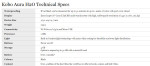
The Aura H2O is expected to launch next week. According to the leaked spec sheet , which was subsequently confirmed by the product listing, it will ship with a 1GHz CPU, 4GB internal storage, and a microSD card slot. It will of course also have Wifi, a frontlight, and an infrared touchscreen.

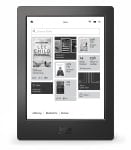
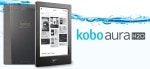
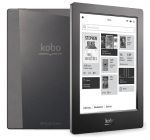
Based on the product images below, I would say that my previous suppositions that the Aura H2O would run Kobo’s proprietary software were correct.

AlleseBook.de

Kindle Unlimited to Launch Internationally at Frankfurt Book Fair?

There’s a new report going around today that Amazon will be expanding their ebook subscription service in the next couple months.

In a story behind a paywall (and referenced here), BuchReport.de is saying that Amazon will launch Kindle Unlimited at the Frankfurt Book Fair in October. I can’t see who their source is and no other details are available to me, but I tend to believe this rumor.

As I reported when Kindle Unlimited launched in July, there was a report coming from a French publisher via the French media blog Actualitte that Kindle Unlimited would launch in France in September or October.

The Frankfurt Book Fair runs from 8 to 12 October this year, so it fits with the time frame, and since it is a major international book fair this would be an ideal time and place for Amazon to launch Kindle Unlimited. We still don’t know for sure whether Amazon will launch in select countries or every where at once, but I would bet on a global launch.

Launched in the US just over a month ago, Kindle Unlimited enables Amazon customers to download and read up to ten ebooks at a time. It costs $8.99, and offers access to a catalog of over 600,000 titles.

Amazon hasn’t revealed yet how many subscribers have signed up, but there are signs that KU is already having an effect on the Kindle Store best seller list.

Unlike Amazon’s competitor’s Scribd and Oyster, the Kindle Unlimited catalog draws almost entirely upon indie titles distributed via the KDP Select program with only a smattering of traditionally published books mixed in.  Amazon has signed HMH, Scholastic, Wiliey, and a few other major publishers, but they do not yet have a deal with any of the Big 5 US trade publishers.

There’s also no information on major publishers in other countries and who they might have signed a deal with, but I would expect that information to be revealed when Kindle Unlimited launches internationally.

German Publishers Lose Antitrust Complaint Against Google

German publishers suffered a major defeat last week in their campaign to force Google to pay for the use of their snippets.

In addition to filing a copyright complaint which demanded 11% of Google’s revenues, in June 2014 a coalition of German publishers also filed an antitrust complaint against Google. That complaint was rejected last Friday by the Bundeskartellamt, the German Federal Cartel Office, which said in a statement (here, in German) that the German publishers had not offered sufficient basis to justify an investigation.

Google’s ability to offer free advertising to websites (aka search result listings) while still generating revenue has made publishers around the world jealous, and earlier this summer German publishers mounted another of their periodic attempts to collect fees from the search engine giant.

I caught the news in Spiegel and FAZ, both of which are part of the coalition which filed the antitrust complaint. While the coalition alleges that Google’s dominant position in the search engine market gave it undue power to force German publishers to agree to its terms, the Bundeskartellamt is described as saying that the antitrust complaint was inconclusive and unsubstantiated, and that the complaint did not tie in with a specific behavior of Google.

I am frankly surprised by that ruling, and given that I saw this antitrust complaint as the publishers' best shot at squeezing money out of Google I have to wonder where they will go from here.

The publishers are seeking to collect fees from Google under a 2013 copyright law which covers ancillary copyrights and was basically written to cover search engines. They want Google to pay for the use of their snippets and links in Google News. In addition to the antitrust complaint, they also filed a request for compensation with the Copyright Arbitration Board of the German Patent and Trade Mark Office.

Unfortunately for those publishers, Google anticipated the new law going into effect in August 2013 by changing their ToS in June 2013. Anyone who wanted to show up in Google search results (in Germany) had to agree to be listed for free.  In short, those German publishers already signed away their rights for nothing, and are now demanding that Google pay.

Not all German publishers agreed to Google’s new ToS, but the ones which did not are not listed in Google News. Since Google is not using their snippets I do not see how they would have grounds to sue.

It’s not clear where this story will go from here, but I do know that Google has in the past delisted websites rather than pay for the privilege of sending them free traffic. The search engine giant was even ordered to do just that when it lost a similar copyright infringement lawsuit in Belgium in 2011.

Should Google lose this fight, it is more than likely that it will delist those publishers in order to avoid having to pay any fees. It would seem the lack of search engine traffic over the long run will likely outweigh whatever short term boost in revenue the publishers get from Google, but the publishers do not appear to think that will happen – or at the very least, they think the potential gain is worth the risk.

German publishers have been trying to extract fees from Google for over 4 years now, but so far they have failed. Well, Nth time is the charm, as they always say.

With OpenStax, e-Textbook Reads You

For the past several years the non-profit OpenStax has been helping college students save money by producing and promoting open source textbook alternatives, and now they’re turning their attention to AP textbooks.

OpenStax recently announced the launch of a pioneering education project to develop new digital textbooks for high school students. Funded by a $9 million grant from the Laura and John Arnold Foundation (LJAF), the project hopes to develop free, digital textbooks capable of delivering personalized lessons.

Whether it’s autocorrect learning what words you use most, Netflix learning which movies to suggest, or Google identifying which ads you’re respond to, I’m sure we’re all familiar with technology that figures out what we might want or need next.

OpenStax wants to use similar tech to craft textbooks which adapt to serve the needs of individual students. "The technology is already here, in the sense that most of us use it online every day," said Daniel Williamson, OpenStax managing director. "However, the full potential of this technology has yet to be realized for education. The project will allow us to demonstrate that this technology is effective and can be used in the classroom to improve both students’ and teachers’ return on effort."

The new textbooks will track each student’s work and pinpoint areas where the student needs more assistance

That work is now being used to train machine-learning algorithms that give OpenStax’s biology and physics textbooks the ability to adapt to individuals. If a reader seems to be struggling with a particular topic – acceleration, say – the book will slot in additional explanations and practice questions, and increase emphasis on related subjects, such as centripetal force, that could otherwise trip that person up.

The adaptive textbooks also incorporate a learning method called retrieval practice, in which material that students have already learned pops up again in occasional quizzes. This method has been shown to enhance students' ability to retain material, and the algorithmic textbooks will be able to decide when to ask questions based on past exercises.

This is going to be at least a two year project, with the goal of creating proof-of-concept, fully personalized textbooks for high school AP biology and physics classes. Luckily OpenStax won’t be starting from scratch; instead they plan to work from 2 existing OpenStax College titles — Concepts of Biology and College Physics.

"The same sort of algorithms that might predict which songs or books you’ll like can be used to deliver a personalized experience to every child in a classroom," said OpenStax Founder Richard Baraniuk, Rice University’s Victor E. Cameron Professor of Engineering.

OpenStax is best known for the CC-licensed college textbooks it has published over the years. Using philanthropic grants, OpenStax has published eleven freshman textbooks (with 3 more on the way) that can be bought as print textbooks for around $34 each. The digital textbooks can be downloaded as PDF or Epub, and a handful of titles are also available in iBooks as interactive textbooks.

That print price is far cheaper than the typical bio 101, chem 101, etc textbook, which often reach a retail price of $200 or more, and the ebook price is simply incomparable. OpenStax reports that their first seven books have already saved students more than $13 million.

Rice University, New Scientist

image by francisco_osorio


New Leaks Show Kobo Aura H2O Coming 1 September, Will Cost $179

When Kobo’s newest ereader cleared the FCC last week I knew it was going to be one of the more interesting ebook readers to launch this fall, and now that the specs have crossed my desk I can see that I was right.

The Kobo Aura H2O is not only going to be the largest and most capable waterproof ereader on the market; it’s going to be the first to sport a new 6.8″ E-ink screen (reportedly).

Like its predecessor, the Kobo Aura HD, this ebook reader will be running Kobo’s proprietary reading software on a 1GHz CPU with 4GB internal storage. The Aura H2O will have a frontlight, infrared touchscreen, Wifi, and a microSD card slot.

Weighing in at 233 grams, the new device will be slightly lighter than the Aura HD. It’s also going to be slightly thinner; looking at the image above I would guess that Kobo lopped off the weird protrusions from the rear of the shell. According to what I was told it’s going to meet the IP67 standard for water, meaning that it is expected to survive being dunked in a meter of water for up to 30 minutes and that it is dust proof.

The Kobo Aura H2O is expected to go up for pre-order on 1 September, with a retail of $179. All in all I am looking forward to this device, and I haven’t even gotten to the best point.

If the is to be believed, the Kobo Aura H2O will have a brand-new 6.8″ Carta E-ink screen. With a screen resolution of 1430 x 1080, it will be ever so slightly less sharp than the screen on the Kobo Aura HD, but it will make up for the lost rows of pixels with a faster and better screen refresh rate.

Bestill my beating heart.

Somehow, Kobo has managed to scoop Amazon for the second year in a row. Last year Kobo got the 6.8″ E-ink screen first, and this year Kobo is (probably) going to get the new 6.8″ Carta screen first.

That leads me to wonder why Amazon is letting it happen, and I can give you three guesses:

  1. Liquavista
  2. Liquavista
  3. Liquavista

I think Amazon is passing on the larger screen because they want to move directly to using a Liquavista screen – possibly the hybrid screen detailed in the patent I discovered a couple weeks ago.

Now that would be fun, would it not?

Alles eBook


Studies Disagree on Whether Readers Absorb Less on Kindles than on Paper

The Guardian reported yesterday on a new study which showed that reading on a Kindle led test subjects to recall fewer details from the story, leading some to speculate that we’ve reached the edges of ebook usability.

While Nicholas Carr might want to use this paper to sound the death knell of ebooks, I think further study is warranted.

From the article:

The study, presented in Italy at a conference last month and set to be published as a paper, gave 50 readers the same short story by Elizabeth George to read. Half read the 28-page story on a Kindle, and half in a paperback, with readers then tested on aspects of the story including objects, characters and settings.

…

But instead, the performance was largely similar, except when it came to the timing of events in the story. "The Kindle readers performed significantly worse on the plot reconstruction measure, ie, when they were asked to place 14 events in the correct order."

The researchers suggest that "the haptic and tactile feedback of a Kindle does not provide the same support for mental reconstruction of a story as a print pocket book does".

The Guardian only briefly mentions the rest of the study, where the Kindle group tested about the same as the control group.

Luckily for us, The NY Times covered this story on Sunday and they crafted a handy little graphic to show us how the test scores differed (click to enlarge):

As you can see, in most categories there wasn’t a huge difference between the two test groups. The one exception is time and events, which is quite similar to plot reconstruction.

So does this mean that there are limits to reading comprehension on ereaders and tablets? Maybe, but maybe not.

For one thing, this study included only two experienced Kindle users, and as you can imagine that might skew the results.

But there are other studies which could shed some light on the issue. The paper referenced by The Guardian does mention a related study, but I don’t think it’s relevant. Tell me if you can see the structural problem with the study:

Mangen also pointed to a paper published last year, which gave 72 Norwegian 10th-graders texts to read in print, or in PDF on a computer screen, followed by comprehension tests. She and her fellow researchers found that "students who read texts in print scored significantly better on the reading comprehension test than students who read the texts digitally".

Luckily that’s not the only study on the topic.

I’ve been following this question for a few years now, and while it is clear that enhanced ebooks don’t enhance education that is certainly no reason to throw out the baby with the bath water.

I also know of a 2012 paper which showed that test subjects who read on a Nook scored slightly higher on reading comprehension tests. Like the latest study that older research was based on a small group of test subjects, so it’s not possibly to use one to refute the other, but it does suggest that further study is warranted.

All in all, I would say that it is too early to draw a conclusion either way.

image  by francisco_osorio,  David Boyle in DC

GigaOm is Wrong to Call Kindle Worlds a Bust

When Amazon launched Kindle Worlds in May 2013 many people misunderstood the new service, and it appears that misunderstanding continues to sway journalists even today.

On Sunday GigaOm published an article describing Kindle Worlds as a bust. Working from a recently published research paper, Jeff John Roberts calls Kindle Worlds "a bust for fans, and for writers too".

While it is possible that KW is a bust, Mr Roberts doesn’t prove that argument. In fact, his approach is not just wrong but completely irrelevant to the reason Kindle Worlds was created.

Later in this post I will discuss my standards for judging whether KW is a bust, but before we do that let’s pin down exactly what we are talking about.

Far from being a portal for fanfiction, Kindle Worlds is a publishing imprint. Organizationally, it belongs to Amazon’s publishing divisions, and it is not part of KDP. This is an important distinction because had KW actually been about fanfic then it would have been announced as a self-publishing portal related to KDP.

Instead, KW is about copyright holders (movie studios, authors, publishers, media companies) choosing whether they wish to publish works by outside authors.

As Tobias Buckell explained last year, it’s about licensing, not fanfic:

It’s really a way for Amazon to disintermediate media tie in novels, where packagers and publishers approach authors to write in an established media universe.

Amazon is using some elements of fan fiction to do an end run around the existing publishing structure of it.

If you look at KW from the viewpoint of licensed content and not fanfic then Mr Roberts arguments tend to fall apart:

In the month of June, authors contributed 46 Pretty Little Liars works to Kindle Worlds, which sounds like a fair number — unless you compare it to the more than 6,000 such works that appeared during this time on two other fan fiction sites.

More broadly, on one of those sites, FanFiction.net, fans posted 100 new stories every hour across all categories. And Amazon? Its entire output for all 24 “Worlds” of content, which also includes franchises like Gossip Girl and Vampire Diaries, was just 538 stories over the course of more than a year.

He is simply wrong to say that "authors contributed 46 Pretty Little Liars works to Kindle Worlds"; that is the number published, not how many were submitted.

We don’t actually know how many were submitted; all we know is the number of works that made it through the process and were published. And that’s not the same thing.

I do not think counting the number of works produced is the right way to go about measuring the success of a program; if that were the case then a publisher which produces 10 titles a year is only a tenth as successful as one which produces 100 titles each year. (And heck, I know one author who only writes a single novel each year; by Mr Roberts' reckoning she must be a failure compared to authors who write 4 or more books a year, and not a financially successful author with a rabid fanbase.)

Bigger is generally better, yes, but I think a better yardstick would be to track the revenues and count the reviews.  If you can show me that authors and publishers aren’t making a lot of money from this, now that would be an argument that Kindle Worlds was a bust.

But Mr Roberts doesn’t have that data, so his argument is a bust.

If you have first-hand experience with Kindle Worlds, please let me know whether you think the imprint is making an impression. I don’t have any financial data, so I can’t answer that question.

Delaware Passes Law Which Makes eBooks and Other Digital Content Inheritable

Do you know that clause in the TOS for the Kindle Store and many other digital content stores which says that the content is licensed to you and is nontransferable?

The state of Delaware just negated that clause (in part).

Last week Governor Jack Markell signed House Bill (HB) 345, “Fiduciary Access to Digital Assets and Digital Accounts Act”, giving heirs and the executors to estates the same rights over digital content which they would have over physical property.

In a case of life imitating art, the new law basically accomplishes what the Daily Mail fictitiously reported in 2012 that Bruce Willis wanted to accomplish; ebooks and other digital content can now be inherited.

Delaware is the first state to follow the latest suggestion from the Uniform Law Commission, a non-profit group that crafts model legislation and lobbies to enact it across all jurisdictions in the United States. Last month the ULC adopted a new legal standard, the Uniform Fiduciary Access to Digital Assets Act (UFADAA), which laid out what rights heirs should have over digital content belonging to the deceased.

Delaware is reportedly the first state to take the UFADAA boilerplate and pass it. While a few states, including Indiana, Virginia, and Rhode Island, do have some statutes related to the digital assets of the deceased, those provisions are far less comprehensive than the new Delaware law.

But even though those laws are more limited in scope, they will probably continue to have a greater impact on legal rulings. The new law in Delaware only affects Delaware residents and wills being probated there. It does not affect the tech companies registered in the state, according to one spokesperson. "If a California resident dies and his will is governed by California law, the representative of his estate would not have access to his Twitter account under HB 345," Kelly Bachman, a spokesperson for the Delaware governor’s office, said by email.

But even with the limited impact, this is still good news for digital rights advocates such as myself. Along with the ReDigi decision, which said that you could resell digital content under certain circumstances, the new law is a major milestone in a growing legal trend.

Year by year, consumers are gaining more rights over the digital content they buy. If this trend continues then it won’t be long before consumers have the same rights over digital content as they do over physical goods.

And while that might upset certain middlemen, as a consumer I am quite pleased.

Ars Technica

images by kalleboo, Meta Mourphic