Amazon to Launch New eBook Subscription Service Called Kindle Unlimited

Word is circulating on Twitter and the KBoards forum  today that Amazon is about to launch a new ebook service.

Update: Kindle Unlimited went live on Friday.

Details are still vague, but at this point I know that about 6 hours ago several authors noticed that there was a new page in the Kindle Store. That page was shortly taken down, but while it was up it was titled Kindle Unlimited, and it offered readers access to a catalog of 600,000 ebook and audiobook titles for $9.99. Thanks, Zara!

Update: Actualitte has screenshots which confirm Kindle Unlimited, including:

Just to be clear, I’m not talking about the Kindle Freetime Unlimited service which Amazon launched in September 2012. That is a different service which offers a kid-safe selection of apps, videos, and ebooks. KFU is only available on Kindle hardware, and it costs $2.99 a month and up.

Update: Here’s the promo video for Kindle Unlimited:

You can find the Kindle Unlimited page here. There’s nothing to see at this time, but if you click through I want you to look at the search bar at the top and note the letters "KU" as the dept. That confirms the reports, I think.

Update: If the page did show something it would probably look like this:


I’m still waiting for comment from Amazon, but at this point it looks like Kindle Unlimited is an expansion on the Kindle Owner’s Lending Library which will be made available to all Amazon customers (KOLL is a free benefit for Prime subscribers only, and is bundled into the $99 a year cost). At launch Kindle Unlimited will likely be limited to the US.

A number of authors on KBoards have confirmed that the titles they submitted to KDP Select had been added to Kindle Unlimited, and not just KOLL. There is also a report that the sales reports on the KDP admin pages now includes a mention of the Kindle Unlimited service, which apparently is going to be counted in combination with KOLL revenues.

Speaking of revenues, that is another question we cannot answer yet.  Kindle Owner’s Lending Library pays indie authors from a pool of money based on the number of times their books have been borrowed. The pool for July is $1.2 million.

Update: There is now confirmation from Scholastic that their titles will be included in Kindle Unlimited under the existing contract they negotiated with Amazon.

As with KOLL, Scholastic will get paid their full wholesale price every time one of their ebooks is opened by a Kindle Unlimited subscriber.

It’s possible that Amazon will expand the pool, but this still raises questions. Prime members can only borrow a single title a month from KOLL, but clearly that limitation will not apply to the Kindle Unlimited service.

In order to compete with services like Scribd and Oyster, Kindle Unlimited will either have to be a lot cheaper or offer similar unlimited reading. Both Scribd and Oyster offer a buffet-style reading experience for $8.99 and $9.99 a month, and they boast catalogs of 400,000 and 500,000, respectively.

If Amazon is launching a direct competitor to Oyster and Scribd then Kindle Unlimited will have to be truly unlimited.

Update: GigaOm found an active test page for Kindle unlimited, and it looks like I can now confirm that this service expands beyond indie titles.  Many publishers who have signed with Oyster and Scribd are also showing up on the test page, including Scholastic, HMH, Open Road, Workman, WW Norton, and Bloomsbury, as well as titles from Amazon’s own imprints.

I have yet to find titles from S&S or HarperCollins, both of which have deals with Scribd and Oyster, but there are also 7300 audiobook titles listed.

I will update this post as I get more details.

Thanks, Zara!

Amazon in Talks with Simon & Schuster – Acquisition?

The publishing world was thrown into a tizzy Tuesday night with the news of new negotiations between Amazon and S&S.

Few details are known at this time, and all we really know is what the WSJ has reported:

Hachette isn’t the only book publisher facing down Amazon.

The country’s largest bookseller is also in talks with Simon & Schuster, said Leslie Moonves, CEO of the publisher’s parent CBS Corp. at the Fortune Brainstorm Tech conference in Aspen, Colo. Moonves added that he’d personally met with Amazon CEO Jeff Bezos at a recent conference in Sun Valley, Idaho.

“Amazon has a definite point of view about what should be done in the publishing business,” said Moonves. “It’s going to be a very interesting thing to watch.”

It wasn’t immediately clear what the nature of Amazon’s talks with Simon & Schuster are, and a spokesman for the book publisher declined to comment. An Amazon spokeswoman didn’t respond to a request for comment.

No one yet knows why Amazon is in talks with Simon & Schuster, but as DBW pointed out Amazon isn’t pulling any dirty tricks with S&S print titles. The responsible thing would be to wait for leaks from S&S which add details to the story.

In the meantime, let me float an idea past you: Could this be a deal for Amazon to buy S&S?

That is a crazy idea, yes, but hear me out. Before you send for the trank guns, just remember that in the past 6 months I accurately called the Dropbox-Readmill deal, the Comixology acquisition, and the Nook Media spin off.

And now I wonder if Amazon is going to buy S&S.

One thing I’ve never shared is that in the back of my mind I keep a list of countries companies Amazon might want to buy. S&S is on that list under the heading major trade publisher.

To put it simply, Simon & Schuster is the smallest of the Big 5, and there’s no real connection between it and its parent company –  not like there is for the 4 other major US trade publishers.

With $800 million in revenue in 2013, S&S is the smallest of the major US trade publishers (in terms of revenue). It is a wholly owned sub of CBS, a $15 billion a year company with operations mainly in the US.

Assuming Amazon were in the market to buy a major trade publisher, S&S would be the easiest target. It’s smaller than HarperCollins and it’s not owned by or part of a multinational publishing conglomerate (unlike PRH, Macmillian, and Hachette).

Of course, we don’t know Amazon is in the market to buy a major trade publisher so this is purely speculative. This could just be a contract negotiation for book and ebook distribution, and if that is the case someone will leak something.

Until we know more, I plan to hold this as a possibility and not a probability.

Icarus Launches Updated Illumina eReader with Android 4.2, Dual-Core CPU

eBook readers which run Android are nothing new, but today I came across one which made my heart skip a beat.

The Dutch ereader retailer Icarus has unveiled an updated version of their Illumina  HD ereader. Initially launched last fall, the Illumina  HD sported a 6″ Pearl HD E-ink screen with frontlight and touchscreen. The new model launching today sports a sleaker, slimmer design with fewer buttons and runs Android 4.2 on a 1GHz dual-core CPU.

If you’re having trouble breathing right now, you’re not alone. The new Illumina  HD is an excellent candidate for the title of best E-ink Android tablet.

This ereader has a 6″ Pearl E-ink display, and not the Carta screen found on a few ereaders at the moment. It has both a frontlight and a touchscreen, and on either side of the screen it has page turn buttons. Crack open the case and you’ll find a 1GHz dual-core CPU with 512MB RAM, 4GB internal storage, a microSD card slot, and Wifi.

The Illumina  HD ships with a reading app which supports Epub, PDF, FB2, and Mobi. It runs Android 4.2, and while there’s no mention of Google Play the product listing does say that:

It comes with several apps pre-installed and you can even install your own apps, from your favorite reading app to social media or productivity apps.

The Illumina  HD does ship with several apps, including a file manager, Dropbox, a web browser and an email client.

The Illumina  HD might not have sound or the best screen on the market, but it does have a better CPU and run a newer version of Android than any other ereader on the market. This is my leading candidate for the title of E-ink Android tablet, and I can’t wait to get my hands on one.

It is up for pre-order from Icarus for 119 euros plus shipping, and yes you can get it shipped internationally. It’s scheduled to ship on 24 July.

Are you planning to get one?

Update: I am not. Cooler heads than mine have convinced me that I should take the negative reviews posted to MobileRead seriously. Several people have commented on devices made by Boyue (the Chinese OEM which licensed the design to Icarus). When you add the reviews to the poor service I am getting from Icarus, I think the new Illunina HD is not worth getting.

Icarus Store

eReaders.nl

eReader Maker Oaxis Launches Kickstarter Project for E-ink Smartphone Case, Hits Funding Goal in 3 Hours

If you are in the market for a case which adds a second E-ink screen to your smartphone then you might want to head over to Kickstarter tout suite. There’s a funding campaign going on right now which is already oversubscribed and is about to run out of prizes.

A certain quietly reputable ereader design firm launched a Kickstarter project this morning to fund their next product. Oaxis is taking their expertise in devloping gadgets with E-ink screens and turning it towards a new product category: smartphone cases.

A number of smartphone cases with E-ink screens have been announced over the past few years, but they all shared one flaw: each case was designed to fit a certain model smartphone. Given that there are hundreds of models on the market, this is something of a troubling problem – one which Oaxis has solved.

Initially announced in February 2014, the Inkcase Plus is designed to be a modular product. It combines a 3.5″ ereader (with a speaker and Bluetooth) and a smartphone case. The two parts are designed to snap together like so (click the image to see an animated gif):

The ereader unit is reversible, and can be mounted facing in either direction.

As I told you back in February, the ereader component sports a 3.5″ Mobius E-ink screen with a screen resolution of 360 x 600, or around 200 ppi. (Or at least that is what the spec sheet said when I put my hands on the device at CES 2014.) The screen, battery, and circuit board are the most expensive parts of the Inkcase Plus, and by separating them into a modular component Oaxis has both reduced the manufacturing complexity and multiplied the number of smartphones they can support.

This is a far better design than the first-gen Inkcase, which was launched last year for the iPhone 5 and Samsung Galaxy Note 2. I reviewed one last fall, and found it to be disappointing, especially in the software department.

If you want to add an E-ink screen to your smartphone then this is the project to get behind. Unlike PopSlate, which has been around for a couple years without shipping a damned thing, Oaxis has a history of producing and licensing their hardware designs. its partners include many different companies in the US, Europe, and around the world.

But Oaxis doesn’t have such a good record when it comes to software, and that could be the one area where the Inkcase Plus falls down. According to the Kickstarter page, the Inkcase Plus can act as an ebook reader, display notifications and photos, and interface with sports/fitness apps (the data is sent over Bluetooth). The model I reviewed last fall didn’t work nearly well enough to justify its $99 price tag, but almost a year has passed so there’s a good chance that the software has been expanded and improved.

But we’ll have to wait for hands-on reports to be sure. The Inkcase Plus is scheduled to ship in October 2014.

Kickstarter

As Booksellers Become Publishers, History Repeats Itself

Late last week Publishers Weekly posted an article on the growing trend of indie bookstores expanding into publishing. Some are acquiring an Espresso Book Machine, but not all.

This article caught my eye both for the innovating booksellers and because their innovations were once quite common.

Here’s an excerpt:

Books & Books, headquartered in Coral Gables, Fla., also earns money on every book, or at least doesn’t lose any, according to Ausbert de Arce, who oversees the store’s publishing program, Books & Books Press. To cover the manufacturing costs, Books & Books Press asks authors to contribute to the cost of production. In return, authors are deeply involved in the publishing process. The press takes advantage of bookstore owner Mitchell Kaplan’s retail acumen, de Arce’s expertise in marketing and production (he founded Taschen America), and photographer and designer Petra Mason’s creativity. It also uses freelance designers and editors on its book projects, most of which come in through contacts between the store staff and authors. De Arce said that publishing 10 books a year has worked well and that every book is guaranteed shelf space at Books & Books, adding that the press can add more distribution if authors want. For a few titles, Books & Books acts as a packager for major trade houses.

And:

An early adopter of the Espresso, Village Books in Bellingham, Wash., returned to publishing with a local printer and IngramSpark after removing its machine. “To be honest,” said publishing director Brendan Clark, “sometimes I miss the EBM. Its unique ability to bind a single copy in minutes was extremely handy, and it constantly drew in new clients just by being there. But our off-site production partners now give us access to a diverse array of options, including hardcover binding and color pages, that the EBM simply doesn’t have the capacity for.” In addition to its publishing operations for self-published authors, the store maintains a separate traditionally oriented publishing program with royalties, Chuckanut Editions, which publishes books selected by Village Books owner Chuck Robinson, general manager Paul Hanson, and Clark.

It’s a neat read but they missed a historical aspect which I think adds depth. There was a time when it was not unusual for a publisher to also be known as a printer and bookseller

In the early printing press era it was common for someone to be known as a publisher, printer, and a bookseller. This extended into the 18th century, in fact. Benjamin Franklin is one example, and he’s not the only one.

That era ended in part due to advances in printing tech which enabled economies of scale, and by improvements in transportation tech which enabled distribution.

And now new technologies, both POD (printing tech) and the Internet (communication and distribution), are reviving an old idea and making it viable once again.

image by Gastev

Onyx’s New E-ink Smartphone Can’t Make Phone Calls

If you didn’t get a chance to buy an Onyx Midia Inkphone before the first shipment went out of stock, count yourself lucky. Early user reports are coming in from MobileRead, and the news is not good.

One early adopter is reporting that they cannot make phone calls:

Got my e43 ink phone today. Very disappointing. I can’t make or receive calls or browse. Only attaches to network and allows to perform *xxxxx# type ussd operation.

Can’t believe I paid good money for this . Sent mail to customer support, they sent it to their service guys and I’m still waiting for response.

That user went on to add in a follow up comment:

Still cannot use phone or SMS function. further as per my provider the phone is not legal as the imei they are using is licences to Nokia in fact it is same imei range as Nokia 7610. A mail from GSMA tech support confirm this. So it’s a matter of time before they block this phone from networks.

Some users are making calls without issue, but this is still a serious issue.

An IMEI number is a unique 15 digit serial number which belongs to a specific cellphone – not just a model but a specific unit. The numbers are managed by an international body, with companies often requesting a range of IMEI numbers for certain models.

Onyx neglected to register their company as a smartphone maker and request the unique serials numbers that would identify Onyx’s smartphones to telecoms around the world. This has been confirmed by other Inkphone owners , and it presents a serious issue for Onyx. As a result, Inkphone owners are at risk of their smartphone being identified as hacked, stolen, or fake by their local telecom.

In short, Onyx can’t guarantee that their E-ink smartphone will function as a smartphone.  Whoops.

Nearly 2 years in development, the Onyx Midia Inkphone is a nifty-looking smartphone errr PDA with a 4.3″ E-ink screen. It runs Android 2.3 on a 1GHz CPU with 512 RAM, and 4GB internal storage. It retails from Onyx’s Polish partner Arta Tech for 149 euros, or at least it did when it was still available.

This PDA had gone up for pre-order in late June, and quickly went out of stock. Something tells me it is going to stay out of stock for quite a while.

If you have an Inkphone, I would suggest that you treat it as a collectible. It’s going to be a rare commodity for quite some time.

Arta Tech was queried for this post but did not respond.

Are Writers Really Earning less than They did 9 Years Ago?

A new survey report was released in the UK this week which appears to show that writers are eaning an average of 29% less in 2013 than they did in 2005. The report comes from the ALCS, an authors' rights group in the UK, and includes details like:

The typical (median) income of the professional author has also fallen dramatically, both in real and actual terms. In 2013, the median income of the professional author was just £11,000 [$18,834], a drop of 29 percent since 2005 when the figure was £12,330 [$21,111] (£15,450 [$26,450] in real terms). According to Joseph Rowntree Foundation figures, single people in the UK need to earn at least £16,850 [$28,847] before tax to achieve a Minimum Income Standard (MIS).

That sounds bad, right?

Not necessarily. I’ve read the report (it was only 12 pages long), and I have serious doubts that it accurately reflects what writers are earning.

For one thing, the report is only 12 pages long and doesn’t include the original survey questions or granular details on the survey group. Respectable organizations (the Pew Research Center, for example) would include this info, and without them the ALCS report is more of a propaganda piece than a survey report.

And that’s not my only concern. I’ve read the report, and I think the survey group was skewed towards older writers, and towards book authors.

If you look on page three of the report you’ll see that 2,454 writers were surveyed, and that 83% of the survey group reported their ages as 44 or older. A full 29% are over 64 years of age. Tell me, does that strike you as a representative sample of all the writers in the UK? I can’t find data to the contrary but based on my gut feeling I would say no.

And speaking of a skewed survey group, the LACS left an important detail out of the report. They say that the survey group totaled 2,454 writers, but they do not say how many are book authors vs freelance journalists, bloggers, etc. As everyone knows, writing a book pays a lot less than (for example) writing for an ad agency or other business. So if the survey group skewed to book authors then it probably does not reflect the state of all writers in the UK.

Unfortunately, we don’t know that for sure. The closest the report comes to answering this point is to say that 69% of respondents retain the copyright for their works, and that 57% have sought a reversion clause in their contracts. That suggests they are either freelancers or book authors, and that would seem to change the importance of the detail concerning the number of professional authors (writers who spend their full time writing) having dropped:

For the majority of people, their ‘profession’ and the way that they earn money are one and the same thing. For writers however this is increasingly often not the case. In 2005, 40% of authors earned their income solely from writing. By 2013, this had dropped to just 11.5%.

The report doesn’t explain the drop; it merely mentioned it and predicts the death of western civilization should it continue.

All in all, this report looks less like a true survey of writers and more like a hatchet job from a group with an axe to grind. I suggest that you ignore it.

found via TeleRead

image by gadl

Wattpad Acquires, Closes Competing Author Site

Wattpad put the $46 million raised in their latest round of funding to good use last week.

PW reports that Wattpad has acquired a smaller rival writer site called Red Room for an undisclosed sum. In what could well be described as a whirlwind acquisition, Red Room informed members only last week that the site had been bought, and they turned off the servers today (no, seriously.)

Launched in 2008, Red Room was one of a number of sites intended to be a "Facebook for authors". The site was founded by Ivory Madison, a lawyer, entrepreneur, and author. The site grew out of Madison’s previous project, the Red Room Writing School. "One grew out of the other,"” Madison said in 2009. "I wanted something scalable that could serve more people than the school. And I wanted it to be about something I care about—writers and writing."

According to the press release, Madison notes that the acquisition will give Red Room authors access to the 30 million people that visit Wattpad each month. "When I launched Red Room in 2008 I wanted to break down the walls between readers and writers. I’m thrilled Red Room authors have found a new home in a friendly and supportive global community."

I am having trouble finding recent coverage of the site, probably due to the commonality of the name.  We do know that the site had 20,000 members in 2009, and that it had raised around two and a half  million dollars in capital. But what I have found in Google suggests that many members only learned of the deal last week.

I’ll be honest with you: I had never heard of it before. From what I found in the Wayback Machine at the Internet Archive, the Red Room was far more commercial than Wattpad, and included both a paid premium membership option and a bookstore. Wattpad, on the other hand, is still trying to find a way to fund operations.

Did you use Red Room? How did it compare to, say, Booklikes, Tumblr, or Wattpad?

Google Responds to The Authors Guild in Google Books Appeal

The Authors Guild may have lost its 8-year-long lawsuit against Google last November, but they’re not through. The AG filed an appeal of that ruling in April of this year, and on last Thursday Google filed its response (PDF).

In the appeal, Google starts by reiterating its arguments that its book-scanning project fell under the Fair Use clause of US copyright law. Frequently citing the similar HaithiTrust ruling, Google’s brief takes us through the four parts of the fair use exception while noting that "statutory factors are not a scorecard".

In addition to going through the factors point by point, Google also took a moment to respond to the arguments raised in The Authors Guild’s appeal, including that Amazon was harmed by the Google Book project. Describing it as a "blatant distortion of the record", Google notes that all of the material cited was drawn not from the library project but from "Google’s Partner Program, which involves extensive display of book excerpts with rightsholder permission."

The search engine giant later disputes the facts of some of The Authors Guild’s arguments, including that Google displays "78% of the verbatim text of millions of in-copyright books". While The AG was correct in that at least 22% of each book is inaccessible, according to Google (and anyone who has used Google Books) they’re wrong in claiming that Google displayed the full 78% to any single user.  Instead, Google contends that  "Google Books displays no more than three snippets from a book in response to a search query" and points out that it is simply not practical for any user to search for multiple snippets and reassemble a book.

Google extensively rebuts the arguments made in The Authors Guild’s appeal as well as points previously raised. All in all, I would bet that Google stands a better chance of winning this appeal than The Authors Guild. After all, this appeal is being tried before the 2nd Circuit Court of Appeals. This is the court which initially suggested that Judge Denny Chin consider fair use as a defense, so it seems likely that the 2nd Circuit will follow its earlier ruling by denying this appeal.

For those just tuning in, The Authors Guild and Google are locked in round N+1 of a court case which started in 2005. Following Google’s announcement in 2004 of a program to scan books in university libraries and show snippets online, The Authors Guild and other parties sued in 2005. After numerous rounds of motions, appeals, a settlement between the AAP and Google as well as a settlement with The AG which was rejected by Judge Chin in 2011, and even more appeals, the lawsuit came to an abrupt middle in November of last year with a decision in Google’s favor. Using the earlier HaithiTrust decision as a guide, Judge Chin ruled that the Google Books project was fair use.

I don’t know about you but I don’t see why this case is still in court. By the time that ruling was issued, the case and the legal points it covered were relatively unimportant and had been subsumed by larger issues including ebook sales and online sales of print books. Snippets don’t matter as much in 2014 as they did in 2005 because now they’re used to sell books online. Authors and publishers (as well as students and academics) unquestionably benefit from Google Books, so I think there are better ways to spend our time.

found via Publishers Lunch

image by smilygrl

The Problem of Reinventing the Bookstore

Bookshops are the platypus of the retail world. Not only are they part of an industry with a unique obsession with and attachment to its products, but they are also one of the types of retailers which are the most susceptible to losing business to online competitors.

Like music, the discoverabilty of books often works better online than in stores, and that has the potential to make booksellers as redundant as music stores (which have closed in record numbers both in the US and around the globe).

A month-old article came across my desk again today, and since I didn’t have the time to write about it when I first saw it I thought it was worth dusting off and commenting upon.

The article was published in the More Intelligent Life magazine in the May/June issue, and it offers three different takes on how to reinvent the bookstore.

More Intelligent Life asked several designers to re imagine a bookstore. There are several flaws in the designs, and there are also a couple flaws in the concept brief shared with the design firms:

We gave each practice—Gensler, 20.20, Burdifi­lek and Coffey Architects—the same brief. They were to design a general-interest bookshop, selling fiction, non-fiction and e-books, in store and online, on a typical European high-street site, with two floors of 1,000 square feet each. The budget was £100,000—modest, we knew, but independent booksellers aren’t minted and that figure was ring-fenced for the fit-out; they could assume there would be further funds for training staff or running events. The shop could be called Intelligent Life Books, or given another name.

The size of the proposed store and the budget are not unreasonable, but I for one question whether such a broad selection of books is practical. Also, did you notice what is not mentioned?

The answer is simple: used books. In this day and age used books are simply another category on Amazon.com next to new and digital, and a redesigned bookstore should at least consider the possibility that it will also sell used books. No one knows how big that market is, but it does exist and thus should be addressed.

But other than that, it’s not a bad concept. Here’s the first of the three designs, from Gensler:

The bookshop, as Gensler saw it, had to anticipate every sort of literary need, from grabbing a paperback or download, to relaxed browsing, personally tailored reading-lists, self-publishing, book clubs, author events and even an enhanced experience of reading a book in the bookish equivalent of a flotation tank.

A week later, Roberts produces a bird’s-eye view of Gensler’s bookshop, another disarmingly simple drawing containing a lot of original ideas. The first surprise is that you don’t have to enter the store to shop from it: the glass façade is a touchscreen that can be tapped on to download e-books from QR codes. The choice could be infinite—“the whole catalogue of the British Library,” said Roberts, taking on Amazon with a sheet of smart glass.

A vending wall swings out onto the pavement, popping out a changing selection of paperbacks. Inside, new titles are laid out on a long table that marches down the space. To one side, there’s a “Harry Potter wonderwall of discovery”, to be explored by ladder (ignoring, for the moment, health and safety). While customers can be in and out of the shop in a matter of minutes, the back half of the store caters to those who can stay longer. Literary sommeliers advise on what to read next, or usher you into a pod for a multi­sensory experience: you curl up and read a hardback with an appropriate drink (tea for Austen, whisky for Hemingway), soundtrack or even smell. Readers wanting a more social experience gather on bleacher seating (“simple timber steps with cushions”) to take part in book clubs, hear an author give a talk or discuss self-publishing, which can be done via screens in the far left-hand corner.

At the back is a floor-to-ceiling wall of books, their spines arranged to spell tl;dr—short for “too long; didn’t read”. As Gensler’s name for the shop, it’s a confident bit of irony: if anywhere could excite a reluctant reader, distracted by social media, into buying a book, it would surely be this tech-smart bookshop. It’s also a compelling bit of graphic design. “It’s a very analogue way of signing,” Roberts says, “but by using the product itself it becomes a sculptural installation. There’s a big visual pull towards the back of the store.”

And here’s the second concept design, from 20.20:

In 20.20’s bookshop (top) people could do all sorts of things: download reviews and e-books (which would be discounted if bought in person), buy printed books from a frequently edited selection, consult well-informed staff, have a coffee or sandwich, read in cubby­holes, listen to audio books, watch a performance by an author, rent a desk at which to write or illustrate, and self-publish on the in-house printing press. The shop would be called The Art of Storytelling, the thinking being that stories endure, no matter what form books take.

Lee and Jim Thompson, 20.20’s managing director, talked persuasively about the nuts and bolts of their bookshop. Like many, it would have a café, but theirs came with a twist: a Yo! Sushi-style conveyor belt delivering short reads and reviews to consume with your coffee. This would act as a draw to the back of the shop—“you need some kind of anchor,” Lee said—while mobile “mid-floor units” carry screens to advertise events, and books that fit a frequently changed theme, such as the ten best adventure stories. These units (at hip height, “because we all tend to look down”) also offer some cover at the threshold—a place for nervous shoppers to hover while they orientate themselves in an unfamiliar place.

To get them upstairs, there’s a staircase. And a tree. “We always believe there should be some kind of ‘wow’ in a space that draws you in,” Lee said. “So this central feature, representing a tree, links the two spaces through a hole in the floor, with lightbulbs dangling from the structure.”

And finally, Burdifi­lek and Coffey Architects crafted a design which I would call a temple of books. It’s more akin to an Apple store than anything a bookseller would be able to afford to build:

Burdifilek’s bookstore (called ILB, for Intelligent Life Books) is more of a gallery, showcasing particular books alongside related merchandise. So for six weeks, the focus might be cookery, with the store selling pots and pans as well as cookbooks; then it might switch to Danish design. When I asked what would make money here, the books or the other products, Burdi said “I think it’s both. It’s a win-win.”

Some book-lovers might find woks and whisks a diversification too far (though they might be happy to sit and flick through a book in an Arne Jacobsen Egg chair), but Burdi thinks there’s a gap in the market. “It’s like a concierge service: everything in one place,” he says. “My frustration [at the moment] is that I buy the book, then I have to go to another store to buy the product. It’s a luxury to see and touch the product. That’s what the internet doesn’t give you.”

Current exhibits are displayed on plinths (“I don’t want to call it a table, it’s more of a sculpture, to make you focus on what’s on top”), while the shelves that bookend the space offer both an edited choice of printed books and, via built-in touchscreens, infinitely more e-books and apps. The materials would be “inexpensive but noble”: European walnut for the shelves, “a very wide-plank dry oak” for the floor, and “a flat white plaster finish, very gallery-like” for the walls.

Besides the lack of any mention of used books, two of the three designs also left out any mention of POD. I am familiar with past suggestions to base a redesigned bookstore around an Espresso Book Machine, and I think those older designs may actually be more practical and realistic than the three professional designs quoted above.

Print on demand might not be a major source of revenue for publishers now, but the bookstores and libraries that own an Espresso Book Machine report that they do a lot of business with authors who bring in their own work to be printed and bound. And at the very least POD has the potential of enabling a bookseller to more closely match the selection of their online competitors.

So what did you think of the designs?

I found the descriptions very pretty, but I was disappointed by the lack of detail on the bookstores’s business models. Only one of the designs really addressed that point, and what they propose just doesn’t sound practical. The real point of this exercise was to find ways for booksellers to make more money, not just design a beautiful mausoleum.

And just to be clear, I do think small booksellers can survive if they adapt. IMO they need to one, offer competitive prices, and two, sell more stuff online. While many bookstores are already doing both, this point is frequently missed in debates about the future of bookselling (which seems to mainly focus on how to save the physical stores).

If, as recent research suggests, book buying is moving online then bookstores need to follow. Amazon might have the majority of online book sales in the US but that doesn’t mean booksellers can’t compete on either price or service.

That is certainly what I am seeing in other types of retail.

I recently got back into model trains, and after I had been buying locomotives and other stuff online for a couple months I realized that I was actually supporting an independently owned hobby shop – just not in my area. One of the hobby shops I buy from is based in Indiana. I buy there because they offer prices and service within range of major retailers like Amazon.com. I know some might suggest that I support the nearest hobby shop, but it’s a half hour drive away and charges full retail (which is sometimes twice what I pay online).

I know some will be disappointed that I am cheap and shirking my duty to my local store, but I feel that driving for an hour to pay full retail is simply too much to ask. I want to shop online, and sellers need to be there for me to find.

This post has now gone incredibly off topic, so let me close it with a question. What do you think is the future of bookstores?

Next Kobo Aura Rumored to be Dust & Water Proof

The rumor about the next Kindle Paperwhite (Ice Wine) may have come to naught but I expect we’ll have better luck with the latest rumor about Kobo.

The font of all leaks, @evleaks, shared a new rumor about the next Kobo Aura last week:

Evan Nelson Blass, the man behind @evleaks, is saying that Kobo’s next ereader will be protected against dust and will be able to handle being dunked into a meter of water (details). If true, the Aura H2O will be as tough as the Pocketbook Aqua (released in Europe in March) and somewhat more in extreme reading situations than the existing Kindle Paperwhite (or Kobo’s current ereaders, for that matter).

I have no evidence to support this rumor (no filings at the FCC, for example), but I tend to think it is true.

For one thing, waterproofing an ereader is a logical next step. Readers interested in this topic may find meansbase to be an informative resource. One common selling point for E-ink screens is that they can be used in full sunlight, and with the Aura H2O Kobo will be able to expand on that sales pitch by promising that the new ereader will be completely safe to use at the beach, lake, or anywhere else where it might get wet.

What’s more, Kobo isn’t the only one to think of it. Pocketbook has the Aqua (on sale in Europe for 109 euro), and if you’re willing to buy from an aftermarket supplier you can also get a Kindle Paperwhite.

Waterfi has been selling waterproofed mobile devices for years now, and as you have probably read in the past few weeks this company also carries a waterproof Kindle which is good to a depth of 200 ft. They’ve offered the Kindle since at least last May, but recently sent one to TechCrunch to review.

Waterfi’s process involves coating the internal electronics, while Kobo is more likely to use a more traditional route of sealing the case from intrusion by water and dust. But no matter how you cut it, this adds to the cost of the ereader. Waterfi adds $90 to the price of the Kindle Paperwhite 3G, and Pocketbook is charging a premium price for a basic ereader.

Kobo will probably have to add at least $20 to $30 to the retail price of the Aura H2O to cover the additional costs. If you want to use your ereader in risky conditions it is probably worth the expense.

It’s Been a Year and a Day Since Google Reader Shutdown. Has Anything Changed?

Almost 15 months have passed since Google announced that they were shuttering Google Reader, and yesterday marked the one year anniversary of its demise. Mashable was the first to notice the anniversary, and they inspired me to look back and see just how much has changed.

I for one am still reading RSS feeds in much the same way I did the day before Google announced the Readerpocalypse, but while I have stood still the industry as a whole has changed.

In the months following the March announcement, dozens of existing feed readers came out of the woodwork or were launched in response to the news. Everyone from Digg to AOL launched a feed reader (and even Zite and Flipboard made plays for former Google Reader users). Some of the news readers were good, others were bad, but of the multitude only one managed to end up on top.

Feedly

On the day before the announcement, Feedly had a set of reading themes which were prettier than they were functional, and a service which was dependent on Google Reader. But they had 3 aces up their sleeve; a crack marketing dept, a beta project which would enable Feedly to break free of Google Reader, and the engineering talent to back it up.

In 3 weeks Feedly grew from 4 million users to 7 million, eventually growing to 15 million users and 24,000 paying customers in February 2014 and earning the crown of leading Google Reader replacement.

Feedly took that title because they had the tech and luck, but not all feed readers were as blessed by the demise of Google Reader. Some were unable to cope with the growth, while others were acquired.

The Old Reader, for example, was a niche service with 10,000 users the day before the announcement, and 130,000 users a week later. The team behind that service were left scrambling to keep it functional as it ballooned to 420,000. The Old Reader came perilously close to being shut down before being sold to a new owner which had the skills and funds to keep it operational.

And they’re not the only ones to be acquired; LinkedIn surprised us all when they acquired Pulse in April 2013. But when Flipboard acquired Zite in March 2014, I doubt anyone was surprised. Both of these services had made bids for casual readers, but with over 100 million users Flipboard was by far the larger service.

In the year since they bought it, LinkedIn used Pulse to build LinkedIn’s own internal blogging platform, but they’re not the only one to make a nontraditional play for the attention of readers.

In addition to trying to push readers into finding new content on Google Now and Google+, Google also launched Google Newsstand in November 2013. The new app combined the Flipboard-esque Google Currents with the existing Google Magazines app, giving readers a single place to read both the content they paid to subscribe to and the articles which Google found for them.

—

Shortly after Google announced the Readerpocalypse, many pundits proclaimed that the end of Google Reader as a sign of the imminent death of RSS feeds as redundant and outdated tech. But a year later and all that I can see that is different is that Zite is now Flipboard, Google Newsstand is now Zite, and Feedly is now Google Reader.

There are also incremental changes, including the increased reliance on robot reporters and and the changes to platforms like Medium as they grow, but those are really incidental to the closure of Google Reader.

It’s been some 15 months since the announcement and aside from the changing of name tags (and the fragmentation of the market among dozens of small competitors), I would say that little has changed in the news reader market. People are still using news reader apps, and some readers are paying for the service (but that’s not new).

Or am I wrong? Tell me, did the end of Google Reader drastically change your reading habits? How do you follow the news?

P.S. If I missed an important event that should have been mentioned in this post, please let me know in the comments.


SFWA Asks for Comments on Admitting Self-Published Authors as Members

It’s 2014, and even though the self-pub revolution is 6 years old writers and authors groups are still struggling to come to terms with the idea of admitting self-published authors to their ranks. It was only in March 2014 that the Writer’s Union of Canada voted to allow self-pub authors to join at a later date, and the SFWA is only now asking its members for feedback  on the question of self-published authors.

This was posted to the SFWA blog on Thursday of last week:

The SFWA Board of Directors is asking members to share their opinions of self-publishing over the summer. The Board has asked the members to consider not just whether or not to make it possible for writers to join on the basis of self-published works but also the issues that would have to be addressed, such as confirming income, sales, and other publishing information from self-published writers. The issue should be submitted to the full membership prior to November’s business meeting at the 2014 World Fantasy Convention.

My initial response to that post was to add that the feedback could be submitted by fax, telegram, Pony Express, and steamship, but then I got my snark under control.

The fact of the matter is, the SFWA set what looks to be a low bar for membership. Self-published works aren’t accepted, no, but to join the SFWA an author only needs to sell 3 stories to a qualified market. That is within the abilities of any of the better self-published authors.

On the other hand, the bar for membership may be low but it is still outdated and archaic. The list of valid markets hasn’t been updated nearly as fast as the publishing industry has changed. For example, Kindle Singles isn’t on the list, and in fact none of Amazon’s publishing imprints are on the list. (I’m sure that’s not the only omission, but it stuck out.)

Say what you will about Amazon, their publishing division meets all the definition of being a publisher. They should be listed, and I bet they would be if not for the 2012 contract dispute between IPG and Amazon. The retailer was pressuring the distributor to change the terms of the contract, which is really neither here nor there, but the SFWA decided to weigh in on the topic and start directing book buyers everywhere but Amazon. Tell me Amazon’s publishing division hasn’t been banned for the same reason, I dare you.

According to some, the SFWA is itself an outdated and redundant organization which exists for no other purpose than to validate existing members and provide a platform for petty politics. I can’t speak from personal experience, but when I see that any number of authors I respect have either let their memberships lapse or declined to join the SFWA I wonder if perhaps the detractors are right.

I don’t bring up the negative opinions to slam the SFWA but to point out that this group has considered updating their membership rules in the past (including one attempt last fall)  and, if the several blogs I found were correct, most of the efforts fizzled.

I think that raises the point whether the latest effort will meet with a similar lack of success. If it falters it will confirm much of what the SFWA’s detractors have been saying will have been proven true.

So what do you think of their plans?

Review: Onyx Boox T68 Lynx eReader Android Tablet

Following in the footsteps of the Nook Glow, Sony Reader Wifi (T1, T2, T3), the Tolino Shine and Vision, and a couple 6″ ereaders from Onyx, the Onyx Boox T68 Lynx is certainly not the first ebook reader to run Android.

But it is the first to get it right.

The T68 Lynx combines the high-resolution screen from the Kobo Aura HD with an OS which enables readers to add addition features and format support beyond what the manufacturer installed. This gives the T68 Lynx abilities almost no ereader can match.

Table of Contents
[—ATOC—] [—TAG:h2—]

Review Date: 29 June 2014 – Review unit purchased from Onyx-boox.com

Pro & Con

Pro

  • High resolution screen – at 1440 x 1080, it’s the sharpest ereader screen on the market
  • Android 4.0 with Google Play
  • Sound + TTS
  • Frontlight – evenly lit and white-colored, I don’t want to turn it off

Con

  • Slow page turns – it took the T68 much longer to turn the page than the Kobo Aura HD (in the stock reading apps, but not for example in Moon+ Reader)
  • Confusing settings (refresh modes, buttons, etc)
  • page turn buttons don’t work with 3rd-party apps (except possibly Moon+ Reader)
  • Frontlight – the minimum setting is too bright
  • Battery – the T68 Lynx behaves erratically when the battery meter drops below 15%

Hardware

The T68 Lynx shares many design similarities with other ereaders, albeit with a larger screen and a few quirks.

This ereader runs Android 4.0 on a 1GHz CPU with 512MB RAM, 4GB internal storage, Wifi, and Bluetooth. It’s built around a 6.8″ Pearl E-ink screen. Like the screen on the Kobo Aura HD, the screen on the T68 Lynx has a screen resolution of 1440 x 1080 (265 ppi).  That’s the sharpest E-ink screen currently on the market.

On either side of the screen you’ll find a pair of what appears to be page turn buttons, but aren’t. The page turn buttons are on the right, while the buttons on the left are the menu and back buttons. Below the screen is a d-pad with a central enter key,  and on the bottom edge you’ll find the power button, microSD card slot, headphone jack, and microUSB port.

All in all the T68 Lynx is well-designed and solidly built, although it is missing a few important details. For example, I would have preferred a second set of page turn buttons to the left of the screen in addition to the menu and back buttons. Also, there are no volume buttons, and there is no speaker. Given that this device runs Android, the limited hardware support for audio unfortunately hampers what you can do with the T68 Lynx.

Frontlight & Touchscreen

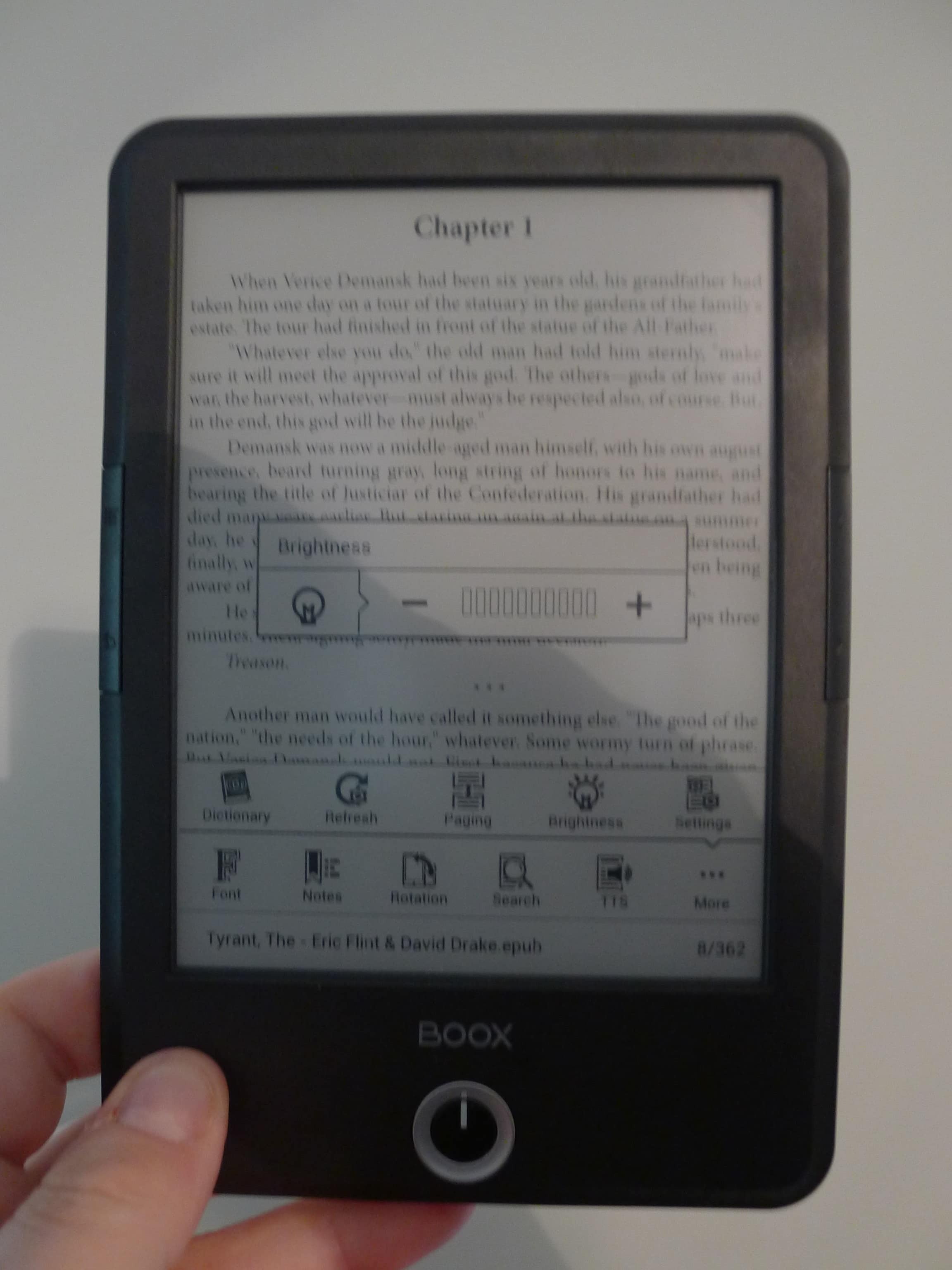
The T68 Lynx has both a capacitive touchscreen and a frontlight. The frontlight offers a total of 10 settings (eleven if you count the option to turn it off). I found the frontlight to add a nice even glow to the screen. The screen sans frontlight is gray, so I usually kept the frontlight on at the lowest setting all the time.

At its brightest the frontlight isn’t as bright as the screen of one of my LCD equipped tablets, which is okay. The max brightness on an LCD screen is usually only required for daylight visibility, and since the T68 Lynx has an E-ink screen it doesn’t need any help there.

At its dimmest, I think the frontlight is too bright and I would much rather have the lowest setting similar to what the Aura HD offers. When I read in dim lighting conditions I want the light as low as possible. The Aura HD makes this possible with a 1% option, but the T68 Lynx does not.

Here is the T68 with the frontlight set to the minimum setting, max setting, and off.

Battery

Onyx claims 8 weeks of battery life, but after my practical tests I found that the battery will last a week to 10 days of moderate use.  I usually kept the frontlight at the minimum setting, which may have reduced the effective battery life, but it improved the reading experience so much that I was loath to turn it off.

I think a week of battery life is great; it’s better than what you would get from a smartphone and it’s as good as most tablets. While it’s not the weeks or months that most device makers claim, that claim was always a bunch of hooey anyway. It didn’t reflect how most people used their ereaders and it was dependent on lab conditions which could not be met in real life.

Is the screen sturdy?

I can confirm that the screen passes my sturdiness test. I worked up the courage stupid to perform a key drop test like the one which killed the frontlight on my original Nook Glow in 2012. Like retty much every ereader except for the original Nook Glow, the T68 Lynx survived the test without any sign of damage, which is what I was expecting.

Hardware Addendum

If you get a T68 Lynx, you might also want to get the smartcover. I can’t confirm this myself, but one of Onyx’s retail partners in Europe posted a video which shows that the T68 Lynx has a smartcover. Close the cover, and it will put the ereader to sleep. Open it and it will wake up. The case looks to be cheap and made from pleather so I wouldn’t want it, but this is a nice feature to have.

Software

The T68 Lynx runs Android 4.0, and since it ships with Google Play you have the option of installing any of a broad selection of apps.

It also ships with AlReader, Onyx’s own ebook app, and stock Android apps including a web browser, gallery, email client, music player, calculator, etc. There are also signs that FBReader and Coolreader are included but they are not listed in the app folder. (According to one Onyx retail partner, Onyx uses those apps in its reading app.)

Native Apps

Before I cover the many third-party apps I have installed on my unit, let me share a few details on  Onyx’s own reading app. It offers quite a few features and customization options, including a couple that surprised me.

I did not see an option to change the line spacing, but there were 4 margin options, a screen rotation option, a control for the frontlight, a refresh button, a notes submenu, and search.In addition to a dictionary, the T68 also offers annotation and TTS (provided by Ivona, which I did not test).

The font selection extended to some dozens of fonts, including both OTF and TTF. I can’t tell you how many font sizes are offered because I couldn’t find a specific set of 6, 8 or however many settings. But I do know that the 32pt font is an option, and that the smallest font size is so small that you would need a magnifying glass to read it.

On a related note, I also discovered quite accidentally that the T68 Lynx can offer a 3 column mode at the smallest font sizes. I found that while confirming that pinch-zoom works to change the font size.

Third-Party Apps

The T68 Lynx lets you install third party apps, and that goes a long way to justifying its high price tag.

Any app you install can be found in the app drawer, which is only a single click away from the main library menu. This is whee you run the apps, and it is also where you manage (move to the internal SD card, for example) or delete an app. A long-press on an app icon will bring up a menu in the upper right corner which lets you go to the settings menu for the app, delete it, or change the order in which the apps are displayed (install date, name, etc).

If you have the T68 long enough and install more than a handful of apps, you’ll need to get used to managing the apps by moving them to the internal SD card.  If you don’t move the apps you will quickly run out of space.

Over the past couple weeks I have been taking requests for apps to try on the T68. Not all of the apps were compatible, but I have installed enough different apps that this is the singular most capable ereader on the market. For my own use, I have Kindle, RepliGo (PDF), Adobe Reader, Opera Mini, Aldiko, ES File Explorer, Moon+ Reader, and more.

Unfortunately, not all apps can be installed.

For example, Dolphin browser and Opera Mini work but Google Play says that Chrome and Firefox are not compatible. Also, Opera Mobile crashed. Feedly worked, and so did Flipboard, but Pulse was not offered as an option. One other problem I encountered was that some apps require Google Play Services to be installed. The T68 Lynx has it, but whatever Onyx did to customize the app has made it incompatible with a number of other apps, including Youtube.

Here is a partial list of apps which can be installed on the T68 Lynx.

  • Kindle
  • ComiXology
  • Google Play Books
  • Google Play Newsstand
  • Goodle Docs
  • Scribd
  • Moon+ Reader
  • Aldiko
  • Feedly
  • Evernote
  • Kobo
  • Pocket
  • Opera Mini
  • Dolphin Browser
  • Adobe Reader
  • RepliGo
  • ezPDF
  • Logos
  • DropSync
  • ES File Explorer
  • ADW Launcher
  • Gmail
  • Flipboard
  • BBC News
  • Menestrello
  • Scribd
  • Oyster
  • Anki

Verdict

I’m not an ereader user; I love real Android tablets and I plan to go back to one as soon as I am done with this review. That being said, I can see what this ereader cum tablet brings to the table. It is by far the single most capable ebook reader on the market.

The T68 is not without its quirks and odd features, but it was still a joy to use. In addition to reading a couple Kindle and Epub ebooks, I also read a 200MB graphic novel PDF. That worked surprisingly well in RepliGo (less so in Adobe Reader or ezPDF) and it shows that the T68 Lynx has admirable memory management abilities.

Between the high resolutions screen, audio, and Bluetooth, it has the best specs of any ereader on the market. And thanks to the ability to install apps, it also offers the most software features as well as the broadest support for ebook and other file formats.

While it is also one of the most expensive ereaders on the market, I think it compares well against its immediate competitors. Setting aside generic 9.7″ ereaders and Onyx’s larger models, I think the T68 Lynx has two serious competitors, the Kindle DX and the Kobo Aura HD.

The Aura HD may have the same screen but it is limited to just running Kobo software. And while the Aura HD can be hacked to run Android, it is described as buggy and frustrating. Given that the T68 Lynx costs only $30 more in the US, I would say that the extra capabilities more than justifies the price.

The Kindle DX may be larger and come with 3G, but it hasn’t been updated in years. It lacks a touchscreen and frontlight, and it can’t even come close to matching the T68 Lynx’s speed and screen resolution. The KDX also limits users to poor PDF support and incomplete support for the Kindle format (no support for KF8  or digital comics, for example).

The T68 Lynx is easily the best ereader on the market.

Videos

Where to Buy it

Arta Tech, Onyx’s retail partner in Poland, is probably your best bet for getting a T68 Lynx. At the time I wrote this review they sold the device on several websites.

Specs

  • CPU 1GHz single-core Freescale i.MX
  • RAM –  512 MB
  • Android 4.0 Ice Cream Sandwich
  • Screen – 6.8″ Pearl E-ink screen, 1440 x 1080 resolution (265 ppi)
  • Capacitive touchscreen
  • Frontlight
  • Storage – 4GB internal, microSD card slot
  • Connectivity – Wifi, Bluetooth
  • Audio – headphone jack, no speaker
  • Battery – 1.7Ah
  • Battery Life – 8 weeks (manufacturer’s claim), 2 weeks ( based on actual use)
  • Weight – 236 grams
  • Dimensions – 1942.2 x 132 x 8.8mm

Used eBook Website Faces Lawsuit in Europe

The used ebook marketplace Tom Kabinet is only a week old but it is already facing legal challenges to its business model.

eReaders.nl reported this morning that the Groep Algemene Uitgevers (GAU), the Dutch Trade Publishers Association, has already sent a warning letter to Tom Kabinet, demanding that the site cease operations.

The GAU believes that Tom Kabinet is engaging in piracy, and if it continues they will take the site to court. "We expect that if they don’t shut their activities down, the next step will probably be a court case in the very short term," Martijn David, secretary general of the GAU, told GigaOm.

Tom Kabinet co-founder Laurens van Hoorn disagrees. He points to the 2012 UsedSoft v Oracle ruling by the Court of Justice of the European Union. Europe’s top court issued a ruling which said that it was legal to resell licenses for downloaded software, even if the ToS forbid the resale.

Naturally the GAU disagrees with van Hoorn’s interpretation, pointing out that the UsedSoft ruling was specific to software and not other types of digital content. This point was arguably settled last year when a German court expanded on the UsedSoft ruling with a clarification that it did not also apply beyond software. For example, ebooks and audiobooks can’t be resold based on the UsedSoft ruling (in Germany, at least).

That’s going to complicate things for Tom Kabinet; while it is not impossible for the site to win in the long run, the odds are stacked against it. van Hoorn’s facing multiple court battles as this legal point is hashed out first in Dutch courts and then in EU courts.

What’s more, the design of Tom Kabinet’s marketplace will probably work against it. As I pointed out last week, the site operates on an honor basis. While buyers receive an ebook which is marked with digital watermark DRM, sellers are trusted to only sell the copy they acquired legally and not to keep a copy after it is sold. Sellers are also restricted to only selling DRM-free ebooks or ebooks with digital watermarks, and that raises the good question as to whether a system which places this much trust in its users can pass legal muster.

All in all, this is a hot topic both in the US and in Europe. While here in the US Redigi is still reselling used music and last year they announced plans to open a similar marketplace for ebooks, it’s still not clear that the Capitol Records v Redigi ruling extends to other types of digital content. And in Europe it looks like Tom Kabinet is going to lose the court battle.