Amazon Introduces Four New Kindle Worlds from Romance Novelists

Amazon expanded their publishing empire today with the launch of 4 new Kindle Worlds.

The tech company announced today that they were opening up new opportunities for writers to contribute stories set in series created leading authors. Four romance authors are now inviting submissions from writers, including Barbara Freethy, Bella Andre, H.M. Ward, and Lucy Kevin.

The new Kindle Worlds include:

  • Barbara Freethy’s The Callaways—The hit series from the best-selling Kindle Direct Publishing author of all-time on Amazon
  • Bella Andre’s Game for Love—The sizzling series about the superstars women lust after from the New York Times best-selling author
  • H.M. Ward’s The Arrangement—The steamy, sexy New York Times best-selling new adult romance series with over a million copies sold
  • Lucy Kevin’s Four Weddings and a Fiasco—The sweet, contemporary romance series from the USA Today best-selling author


The authors aren’t opening up worlds for new contributions so much as they are inviting new additions to existing series. That’s a smart move; I’m not sure readers would accept a character whose voice, behavior, and beliefs changed from one book to the next (I certainly wouldn’t be satisfied). But additions to a series of books, each with a different lead character, is more likely to be accepted by discerning readers.

Initially launched in May 2013 under the cover of publishing fanfiction, Kindle Worlds is one of Amazon’s numerous publishing imprints. It focuses on short works set in licensed worlds – 26, at last count. Amazon’s Kindle World publishing partners include tv shows like Veronica Mars, WB’s Vampire Diaries, and Pretty Little Liars, comic books like Valiant Comics' Harbinger and  Archer & Armstrong, and books like the Foreword Saga, and more.

Priced between deer nuts and $3.99, a Kindle Worlds ebook is intended to be a quick read. Amazon hasn’t revealed how many copies have sold or the revenue generated.

Google’s Android One Budget Smartphone Designs Could Mean More eReading in the 3rd World

Long term readers of this blog know that I am a fan of low-cost Android tablets. I’ve owned quite a few over the past few years and prefer them as my main reading device, so when I read today about Google’s new Android One initiative I was cautiously optimistic.

According to the Google blog:

We’re working with partners on a comprehensive solution—which includes hardware reference platforms—to address the mobile computing needs of those in emerging markets. Android One will provide smartphones that are high quality, affordable and come with reasonable data plans. Our partners will launch an initial range of sub-$100 Android One smartphones starting in India this Fall, with more countries to follow. We’ve long wondered what potential could be unleashed if people everywhere had access to the latest technology and the world’s information. It’s time to find out.

Assuming this works out, Google is going to be coming up with the reference design smartphones for 3rd-party device makers, including Indian firms like Karbonn and Spice, to produce. In fact, Engadget says that one design, which will be made by Micromax, was shown off yesterday. It reportedly features dual-SIM and SD card slots, a 4.5″ screen, and an FM radio, all priced at just $100.

A smartphone with a 4.5″ screen might not be as useful as the 7″ tablets I love, but it is still an improvement over the ereader used in much of the third world: a feature phone. The first world aside, the feature phone is still much more common than smartphones. This has led both nonprofits like Wolrdreader and service providers like Bookmate to target feature phone owners and try to turn them into readers.

As you may know, Worldreader originally launched with the goal of distributing Kindles in Africa, but they later expanded their literacy efforts to include developing a reading app for feature phones. And Bookmate offers a subscription ebook service which support Android, iOS, and even feature phones.

I first heard about this over on Teleread, where I raised the point that we already had cheap Android hardware on the market, including the Aakash tablet in India. The existing cheap hardware is nearly universally bad, so I didn’t see what Google would be adding. The problem we are seeing right now is that the drive to get the price down leads device makers to cut corners,  resulting in flawed in inherently Android devices.

But Google thinks they can fix the problems introduced by the device makers, and that has me intrigued. Part of Google’s plan is to offer preferential treatment as a carrot; Android One smartphones will get the same preferential treatment as the Nexus and Google Play devices when it comes to automatic software updates.

This is a bigger carrot than you might think; bottom of the market devices are usually released with a quick-and-dirty firmware and then never updated, so in addition to saving the device makers money Google is also giving them a strong selling point which will appeal to consumers.

New Report Shows US Trade Publishing Industry Revenues Dropped 1% in 2013

The American Association of Publishers announced today that their latest annual BookStats report, which was produced in partnership with the BISG, is now for sale.

Like the 2012 report (released in May 2013), I don’t have the report but I do have the press release, and between this press release and other AAP data I have put together a few useful details, including:

  • the total publishing industry generated around $27 billion in revenue
  • Publishers’ net revenue from sales of digital and print content via online retail is now ahead of revenue from brick-and-mortar retail
  • the trade publishing industry accounted for $14.63 billion, down from $14.98 billion in 2012 (asterisk)
  • the AAP’s monthly reports track about $7 billion in annual revenue (in 2013)

On a related note, the annual figures released this year don’t quite match what the AAP released last year; the estimates for the trade publishing industry were adjusted downward by about $60 million.

The press release goes on to mention a few highlights.

  • Of the 5 trade sectors tracked by the AAP, Adult nonfiction grew the fastest. Total revenue increased 5.4% ($4.41 billion in 2012 to $4.65 billion in 2013), adding about 2.8% more units sold (488.78 million in 2012 to 502.30 million in 2013).
  • The AAP also reported that the dollar value for the eBook sector in 2013 decreased a fraction of a percent in 2013 ($3.06 billion in 2012 to $3.04 billion in 2013), but the number of units sold grew by 10.1% (465.49 million in 2012 to 512.70 million in 2013). eBook sales in 2013 were also up +43% over 2011.
  • Downloaded audiobooks also saw impressive growth, with revenue up 19.2% in 2013 over 2012 ($228.83 million in 2012 to $272.82 millionin 2013), and units sold up 14.2% in 2013 over 2012 (30.38 million in 2012 to 34.68 in 2013).

Bookstats is a joint project between the AAP and the Book Industry Study Group. Based on data from 1,600 publishers, the AAP and BISG generate estimates of the size of the publishing industry and its net revenues. The estimates don’t reflect retailer/consumer sales, and they don’t include all self-published ebooks.

The Bookstats report can be ordered here.

I Think It’s Time for Indies to Join Publishers in Their Fight Against Amazon

Over the past two months Amazon has been supporting their very public and very rough book contract negotiations with a subtle media campaign which has kept indies on the sideline. By saying little and letting the publishers leak details, Amazon has avoided giving indies a reason to join sides with the major publishers that Amazon is fighting.

That was a smart move, but yesterday everything changed. Amazon released a statement which inadvertently confirmed that indie authors and publishers have a horse in this race.

Amazon responded to the news that a German trade group had filed an antitrust complaint, and the statement said in part:

It’s widely understood that e-books should cost customers less than the corresponding print edition – in digital there is no printing, freight, warehousing, or returns. We believe this should also be reflected in the terms under which booksellers buy their books from publishers, and this is the case in our terms with most publishers around the world, including in Germany. For the vast majority of the books we sell from Bonnier (a division of the 3 billion Euro international media conglomerate, Bonnier Media Group AB), they are asking us to pay them significantly more when we sell a digital edition than when we sell a print edition of the same title.

In short, Amazon has confirmed the rumors that the Bonnier negotiations include a fight over ebook payments. This is also a strong indicator that the similar rumors coming out of the UK are also true.

As a result, Amazon has told us that indies have a dog in this fight.

Indie authors might not care whether Amazon is extracting increased and specific co-op service fees from Hachette (they might actually want to pay for the services – if they boost sales), but now that Amazon is pushing major publishers to accept a smaller cut of ebook sales it is time to be concerned.

Tell me, if Amazon manages to force the major publishers to accept a smaller cut of ebook sales, how long do you think Amazon will continue to offer the 70% option in KDP?

I think it would last about 15 minutes.

As I have argued in the past, I see the 70% royalty option in KDP as one of Amazon’s carrots. Amazon offers the high royalty in order to encourage authors and small publishers to deal directly with Amazon. It also encourages authors to stay independent and to get their rights back and republish their backlist.

I think Amazon is using the high royalty rate to keep the publishing industry fragmented. By offering better terms, Amazon keeps power from concentrating into fewer hands. But if Amazon manages to force publishers to accept a lower rate, it won’t need to offer such a high rate via KDP any more.

Amazon can cut it, and I would expect them to do so once they think they have the advantage.

Edited to Add: Remember, Amazon has already arbitrarily cut royalties on one occasion. Earlier this year they lowered the rates they paid on Audible audiobooks. They have no effective competition for audiobooks so they decided to use their monopoly power to grab a larger share of sales.

With that in mind, I think it’s time for indies to hold our noses and side with publishers. This bothers me, but we are potentially in a situation where indie revenues are at stake.

Or am I wrong?

P.S. If anyone cares to suggest an effective course of action, the comments are open.

Readmill is Closing in 6 Days – Back up Your Account

The beloved social reading platform Readmill is shutting down next Monday, and a couple days ago they sent out an email to remind users that they need to back up their content and account, and move it to another service.

Dear Reader,

Readmill closes July 1 at 6pm PDT. At that time, our servers will be closed down, and your data will be deleted. Please take a moment to export your books and data, if you haven’t already.

Over the past three months, we’ve been overwhelmed by the kind and thoughtful response of this community. Thank you for all of your support, from beginning to end.

Citing an inability to find a viable business model, Readmill announced in March 2014 that they had sold out to Dropbox and would be closing down their platform. the Readmill team is turning its attention to Dropbox’s recently collaboration tools, which are still under development.

If you haven’t migrated your Readmill account yet, now would be a good time. I laid out the necessary steps in this post. There is some work involved, but if you want a quick and dirty option you could also try Fastr.

Along with Bookmate, Fastr is one of Readmill’s direct competitors, and they created a one-step automatic import process. I haven’t had a chance to try Fastr (I’m really not much of a social reader, anyway)so I can’t recommend the service, but I have heard good things. Also, Fastr reports that over the past week Readmill users have transferred 10,000 books from Readmill to Fastr.

Did you use Readmill? What service did you switch to?


German Publishers File Antitrust Complaint Against Google over Ad Revenues, Snippets

When German publishers filed a copyright licensing complaint against Google last week, I pointed out that the publishers had a weak case in their demands that Google pay them 11% of its revenues.

They had already given Google permission to use their snippets and links for free, thus rendering any demands for payment moot. Apparently the publishers saw that flaw in their case as well, and they have taken steps to repair it.

The German news site Heise reported today that VZ Media (the newspaper coalition which filed the copyright complaint next week) and 12 other German media companies have collectively filed an antitrust complaint against Google.

If I understand this correctly, the publishers are arguing that Google’s dominance of the search engine market in Germany gives it undue power over the publishers. As a result, when Google asked last year for the publishers to agree to let Google use the snippets and links for free, the publishers feel they were blackmailed or extorted into giving Google what it wanted.

They say that is an antitrust violation.

If you’ve been following this story for long enough then you know that last year Germany passed a new law which ostensibly gave German publishers complete control over how their content is used. In reality that was designed to force Google and other search engines to pay for the privilege of using links and snippets. German publishers had been trying to get money out of Google since 2010, and after failing in the courts and with regulators they got new regulations passed which gave them the control they wanted.

That law went into effect in August 2013. In June 2013 Google anticipated the law by changing the ToS for Google News (in Germany). Now any site that wanted to be listed had to explicitly agree to let Google use the snippets and links for free otherwise Google would delist the site (and cost the site all of the free advertising Google provides).

It is that threat which is now the subject of an antitrust complaint. "For us, this threat is clearly a market abuse," said Thomas Düffert, chairman of the Madsack newspaper conglomerate. (Why the publishers didn’t make this argument at the time Google extracted that permission from them, I don’t know. Perhaps their lawyers hadn’t thought it up yet.)

The complaint has been filed with Bundeskartellamt, the German Federal Cartel Office today, so it will likely be weeks or months before we get a response.

Over the past few years Google Google has been the subject of numerous antitrust investigations in Germany. In fact, one early attempt to get Google to pay for the use of snippets was an antitrust complaint filed in January 2010. That obviously failed, as have others.

But not all such antitrust complaints have failed. Google is currently trying to settle an antitrust action brought by the EU over Google’s dominance of the search engine market. At this point it is still not clear how it will turn out, but regulators do seem to have ruled out breaking up Google.

"Europe can’t dismantle Chinese, American, Indian or South American companies,"German Interior Minister Thomas de Maiziere, 60, said on Tuesday when asked about Mountain View, California-based Google, the world’s biggest search provider. "What kind of a legal system is that? That’s not going to work."

Thanks, Name!

image by Gastev

Used eBook Website Launches in Europe

The question of whether it is legal to resell ebooks is still hotly contested in the US and Europe, but there is at least one startup which isn’t going to wait for an answer. A new Dutch website crossed my desk this week which appears to have been launched by someone who would rather beg forgiveness than ask permission.

TomKabinet.nl is a marketplace for buying and selling used ebooks similar to the ReDigi service here in the US. The Tom Kabinet website doesn’t sell the ebooks directly but instead acts as an facilitator between the buyer and seller, handling both the payment processing (for a fee) and the transfer of the ebook file.

Unlike Redigi, which requires buyers and sellers install an app so Redigi can ensure that a music file is deleted when sold, Tom Kabinet would appear to operate on the honor system with sellers, trusting them to remove the file from their computers. But the service is not quite so trusting with buyers, the FAQ mentions digital watermarks, suggesting that Tom Kabinet adds identifying details to the ebook files during the transfer process.

The current selection in the marketplace is still limited, and is mainly focused on Dutch titles. All of the ebooks are in Epub, and aside from the digital watermarks the ebooks are DRM-free. Due to technical and legal complications, Tom Kabinet has no plans to handle DRMed ebooks from iBooks, Google Play, or other sites, and Kindle ebooks are not supported – DRM-free or no.

So is this legal?

I can’t answer that question yet in Europe, but reselling ebooks in the US is almost certainly legal.  Thanks to the nuances of the Capital Records v ReDigi decision, it is arguably legal in the US to resell an ebook so long as you sell the medium it resides on. ReDigi continues to act as a used music marketplace under that theory (they even have a patent on it), and last year they announced plans to launch a used ebook marketplace. Nothing seems to have come of that plan, though.

And as for Europe, Tom Kabinet argues that the resale of ebooks is legal under recent rulings from the European Court of Justice. That might be true, but it’s no guarantee that Tom Kabinet will win in the inevitable court case.

eReaders.nl

OverDrive Carries Self-Published eBooks, but Don’t Worry – They’re in a Ghetto

When OverDrive and Smashwords announced a deal last month which made hundreds of thousands of self-published available to public libraries, I was thrilled. Besides the potential increase in revenues and ebook sales, indie authors were gaining access to a whole new market with opportunities to find new readers.

Unfortunately, the deal between Smashwords and Overdrive isn’t working out as well as one would like. In fact, I’m not sure how it could be worse.

Maria Schneider, an author who self-publishes under the Bear Mountain Books imprint, writes over on her blog about her dismay over  the hassle of finding self-published ebooks at OverDrive:

I was pretty excited the other day to learn that Smashwords, an ebook distributor, would be distributing books to Overdrive. Overdrive supplies libraries with ebooks. I made sure my books were all signed up. Yesterday I saw they had shipped and were available for libraries to order!

I immediately contacted my librarian friend to make sure they could be seen in the overdrive library system. I’ve had several requests from fans who want their library to order my series. I wanted to make sure the books showed up in the system before I shared the news.

Well. Smashwords does ship the books to Overdrive. HOWEVER, in order for the librarian to even FIND the books in the list, she had to spend a lot of time researching. None of the usual methods worked: Title, nope. Author name, nope. OH. Turns out there is a box on overdrive underneath some other menu…labeled “Self-published.” Once she FOUND that menu and clicked that box and did a search, well THEN the titles would show up. The button was not obvious and had she not known me personally and asked someone else about it…they would never have found my titles at all.

No, you did not read that wrong. Overdrive has put self-published ebooks in their own ghetto.

One could argue that this is justifiable based on certain assumptions about quality, but that argument tends to fall apart when you consider the average quality of the latest celeb bio, or the latest – never mind, I’m not going to tear others down just to build up self-published ebooks.

I would suggest that any argument in favor of a ghetto for self-published ebooks tends to fall apart once you recall that ebooks accounted for half of the growth of the UK ebook market in 2013. People are clearly willing to pay for self-published ebooks, and yet at OverDrive they’re in the ghetto.

And if that doesn’t convince you, just remember that ebooks distributed by Smashwords have been hitting the NY Times best seller list since 2012.

Take a look at the August 5 edition of The New York Times Fiction Ebook bestseller list, out yesterday.  Lightning struck multiple times this week.

Congrats to Colleen Hoover (Slammed at #8, Point of Retreat at #18), R.L. Mathewson (Playing for Keeps at #16), Lyla Sinclair (Training Tessa at #17) and Bella Andre (If You Were Mine at #22, Can’t Help Falling in Love at #23, and I Only Have Eyes for You at #24).

All the credit for these results go to the authors who wrote the books, the readers who purchased them and the retailers who connected these books with readers.

Yes, OverDrive has put New York Times best sellers in a ghetto. And according to the statement I just got from OverDrive, they seem to think it’s a good idea:

We value self-published works and are proud to make them available to the library. We think it’s a benefit to give the Smashwords and other self-published titles their own tab in our Marketplace catalog portal. This was a direct request from librarians to make their selection process easier by splitting off this important and valuable collection. It’s not because the collection is any less valuable, but instead because it is a large selection it’s much more efficient to search and find what you’re looking for. This is similar to other special collections, like simultaneous use titles.

Horse manure. A ghetto is a ghetto is a ghetto, no matter what you call it.

And it really doesn’t matter what OverDrive says or why they think they did it; the result is the same. By setting self-published ebooks apart (they’re not even in the same search indices as the rest of OverDrive’s catalog) OD is inherently labeling self-published ebooks as inferior.

OverDrive is also making it inherently difficult for libraries to find and buy the ebooks. How does that serve anyone’s purposes?

image by uvw916a

Apple is Now Discounting eBook Pre-Orders that Amazon Won’t Sell You

Remember the good old days when Apple didn’t want to compete in the ebook market?

I hope you remember them well, because they’re long gone.

Apple has joined Walmart, Books-a-Million, and Zola Books in making hay from the ongoing Amazon-Hachette contract dispute.

Re/Code has noticed that Apple has reorganized the iBookstore and brought a new section to the front of the store. The gadget maker is now highlighting a new section called"Popular Pre-Orders: $9.99 or Less". There are 26 titles in this section, and they are all published by Hachette, including Invisible by James Patterson, The Silkworm by J.K. Rowling, The Burning Room by Michael Connolly.

Apple is encouraging pre-orders of these books while at the same time Amazon has disabled the pre-order buttons from Hachette titles as a pressure tactic in its 8 month long contract fight with Hachette.

Re/code has confirmed with Apple that the promotion is ongoing, but no one is talking about the prices or exactly who authorized the discounts. At this point it’s not clear whether Apple is eating the cost or if Hachette is footing the bill in order to tweak Amazon’s nose, but I would say that this is point is unimportant.

IMO the important point is that Apple, a company that wasn’t going to have to enter the ebook market if they had to compete on price, is now discounting ebooks. Apple, a company known for making the $14.99 price point an industry standard, is pushing ebooks which cost under $10.

Sure, Apple has been discounting ebooks ever since the major publishers negotiated their post-agency contracts in late 2012 and early 2013, but those discounts were relatively mild. Today Apple is discounting ebooks like there is no tomorrow.

Black is white, folks. Up is down. Left is right. Dogs and cats, living together. And Apple is discounting ebooks while Amazon won’t let you order them.

We live in a mad, mad world. Pass the absinthe; I think I might be going sane.

$574 Pocketbook CAD Reader Delayed Until Next Year, Will Have a 13.3″ Mobius E-ink Screen

Pocketbook’s 13.3″ ereader has been delayed again, and that’s a good thing. New reports are coming in today from Russia that Pocketbook has changed the design of CAD Reader.

The tech blog Mobile-Review.com (found via MobileRead user fgdas) got their hands on the CAD Reader, and they revealed that this ereader is now going to use a flexible 13.3″ Mobius display like the one on the Sony Digital Paper DPT-S1.

When it was initially announced last December, the CAD Reader was to be built around a 13.3″ Fina E-ink display. The Fina display is the same size and resolution as the Mobius display (1600 x 1200), only instead of the flexible and rugged plastic backplane found in the Mobius display, the Fina display uses a glass backplane similar to that found in many ereaders, including the Kindle Paperwhite.

As everyone knows, E-ink screens like the one on the Kindle Paperwhite are prone to breakage simply through ordinary usage. The Fina display, with its enormous size, will likely be extremely fragile. This led Pocketbook to revise the design of the CAD Reader and replace the screen.

As someone who has broken his share of ereaders, that’s great news. Unfortunately it also comes at a price; the CAD Reader is going to be delayed again. The release date has been bumped from late 2014 to early 2015.

On the plus side, Pocketbook is saying that the price in Russia will be around  20,000 rubles. According to Google, that comes to roughly $574, which is simply wonderful news.

Yes, the Pocketbook CAD Reader is going to be the second most expensive ereader on the market if and when it ships, but it is still going to cost $500 less than the Sony Digital Paper (which has a US list price of $1,100).

While it won’t be sold at retail and is primarily intended for displaying blueprints in the construction market, the CAD Reader is still a far more capable device than the Sony Digital Paper. The latter device only reads PDFs, while the CAD Reader is expected to run a modified version of Android 4.0.4 on a dual-core 1 GHz CPU with 2 GB RAM and 16 GB Flash storage.

We don’t know yet just how many Android apps will be compatible with the CAD Reader, but this blogger is nevertheless hopeful that the Kindle and other reading apps will work.

Springer Sued in Germany over Adobe DRM

In the US consumers are used to thinking of fixed book prices only in relation to the actual retail price, but in countries where fixed prices (resale price maintenance) are mandated by law there’s more to it than just the retail price.

For example, Germany’s book pricing laws prevent Amazon from offering free shipping on books sold there, and those same laws are why Apple cannot sell you a discounted iTunes gift card and let you buy ebooks.

And now it looks like the laws might also force publishers to go fully DRM-free. A bookseller based in southwest Germany is suing a publisher over its DRM policies, and the resulting ruling could affect ebook sales in many market.

Springer, one of the larger publishers in Germany and globally, sells ebooks both on its website and via 3rd-party retailers. The ebooks sold directly are only encumbered by digital watermarks, while the ebooks distributed through booksellers are locked down with Adobe DE DRM (and Kindle DRM). This puts the booksellers at a disadvantage, and naturally they’re not too pleased.

An ebook protected by a digital watermark can easily be transferred from one ebook reader to the next or converted from one format to another, but the same can’t be said for an ebook encrypted by Adobe DE DRM. Adobe’s DRM complicates a task as simple as transferring an ebook, and as for converting the ebook to another format? Don’t bother – not unless you want to first strip the DRM.

Osiander, a chain of 29 bookstores located in Baden-Württemberg, Rhineland-Palatinate, and Bavaria, is suing Springer over DRM. While both Springer and Osiander are selling ebooks at the same price and under the same ISBN, the bookseller argues that thanks to the differences in DRM it is forced to sell an inferior product.

It is illegal under German law for a publisher to put one retailer at a disadvantage in favor of another. True, this legal principle has never been applied to DRM, but it is arguably valid and that is going to cause problems for Springer and other publishers.

If Osiander wins this lawsuit then Springer is going to have a problem on their hands. They’ll either have to start using Adobe DRM on their website or they will have to distribute ebooks without Adobe DRM (or Kindle DRM). Springer can still require digital watermarks and get a minimum of protection, but that won’t help everywhere.

Unfortunately for Springer, not all ebook platforms offer digital watermark DRM. The Kindle Store, for example, doesn’t offer this option to authors who use KDP (I don’t know if Amazon offers it to major publishers). I’m also not sure how many other ebook retailers and distributors support digital watermarks (aside from txtr and Centraal Boekhuis), but I suspect it is a minority.

Edit: Curiously enough, Osiander’s ebook distributor, Libreka, offers the option of digital watermarks (source). This raises the question of whether Springer is either unwilling or unable o use this option.

Update: It’s been explained to me that Springer has already complied with this request. Nevertheless,  Osiander is still pushing the issue with the goal of getting it officially decided as to whether publishers can offer different levels of DRM in different ebookstores.They’ve filed a complaint with regulators.

As a result, Springer is between a rock and a hard place (and so are the other publishers who have chosen to adopt friendlier forms of DRM). They can either choose to be nice to readers, and have to go DRM-free in the Kindle Store, or they can adopt a stricter DRM policy.

Needless to say, no one likes that second option but I can see why publishers might choose it. Most publishers who opt for digital watermarks want at least a limited form of DRM, so I doubt that they would be willing to forgo DRM entirely.

On the other hand, this lawsuit could result in publishers pressuring ebook distributors to add support for digital watermark DRM. And that would be a win all around, I think.

BuchReport.de, lesen.net

image by marc kjerland
My Onyx Boox T68 has Arrived – What Should I Do With It?

After waiting nearly 8 months, I finally got my hands on the Onyx’s 6.8″ ereader.

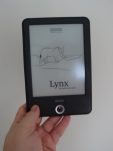
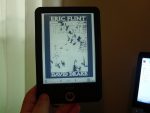
The Onyx Boox t68 Lynx marries the 6.8″ screen from the Kobo Aura HD with Android 4.0 running on a 1GHz CPU with 512MB RAM. It has a screen sharper than on the Kindle Paperwhite, a capacitive touchscreen, frontlight, 4GB storage, and a headphone jack.

I pre-ordered mine from Arta Tech, Onyx’s retail partner in Poland, and it arrived today.

At $250 (prices plus shipping to the US), it’s a very pricy ereader. So rather than put readers in my position of taking an expensive gamble on an unknown device, I would like to help everyone make an informed decision about this ereader.

In short, what would you like me to try and comment on?

The T68 ships with Google Play, so if you suggest an app I will try to install it and then report back. I can also answer questions about Onyx’s software.

So far I have only set up the Lynx, added a few ebooks, and configured my Google account, and my first impressions are not favorable.

Update: But that changed as I figured out more of the settings and quirks of the T68.

I don’t think this will prove very useful as an E-ink Android tablet, and it’s a good thing I had already tried the Sony Reader PRS-T1 and found that device workable as an E-ink Android tablet. Otherwise the poor performance of the Lynx would be enough to make me give up on the idea.

  • The stock settings on the Onyx reading app combine illegible text with badly rendered images. And while I fixed the issues with the text I don’t see a way to get the T68 to render images properly (see below).
  • Google Play and a lot of other basic Android features are nearly unusable due to poor graphics; apparently no one at Onyx thought that it was necessary for color menus to be legible on grayscale E-ink.
  • The Kindle app crashed. I also cannot get it to sync correctly or download ebooks. Update: Changing the refresh mode fixed the issue with the Kindle app.

Onyx has been making ereaders for 5 years now and working on Android on E-ink since 2012, but I can’t see that technical expertise in the T68 Lynx. The software is best described as rough. If you plan to get one I would wait until after the next major update.

Video Review of Onyx Boox C65 AfterGlow eReader

I’ve been Youtubing today, getting ready for my new ereader, and I came across a related model which isn’t strictly available in the US but can be ordered online.

The Onyx Boox C65 AfterGlow is a 6″ Android-equipped ereader which can be bought from one of Onyx’s retail partners. It’s a little pricy for the US market, but on the upside it ships with Google Play, a feature which few ereaders can boast.

I found a couple videos for this ereader.  Neither is in English, but they show enough detail that they give a good idea of how well this device works. The first is a short silent demo which takes you through a few features.

The AfterGlow sports a 6″ Pearl HD E-ink screen with a resolution of 1024 x 758. It runs Android on a 1Ghz CPU with 512MB RAM. It has 4GB internal storage, a microSD card slot, Wifi, and unlike some of Onyx’s cheaper models, the AfterGlow has both a frontlight and a capacitive touchscreen.

Weighing in at 186 grams, the AfterGlow has a 1.7Ah battery with an estimated battery life of around 8 weeks. It also has page turn buttons and ships with a case. And well it should, given that it retails for 100 euros (plus VAT and shipping).

In terms of software, the AfterGlow runs Android and ships with Google Play, giving users access to a broad range of reading apps. It also ships with Onyx’s own reading app, which includes broad support for ebook formats, extensive annotation abilities, and TTS from Ivona.

Google Play Books Expands into 11 Countries in Latin America

Google inadvertently and prematurely announced their next round of expansion today.

According to a Google+ post (which went a little earlier than it should), Google has announced that Google Play Books is launching in Luxembourg and whole host of countries in Latin America:

  • Paraguay
  • Bolivia
  • Uruguay
  • Guatemala
  • Honduras
  • Panama
  • Dominican Republic
  • El Salvador
  • Ecuador
  • Nicaragua
  • Costa Rica
  • Luxembourg

Counting Norway (whose local Google Play Books went live last week) and Luxembourg, Google  has launched Play Books in 13 countries in the past week, bringing the total to 57.

It looks like I was right when I guessed that the hiatus was over, which means that in the coming months we can expect to see Google launching Google Play Books in 6 to a dozen countries every  6 weeks or so. I would not be surprised to see Google Play Books available in 100 countries or more.

Android Police

Macmillan is Testing the eBook Subscription Market – Adds Titles from Tor Books to Skoobe

Only two of the 5 major US trade publishers have shown an interest in the ebook subscription market, and Macmillan is showing signs that they could be the third.

Late last week Macmillan announced, via their German parent company Verlagsgruppe Georg von Holtzbrinck, that 1,500 Macmillan titles are now available through Skoobe, the German ebook subscription service.

The 1,500 titles are drawn from the US- and UK-based SF publisher Tor Books. All of the titles are in English, including Ender’s Game, Mistborn, and Children of the Mind. As the first and (so far) only Macmillan imprint to go DRM-free two years ago, this publisher is Macmillan’s guinea pig for testing new markets and new ideas, and now that includes subscription ebooks.

This deal represents Macmillan’s first foray into this market, and while it might sound odd to see Macmillan sign with a German service it makes sense once you look at Skoobe. The ebook company was launched in 2012, and it is owned by Holtzbrinck and Bertelsmann (which also owns Penguin Random House).

Far from being one of the major services, Skoobe offers a relatively small catalog of around 40,000 titles from 900 publishers, and its service is limited to Germany, Austria, and Switzerland. Readers can pay between 10 and 20 euros per month to read as many titles as they want, albeit with some restrictions on the lower service tiers.

Skoobe is no Oyster or Scribd, and that could be what attracted Macmillan in the first place. Both of those larger services offer catalogs with hundreds of thousands of titles, and they both serve the US market (and they charge a heck of a lot less than Skoobe). Oyster and Scribd both offer titles from HarperCollins and S&S, along with many other publishers and distributors, and they get the most attention in the press.

Macmillan likely declined to sign with one or the other out of concern for lost ebook sales. (Or possibly because Scribd could not afford the advance that some publishers are rumored to be demanding.)

This is a hopeful sign from Macmillan, but I would not read too much into it. Macmillan also experimented in letting Tor Books titles be sold DRM-free. This started in 2012, and even though the past two years have shown that there’s no downside to the move Macmillan has shown no indication of plans to remove DRM from the rest of their imprints.

image by melenita2012