Amazon Started the Day Against DRM Festivities a Week Early by Intentionally Breaking My Kindle eBooks

Defective by Design’s International Day Against DRM is coming up next week, and fortuitously Amazon has given us another example of why DRM is harmful.

Early this morning I got an email with an ebook I have been waiting for. It was Mytro by John Biggs, which I had backed in the Kickstarter campaign, and the email delivered the DRM-free ebooks I had bought. I’m not one to wait, so i immediately downloaded the ebook and tried to open it in the Kindle app on my PC.

And that’s when I saw this error message:

For those who can’t read the text, it says "The version of the Kindle application has expired and can no longer be used. Please update to a newer version."

You see, every so often Amazon likes to disable existing Kindle for PC apps and force users to upgrade. This is the first time I encountered it, but according to the support forums thread I found Amazon has been pulling this trick since at least 2012. I’m not the first person to be surprised when my Kindle app refused to run, and I am probably not even the 41st.

I was able to download and install the updated Kindle app, so this was only a minor inconvenience – today. Luckily I had a functional internet connection; if I were traveling, at a conference, or anywhere away from my home, I might have been out of luck.

And this time around I was also lucky in that the update didn’t bork access to my ebook library. Back in 2011 Amazon pushed out an update for the K4PC app which was simply broken. I, and many other Kindle users, lost access to every Kindle format ebook on our PCs, including stuff we bought elsewhere as well as any annotations or notes we made in those other ebooks.

And that, folks, is what makes DRM, and especially Amazon’s DRM, so utterly pernicious. Not only was Amazon able to block me from accessing the content which I licensed from them, they also cut me off from content I own and content I created myself.

So when the Day Against DRM rolls around again next week, it might be worth your time to make sure your content is safe. Like Cory Doctorow says:

If you can’t open it, You don’t own it!

AAP Reports Book Market up 10% in January, eBooks up 12.8%

The American Association of Publishers issued a new Statshot report this morning, and it looks like Amazon has once again failed to kill the publishing industry.

According to the AAP, the 1,218 publishers who contributed revenue data to the AAP in January 2014 saw a 10% bump in revenue over last year ( from $500 million to $550 million).

The adult segment was up 2.8% (to $362 million from $352 million). The YA/kids segment saw impressive growth of 43.7% (to $144 million from $100 million), but the religious presses saw a drop in revenue of about 7.4%.

I of course have embedded the full charts below, and the news is generally good. Both the adult and kids segments showed increases in most categories, with the exception of adult paperback books. This comes as no surprise given the general decline of paperback sales as they are being replaced by ebooks.

Speaking of ebooks, ebook sales across the 3 segments grew slightly faster than the market average in January, and were up 12.8% (to $142 million from $125 million). I would like to crow about this being great news but in all honesty it only slightly beat the market rate, making this more of a fluctuation than actual growth.

Still, I’m going to wait until next month before popping the champagne.


Users are Reporting the New Comixology App is Missing Old Purchases

Amazon ignited a storm of protest when they removed the in-app store from the Comixology app on Saturday, but the story isn’t over yet.

Numerous comic fans have reported on Twitter that the new Comixology app has lost many of their existing purchases. In addition to no longer being able to buy content inside the app, they are no longer able to even read some of the content they already bought!

I have no information on how widespread this problem is, but in the space of only a few minutes I found 5 different tweets complaining about this problem, ranging from a few titles missing to whole swathes of content lost.

If you have not checked your Comixology app yet, I suggest you do so. Based on the pattern of Comixology’s responses on Twitter I am not sure that they are aware of a systemic problem, and I don’t think they will notice until more people complain.

I have of course contacted Comixology with a heads up concerning this post, but I have not received a response.

I must say that I am disappointed with Comixology and Amazon. When the news broke a few weeks ago that Amazon bought Comixology, I expected Amazon to make the Comixology platform more robust and make the apps more reliable. Instead their first move, before the ink was even dry on the contract, was to muck everything up.

Not cool.

Harper Lee’s "To Kill a Mockingbird" is Coming Soon to an eReader Near You

To Kill a Mockingbird became an instant classic when it was published in 1960, earning it a special place in libraries and classrooms everywhere. This title also had a unique status in ebooks; it was one of the few great titles there were not available to buy digitally (pirated copies are another matter), but that’s going to change soon.

HarperCollins announced on Monday that Harper Lee’s first and last novel will soon be available as an ebook. Starting 8 July, readers will be able to find this ebook in ebookstores. The audiobook, which is currently available on a CD with narration by Sissy Spacek, will also be re-released as a digital download.

Harper Lee had long been a digital holdout, but recently she changed her mind (I wonder if the contract was coming up for renewal). "I’m still old-fashioned. I love dusty old books and libraries," Lee, who turned 88 on Monday, said through her publisher. "I am amazed and humbled that ‘Mockingbird’ has survived this long. This is ‘Mockingbird’ for a new generation."

Following Ray Bradbury and JK Rowling, Harper Lee is but the latest author to acquiesce to market pressure. With Mockingbird now set to be released as an ebook, the list of books that cannot be bought as ebooks is down to a handful of titles The Catcher In the Rye, The Autobiography of Malcolm X and Gabriel Garcia Marquez’s One Hundred Years of Solitude. (edit: this last title is available digitally outside the US).

All of those works are available as a pirated copy only a Google search away, but of course we knew that already.

AP


This Coffee Mug’s E-ink Display Is Powered By Hot Coffee

Here’s the perfect gift for anyone powered by caffeine: a coffee mug with an E-ink screen powered by hot coffee.

Last week Paulig, a specialty coffee roaster based in Finland, unveiled a new coffee mug design called the Muki. This mug features a small and simple E-ink which is powered by pouring hot coffee into the cup. (Or at least that is what Paulig claims; if you look at the photos of the prototype you’ll see that there is also )

The Muki is probably the world’s first smart mug, which in this case means that every time you fill it up the mug can sync with your smartphone over Bluetooth, enabling you to transfer an image and update the screen. The Muki also has a temperature sensor, and it will report back to the paired smartphone app with the current temperature of the coffee.

Here’s the promo video Paulig released last week:

I can’t find any details on the size of the screen, and it’s not easy to judge from the photo. I do know that E-ink offers a couple screen sizes under 4″ and that Pervasive Display also offers several E-ink screen sizes ranging from 1.4″ to 2.7″, and it might be any of the screens over 2″.

There’s also no info on cost, but I do know that the Muki is still under development, and is expected to be released next year.

Mashable

Ten Years Ago This Week, the Sony Librie Ships in Japan

The grandaddy of all modern ebook readers shipped 10 years ago this week in Japan.

The Sony Librie was certainly not the most successful ereader, but it paved the way for all that came after. Its influence can be seen in everything from the keyboard on the original Kindle to the 6″ screen found on most ebook readers today.

Weighing in at 10.6 ounces, the Librie sported the first commercially available 6″ E-ink screen, with the now standard 800 x 600 resolution. It had a keyboard, page turn buttons, a paltry 10MB internal storage, and a card slot for a Sony Memory Stick. It was powered by 4 AAA batteries, and read Sony’s proprietary BBeB ebook format (later used on the Sony Readers).

Retail was a not too unreasonable 41,790 yen (about $410). While that is damned steep by today’s standards, computers and other electronics cost 3 and 4 times as much back then as they do now.

The Librie never amounted to much, and this was probably due to the lack of available content and the DRM. This ereader was tied to an ebookstore where the ebooks were rented and not sold, and they expired in 60 days. (The lack of tools to make your own ebooks probably didn’t help either.)

But in spite of the Librie’s lack of success, it still influenced all the ereaders that came after it. It used a 6″ screen which was developed by E-ink, Sony, and Phillips (and manufactured by Toppan).

I was told by a contact at Toppan that this screen geometry was chosen because it closely resembled the dimensions of a standard size for paperback books in Japan. Sony funded the development just so it could be used as an ebook reader, and it is not unreasonable to say that without Sony’s funding this particular screen geometry might never have existed.

Without the Librie there would have been no screen for the Kindle to use when it launched in 2007. Sure, there’s a chance that Amazon might have funded the development of an E-ink screen for the Kindle, but your guess is as good as mine what the Kindle would have look like.

Jeff Bezos is famous for saying that Amazon will only get into a market when they know that they can outperform the existing players. I would not be surprised if the original spark of the idea of a Kindle with an E-ink screen was ignited when someone at Amazon looked at the Librie and said "we can do better".

Sure, it has been widely reported that Bezos influenced the design of the original Kindle so it looked more like his Blackberry, but the original idea of having a 6″ E-ink screen and a keyboard?

That was probably influenced by the Librie.

Don’t get me wrong, I think Amazon would have used ebooks to disrupt the book industry at some point, but I also think that without the Librie Amazon might have taken a very different path.

The Librie was not the only ereader on the market during that era, so if it had not existed Amazon would still have been inspired by other devices – like the Rocketbook, for example. This was launched in 1999 by Nuvomedia. While it didn’t amount to much, later models based on the RocketBook were still on the market in 2004, 2005. Those devices had a 5.5″ LCD screen with a touchscreen and stylus.

If the Librie hadn’t existed, Amazon could well have decided to give the first Kindle an LCD screen. Battery life would have been terrible, but if the alternate Kindle still managed to keep all of the features then I for one would not have cared.

So folks, if you like the screen on your ereader, and if you like the weeks or months of battery life, and if you like the option of comfortably reading outside, then tonight I would raise a glass to the Sony Librie.

P.S. In case you’re interested, I missed the anniversary of the press coverage by 3 days.

Tales of Amazon’s Dominance of UK Online Retail Were Greatly Exaggerated

The BBC is reporting this week that Amazon has half of Britain’s online retail market, but I’m not so sure that there are enough facts to back up the claim.

On Sunday the BBC broadcast and published a documentary that examined Amazon’s dominance of UK retail. The text version of the piece led with a startling claim:

On average, every person in Britain spends just over £70 a year on Amazon. That’s more than half the country’s entire online retail spend. It’s an impressive result for a business started on a couple of computers exactly 20 years ago.

This is quite the newsworthy story, but when I went to confirm the story and find details which would put it into perspective I ended up with new information that made me doubt whether the BBC is correct.

Update: And I just received confirmation that this detail was not correct:

According to The Independent, Amazon’s revenues for 2013 were under £5 billion:

Analysts said Britain’s biggest online retailer was feeling the squeeze as traditional players such as John Lewis and Dixons raised their game — particularly with “click and collect” services.

Accounts filed by the US parent company show Amazon’s UK sales were $7.29 billion (£4.46 billion) — a rise of around $800 million on a year earlier. British revenues rose by $1 billion to $6.48 billion in 2012 and by $1.4 billion to $5.35 billion in 2011.

Depending on your perspective, that could be a large sum. But before I posted I went looking for details on the overall retail spending in the UK, which I thought would present a useful perspective on Amazon’s share of UK retail.

I was aiming for a post similar to the one I wrote on Friday which compared Amazon’s revenues to other US retailers, but instead I ended up with information that lead in a completely different direction.

According to the latest estimates, online retail in the UK were a lot larger than the BBC would have you believe:

UK shoppers spent £91bn online in 2013, according to new figures.

The internet retailing market grew by 16% during the course of the year, according to the IMRG-Capgemini eRetail Sales Index for December. It was capped by a final month in which online sales rose by 18%, with £11bn spent up from £9bn in December 2012. Twice as much was spent via mobile devices as was spent using them in December 2012. The figures beat IMRG’s original estimate, last January of 12% growth.

The BBC said that Amazon accounts for "more than half the country’s entire online retail spend". I’m sorry, but that just doesn’t add up. There isn’t even any way to massage the numbers and make that statement come out true.

Does anyone have a clue as to why the numbers don’t add up?

I will admit to being baffled.

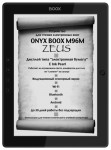
Onyx Launches a 9.7″ E-ink Android Tablet in Russia

Android on E-ink is still a pipe dream in the US but the rest of the world is another matter. Onyx’s Russian retail partner MakCentr has just announced a new 9.7″ Onyx Boox ebook reader.

The Boox M96M Zeus runs Android 4.0 and is available now with a retail price of 14,990 rubles, or about $420 USD.

This ereader is based on a 9.7″ Pearl E-ink screen with a resolution of 1200 x 825, and it comes with both a touchscreen and a frontlight. It runs a customized version of Android 4.0.4 on a 1GHz Freescale i.MX6 Solo Lite  CPU with 512MB RAM, 4GB Flash storage, a microSD card slot, Bluetooth, and Wifi. Weighing in at 510 grams, the Boox M96M Zeus has a 1.6Ah battery with an expected one month of runtime without charging.

In terms of software, the Zeus runs Onyx’s custom reading app, which includes support for a wide variety of ebook formats. The Zeus is also going to ship with FBReader, CoolReader, and AlReader, giving readers the choice of several good reading apps. Readers will also find English-Russian and Russian-English dictionaries on the Zeus, as well as the option for installing additional dictionaries.

If you’re thinking that the specs are rather thin for a $400 device, I agree. I think this device would have a lot more success if it had a dual-core CPU (at least) as well as more RAM and an external USB for accessories. The extra hardware would enable users to use the Zeus as an Android tablet rather than as an ebook reader. As it stands, the Zeus is so underpowered and overpriced that it has priced itself out of my pocketbook.

The-eBook.org

Barnes & Noble Launches New e-Textbook App – Yuzu

Barnes & Noble quietly launched the beta version of a new digital textbook app earlier this month. It’s called Yuzu, and it is currently available for the iPad and for web browsers.

Yuzu is a digital education platform that Barnes & Noble says is going to "make the everyday learning experience remarkably gratifying". Few details are available at this time, but B&N says that the new platform will support "the collaborative, free flow of information between learners and educators".

When it officially launches this summer Yuzu is going to be B&N’s replacement for NookStudy, which according to the website has already been retired. At this point it looks like Yuzu is an entirely new platform, and it would appear that Yuzu does not share the same accounts as the Nook Store or NookStudy. In fact, one of the FAQs I found says that Yuzu is not compatible with NookStudy textbooks.

The app is currently only available for Internet Explorer and Safari 6.1/7 (but not Firefox), and for iPads running iOS7, and it is far from complete. While the app does run in IE, all I can do is play around with the set up process. I can create terms and add courses to a term, but I cannot actually read any content. There’s no option for uploading my own files, and Yuzu’s bookstore has not yet been enabled.

At this point we have little more to go on than B&N’s own description, and it makes Yuzu sound more like a digital textbook app like iBooks or Nook Study than an educational and academic app like iTunes U. Like its predecessor NookStudy, Yuzu offers students a next-generation reading and note-taking experience in a simple app, but it also improves on NookStudy by making it easier for educators to provide course materials.

In addition to launching the Yuzu platform, B&N is also tying in FacultyEnlight. This is a website where educators can assemble academic materials into course packs, and from what I can tell B&N launched it in 2011 (if not earlier). Educators  can search for the textbooks and other academic material they need, and then build a required and recommended textbook list for a class.

FacultyEnlight is very much focused on the college market, so I would bet that it is also tied in to the 600 plus college bookstore websites run by B&N College. On a related note, the site also prompts educators to sell their original course materials via Nook Press, where they will end up in the Nook Store – and probably Yuzu as well.

Yuzu is only available for IE, Safari, and the iPad, but I have been told that B&N plans to have a Yuzu Android app and support for more web browsers by the time the platform launches this summer.

The Digital Reader was the first to report earlier this year that Barnes & Noble was turning their attention to the digital education market (I scooped the official announcement by about 3 weeks). At the time I was hopeful that this pivot could save B&N’s digital division, but now I am not so sure that it will.

Everything I have read today suggests that Barnes & Noble is pursuing a retail strategy where they will sell (or rent) digital textbooks to students. Given the general failure of the digital textbook market, this does not bode well for B&N.

Over the past six months we have seen several digital textbook providers go bankrupt, sell out to their competition, or pivot to serve a new market. Kno was acquired out of bankruptcy by Intel, Coursesmart was sold off to its competitor, and Inkling pivoted to a new business model based on licensing its tech to publishers.

I predicted about a month ago that the future of digital textbooks is in publishers selling to schools, not retail. If B&N is going to ignore that trend then I expect that Yuzu is even more doomed than the Nook platform.

On the other hand, B&N does have an advantage that none of the startups could claim; B&N runs over 600 college bookstores. This gives them a market presence that few other than Follett (which also runs college bookstores) can match.

And in any case, it is too early to say for sure how B&N will generate revenue; they might be planning to use a different model than selling digital textbooks to cash-strapped students. We shall have to wait and see.


Now that Amazon Owns Comixology , What Will Happen To Submit?

It’s been a week since Amazon announced that they were acquiring Comixology , and the surprise deal has left many questions unanswered, including what Amazon plans to do with Submit.

Comixology launched their self-pub platform and/or publishing imprint in March 2013, and over the following year 1,000 titles were accepted for sale.

But now that Comixology is owned by Amazon, it would seem that Submit is redundant. After all, Amazon owns a comics imprint (Jet City Comics launched in July 2013) and a self-pub platform (KDP), so there is little reason to keep Submit around.

Or is there? At least one comics creator thinks Submit will be sticking around, and I agree with him. Bleeding Cool invited Tim Gibson, author and artist on ComiXology Submit title Moth City, what he thought:

I think it’ll affect Submit hugely, though it’s hard to tell how at this stage. I suspect with Amazon’s financial success with Self Published Fiction (a real money spinner for them, as seen here) Comixology’s Submit platform and its recent growth might have been the cherry on the top of the Comixology sundae.

…

Overall, I’m feeling optimistic. Comics and Graphic Novels make up such a small part of Amazon’s e-book system. Around 1% of e-sales if you believe Hugh Howley’s author earnings data (linked to above), so they’re an untapped market within the Amazon platform. They changed their submission engine to encourage more comic submission in the last year or so, but were hampered by some odd file-delivery fees and a small comic audience.

Comixology Submit was definitely the first priority for interdependent comics creators looking to sell digital comics, and if Amazon absorbs some of their systems and oversight it could open up a whole new audience for creators.

Comixology Submit is a strange beast. It was originally launched as a way for creators to self-publish, but unlike KDP Submit is run with a fair amount of oversight. Not every title is accepted by Comixology, and that in many way’s makes Submit more of a publishing imprint than a self-pub platform (and Amazon already has one of each of those).

But I don’t think it’s going away.

Amazon made it clear last week that Comixology would remain its own platform, and if that is true then Comixology will probably have as much independence as Audible. That audiobook distributor is closely integrated with many of Amazon’s systems, including accounts, the Amazon.com website, and the Kindle Fire Android tablets,  but it is still its own entity with its own distribution network and even a self-pub platform (ACX, which launched in 2012).

It’s more than likely that Comixology will retain a similar degree of independence even after it has been closely integrated with Amazon. And that means keeping its own self-pub channel, apps, and distribution network. And given Comixology’s success so far, it’s probably the right move.

If nothing else, the basic structural differences between prose and comics support the idea that they not be combined into a single ebook format in a single store.

Bleeding Cool

Enhanced eBooks Don’t Necessarily Enhance Education

We’ve long known that when games and other enhancements are added to ebooks they can  distract readers from paying attention to the text, and now it appears that enhancements can have a negative academic impact.

Researchers at West Chester University have published a paper which looks at the impact of using digital textbooks on iPads. In a small study they found that students’ reading comprehension  was higher when they read conventional books than when they read enhanced ebook. In a second related study the researchers discovered that the students "often skipped over the text altogether".

The Schugars, a husband-and-wife research team at West Chester University, have been researching this topic for the past 3 plus years. They’ve published numerous papers, including one which I wrote about back in 2012. That paper discussed a study which showed that college students who read on ebook readers performed better on tests than the related group of students who read paper books. That is a markedly different outcome from the two most recent studies, both of which focused on students reading on tablets.

The first study compared students reading ebook apps downloaded from app stores like iTunes to students reading paper books. It focused on just 13  middle school students, so it isn’t possible to draw wide conclusions, but what the Schugars found is concerning enough to merit further study. Students showed a noticeably lower level of comprehension when they read on the iPad. The Schugars attributed the difference to the distractions of the enhancements.

In the second study, the researchers observed students in 18 classrooms where iPads and digital textbooks were in common use. The classes were being taught with enhanced digital textbooks created using iBooks Author. While students were "highly motivated by their interactions" with the enhancements found in the ebooks, they also "often skipped over text, where the meat of the information was."

While it is easy to add game-like elements to ebooks, crafting an enhanced ebook that improves upon the original is much harder. What is more likely to happen is that readers will be distracted from the text, leading to situations like in one study cited by the Schugars, which showed that children spent 43% of their ebook engagement time playing games embedded in the ebooks rather than reading the text.

So is this a sign that enhanced ebooks should be kept out of the classroom? Not exactly.

The researchers also found that some enhancements really did enhance comprehension. The researchers advised parents and educators to avoid enhanced ebooks where the enhancements distract from the text and where the enhancements are time-consuming, lead students away from the page of text they are reading, or don’t contribute academically useful features like understanding difficult vocabulary terms.

"It’s not necessarily that ebooks are bad for reading," Heather Ruetschlin Schugar said in an interview with Education Week. "But teachers need more strategies for teaching kids to use what they know about reading in an ebook environment."

NYTimes, Education Week

The Chicago Sun-Times Shuts Down Their Comment Section

It’s widely accepted that the anonymity of the internet can turn almost anyone into a troll, and nowhere is this more true than in the comment section. This unfortunate trend has led a number of sites to respond by either removing any aspect of anonymity or taking a more extreme step of killing their comment section entirely.

The Chicago Sun-Times is the latest media organization to take the latter path; they announced over the weekend that the comments were going to be temporarily disabled.

"The world of Internet commenting offers a marvelous opportunity for discussion and the exchange of ideas," wrote managing editor Craig M. Newman this weekend. "But as anyone who has ever ventured into a comment thread can attest, these forums too often turn into a morass of negativity, racism, hate speech and general trollish behaviors that detract from the content."

The Sun-Times will be launching a new comment section  which they hope will "not only allow for free discussion, but encourage increased quality of the commentary and help us better police the worst elements of these threads".

This paper is not the first to to try to fix online comments, nor will they be the last. Many sites have adopted comment management platforms like Disqus as a way of managing the troll problem, but that solution comes with its own problems. Other sites require that commenters create accounts, but when the bar is set that high it tends to discourage casual commenters. Some sites that use Disqus share this problem; those sites require an account in order to comment, which usually discourages me from leaving a comment (instead I go to Twitter).

TechCrunch stands as an example of a site that went from anonymous comments to Facebook comments as a way to reduce the presence of trolls, and it worked for them. But they might be the exception.

South Korea first started requiring internet commenters use their real names in 2007. The rule initially only applied to sites with more than 300,000 users, but was later tightened to sites with more than 100,000 users.

The rule was scrapped in 2011 because it was deemed largely ineffective at curbing trolls:

The system has been ineffective in preventing people from posting abusive messages or spreading false rumors. According to a study by the KCC, malicious comments accounted for 13.9 percent of all messages posted on Internet threads in 2007 but decreased only 0.9 percentage points in 2008, a year after the regulation went into force.

Another reason to scrap the rule is that it potentially discriminates against domestic companies. Internet users simply post malicious comments on Facebook, Twitter or other international websites, where the rule does not apply.

Talking New Media

image by Cali4beach

Amazon’s Deal with Bokrondellen Paves the Way for a Swedish Kindle Store

Following months-long talks with Swedish firms, news is breaking today that Amazon has signed a deal with Bokrondellen, a Swedish publishing services company.

Given that Bokrondellen runs the central book database for the Swedish bookselling industry, this deal paves the way for Amazon to enter the Swedish book and ebook market. This company is owned by a consortium of publishers, and it is the primary source of information on what book titles are in print and being published in Sweden.

Christer Perslöv, CEO of Bokrondellen, confirmed the news. "Now Amazon can sell Swedish books on all their sites. If they want to make it in the USA, Germany, England – or if they want to start a Swedish site – it’s up to them. Obviously they haven’t shared their plans with us."

There’s not even any rumors about a time frame for Amazon to enter the Swedish ebook market, but when they do they will not be alone.

At the moment there are 3 international ebookstores in Sweden, iBooks, Nook, and Google Play Books. Apple launched there in September 2011, and Google expanded into the country in July 2013. Barnes & Noble also established a presence in that market when the Nook Store went international in November 2013.

I have known that Amazon has been interested in the Swedish market since at least September 2013, when I discovered that Amazon had added support for Swedish to KDP. With a population under 10 million, Sweden might not be the largest book market in Europe but it is also one of the markets with the highest concentration of consumers buying books online.

There’s no information yet on when Amazon will launch a local operation in Sweden, but we do know that they won’t be running the usual local retail site. Amazon has so far been unable to procure the Amazon.se website address. That is reportedly owned by a Swedish marketing firm which has declined to sell the domain to Amazon.

Amazon faced similar issues in Brazil and was able to negotiate a deal for the Amazon.com.br domain. The terms of that deal have not been disclosed.

The Local

image by roger4336


Entitle Adds eReader Support to Their Subscription eBook Service

When Entitle first launched in September 2013, one of its stronger selling points was that readers would own the ebooks they acquired through the Audible-like subscription service.

This set the service apart from Oyster and Scribd; both of those let you read as much as you want but cut off your access as soon as you stopped paying, while Entitle let readers continue to read the ebooks – albeit only inside Entitle’s apps.

Today Entitle removed that last restriction. Readers can now download the ebooks they buy from Entitle, and what’s more they can transfer those ebooks to ebook readers.

Entitle has apps for the iPad, iPhone, Android, and the Kindle Fire, and today they are announcing  support for a broad spectrum of ereaders from manufacturers like Sony, Pocketbook, Kobo, and Barnes & Noble. This support was actually added in late December 2013, shortly after I complained about its absence, but Entitle is only officially announcing it today.

The Kindle is of course not supported, but that comes as no surprise.

The  process of downloading the ebooks works much the same as from most other ebook retailers whose names don’t start with A. The ebooks are encumbered by Adobe DE DRM, so you’ll need either Adobe DE or a compatible app like Nook Study running on your PC. The ebooks can be downloaded from the Entitle website, and once on your computer they can be transferred to your ebook reader.

You will need to follow Entitle’s instructions; they’re not quite the same steps as with other ebook retailers.

Entitle has changed a lot since they launched 7 months ago. The service now offers a 2 title per month subscription for $10 a month, down from the $17 a month in September.  The catalog has grown to include around 150,000, or about 50,000 new titles from 10 publishers. This including both backlist and frontlist works published or distributed by HarperCollins, HMH, IPG, Ingram Content Group, and Simon & Schuster.

The Entitle catalog is smaller than what you would find in a leading ebookstore, where you would expect to find millions of title. It is larger than the catalog offered by Oyster, but smaller than the catalog belonging to Scribd. Both of those services offer a buffet style subscription service for $9 to $10 a month.

TechCrunch

Amazon to Acquire ComiXology

Coming nearly 2 weeks after rumors broke about the deal, Amazon announced today that they were acquiring the leading digital comics distributor comiXology.

In one fell swoop Amazon has bought a strong position in yet another digital market.

comiXology is the leading digital comics distributor; it dominates a market where Amazon only has a token presence, and that is probably why Amazon bought them.

With partnerships with over 75 comic book publishers including Marvel and DC, comiXology sells digital comics to millions of readers. They have apps for Android,  iPad, Windows 8, iPhone, and the web browser, as well as the largest digital comic catalog anywhere.

comiXology has been selling digital comics since July 2009. Amazon, on the other hand, only started selling digital comics in the Kindle Store in November 2011. Amazon’s digital comics efforts launched at the same time as the Kindle Fire, and at first were only available on that device.

Amazon has never disclosed how many digital comics they’ve sold, but it is safe to say that comiXology sells quite a few more. In many ways, comiXology is like Audible, the audiobook distributor Amazon acquired in 2008. Both companies secured control of a market via early investment in tech and aggressive pursuit of partnerships with publishers.

Update: I finally heard back from Amazon, and they told me that, like Amazon’s many other acquisitions, comiXology is going to be operated as a standalone business, with its brand, management team and headquarters in New York City intact. "Amazon, when it buys a working company that’s doing a good job, tends to let them spread their wings," said comiXology co-founder and CEO David Steinberger. "It gives them resources and lets them go on the same path, only faster, better and stronger."

P.S. This deal had to have been in the works for 6 months or more, and negotiations may even have started before I predicted last July that Amazon should be interested in comiXology. I wish I knew which came first.