New Survey Shows eBook Adoption at 29% in England

The UK reading charity Booktrust has just released a report which looks into that nation’s reading habits, and it has some good news for this ebook-loving blogger.

The 53 page report is based on a survey of 1,500 adults in England (but not Scotland or Northern Ireland), and it includes extensive details on reading habits including both paper and digital.

The report showed that a fifth of respondents never buy physical books, and that nearly as many (18%) don’t read paper books at all. A growing number of the respondents (45%) reported preferring watching tv shows and movies to reading, and over a quarter prefer the internet and social media to reading books (rising to 56% among 18-30 year olds).

This survey report mirrors the latest report from the Pew Research Center. The latter report doesn’t go into the same level of detail as the Booktrust survey nor does it ask the same questions, but its results did show a similar difference in reading preferences.

Both reports show similar levels of ebook adoption. Here in the US, Pew reported in January that 28% of Americans had read an ebook in the past year, while in England Booktrust reported that 29% of respondents had read an ebook at some point. The Booktrust survey goes on to break up that 29% and show that 20% of respondents read ebooks at least weekly, with another 9% reading ebooks less often.

Both reports show similar levels of paper book use, with Pew reporting that 76% of Americans had read a book in the past year, while Booktrust reported that 78% of the English had read a paper book "daily, at least week, or less often(?)".

Audiobooks, on the other hand, have only been adopted by about 6% of the respondents in the Booktrust survey. This stands in stark contrast to the US, where Pew reports that 14% of US adults had listened to an audiobook in the past year.

A later section of the survey delves into book ownership. As you might expect, the 6% of the respondents who read the most also owned the most books, averaging 994 titles in their library. Those bookworms read 12 books a month, while the group of next most enthusiastic readers (15%) read  3 to 4 books a month and had 252 books in their library. A similar group of voracious voracious readers (14%) read slightly fewer books but more magazines and other periodicals, and actually owned more books in their personal library (262).

Report (PDF)

Guardian

Marvel Adds Soundtracks to Digital Comics

Marvel unveiled their long awaited adaptive audio feature yesterday at SxSW, and it has proven much more interesting than I had expected.

Adaptive audio, which was initially announced at SxSW last year under the codename Project Gamma, adds an audio element to Marvel’s digital comics. Described last year as a way to add an "adaptive, non-repetitive score" to digital comics, Project Gamma was intended to a background soundtrack which changed as a reader read the comic. The sound track was keyed to certain panels, and it was also supposed to respond to the speed at which the reader turned the page.

Or at least that’s what Project Gamma was supposed to do when it was announced last year; how well does it perform now?

If you like, you can find out for yourself. The new feature is available in the Marvel Unlimited app. This is a free download, and all of the titles that have the new audio are available as free samples. You’ll only get a part of each volume, but it’s enough to at least give you an idea of how the soundtrack adds to the reading experience.

 I tried the new feature on my iPad, and I think the soundtrack improves upon the original comic. The sounds ranged from music clips that set the mood to sounds that were tied to specific events in the story, and in general they improved upon the story.

Should I encounter new titles from Marvel that include audio I might buy them. But I won’t be buying any of the several titles released so far.

Marvel debuted the adaptive audio by adding it to comics originally published 10 years ago. Captain America: Winter Soldier is the inspiration for the movie that is coming out in April, so this move makes sense, but unfortunately the original comics are so old that they do not translate well to Marvel’s digital format.

The latest trick in comics is to avoid showing an entire page at once, and instead show each panel in sequence. This introduces time as a story telling element, which can add a lot to the reading experience.

The CA:WS comics I read are so old that they were not created as high definition digital files, and that is blindingly obvious when I tried to read them. Have you ever zoomed in on an image to the point that it was started getting fuzzy? That is what I frequently saw with the CA:WS comics.

This is regrettable because it detracts from the new audio feature. It also tells us that Marvel is only making a half-hearted effort to convert and sell their backlist, but that’s a tale for another post.

But in spite of Marvel’s early stumbles, they could have a real winner here – if it is used correctly. But if Marvel treats it like another gimmick and adds it to old titles simply to try to get you to buy them again, then they’ll ruin it. Let’s hope that doesn’t happen.

Cnet

Onyx E-ink Smartphone Gets New Name & Launch Partner in Poland

The Chinese ereader maker Onyx has been teasing us with visions of their E-ink Android smartphone for well over a year now, and new reports suggest that it is about to hit the market. It’s now called the Midia InkPhone, and it is the hot story this week at the CeBIT trade show.

The InkPhone has a 4.3″ E-ink screen. The specific details on the current model are scarce, but my latest info (from October 2013) says that the screen resolution is 800 x 480 (specs confirmed by a new press release).

This phone is running Android 2.3 Gingerbread on  a 1GHz CPU with 512MB RAM, a microSD card slot, Wifi, Bluetooth, and support for EDGE networks. Unlike the Yotaphone, there’s no LCD screen. There’s also no camera, but given the limitations of the E-ink screen I don’t think you would want to take photos with it anyway.

This smartphone was developed by Onyx, but it’s being shown off this week by Arta Tech. This Polish firm is a local retail partner for Onyx, and they have committed to releasing the Midia InkPhone in Poland. There’s no word on the retail price or release date, but I have learned that Arta Tech initially announced this phone back in December 2013. This story only crossed my desk this morning when Engadget got to play with the InkPhone (those lucky bastards).

Engadget says that this phone will ship with only 4GB Flash storage and a Rockchip CPU. They don’t have any details on the price, but they did repeat the detail that the InkPhone should run for more than two weeks on a single charge of its 1.8Ah battery. They also posted a gallery of 9 photos. I can’t see them for some reason, but you may want to check them out.

Update: Engadget is now reporting that the InkPhone is expected to be available in Germany and Poland at some point in April. It’ll be priced at around €140 ($195).

But even though I can’t see those photos I do have a video I can share. Charbax got a look at this smartphone back in October:

B&N Cuts Nook Funding by 74%

Barnes & Noble has lost over a billion dollars on their digital investment in the past 4 years but they’re not going to let that continue. B&N’s most recent quarterly SEC filing has revealed that they’ve cut funding for Nook Media significantly.

B&N reported that during their third fiscal quarter, which ended on 25 January 2014, the capital expenditures for the Nook were $7.4 million. This represents a decline of 74% from the amount spent on the group in the same period in the previous fiscal year, and over the past 9 months B&N has cut Nook capital expenditures by an average of 55%.

B&N reported a $61 million loss on the Nook that quarter on $157 million in revenue from Nook content and hardware sales.

Part of the reduced expenditures comes from the layoffs which we’ve been reading about for the past several months. B&N confirmed on their conference call with analysts last month that 190 positions had been eliminated as B&N shifts focus from the consumer ebook market to the educational market. They have also been hiring new staff with that goal in mind.

The SEC filing also notes that Barnes & Noble has yet to fully comply with their international obligations to Microsoft, and that B&N is still working towards selling a sufficiency of ebooks in 10 markets. While they did launch the Nook store in 32 countries in 2014, B&N has acknowledged that effort has not reached the “content thresholds” called for by the Microsoft contract. B&N was supposed to hit that milestone by June 2013, and then by the end of the 2013 calendar year, but they believe they will still make their latest deadline of April 2014, when the current fiscal year ends.

Until Barnes & Noble achieves the necessary level, the delay "may entitle Microsoft to defer a portion of advance payments until the target expansion requirement is met." As part of their investment in Nook Media in 2012, Microsoft is paying B&N $25 million annually for five years to help with the international expansion.

PW

Kobo: Ending Agency Pricing Will Kill Us

Canada’s Competition Bureau announced a settlement last month with 4 publishers to end agency pricing, but it looks like the process isn’t going to go as smooth as one might have expected.

Kobo has filed an objection to the consent decree, and they ask that the settlement be modified so that they are not negatively impacted by the sudden and radical change to the Canadian ebook market.

As part of their filing. Kobo revealed some rather telling details about their business. They blame the end of agency in the US for the loss of their market share, and they predict that the same will happen in Canada.

Kobo’s objection was actually filed 2 weeks ago, but I only got a copy (PDF) yesterday (via Quill and Quire). it’s an interesting read, and if you take it at face value then the future does not bode well for Kobo.

Here are a couple sections from the PDF that spell out how

44. The losses would impact Kobo’s ability to compete in the Canadian market. By analogy, in the US, when Agency Lite was brought into existence, Kobo saw its net revenues steadily decline. Kobo has since stopped investing in marketing in the US, closed its office in Chicago and is focusing on other markets. Its market share and revenues are now negligible there. Although Kobo is a bigger player in the Canadian market, this will not detract from the fact that such significant losses will impact Kobo’s ability to invest in technology and to market its offerings. Regardless of which pricing strategy Kobo chooses to adopt, it expects to be less competitive than it is presently and will lose market share to E-book Retailers who are willing to consistently price their E-books at unsustainably low levels that other competitors simply cannot meet.

45. The harm to the E-book market more broadly will also be significant in that the prohibition on Agency will likely lead to the exit of competitors from the Canadian market and significant financial pressure being brought to bear on the ones who remain. Sony and Barnes & Noble’s respective experiences in the US are illustrative of the negative effect of a ban on Agency. Sony exited the E-book market in the US entirely (and has now had its E-book business acquired by Kobo) , and Barnes & Noble’s NOOK E-book division reported heavy losses fo r the 2013 fiscal year. A ban on Agency, even in the short term, will have a lasting and irreversible negative impact on the market for E-books in Canada.

In short, Kobo is saying that when Amazon was allowed to discount ebooks in the US, Kobo was unable to compete effectively, not even by means other than price (marketing, CS, features, community). This is rather curious because other companies, including Zola Books, The Reading Room, Bilbary, Oyster, and Scribd all seem to be able to compete effectively against Amazon in the US ebook market. Also, (Barnes & Noble saw most of its growth in the pre-agency era, claiming a 20% market share by the end of April 2010. This only grew another 6% to 8% in the following years. )

Perhaps Kobo should buy out one of their smaller competitors and put that smaller competitor in charge of the Kobo ebookstore?

On a related note, if Kobo has only a negligible market share in the US then I have to wonder whether their partners at the ABA, and its IndieBound program, are beginning to regret betting on the losing horse. Indie booksellers who belong to the ABA can take part in an affiliate program and earn a commission on Kobo ebooks and hardware, but if Kobo only has a negligible share of the US ebook market then the booksellers are not generating a lot of revenue.

image by Sean MacEntee


Pocketbook Ultra’s next eReader to Have Carta E-ink Screen and a Camera?

Richard Palombo, writing over at eeevolution.it, has uncovered a couple images on a design website which may or may not be Pocketbook’s next ebook reader.

Few details are available on the Pocketbook Ultra, but according to the description this device has a 6″ Carta E-ink screen, frontlight, touchscreen, and a camera. This device also has page turn buttons on the rear of the case rather than the front, and the camera may or may not have an LED flash.

There’s no word on the CPU, storage, or the camera resolution, and in fact I am still waiting on confirmation that this wasn’t the work of some ambitious design student, but if this ebook reader design is real then it’s going to be the most interesting ereader launched in 2014.

The Ultra would be only the second ereader to get the Carta screen. This is the latest generation E-ink screen, and I was under the impression that it was exclusive to the Amazon Kindle Paperwhite. Kobo doesn’t even have this screen, and we all know that they would have used it on the Kobo Aura if they could have.

Furthermore, this would be the first ebook reader which included a camera as well as the ability to scan books and convert the image to text. This useful feature can be found on many a smartphone, but not on any ereader that I know of.

But is this a design that Pocketbook plans to release or is this merely a concept design which an independent designer created just to explore the idea?

I’m not sure. I have queried Pocketbook for confirmation, and I am waiting for someone to confirm that this is the real deal. While I hope that this is real, I have my doubts. Some details of the design, including the placement of the camera, make me wonder if this design is a independent project and not the work of Pocketbook.

Stay tuned.

Pocketbook Aqua Waterproof eReader Officially Launches, Will Cost $194

Pocketbook has officially launched their new dust and water-resistant ereader, and they’re charging more than I would be willing to pay for it given its limited features and minimal water protection.

This ebook reader is scheduled to be unveiled later this month at the Salon du Livre  in Paris, and it has a projected retail price of 6990 rubles or 109 euros, depending on the market.

When the Pocketbook Aqua leaked last month, I was less than sure that the technical details were accurate or complete. Now that we have the official press release I can confirm that this ereader has a low-resolution E-ink screen, 4GB of storage, Wifi, a touchscreen, but no frontlight or microSD card slot.

It’s also lacking any type of page turn buttons, which were probably dropped from the design in order to simplify the design and make it easier to waterproof it. This is also why there’s no microSD card slot.

The Aqua is also known as the Pocketbook 640, and it runs Pocketbook’s software on a 1GHz CPU with 256MB RAM. It’s going to ship with a broad selection of dictionaries, including quite a few translation dictionaries for Russian, Ukrainian, and European languages. And like Pocketbook’s other ebook readers, the Aqua will offer support for a number of ebook formats, including Epub and PDF.

The Aqua has already been announced for the Russian market, where it will cost 6990 rubles, and for the German market, where it will cost 109 euros. The latter price converts to $149 USD, which is not terribly unreasonable for the market.

Just to give you a comparison, I can get a Kindle Paperwhite that was waterproofed by WaterFi for $219. This firm offers an after market service which waterproof mobile electronics, and they’ve been selling the KPW since May 2013.

WaterFi guarantees their work to a depth of 200 feet, which is a far higher standard than what Pocketbook promises for the Aqua. That ereader is only certified for the IP57 standard, meaning that it can be submerged in up to a meter of water for up to 30 minutes.

P.S. On a related note, it looks like there is a good chance that the Earl back-country tablet will indeed make its way into user’s hands; according to the latest updates its development is progressing, albeit slowly. This device has a ruggedized shell and a flexible 6″ E-ink screen,  making it a much better choice for anyone who plans to use it in unsafe situations. Of course, it is also up for pre-order for $300, but you get what you pay for.

Infographic: Reader Sutra

What’s your favorite reading position (he asks suggestively)?

The ebook subscription service 24Symbols took that question and ran with it. A few weeks ago they posted a chart which showed 24 reading positions inspired by famous books.

The titles for each image are in Spanish, but with most of the titles I don’t think that will be an issue.

24Symbols

Amplify Launches New Tablet, Will Ship it this Fall

With an entire 15,000 unit order recalled after only a few months, Amplify’s first educational tablet was one of the more spectacular tech fiascoes of 2013. This resulted in quite a few disappointed and frustrated students, and that is a mistake that this 2 year old startup is not looking to repeat.

Amplify has just unveiled their second tablet, and it’s pretty clear that they’ve learned a thing or two. This tablet was developed in partnership with Intel, and it’s based on the reference designs that Intel has been developing over the past few years.

The new Amplify tablet takes the 10″ reference design Intel unveiled in January and improves upon it. Like the reference design the Amplify tablet has a rugged shell and is running Android 4.2 Jelly Bean, but Amplify boosted the CPU, stepping it up to a 2GHz dual-core Z2580. This tablet also has twice the RAM, 16GB of storage, a microSD card slot, and Bluetooth.

The 10″ screen still has a resolution of 1280 x 800, but on top of the screen you’ll find a layer of Gorilla Glass. There’s also 2 cameras (5MP and 1.3MP), Mimo Wifi antennas for increased reception, stereo speakers, and a microphone. And finally, the battery life is listed as 8 plus hours; according to the spec the battery is rated at 8.1Ah.

In terms of accessories, the new Amplify tablet will have the integrated stylus as well as headphones and an external keyboard.

As you can see from the specs, the new Amplify tablet is going to be faster and more rugged than the one it replaced. That tablet was based on an Asus consumer tablet which has proven to be less than sturdy in the hands of schoolkids. Counting the 15,000 rented to the Guilford School District, about 20 thousand have been distributed so far. They will be recalled and replaced by the new model, which is expected to ship in the Fall and be in students' hands in time for the new school year.

Like their predecessor, the new tablets will be rented for $199 per year for 3 years.  It will come with device management tools as well as a suite of CC-licensed content. The previous tablet shipped with content from Khan Academy, CK-12 textbooks, and more, but the new tablet will have a slightly different bundle. You’ll also find public domain ebooks as well as a number of useful educational apps, including the Desmos graphing calculator, Encyclopaedia Britannica, EverFi’s digital literacy curriculum, Geogebra, Google Apps for Education, Merriam Webster Dictionary, Project Noah science tools, etc.

Amplify will also be licensing additional academic content separately. The first of the new content launched today, and it focuses on Language Arts curricula for 6th, through 8th grades. it  will set schools back $45 per student per year.

BookBaby Launches Bookshop

The indie ebook distributor BookBaby launched a new tool this week that could help self-published authors connect potential readers with ebookstores where an author’s book can be found.

Bookshop is designed to help authors connect directly with readers in ways they’ve never been able to before. This new service enables authors to create easy-to-use landing pages which contain links to an author’s website as well as links each ebookstore where an author’s work can be found, making it easier for authors to promote each of their books directly to potential readers.

Each landing page will feature an elegant design and all a book’s vital info, starting with an over-sized version of the book cover as well as relevant metadata, the book description, and details about the author and related books.

And most importantly, each page will include links to sites where readers can buy a copy. “Having a page on BookBaby is free for everyone, even if they don’t want to use us for distribution,” says director of marketing Kevin Breuner. “Their pages have links to the places where people can buy their work. And with BookShop, authors can market their work directly from their pages to readers, setting their own prices, as well as going through all the other outlets. We’ve learned a great deal running CD Baby, and we’re applying it to this. We’re working for the authors.”

To find out more, check out the BookBaby website.

Russian Author Releases Custom eBook Reader, Targets Fans and Readers Alike

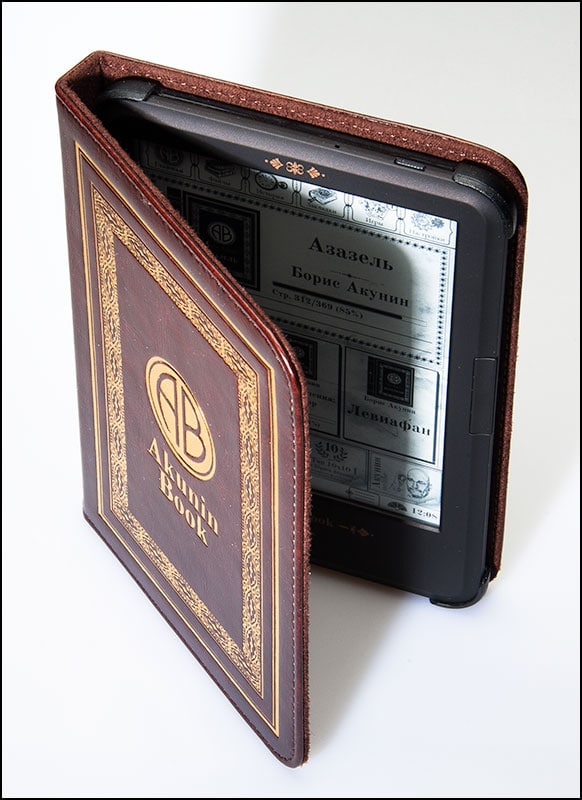
Publishers and authors have long sold limited edition books to fans in order to raise revenue, and Russian author Boris Akunin has taken that idea in a new direction. A few weeks ago he launched the AkuninBook, a limited edition 6″ ebook reader that comes bundled with a selection of his works and other content.

Boris Akunin is a pen name for Grigory Shalvovich Chkhartishvili. According to Wikipedia he writes detective and historical fiction, but he’s also an essayist and literary translator.  On his blog he says that the AkuninBook contains both his works as well as several lists of titles he recommends, a bibliography of all his other works including links to where they can be bought in Russia, and samples of audiobooks as well as links to where those can be bought.

The AkuninBook is also configured to receive updates from the author, including his Facebook updates.

This ereader is running software that was customized beBook Applications, and underneath the custom work you will find a regular ereader from the Chinese company Onyx. The AkuninBook is actually a customized version of the Onyx Boox C63ML, one of the ebook readers Onyx sells in Russia. It has a 6″ HD E-ink screen, frontlight, touchscreen, and Wifi.

The C63ML runs Android 2.3 on a 1GHz CPU with 512MB RAM, 4GB storage, and a microSD card slot. It weighs in at a svelte 169 grams. In addition to a broad range of ebook formats, it also supports mp3 audio.

The AkuninBook costs the same as the regular C63ML, but readers get a lot more. As you can see in the gallery below, this ereader comes in a pretty cardboard box and includes a beautiful leather cover. And since this is regular ereader users can also read other ebooks on it.

You can buy the AkuninBook on Onyx Russia’s website. Retail is 6990 rubles, or about $126 USD.

If that’s too much you can also find an AkuninBook app in Google Play. (A similar app for iPad and iPhone is in the works.) The Android app features color illustrations and the same content found on the ebook reader.

The-eBook.org

AkuninBook website

Pocketbook to Launch Waterproof eBook Reader, the Aqua

New ereader launches might be few and far between in the US but not in Europe. The Ukrainian ebook company Pocketbook has just revealed that they are planning to launch a water and dust resistant ebook reader called the Aqua.

The news came to light via an accidentally leaked press release, so details are still limited. But I do know that the Aqua will have a 6″ E-ink screen with a resolution of 600 x 800. It has a touchscreen but no frontlight, and it’s going to ship with 4GB Flash storage, Wifi. It will run Pocketbook’s reading software with its broad support for a variety of ebook formats.

I don’t have any details yet on the screen (and whether it too has been ruggedized), but early reports say that this ereader has a slightly modified design and is not just a regular model that has been dipped in a sealant. For one thing, the Aqua lacks a microSD card slot. This was sacrificed in order to reduce the number of weakpoints where water or dust might enter. The lack of a card slot will probably not be an issue for most readers – not unless you like to carry around a lot of PDFs.

With luck Pocketbook will also have seen fit to replace the standard 6″ screen with one that is more impact resistant. Most ereaders ship with a E-ink screen built on a glass backplane, which as I’m sure you know is easy to damage. A few, like the Earl back country tablet, use a slightly more expensive E-ink screens based on a plastic or  metal foil backplane. This makes the screen much more resistant to impact damage, and I am hoping that the Aqua will be equally rugged.

The Aqua is reportedly scheduled to ship in March 2014. There’s no information yet on the price or availability, but Pocketbook has revealed that the Aqua will meet the IP57 standard for dust and water resistance. This means that you should be able to submerge the Aqua in up to a meter of water for 30 minutes, and should the Aqua come in the way of a high pressure stream of water, the ebook reader will continue to function.

The-eBook.org

Patent Awarded on System for Libraries to Sell eBooks

The USPTO awarded a new patent last week for a system which will enable libraries to sell ebooks to patrons. For the past several years publishers have been pushing libraries to sell ebooks, and now a couple Canadians have a lock on the idea.

US Patent No 8,655,739 was awarded to Ronald Dick and Gordon Freedman of Ottawa Canada, and it describes one way that one way for libraries to generate revenue from ebooks. Here’s how it could work.

A borrower would check out and download an ebook. Once the ebook was opened in the related reading app, the system would track how much of the ebook had been read.  As the lending period ran out and the patron is about to lose access, the system determines whether the reader is going to finish the ebook.  If not, the borrower receives an on-screen offer to buy the ebook on the spot and keep it permanently.

Amazon operates on a similar basis, though their methods are different. As you know, they have partnered with OverDrive to enable their customers to read library ebooks on Kindles and in Kindle apps, and I can speak from first hand experience that Amazon has tried to sell me a copy of the ebook I checked out.

The system discussed in the patent is built on the assumption that borrowers might want to pay for the ability to complete the book at their leisure. There’s also the option for patrons to buy the ebook for another, or even donate it to the library.

That’s a pretty safe assumption for some titles in a library’s collection, but I wouldn’t necessarily expect it to happen all that often. What this patent describes is a digital equivalent of browsing in a bookshop, and I’m sure I’m not the only one who browses more titles than I buy.

USPTO

The Cite

image by Wiertz Sébastien

B&N Reports Digital Sales Down 50%, But It’s Okay Because They Have a New Tablet in the Works

Barnes & Noble released their latest quarterly financial report today, and the news is as bad as one could imagine. Sales were down slightly in the retail stores and in the college bookstores, which is bad enough, but sales in the Nook Store dropped through the floor.

B&N reported their third quarter earnings (for the quarter that ended January 25, 2014). Overall revenue fell 10% to $2.0 billion, and EBITDA increased to $173 million from $74 million a year ago.

According to the press release, the B&N the retail unit, including the bookstores and BN.com, had revenues of $1.4 billion for the quarter, decreasing 6.3% over the prior year. B&N College, the 600 odd college bookstores which are operated under contract, had revenues of $486 million, decreasing 6.0% as compared to a year ago.

And that brings us to the Nook division. You might want to sit down for this.

According to the B&N press release, revenues for the Nook segment dropped by half as compared to the same quarter last year.

The NOOK segment (including digital content, devices and accessories) had revenues of $157 million for the quarter, decreasing 50.4% from a year ago.  Device and accessories sales were $100 million for the quarter, a decrease of 58.2% from a year ago, due to lower unit selling volume and lower average selling prices.  Digital content sales were $57 million for the quarter, a decline of 26.5% compared to a year ago, due primarily to lower device unit sales.

In spite of the terrible news, it’s not all bad; B&N also reported that they took a smaller loss on the Nook last quarter; their money pit only cost them $60 million EBITA, and not the $190 million loss in the same quarter last year.

One could argue that this is actually good news in that B&N isn’t losing quite so much money, but the losses are going to have to eventually be covered by revenues. What with Nook revenues continuing to decline for the 5th straight quarter, there’s a good chance that revenues will cancel out the losses at about the point that both reach zero.

But never mind that; B&N has also shared today that they are planning to release another tablet this year. "The Company is actively engaged in discussions with several world-class hardware partners related to device development as well as content packaging and distribution." said Michael P. Huseby, Chief Executive Officer of Barnes & Noble, Inc. said in a released statement. "As a result, we plan to launch a new NOOK color device in early fiscal 2015."

Rumors of said tablet have been circulating since at least last August; at last report it had a model number of BNTV800 and was running Android on an Nvidia Tegra 4 CPU. These details were revealed in a leaked benchmark test in November, and have yet to be confirmed by B&N or by other leaks.

At this point I would think this is another mistake on the part of B&N; as has been pointed out at MobileRead B&N has already lost nearly 1.4 billion dollars investing in hardware. This is not their strength, and since they cannot afford to keep throwing money away I think it would be better for B&N to focus on apps and content.

IMO tablets were B&N’s single greatest error. If they had stuck with Nook ebook readers, and never released the first Nook Color,  B&N could have saved themselves the money invested in the Nook Tablet and Nook HD/HD+, 3 devices no one wanted to buy – not even after the latter two were cheap and shipped with Google Play.

Next Windows 8 Update Coming This Spring, Includes Improved Support for Mouse

If you’ve been avoiding Windows 8 because of the horrible Metro interface then I have some good news for you. Microsoft held a press conference today where they shared a few details about the next update for Windows 8 and Windows RT, and it looks like MS is finally bowing to market pressure.

Microsoft is in Barcelona this week for MWC, and they kicked off the week with a press conference where they share details about new updates for Windows and Windows Phone.

The new version of Windows is due out in the next few months, and Microsoft says that it will expand the options for hardware makers to tablets for the budget market, include compatibility for use in schools and large business, and improve the non-touch user interface controls.

According to Joe Belfiore, VP of operating systems for Microsoft, the updates adds a new mouse user interface, giving users new ways to access Start and to close apps. It will also be easier to launch and switch between apps through the task bar, and Microsoft is also adding search, power, and settings icons on the Start screen. Those icons can currently be found on a menu accessed by swiping from the right of the screen, making them difficult to access if you have a mouse and not a touchscreen.

When Microsoft announced Windows 8 at CES 2011, many looked on with a sense of dismay as MS showed just how obsessed they were on pushing the touch-focused Metro interface.

Unfortunately for MS, the market doesn’t seem to have liked the idea nearly as much as MS. Today’s presentation also revealed that only 40% of Windows 8 devices are equipped with a touchscreen, meaning that MS developed an interface that won’t function properly on 60% of the devices it’s running on.

The Metro interface is so unpopular that dual-boot Android/Win7 devices made an appearance at CES 2014, close to 18 months after Windows 8 shipped. Metro is in fact so unpopular that in the past few months several laptop makers brought back Windows 7 as an alternative.

In other news today, Microsoft is also making moves to go after the budget end of the device market. A few days ago they lowered the license fee for Windows 8 and Windows RT, and today they lowered their minimum hardware requirements.

According to reports,Windows 8 devices that retail for less than $250 have had their license fee slashed by 70%. The new minimum requirement is 1GB of RAM and 16GB of storage. That’s not exactly a budget device when compared most of the bottom of the barrel Android tablets, but it is considerably cheaper than Microsoft’s previous standard.

Many are viewing these changes as a move against Chromebooks, which have made some headway in the educational market. That’s probably true, which might explain the new IE8 compatibility mode for Internet Explorer 11.

SlashGear